

Relationship Between Facebook Problematic use and Pathological Personality Traits: a Systematic Review
Open accessThe DOI matches its Crossref record; 50 of the 51 references it cites were found in a registry or an index, and 1 are not checked yet.
Abstract
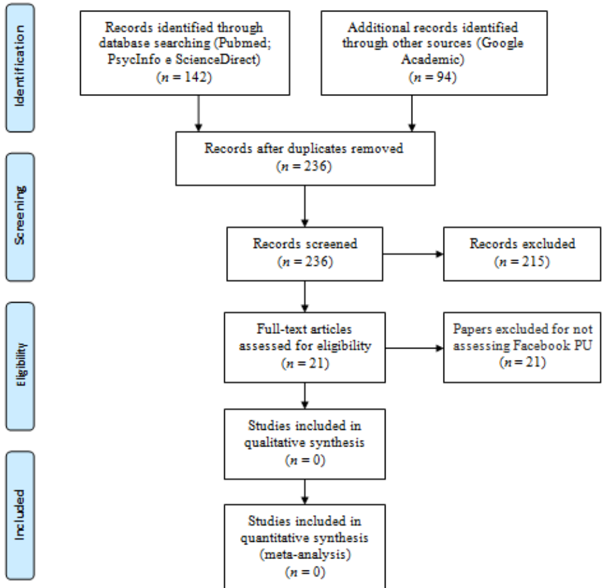
We aimed to investigate relationships between Facebook problematic use (Facebook PU) and pathological traits of personality, by a systematic review. The literature search was proceeded based on a search strategy including the keywords “Facebook”, “problematic use” and “personality”. We found a total of 236 publications and selected 21 papers for full verification. All of them were excluded, characterizing an empty review. As an attempt to increase the probability of finding eligible publications, first, we have broadened the search of the systematic review from “Facebook” to “social network sites” (and variations); and then from “social network sites” to “internet”. Regarding this last change, the final set of publications after full reading based on the eligibility criteria was composed by 15 papers. We emphasize that there was no empirical evidence on the relationship between Facebook PU and pathological traits of personality. Given the proximity between Facebook PU and internet addiction, it is possible to hypothesize that there is a relationship between pathological traits (i.e., Neuroticism, Impulsivity, and Psychoticism) and Facebook PU.
Overview
The claims and statistics of this paper haven’t been checked yet.
Free: it reads the open-access text and checks the first 5 claims that cite a source we can check. Create a free account to check every claim.
Integrity signals
Registry
Cites
Statistics
Figures
Verification
Claims the paper makes
The claims and statistics of this paper haven’t been checked yet.
Free: it reads the open-access text and checks the first 5 claims that cite a source we can check. Create a free account to check every claim.
Self-check
Percentages, sums and reported differences re-computed from the paper’s own numbers.
The self-check needs the paper’s full text.
Citations
Cites
Preferred Reporting Items for Systematic Reviews and Meta-Analyses: The PRISMA Statement
Moher, D., Liberati, A., Tetzlaff, J., Altman, D. G., & The PRISMA Group (2009) · PLoS Medicine · doi:10.1371/journal.pmed.1000097 · Cited by 64,042
Elm, E. V., Altman, D. G., Egger, M., Pocock, S. J., Gøtzsche, P. C., & Vandenbroucke, J. P. (2007) · BMJ · doi:10.1136/bmj.39335.541782.ad · Cited by 10,766
Internet Addiction: The Emergence of a New Clinical Disorder
YOUNG, K. S. (1998) · CyberPsychology & Behavior · doi:10.1089/cpb.1998.1.237 · Cited by 5,513
Moons, K. G. M., de Groot, J. A. H., Bouwmeester, W., Vergouwe, Y., Mallett, S., Altman, D. G., Reitsma, J. B., & Collins, G. S. (2014) · PLoS Medicine · doi:10.1371/journal.pmed.1001744 · Cited by 2,018
Development of a Facebook Addiction Scale
Andreassen, C. S., Torsheim, T., Brunborg, G. S., & Pallesen, S. (2012) · Psychological Reports · doi:10.2466/02.09.18.pr0.110.2.501-517 · Cited by 1,884
Issues for DSM-V: Internet Addiction
Block, J. J. (2008) · American Journal of Psychiatry · doi:10.1176/appi.ajp.2007.07101556 · Cited by 1,385
Online Social Network Site Addiction: A Comprehensive Review
Andreassen, C. S. (2015) · Current Addiction Reports · doi:10.1007/s40429-015-0056-9 · Cited by 1,212
Psychology of Computer Use: XL. Addictive Use of the Internet: A Case That Breaks the Stereotype
Young, K. S. (1996) · Psychological Reports · doi:10.2466/pr0.1996.79.3.899 · Cited by 1,108
Self-presentation 2.0: Narcissism and self-esteem on facebook
Mehdizadeh, S. (2010) · Cyberpsychology, Behavior, and Social Networking · doi:10.1089/cyber.2009.0257 · Cited by 1,064
High Impulsivity Predicts the Switch to Compulsive Cocaine-Taking
Belin, D., Mar, A. C., Dalley, J. W., Robbins, T. W., & Everitt, B. J. (2008) · Science · doi:10.1126/science.1158136 · Cited by 989
Harnessing Smartphone-Based Digital Phenotyping to Enhance Behavioral and Mental Health
Onnela, J.-P., & Rauch, S. L. (2016) · Neuropsychopharmacology · doi:10.1038/npp.2016.7 · Cited by 726
Elphinston, R. A., & Noller, P. (2011) · Cyberpsychology, Behavior, and Social Networking · doi:10.1089/cyber.2010.0318 · Cited by 596
Personality and self reported mobile phone use
Butt, S., & Phillips, J. G. (2008) · Computers in Human Behavior · doi:10.1016/j.chb.2007.01.019 · Cited by 517
McCrae, R. R., Costa, P. T., Terracciano, A., Parker, W. D., Mills, C. J., De Fruyt, F., & Mervielde, I. (2002) · Journal of Personality and Social Psychology · doi:10.1037/0022-3514.83.6.1456 · Cited by 499
What People Desire, Feel Conflicted About, and Try to Resist in Everyday Life
Hofmann, W., Vohs, K. D., & Baumeister, R. F. (2012) · Psychological Science · doi:10.1177/0956797612437426 · Cited by 490
Rosen, L. D., Whaling, K., Rab, S., Carrier, L. M., & Cheever, N. A. (2013) · Computers in Human Behavior · doi:10.1016/j.chb.2012.11.012 · Cited by 472
Internet addiction: a descriptive clinical study focusing on comorbidities and dissociative symptoms
Bernardi, S., & Pallanti, S. (2009) · Comprehensive Psychiatry · doi:10.1016/j.comppsych.2008.11.011 · Cited by 406
Psychological Characteristics of Compulsive Internet Use: A Preliminary Analysis
GREENFIELD, D. N. (1999) · CyberPsychology & Behavior · doi:10.1089/cpb.1999.2.403 · Cited by 376
The risk factors of Internet addiction—A survey of university freshmen
Tsai, H. F., Cheng, S. H., Yeh, T. L., Shih, C.-C., Chen, K. C., Yang, Y. C., & Yang, Y. K. (2009) · Psychiatry Research · doi:10.1016/j.psychres.2008.01.015 · Cited by 368
What people desire, feel conflicted about, and try to resist in everyday life
Hofmann, W., Vohs, K. D., & Baumeister, R. F. (2018) · Self-Regulation and Self-Control · doi:10.4324/9781315175775-7 · Cited by 337
Latent class analysis on internet and smartphone addiction in college students
Choi, S.-W., Mok, J. Y., Kim, D.-J., Choi, J.-S., Lee, J.-W., Ahn, H.-J., Choi, E.-J., & Song, W.-Y. (2014) · Neuropsychiatric Disease and Treatment · doi:10.2147/ndt.s59293 · Cited by 292
Yaffe, J., Montgomery, P., Hopewell, S., & Shepard, L. D. (2012) · PLoS ONE · doi:10.1371/journal.pone.0036626 · Cited by 220
Yen, J., Ko, C., Yen, C., Chen, C., & Chen, C. (2009) · Psychiatry and Clinical Neurosciences · doi:10.1111/j.1440-1819.2009.01943.x · Cited by 207
Błachnio, A., Przepiorka, A., Senol-Durak, E., Durak, M., & Sherstyuk, L. (2017) · Computers in Human Behavior · doi:10.1016/j.chb.2016.11.037 · Cited by 200
Extraversion, Impulsivity, and Online Group Membership as Predictors of Problematic Internet Use
Mottram, A. J., & Fleming, M. J. (2009) · CyberPsychology & Behavior · doi:10.1089/cpb.2007.0170 · Cited by 167
Dalbudak, E., Evren, C., Aldemir, S., & Evren, B. (2014) · Psychiatry Research · doi:10.1016/j.psychres.2014.02.032 · Cited by 145
Safety in home care: a broadened perspective of patient safety
Lang, A., Edwards, N., & Fleiszer, A. (2007) · International Journal for Quality in Health Care · doi:10.1093/intqhc/mzm068 · Cited by 130
Internet addiction update: diagnostic criteria, assessment and prevalence
Poli, R. (2017) · Neuropsychiatry · doi:10.4172/neuropsychiatry.1000171 · Cited by 129
Mazhari, S. (2012) · Cyberpsychology, Behavior, and Social Networking · doi:10.1089/cyber.2011.0548 · Cited by 122
Dalbudak, E., & Evren, C. (2014) · Comprehensive Psychiatry · doi:10.1016/j.comppsych.2013.11.018 · Cited by 119
Narcissism as a predictor of motivations behind Facebook profile picture selection
Kapidzic, S. (2013) · Cyberpsychology Behavior and Social Networking · doi:10.1089/cyber.2012.0143 · Cited by 104
Şenormancı, Ö., Saraçlı, Ö., Atasoy, N., Şenormancı, G., Köktürk, F., & Atik, L. (2014) · Comprehensive Psychiatry · doi:10.1016/j.comppsych.2014.04.025 · Cited by 103
Marino, C., Vieno, A., Moss, A. C., Caselli, G., Nikčević, A. V., & Spada, M. M. (2016) · Personality and Individual Differences · doi:10.1016/j.paid.2016.05.053 · Cited by 98
Floros, G. D., Siomos, K. E., Stogiannidou, A., Giouzepas, I., & Garyfallos, G. (2014) · Addictive Behaviors · doi:10.1016/j.addbeh.2014.07.031 · Cited by 97
Dong, G., Wang, J., Yang, X., & Zhou, H. (2013) · Asia-Pacific Psychiatry · doi:10.1111/j.1758-5872.2012.00185.x · Cited by 96
Dalbudak, E., Evren, C., Topcu, M., Aldemir, S., Coskun, K. S., Bozkurt, M., Evren, B., & Canbal, M. (2013) · Psychiatry Research · doi:10.1016/j.psychres.2013.08.014 · Cited by 91
An Investigation into the Problematic Use of Facebook
Lee, Z. W. Y., Cheung, C. M. K., & Thadani, D. R. (2012) · 2012 45th Hawaii International Conference on System Sciences · doi:10.1109/hicss.2012.106 · Cited by 86
Use of social networking in a linguistically and culturally rich India
Mahajan, P. (2009) · The International Information & Library Review · doi:10.1016/j.iilr.2009.07.004 · Cited by 82
Müller, K. W., Koch, A., Dickenhorst, U., Beutel, M. E., Duven, E., & Wölfling, K. (2013) · BioMed Research International · doi:10.1155/2013/546342 · Cited by 79
Zadra, S., Bischof, G., Besser, B., Bischof, A., Meyer, C., John, U., & Rumpf, H.-J. (2016) · Journal of Behavioral Addictions · doi:10.1556/2006.5.2016.086 · Cited by 75
Social networking, a new online addiction: a review of Facebook and other addiction disorders
Guedes, E., Nardi, A. E., Guimarães, F. M. C. L., Machado, S., & King, A. L. S. (2016) · Medical Express · doi:10.5935/medicalexpress.2016.01.01 · Cited by 67
‘Empty’ reviews and evidence-based practice
Schlosser, R. W., & Sigafoos, J. (2009) · Evidence-Based Communication Assessment and Intervention · doi:10.1080/17489530902801067 · Cited by 52
Ginige, P. (2017) · InTech eBooks · doi:10.5772/66966 · Cited by 44
Wölfling, K., Beutel, M. E., Dreier, M., & Müller, K. W. (2015) · Journal of Behavioral Addictions · doi:10.1556/2006.4.2015.011 · Cited by 42
Personality Disorders in Female and Male College Students With Internet Addiction
Wu, J. Y., Ko, H., & Lane, H. (2016) · The Journal of Nervous and Mental Disease · doi:10.1097/nmd.0000000000000452 · Cited by 39
Social Gambling via Facebook: Further Observations and Concerns
Griffiths, M. D. (2013) · Gaming Law Review and Economics · doi:10.1089/glre.2013.1726 · Cited by 36
Twelve myths about systematic reviews for health system policymaking rebutted
Moat, K. A., Lavis, J. N., Wilson, M. G., Røttingen, J., & Bärnighausen, T. (2013) · Journal of Health Services Research & Policy · doi:10.1258/jhsrp.2012.011175 · Cited by 35
Utilisation problématique d’Internet, temps passé en ligne et traits de personnalité
Laconi, S., Andreoletti, A., Chauchard, É., Rodgers, R. F., & Chabrol, H. (2016) · L Encéphale · doi:10.1016/j.encep.2015.12.017 · Cited by 34
Wu, J. Y., Ko, H., Tung, Y.-Y., & Li, C.-C. (2015) · Computers in Human Behavior · doi:10.1016/j.chb.2015.09.047 · Cited by 32
Slyer, J. T. (2016) · The JBI Database of Systematic Reviews and Implementation Reports · doi:10.11124/jbisrir-2016-002934 · Cited by 29
Chang, W. H., Cheng, S., Sun, Z., Lee, I., Lee, C., Chen, K., Tsai, C., Yang, Y. K., & Yang, Y. (2015) · The Kaohsiung Journal of Medical Sciences · doi:10.1016/j.kjms.2014.12.009 · Cited by 13
Research works printed but not linked: 1
- Griffiths, M. D., Kuss, D. J., & Demetrovics, Z. (2014). Social networking addiction: an overview of preli- minary findings. In K. P. Rosenberg, & L. Curtiss Feder (Eds.), Behavioral addictions: Criteria, evidence, and treatment (pp. 119-141). San Diego, CA, US: El- sevier Academic Press.
Cited by
Real Delor, R. E., Mendoza Melgar, J. G., Gomes da Silva Neto, P., Oliveira Silva Gomes, C. B., Nascimento de Medeiros, G., & Pimenta Cavalcante, L. (2025) · Revista de la Facultad de Ciencias Médicas de Córdoba · doi:10.31053/1853.0605.v82.n3.48138 · Cited by 3
Daviccino, A. T., Chibas-Muñoz, E. E., Guevara, A., Davalos, J. M. H., Escalante, S. C. L., Benítez, L. E. O., Galeano, B. D. O., Gómez, C. G. P., Lezcano, E. A. R., Paniagua, R. R. R., et al. (2025) · Revista Virtual de la Sociedad Paraguaya de Medicina Interna · doi:10.18004/rvspmi/2312-3893/2025.e12122517 · Cited by 1
Metadata
- Authors
- Ferrari, B. L., Carvalho, L. D. F., & Sette, C. P.
- Affiliations
- Universidade São Francisco (BR)
- Venue
- Psico-USF
- Publisher
- FapUNIFESP (SciELO)
- Published
- 2021-09
- Volume
- 26
- Issue
- 3
- Pages
- 451-465
- ISSN
- 1413-8271 (ISSN-L)
- 2175-3563
- OpenAlex
- W4200481812
- Cited by
- 2
- References
- 47
- Citations by year
- 2025: 2
- FWCI
- 0.00
- Type
- journal article
- Language
- en
- Open access
- diamond
- doi.org
- Licence
- cc-by
- creativecommons.org/licenses/by/4.0/ (vor)
- creativecommons.org/licenses/by/4.0/ (am)
- creativecommons.org/licenses/by/4.0/ (tdm)
- Locations
- Psico-USF (publishedVersion, cc-by)
- LA Referencia (Red Federada de Repositorios Institucionales de Publicaciones Científicas) (publishedVersion, other-oa)
- DOAJ (DOAJ: Directory of Open Access Journals) (submittedVersion, cc-by-sa)
- Topics
- Social Sciences › Sociology and Political Science › Impact of Technology on Adolescents
- Social Sciences › Psychology › Clinical Psychology › Personality Traits and Psychology
- Social Sciences › Psychology › Clinical Psychology › Sexuality, Behavior, and Technology
- Keywords
- pathological personality traits, social network sites, internet addiction, neuroticism, impulsivity, psychoticism, Big Five personality traits
About these checks
Registry, retraction, Cites and statistics results are computed, not judged, with one exception: a printed reference that no index lists is read once by a model before it counts as a citation error. Claims are extracted by a model and kept only when their quote appears verbatim in the text; each cited source is then checked, with a model’s help, for whether it says what the claim relies on. Those verdicts can be wrong — read the claim’s quote and the cited source before relying on one.
Statistics and arithmetic are recomputed, not judged.
Confidence bands are shown only for fields calibrated on our annotated test set. None is calibrated yet, so no band is shown.
What counts as a claim ›How we measure confidence ›How we check this ›
Are you an author, or do you see a problem with this page? Request a review
Data sources
Bibliographic data: Semantic Scholar, OpenAlex, Crossref.
Contains information from the Semantic Scholar Academic Graph Datasets, made available under the ODC Attribution License (ODC-BY 1.0).
Semantic Scholar’s data is described in: Kinney, R., et al. (2023). The Semantic Scholar Open Data Platform. arXiv:2301.10140.
