

Randomized controlled trials of serotonin-norepinephrine reuptake inhibitor in treating major depressive disorder in children and adolescents: a meta-analysis of efficacy and acceptability
Open accessThe DOI matches its Crossref record; 33 of the 34 references it cites were found in a registry or an index, and 1 are not checked yet.
Abstract
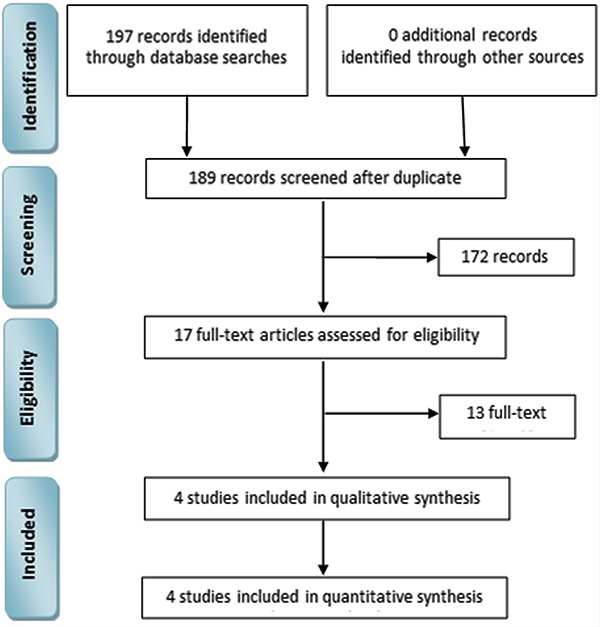
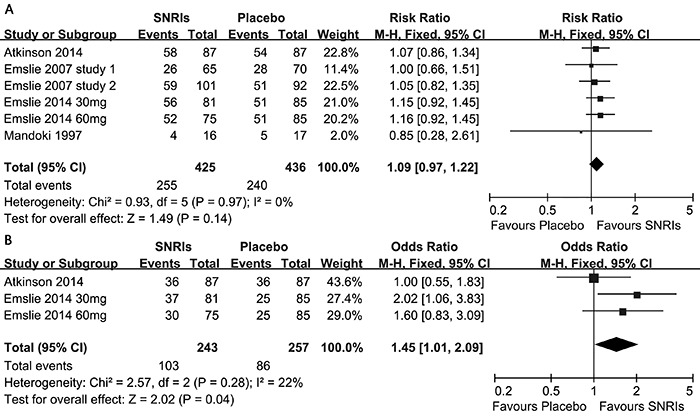
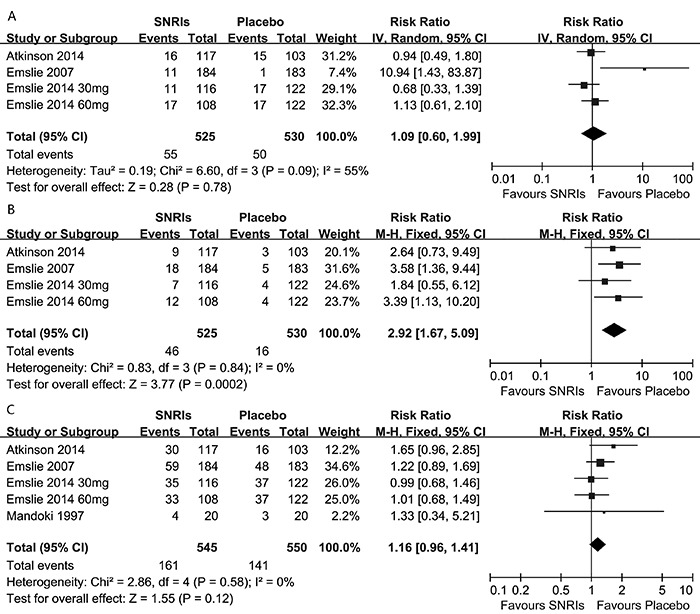
New generation antidepressant therapies, including serotonin-norepinephrine reuptake inhibitor (SNRIs), were introduced in the late 1980s; however, few comprehensive studies have compared the benefits and risks of various contemporary treatments for major depressive disorder (MDD) in young patients. A comprehensive literature search of PubMed, Cochrane, Embase, Web of Science, and PsycINFO databases was conducted from 1970 to January 2015. Only clinical trials that randomly assigned one SNRI or placebo to patients aged 7 to 18 years who met the diagnostic criteria for major depressive disorder were included. Treatment success, dropout rate, and suicidal ideation/attempt outcomes were measured. Primary efficacy was determined by pooling the risk ratios (RRs) of treatment response and remission. Acceptability was determined by pooling the RRs of dropouts for all reasons and for adverse effects as well as suicide-risk outcomes. Five trials with a total of 973 patients were included. SNRIs were not significantly more effective than placebo for treatment response but were for remission. The comparison of patients taking SNRIs that dropped out for all reasons and those taking placebo did not reach statistical significance. Significantly more patients taking SNRIs dropped out for adverse effects than those taking placebo. No significant difference was found in suicide-related risk outcomes. SNRI therapy does not display a superior efficacy and is not better tolerated compared to placebo in these young patients. However, duloxetine has a potential beneficial effect for depression in young populations, showing a need for further research.
Overview
The claims and statistics of this paper haven’t been checked yet.
Free: it reads the open-access text and checks the first 5 claims that cite a source we can check. Create a free account to check every claim.
Integrity signals
Registry
Cites
Statistics
Figures
Verification
Claims the paper makes
The claims and statistics of this paper haven’t been checked yet.
Free: it reads the open-access text and checks the first 5 claims that cite a source we can check. Create a free account to check every claim.
Claims other papers make about this one
Each is checked against this paper’s own text: does it say what the citing paper says it does?
The cited source doesn’t support the claim as written.
In the citing paper
“One systematic review of antidepressants in pediatric populations found SSRIs increased odds of a suicide attempt,(53) but most subsequent meta-analyses and epidemiological studies in both pediatric(48),(50) and adult populations(49, 52, 66, 67, 86) reported a more favorable risk-benefit ratio than the FDA analyses,(51, 87) including benefits for suicidal behavior.”
From Improving Suicide Prevention Through Evidence-Based Strategies: A Systematic Review (2021) · cites this paper as [48]
Checked by a reasoning model — may be wrong.
Experimental — accuracy not yet measuredThe cited source doesn’t support the claim as written.
In the citing paper
“Both pediatric and adult studies of antidepressant effects on suicidal behavior show reductions in suicidal behavior in meta-analyses, more readily than in individual RCTs, probably because the low base rate of suicide attempts requires larger sample sizes.”
From Improving Suicide Prevention Through Evidence-Based Strategies: A Systematic Review (2021) · cites this paper as [48]
Checked by a reasoning model — may be wrong.
Experimental — accuracy not yet measuredThe source backs part of the claim, not all of it — or backs it for a different population, condition or comparison.
In the citing paper
“Seventeen pharmacotherapy trials with suicidal behavior as an outcome (Table S2a), including twelve studies in adults, five pediatric studies and seven RCT meta-analyses(48–54), have appeared since the FDA(51) adopted black box warnings in 2004 and 2006 regarding psychotropic medication-related suicide risk in children and young adults, respectively.”
From Improving Suicide Prevention Through Evidence-Based Strategies: A Systematic Review (2021) · cites this paper as [48]
Experimental — accuracy not yet measured
Self-check
Percentages, sums and reported differences re-computed from the paper’s own numbers.
The self-check needs the paper’s full text.
Citations
Cites
Bias in meta-analysis detected by a simple, graphical test
Egger, M., Smith, G. D., Schneider, M., & Minder, C. (1997) · BMJ · doi:10.1136/bmj.315.7109.629 · Cited by 56,722
Operating characteristics of a rank correlation test for publication bias
Begg, C. B., & Mazumdar, M. (1994) · Biometrics · doi:10.2307/2533446 · Cited by 16,955
Power failure: why small sample size undermines the reliability of neuroscience
Button, K. S., Ioannidis, J. P. A., Mokrysz, C., Nosek, B. A., Flint, J., Robinson, E. S. J., & Munafò, M. R. (2013) · Nature Reviews Neuroscience · doi:10.1038/nrn3475 · Cited by 7,641 · cited 1×
“Methodologists and authors of systematic reviews have also stated that many effects have been mixed due to failures in study planning and inadequate sample sizes (34).”
BackgroundChildhood and adolescent depression: a review of the past 10 years, Part I
BIRMAHER, B., RYAN, N. D., WILLIAMSON, D. E., BRENT, D. A., KAUFMAN, J., DAHL, R. E., PEREL, J., & NELSON, B. (1996) · Journal of the American Academy of Child & Adolescent Psychiatry · doi:10.1097/00004583-199611000-00011 · Cited by 2,076
Frank, E. (1991) · Archives of General Psychiatry · doi:10.1001/archpsyc.1991.01810330075011 · Cited by 1,959 · cited 1×
“A more stringent measure of antidepressant efficacy is remission, which is a clinical state characterized by minimal residual symptoms (20).”
BackgroundSuicidality in Pediatric Patients Treated With Antidepressant Drugs
Hammad, T. A., Laughren, T., & Racoosin, J. (2006) · Archives of General Psychiatry · doi:10.1001/archpsyc.63.3.332 · Cited by 1,054 · cited 1×
“Though there were limited cases in the venlafaxine study, some other reports have also demonstrated that venlafaxine increases the risk of suicide (14,31,32).”
ResultIs there an epidemic of child or adolescent depression?
Jane Costello, E., Erkanli, A., & Angold, A. (2006) · Journal of Child Psychology and Psychiatry · doi:10.1111/j.1469-7610.2006.01682.x · Cited by 983
Depressed Adolescents Grown Up
Weissman, M. M. (1999) · JAMA · doi:10.1001/jama.281.18.1707 · Cited by 952
Remission rates during treatment with venlafaxine or selective serotonin reuptake inhibitors
Thase, M. E., Entsuah, A. R., & Rudolph, R. L. (2001) · British Journal of Psychiatry · doi:10.1192/bjp.178.3.234 · Cited by 801
Kovacs, M. (1984) · Archives of General Psychiatry · doi:10.1001/archpsyc.1984.01790140019002 · Cited by 712
COMPTON, S. N., MARCH, J. S., BRENT, D., ALBANO, A. M., WEERSING, V. R., & CURRY, J. (2004) · Journal of the American Academy of Child & Adolescent Psychiatry · doi:10.1097/01.chi.0000127589.57468.bf · Cited by 616
Goldstein, D. J., Lu, Y., Detke, M. J., Wiltse, C., Mallinckrodt, C., & Demitrack, M. A. (2004) · Journal of Clinical Psychopharmacology · doi:10.1097/01.jcp.0000132448.65972.d9 · Cited by 314
Miller, I. W., Keitner, G. I., Schatzberg, A. F., Klein, D. N., Thase, M. E., Rush, A. J., Markowitz, J. C., Schlager, D. S., Kornstein, S. G., Davis, S. M., et al. (1998) · The Journal of Clinical Psychiatry · doi:10.4088/jcp.v59n1108 · Cited by 305
Six-Year Outcome for Cognitive Behavioral Treatment of Residual Symptoms in Major Depression
Fava, G. A., Rafanelli, C., Grandi, S., Canestrari, R., & Morphy, M. A. (1998) · American Journal of Psychiatry · doi:10.1176/ajp.155.10.1443 · Cited by 299
Newer generation antidepressants for depressive disorders in children and adolescents
Hetrick, S. E., McKenzie, J. E., Cox, G. R., Simmons, M. B., & Merry, S. N. (2012) · Cochrane Database of Systematic Reviews · doi:10.1002/14651858.cd004851.pub3 · Cited by 291 · cited 1×
“In addition to SSRIs, several other classes of antidepressants are now being used, including selective norepinephrine reuptake inhibitors (SNRIs), norepinephrine reuptake inhibitors (NRIs), norepinephrine dopamine reuptake inhibitors (NDRIs), norepinephrine dopamine disinhibitors (NDDIs), and tetracyclic antidepressan…”
BackgroundTricyclic drugs for depression in children and adolescents
Hazell, P., & Mirzaie, M. (2013) · Cochrane Database of Systematic Reviews · doi:10.1002/14651858.cd002317.pub2 · Cited by 286
Harrington, R., Whittaker, J., Shoebridge, P., & Campbell, F. (1998) · BMJ · doi:10.1136/bmj.316.7144.1559 · Cited by 180
Tricyclic drugs for depression in children and adolescents
Hazell, P., O'Connell, D., Heathcote, D., & Henry, D. A. (2002) · Cochrane Database of Systematic Reviews · doi:10.1002/14651858.cd002317 · Cited by 167
Prien, R. F. (1991) · Archives of General Psychiatry · doi:10.1001/archpsyc.1991.01810330020003 · Cited by 155
Venlafaxine in the treatment of children and adolescents with major depression.
MANDOKI, M. W., Tapia, M., Tapia, M., Sumner, G. S., & Parker, J. L. (1997) · PubMed · Cited by 144
Dual Monoamine Modulation for Improved Treatment of Major Depressive Disorder
Tran, P. V., Bymaster, F. P., McNamara, R. K., & Potter, W. Z. (2003) · Journal of Clinical Psychopharmacology · doi:10.1097/00004714-200302000-00011 · Cited by 139
Venlafaxine ER for the Treatment of Pediatric Subjects With Depression
EMSLIE, G. J., FINDLING, R. L., YEUNG, P. P., KUNZ, N. R., & LI, Y. (2007) · Journal of the American Academy of Child & Adolescent Psychiatry · doi:10.1097/chi.0b013e31802f5f03 · Cited by 135
Psychotropic Medication in Children: A Study From The Netherlands
Schirm, E., Tobi, H., Zito, J. M., & de Jong-van den Berg, L. T. W. (2001) · Pediatrics · doi:10.1542/peds.108.2.e25 · Cited by 131
Dubicka, B., Hadley, S., & Roberts, C. (2006) · British Journal of Psychiatry · doi:10.1192/bjp.bp.105.011833 · Cited by 123
Four-year outcome for cognitive behavioral treatment of residual symptoms in major depression
(1996) · American Journal of Psychiatry · doi:10.1176/ajp.153.7.945 · Cited by 120
Murray, M. L. (2004) · Archives of Disease in Childhood · doi:10.1136/adc.2004.064956 · Cited by 119
Emslie, G. J., Prakash, A., Zhang, Q., Pangallo, B. A., Bangs, M. E., & March, J. S. (2014) · Journal of Child and Adolescent Psychopharmacology · doi:10.1089/cap.2013.0096 · Cited by 106
Atkinson, S. D., Prakash, A., Zhang, Q., Pangallo, B. A., Bangs, M. E., Emslie, G. J., & March, J. S. (2014) · Journal of Child and Adolescent Psychopharmacology · doi:10.1089/cap.2013.0146 · Cited by 80
A Review of Pharmacotherapy of Major Depression in Children and Adolescents
Ambrosini, P. J. (2000) · Psychiatric Services · doi:10.1176/appi.ps.51.5.627 · Cited by 64
Fava, G. A. (1996) · American Journal of Psychiatry · doi:10.1176/ajp.153.8.1109-a · Cited by 49
Bolin, U. W., Göransson, H., Fryknäs, M., Gustafsson, M. G., & Isaksson, A. (2006) · BMC Bioinformatics · doi:10.1186/1471-2105-7-127 · Cited by 28
Ball, S. G., Desaiah, D., Zhang, Q., Thase, M., & David, P. (2013) · Drugs in Context · doi:10.7573/dic.212245 · Cited by 26
Increase in non-evidence based use of antidepressants in children is cause for concern
Clavenna, A., Bonati, M. R., Rossi, E., & Rosa, M. D. (2004) · BMJ · doi:10.1136/bmj.328.7441.711-c · Cited by 21
A guide to what works for depression in young people
Purcell, R., Ryan, S., Scanlan, F., Morgan, A. J., Callahan, P. M., Allen, N., & Jorm, A. F. (2010) · Swinburne figshare (Swinburne University of Technology) · Cited by 9
Cited by
Improving Suicide Prevention Through Evidence-Based Strategies: A Systematic Review
Mann, J. J., Michel, C. A., & Auerbach, R. P. (2021) · American Journal of Psychiatry · doi:10.1176/appi.ajp.2020.20060864 · Cited by 655
Pharmacological treatment of children and adolescents with depression
Vitiello, B., & Ordóñez, A. E. (2016) · Expert Opinion on Pharmacotherapy · doi:10.1080/14656566.2016.1244530 · Cited by 54
Trends in antidepressant use among children and adolescents: a Scandinavian drug utilization study
Wesselhoeft, R. T., Jensen, P. B., Talati, A., Reutfors, J., Furu, K., Strandberg‐Larsen, K., Damkier, P., Pottegård, A., & Bliddal, M. (2019) · Acta Psychiatrica Scandinavica · doi:10.1111/acps.13116 · Cited by 51
Meta-analysis: Risk of dry mouth with second generation antidepressants
Cappetta, K., Beyer, C., Johnson, J. A., & Bloch, M. H. (2018) · Progress in Neuro-Psychopharmacology and Biological Psychiatry · doi:10.1016/j.pnpbp.2017.12.012 · Cited by 49
Improving Suicide Prevention Through Evidence-Based Strategies: A Systematic Review
Mann, J. J., Michel, C. A., & Auerbach, R. P. (2023) · FOCUS The Journal of Lifelong Learning in Psychiatry · doi:10.1176/appi.focus.23021004 · Cited by 39
Metadata
- Authors
- Xu, Y., Bai, S. J., Lan, X. H., Qin, B., Huang, T., & Xie, P.
- Affiliations
- Chongqing Medical University (CN)
- Corresponding author
- Xu, Y.
- Bai, S.J.
- Lan, X.H.
- Xie, P.
- Venue
- Brazilian Journal of Medical and Biological Research
- Publisher
- FapUNIFESP (SciELO)
- Published
- 2016
- Volume
- 49
- Issue
- 6
- ISSN
- 0100-879X (ISSN-L)
- 1414-431X
- PMC
- PMC4897997
- OpenAlex
- W2402631631
- Cited by
- 24
- References
- 33
- Citations by year
- 2026: 2 · 2025: 1 · 2024: 2 · 2023: 1 · 2022: 2 · 2021: 4 · 2020: 3 · 2019: 3 · 2018: 2 · 2017: 2 · 2016: 2
- FWCI
- 0.34
- Type
- journal article
- Language
- en
- Open access
- gold
- doi.org
- Licence
- cc-by
- creativecommons.org/licenses/by/4.0/ (vor)
- creativecommons.org/licenses/by/4.0/ (am)
- creativecommons.org/licenses/by/4.0/ (tdm)
- Locations
- Brazilian Journal of Medical and Biological Research (publishedVersion, cc-by)
- Europe PMC (PubMed Central) (publishedVersion, cc-by)
- PubMed Central (publishedVersion, cc-by)
- PubMed (publishedVersion)
- LA Referencia (Red Federada de Repositorios Institucionales de Publicaciones Científicas) (publishedVersion, other-oa)
- Americanae (AECID Library) (submittedVersion, other-oa)
- DOAJ (DOAJ: Directory of Open Access Journals) (submittedVersion, cc-by-sa)
- Topics
- Health Sciences › Medicine › Pharmacology (medical) › Treatment of Major Depression
- Social Sciences › Psychology › Clinical Psychology › Child and Adolescent Psychosocial and Emotional Development
- Health Sciences › Medicine › Psychiatry and Mental health › Mental Health Treatment and Access
- Keywords
- serotonin-norepinephrine reuptake inhibitors, major depressive disorder, childhood depression, adolescents, duloxetine, antidepressant efficacy, treatment discontinuation, adverse effects, suicidal ideation, placebo comparison
- MeSH terms
- Duloxetine Hydrochloride, Serotonin and Noradrenaline Reuptake Inhibitors, Desvenlafaxine Succinate, Venlafaxine Hydrochloride, Milnacipran, Adolescent, Antidepressive Agents, Child, Cyclopropanes, Major Depressive Disorder, Female, Humans, Male, Placebos, Randomized Controlled Trials as Topic, Treatment Outcome
About these checks
Registry, retraction, Cites and statistics results are computed, not judged, with one exception: a printed reference that no index lists is read once by a model before it counts as a citation error. Claims are extracted by a model and kept only when their quote appears verbatim in the text; each cited source is then checked, with a model’s help, for whether it says what the claim relies on. Those verdicts can be wrong — read the claim’s quote and the cited source before relying on one.
Statistics and arithmetic are recomputed, not judged.
Confidence bands are shown only for fields calibrated on our annotated test set. None is calibrated yet, so no band is shown.
What counts as a claim ›How we measure confidence ›How we check this ›
Are you an author, or do you see a problem with this page? Request a review
Data sources
Bibliographic data: Semantic Scholar, OpenAlex, Crossref.
Contains information from the Semantic Scholar Academic Graph Datasets, made available under the ODC Attribution License (ODC-BY 1.0).
Semantic Scholar’s data is described in: Kinney, R., et al. (2023). The Semantic Scholar Open Data Platform. arXiv:2301.10140.
