

The DOI matches its Crossref record; 3 of the 3 references it cites were found in a registry or an index.
Depressive Symptoms and Relationship Between Genders: Differences in Young Adults in a Randomized Clinical Trial
Abstract
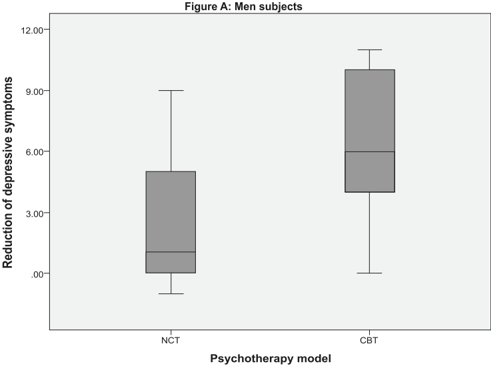
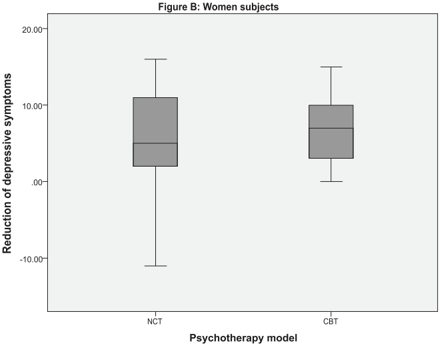
Abstract: Depression has a high prevalence in the general population, especially among women. There is no consensus in the scientific literature about differences between men and women in the manifestations of depressive symptoms, nor about psychotherapy indications according to gender. This research aimed to verify differences in depressive symptoms and symptoms improvement between young adult men and women with current Major Depressive Disorder and to identify differences between two brief Cognitive Psychotherapy models. Randomized clinical trial in which participants were randomized between: Cognitive Behavioral Therapy and Narrative Cognitive Therapy. Depressive symptoms pre and post-intervention were evaluated using the Hamilton Depression Rating Scale. The sample was composed of 25 men and 95 women. Genital symptoms and insight were significantly different between genders. Concerning improvement in symptoms according to the psychotherapy model, CBT presented a trend toward being more effective in men. Therefore, the symptoms and improvement in depressive symptoms are manifested differently between genders.
Overview
The claims and statistics of this paper haven’t been checked yet.
Run the check — free, no account needed. It reads the open-access text and checks the sources it cites.
Integrity signals
Registry
Cites
Statistics
Figures
Verification
Claims the paper makes
The claims and statistics of this paper haven’t been checked yet.
Run the check — free, no account needed. It reads the open-access text and checks the sources it cites.
Claims other papers make about this one
Each is checked against this paper’s own text: does it say what the citing paper says it does?
In the citing paper
“Aya's condition is similar to the depressive symptoms reported by participants in previous research (Lopes et al., 2014;Molina et al., 2017;Vromans & Schweitzer, 2011) such as feeling guilty, somatic complaints, insomnia, psychomotor retardation, agitation, suicidal thoughts and low energy in daily functioning.”
From Narrative Therapy to Treat a College Student's Depression: A Case Report (2024) · cites this paper as Molina et al., 2017
In the citing paper
“This shift in perspective reduces self-blame and self-stigma, allowing her to reframe her past experiences and develop a more hopeful outlook (Koganei et al., 2021;Lopes et al., 2014;Molina et al., 2017;Vromans & Schweitzer, 2011).”
From Narrative Therapy to Treat a College Student's Depression: A Case Report (2024) · cites this paper as Molina et al., 2017
Self-check
Percentages, sums and reported differences re-computed from the paper’s own numbers.
The self-check needs the paper’s full text.
Citations
Cites
Vittengl, J. R., Clark, L. A., Dunn, T. W., & Jarrett, R. B. (2007) · Journal of Consulting and Clinical Psychology · doi:10.1037/0022-006x.75.3.475 · Cited by 551
Estimating remission from untreated major depression: a systematic review and meta-analysis
Whiteford, H. A., Harris, M. G., McKeon, G., Baxter, A., Pennell, C., Barendregt, J. J., & Wang, J. (2013) · Psychological Medicine · doi:10.1017/s0033291712001717 · Cited by 375 · cited 1×
“Another factor discussed in this research was depressive symptom improvement, where no significant differences between genders were found, like in a review about improvement in untreated depressive symptoms (Whiteford et al., 2013).”
Bressi, C., Porcellana, M., Marinaccio, P. M., Nocito, E. P., & Magri, L. (2010) · Journal of Nervous & Mental Disease · doi:10.1097/nmd.0b013e3181ef3ebb · Cited by 55
Research works printed but not linked: 34
- Agam R., 2015, Gender differences in respect to self-esteem and body image as well as response to adolescents’ school based prevention programs, Journal of Psychology and Clinical Psychiatry, 2, 00092
- Aragão T. A., 2009, Uma perspectiva psicossocial da sintomatologia depressiva na adolescência [A psychosocial perspective of depressive symptoms in adolescence], Ciência & Saúde Coletiva, 14, 395, 10.1590/S1413-81232009000200009 · DOI
- Barros A. J. D., 2005, A nationwide wealth score based on the 2000 Brazilian demographic census, Revista de Saúde Pública, 39, 523
- Bem S. L., 1981, Gender schema theory: A cognitive account of sex typing, Psychological Review, 88, 354, 10.1037/0033-295X.88.4.354 · DOI
- Brooks G. R., 2010, A transtheoretical model, 139
- Collado A., 2016, A systematic review of depression psychotherapies among Latinos, Clinical Psychology Review, 45, 193, 10.1016/j.cpr.2016.04.001 · DOI
- Corruble E., 2016, Telephone-administered psychotherapy in combination with antidepressant medication for the acute treatment of major depressive disorder, Journal of Affective Disorders, 190, 6, 10.1016/j.jad.2015.07.052 · DOI
- Cunha C., 2012, Therapist interventions and client innovate moments in emotion focused therapy for depression, Psychoterapy, 49, 536, 10.1037/a0028259 · DOI
- Dal Bó M. J., 2011, Prevalência de sintomas depressivos em pacientes internados em enfermarias de clínica médica de um hospital geral no Sul de Santa Catarina, Revista da Sociedade Brasileira de Clínica Médica, 9, 264
- Del-Ben C. M., 2001, Confiabilidade da Entrevista Clínica Estruturada para o DSM-IV - Versão clínica traduzida para o português, Revista Brasileira de Psiquiatria, 23, 156, 10.1590/S1516-44462001000300008 · DOI · Paper page
- Englar-Carlson M., 2006, Masculine norms and the therapy process, 13
- Freire M. A., 2014, Escala Hamilton: Estudo das características psicométricas em uma amostra do sul do Brasil, Jornal Brasileiro de Psiquiatria, 63, 281, 10.1590/0047-2085000000036 · DOI
- Gonçalves O. F., 1999, Cognitive narrative psychotherapy: Research foundations, Journal of Clinical Psychology, 55, 1179, 10.1002/(SICI)1097-4679(199910)55:10<1179::AID-JCLP2>3.0.CO;2-L · DOI
- Hamilton M., 1967, Development of a rating scale for primary depressive illness, British Journal of Social & Clinical Psychology, 6, 278, 10.1111/j.2044-8260.1967.tb00530.x · DOI
- Hollon S. D., 2014, Effect of cognitive therapy with antidepressant medications vs antidepressants alone on the rate of recovery in major depressive disorder: A randomized clinical trial, JAMA Psychiatry, 71, 1157, 10.1001/jamapsychiatry.2014.1054 · DOI · Paper page
- Hollon S. D., 2005, Psychotherapy and medication in the treatment of adult and geriatric depression: Which monotherapy or combined treatment?, The Journal of Clinical Psychiatry, 66, 455, 10.4088/JCP.v66n0408 · DOI
- Hollon S. D., 2006, Enduring effects for cognitive behavior therapy in the treatment of depression and anxiety, Annual Review of Psychology, 57, 285, 10.1146/annurev.psych.57.102904.190044 · DOI · Paper page
- Justo L. P., 2006, Depressão: O mesmo acometimento para homens e mulheres?, Revista de Psiquiatria Clínica, 33, 74, 10.1590/S0101-60832006000200007 · DOI
- Kennedy S. H., 2013, Gender/sex differences in emotions, Medicographia, 35, 271
- Kessler R. C., 2003, Epidemiology of women and depression, Jounal of Affective Disorders, 74, 5, 10.1016/S0165-0327(02)00426-3 · DOI · Paper page
- Koppers D., 2011, Prevalence and risk factors for recurrence of depression five years after short term psychodynamic therapy, Journal of Affective Disorders, 134, 468, 10.1016/j.jad.2011.05.027 · DOI
- Machado R. M., 2013, Características sociodemográficas e clínicas das internações psiquiátricas de mulheres com depressão, Revista Eletrônica de Enfermagem, 15, 223, 10.5216/ree.v15i1.14564 · DOI
- McCusker M. G., 2011, The impact of men seeking help for depression on perceptions of masculine and feminine characteristics, Psychology of Men and Masculinity, 12, 275, 10.1037/a0021071 · DOI
- Molina M. A. L., 2014, Major depressive disorder symptoms in male and female young adults, Psychology Health & Medicine, 19, 136, 10.1080/13548506.2013.793369 · DOI
- Nardi B., 2013, Adolescent depression: Clinical features and therapeutic strategies, European Review for Medical and Pharmacological Sciences, 17, 1546
- Nyer M. B., 2016, Cognitive behavioral therapy for depression, 63
- Parker G., 2011, Does gender influence response to differing psychotherapies by those with unipolar depression?, Journal of Affective Disorders, 130, 17, 10.1016/j.jad.2010.05.020 · DOI
- Picardi A., 2014, Psychotherapy of mood disorders, Clinical Practice and Epidemiology in Mental Health, 10, 140, 10.2174/1745017901410010140 · DOI
- Piccinelli M., 2000, Gender differences in depression. Critical review, The British Journal of Psychiatry, 177, 486, 10.1192/bjp.177.6.486 · DOI · Paper page
- Rombaldi A. J., 2010, Prevalência e fatores associados a sintomas depressivos em adultos do sul do Brasil: Estudo transversal de base populacional, Revista Brasileira de Epidemiologia, 13, 620, 10.1590/S1415-790X2010000400007 · DOI
- Silva G. D. G., 2016, Pro-inflammatory cytokines and psychotherapy in depression: Results from a randomized clinical trial, Journal of Psychiatric Research, 75, 57, 10.1016/j.jpsychires.2016.01.008 · DOI · Paper page
- Spendelow J. S., 2015, Cognitive-behavioral treatment of depression in men: Tailoring treatment and directions for future research, American Journal of Men’s Health, 9, 94, 10.1177/1557988314529790 · DOI · Paper page
- Wilhelm K., 1994, Sex differences in the lifetime prevalence of depression: Fact or artefact?, Psychological Medicine, 24, 97, 10.1017/S0033291700026878 · DOI
- Young E. A., 2009, Sex differences in response to citalopram: A STAR*D report, Journal of Psychiatric Research, 43, 503, 10.1016/j.jpsychires.2008.07.002 · DOI
Cited by
Sorted by citations
Narrative Therapy to Treat a College Student's Depression: A Case Report
Swasti, I. K. (2024) · INSAN Jurnal Psikologi dan Kesehatan Mental · doi:10.20473/jpkm.v9i12024.1-34 · Cited by 1
Metadata
- Authors
- Molina, M. R. A. L., Jansen, K., Pinheiro, R. T., Silva, R. A. D., Passos, M. B. D., & Souza, L. D. D. M.
- Affiliations
- Universidade Católica de Pelotas, Brazil
- Venue
- Paidéia (Ribeirão Preto)
- Publisher
- FapUNIFESP (SciELO)
- Published
- 2017-08
- Volume
- 27
- Issue
- 67
- Pages
- 3-9
- ISSN
- 0103-863X
- Cited by
- 1
- References
- 3
About these checks
Registry, retraction, Cites and statistics results are computed, not judged, with one exception: a printed reference that no index lists is read once by a model before it counts as a citation error. Claims are extracted by a model and kept only when their quote appears verbatim in the text; each cited source is then checked, with a model’s help, for whether it says what the claim relies on. Those verdicts can be wrong — read the claim’s quote and the cited source before relying on one.
Statistics and arithmetic are recomputed, not judged.
Confidence bands are shown only for fields calibrated on our annotated test set. None is calibrated yet, so no band is shown.
What counts as a claim ›How we measure confidence ›How we check this ›
Are you an author, or do you see a problem with this page? Request a review
