

The DOI matches its Crossref record; 33 of the 33 references it cites were found in a registry or an index.
E-BERT: Efficient-Yet-Effective Entity Embeddings for BERT
Open accessAbstract
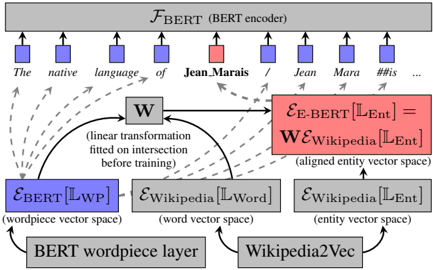
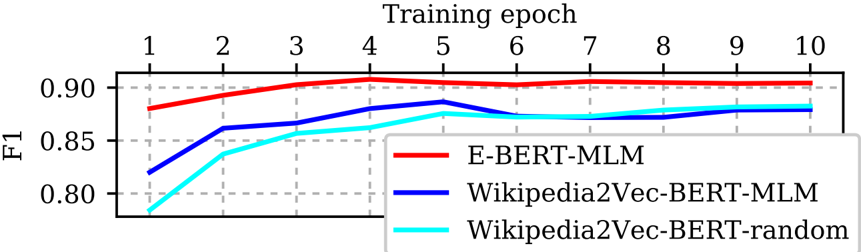
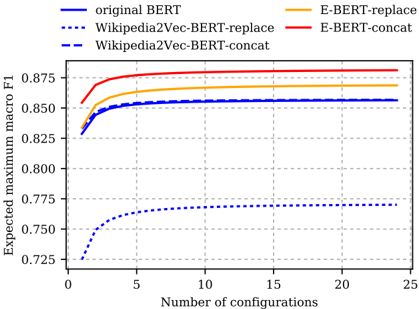
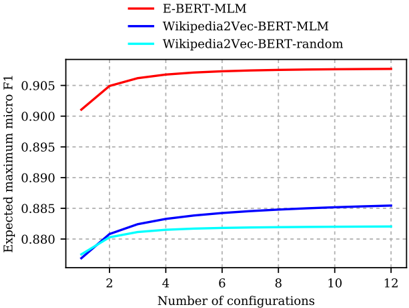
We present a novel way of injecting factual knowledge about entities into the pretrained BERT model ( Devlin et al., 2019): We align Wikipedia2Vec entity vectors (Yamada et al., 2016) with BERT's native wordpiece vector space and use the aligned entity vectors as if they were wordpiece vectors.The resulting entity-enhanced version of BERT (called E-BERT) is similar in spirit to ERNIE (Zhang et al., 2019) and KnowBert (Peters et al., 2019), but it requires no expensive further pretraining of the BERT encoder.We evaluate E-BERT on unsupervised question answering (QA), supervised relation classification (RC) and entity linking (EL).On all three tasks, E-BERT outperforms BERT and other baselines.We also show quantitatively that the original BERT model is overly reliant on the surface form of entity names (e.g., guessing that someone with an Italian-sounding name speaks Italian), and that E-BERT mitigates this problem.
Overview
The claims and statistics of this paper haven’t been checked yet.
Run the check — free, no account needed. It reads the open-access text and checks the sources it cites.
Integrity signals
Registry
Cites
Statistics
Figures
Verification
Claims the paper makes
The claims and statistics of this paper haven’t been checked yet.
Run the check — free, no account needed. It reads the open-access text and checks the sources it cites.
Claims other papers make about this one
Each is checked against this paper’s own text: does it say what the citing paper says it does?
In the citing paper
“The ability of Large Language Models to retrieve factual knowledge as explicit knowledge bases [53-56, 56-61] has been stirred discussed, which presents an opportunity to construct more comprehensive knowledge graphs within recommender systems.”
From When large language models meet personalization: perspectives of challenges and opportunities (2024) · cites this paper as [58]
Self-check
Percentages, sums and reported differences re-computed from the paper’s own numbers.
The self-check needs the paper’s full text.
Citations
Cites
Vaswani, A., Shazeer, N., Parmar, N., Uszkoreit, J., Jones, L., Gomez, A. N., Kaiser, L., & Polosukhin, I. (2017) · arXiv · doi:10.48550/arxiv.1706.03762 · Cited by 120,404
BERT: Pre-training of Deep Bidirectional Transformers for Language Understanding
Devlin, J., Chang, M.-W., Lee, K., & Toutanova, K. (2019) · Proceedings of the 2019 Conference of the North American Chapter of the Association for Computational Linguistics: Human Language Technologies, Volume 1 (Long and Short Papers) · doi:10.18653/v1/n19-1423 · Cited by 54,325
Efficient Estimation of Word Representations in Vector Space
Mikolov, T., Chen, K., Corrado, G., & Dean, J. (2013) · arXiv · doi:10.48550/arxiv.1301.3781 · Cited by 26,568
RoBERTa: A Robustly Optimized BERT Pretraining Approach
Liu, Y., Ott, M., Goyal, N., Du, J., Joshi, M., Chen, D., Levy, O., Lewis, M., Zettlemoyer, L., & Stoyanov, V. (2019) · arXiv · doi:10.48550/arxiv.1907.11692 · Cited by 16,515
Introduction to information retrieval
(2009) · Choice Reviews Online · doi:10.5860/choice.46-2715 · Cited by 12,278
Self-citationIntroduction to Information Retrieval
Manning, C. D., Raghavan, P., & Schütze, H. (2008) · doi:10.1017/cbo9780511809071 · Cited by 11,288
Self-citationXLNet: Generalized Autoregressive Pretraining for Language Understanding
Yang, Z., Dai, Z., Yang, Y., Carbonell, J., Salakhutdinov, R., & Le, Q. V. (2019) · arXiv · doi:10.48550/arxiv.1906.08237 · Cited by 6,687
Exploiting Similarities among Languages for Machine TranslationPreprint
Mikolov, T., Le, Q. V., & Sutskever, I. (2013) · arXiv (Cornell University) · doi:10.48550/arxiv.1309.4168 · Cited by 1,728
ERNIE: Enhanced Language Representation with Informative Entities
Zhang, Z., Han, X., Liu, Z., Jiang, X., Sun, M., & Liu, Q. (2019) · Proceedings of the 57th Annual Meeting of the Association for Computational Linguistics · doi:10.18653/v1/p19-1139 · Cited by 1,482
Fixing Weight Decay Regularization in Adam
Loshchilov, I., & Hutter, F. (2018) · Cited by 1,297
Research works printed but not linked: 2
- Hady Elsahar, Pavlos Vougiouklis, Arslen Remaci, Christophe Gravier, Jonathon Hare, Frédérique Laforest, and Elena Simperl. 2018. T-REx: A large scale alignment of natural language with knowledge base triples. In LREC, pages 3448-3452, Miyazaki, Japan.
- Diederik P Kingma and Jimmy Ba. 2014. Adam: A method for stochastic optimization. arXiv preprint arXiv:1412.6980. · arXiv
Cited by
Sorted by citations
On the Opportunities and Risks of Foundation Models
Bommasani, R., Hudson, D. A., Adeli, E., Altman, R., Arora, S., von Arx, S., Bernstein, M. S., Bohg, J., Bosselut, A., Brunskill, E., et al. (2021) · arXiv · doi:10.48550/arxiv.2108.07258 · Cited by 2,676
A primer in BERTology: What we know about how BERT works
Rogers, A., Kovaleva, O., & Rumshisky, A. (2020) · Transactions of the Association for Computational Linguistics · doi:10.1162/tacl_a_00349 · Cited by 1,552
Pre-trained models for natural language processing: A survey
Qiu, X., Sun, T., Xu, Y., Shao, Y., Dai, N., & Huang, X. (2020) · Science China Technological Sciences · doi:10.1007/s11431-020-1647-3 · Cited by 1,591
How Can We Know What Language Models Know?
Jiang, Z., Xu, F. F., Araki, J., & Neubig, G. (2020) · Transactions of the Association for Computational Linguistics · doi:10.1162/tacl_a_00324 · Cited by 1,002
Pre-trained models: Past, present and future
Han, X., Zhang, Z., Ding, N., Gu, Y., Liu, X., Huo, Y., Qiu, J., Yao, Y., Zhang, A., Zhang, L., et al. (2021) · AI Open · doi:10.1016/j.aiopen.2021.08.002 · Cited by 994
KEPLER: A Unified Model for Knowledge Embedding and Pre-trained Language Representation
Wang, X., Gao, T., Zhu, Z., Zhang, Z., Liu, Z., Li, J., & Tang, J. (2021) · Transactions of the Association for Computational Linguistics · doi:10.1162/tacl_a_00360 · Cited by 676
K-Adapter: Infusing Knowledge into Pre-Trained Models with Adapters
Wang, R., Tang, D., Duan, N., Wei, Z., Huang, X., Ji, J., Cao, G., Jiang, D., & Zhou, M. (2021) · Findings of the Association for Computational Linguistics: ACL (Findings of ACL) · doi:10.18653/v1/2021.findings-acl.121 · Cited by 600
When large language models meet personalization: perspectives of challenges and opportunities
Chen, J., Liu, Z., Huang, X., Wu, C., Liu, Q., Jiang, G., Pu, Y., Lei, Y., Chen, X., Wang, X., et al. (2024) · World Wide Web · doi:10.1007/s11280-024-01276-1 · Cited by 367
Mallen, A., Asai, A., Zhong, V., Das, R., Khashabi, D., & Hajishirzi, H. (2023) · Proceedings of the 61st Annual Meeting of the Association for Computational Linguistics (Volume 1: Long Papers) · doi:10.18653/v1/2023.acl-long.546 · Cited by 340
Yang, L., Chen, H., Li, Z., Ding, X., & Wu, X. (2024) · IEEE Transactions on Knowledge and Data Engineering · doi:10.1109/tkde.2024.3360454 · Cited by 238
True Few-Shot Learning with Language Models
Perez, E., Kiela, D., & Cho, K. (2021) · arXiv · doi:10.48550/arxiv.2105.11447 · Cited by 226
Measuring and improving consistency in pretrained language models
Elazar, Y., Kassner, N., Ravfogel, S., Ravichander, A., Hovy, E., Schütze, H., & Goldberg, Y. (2021) · Transactions of the Association for Computational Linguistics · doi:10.1162/tacl_a_00410 · Cited by 220
Self-citationDomain Adaptation via Prompt Learning
Ge, C., Huang, R., Xie, M., Lai, Z., Song, S., Li, S., & Huang, G. M. (2023) · IEEE Transactions on Neural Networks and Learning Systems · doi:10.1109/tnnls.2023.3327962 · Cited by 264
Jiang, Z., Araki, J., Ding, H., & Neubig, G. (2021) · Transactions of the Association for Computational Linguistics · doi:10.1162/tacl_a_00407 · Cited by 177
AMMUS : A Survey of Transformer-based Pretrained Models in Natural Language ProcessingPreprint
Kalyan, K. S., Rajasekharan, A., & Sangeetha, S. (2021) · arXiv (Cornell University) · doi:10.48550/arxiv.2108.05542 · Cited by 357
Information-Theoretic Probing with Minimum Description Length
Voita, E., & Titov, I. (2020) · Proceedings of the 2020 Conference on Empirical Methods in Natural Language Processing (EMNLP) · doi:10.18653/v1/2020.emnlp-main.14 · Cited by 251
Neural entity linking: A survey of models based on deep learning
Sevgili, Ö., Shelmanov, A., Arkhipov, M., Panchenko, A., & Biemann, C. (2022) · Semantic Web · doi:10.3233/sw-222986 · Cited by 202
How Context Affects Language Models' Factual Predictions
Petroni, F., Lewis, P., Piktus, A., Rocktäschel, T., Wu, Y., Miller, A. H., & Riedel, S. (2020) · arXiv · doi:10.48550/arxiv.2005.04611 · Cited by 154
Calibration of Transformer-Based Models for Identifying Stress and Depression in Social Media
Ilias, L., Mouzakitis, S., & Askounis, D. (2023) · IEEE Transactions on Computational Social Systems · doi:10.1109/tcss.2023.3283009 · Cited by 125
X-FACTR: Multilingual Factual Knowledge Retrieval from Pretrained Language Models
Jiang, Z., Anastasopoulos, A., Araki, J., Ding, H., & Neubig, G. (2020) · Proceedings of the 2020 Conference on Empirical Methods in Natural Language Processing (EMNLP) · doi:10.18653/v1/2020.emnlp-main.479 · Cited by 88
Heinzerling, B., & Inui, K. (2021) · Proceedings of the 16th Conference of the European Chapter of the Association for Computational Linguistics: Main Volume · doi:10.18653/v1/2021.eacl-main.153 · Cited by 78
Meta-learning via Language Model In-context Tuning
Chen, Y., Zhong, R., Zha, S., Karypis, G., & He, H. (2022) · Proceedings of the conference - Association for Computational Linguistics. Meeting · doi:10.18653/v1/2022.acl-long.53 · Cited by 143
Knowledgeable or Educated Guess? Revisiting Language Models as Knowledge Bases
Cao, B., Lin, H., Han, X., Sun, L., Yan, L., Liao, M., Xue, T., & Xu, J. (2021) · doi:10.18653/v1/2021.acl-long.146 · Cited by 107
Can Language Models be Biomedical Knowledge Bases?
Sung, M., Lee, J., Yi, S. S., Jeon, M., Kim, S., & Kang, J. (2021) · Conference on Empirical Methods in Natural Language Processing (EMNLP) · doi:10.18653/v1/2021.emnlp-main.388 · Cited by 76
Pre-training Is (Almost) All You Need: An Application to Commonsense Reasoning
Tamborrino, A., Pellicanò, N., Pannier, B., Voitot, P., & Naudin, L. (2020) · Proceedings of the conference - Association for Computational Linguistics. Meeting · doi:10.18653/v1/2020.acl-main.357 · Cited by 65
Towards Continual Knowledge Learning of Language Models
Jang, J., Ye, S., Yang, S., Shin, J., Han, J., Kim, G., Choi, S. J., & Seo, M. (2021) · arXiv · doi:10.48550/arxiv.2110.03215 · Cited by 49
“We also remove instances where the answer overlapped with the subject following Poerner et al. (2019) since the answers for these instances can be inferred from the cloze statement itself.”
BackgroundBootleg: Chasing the Tail with Self-Supervised Named Entity DisambiguationPreprint
Orr, L., Leszczynski, M., Arora, S., Wu, S., Guha, N., Xiao, L., & Ré, C. (2020) · arXiv (Cornell University) · doi:10.48550/arxiv.2010.10363 · Cited by 55
Jiang, Z., Araki, J., Ding, H., & Neubig, G. (2020) · arXiv (Cornell University) · doi:10.48550/arxiv.2012.00955 · Cited by 39
Yamada, I., Asai, A., Sakuma, J., Shindo, H., Takeda, H., Takefuji, Y., & Matsumoto, Y. (2018) · arXiv (Cornell University) · doi:10.48550/arxiv.1812.06280 · Cited by 81
Combining BERT with Static Word Embeddings for Categorizing Social Media
Alghanmi, I., Espinosa-Anke, L., & Schockaert, S. (2020) · Workshop on Noisy User-generated Text (W-NUT) · doi:10.18653/v1/2020.wnut-1.5 · Cited by 35
Empowering Language Models with Knowledge Graph Reasoning for Open-Domain Question Answering
Hu, Z., Yi‐chong, X., Yu, W., Wang, S., Yang, Z., Zhu, C., Chang, K.-W., & Sun, Y. (2022) · Conference on Empirical Methods in Natural Language Processing (EMNLP) · doi:10.18653/v1/2022.emnlp-main.650 · Cited by 49
Relational World Knowledge Representation in Contextual Language Models: A Review
Safavi, T., & Koutra, D. (2021) · Conference on Empirical Methods in Natural Language Processing (EMNLP) · doi:10.18653/v1/2021.emnlp-main.81 · Cited by 52
EcomGPT: Instruction-Tuning Large Language Models with Chain-of-Task Tasks for E-commerce
Li, Y., Ma, S., Wang, X., Huang, S., Jiang, C., Zheng, H.-T., Xie, P., Huang, F., & Jiang, Y. (2024) · Proceedings of the AAAI Conference on Artificial Intelligence · doi:10.1609/aaai.v38i17.29820 · Cited by 58
How Pre-trained Language Models Capture Factual Knowledge? A Causal-Inspired Analysis
Li, S., Li, X., Shang, L., Dong, Z., Sun, C., Liu, B., Ji, Z., Jiang, X., & Liu, Q. (2022) · Findings of the Association for Computational Linguistics: ACL (Findings of ACL) · doi:10.18653/v1/2022.findings-acl.136 · Cited by 45
Facts as Experts: Adaptable and Interpretable Neural Memory over Symbolic KnowledgePreprint
Verga, P., Sun, H., Soares, L. B., & Cohen, W. W. (2020) · arXiv (Cornell University) · doi:10.48550/arxiv.2007.00849 · Cited by 53
Verlinden, S., Zaporojets, K., Deleu, J., Demeester, T., & Develder, C. (2021) · Findings of the Association for Computational Linguistics: ACL (Findings of ACL) · doi:10.18653/v1/2021.findings-acl.171 · Cited by 35
A survey on knowledge-enhanced multimodal learning
Lymperaiou, M., & Stamou, G. B. (2024) · Artificial Intelligence Review · doi:10.1007/s10462-024-10825-z · Cited by 45
Entity-aware Transformers for Entity Search
Gerritse, E. J., Hasibi, F., & de Vries, A. P. (2022) · International ACM SIGIR Conference on Research and Development in Information Retrieval (SIGIR) · doi:10.1145/3477495.3531971 · Cited by 32
García-Barragán, Á., Sakor, A., Vidal, M.-E., Menasalvas, E., Gonzalez, J. C. S., Provencio, M., & Robles, V. (2024) · Medical & Biological Engineering & Computing · doi:10.1007/s11517-024-03227-4 · Cited by 30
Li, R., Jiang, Z., Wang, L., Lu, X., Zhao, M., & Chen, D. (2021) · Knowledge-Based Systems · doi:10.1016/j.knosys.2021.106936 · Cited by 28
Knowledge Enhanced Pretrained Language Models: A Compreshensive SurveyPreprint
Wei, X., Wang, S., Zhang, D., Bhatia, P., & Arnold, A. O. (2021) · arXiv (Cornell University) · doi:10.48550/arxiv.2110.08455 · Cited by 57
Suresh, V., & Ong, D. C. (2021) · International Conference on Affective Computing and Intelligent Interaction and workshops · doi:10.1109/acii52823.2021.9597390 · Cited by 26
Fusing external knowledge resources for natural language understanding techniques: A survey
Wang, Y., Wang, W., Chen, Q., Huang, K., Nguyen, A., De, S., & Hussain, A. (2022) · Information Fusion · doi:10.1016/j.inffus.2022.11.025 · Cited by 23
Graph Machine Learning in the Era of Large Language Models (LLMs)
Wang, S., Huang, J., Chen, Z., Song, Y., Tang, W., Mao, H., Fan, W., Liu, H., Liu, X., Yin, D., et al. (2025) · ACM Transactions on Intelligent Systems and Technology · doi:10.1145/3732786 · Cited by 79
Structure-inducing pre-training
McDermott, M. B. A., Yap, B., Szolovits, P., & Žitnik, M. (2023) · Nature Machine Intelligence · doi:10.1038/s42256-023-00647-z · Cited by 29
Meng, Z., Liu, F., Shareghi, E., Su, Y., Collins, C., & Collier, N. (2022) · Proceedings of the conference - Association for Computational Linguistics. Meeting · doi:10.18653/v1/2022.acl-long.329 · Cited by 26
Can Prompt Probe Pretrained Language Models? Understanding the Invisible Risks from a Causal View
Cao, B., Lin, H., Han, X., Liu, F., & Sun, L. (2022) · Proceedings of the conference - Association for Computational Linguistics. Meeting · doi:10.18653/v1/2022.acl-long.398 · Cited by 28
Cross-Domain Aspect Extraction using Transformers Augmented with Knowledge Graphs
Howard, P., Ma, A., Lal, V., Simoes, A. P., Korat, D., Pereg, O., Wasserblat, M., & Singer, G. (2022) · ACM International Conference on Information and Knowledge Management (CIKM) · doi:10.1145/3511808.3557275 · Cited by 20
Chatterjee, S., & Dietz, L. (2022) · International ACM SIGIR Conference on Research and Development in Information Retrieval (SIGIR) · doi:10.1145/3477495.3531944 · Cited by 22
The Life Cycle of Knowledge in Big Language Models: A Survey
Cao, B., Lin, H., Han, X., & Sun, L. (2024) · Machine Intelligence Research · doi:10.1007/s11633-023-1416-x · Cited by 18
The Life Cycle of Knowledge in Big Language Models: A Survey
Cao, B., Lin, H., Han, X., & Sun, L. (2023) · arXiv · doi:10.48550/arxiv.2303.07616 · Cited by 18
García-Olano, D., Onoe, Y., & Ghosh, J. (2022) · International World Wide Web Conference (WWW) · doi:10.1145/3487553.3524648 · Cited by 20
Evaluating Language Models for Knowledge Base Completion
Veseli, B., Singhania, S., Razniewski, S., & Weikum, G. (2023) · Lecture notes in computer science · doi:10.1007/978-3-031-33455-9_14 · Cited by 23
Al-Zoubi, A. M., Mora, A. M., & Faris, H. (2023) · IEEE Access · doi:10.1109/access.2023.3293641 · Cited by 20
Enhancing Multilingual Language Model with Massive Multilingual Knowledge Triples
Liu, L., Li, X., He, R., Bing, L., Joty, S., & Si, L. (2022) · Conference on Empirical Methods in Natural Language Processing (EMNLP) · doi:10.18653/v1/2022.emnlp-main.462 · Cited by 23
Language Models As or For Knowledge Bases
Razniewski, S., Yates, A., Kassner, N., & Weikum, G. (2021) · arXiv · doi:10.48550/arxiv.2110.04888 · Cited by 16
Understanding Transformer Memorization Recall Through Idioms
Haviv, A., Cohen, I., Gidron, J., Schuster, R., Goldberg, Y., & Geva, M. (2023) · Conference of the European Chapter of the Association for Computational Linguistics · doi:10.18653/v1/2023.eacl-main.19 · Cited by 35
DiPrompT: Disentangled Prompt Tuning for Multiple Latent Domain Generalization in Federated Learning
Bai, S., Zhang, J., Guo, S., Li, S. C., Guo, J., Hou, J., Han, T., & Lu, X. (2024) · IEEE Computer Society Conference on Computer Vision and Pattern Recognition/Proceedings - IEEE Computer Society Conference on Computer Vision and Pattern Recognition/Proceedings · doi:10.1109/cvpr52733.2024.02576 · Cited by 14
Detection, Disambiguation, Re-ranking: Autoregressive Entity Linking as a Multi-Task Problem
Mrini, K., Nie, S., Gu, J., Wang, S., Sanjabi, M., & Firooz, H. (2022) · Findings of the Association for Computational Linguistics: ACL (Findings of ACL) · doi:10.18653/v1/2022.findings-acl.156 · Cited by 19
Impact of Co-occurrence on Factual Knowledge of Large Language Models
Kang, C., & Choi, J. (2023) · Findings of the Association for Computational Linguistics: EMNLP (Findings of EMNLP) · doi:10.18653/v1/2023.findings-emnlp.518 · Cited by 38
Garg, A., Gupta, S., Vats, S., Handa, P., & Goel, N. (2024) · Expert Systems · doi:10.1111/exsy.13697 · Cited by 14
Conversational Entity Linking: Problem Definition and Datasets
Joko, H., Hasibi, F., Balog, K., & de Vries, A. P. (2021) · NORA - Norwegian Open Research Archives · Cited by 13
Pre-training Language Models with Deterministic Factual Knowledge
Li, S., Li, X., Shang, L., Sun, C., Liu, B., Ji, Z., Jiang, X., & Liu, Q. (2022) · Conference on Empirical Methods in Natural Language Processing (EMNLP) · doi:10.18653/v1/2022.emnlp-main.764 · Cited by 16
Exploiting global context and external knowledge for distantly supervised relation extraction
Gao, J., Wan, H., & Lin, Y. (2022) · Knowledge-Based Systems · doi:10.1016/j.knosys.2022.110195 · Cited by 13
Khowaja, S. A., Nkenyereye, L., Khuwaja, P., Hamadi, H. A., & Dev, K. (2024) · IEEE Transactions on Fuzzy Systems · doi:10.1109/tfuzz.2024.3461776 · Cited by 13
Static Embeddings as Efficient Knowledge Bases?
Dufter, P., Kassner, N., & Schütze, H. (2021) · Conference of the North American Chapter of the Association for Computational Linguistics: Human Language Technologies (NAACL-HLT) · doi:10.18653/v1/2021.naacl-main.186 · Cited by 15
Self-citationConversational Entity Linking: Problem Definition and Datasets
Joko, H., Hasibi, F., Balog, K., & de Vries, A. P. (2021) · International ACM SIGIR Conference on Research and Development in Information Retrieval (SIGIR) · doi:10.1145/3404835.3463258 · Cited by 21
KgPLM: Knowledge-guided Language Model Pre-training via Generative and Discriminative LearningPreprint
He, B., Jiang, X., Xiao, J., & Liu, Q. (2020) · arXiv (Cornell University) · doi:10.48550/arxiv.2012.03551 · Cited by 17
P-Adapters: Robustly Extracting Factual Information from Language Models with Diverse PromptsPreprint
Newman, B., Choubey, P. K., & Rajani, N. F. (2021) · arXiv (Cornell University) · doi:10.48550/arxiv.2110.07280 · Cited by 17
Islam, S. M., & Bhattacharya, S. (2022) · International World Wide Web Conference (WWW) · doi:10.1145/3485447.3511941 · Cited by 13
Plug-and-Play Knowledge Injection for Pre-trained Language Models
Zhang, Z., Zeng, Z., Lin, Y., Wang, H., Ye, D., Xiao, C., Han, X., Liu, Z., Li, P., Sun, M., et al. (2023) · Proceedings of the conference - Association for Computational Linguistics. Meeting · doi:10.18653/v1/2023.acl-long.594 · Cited by 22
Heinzerling, B., & Inui, K. (2020) · arXiv (Cornell University) · doi:10.48550/arxiv.2008.09036 · Cited by 11
App review driven collaborative bug finding
Tang, X., Tian, H., Kong, P., Ezzini, S., Liu, K., Xia, X., Klein, J., & Bissyandé, T. F. (2024) · Empirical Software Engineering · doi:10.1007/s10664-024-10489-x · Cited by 10
A Simple but Effective Pluggable Entity Lookup Table for Pre-trained Language Models
Ye, D., Lin, Y., Li, P., Sun, M., & Liu, Z. (2022) · Proceedings of the conference - Association for Computational Linguistics. Meeting · doi:10.18653/v1/2022.acl-short.57 · Cited by 12
SpEL: Structured Prediction for Entity Linking
Shavarani, H. S., & Sarkar, A. (2023) · Conference on Empirical Methods in Natural Language Processing (EMNLP) · doi:10.18653/v1/2023.emnlp-main.686 · Cited by 13
Metadata Shaping: A Simple Approach for Knowledge-Enhanced Language Models
Arora, S., Wu, S., Liu, E., & Ré, C. (2022) · Findings of the Association for Computational Linguistics: ACL (Findings of ACL) · doi:10.18653/v1/2022.findings-acl.137 · Cited by 10
Knowledgeable or Educated Guess? Revisiting Language Models as Knowledge Bases
Cao, B., Lin, H., Han, X., Sun, L., Yan, L., Liao, M., Xue, T., & Xu, J. (2021) · arXiv · doi:10.48550/arxiv.2106.09231 · Cited by 10
LM-CORE: Language Models with Contextually Relevant External Knowledge
Kaur, J. N., Bhatia, S., Aggarwal, M., Bansal, R., & Krishnamurthy, B. (2022) · Findings of the Association for Computational Linguistics: NAACL · doi:10.18653/v1/2022.findings-naacl.57 · Cited by 11
KG-prompt: Interpretable knowledge graph prompt for pre-trained language models
Chen, L., Liu, J., Duan, Y., & Wang, R. (2025) · Knowledge-Based Systems · doi:10.1016/j.knosys.2025.113118 · Cited by 9
Exploring Pre-Trained Language Models to Build Knowledge Graph for Metal-Organic Frameworks (MOFs)
An, Y., Greenberg, J., Hu, X. T., Kalinowski, A., Fang, X., Zhao, X., McClellan, S., Uribe‐Romo, F. J., Langlois, K., Furst, J. D., et al. (2022) · IEEE International Conference on Big Data (BigData) · doi:10.1109/bigdata55660.2022.10020568 · Cited by 12
Give Me the Facts! A Survey on Factual Knowledge Probing in Pre-trained Language Models
Youssef, P., Koraş, O. A., Li, M., Schlötterer, J., & Seifert, C. (2023) · Findings of the Association for Computational Linguistics: EMNLP (Findings of EMNLP) · doi:10.18653/v1/2023.findings-emnlp.1043 · Cited by 18
Linking Entities to Unseen Knowledge Bases with Arbitrary Schemas
Vyas, Y., & Ballesteros, M. (2021) · Conference of the North American Chapter of the Association for Computational Linguistics: Human Language Technologies (NAACL-HLT) · doi:10.18653/v1/2021.naacl-main.65 · Cited by 12
Hengle, A., Kshirsagar, A., Desai, S., & Marathe, M. V. (2021) · arXiv (Cornell University) · doi:10.48550/arxiv.2103.05683 · Cited by 17
How to Query Language Models?Preprint
Adolphs, L., Dhuliawala, S., & Hofmann, T. (2021) · arXiv (Cornell University) · doi:10.48550/arxiv.2108.01928 · Cited by 15
Transparency Helps Reveal When Language Models Learn Meaning
Wu, Z., Merrill, W., Peng, H. M., Beltagy, I., & Smith, N. A. (2023) · Transactions of the Association for Computational Linguistics · doi:10.1162/tacl_a_00565 · Cited by 8
M-Tuning: Prompt Tuning With Mitigated Label Bias in Open-Set Scenarios
Liao, N., Zhang, X., Cao, M., & Yan, J. (2024) · IEEE Transactions on Circuits and Systems for Video Technology · doi:10.1109/tcsvt.2024.3524181 · Cited by 10
ECIR 23 Tutorial: Neuro-Symbolic Approaches for Information Retrieval
Dietz, L., Bast, H., Chatterjee, S., Dalton, J., Meij, E., & de Vries, A. P. (2023) · Lecture notes in computer science · doi:10.1007/978-3-031-28241-6_33 · Cited by 7
A Multilingual Bag-of-Entities Model for Zero-Shot Cross-Lingual Text Classification
Nishikawa, S., Yamada, I., Tsuruoka, Y., & Echizen, I. (2022) · Conference on Computational Natural Language Learning · doi:10.18653/v1/2022.conll-1.1 · Cited by 8
LMTurk: Few-Shot Learners as Crowdsourcing Workers in a Language-Model-as-a-Service Framework
Zhao, M., Mi, F., Wang, Y., Li, M., Jiang, X., Liu, Q., & Schuetze, H. (2022) · Findings of the Association for Computational Linguistics: NAACL · doi:10.18653/v1/2022.findings-naacl.51 · Cited by 12
Commonsense Evidence Generation and Injection in Reading Comprehension
Liu, Y., Yang, T., You, Z., Fan, W., & Yu, P. S. (2020) · Annual Meeting of the Special Interest Group on Discourse and Dialogue · doi:10.18653/v1/2020.sigdial-1.9 · Cited by 11
Does Knowledge Help General NLU? An Empirical StudyPreprint
Xu, R., Fang, Y., Zhu, C., & Zeng, M. (2021) · arXiv (Cornell University) · doi:10.48550/arxiv.2109.00563 · Cited by 13
Xu, N., Wang, F., Li, B., Dong, M., & Chen, M. (2022) · Conference on Empirical Methods in Natural Language Processing (EMNLP) · doi:10.18653/v1/2022.emnlp-main.592 · Cited by 12
An Empirical Study on Few-shot Knowledge Probing for Pretrained Language ModelsPreprint
He, T., Cho, K., & Glass, J. R. (2021) · arXiv (Cornell University) · doi:10.48550/arxiv.2109.02772 · Cited by 12
Evaluating the Knowledge Base Completion Potential of GPT
Veseli, B., Razniewski, S., Kalo, J.-C., & Weikum, G. (2023) · Findings of the Association for Computational Linguistics: EMNLP (Findings of EMNLP) · doi:10.18653/v1/2023.findings-emnlp.426 · Cited by 9
Towards Efficient Methods in Medical Question Answering using Knowledge Graph Embeddings
Sengupta, S., Heaton, C., Cui, S., Sarkar, S., & Mitra, P. (2024) · IEEE International Conference on Bioinformatics and Biomedicine (BIBM) · doi:10.1109/bibm62325.2024.10821824 · Cited by 8
Improving Zero-Shot Entity Retrieval through Effective Dense Representations
Partalidou, E., Christou, D., & Tsoumakas, G. (2022) · Hellenic Conference on Artificial Intelligence · doi:10.1145/3549737.3549771 · Cited by 6
Selective UMLS knowledge infusion for biomedical question answering
Park, H., Son, J., Min, J., & Choi, J. (2023) · Scientific Reports · doi:10.1038/s41598-023-41423-8 · Cited by 5
Leveraging Emotion-Specific features to improve Transformer performance for Emotion Classification
Desai, S., Kshirsagar, A., Sidnerlikar, A., Khodake, N., & Marathe, M. V. (2022) · Workshop on Computational Approaches to Subjectivity, Sentiment and Social Media Analysis (WASSA) · doi:10.18653/v1/2022.wassa-1.24 · Cited by 4
Enriching Contextualized Representations with Biomedical Ontologies: Extending KnowBert to UMLS
Piat, G., Semmar, N., Allauzen, A., Essafi, H., & Tourille, J. (2022) · Lecture notes in networks and systems · doi:10.1007/978-3-031-10464-0_52 · Cited by 4
Knowledge Based Multilingual Language ModelPreprint
Liu, L., Li, X., He, R., Bing, L., Joty, S., & Si, L. (2021) · arXiv (Cornell University) · Cited by 5
Metadata
- Authors
- Poerner, N., Waltinger, U., & Schütze, H.
- Affiliations
- Siemens (Germany) (DE)
- Ludwig-Maximilians-Universität München (DE)
- Venue
- Findings of the Association for Computational Linguistics: EMNLP 2020
- Published
- 2020
- Pages
- 803-818
- OpenAlex
- W3021191241
- Cited by
- 146
- References
- 33
- Citations by year
- 2026: 5 · 2025: 11 · 2024: 21 · 2023: 24 · 2022: 34 · 2021: 34 · 2020: 15
- FWCI
- 10.21
- Type
- conference paper
- Language
- en
- Open access
- hybrid
- doi.org
- Licence
- cc-by
- Locations
- Findings of the Association for Computational Linguistics: EMNLP (Findings of EMNLP) (publishedVersion, cc-by)
- arXiv (Cornell University) (submittedVersion)
- arXiv (Cornell University)
- Funders
- Siemens
- Topics
- Physical Sciences › Computer Science › Artificial Intelligence › Topic Modeling
- Physical Sciences › Computer Science › Computer Vision and Pattern Recognition › Multimodal Machine Learning Applications
- Physical Sciences › Computer Science › Artificial Intelligence › Natural Language Processing Techniques
- Keywords
- entity embeddings, BERT, knowledge injection, relation classification, entity linking
About these checks
Registry, retraction, Cites and statistics results are computed, not judged, with one exception: a printed reference that no index lists is read once by a model before it counts as a citation error. Claims are extracted by a model and kept only when their quote appears verbatim in the text; each cited source is then checked, with a model’s help, for whether it says what the claim relies on. Those verdicts can be wrong — read the claim’s quote and the cited source before relying on one.
Statistics and arithmetic are recomputed, not judged.
Confidence bands are shown only for fields calibrated on our annotated test set. None is calibrated yet, so no band is shown.
What counts as a claim ›How we measure confidence ›How we check this ›
Are you an author, or do you see a problem with this page? Request a review
