

Language Models Resist Alignment: Evidence From Data Compression
Open accessThe DOI matches its Crossref record; 89 of the 89 references it cites were found in a registry or an index; none of the 16 sources its claims cite is checked for support yet.
Abstract
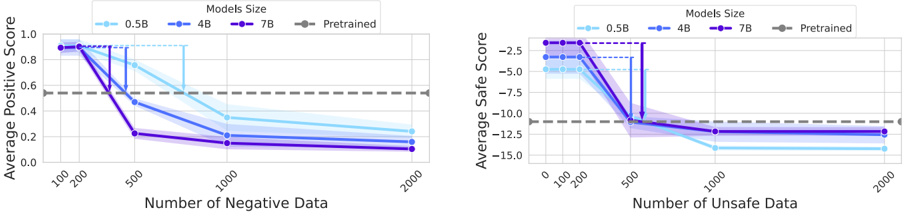
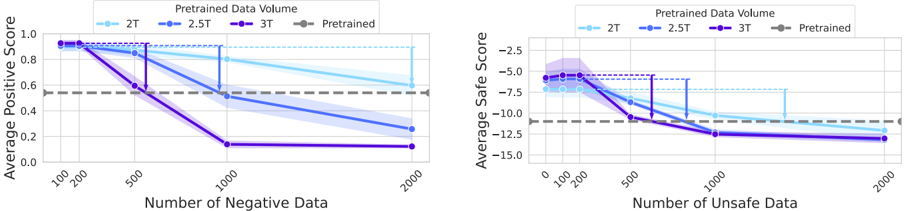
Large language models (LLMs) may exhibit unintended or undesirable behaviors. Recent works have concentrated on aligning LLMs to mitigate harmful outputs. Despite these efforts, some anomalies indicate that even a well-conducted alignment process can be easily circumvented, whether intentionally or accidentally. Does alignment fine-tuning yield have robust effects on models, or are its impacts merely superficial? In this work, we make the first exploration of this phenomenon from both theoretical and empirical perspectives. Empirically, we demonstrate the elasticity of post-alignment models, i.e., the tendency to revert to the behavior distribution formed during the pre-training phase upon further fine-tuning. Leveraging compression theory, we formally deduce that fine-tuning disproportionately undermines alignment relative to pre-training, potentially by orders of magnitude. We validate the presence of elasticity through experiments on models of varying types and scales. Specifically, we find that model performance declines rapidly before reverting to the pre-training distribution, after which the rate of decline drops significantly. Furthermore, we further reveal that elasticity positively correlates with the increased model size and the expansion of pre-training data. Our findings underscore the need to address the inherent elasticity of LLMs to mitigate their resistance to alignment.
Overview
CoChat Summary
TL;DR
The paper argues that LLMs exhibit “elasticity”: after alignment, further fine-tuning tends to revert them toward the pretraining distribution, making alignment fragile. It formalizes this via compression theory and validates resistance and rebound across several models and datasets.
Key findings
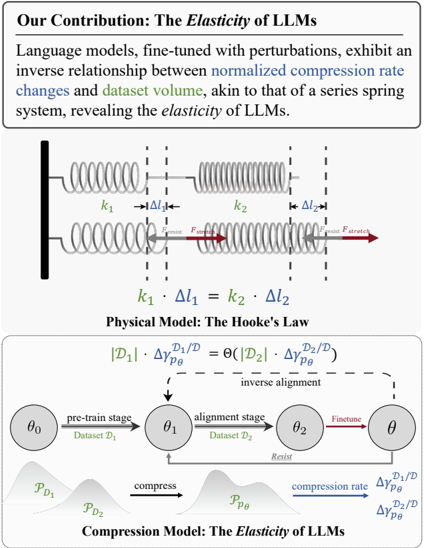
- Theoretically, after perturbation, normalized compression-rate changes for different datasets are inversely proportional to dataset size; the model tends to retain the larger pretraining distribution and forget smaller alignment distributions, enabling inverse alignment.
- Resistance: inverse alignment training loss was consistently lower than forward alignment across Llama2-7B, Llama2-13B, Llama3-8B and Alpaca, TruthfulQA, Beavertails. Example from Table 1: Llama2-7B on Alpaca, θ2→θ1 vs. θ1→θ2, 0.1589 vs. 0.2018. Table 2 reports KL divergence for θ1 vs. θ2: forward alignment 0.4568 vs. inverse alignment 0.2796.
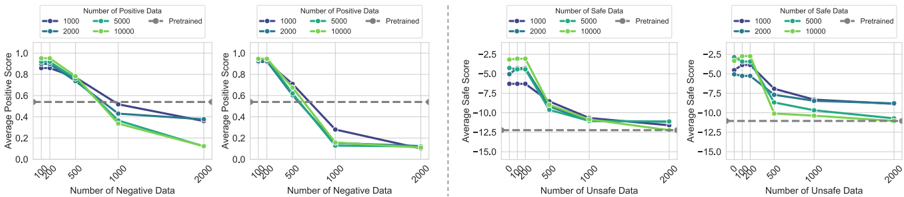
- Rebound: models fine-tuned with more positive data initially performed better but degraded faster under small negative fine-tuning, then the decline slowed. In the KL-divergence experiment, unsafe data needed to drop below ε = 1×10⁻² were, for Llama2-7B, 961, 844, 801, 729 for positive data amounts 1000, 2000, 5000, 10000; for Gemma-2B, 923, 853, 709, 598.
- Rebound increased with model size (Qwen 0.5B, 4B, 7B) and with pretraining data volume (TinyLlama 2.0T, 2.5T, 3.0T; also 0.1T, 0.5T, 1.0T).
Methods
- Theoretical: models LLM training/alignment as a lossless compression protocol using token trees, Huffman coding, ideal code length, normalized compression rate, and a Pareto mass distribution; derives an elasticity theorem and analogizes it to springs in series.
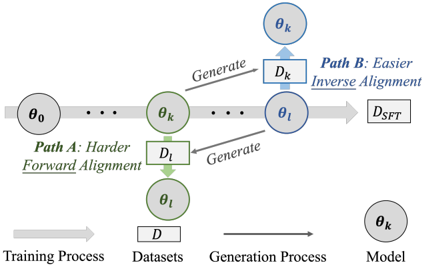
- Resistance experiments: perform one epoch of SFT on a pretrained model, save slices {θ1, θ2, …, θn}; compare forward alignment (train θk on D_l) vs. inverse alignment (train θl on D_k) using training loss and KL divergence. Models: Llama2-7B, Llama2-13B, Llama3-8B; datasets: Alpaca, TruthfulQA, Beavertails.
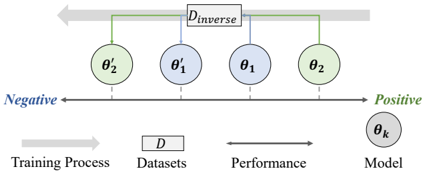
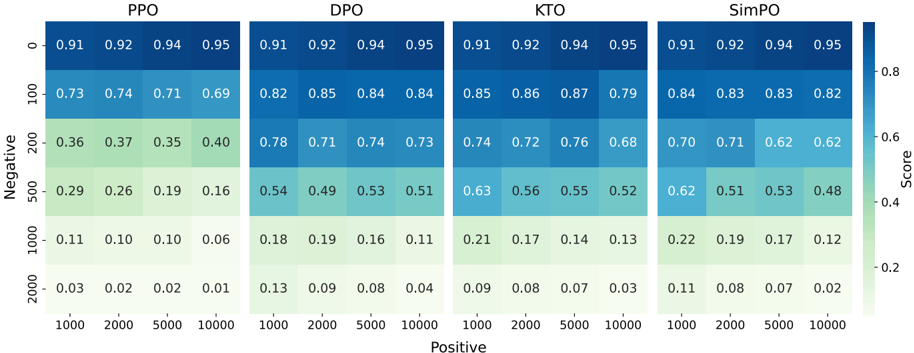
- Rebound experiments: train on positive/safe data volumes {1000, 2000, 5000, 10000}, then inverse fine-tune with negative/unsafe data {100, 200, 500, 1000, 2000}; tasks are IMDb positive/negative generation and Beavertails safe/unsafe single-turn dialogue; evaluation uses Sentiment Roberta and a cost model. Models include Llama2-7B, Gemma-2B, Qwen 0.5B/4B/7B, and TinyLlama pretraining slices; additional tests use RLHF, DPO, KTO, and SimPO.
Limitations
- Stated: the theory relies on specifying the mass distribution (Assumption A.7); empirical validation did not systematically cover the entire pretraining and alignment lifecycle due to cost constraints; future work includes multimodal models and scaling laws.
- Stated/evident: the paper cannot accurately determine the critical pretraining-data threshold where resistance becomes significant, and lacks sufficiently fine-grained pretraining data and controllable model series to quantify it.
- Stated/evident: real-world datasets often contain fused features, making it difficult to distinguish the independent and differently distributed datasets assumed by the elasticity theory; experiments are also limited to selected model families, scales, and tasks.
Model-written summary. Check it against the paper before relying on it.
Integrity signals
Registry
Cites
Statistics
Figures



Verification
Claims the paper makes
0 Valid · 1 Not valid · 11 Not checked · 66 Own results and interpretations
A result the paper reports from its own data — it cites no other source for it, so there is none to check. The quote shows it is in the paper.
In the paper
“As the model size increases, the performance of the aligned model deteriorates more rapidly after fine-tuning with negative data.”
§ Language Models Resist Alignment: Evidence From Data Compression > Additional information
plainstates a cause- Asserted: passes — The authors put it forward as true.
- Checkable: passes — It can be checked against evidence.
- Load-bearing: passes — The paper’s conclusions depend on it.
- Based: passes — The paper gives a reason why it holds.
A result the paper reports from its own data — it cites no other source for it, so there is none to check. The quote shows it is in the paper.
In the paper
“As pre-training data volume increases, aligned model performance deteriorates more rapidly after fine-tuning with negative data.”
§ Language Models Resist Alignment: Evidence From Data Compression > Additional information
plainstates a cause- Asserted: passes — The authors put it forward as true.
- Checkable: passes — It can be checked against evidence.
- Load-bearing: passes — The paper’s conclusions depend on it.
- Based: passes — The paper gives a reason why it holds.
A result the paper reports from its own data — it cites no other source for it, so there is none to check. The quote shows it is in the paper.
In the paper
“Under different models and data scales, we observe that only a small amount of unsafe data is needed for a positively fine-tuned model to revert to the pre-training distribution in terms of KL divergence.”
§ Language Models Resist Alignment: Evidence From Data Compression > Additional information
plainstates a cause- Asserted: passes — The authors put it forward as true.
- Checkable: passes — It can be checked against evidence.
- Load-bearing: passes — The paper’s conclusions depend on it.
- Based: passes — The paper gives a reason why it holds.
- Rests on 2 assumptions not shown here.
A result the paper reports from its own data — it cites no other source for it, so there is none to check. The quote shows it is in the paper.
In the paper
“The experimental results, presented in Figure 9, demonstrate that rebound remains evident under the DPO algorithm, with its strength increasing as model size grows.”
§ Language Models Resist Alignment: Evidence From Data Compression > Additional information
boosted- Asserted: passes — The authors put it forward as true.
- Checkable: passes — It can be checked against evidence.
- Load-bearing: passes — The paper’s conclusions depend on it.
- Based: passes — The paper gives a reason why it holds.
A result the paper reports from its own data — it cites no other source for it, so there is none to check. The quote shows it is in the paper.
In the paper
“The results show that forward alignment exhibits higher values compared to inverse alignment, providing evidence for the existence of Resistance.”
§ Language Models Resist Alignment: Evidence From Data Compression > Additional information
plainstates an association- Asserted: passes — The authors put it forward as true.
- Checkable: passes — It can be checked against evidence.
- Load-bearing: passes — The paper’s conclusions depend on it.
- Based: passes — The paper gives a reason why it holds.
- Rests on 2 assumptions not shown here.
48 more claims
Create a free account to see all 78 claims and to verify the 3 references still open.
- It may state two separate claims as one. 16
- Probably not a substantial claim. 9
- The quote only partly states this claim. 2
Self-check
Percentages, sums and reported differences re-computed from the paper’s own numbers.
Each contradiction between two passages listed here was confirmed by an independent check.
Rated minor: it would not touch a result — a value no result rests on, a p-value that stays on the same side of the significance level, or a conflict that is clerical, resolved elsewhere in the paper, or outside its own findings.
In the paper
§ Language Models Resist Alignment: Evidence From Data Compression > Theorem A.2 (Ideal Code Length).
“Let X D be the random variable representing the probability value taken at each leaf.”
§ Language Models Resist Alignment: Evidence From Data Compression > Lemma A.5 (Entropy of Mass Distribution). Consider the pruned trees T ′
“According to the definitions of the response distribution P and mass distribution P mass , we have M p D j = X D j , ∀j ∈ {1, . . ., N }.”
Citations
Cites
A Mathematical Theory of Communication
Shannon, C. E. (1948) · Bell System Technical Journal · doi:10.1002/j.1538-7305.1948.tb01338.x · Cited by 88,486
Scaling Laws for Neural Language Models
Kaplan, J., McCandlish, S., Henighan, T., Brown, T. B., Chess, B., Child, R., Gray, S., Radford, A., Wu, J., & Amodei, D. (2020) · arXiv · doi:10.48550/arxiv.2001.08361 · Cited by 9,550 · cited 1×
“Additionally, we aim to theoretically uncover the relationship between model elasticity and scaling laws (Kaplan et al., 2020; Xiao et al., 2024), specifically determining the amount of training data required for elasticity to manifest and quantitatively analyzing whether elasticity intensifies as…”
Learning Word Vectors for Sentiment Analysis
Maas, A. L., Daly, R. E., Pham, P. T., Huang, D., Ng, A. Y., & Potts, C. (2011) · Cited by 6,960
A Comprehensive Survey on Transfer Learning
Zhuang, F., Qi, Z., Duan, K., Xi, D., Zhu, Y., Zhu, H., Xiong, H., & He, Q. (2021) · Proceedings of the IEEE · doi:10.1109/jproc.2020.3004555 · Cited by 6,678 · cited 1×
“(Zhuang et al., 2020; Weiss et al., 2016).”
A Method for the Construction of Minimum-Redundancy Codes
Huffman, D. (1952) · Proceedings of the IRE · doi:10.1109/jrproc.1952.273898 · Cited by 6,334
Weiss, K., Khoshgoftaar, T. M., & Wang, D. (2016) · Journal of Big Data · doi:10.1186/s40537-016-0043-6 · Cited by 6,260
Newman (2005) · doi:10.1080/00107510500052444 · Cited by 5,749
Training Language Models to Follow Instructions with Human Feedback
Ouyang, L., Wu, J., Jiang, X., Almeida, D., Wainwright, C., Mishkin, P., Zhang, C., Agarwal, S., Slama, K., Ray, A., et al. (2022) · Advances in Neural Information Processing Systems 35 · doi:10.52202/068431-2011 · Cited by 3,117 · cited 5×
“Recent initiatives (Ouyang et al., 2022; Bai et al., 2022a; Yang et al., 2024) have aimed to align these models to minimize harmful outputs (Yang et al., 2023a; Cui et al., 2024).”
InfluentialArithmetic coding for data compression
Witten, I. H., Neal, R. M., & Cleary, J. G. (1987) · Communications of the ACM · doi:10.1145/214762.214771 · Cited by 2,877 · cited 1×
“Consider a model p θ and x = ( x 0 , · · · , x m − 1 ) derived from a dataset D , the expected code length L under arithmetic coding (Witten et al., 1987) satisfies: which is the current training objective of language models.”
Llama 2: Open Foundation and Fine-Tuned Chat Models
Touvron, H., Martin, L., Stone, K., Albert, P., Almahairi, A., Babaei, Y., Bashlykov, N., Batra, S., Bhargava, P., Bhosale, S., et al. (2023) · arXiv · doi:10.48550/arxiv.2307.09288 · Cited by 2,604 · cited 5×
“We evaluate the rebound phenomenon on Llama2-7B (Touvron et al., 2023) and Gemma-2B (Team et al., 2024).”
Influential
Research works printed but not linked: 4
- Marcus Hutter. 2005. Universal Artificial Intelligence: Sequential Decisions Based On Algorithmic Proba- bility. Springer Science & Business Media.
- Jiaming Ji, Boyuan Chen, Hantao Lou, Donghai Hong, Borong Zhang, Xuehai Pan, Juntao Dai, and Yaodong Yang. 2024a. Aligner: Achieving efficient alignment through weak-to-strong correction. arXiv preprint arXiv:2402.02416. · arXiv
- Mark EJ Newman. 2005. Power laws, pareto dis- tributions and zipf's law. Contemporary physics, 46(5):323-351.
- George Kingsley Zipf. 1946. The psychology of lan- guage. In Encyclopedia of psychology, pages 332- 341. Philosophical Library.
Cited by
AI Alignment: A Contemporary Survey
Ji, J., Qiu, T., Chen, B., Zhou, J., Zhang, B., Hong, D., Lou, H., Wang, K., Duan, Y., He, Z., et al. (2025) · ACM Computing Surveys · doi:10.1145/3770749 · Cited by 808
Self-citationA Comprehensive Survey in LLM(-Agent) Full Stack Safety: Data, Training and DeploymentPreprint
Wang, K., Zhang, G., Zhou, Z., Wu, J., Yu, M., Zhao, S., Yin, C., Fu, J., Yan, Y., Luo, H., et al. (2025) · arXiv · doi:10.48550/arxiv.2504.15585 · Cited by 202
Self-citationSafeVLA: Towards Safety Alignment of Vision-Language-Action Model via Constrained Learning
Zhang, B., Zhang, Y., Ji, J., Lei, Y., Dai, J., Chen, Y., & Yang, Y. (2025) · neural information processing systems · doi:10.52202/085713-5128 · Cited by 160
“Ensuring the alignment of these models with human values and safety has become more critical than ever [8, 9], due to their increasing complexity and power [10, 11, 12, 13, 14].”
Self-citationOpen Problems in Machine Unlearning for AI SafetyPreprint
Barez, F., Fu, T., Prabhu, A., Casper, S., Sanyal, A., Bibi, A., O’Gara, A., Kirk, R., Bucknall, B., Fist, T., et al. (2025) · arXiv · doi:10.48550/arxiv.2501.04952 · Cited by 104
Knowledge-Empowered, Collaborative, and Co-Evolving AI Models: The Post-LLM Roadmap
Wu, F., Shen, T., Bäck, T., Chen, J., Huang, G., Jin, Y., Kuang, K., Li, M., Lu, C., Miao, J., et al. (2024) · Engineering · doi:10.1016/j.eng.2024.12.008 · Cited by 62
Self-citation
Metadata
- Authors
- Ji, J., Wang, K., Qiu, T. A., Chen, B., Zhou, J., Li, C., Lou, H., Dai, J., Liu, Y., & Yang, Y.
- Affiliations
- Peking University (CN)
- Venue
- Proceedings of the 63rd Annual Meeting of the Association for Computational Linguistics (Volume 1: Long Papers)
- Published
- 2025
- Pages
- 23411-23432
- ISSN
- 0736-587X (ISSN-L)
- OpenAlex
- W4412944786
- Cited by
- 83
- References
- 84
- Citations by year
- 2026: 61 · 2025: 17
- FWCI
- 11.48
- Type
- conference paper
- Language
- en
- Open access
- hybrid
- doi.org
- Licence
- cc-by
- Locations
- Proceedings of the conference - Association for Computational Linguistics. Meeting (publishedVersion, cc-by)
- arXiv (submittedVersion)
- Funders
- National Natural Science Foundation of China (62376013)
- Topics
- Physical Sciences › Computer Science › Artificial Intelligence › Topic Modeling
- Physical Sciences › Computer Science › Artificial Intelligence › Adversarial Robustness in Machine Learning
- Physical Sciences › Computer Science › Artificial Intelligence › Ethics and Social Impacts of AI
- Keywords
- large language models, alignment, fine-tuning, data compression, alignment robustness, model size
About these checks
Registry, retraction, Cites and statistics results are computed, not judged, with one exception: a printed reference that no index lists is read once by a model before it counts as a citation error. Claims are extracted by a model and kept only when their quote appears verbatim in the text; each cited source is then checked, with a model’s help, for whether it says what the claim relies on. Those verdicts can be wrong — read the claim’s quote and the cited source before relying on one.
A language model drew the claims from the paper on 2026-11-28, under version 3 of the claim definition (model deepseek-v4.1-flash, prompt extract-v3).
A second model labelled each claim on 2026-11-28 (model jev-1.13-20260917, definition revision gold-guideline-v0.2).
Statistics and arithmetic are recomputed, not judged.
Confidence bands are shown only for fields calibrated on our annotated test set. None is calibrated yet, so no band is shown.
What counts as a claim ›How we measure confidence ›How we check this ›
Are you an author, or do you see a problem with this page? Request a review
Data sources
Bibliographic data: Semantic Scholar, OpenAlex, Crossref.
Contains information from the Semantic Scholar Academic Graph Datasets, made available under the ODC Attribution License (ODC-BY 1.0).
Semantic Scholar’s data is described in: Kinney, R., et al. (2023). The Semantic Scholar Open Data Platform. arXiv:2301.10140.
