

Men Also Like Shopping: Reducing Gender Bias Amplification using Corpus-level Constraints
Open accessThe DOI matches its Crossref record; 30 of the 30 references it cites were found in a registry or an index.
Abstract
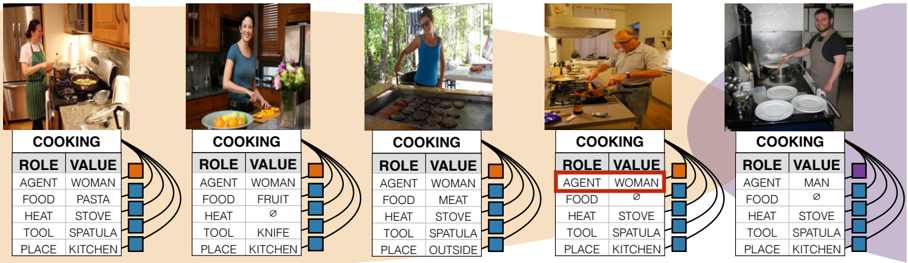
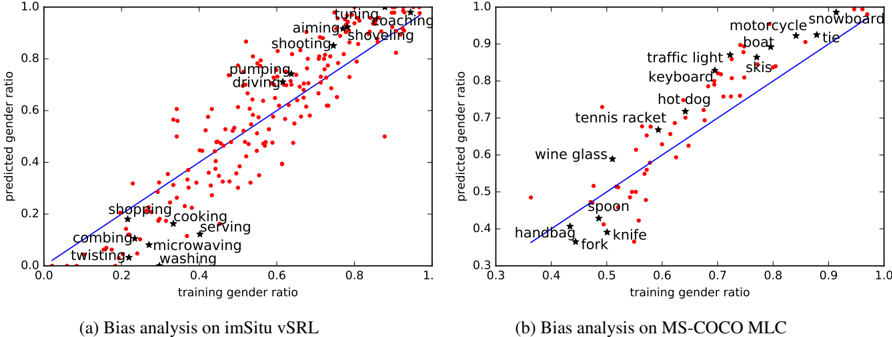
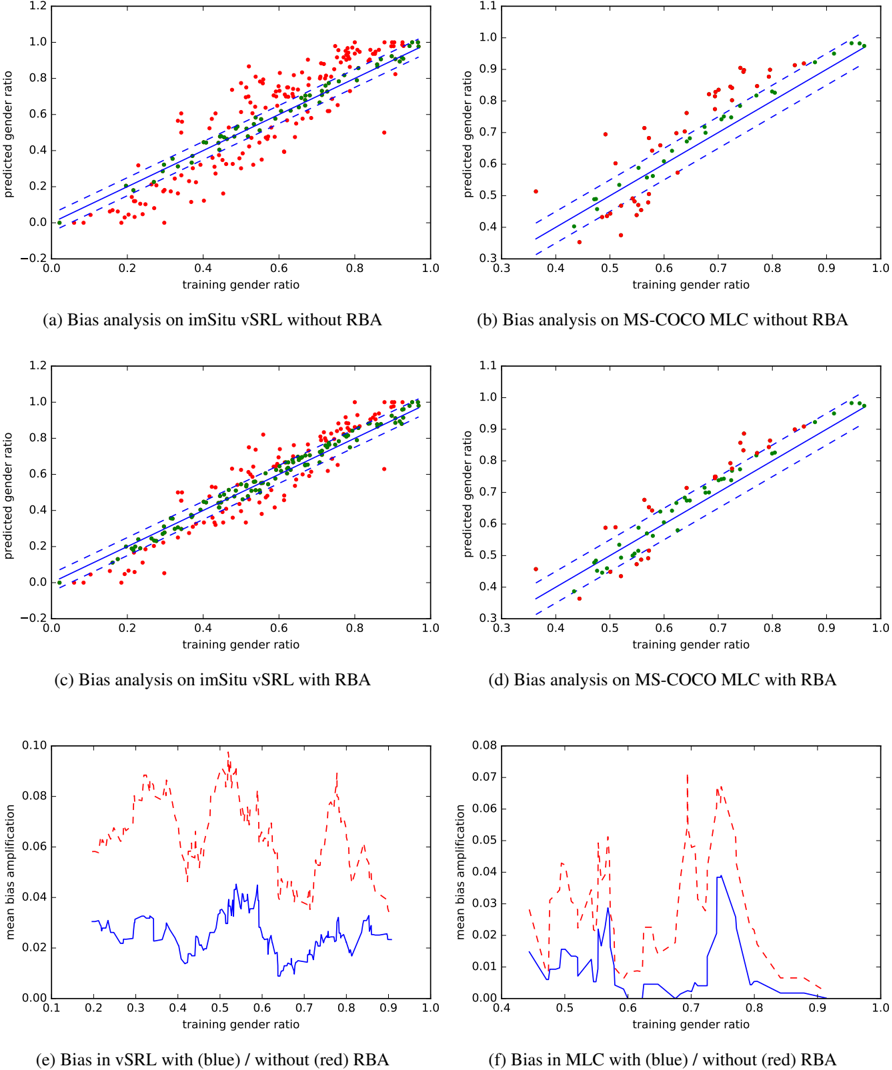
Language is increasingly being used to define rich visual recognition problems with supporting image collections sourced from the web.Structured prediction models are used in these tasks to take advantage of correlations between co-occurring labels and visual input but risk inadvertently encoding social biases found in web corpora.In this work, we study data and models associated with multilabel object classification and visual semantic role labeling.We find that (a) datasets for these tasks contain significant gender bias and (b) models trained on these datasets further amplify existing bias.For example, the activity cooking is over 33% more likely to involve females than males in a training set, and a trained model further amplifies the disparity to 68% at test time.We propose to inject corpus-level constraints for calibrating existing structured prediction models and design an algorithm based on Lagrangian relaxation for collective inference.Our method results in almost no performance loss for the underlying recognition task but decreases the magnitude of bias amplification by 47.5% and 40.5% for multilabel classification and visual semantic role labeling, respectively.
Overview
The claims and statistics of this paper haven’t been checked yet.
Free: it reads the open-access text and checks the first 5 claims that cite a source we can check. Create a free account to check every claim.
Integrity signals
Registry
Cites
Statistics
Figures
Verification
Claims the paper makes
The claims and statistics of this paper haven’t been checked yet.
Free: it reads the open-access text and checks the first 5 claims that cite a source we can check. Create a free account to check every claim.
Claims other papers make about this one
Each is checked against this paper’s own text: does it say what the citing paper says it does?
The source backs part of the claim, not all of it — or backs it for a different population, condition or comparison.
In the citing paper
“and processes of creating resources and technologies may further entrench such disparities [25, 38, 144].”
From Data Governance in the Age of Large-Scale Data-Driven Language Technology (2022) · cites this paper as [144]
Experimental — accuracy not yet measuredThe source backs part of the claim, not all of it — or backs it for a different population, condition or comparison.
In the citing paper
“It is well-documented that LMs learn the biases, prejudices, and racism present in the language they are trained on35–38.”
From Large language models to identify social determinants of health in electronic health records (2024) · cites this paper as [36]
Experimental — accuracy not yet measuredThe source backs part of the claim, not all of it — or backs it for a different population, condition or comparison.
In the citing paper
“Neural networks are prone to learning biases from training data and amplifying them at test time50, giving rise to a much discussed aspect of AI behaviour: fairness51.”
From The METRIC-framework for assessing data quality for trustworthy AI in medicine: A systematic review (2024) · cites this paper as [50]
Experimental — accuracy not yet measuredThe cited source says what the claim attributes to it.
In the citing paper
“It is well acknowledged that machine learning models, such as those ofered by the API providers, are prone to exhibiting various kinds of discriminatory behaviours, including diferent error rates across demographic groups [22,126,127], stereotyping [64,163] or minority groups under-representation [134,137].”
From Out of Context: Investigating the Bias and Fairness Concerns of “Artificial Intelligence as a Service” (2023) · cites this paper as [163]
Self-check
Percentages, sums and reported differences re-computed from the paper’s own numbers.
The self-check needs the paper’s full text.
Citations
Cites
Very Deep Convolutional Networks for Large-Scale Image Recognition
Simonyan, K., & Zisserman, A. (2014) · arXiv · doi:10.48550/arxiv.1409.1556 · Cited by 114,148 · cited 1×
“where each potential value in the CRF for subpart x, is computed using features fi from the VGG convolutional neural network (Simonyan and Zisserman, 2014) on an input image, as follows:”
MethodMicrosoft COCO: Common Objects in Context
Lin, T.-Y., Maire, M., Belongie, S., Hays, J., Perona, P., Ramanan, D., Dollár, P., & Zitnick, C. L. (2014) · Lecture Notes in Computer Science · doi:10.1007/978-3-319-10602-1_48 · Cited by 45,460 · cited 2×
“For MLC, we use MS-COCO (Lin et al., 2014; Chen et al., 2015), a recognition task covering 80 object classes.”
MethodShow and tell: A neural image caption generator
Vinyals, O., Toshev, A., Bengio, S., & Erhan, D. (2015) · 2015 IEEE Conference on Computer Vision and Pattern Recognition (CVPR) · doi:10.1109/cvpr.2015.7298935 · Cited by 6,318 · cited 2×
“Visual recognition tasks involving language, such as captioning (Vinyals et al., 2015), visual question answering (Antol et al.”
BackgroundVQA: Visual Question Answering
Antol, S., Agrawal, A., Lu, J., Mitchell, M., Batra, D., Zitnick, C. L., & Parikh, D. (2015) · 2015 IEEE International Conference on Computer Vision (ICCV) · doi:10.1109/iccv.2015.279 · Cited by 4,487
Dwork, C., Hardt, M., Pitassi, T., Reingold, O., & Zemel, R. (2012) · Proceedings of the 3rd Innovations in Theoretical Computer Science Conference · doi:10.1145/2090236.2090255 · Cited by 3,501 · cited 1×
“Various approaches have been proposed to make a “fair” binary classification (Baro-cas and Selbst, 2014; Dwork et al., 2012; Feldman et al., 2015; Zliobaite, 2015).”
BackgroundBarocas, S., & Selbst, A. D. (2014) · doi:10.2139/ssrn.2477899 · Cited by 3,048
Semantics derived automatically from language corpora contain human-like biases
Caliskan, A., Bryson, J. J., & Narayanan, A. (2017) · Science · doi:10.1126/science.aal4230 · Cited by 2,887 · cited 2×
“Such issues have been demonstrated in various learning systems, including online advertisement systems (Sweeney, 2013), word embedding models (Bolukbasi et al., 2016; Caliskan et al., 2017), online news (Ross and Carter, 2011), web search (Kay et al., 2015), and credit score (Hardt et al., 2016).”
BackgroundEquality of Opportunity in Supervised Learning
Hardt, M., Price, E., & Srebro, N. (2016) · arXiv · doi:10.48550/arxiv.1610.02413 · Cited by 2,536 · cited 1×
“Such issues have been demonstrated in various learning systems, including online advertisement systems (Sweeney, 2013), word embedding models (Bolukbasi et al., 2016; Caliskan et al., 2017), online news (Ross and Carter, 2011), web search (Kay et al., 2015), and credit score (Hardt et al., 2016).”
BackgroundBaker, C. F., Fillmore, C. J., & Lowe, J. B. (1998) · Proceedings of the 36th annual meeting on Association for Computational Linguistics - · doi:10.3115/980845.980860 · Cited by 2,518 · cited 2×
“Dataset We evaluate on imSitu (Yatskar et al., 2016) where activity classes are drawn from verbs and roles in FrameNet (Baker et al., 1998) and noun categories are drawn from WordNet (Miller et al., 1990).”
BackgroundMethodCertifying and Removing Disparate Impact
Feldman, M., Friedler, S. A., Moeller, J., Scheidegger, C., & Venkatasubramanian, S. (2015) · Proceedings of the 21th ACM SIGKDD International Conference on Knowledge Discovery and Data Mining · doi:10.1145/2783258.2783311 · Cited by 1,827 · cited 2×
“e cost of making mistakes on samples in the minority class can be neglected. Various approaches have been proposed to make a “fair” binary classification (Barocas and Selbst, 2014; Dwork et al., 2012; Feldman et al., 2015; Zliobaite, 2015). For structured prediction tasks the effect is harder to quantify and we are the…”
BackgroundMicrosoft COCO Captions: Data Collection and Evaluation Server
Chen, X., Fang, H., Lin, T.-Y., Vedantam, R., Gupta, S., Dollar, P., & Zitnick, C. L. (2015) · arXiv · doi:10.48550/arxiv.1504.00325 · Cited by 1,614 · cited 8×
“Dataset We use MS-COCO (Lin et al., 2014), a common object detection benchmark, for multi-label object classification.”
MethodInfluentialDiscrimination in online ad delivery
Sweeney, L. (2013) · Communications of the ACM · doi:10.1145/2447976.2447990 · Cited by 783 · cited 1×
“Such issues have been demonstrated in various learning systems, including online advertisement systems (Sweeney, 2013), word embedding models (Bolukbasi et al.”
BackgroundVQA: Visual Question Answering: www.visualqa.org
Agrawal, A., Lu, J., Antol, S., Mitchell, M., Zitnick, C. L., Parikh, D., & Batra, D. (2017) · International Journal of Computer Vision · doi:10.1007/s11263-016-0966-6 · Cited by 570
Baker, C. F., Fillmore, C. J., & Lowe, J. B. (1998) · Proceedings of the 17th international conference on Computational linguistics - · doi:10.3115/980451.980860 · Cited by 522
Unequal Representation and Gender Stereotypes in Image Search Results for Occupations
Kay, M., Matuszek, C., & Munson, S. A. (2015) · Proceedings of the 33rd Annual ACM Conference on Human Factors in Computing Systems · doi:10.1145/2702123.2702520 · Cited by 509 · cited 2×
“Such issues have been demonstrated in various learning systems, including online advertisement systems (Sweeney, 2013), word embedding models (Bolukbasi et al., 2016; Caliskan et al., 2017), online news (Ross and Carter, 2011), web search (Kay et al., 2015), and credit score (Hardt et al., 2016).”
BackgroundWomen and news: A long and winding road
Ross, K., & Carter, C. (2011) · Media, Culture & Society · doi:10.1177/0163443711418272 · Cited by 345 · cited 1×
“, 2017), online news (Ross and Carter, 2011), web search (Kay et al.”
BackgroundSituation Recognition: Visual Semantic Role Labeling for Image Understanding
Yatskar, M., Zettlemoyer, L., & Farhadi, A. (2016) · 2016 IEEE Conference on Computer Vision and Pattern Recognition (CVPR) · doi:10.1109/cvpr.2016.597 · Cited by 242 · cited 7×
“Dataset We evaluate on imSitu (Yatskar et al., 2016) where activity classes are drawn from verbs and roles in FrameNet (Baker et al.”
BackgroundMethodInfluentialSelf-citationSeeing through the Human Reporting Bias: Visual Classifiers from Noisy Human-Centric Labels
Misra, I., Zitnick, C. L., Mitchell, M., & Girshick, R. (2016) · 2016 IEEE Conference on Computer Vision and Pattern Recognition (CVPR) · doi:10.1109/cvpr.2016.320 · Cited by 199 · cited 1×
“Data collection biases have been discussed in the context of creating image corpus (Misra et al., 2016; van Miltenburg, 2016) and text corpus (Gordon and Van Durme, 2013; Van Durme, 2010).”
BackgroundIntroduction to dual composition for inference
Sontag, D. A., Globerson, A., & Jaakkola, T. (2011) · Cited by 150
Rush, A. M., & Collins, M. J. (2012) · Journal of Artificial Intelligence Research · doi:10.1613/jair.3680 · Cited by 128 · cited 3×
“(3) using a Lagrangian relaxation technique (Rush and Collins, 2012).”
MethodIntroduction to Dual Decomposition for Inference
Sontag, D. A., Globerson, A., & Jaakkola, T. (2011) · The MIT Press eBooks · doi:10.7551/mitpress/8996.003.0010 · Cited by 71
Stereotyping and Bias in the Flickr30K Dataset
van Miltenburg, E. (2016) · arXiv (Cornell University) · doi:10.48550/arxiv.1605.06083 · Cited by 58 · cited 1×
“Data collection biases have been discussed in the context of creating image corpus (Misra et al., 2016; van Miltenburg, 2016) and text corpus (Gordon and Van Durme, 2013; Van Durme, 2010).”
BackgroundExact Decoding of Phrase-based Translation Models through Lagrangian Relaxation
Chang, Y.-W., & Collins, M. (2011) · DSpace@MIT (Massachusetts Institute of Technology) · Cited by 45
Commonly Uncommon: Semantic Sparsity in Situation Recognition
Yatskar, M., Ordonez, V., Zettlemoyer, L., & Farhadi, A. (2017) · 2017 IEEE Conference on Computer Vision and Pattern Recognition (CVPR) · doi:10.1109/cvpr.2017.671 · Cited by 40 · cited 1×
“In vSRL, we use the imSitu formalism (Yatskar et al., 2016, 2017), where the goal is to predict activities, objects and the roles those objects play within an activity.”
MethodSelf-citationExtracting implicit knowledge from text
Durme, V., & Benjamin, D. J. (2009) · Cited by 20
Reporting Bias and Knowledge Extraction
Gordon, J., & Durme, B. V. (2013) · Cited by 19
Tractable Semi-supervised Learning of Complex Structured Prediction Models
Chang, K.-W., Sundararajan, S., & Keerthi, S. S. (2013) · Lecture notes in computer science · doi:10.1007/978-3-642-40994-3_12 · Cited by 11 · cited 1×
“Similar techniques (Chang et al., 2013; Dalvi, 2015) have been applied in handling corpus-level constraints for semi-supervised multilabel classification.”
MethodSelf-citationDual Decomposition Inference for Graphical Models over Strings
Peng, N., Cotterell, R., & Eisner, J. M. (2015) · Conference on Empirical Methods in Natural Language Processing (EMNLP) · doi:10.18653/v1/d15-1108 · Cited by 8 · cited 1×
“Lagrangian relaxation and dual decomposition techniques have been widely used in NLP tasks (e.g., (Sontag et al., 2011; Rush and Collins, 2012; Chang and Collins, 2011; Peng et al., 2015)) for dealing with instance-level constraints.”
MethodConstrained Semi-supervised Learning in the Presence of Unanticipated Classes
Dalvi, B. B. (2016) · ACM SIGIR Forum · doi:10.1145/2888422.2888447 · Cited by 2 · cited 1×
“Similar techniques (Chang et al., 2013; Dalvi, 2015) have been applied in handling corpus-level constraints for semi-supervised multilabel classification.”
MethodA survey on measuring indirect discrimination in machine learning
Zliobaite, I. (2015) · arXiv · doi:10.48550/arxiv.1511.00148 · cited 1×
“Various approaches have been proposed to make a “fair” binary classification (Baro-cas and Selbst, 2014; Dwork et al., 2012; Feldman et al., 2015; Zliobaite, 2015).”
Background
Research works printed but not linked: 4
- Stanislaw Antol, Aishwarya Agrawal, Jiasen Lu, Mar- garet Mitchell, Dhruv Batra, C Lawrence Zitnick, and Devi Parikh. 2015. Vqa: Visual question an- swering. In Proceedings of the IEEE International Conference on Computer Vision, pages 2425-2433.
- Tolga Bolukbasi, Kai-Wei Chang, James Y Zou, Venkatesh Saligrama, and Adam T Kalai. 2016. Man is to computer programmer as woman is to homemaker? debiasing word embeddings. In The Conference on Advances in Neural Information Pro- cessing Systems (NIPS), pages 4349-4357.
- Bernhard Korte and Jens Vygen. 2008. Combinatorial Optimization: Theory and Application. Springer Verlag.
- G. Miller, R. Beckwith, C. Fellbaum, D. Gross, and K.J. Miller. 1990. Wordnet: An on-line lexical database. International Journal of Lexicography, 3(4):235-312.
Cited by
Kirillov, A., Mintun, E., Ravi, N., Mao, H., Rolland, C., Gustafson, L., Xiao, T., Whitehead, S., Berg, A. C., Lo, W.-Y., et al. (2023) · 2023 IEEE/CVF International Conference on Computer Vision (ICCV) · doi:10.1109/iccv51070.2023.00371 · Cited by 11,953
“We note that females have been shown to be underrepresented in detection and segmentation datasets [115], but observe that SAM performs similarly across groups.”
BackgroundA Survey on Bias and Fairness in Machine Learning
Mehrabi, N., Morstatter, F., Saxena, N., Lerman, K., & Galstyan, A. (2022) · ACM Computing Surveys · doi:10.1145/3457607 · Cited by 5,812
“In [139], authors studied the semantic role-labeling models and a famous dataset, imSitu, and realized that only 33% of agent roles in cooking images are man, and the rest of 67% cooking images have woman as agents in the imSitu training set.”
BackgroundA Survey on Bias and Fairness in Machine Learning
Mehrabi, N., Morstatter, F., Saxena, N., Lerman, K., & Galstyan, A. (2019) · arXiv · doi:10.48550/arxiv.1908.09635 · Cited by 5,812
On the Opportunities and Risks of Foundation Models
Bommasani, R., Hudson, D. A., Adeli, E., Altman, R., Arora, S., von Arx, S., Bernstein, M. S., Bohg, J., Bosselut, A., Brunskill, E., et al. (2021) · arXiv · doi:10.48550/arxiv.2108.07258 · Cited by 2,676
Ray, P. P. (2023) · Internet of Things and Cyber-Physical Systems · doi:10.1016/j.iotcps.2023.04.003 · Cited by 2,463
Metadata
- Authors
- Zhao, J., Wang, T., Yatskar, M., Ordonez, V., & Chang, K.-W.
- Affiliations
- University of Virginia (US)
- University of Washington (US)
- Venue
- Proceedings of the 2017 Conference on Empirical Methods in Natural Language Processing
- Published
- 2017
- Pages
- 2979-2989
- OpenAlex
- W2962787423
- Semantic Scholar
- 135bafc83e9a73c88e759f98a28edfdb5c02f81d
- Cited by
- 829
- References
- 30
- Citations by year
- 2026: 36 · 2025: 86 · 2024: 82 · 2023: 133 · 2022: 122 · 2021: 114 · 2020: 108 · 2019: 97 · 2018: 48 · 2017: 3
- FWCI
- 174.43
- Type
- conference paper
- Language
- en
- Open access
- hybrid
- doi.org
- Licence
- cc-by
- Locations
- Conference on Empirical Methods in Natural Language Processing (EMNLP) (publishedVersion, cc-by)
- arXiv (Cornell University) (submittedVersion)
- arXiv (Cornell University)
- Funders
- National Science Foundation (1657193)
- Nvidia
- Topics
- Physical Sciences › Computer Science › Artificial Intelligence › Ethics and Social Impacts of AI
- Physical Sciences › Computer Science › Computer Vision and Pattern Recognition › Advanced Neural Network Applications
- Physical Sciences › Computer Science › Computer Vision and Pattern Recognition › Multimodal Machine Learning Applications
- Keywords
- gender bias, bias amplification, structured prediction, Lagrangian relaxation, collective inference, image collections, cooking
About these checks
Registry, retraction, Cites and statistics results are computed, not judged, with one exception: a printed reference that no index lists is read once by a model before it counts as a citation error. Claims are extracted by a model and kept only when their quote appears verbatim in the text; each cited source is then checked, with a model’s help, for whether it says what the claim relies on. Those verdicts can be wrong — read the claim’s quote and the cited source before relying on one.
Statistics and arithmetic are recomputed, not judged.
Confidence bands are shown only for fields calibrated on our annotated test set. None is calibrated yet, so no band is shown.
What counts as a claim ›How we measure confidence ›How we check this ›
Are you an author, or do you see a problem with this page? Request a review
Data sources
Bibliographic data: Semantic Scholar, OpenAlex, Crossref.
Contains information from the Semantic Scholar Academic Graph Datasets, made available under the ODC Attribution License (ODC-BY 1.0).
Semantic Scholar’s data is described in: Kinney, R., et al. (2023). The Semantic Scholar Open Data Platform. arXiv:2301.10140.
