

The DOI matches its Crossref record; 45 of the 45 references it cites were found in a registry or an index.
Towards a Better Metric for Evaluating Question Generation Systems
Open accessAbstract
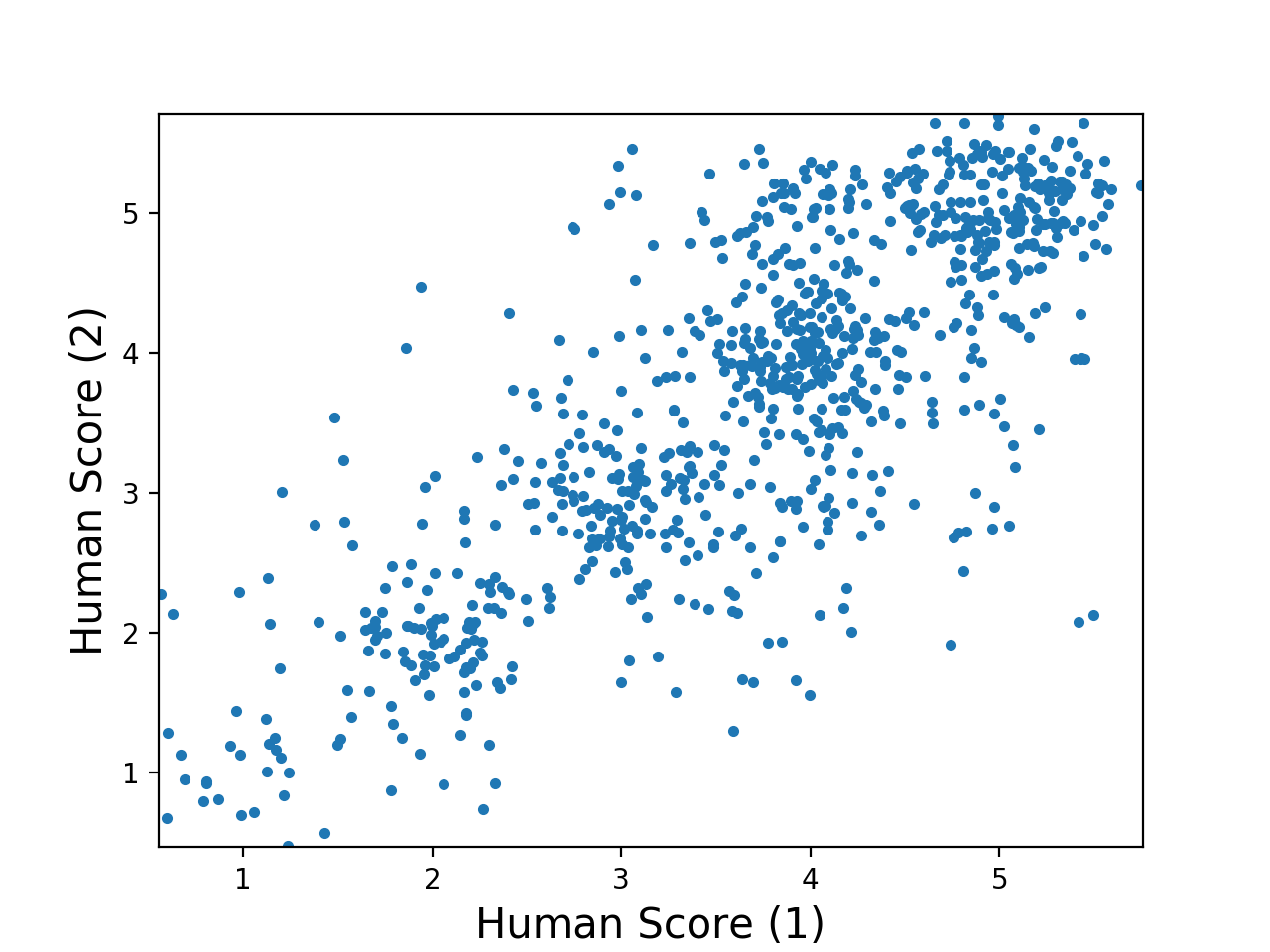
There has always been criticism for using ngram based similarity metrics, such as BLEU, NIST, etc, for evaluating the performance of NLG systems.However, these metrics continue to remain popular and are recently being used for evaluating the performance of systems which automatically generate questions from documents, knowledge graphs, images, etc.Given the rising interest in such automatic question generation (AQG) systems, it is important to objectively examine whether these metrics are suitable for this task.In particular, it is important to verify whether such metrics used for evaluating AQG systems focus on answerability of the generated question by preferring questions which contain all relevant information such as question type (Wh-types), entities, relations, etc.In this work, we show that current automatic evaluation metrics based on n-gram similarity do not always correlate well with human judgments about answerability of a question.To alleviate this problem and as a first step towards better evaluation metrics for AQG, we introduce a scoring function to capture answerability and show that when this scoring function is integrated with existing metrics, they correlate significantly better with human judgments.The scripts and data developed as a part of this work are made publicly available.1
Overview
The claims and statistics of this paper haven’t been checked yet.
Run the check — free, no account needed. It reads the open-access text and checks the sources it cites.
Integrity signals
Registry
Cites
Statistics
Figures
Verification
Claims the paper makes
The claims and statistics of this paper haven’t been checked yet.
Run the check — free, no account needed. It reads the open-access text and checks the sources it cites.
Claims other papers make about this one
Each is checked against this paper’s own text: does it say what the citing paper says it does?
The cited source doesn’t support the claim as written.
In the citing paper
“1) focusing only on specific dimensions like answerability;”
From QGEval: Benchmarking Multi-dimensional Evaluation for Question Generation (2024) · cites this paper as Nema and Khapra, 2018
Checked by a reasoning model — may be wrong.
Experimental — accuracy not yet measuredThe source backs part of the claim, not all of it — or backs it for a different population, condition or comparison.
In the citing paper
“Automatic evaluation of QG is still dominated by reference-based metrics such as BLEU (Papineni et al., 2002) and Q-Metric”
From QGEval: Benchmarking Multi-dimensional Evaluation for Question Generation (2024) · cites this paper as Nema and Khapra, 2018
Experimental — accuracy not yet measuredThe cited source says what the claim attributes to it.
In the citing paper
“Q-BLEU is a variant of BLEU with a higher weight for matching entities and has higher correlation with human judgment for question generation than standard metrics.”
From Retrieval-Augmented Generation for Knowledge-Intensive NLP Tasks (2020) · cites this paper as [42]
In the citing paper
“One notable contribution is made in [105], where the authors first use the answerability of a question through human evaluation to modify the existing automatic evaluation metrics to include the influence of relevant words, question types, function words, and named entities.”
From Automatic question generation: a review of methodologies, datasets, evaluation metrics, and applications (2023) · cites this paper as [105]
In the citing paper
“They further proved that their proposed metrics had a better correlation with the human evaluation scores.”
From Automatic question generation: a review of methodologies, datasets, evaluation metrics, and applications (2023) · cites this paper as [105]
Self-check
Percentages, sums and reported differences re-computed from the paper’s own numbers.
The self-check needs the paper’s full text.
Citations
Cites
BLEU: a method for automatic evaluation of machine translation
Papineni, K., Roukos, S., Ward, T., & Zhu, W.-J. (2001) · Proceedings of the 40th Annual Meeting on Association for Computational Linguistics - ACL '02 · doi:10.3115/1073083.1073135 · Cited by 21,344
Interrater reliability: The kappa statistic
McHugh, M. L. (2012) · Biochemia Medica · doi:10.11613/bm.2012.031 · Cited by 19,877
(2004) · Cited by 9,718
Weighted kappa: nominal scale agreement provision for scaled disagreement or partial credit
Cohen, J. (1968) · Psychological Bulletin · doi:10.1037/h0026256 · Cited by 8,736
SQuAD: 100,000+ Questions for Machine Comprehension of Text
Rajpurkar, P., Zhang, J., Lopyrev, K., & Liang, P. (2016) · Proceedings of the 2016 Conference on Empirical Methods in Natural Language Processing · doi:10.18653/v1/d16-1264 · Cited by 6,208
VQA: Visual Question Answering
Antol, S., Agrawal, A., Lu, J., Mitchell, M., Batra, D., Zitnick, C. L., & Parikh, D. (2015) · 2015 IEEE International Conference on Computer Vision (ICCV) · doi:10.1109/iccv.2015.279 · Cited by 4,487
Loper, E., & Bird, S. (2002) · doi:10.3115/1118108.1118117 · Cited by 3,323
MS MARCO: A Human Generated MAchine Reading COmprehension Dataset
Bajaj, P., Campos, D., Craswell, N., Deng, L., Gao, J., Liu, X., Majumder, R., McNamara, A., Mitra, B., Nguyen, T., et al. (2016) · arXiv · doi:10.48550/arxiv.1611.09268 · Cited by 2,473
NLTK: The Natural Language ToolkitPreprint
Loper, E., & Bird, S. (2002) · arXiv (Cornell University) · doi:10.48550/arxiv.cs/0205028 · Cited by 1,893
CLEVR: A Diagnostic Dataset for Compositional Language and Elementary Visual Reasoning
Johnson, J., Hariharan, B., van der Maaten, L., Fei-Fei, L., Zitnick, C. L., & Girshick, R. (2017) · 2017 IEEE Conference on Computer Vision and Pattern Recognition (CVPR) · doi:10.1109/cvpr.2017.215 · Cited by 1,781
Bidirectional Attention Flow for Machine ComprehensionPreprint
Seo, M. J., Kembhavi, A., Farhadi, A., & Hajishirzi, H. (2016) · arXiv (Cornell University) · doi:10.48550/arxiv.1611.01603 · Cited by 1,698
TriviaQA: A Large Scale Distantly Supervised Challenge Dataset for Reading Comprehension
Joshi, M., Choi, E., Weld, D., & Zettlemoyer, L. (2017) · Proceedings of the 55th Annual Meeting of the Association for Computational Linguistics (Volume 1: Long Papers) · doi:10.18653/v1/p17-1147 · Cited by 1,690
Automatic evaluation of machine translation quality using n-gram co-occurrence statistics
Doddington, G. R. (2002) · International Conference on Human Language Technology Research · doi:10.3115/1289189.1289273 · Cited by 1,624
Liu, C., Lowe, R., Serban, I. V., Noseworthy, M., Charlin, L., & Pineau, J. (2016) · Conference on Empirical Methods in Natural Language Processing (EMNLP) · doi:10.18653/v1/d16-1230 · Cited by 1,377
(2016) · doi:10.18653/v1/d16-1147 · Cited by 1,035
MUTAN: Multimodal Tucker Fusion for Visual Question Answering
Ben-younes, H., Cadène, R., Cord, M., & Thome, N. (2017) · IEEE/CVF International Conference on Computer Vision (ICCV) · doi:10.1109/iccv.2017.285 · Cited by 753
Learning to Ask: Neural Question Generation for Reading Comprehension
Du, X., Shao, J., & Cardie, C. (2017) · Proceedings of the 55th Annual Meeting of the Association for Computational Linguistics (Volume 1: Long Papers) · doi:10.18653/v1/p17-1123 · Cited by 696 · cited 3×
“…problem and create even more training data, there is growing interest in developing techniques that can automatically generate questions from a given source, say a document (Du et al., 2017; Du and Cardie, 2017), knowledge base (Reddy et al., 2017; Serban et al., 2016), or image (Li et al., 2017) .”
BackgroundRe-evaluating the Role of Bleu in Machine Translation Research
Callison-Burch, C., Osborne, M., & Koehn, P. (2006) · Edinburgh Research Explorer (University of Edinburgh) · Cited by 632
Liu, C., Lowe, R., Serban, I. V., et al. (2016) · arXiv (Cornell University) · doi:10.48550/arxiv.1603.08023 · Cited by 603
VQA: Visual Question Answering: www.visualqa.org
Agrawal, A., Lu, J., Antol, S., Mitchell, M., Zitnick, C. L., Parikh, D., & Batra, D. (2017) · International Journal of Computer Vision · doi:10.1007/s11263-016-0966-6 · Cited by 570
MS MARCO: A Human Generated MAchine Reading COmprehension Dataset.
Nguyen, T. G., Rosenberg, M., Xia, S., Gao, J., Tiwary, S., Majumder, R., & Deng, L. (2016) · neural information processing systems · Cited by 539
Large-scale Simple Question Answering with Memory Networks
Bordes, A., Usunier, N., Chopra, S., & Weston, J. (2015) · arXiv · doi:10.48550/arxiv.1506.02075 · Cited by 528
Fast, cheap, and creative: evaluating translation quality using Amazon's Mechanical Turk
Callison-Burch, C. (2009) · Proceedings of the 2009 Conference on Empirical Methods in Natural Language Processing Volume 1 - EMNLP '09 · doi:10.3115/1699510.1699548 · Cited by 412
Confidence estimation for machine translation
Blatz, J., Fitzgerald, E., Foster, G. F., Gandrabur, S., Goutte, C., Kulesza, A., Sanchís, A., & Ueffing, N. (2004) · International Conference on Computational Linguistics · doi:10.3115/1220355.1220401 · Cited by 368
Good Question! Statistical Ranking for Question Generation
Heilman, M., & Smith, N. A. (2018) · Figshare · doi:10.1184/r1/6473390 · Cited by 366
The Meteor metric for automatic evaluation of machine translation
Lavie, A., & Denkowski, M. (2009) · Machine Translation · doi:10.1007/s10590-009-9059-4 · Cited by 351
Towards an Automatic Turing Test: Learning to Evaluate Dialogue Responses
Lowe, R., Noseworthy, M., Serban, I. V., Angelard-Gontier, N., Bengio, Y., & Pineau, J. (2017) · Proceedings of the 55th Annual Meeting of the Association for Computational Linguistics (Volume 1: Long Papers) · doi:10.18653/v1/p17-1103 · Cited by 341
Generating Factoid Questions With Recurrent Neural Networks: The 30M Factoid Question-Answer Corpus
Serban, I. V., García-Durán, A., Gulcehre, C., Ahn, S., Chandar, S., Courville, A., & Bengio, Y. (2016) · Proceedings of the 54th Annual Meeting of the Association for Computational Linguistics (Volume 1: Long Papers) · doi:10.18653/v1/p16-1056 · Cited by 280
Question Generation for Question Answering
Duan, N., Tang, D., Chen, P., & Zhou, M. (2017) · Conference on Empirical Methods in Natural Language Processing (EMNLP) · doi:10.18653/v1/d17-1090 · Cited by 280
Saha, A., Pahuja, V., Khapra, M. M., Sankaranarayanan, K., & Chandar, S. (2018) · Proceedings of the AAAI Conference on Artificial Intelligence · doi:10.1609/aaai.v32i1.11332 · Cited by 185
Self-citationVisual Question Generation as Dual Task of Visual Question Answering
Li, Y., Duan, N., Zhou, B., Chu, X., Ouyang, W., Wang, X., & Zhou, M. (2018) · IEEE Computer Society Conference on Computer Vision and Pattern Recognition/Proceedings - IEEE Computer Society Conference on Computer Vision and Pattern Recognition/Proceedings · doi:10.1109/cvpr.2018.00640 · Cited by 177
Machine Comprehension by Text-to-Text Neural Question Generation
Yuan, X., Wang, T., Gülçehre, Ç., Sordoni, A., Bachman, P., Zhang, S., Subramanian, S., & Trischler, A. (2017) · Workshop on Representation Learning for NLP (RepL4NLP) · doi:10.18653/v1/w17-2603 · Cited by 164
Question Answering and Question Generation as Dual TasksPreprint
Tang, D., Duan, N., Qin, T., Yan, Z., & Zhou, M. (2017) · arXiv (Cornell University) · doi:10.48550/arxiv.1706.02027 · Cited by 155
Semi-Supervised QA with Generative Domain-Adaptive Nets
Yang, Z., Hu, J., Salakhutdinov, R., & Cohen, W. W. (2017) · Proceedings of the conference - Association for Computational Linguistics. Meeting · doi:10.18653/v1/p17-1096 · Cited by 151
Deep Questions without Deep Understanding
Labutov, I., Basu, S., & Vanderwende, L. (2015) · doi:10.3115/v1/p15-1086 · Cited by 141
Creativity: Generating Diverse Questions Using Variational Autoencoders
Jain, U., Zhang, Z., & Schwing, A. G. (2017) · IEEE Computer Society Conference on Computer Vision and Pattern Recognition/Proceedings - IEEE Computer Society Conference on Computer Vision and Pattern Recognition/Proceedings · doi:10.1109/cvpr.2017.575 · Cited by 135
DuoRC: Towards Complex Language Understanding with Paraphrased Reading Comprehension
Saha, A., Aralikatte, R., Khapra, M. M., & Sankaranarayanan, K. (2018) · Proceedings of the conference - Association for Computational Linguistics. Meeting · doi:10.18653/v1/p18-1156 · Cited by 125
Self-citationGenerating Natural Language Questions to Support Learning On-Line
Lindberg, D., Popowich, F. P., Nesbit, J. C., & Winne, P. H. (2013) · Cited by 122
A Joint Model for Question Answering and Question GenerationPreprint
Wang, T., Yuan, X., & Trischler, A. (2017) · arXiv (Cornell University) · doi:10.48550/arxiv.1706.01450 · Cited by 103
Generating Instruction Automatically for the Reading Strategy of Self-Questioning
Jack, M., & Wei, C. (2009) · Frontiers in Artificial Intelligence and Applications · doi:10.3233/978-1-60750-028-5-465 · Cited by 101
Identifying Where to Focus in Reading Comprehension for Neural Question Generation
Du, X., & Cardie, C. (2017) · Proceedings of the 2017 Conference on Empirical Methods in Natural Language Processing · doi:10.18653/v1/d17-1219 · Cited by 100
Reddy, S., Raghu, D., Khapra, M. M., & Joshi, S. (2017) · Proceedings of the 15th Conference of the European Chapter of the Association for Computational Linguistics: Volume 1, Long Papers · doi:10.18653/v1/e17-1036 · Cited by 93
Self-citationCreativity: Generating Diverse Questions using Variational AutoencodersPreprint
Jain, U., Zhang, Z., & Schwing, A. G. (2017) · arXiv (Cornell University) · doi:10.48550/arxiv.1704.03493 · Cited by 36
Saha, A., Pahuja, V., Khapra, M. M., et al. (2018) · arXiv (Cornell University) · doi:10.48550/arxiv.1801.10314 · Cited by 23
Self-citationAsking the Difficult Questions: Goal-Oriented Visual Question Generation via Intermediate RewardsPreprint
Zhang, J., Wu, Q., Shen, C., Zhang, J., Lu, J., & van den Hengel, A. (2017) · arXiv (Cornell University) · doi:10.48550/arxiv.1711.07614 · Cited by 14
Research works printed but not linked: 3
- Stanislaw Antol, Aishwarya Agrawal, Jiasen Lu, Mar- garet Mitchell, Dhruv Batra, C. Lawrence Zitnick, and Devi Parikh. 2015. VQA: Visual Question An- swering. In International Conference on Computer Vision (ICCV).
- Alexander H. Miller, Adam Fisch, Jesse Dodge, Amir- Hossein Karimi, Antoine Bordes, and Jason We- ston. 2016. Key-value memory networks for directly reading documents. In EMNLP. The Association for Computational Linguistics, pages 1400-1409.
- Ananthakrishnan R, Pushpak Bhattacharyya, M Sasikumar, and Ritesh M Shah. 2007. Some issues in automatic evaluation of english-hindi mt: More blues for bleu. In International Conference on Natural Language Processing.
Cited by
Sorted by citations
Retrieval-Augmented Generation for Knowledge-Intensive NLP Tasks
Lewis, P., Perez, E., Piktus, A., Petroni, F., Karpukhin, V., Goyal, N., Küttler, H., Lewis, M., Yih, W.-T., Rocktäschel, T., et al. (2020) · arXiv · doi:10.48550/arxiv.2005.11401 · Cited by 3,101
A Survey of Evaluation Metrics Used for NLG Systems
Sai, A. B., Mohankumar, A. K., & Khapra, M. M. (2023) · ACM Computing Surveys · doi:10.1145/3485766 · Cited by 235
Self-citationHandling Divergent Reference Texts when Evaluating Table-to-Text Generation
Dhingra, B., Faruqui, M., Parikh, A., Chang, M.-W., Das, D., & Cohen, W. (2019) · Proceedings of the 57th Annual Meeting of the Association for Computational Linguistics · doi:10.18653/v1/p19-1483 · Cited by 150
Mulla, N., & Gharpure, P. (2023) · Progress in Artificial Intelligence · doi:10.1007/s13748-023-00295-9 · Cited by 132
MCQGen: A Large Language Model-Driven MCQ Generator for Personalized Learning
Hang, C. N., Tan, C. W., & Yu, P.-D. (2024) · IEEE Access · doi:10.1109/access.2024.3420709 · Cited by 130
Metadata
- Authors
- Nema, P., & Khapra, M. M.
- Affiliations
- Indian Institute of Technology Madras (IN)
- ORCID
- Khapra, Mitesh M.
- Venue
- Proceedings of the 2018 Conference on Empirical Methods in Natural Language Processing
- Published
- 2018
- Pages
- 3950-3959
- OpenAlex
- W2888812214
- Cited by
- 106
- References
- 43
- Citations by year
- 2026: 4 · 2025: 6 · 2024: 18 · 2023: 18 · 2022: 19 · 2021: 18 · 2020: 11 · 2019: 12
- FWCI
- 4.19
- Type
- conference paper
- Language
- en
- Open access
- hybrid
- doi.org
- Licence
- cc-by
- Locations
- Conference on Empirical Methods in Natural Language Processing (EMNLP) (publishedVersion, cc-by)
- Topics
- Physical Sciences › Computer Science › Artificial Intelligence › Natural Language Processing Techniques
- Physical Sciences › Computer Science › Artificial Intelligence › Topic Modeling
- Physical Sciences › Computer Science › Artificial Intelligence › Speech and dialogue systems
- Keywords
- automatic question generation, evaluation metrics, n-gram similarity, BLEU, NIST, answerability, scoring functions, human judgment correlation, natural language generation evaluation
About these checks
Registry, retraction, Cites and statistics results are computed, not judged, with one exception: a printed reference that no index lists is read once by a model before it counts as a citation error. Claims are extracted by a model and kept only when their quote appears verbatim in the text; each cited source is then checked, with a model’s help, for whether it says what the claim relies on. Those verdicts can be wrong — read the claim’s quote and the cited source before relying on one.
Statistics and arithmetic are recomputed, not judged.
Confidence bands are shown only for fields calibrated on our annotated test set. None is calibrated yet, so no band is shown.
What counts as a claim ›How we measure confidence ›How we check this ›
Are you an author, or do you see a problem with this page? Request a review
