

Quantity doesn’t buy quality syntax with neural language models
Open accessThe DOI matches its Crossref record; 32 of the 32 references it cites were found in a registry or an index.
Abstract
Marten van Schijndel, Aaron Mueller, Tal Linzen. Proceedings of the 2019 Conference on Empirical Methods in Natural Language Processing and the 9th International Joint Conference on Natural Language Processing (EMNLP-IJCNLP). 2019.
Overview
The claims and statistics of this paper haven’t been checked yet.
Free: it reads the open-access text and checks the first 5 claims that cite a source we can check. Create a free account to check every claim.
Integrity signals
Registry
Cites
Statistics
Figures
Verification
Claims the paper makes
The claims and statistics of this paper haven’t been checked yet.
Free: it reads the open-access text and checks the first 5 claims that cite a source we can check. Create a free account to check every claim.
Claims other papers make about this one
Each is checked against this paper’s own text: does it say what the citing paper says it does?
The source backs part of the claim, not all of it — or backs it for a different population, condition or comparison.
In the citing paper
“When restricted to developmentally plausible data volumes, language models no longer perform well on benchmarks for human-like syntactic and semantic behavior (van Schijndel et al., 2019;Zhang et al., 2021).”
From Findings of the BabyLM Challenge: Sample-Efficient Pretraining on Developmentally Plausible Corpora (2023) · cites this paper as van Schijndel et al., 2019
Experimental — accuracy not yet measuredIn the citing paper
“There is an emerging consensus that the creation of such training sets is feasible.”
From Natural syntax, artificial intelligence and language acquisition (2023) · cites this paper as [26]
Self-check
Percentages, sums and reported differences re-computed from the paper’s own numbers.
The self-check needs the paper’s full text.
Citations
Cites
Vaswani, A., Shazeer, N., Parmar, N., Uszkoreit, J., Jones, L., Gomez, A. N., Kaiser, L., & Polosukhin, I. (2017) · arXiv · doi:10.48550/arxiv.1706.03762 · Cited by 120,404 · cited 2×
“Comparison with Transformers: Finally, we report results from two publicly available LMs based on non-recurrent self-attention (Transform-ers; Vaswani et al., 2017): GPT (Radford et al., 2018) and BERT (Devlin et al., 2019).”
Hochreiter, S., & Schmidhuber, J. (1997) · Neural Computation · doi:10.1162/neco.1997.9.8.1735 · Cited by 102,318 · cited 1×
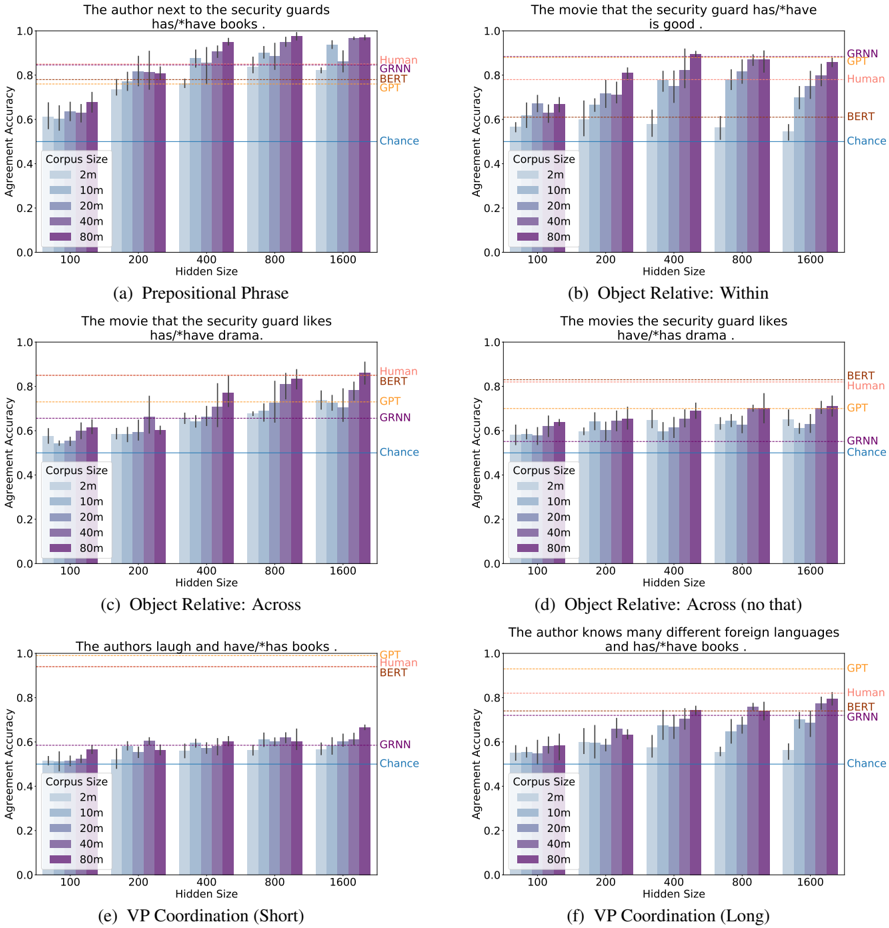
“We train 125 RNN LMs with long short-term memory (LSTM, Hochreiter and Schmidhuber, 1997) units, systematically varying the size of the training corpus and the dimensionality of the models’ hidden layer, and track the relationship between these parameters and the performance of the models on…”
Exploiting Generative AI to Scale up Intelligent Tutoring Systems
Jakubův, J., Chvalovský, K., Goertzel, Z., Kaliszyk, C., Olšák, M., Piotrowski, B., Schulz, S., Suda, M., & Urban, J. (2023) · DROPS (Schloss Dagstuhl – Leibniz Center for Informatics) · doi:10.4230/lipics.itp.2023.19 · Cited by 76,658
BERT: Pre-training of Deep Bidirectional Transformers for Language Understanding
Devlin, J., Chang, M.-W., Lee, K., & Toutanova, K. (2018) · arXiv · doi:10.48550/arxiv.1810.04805 · Cited by 73,173 · cited 3×
“Comparison with Transformers: Finally, we report results from two publicly available LMs based on non-recurrent self-attention (Transform-ers; Vaswani et al., 2017): GPT (Radford et al., 2018) and BERT (Devlin et al., 2019).”
BERT: Pre-training of Deep Bidirectional Transformers for Language Understanding
Devlin, J., Chang, M.-W., Lee, K., & Toutanova, K. (2019) · Proceedings of the 2019 Conference of the North American Chapter of the Association for Computational Linguistics: Human Language Technologies, Volume 1 (Long and Short Papers) · doi:10.18653/v1/n19-1423 · Cited by 54,325 · cited 3×
“Comparison with Transformers: Finally, we report results from two publicly available LMs based on non-recurrent self-attention (Transform-ers; Vaswani et al., 2017): GPT (Radford et al., 2018) and BERT (Devlin et al., 2019).”
Glove: Global Vectors for Word Representation
Pennington, J., Socher, R., & Manning, C. (2014) · Proceedings of the 2014 Conference on Empirical Methods in Natural Language Processing (EMNLP) · doi:10.3115/v1/d14-1162 · Cited by 34,071 · cited 2×
“The vocabulary consisted of an intersection of the 400k word GloVe vocabulary (Pennington et al., 2014) with the 50k words used by GRNN (see below); the resulting vocabulary had 28,438 words.”
Greff, K., Srivastava, R. K., Koutnik, J., Steunebrink, B. R., & Schmidhuber, J. (2017) · IEEE Transactions on Neural Networks and Learning Systems · doi:10.1109/tnnls.2016.2582924 · Cited by 6,955 · cited 2×
“The limited effect of network size is consistent with previous findings on sequence labeling tasks (Reimers and Gurevych, 2017; Greff et al., 2017).”
Recurrent neural network based language model
Mikolov, T., Karafiát, M., Burget, L., Černocký, J., & Khudanpur, S. (2010) · Interspeech 2010 · doi:10.21437/interspeech.2010-343 · Cited by 5,390 · cited 2×
“Recurrent neural network language models (LMs) can learn to predict upcoming words with remarkably low perplexity (Mikolov et al., 2010; Jozefowicz et al., 2016; Radford et al., 2019).”
Bayesian t tests for accepting and rejecting the null hypothesis
Rouder, J. N., Speckman, P. L., Sun, D., Morey, R. D., & Iverson, G. (2009) · Psychonomic Bulletin & Review · doi:10.3758/pbr.16.2.225 · Cited by 3,688 · cited 1×
“We performed statistical tests of our hypotheses using Bayes factors, which quantify the support the data provide for a more complex model compared to a simpler one (Rouder et al., 2009).”
Transformer-XL: Attentive language models beyond a fixed-length context
Dai, Z., Yang, Z., Yang, Y., Carbonell, J., Le, Q., & Salakhutdinov, R. (2019) · Proceedings of the 57th Annual Meeting of the Association for Computational Linguistics · doi:10.18653/v1/p19-1285 · Cited by 3,169 · cited 12×
“RNN LMs have been shown to favor the grammatical variant in the vast majority of cases sampled at random from a corpus (Linzen et al., 2016), but their accuracy decreases in the presence of distracting nouns intervening between the head of the subject and the verb, especially when those nouns are in relative clauses (…”
InfluentialThe Unreasonable Effectiveness of Data
Halevy, A., Norvig, P., & Pereira, F. (2009) · IEEE Intelligent Systems · doi:10.1109/mis.2009.36 · Cited by 1,767 · cited 2×
“Can we hope to address these deficits by training larger and larger networks on larger and larger corpora, relying on the “unreasonable effective-ness” of massive datasets (Halevy et al., 2009) and computational power?”
BayesFactor: Computation of Bayes Factors for Common Designs
Morey, R. D., & Rouder, J. N. (2012) · CRAN: Contributed Packages · doi:10.32614/cran.package.bayesfactor · Cited by 1,173
Exploring the Limits of Language Modeling
Józefowicz, R., Vinyals, O., Schuster, M., Shazeer, N., & Wu, Y. (2016) · arXiv (Cornell University) · doi:10.48550/arxiv.1602.02410 · Cited by 823 · cited 1×
“Recurrent neural network language models (LMs) can learn to predict upcoming words with remarkably low perplexity (Mikolov et al., 2010; Jozefowicz et al., 2016; Radford et al., 2019).”
Assessing the Ability of LSTMs to Learn Syntax-Sensitive Dependencies
Linzen, T., Dupoux, E., & Goldberg, Y. (2016) · Transactions of the Association for Computational Linguistics · doi:10.1162/tacl_a_00115 · Cited by 737 · cited 3×
“One such evaluation strategy compares the probability assigned by the LM to a minimal pair of sentences differing only in grammaticality (Linzen et al., 2016).”
InfluentialSelf-citationUsing the Output Embedding to Improve Language Models
Press, O., & Wolf, L. (2017) · Proceedings of the 15th Conference of the European Chapter of the Association for Computational Linguistics: Volume 2, Short Papers · doi:10.18653/v1/e17-2025 · Cited by 596
Colorless Green Recurrent Networks Dream Hierarchically
Gulordava, K., Bojanowski, P., Grave, E., Linzen, T., & Baroni, M. (2018) · Proceedings of the 2018 Conference of the North American Chapter of the Association for Computational Linguistics: Human Language Technologies, Volume 1 (Long Papers) · doi:10.18653/v1/n18-1108 · Cited by 465
Self-citationReimers, N., & Gurevych, I. (2017) · Proceedings of the 2017 Conference on Empirical Methods in Natural Language Processing · doi:10.18653/v1/d17-1035 · Cited by 463 · cited 1×
“The limited effect of network size is consistent with previous findings on sequence labeling tasks (Reimers and Gurevych, 2017; Greff et al., 2017).”
Assessing BERT's Syntactic Abilities
Goldberg, Y. (2019) · arXiv · doi:10.48550/arxiv.1901.05287 · Cited by 385 · cited 2×
“Both of these models have been argued to learn powerful syntactic representations (Goldberg, 2019; Wolf, 2019).”
Targeted Syntactic Evaluation of Language Models
Marvin, R., & Linzen, T. (2018) · Proceedings of the 2018 Conference on Empirical Methods in Natural Language Processing · doi:10.18653/v1/d18-1151 · Cited by 334 · cited 1×
“ality of the models’ hidden layer, and track the relationship between these parameters and the performance of the models on agreement dependencies in a range of syntactic constructions (Marvin and Linzen, 2018).”
Self-citationTying Word Vectors and Word Classifiers: A Loss Framework for Language Modeling
Inan, H., Khosravi, K., & Socher, R. (2016) · arXiv (Cornell University) · doi:10.48550/arxiv.1611.01462 · Cited by 288 · cited 1×
“Input and output weights were tied during training (Press and Wolf, 2017; Inan et al., 2017); consequently, the input embedding had the same dimensionality as the hidden layers.”
Theory of Probability (3rd Edition)
Litton, C. D. (1984) · Journal of the Operational Research Society · doi:10.1057/jors.1984.141 · Cited by 282
Cloze-driven Pretraining of Self-attention Networks
Baevski, A., Edunov, S., Liu, Y., Zettlemoyer, L., & Auli, M. (2019) · Proceedings of the 2019 Conference on Empirical Methods in Natural Language Processing and the 9th International Joint Conference on Natural Language Processing (EMNLP-IJCNLP) · doi:10.18653/v1/d19-1539 · Cited by 215 · cited 1×
“Dra-matically increasing the pre-training corpus for a BERT-like model from 562M words to 18G words only leads to a modest improvement in its natu-ral language inference accuracy, from 81.7% to 82.3% (Baevski et al., 2019).”
InfluentialCloze-driven Pretraining of Self-attention Networks
Baevski, A., Edunov, S., Liu, Y., Zettlemoyer, L., & Auli, M. (2019) · arXiv · doi:10.48550/arxiv.1903.07785 · Cited by 215 · cited 1×
“Dra-matically increasing the pre-training corpus for a BERT-like model from 562M words to 18G words only leads to a modest improvement in its natu-ral language inference accuracy, from 81.7% to 82.3% (Baevski et al., 2019).”
InfluentialLSTMs Can Learn Syntax-Sensitive Dependencies Well, But Modeling Structure Makes Them Better
Kuncoro, A., Dyer, C., Hale, J., Yogatama, D., Clark, S., & Blunsom, P. (2018) · Proceedings of the 56th Annual Meeting of the Association for Computational Linguistics (Volume 1: Long Papers) · doi:10.18653/v1/p18-1132 · Cited by 137
Learning Longer-term Dependencies in RNNs with Auxiliary Losses
Trinh, T. H., Dai, A. M., Luong, M.-T., & Le, Q. V. (2018) · arXiv (Cornell University) · doi:10.48550/arxiv.1803.00144 · Cited by 84
Trask, A., Hill, F., Reed, S., Rae, J. W., Dyer, C., & Blunsom, P. (2018) · arXiv (Cornell University) · doi:10.48550/arxiv.1808.00508 · Cited by 74 · cited 1×
“…known to struggle with generalizing short patterns to longer sequences, this pattern constitutes a failure to generalize to shorter sequences (cf. Trask et al., 2018); techniques for improving longer distance dependency learning in LMs (e.g., Trinh et al., 2018; Dai et al., 2019) are unlikely to…”
Structural Supervision Improves Learning of Non-Local Grammatical Dependencies
Wilcox, E., Qian, P., Futrell, R., Ballesteros, M., & Levy, R. (2019) · Proceedings of the 2019 Conference of the North · doi:10.18653/v1/n19-1334 · Cited by 57 · cited 2×
“Overall, this body of results points to the limited data efficiency of standard RNNs and Transformers, and indicates that learning syntax from realistic amounts of data—in particular the amount of data available to humans when they learn language—may require syntactically structured architectures or explicit syntactic…”
Theory of Probability (3rd Edition).
Litton, C. D., & Jefferys, H. (1984) · Journal of the Operational Research Society · doi:10.2307/2582798 · Cited by 50
Distinct patterns of syntactic agreement errors in recurrent networks and humans
Linzen, T., & Leonard, B. (2018) · arXiv (Cornell University) · doi:10.48550/arxiv.1807.06882 · Cited by 45 · cited 1×
“While modeling human errors is of considerable interest to cognitive scientists (Linzen and Leonard, 2018), we believe that in most applied contexts it is desirable for the model to make no errors at all.”
Self-citationScalable Syntax-Aware Language Models Using Knowledge Distillation
Kuncoro, A., Dyer, C., Rimell, L., Clark, S. R. L., & Blunsom, P. (2019) · Proceedings of the conference - Association for Computational Linguistics. Meeting · doi:10.18653/v1/p19-1337 · Cited by 36 · cited 1×
“…indicates that learning syntax from realistic amounts of data—in particular the amount of data available to humans when they learn language—may require syntactically structured architectures or explicit syntactic supervision (Enguehard et al., 2017; Kuncoro et al., 2018, 2019; Wilcox et al., 2019).”
Exploring the Syntactic Abilities of RNNs with Multi-task Learning
Enguehard, É., Goldberg, Y., & Linzen, T. (2017) · Proceedings of the 21st Conference on Computational Natural Language Learning (CoNLL 2017) · doi:10.18653/v1/k17-1003 · Cited by 24 · cited 2×
“Overall, this body of results points to the limited data efficiency of standard RNNs and Transformers, and indicates that learning syntax from realistic amounts of data—in particular the amount of data available to humans when they learn language—may require syntactically structured architectures or explicit syntactic…”
Self-citationDoes BERT agree? Evaluating knowledge of structure dependence through agreement relationsPreprint
Bacon, G., & Regier, T. (2019) · arXiv (Cornell University) · doi:10.48550/arxiv.1908.09892 · Cited by 20 · cited 1×
“BERT’s agreement accuracy decreases as the subject becomes more distant from its verb (Bacon and Regier, 2019).”
Research works printed but not linked: 3
- Kathryn Bock and Carol A. Miller. 1991. Broken agreement. Cognitive Psychology, 23(1):45-93.
- Guyon, U. V. Luxburg, S. Bengio, H. Wallach, R. Fergus, S. Vishwanathan, and R. Gar- nett, editors, Advances in Neural Information Pro- cessing Systems 30, pages 5998-6008.
- Ethan Wilcox, Peng Qian, Richard Futrell, Miguel Ballesteros, and Roger Levy. 2019. Structural su- pervision improves learning of non-local grammat- ical dependencies. In Proceedings of the 2019 An- nual Conference of the North American Chapter of the Association for Computational Linguistics. As- sociation for Computational Linguistics.
Cited by
A primer in BERTology: What we know about how BERT works
Rogers, A., Kovaleva, O., & Rumshisky, A. (2020) · Transactions of the Association for Computational Linguistics · doi:10.1162/tacl_a_00349 · Cited by 1,552
Pre-trained models: Past, present and future
Han, X., Zhang, Z., Ding, N., Gu, Y., Liu, X., Huo, Y., Qiu, J., Yao, Y., Zhang, A., Zhang, L., et al. (2021) · AI Open · doi:10.1016/j.aiopen.2021.08.002 · Cited by 994
Dissociating language and thought in large language models
Mahowald, K., Ivanova, A. A., Blank, I. A., Kanwisher, N., Tenenbaum, J. B., & Fedorenko, E. (2024) · Trends in Cognitive Sciences · doi:10.1016/j.tics.2024.01.011 · Cited by 345
“GPT-3 davinci-002 (Brown et al., 2020) The meaning of life is a mystery to us all, and a question that will never be answered.”
Bisk, Y., Holtzman, A., Thomason, J., Andreas, J., Bengio, Y., Chai, J., Lapata, M., Lazaridou, A., May, J., Nisnevich, A., et al. (2020) · Proceedings of the 2020 Conference on Empirical Methods in Natural Language Processing (EMNLP) · doi:10.18653/v1/2020.emnlp-main.703 · Cited by 274
Syntactic Structure from Deep Learning
Linzen, T., & Baroni, M. (2021) · Annual Review of Linguistics · doi:10.1146/annurev-linguistics-032020-051035 · Cited by 202
“This divergence limits the cognitive conclusions that can be drawn from testing off-the-shelf NLP systems and implies that linguists need to train their ownDNNs to assess how the volume of training data affects DNNs’ syntactic knowledge (van Schijndel et al. 2019).”
BackgroundSelf-citation
Metadata
- Authors
- van Schijndel, M., Mueller, A., & Linzen, T.
- Affiliations
- Johns Hopkins University (US)
- Venue
- Proceedings of the 2019 Conference on Empirical Methods in Natural Language Processing and the 9th International Joint Conference on Natural Language Processing (EMNLP-IJCNLP)
- Published
- 2019
- Pages
- 5830-5836
- OpenAlex
- W2971016963
- Cited by
- 65
- References
- 30
- Citations by year
- 2026: 1 · 2025: 1 · 2024: 4 · 2023: 12 · 2022: 7 · 2021: 17 · 2020: 23
- FWCI
- 4.59
- Type
- conference paper
- Language
- en
- Open access
- hybrid
- doi.org
- Licence
- cc-by
- Locations
- Conference on Empirical Methods in Natural Language Processing (EMNLP) (publishedVersion, cc-by)
- Topics
- Physical Sciences › Computer Science › Artificial Intelligence › Natural Language Processing Techniques
- Physical Sciences › Computer Science › Artificial Intelligence › Topic Modeling
- Social Sciences › Arts and Humanities › Language and Linguistics › Syntax, Semantics, Linguistic Variation
- Keywords
- neural language models, syntax, sentence length, model size
About these checks
Registry, retraction, Cites and statistics results are computed, not judged, with one exception: a printed reference that no index lists is read once by a model before it counts as a citation error. Claims are extracted by a model and kept only when their quote appears verbatim in the text; each cited source is then checked, with a model’s help, for whether it says what the claim relies on. Those verdicts can be wrong — read the claim’s quote and the cited source before relying on one.
Statistics and arithmetic are recomputed, not judged.
Confidence bands are shown only for fields calibrated on our annotated test set. None is calibrated yet, so no band is shown.
What counts as a claim ›How we measure confidence ›How we check this ›
Are you an author, or do you see a problem with this page? Request a review
Data sources
Bibliographic data: Semantic Scholar, OpenAlex, Crossref.
Contains information from the Semantic Scholar Academic Graph Datasets, made available under the ODC Attribution License (ODC-BY 1.0).
Semantic Scholar’s data is described in: Kinney, R., et al. (2023). The Semantic Scholar Open Data Platform. arXiv:2301.10140.
