

Exploiting Argument Information to Improve Event Detection via Supervised Attention Mechanisms
Open accessThe DOI matches its Crossref record; 28 of the 29 references it cites were found in a registry or an index.
Abstract
This paper tackles the task of event detection (ED), which involves identifying and categorizing events.We argue that arguments provide significant clues to this task, but they are either completely ignored or exploited in an indirect manner in existing detection approaches.In this work, we propose to exploit argument information explicitly for ED via supervised attention mechanisms.In specific, we systematically investigate the proposed model under the supervision of different attention strategies.Experimental results show that our approach advances state-ofthe-arts and achieves the best F 1 score on ACE 2005 dataset.
Overview
The claims and statistics of this paper haven’t been checked yet.
Free: it reads the open-access text and checks the first 5 claims that cite a source we can check. Create a free account to check every claim.
Integrity signals
Registry
Cites
Statistics
Figures
Verification
Claims the paper makes
The claims and statistics of this paper haven’t been checked yet.
Free: it reads the open-access text and checks the first 5 claims that cite a source we can check. Create a free account to check every claim.
Claims other papers make about this one
Each is checked against this paper’s own text: does it say what the citing paper says it does?
The cited source says what the claim attributes to it.
In the citing paper
“Supervised attention [76] aims to provide explicit supervision over the attention of models based on the fact that completely data-driven attention can overfit to some artifacts [73].”
From Pre-train, Prompt, and Predict: A Systematic Survey of Prompting Methods in Natural Language Processing (2023) · cites this paper as [76]
Self-check
Percentages, sums and reported differences re-computed from the paper’s own numbers.
The self-check needs the paper’s full text.
Citations
Cites
Efficient Estimation of Word Representations in Vector Space
Mikolov, T., Chen, K., Corrado, G., & Dean, J. (2013) · arXiv · doi:10.48550/arxiv.1301.3781 · Cited by 26,568 · cited 2×
“Speci(cid:12)cally, we use the Skip-gram model (Mikolov et al., 2013) to learn word embed-dings on the NYT corpus 3 .”
MethodConvolutional Neural Networks for Sentence Classification
Kim, Y. (2014) · Proceedings of the 2014 Conference on Empirical Methods in Natural Language Processing (EMNLP) · doi:10.3115/v1/d14-1181 · Cited by 14,831 · cited 1×
“Regularization is implemented by a dropout (Kim, 2014; Hinton et al., 2012) and L2 norm.”
BackgroundImproving neural networks by preventing co-adaptation of feature detectors
Hinton, G. E., Srivastava, N., Krizhevsky, A., Sutskever, I., & Salakhutdinov, R. R. (2012) · arXiv · doi:10.48550/arxiv.1207.0580 · Cited by 6,382 · cited 2×
“Regularization is implemented by a dropout (Kim, 2014; Hinton et al., 2012) and L2 norm.”
BackgroundADADELTA: An Adaptive Learning Rate Method
Zeiler, M. D. (2012) · arXiv · doi:10.48550/arxiv.1212.5701 · Cited by 5,322 · cited 1×
“We train the model by using a simple optimization technique called stochastic gradient descent (SGD) over shuffled mini-batches with the Adadelta rule (Zeiler, 2012).”
MethodHagan, M., Demuth, H. B., Beale, M. H., & Jes?s, O. D. (2016) · Institutional Repository of the National University Open and Distance UNAD (Universidad Nacional Abierta y a Distancia) · Cited by 5,133
A neural probabilistic language model
BengioYoshua, DucharmeRéjean, VincentPascal, & JanvinChristian (2003) · Journal of Machine Learning Research · doi:10.5555/944919.944966 · Cited by 2,644
Why Does Unsupervised Pre-training Help Deep Learning?
Erhan, D., Bengio, Y., Courville, A. C., Manzagol, P.-A., Vincent, P., & Bengio, S. (2010) · Journal of Machine Learning Research · Cited by 2,643
Baker, C. F., Fillmore, C. J., & Lowe, J. B. (1998) · Proceedings of the 36th annual meeting on Association for Computational Linguistics - · doi:10.3115/980845.980860 · Cited by 2,518 · cited 1×
“In order to further demonstrate the e(cid:11)ectiveness of our approach, we also use events from FrameNet (FN) (F. Baker et al., 1998) as extra training data, as the same as Liu et al. (2016a) to alleviate the data-sparseness problem for ED to augment the performance of the proposed approach.”
MethodEvent Extraction via Dynamic Multi-Pooling Convolutional Neural Networks
Chen, Y., Xu, L., Liu, K., Zeng, D., & Zhao, J. (2015) · Proceedings of the 53rd Annual Meeting of the Association for Computational Linguistics and the 7th International Joint Conference on Natural Language Processing (Volume 1: Long Papers) · doi:10.3115/v1/p15-1017 · Cited by 906 · cited 7×
“Representation-based methods typically represent candidate event mentions by embeddings and feed them into neural networks (Chen et al., 2015; Nguyen and Grishman, 2015; Liu et al., 2016a; Nguyen and Grishman, 2016).”
MethodInfluentialSelf-citationJoint Event Extraction via Recurrent Neural Networks
Nguyen, T. H., Cho, K., & Grishman, R. (2016) · Proceedings of the 2016 Conference of the North American Chapter of the Association for Computational Linguistics: Human Language Technologies · doi:10.18653/v1/n16-1034 · Cited by 647 · cited 6×
“…learning based methods have been proposed, which tackled event detection and argu-ment extraction simultaneously (Riedel et al., 2009; Li et al., 2013; Venugopal et al., 2014; Nguyen et al., 2016), these approaches usually only make remarkable improvements to AE, but insigni(cid:12)cant to ED.”
BackgroundMethodInfluential
Research works printed but not linked: 1
- [25]25. Sebastian Riedel, Hong-Woo Chun, Toshihisa Tak- agi, and Jun'ichi Tsujii. 2009. Proceed- ings of the bionlp 2009 workshop compan- ion volume for shared task. Association for Computational Linguistics, pages 41-49. http://aclweb.org/anthology/W09-1406.
Cited by
Liu, P., Yuan, W., Fu, J., Jiang, Z., Hayashi, H., & Neubig, G. (2023) · ACM Computing Surveys · doi:10.1145/3560815 · Cited by 4,361
“Supervised attention [76] aims to provide explicit supervision over the attention of models based on the fact that completely data-driven attention can overit to some artifacts [73].”
BackgroundA General Survey on Attention Mechanisms in Deep Learning
Brauwers, G., & Frasincar, F. (2023) · IEEE Transactions on Knowledge and Data Engineering · doi:10.1109/tkde.2021.3126456 · Cited by 695
Liu, P., Yuan, W., Fu, J., Jiang, Z., Hayashi, H., & Neubig, G. (2021) · arXiv · doi:10.48550/arxiv.2107.13586 · Cited by 4,352
“Supervised attention [76] aims to provide explicit supervision over the attention of models based on the fact that completely data-driven attention can overit to some artifacts [73].”
BackgroundJointly Multiple Events Extraction via Attention-based Graph Information Aggregation
Liu, X., Luo, Z., & Huang, H. (2018) · Proceedings of the 2018 Conference on Empirical Methods in Natural Language Processing · doi:10.18653/v1/d18-1156 · Cited by 397
“• The positional embedding vector of w i : If w c is the current word, we encode the relative distance i − c from w i to w c as a real-valued vector by looking up the randomly initialized position embedding table (Nguyen et al., 2016; Liu et al., 2017; Nguyen and Gr-ishman, 2018).”
Graph Convolutional Networks With Argument-Aware Pooling for Event Detection
Nguyen, T., & Grishman, R. (2018) · Proceedings of the AAAI Conference on Artificial Intelligence · doi:10.1609/aaai.v32i1.12039 · Cited by 383
“Syntactic dependency graphs represents sentences as directed trees with head-modifier dependency arcs between related words (Mcdonald and Pereira 2006; Koo, Carreras, and Collins 2008).”
BackgroundExploring Pre-trained Language Models for Event Extraction and Generation
Yang, S., Feng, D., Qiao, L., Kan, Z., & Li, D. (2019) · Proceedings of the 57th Annual Meeting of the Association for Computational Linguistics · doi:10.18653/v1/p19-1522 · Cited by 348
“While Liu et al. (2016, 2017) manages to mine additional events from the frames in FrameNet.”
BackgroundMethodAn Introductory Survey on Attention Mechanisms in NLP Problems
Hu, D. (2020) · Advances in Intelligent Systems and Computing · doi:10.1007/978-3-030-29513-4_31 · Cited by 247
A Survey of Event Extraction From Text
Xiang, W., & Wang, B. (2019) · IEEE Access · doi:10.1109/access.2019.2956831 · Cited by 195
“Many word-level attention mechanisms have been proposed to learn the importance of each word in a sentence, like distinguishing different argument words, word types, word relations [197]–[202].”
BackgroundYang, H., Chen, Y., Liu, K., Xiao, Y., & Zhao, J. (2018) · Proceedings of ACL 2018, System Demonstrations · doi:10.18653/v1/p18-4009 · Cited by 179
Self-citationDoc2EDAG: An End-to-End Document-level Framework for Chinese Financial Event Extraction
Zheng, S., Cao, W., Xu, W., & Bian, J. (2019) · Proceedings of the 2019 Conference on Empirical Methods in Natural Language Processing and the 9th International Joint Conference on Natural Language Processing (EMNLP-IJCNLP) · doi:10.18653/v1/d19-1032 · Cited by 184
“Although a great number of efforts (Ahn, 2006; Ji and Grishman, 2008; Liao and Grishman, 2010; Hong et al., 2011; Riedel and McCallum, 2011; Li et al., 2013, 2014; Chen et al., 2015; Yang and Mitchell, 2016; Nguyen et al., 2016; Liu et al., 2017; Sha et al., 2018; Zhang and Ji, 2018; Nguyen and Nguyen, 2019; Wang et a…”
MAVEN: A Massive General Domain Event Detection Dataset
Wang, X., Wang, Z., Han, X., Jiang, W., Han, R., Liu, Z., Li, J., Li, P., Lin, Y., & Zhou, J. (2020) · Conference on Empirical Methods in Natural Language Processing (EMNLP) · doi:10.18653/v1/2020.emnlp-main.129 · Cited by 275
Adversarial Training for Weakly Supervised Event Detection
Wang, X., Han, X., Liu, Z., Sun, M., & Li, P. (2019) · Conference of the North American Chapter of the Association for Computational Linguistics: Human Language Technologies (NAACL-HLT) · doi:10.18653/v1/n19-1105 · Cited by 185
“Some advanced architectures have also been applied, such as attention mechanism (Liu et al., 2017, 2018a), graph convolutional networks (Nguyen and Grishman, 2018) and generative adversarial networks (Hong et al., 2018).”
BackgroundMethodA language-independent neural network for event detection
Feng, X., Qin, B., & Liu, T. (2018) · Science China Information Sciences · doi:10.1007/s11432-017-9359-x · Cited by 152
Event Detection via Gated Multilingual Attention Mechanism
Liu, J., Chen, Y., Liu, K., & Zhao, J. (2018) · Proceedings of the AAAI Conference on Artificial Intelligence · doi:10.1609/aaai.v32i1.11919 · Cited by 132
“While for external resource based methods, they usually need to transfer external data to fit the current event schemas by some heuristic rules (Chen et al. 2017; Liu et al. 2017).”
BackgroundMethodInfluentialSelf-citationOne for All: Neural Joint Modeling of Entities and Events
Nguyen, T. M., & Nguyen, T. H. (2019) · Proceedings of the AAAI Conference on Artificial Intelligence · doi:10.1609/aaai.v33i01.33016851 · Cited by 154
Meta-Learning with Dynamic-Memory-Based Prototypical Network for Few-Shot Event Detection
Deng, S., Zhang, N., Kang, J., Zhang, Y., Zhang, W., & Chen, H. (2020) · ACM International Conference on Web Search and Data Mining (WSDM) · doi:10.1145/3336191.3371796 · Cited by 167
“Few-shot ED tasks with sparse labeled instances make it vital to make full use of available data, especially contextual information which has been shown effective on ED tasks [19, 24].”
BackgroundDocument Embedding Enhanced Event Detection with Hierarchical and Supervised Attention
Zhao, Y., Jin, X., Wang, Y., & Cheng, X. (2018) · Proceedings of the conference - Association for Computational Linguistics. Meeting · doi:10.18653/v1/p18-2066 · Cited by 117
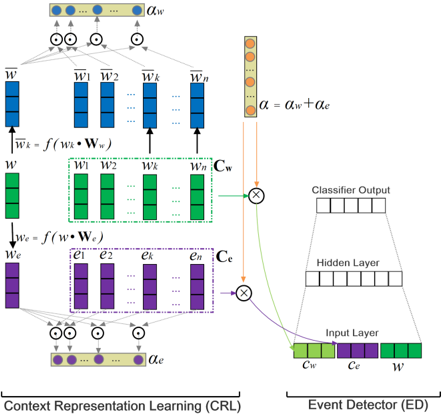
“ANN-S2 is a representation-based model developed in (Liu et al., 2017), which explicitly exploits argument information for event detection via supervised attention mechanisms.”
BackgroundEdge-Enhanced Graph Convolution Networks for Event Detection with Syntactic Relation
Cui, S., Yu, B., Liu, T., Zhang, Z., Wang, X., & Shi, J. (2020) · Findings of the Association for Computational Linguistics: EMNLP (Findings of EMNLP) · doi:10.18653/v1/2020.findings-emnlp.211 · Cited by 151
“Compared with the baseline RGCN which also exploit-Model (Li et al., 2013) 74.5 59.1 65.9 CrossEntity (Hong et al., 2011) 72.9 64.3 68.3 DMCNN (Chen et al., 2015) 75.6 63.6 69.1 JRNN (Nguyen et al., 2016) 66.0 73.0 69.3 ANN-AugAtt (Liu et al., 2017) 78.0 66.3 71.7 dbRNN † (Sha et al., 2018) 74.1 69.8 71.9 HBTNGMA (Che…”
BackgroundMethodInfluentialChen, Y., Yang, H., Liu, K., Zhao, J., & Jia, Y. (2018) · Conference on Empirical Methods in Natural Language Processing (EMNLP) · doi:10.18653/v1/d18-1158 · Cited by 113
“…2010; Hong et al., 2011; Huang and Riloff, 2012), and neural-based methods which use neural networks to automatically capture clues from plain texts (Chen et al., 2015; Nguyen and Grishman, 2015; Feng et al., 2016; Nguyen and Grishman, 2016; Chen et al., 2017; Duan et al., 2017; Liu et al., 2017).”
MethodInfluentialSelf-citationImproving Event Detection via Open-domain Trigger Knowledge
Tong, M., Xu, B., Wang, S., Cao, Y., Hou, L., Li, J., & Xie, J. (2020) · Proceedings of the conference - Association for Computational Linguistics. Meeting · doi:10.18653/v1/2020.acl-main.522 · Cited by 129
“Our base-line ANN-S2 (Liu et al., 2017) designs a supervised attention to leverage the event argument knowledge.”
BackgroundMethodA Survey of Information Extraction Based on Deep Learning
Yang, Y., Wu, Z., Yang, Y., Lian, S., Guo, F., & Wang, Z. (2022) · Applied Sciences · doi:10.3390/app12199691 · Cited by 176
Document-Level Event Role Filler Extraction using Multi-Granularity Contextualized Encoding
Du, X., & Cardie, C. (2020) · Proceedings of the conference - Association for Computational Linguistics. Meeting · doi:10.18653/v1/2020.acl-main.714 · Cited by 132
Progressive Self-Supervised Attention Learning for Aspect-Level Sentiment Analysis
Tang, J., Lu, Z., Su, J., Ge, Y., Song, L., Sun, L., & Luo, J. (2019) · Proceedings of the conference - Association for Computational Linguistics. Meeting · doi:10.18653/v1/p19-1053 · Cited by 114
“Different from these work, our work is in line with the studies of introducing attention supervision to refine the attention mechanism, which have become hot research topics in several NNbased NLP tasks, such as event detection (Liu et al., 2017), machine translation (Liu et al.”
BackgroundResultA Survey on Deep Learning Event Extraction: Approaches and Applications
Li, Q., Li, J., Sheng, J., Cui, S., Wu, J. X., Hei, Y., Peng, H. M., Guo, S., Wang, L., Beheshti, A., et al. (2022) · IEEE Transactions on Neural Networks and Learning Systems · doi:10.1109/tnnls.2022.3213168 · Cited by 174
“[97] supervised classification ACL ACE X - -”
MethodDeriving Machine Attention from Human Rationales
Bao, Y., Chang, S., Yu, M., & Barzilay, R. (2018) · Conference on Empirical Methods in Natural Language Processing (EMNLP) · doi:10.18653/v1/d18-1216 · Cited by 140
“…using word alignments to learn attention in neural machine translation (Liu et al., 2016), employing argu-ment words to supervise attention in event detection (Liu et al., 2017), utilizing linguistically-motivated annotations to guide attention in constituency parsing (Kamigaito et al., 2017).”
MethodLai, V. D., Nguyen, T. N., & Nguyen, T. H. (2020) · Conference on Empirical Methods in Natural Language Processing (EMNLP) · doi:10.18653/v1/2020.emnlp-main.435 · Cited by 91
Frisoni, G., Moro, G., & Carbonaro, A. (2021) · IEEE Access · doi:10.1109/access.2021.3130956 · Cited by 84
“[153] argued that argument words should be more”
BackgroundMethodSelf-regulation: Employing a Generative Adversarial Network to Improve Event Detection
Hong, Y., Zhou, W., Zhang, J., Zhou, G., & Zhu, Q. (2018) · Proceedings of the conference - Association for Computational Linguistics. Meeting · doi:10.18653/v1/p18-1048 · Cited by 73
“RNN with long short-term memory (abbr., LSTM) is adopted due to the superior performance in a variety of NLP tasks (Liu et al., 2016a; Lin et al., 2017; Liu et al., 2017a).”
BackgroundMethodInfluentialTrigger is Not Sufficient: Exploiting Frame-aware Knowledge for Implicit Event Argument Extraction
Wei, K., Sun, X., Zhang, Z., Zhang, J., Guo, Z. M., & Jin, L. (2021) · doi:10.18653/v1/2021.acl-long.360 · Cited by 121
“Liu et al. (2017) model event arguments as supervising attention information to promote trigger extraction.”
BackgroundLiu, J., Chen, Y., & Liu, K. (2019) · Proceedings of the AAAI Conference on Artificial Intelligence · doi:10.1609/aaai.v33i01.33016754 · Cited by 79
“Previous studies have shown that the chunk knowledge corresponding to the sentences can provide evidence for event type disambiguation (Hong et al. 2011; Li, Ji, and Huang 2013; Feng et al. 2016; Liu et al. 2017).”
BackgroundMethodInfluentialSelf-citationGRIT: Generative Role-filler Transformers for Document-level Event Entity Extraction
Du, X., Rush, A. M., & Cardie, C. (2021) · Conference of the European Chapter of the Association for Computational Linguistics · doi:10.18653/v1/2021.eacl-main.52 · Cited by 122
“More recently, neural network based models such as recurrent neural networks (Nguyen et al., 2016; Feng et al., 2018), convolutional neural networks (Nguyen and Grish-man, 2015; Chen et al., 2015) and attention mechanisms (Liu et al., 2017, 2018) have also been shown to help improve performance.”
BackgroundSims, M., Park, J. H., & Bamman, D. (2019) · Proceedings of the 57th Annual Meeting of the Association for Computational Linguistics · doi:10.18653/v1/p19-1353 · Cited by 23
“…2015) and skip-gram CNNs (Nguyen and Grishman, 2018), RNNs (Nguyen et al., 2016), hybrid LSTM-CNN architectures (Feng et al., 2016), and attention (Liu et al., 2017, 2018) While most approaches use sentence-level information to detect events, we also draw on the work of Liao and Grishman (2010),…”
Enhanced aspect-based sentiment analysis models with progressive self-supervised attention learning
Su, J., Tang, J., Jiang, H., Lu, Z., Ge, Y., Song, L., Xiong, D., Sun, L., & Luo, J. (2021) · Artificial Intelligence · doi:10.1016/j.artint.2021.103477 · Cited by 70
Extensively Matching for Few-shot Learning Event Detection
Lai, V. D., Nguyen, T. H., & Dernoncourt, F. (2020) · doi:10.18653/v1/2020.nuse-1.5 · Cited by 74
Human Attention Maps for Text Classification: Do Humans and Neural Networks Focus on the Same Words?
Şen, C., Hartvigsen, T., Yin, B., Kong, X., & Rundensteiner, E. A. (2020) · Proceedings of the conference - Association for Computational Linguistics. Meeting · doi:10.18653/v1/2020.acl-main.419 · Cited by 74
“However, initial research offers compelling evidence for the success of supervised attention models (Chen et al., 2017; Liu et al., 2017b) in the computer vision area.”
BackgroundMLBiNet: A Cross-Sentence Collective Event Detection Network
Lou, D., Liao, Z., Deng, S., Zhang, N., & Chen, H. (2021) · doi:10.18653/v1/2021.acl-long.373 · Cited by 67
“The existing methods (Chen et al., 2015; Nguyen and Grishman, 2015; Liu et al., 2017; Nguyen and Grishman, 2018; Deng et al., 2020; Tong et al., 2020; Lai et al., 2020; Liu et al., 2020; Li et al., 2020; Cui et al., 2020; Deng et al., 2021; Shen et al., 2021) mainly focus on sentence-level event…”
MethodExploiting Document Level Information to Improve Event Detection via Recurrent Neural Networks
Duan, S., He, R., & Zhao, W. (2017) · International Joint Conference on Natural Language Processing · Cited by 54
Biomedical Event Extraction based on Knowledge-driven Tree-LSTM
Li, D., Huang, L., Ji, H., & Han, J. (2019) · Conference of the North American Chapter of the Association for Computational Linguistics: Human Language Technologies (NAACL-HLT) · doi:10.18653/v1/n19-1145 · Cited by 100
“Liu et al. (2017) takes advantage of external resources, such as FrameNet, to label events while Chen et al. (2017) adopts distance supervision to augment the training data.”
BackgroundMVGAN: Multi-View Graph Attention Network for Social Event Detection
Cui, W., Du, J., Wang, D., Kou, F., & Xue, Z. (2021) · ACM Transactions on Intelligent Systems and Technology · doi:10.1145/3447270 · Cited by 58
Event Detection without Triggers
Liu, S., Li, Y., Zhang, F., Yang, T., & Zhou, X. (2019) · Conference of the North American Chapter of the Association for Computational Linguistics: Human Language Technologies (NAACL-HLT) · doi:10.18653/v1/n19-1080 · Cited by 52
“Following previous work (Liao and Grishman, 2010; Li et al., 2013; Chen et al., 2015; Liu et al., 2017), we use precision (P), recall (R) and F1measure (F1) to evaluate the results.”
MethodInfluentialSelf-citationA novel joint biomedical event extraction framework via two-level modeling of documents
Zhao, W., Zhang, J., Yang, J., He, T., Ma, H., & Li, Z. (2020) · Information Sciences · doi:10.1016/j.ins.2020.10.047 · Cited by 60
Region Reinforcement Network With Topic Constraint for Image-Text Matching
Wu, J., Wu, C., Lu, J. J., Wang, L., & Cui, X. (2021) · IEEE Transactions on Circuits and Systems for Video Technology · doi:10.1109/tcsvt.2021.3060713 · Cited by 48
Lu, Y., Lin, H., Han, X., & Sun, L. (2019) · Proceedings of the conference - Association for Computational Linguistics. Meeting · doi:10.18653/v1/p19-1429 · Cited by 57
“External Resource based Approaches aim to enhance event detection with external resources, including: SA-ANN-Arg (Liu et al., 2017) which injects event arguments information via supervised attention mechanism; GCN-ED (Nguyen and Grishman, 2018) which exploits syntactic information to capture more…”
BackgroundMethodInfluentialIncremental Event Detection via Knowledge Consolidation Networks
Cao, P., Chen, Y., Zhao, J., & Wang, T. (2020) · Conference on Empirical Methods in Natural Language Processing (EMNLP) · doi:10.18653/v1/2020.emnlp-main.52 · Cited by 64
“The proposed models can be divided into feature-based methods (Ahn, 2006; Ji and Grishman, 2008; Liao and Grishman, 2010; Li et al., 2013; Li and Ji, 2014) and neural network-based methods (Chen et al., 2015; Nguyen and Grishman, 2015; Liu et al., 2017, 2018a,b; Lu et al., 2019; Ding et al., 2019).”
MethodSelf-citationEnhancing Document-level Event Argument Extraction with Contextual Clues and Role Relevance
Liu, W., Cheng, S., Zeng, D., & Qu, H. (2023) · Findings of the Association for Computational Linguistics: ACL (Findings of ACL) · doi:10.18653/v1/2023.findings-acl.817 · Cited by 78
“, 2015) firstly propose a neural pipeline model for event extraction and (Nguyen et al., 2016; Nguyen and Grishman, 2015; Liu et al., 2017; Zhou et al., 2020) further extend the pipeline model to recurrent neural networks and convolutional neural networks.”
BackgroundUnleash GPT-2 Power for Event Detection
Veyseh, A. P. B., Lai, V. D., Dernoncourt, F., & Nguyen, T. H. (2021) · doi:10.18653/v1/2021.acl-long.490 · Cited by 73
“…P R F1 CNN (Nguyen and Grishman, 2015) 71.8 66.4 69.0 DMCNN (Chen et al., 2015) 75.6 63.6 69.1 DLRNN (Duan et al., 2017) 77.2 64.9 70.5 ANN-S2 (Liu et al., 2017) 78.0 66.3 71.7 GMLATT (Liu et al., 2018) 78.9 66.9 72.4 GCN-ED (Nguyen and Grishman, 2018) 77.9 68.8 73.1 Lu’s DISTILL (Lu et al.,…”
InfluentialGraph Transformer Networks with Syntactic and Semantic Structures for Event Argument Extraction
Veyseh, A. P. B., Nguyen, T. N., & Nguyen, T. H. (2020) · Findings of the Association for Computational Linguistics: EMNLP (Findings of EMNLP) · doi:10.18653/v1/2020.findings-emnlp.326 · Cited by 62
Joint event extraction along shortest dependency paths using graph convolutional networks
Balali, A., Asadpour, M., Campos, R., & Jatowt, A. (2020) · Knowledge-Based Systems · doi:10.1016/j.knosys.2020.106492 · Cited by 51
Event Detection with Neural Networks: A Rigorous Empirical Evaluation
Orr, W., Tadepalli, P. V., & Fern, X. Z. (2018) · Conference on Empirical Methods in Natural Language Processing (EMNLP) · doi:10.18653/v1/d18-1122 · Cited by 45
“Based on the intuition that entity and argument information is important for event detection, Liu et al. (2017) built an attention model over annotated arguments and the context surrounding event trigger candidates.”
BackgroundExploiting the Matching Information in the Support Set for Few Shot Event Classification
Lai, V. D., Dernoncourt, F., & Nguyen, T. H. (2020) · Lecture notes in computer science · doi:10.1007/978-3-030-47436-2_18 · Cited by 47
“ng linguistic features [1,9,12] for statistical models. Due to the development of deep learning, many advanced network architectures have been investigated to advance the event classification accuracy [5,19,17,18,21,13,22]. However, none of them investigates the few-shot learningproblem forEC aswedo in this work.Althou…”
BackgroundFine-grained Sentiment Analysis with Faithful AttentionPreprint
Zhong, R., Shao, S., & McKeown, K. R. (2019) · arXiv (Cornell University) · doi:10.48550/arxiv.1908.06870 · Cited by 64
“For instance, Mi et al. (2016) used word alignment to guide machine translation and Liu et al. (2017) used argument keywords to improve event detection.”
MethodIntroducing a New Dataset for Event Detection in Cybersecurity Texts
Trong, H. M. D., Le, D. T., Veyseh, A. P. B., Nguyen, T., & Nguyen, T. H. (2020) · Conference on Empirical Methods in Natural Language Processing (EMNLP) · doi:10.18653/v1/2020.emnlp-main.433 · Cited by 38
“…(Liao and Grishman, 2010; Li et al., 2013; Nguyen and Grishman, 2015, 2016e; Chen et al., 2015; Nguyen et al., 2016g; Lu and Nguyen, 2018; Liu et al., 2016b, 2017; Chen et al., 2017; Hong et al., 2018; Lai et al., 2020b), partly due to the availability of the large evaluation datasets…”
BackgroundLiu, K., Chen, Y., Liu, J., Zuo, X., & Zhao, J. (2020) · AI Open · doi:10.1016/j.aiopen.2021.02.004 · Cited by 54
Self-citationExploiting Contextual Information via Dynamic Memory Network for Event Detection
Liu, S., Cheng, R., Yu, X., & Cheng, X. (2018) · Conference on Empirical Methods in Natural Language Processing (EMNLP) · doi:10.18653/v1/d18-1127 · Cited by 38
“Exisiting methods (Liu et al., 2017; Chen et al., 2015; Li et al., 2013; Nguyen et al., 2016; Venugopal et al., 2014) mainly exploited sentence-level features and (Liao and Grishman, 2010; Zhao et al., 2018) proposed document-level models to utilize the context.”
MethodSelf-citationExploring Sentence Community for Document-Level Event Extraction
Huang, Y., & Weijia Jia, B. (2021) · Findings of the Association for Computational Linguistics: EMNLP (Findings of EMNLP) · doi:10.18653/v1/2021.findings-emnlp.32 · Cited by 32
“This task can be further decomposed into two sub-tasks: Event Detection that aims to identify the event triggers (Feng et al., 2016; Liu et al., 2017; Zhao et al., 2018; Yan et al., 2019; Cui et al., 2020; Lai et al., 2020a,b) and Event Argument Role Labeling that aims to predict whether words or…”
MethodLu, W., & Nguyen, T. H. (2018) · Conference on Empirical Methods in Natural Language Processing (EMNLP) · doi:10.18653/v1/d18-1517 · Cited by 38
“It is important to note that, different from the prior works (Nguyen and Grishman, 2015b; Liu et al., 2017), we do not include the entity type label of each token into its representation.”
InfluentialEnhanced Language Representation with Label Knowledge for Span Extraction
Yang, P., Cong, X., Sun, Z., & Liu, X. (2021) · Conference on Empirical Methods in Natural Language Processing (EMNLP) · doi:10.18653/v1/2021.emnlp-main.379 · Cited by 36
“…epoch; 2) English ACE2005 for ED (Flat) Model P R F1 DMCNN (Chen et al., 2015) 75.6 63.6 69.1 JRNN (Nguyen et al., 2016) 66.0 73.0 69.3 ANN-AugAtt (Liu et al., 2017) 78.0 66.3 71.7 JMEE (Liu et al., 2018b) 76.3 71.3 73.7 EE-GCN (Cui et al., 2020) 76.7 78.6 77.6 BERT_QA_Trigger† (Du and Cardie,…”
MethodInfluentialKnowledge as A Bridge: Improving Cross-domain Answer Selection with External Knowledge
Deng, Y., Shen, Y., Yang, M., Li, Y., Du, N., Fan, W., & Lei, K. (2018) · Singapore Management University Institutional Knowledge (InK) (Singapore Management University) · Cited by 35
Lifelong Event Detection with Knowledge Transfer
Yu, P., Ji, H., & Natarajan, P. (2021) · Conference on Empirical Methods in Natural Language Processing (EMNLP) · doi:10.18653/v1/2021.emnlp-main.428 · Cited by 45
“Event detection under the traditional setting has been widely studied (Ji and Grishman, 2008; Chen et al., 2015; Feng et al., 2016; Liu et al., 2017, 2018, 2019; Lu et al., 2019; Ding et al., 2019; Yan et al., 2019; Tong et al., 2020).”
MethodEmpower event detection with bi-directional neural language model
Zhang, Y., Xu, G., Wang, Y., Liang, X., Wang, L., & Huang, T. (2019) · Knowledge-Based Systems · doi:10.1016/j.knosys.2019.01.008 · Cited by 25
Who is Killed by Police: Introducing Supervised Attention for Hierarchical LSTMsPreprint
Nguyen, M., & Nguyen, T. H. (2018) · arXiv (Cornell University) · doi:10.48550/arxiv.1807.03409 · Cited by 26
Self-Attention Graph Residual Convolutional Networks for Event Detection with dependency relations
Liu, A.-A., Xu, N., & Liu, H. (2021) · Findings of the Association for Computational Linguistics: EMNLP (Findings of EMNLP) · doi:10.18653/v1/2021.findings-emnlp.28 · Cited by 27
“mation (Liu et al., 2017) , document information (Duan et al.”
BackgroundMethodDAFS: a domain aware few shot generative model for event detection
Xia, N., Yu, H., Wang, Y., Xuan, J., & Luo, X. (2022) · Machine Learning · doi:10.1007/s10994-022-06198-5 · Cited by 24
“While (Liu et al., 2017) manages to mine additional events from the frames in FrameNet.”
BackgroundA Deep Learning Model with Hierarchical LSTMs and Supervised Attention for Anti-PhishingPreprint
Nguyen, L.-M., Nguyen, T. Q., & Nguyen, T. H. (2018) · arXiv (Cornell University) · doi:10.48550/arxiv.1805.01554 · Cited by 41
“supervise the attention mechanism [24, 21, 22] at the word level of the hierarchical LSTMs based on the appearance rank of the words in the vocabulary.”
BackgroundGraph Learning Regularization and Transfer Learning for Few-Shot Event Detection
Lai, V. D., Nguyen, M., Nguyen, T. H., & Dernoncourt, F. (2021) · International ACM SIGIR Conference on Research and Development in Information Retrieval (SIGIR) · doi:10.1145/3404835.3463054 · Cited by 23
“useful information to identify the event trigger [25].”
BackgroundHoney or Poison? Solving the Trigger Curse in Few-shot Event Detection via Causal Intervention
Chen, J., Lin, H., Han, X., & Sun, L. (2021) · Conference on Empirical Methods in Natural Language Processing (EMNLP) · doi:10.18653/v1/2021.emnlp-main.637 · Cited by 36
“tion models, especially in few-shot scenario (Bronstein et al., 2015; Liu et al., 2017; Chen et al., 2018; Liu et al., 2019; Ji et al., 2019).”
BackgroundMethodExtending Event Detection to New Types with Learning from Keywords
Lai, V. D., & Nguyen, T. H. (2019) · Workshop on Noisy User-generated Text (W-NUT) · doi:10.18653/v1/d19-5532 · Cited by 21
“, 2018), and the attention mechanism (Liu et al., 2017; Nguyen and Nguyen, 2018b; Liu et al., 2018).”
InfluentialAn event knowledge graph system for the operation and maintenance of power equipment
Tian, J., Song, H., Sheng, G., & Jiang, X. (2022) · IET Generation Transmission & Distribution · doi:10.1049/gtd2.12598 · Cited by 23
Cost-sensitive Regularization for Label Confusion-aware Event Detection
Lin, H., Lu, Y., Han, X., & Sun, L. (2019) · Proceedings of the conference - Association for Computational Linguistics. Meeting · doi:10.18653/v1/p19-1521 · Cited by 18
“Furthermore, the majority of remaining errors are between sibling sub-types of the same coarse type because of their semantic relatedness (Liu et al., 2017b).”
BackgroundTaxonomy-aware Learning for Few-Shot Event Detection
Zheng, J., Cai, F., Chen, W., Lei, W., & Chen, H. (2021) · International World Wide Web Conference (WWW) · doi:10.1145/3442381.3449949 · Cited by 19
“, convolutional neural networks [6, 34, 35], recurrent neural networks [16, 33], graph neural networks [26, 36], attention-based networks [23, 25], et al.”
BackgroundKnowledge Graph Enhanced Event Extraction in Financial Documents
Guo, K., Jiang, T., & Zhang, H. (2020) · IEEE International Conference on Big Data (BigData) · doi:10.1109/bigdata50022.2020.9378471 · Cited by 19
“Knowledge bases, such as the FrameNet lexical database, are utilized to label events [1].”
HGEED: Hierarchical graph enhanced event detection
Lv, J., Zhang, Z., Jin, L., Li, S., Li, X., Xu, G., & Sun, X. (2021) · Neurocomputing · doi:10.1016/j.neucom.2021.04.087 · Cited by 17
A Hybrid Character Representation for Chinese Event Detection
Xi, X., Tong, Z., Ye, W., Zhang, J., Xie, R., & Shikun, Z. (2019) · International Joint Conference on Neural Networks (IJCNN) · doi:10.1109/ijcnn.2019.8851786 · Cited by 19
Liu, J., Chen, Y., Liu, K., Jia, Y., & Sheng, Z. (2020) · Findings of the Association for Computational Linguistics: EMNLP (Findings of EMNLP) · doi:10.18653/v1/2020.findings-emnlp.229 · Cited by 21
“More recent works have designed advanced architectures for the task (Liu et al., 2017, 2018a; Lu et al., 2019; Liu et al., 2019a).”
MethodSelf-citationDo Context-Aware Translation Models Pay the Right Attention?
Yin, K., Fernandes, P., Pruthi, D., Chaudhary, A., Martins, A. F. T., & Neubig, G. (2021) · doi:10.18653/v1/2021.acl-long.65 · Cited by 38
“, 2016), event arguments and trigger words (Liu et al., 2017; Zhao et al., 2018), syntactic dependencies (Strubell”
BackgroundAugPrompt: Knowledgeable augmented-trigger prompt for few-shot event classification
Song, C., Cai, F., Zheng, J., Zhao, X. H., & Shao, T. (2022) · Information Processing & Management · doi:10.1016/j.ipm.2022.103153 · Cited by 19
Zhang, R., Wei, W., Mao, X.-L., Fang, R., & Chen, D. (2022) · Findings of the Association for Computational Linguistics: EMNLP (Findings of EMNLP) · doi:10.18653/v1/2022.findings-emnlp.130 · Cited by 22
Event detection from text using path-aware graph convolutional network
Lu, S., Li, S., Xu, Y., Wang, K., Lan, H., & Guo, J. H. (2021) · Applied Intelligence · doi:10.1007/s10489-021-02695-7 · Cited by 16
“We evaluate proposed method using the ACE 2005 English dataset, in the setting with golden (perfect) annotation for entity mentions as previous works [8, 20, 38].”
MethodTaxonPrompt: Taxonomy-aware curriculum prompt learning for few-shot event classification
Song, C., Cai, F., Wang, M., Zheng, J., & Shao, T. (2023) · Knowledge-Based Systems · doi:10.1016/j.knosys.2023.110290 · Cited by 18
MsPrompt: Multi-step prompt learning for debiasing few-shot event detection
Wang, S., Zheng, J., Cai, F., Song, C., & Luo, X. (2023) · Information Processing & Management · doi:10.1016/j.ipm.2023.103509 · Cited by 15
A Survey on Event Tracking in Social Media Data Streams
Han, Z., Shi, L., Liu, L., Jiang, L., Fang, J., Lin, F., Zhang, J., Panneerselvam, J., & Antonopoulos, N. (2023) · Big Data Mining and Analytics · doi:10.26599/bdma.2023.9020021 · Cited by 18
Graph Convolution Over Multiple Latent Context-Aware Graph Structures for Event Detection
Li, L., Jin, L., Zhang, Z., Liu, Q., Sun, X., & Wang, H. (2020) · IEEE Access · doi:10.1109/access.2020.3024872 · Cited by 15
“ATT+FrameNet [34], the attention-based model augmented with annotated data in FrameNet.”
MethodImplicit Event Argument Extraction With Argument-Argument Relational Knowledge
Wei, K., Sun, X., Zhang, Z., Jin, L., Zhang, J., Jianwei, L. V., & Guo, Z. M. (2022) · IEEE Transactions on Knowledge and Data Engineering · doi:10.1109/tkde.2022.3218830 · Cited by 26
“[21] models event arguments as super-vising attention information to promote trigger extraction.”
BackgroundA Chinese Event Relation Extraction Model Based on BERT
Tian, C., Zhao, Y., & Ren, L. (2019) · International Conference on Artificial Intelligence and Big Data (ICAIBD) · doi:10.1109/icaibd.2019.8837002 · Cited by 20
“Some works are only need to identify whether an event in a sentence which named event detection [13].”
BackgroundA Neural Network based Event Extraction System for Indian Languages.
Kuila, A., Bussa, S. C., & Sarkar, S. (2018) · FIRE (Working Notes) · Cited by 14
Event detection with multi-order edge-aware graph convolution networks
Wang, J., Wang, K., Yao, Y., & Zhao, H. (2022) · Data & Knowledge Engineering · doi:10.1016/j.datak.2022.102109 · Cited by 13
Li, L., & Liu, Y. (2017) · IEEE International Conference on Bioinformatics and Biomedicine (BIBM) · doi:10.1109/bibm.2017.8217711 · Cited by 14
Extracting Rich Semantic Information about Cybersecurity Events
Satyapanich, T., Finin, T., & Ferraro, F. (2019) · IEEE International Conference on Big Data (BigData) · doi:10.1109/bigdata47090.2019.9006444 · Cited by 15
“Many approaches have been used for this task, such as the features based models in state-of-the-art systems like [5], [9], [10], novel methods such as modified Convolu-tional Neural Networks [2], [22]–[24] and applied attention mechanism [14], [15], [25].”
MethodLearning to Select Important Context Words for Event Detection
Ngo, N. T., Nguyen, T. N., & Nguyen, T. H. (2020) · Lecture notes in computer science · doi:10.1007/978-3-030-47436-2_57 · Cited by 13
“This is in contrast to all the previous models for ED where all the words in the sentences are included in the prediction representation via the weighting schema [9, 16] (i.e., soft attention), potentially preserving the noise in the irrelevant words and degrading the ED performance.”
BackgroundMethodResultInfluentialDocument-level Event-based Extraction Using Generative Template-filling Transformers.Preprint
Du, X., Rush, A. M., & Cardie, C. (2020) · arXiv (Cornell University) · Cited by 12
Kan, Z., Qiao, L., Yang, S., Liu, F., & Huang, F. (2020) · IEEE Access · doi:10.1109/access.2020.3004378 · Cited by 13
“And the third ones are Attention Mechanism (AM) based neural works [21], [22], which could be simply formulated as yt = f (xt ,A,B), where A,B are an external matrix to obtain attention.”
BackgroundA biomedical event extraction method based on fine-grained and attention mechanism
He, X., Tai, P., Lu, H., Huang, X., & Ren, Y. (2022) · BMC Bioinformatics · doi:10.1186/s12859-022-04854-0 · Cited by 12
“[31] pointed out that data sparsity is an important factor affecting the performance of event extraction.”
BackgroundUtilizing structured knowledge bases in open IE based event template extraction
Romadhony, A., Widyantoro, D. H., & Purwarianti, A. (2018) · Applied Intelligence · doi:10.1007/s10489-018-1269-0 · Cited by 12
“A similar approach to biomedical event trigger identification was also performed by Li and Liu, and the experimental results show an improvement on F1 [27].”
MethodResultLearning Target-Dependent Sentence Representations for Chinese Event Detection
Zhang, W., Ding, X., & Liu, T. (2018) · Lecture notes in computer science · doi:10.1007/978-3-030-01012-6_20 · Cited by 12
Interactive learning for joint event and relation extraction
Zhang, J., Hong, Y., Zhou, W., Yao, J., & Zhang, M. (2019) · International Journal of Machine Learning and Cybernetics · doi:10.1007/s13042-019-00985-8 · Cited by 12
“• GMLATT [17] takes advantage of the multilingual information and attention mechanism for the event detection.”
BackgroundInfluentialGong, H., Valido, A., Ingram, K. M., Fanti, G. C., Bhat, S., & Espelage, D. L. (2021) · Proceedings of the AAAI Conference on Artificial Intelligence · doi:10.1609/aaai.v35i17.17738 · Cited by 20
Few-Shot Semantic Parsing for New Predicates
Li, Z., Qu, L., Huang, S., & Haffari, G. (2021) · Conference of the European Chapter of the Association for Computational Linguistics · doi:10.18653/v1/2021.eacl-main.109 · Cited by 13
ESA: Entity Summarization with AttentionPreprint
Wei, D., Liu, Y., Zhu, F., Zang, L., Zhou, W., Han, J., & Hu, S. (2019) · arXiv (Cornell University) · doi:10.48550/arxiv.1905.10625 · Cited by 14
“How to employ AM to calculate machine attention vectors, which have low error with the gold attention vectors in Task 1 [22].”
MethodImproving document-level event detection with event relation graph
Zhou, J., Shuang, K., An, Z., Guo, J., & Loo, J. (2023) · Information Sciences · doi:10.1016/j.ins.2023.119355 · Cited by 11
Multi-view inter-modality representation with progressive fusion for image-text matching
Wu, J., Wang, L., Chen, C., Lu, J., & Wu, C. (2023) · Neurocomputing · doi:10.1016/j.neucom.2023.02.043 · Cited by 11
Metadata
- Authors
- Liu, S., Chen, Y., Liu, K., & Zhao, J.
- Affiliations
- Chinese Academy of Sciences (CN)
- Venue
- Proceedings of the 55th Annual Meeting of the Association for Computational Linguistics (Volume 1: Long Papers)
- Published
- 2017
- Pages
- 1789-1798
- ISSN
- 0736-587X (ISSN-L)
- OpenAlex
- W2739918945
- Cited by
- 250
- References
- 29
- Citations by year
- 2026: 2 · 2025: 10 · 2024: 15 · 2023: 33 · 2022: 37 · 2021: 55 · 2020: 36 · 2019: 34 · 2018: 25 · 2017: 3
- FWCI
- 12.22
- Type
- conference paper
- Language
- en
- Open access
- hybrid
- doi.org
- Licence
- cc-by
- Locations
- Proceedings of the conference - Association for Computational Linguistics. Meeting (publishedVersion, cc-by)
- Funders
- National Natural Science Foundation of China (61533018)
- National Key Research and Development Program of China (2014CB340503)
- Topics
- Physical Sciences › Computer Science › Artificial Intelligence › Topic Modeling
- Physical Sciences › Computer Science › Artificial Intelligence › Natural Language Processing Techniques
- Physical Sciences › Computer Science › Artificial Intelligence › Sentiment Analysis and Opinion Mining
- Keywords
- event detection, argument mining, event argument extraction, attentional strategies
About these checks
Registry, retraction, Cites and statistics results are computed, not judged, with one exception: a printed reference that no index lists is read once by a model before it counts as a citation error. Claims are extracted by a model and kept only when their quote appears verbatim in the text; each cited source is then checked, with a model’s help, for whether it says what the claim relies on. Those verdicts can be wrong — read the claim’s quote and the cited source before relying on one.
Statistics and arithmetic are recomputed, not judged.
Confidence bands are shown only for fields calibrated on our annotated test set. None is calibrated yet, so no band is shown.
What counts as a claim ›How we measure confidence ›How we check this ›
Are you an author, or do you see a problem with this page? Request a review
Data sources
Bibliographic data: Semantic Scholar, OpenAlex, Crossref.
Contains information from the Semantic Scholar Academic Graph Datasets, made available under the ODC Attribution License (ODC-BY 1.0).
Semantic Scholar’s data is described in: Kinney, R., et al. (2023). The Semantic Scholar Open Data Platform. arXiv:2301.10140.
