

Transformation Networks for Target-Oriented Sentiment Classification
Open accessThe DOI matches its Crossref record; 44 of the 44 references it cites were found in a registry or an index.
Abstract
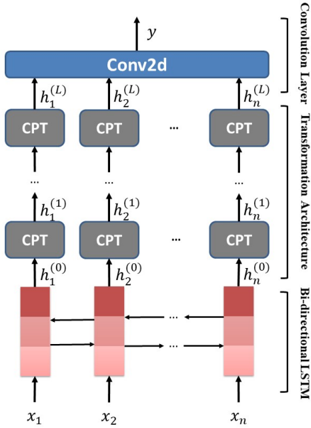
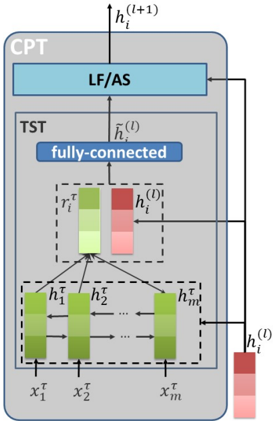
Target-oriented sentiment classification aims at classifying sentiment polarities over individual opinion targets in a sentence.RNN with attention seems a good fit for the characteristics of this task, and indeed it achieves the state-of-the-art performance.After re-examining the drawbacks of attention mechanism and the obstacles that block CNN to perform well in this classification task, we propose a new model to overcome these issues.Instead of attention, our model employs a CNN layer to extract salient features from the transformed word representations originated from a bi-directional RNN layer.Between the two layers, we propose a component to generate target-specific representations of words in the sentence, meanwhile incorporate a mechanism for preserving the original contextual information from the RNN layer.Experiments show that our model achieves a new state-of-the-art performance on a few benchmarks. 1
Overview
The claims and statistics of this paper haven’t been checked yet.
Free: it reads the open-access text and checks the first 5 claims that cite a source we can check. Create a free account to check every claim.
Integrity signals
Registry
Cites
Statistics
Figures
Verification
Claims the paper makes
The claims and statistics of this paper haven’t been checked yet.
Free: it reads the open-access text and checks the first 5 claims that cite a source we can check. Create a free account to check every claim.
Self-check
Percentages, sums and reported differences re-computed from the paper’s own numbers.
The self-check needs the paper’s full text.
Citations
Cites
Deep Residual Learning for Image Recognition
He, K., Zhang, X., Ren, S., & Sun, J. (2016) · 2016 IEEE Conference on Computer Vision and Pattern Recognition (CVPR) · doi:10.1109/cvpr.2016.90 · Cited by 235,474
Adam: A Method for Stochastic Optimization
Kingma, D. P., & Ba, J. (2014) · arXiv · doi:10.48550/arxiv.1412.6980 · Cited by 98,946
LeCun, Y., Bengio, Y., & Hinton, G. (2015) · Nature · doi:10.1038/nature14539 · Cited by 84,126
Glove: Global Vectors for Word Representation
Pennington, J., Socher, R., & Manning, C. (2014) · Proceedings of the 2014 Conference on Empirical Methods in Natural Language Processing (EMNLP) · doi:10.3115/v1/d14-1162 · Cited by 34,071
Neural Machine Translation by Jointly Learning to Align and Translate
Bahdanau, D., Cho, K., & Bengio, Y. (2014) · arXiv · doi:10.48550/arxiv.1409.0473 · Cited by 16,213
Convolutional Neural Networks for Sentence Classification
Kim, Y. (2014) · Proceedings of the 2014 Conference on Empirical Methods in Natural Language Processing (EMNLP) · doi:10.3115/v1/d14-1181 · Cited by 14,831
Representation Learning: A Review and New Perspectives
Bengio, Y., Courville, A., & Vincent, P. (2013) · IEEE Transactions on Pattern Analysis and Machine Intelligence · doi:10.1109/tpami.2013.50 · Cited by 13,001
Identity mappings in deep residual networks
He, K., Zhang, X., Ren, S., & Sun, J. (2016) · Lecture Notes in Computer Science · doi:10.1007/978-3-319-46493-0_38 · Cited by 10,741
Identity Mappings in Deep Residual Networks
He, K., Zhang, X., Ren, S., & Sun, J. (2016) · arXiv · doi:10.48550/arxiv.1603.05027 · Cited by 10,665 · cited 1×
“CPT also contains a context-preserving mechanism, resembling identity mapping (He et al., 2016a,b) and highway connection (Srivastava et al., 2015a,b), allows preserving the context information and learning more abstract word-level features using a deep network.”
BackgroundEffective Approaches to Attention-based Neural Machine Translation
Luong, T., Pham, H., & Manning, C. D. (2015) · Proceedings of the 2015 Conference on Empirical Methods in Natural Language Processing · doi:10.18653/v1/d15-1166 · Cited by 8,382
Cited by
Items 501–600 of 601
ABSA Methodology Based on Interval-Enhanced Talking-Heads Attention Network
Wu, Y., Huang, Y., Yang, J., Zhao, Y., An, N., & Feng, D. (2024) · Lecture notes in computer science · doi:10.1007/978-3-031-72350-6_6 · Cited by 1
Deng, R., Zhang, Q., Gao, M., Fu, M., Wang, Y., & Wang, G. (2024) · IEEE International Conference on Medical Artificial Intelligence (MedAI) · doi:10.1109/medai62885.2024.00062 · Cited by 1
Sun, M.-Y., Zhang, Z., & Xie, S.-S. (2025) · 電腦學刊 · doi:10.63367/199115992025023601012 · Cited by 1
SDGCN: Span Dual-Channel Graph Convolutional Networks for Aspect Sentiment Triplet Extraction
Ma’rufah, L., Sarno, R., Sungkono, K. R., Haryono, A. T., & Septiyanto, A. F. (2024) · Beyond Technology Summit on Informatics International Conference (BTS-I2C) · doi:10.1109/bts-i2c63534.2024.10942108 · Cited by 1
Aspect sentiment learning for Aspect-Level Sentiment Classification
Jian, Z., Li, J., Wang, M., Yao, J., & Wu, Q. (2025) · Neural Networks · doi:10.1016/j.neunet.2025.107758 · Cited by 1
Guo, J., Xu, B., & Li, H. (2025) · Multimedia Systems · doi:10.1007/s00530-025-01963-7 · Cited by 1
An entropy-regularized counterfactual framework for robust and generalizable ABSA
Deng, Q., Yang, H., Shen, J., Gu, J., Liu, J., Wang, M., & Yan, Y. (2025) · Complex & Intelligent Systems · doi:10.1007/s40747-025-02170-7 · Cited by 1
BSAN: bilateral synergistic aggregation network for aspect-based sentiment analysis
Zheng, Y., Tang, M., Chen, Y., Yang, K., & Hu, J. (2026) · Applied Intelligence · doi:10.1007/s10489-025-07082-0 · Cited by 1
A dual syntax bidirectional interactive network for fine-grained sentiment analysis
Ke, T., Liu, J., Chen, Z., & Chen, K. (2026) · Engineering Applications of Artificial Intelligence · doi:10.1016/j.engappai.2026.113944 · Cited by 1
Zhu, C., & Luo, L. (2026) · Expert Systems with Applications · doi:10.1016/j.eswa.2026.132392 · Cited by 1
Liao, X., Chen, X., Wang, L., Rong, Z., Yang, J., Li, J., & Chen, Z. (2026) · Knowledge and Information Systems · doi:10.1007/s10115-026-02826-x · Cited by 1
Suneetha, S., & Row, S. V. (2024) · International Journal of Intelligent Systems and Applications in Engineering · Cited by 1
Target Information Fusion Based on Memory Network for Aspect-Level Sentiment Classification
Wei, Z., Peng, J. M., Cai, X., & He, G. (2019) · Advances in intelligent systems and computing · doi:10.1007/978-3-030-16946-6_58 · Cited by 1
Transformer and Multi-scale Convolution for Target-Oriented Sentiment Analysis
Pan, Y., Song, B., Luo, N., Chen, X., & Cui, H. (2019) · Lecture notes in computer science · doi:10.1007/978-3-030-26075-0_24 · Cited by 1
Aspect-Level Sentiment Classification with Dependency Rules and Dual Attention
Yang, Y., Qian, T., & Chen, Z. (2019) · Lecture notes in computer science · doi:10.1007/978-3-030-36711-4_54 · Cited by 1
Deep Multi-Head Attention Network for Aspect-Based Sentiment Analysis
Yan, D., Chen, J., Cui, J., Shan, A., & Shi, W. (2019) · IEEE International Conference on Big Data (BigData) · doi:10.1109/bigdata47090.2019.9006157 · Cited by 1
An Algorithm for Emotion Evaluation and Analysis Based on CBOW
Guo, J., & Xia, Z. (2020) · Lecture notes in computer science · doi:10.1007/978-3-030-55393-7_31 · Cited by 1
Aspect-Based Sentiment Classification with Background Information and Syntactic Auxiliary Tasks
Li, M.-F., Zhou, K., Li, X., & Shen, J. (2021) · International Joint Conference on Neural Networks (IJCNN) · doi:10.1109/ijcnn52387.2021.9533506 · Cited by 1
Self-citationNeighborhood Network for Aspect-Based Sentiment Analysis
Liu, H., & Dou, Q. (2022) · IFIP advances in information and communication technology · doi:10.1007/978-3-031-03948-5_18 · Cited by 1
Pecar, S., Daudert, T., & Šimko, M. (2022) · Intelligent Data Analysis · doi:10.3233/ida-216252 · Cited by 1
Aspect-sited hybrid graph neural networks for sentiment classification
Wu, Q. (2022) · doi:10.1145/3556384.3556394 · Cited by 1
Text Classification Based on Graph Convolution Neural Network and Attention Mechanism
Zhai, S., Zhang, W., Cheng, D., & Bai, X. (2022) · doi:10.1145/3573942.3573963 · Cited by 1
A Deep Learning-fuzzy Based Hybrid Ensemble Approach for Aspect Level Sentiment Classification
Sharma, T., & Kaur, K. (2023) · Informatica · doi:10.31449/inf.v47i6.4607 · Cited by 1
Aspect-Level Semantic and Syntactic Reinforcement for Aspect-Based Sentiment Analysis
Wang, S., Dong, H., Fang, Z., & Chen, C. (2022) · IEEE Smart World Congress (SWC) · doi:10.1109/smartworld-uic-atc-scalcom-digitaltwin-pricomp-metaverse56740.2022.00088 · Cited by 1
Multi-branch Attention Fusion Network for Aspect Sentiment Classification
Zhao, H., Yan, K., & Cao, M. (2023) · International Conference on Intelligent Computing and Signal Processing (ICSP) · doi:10.1109/icsp58490.2023.10248925 · Cited by 1
CoSFGCN: Co-Sensitive Fusion Graph Convolution Network for Sentiment Analysis
Priya Alagu Dharshini, M., Antelin Vijila, S., & Victor, S. (2023) · International Journal of Engineering Trends and Technology · doi:10.14445/22315381/ijett-v71i10p228 · Cited by 1
An Equilibrium Optimizer-Based Ensemble for Aspect-Level Sentiment Classification
Sharma, T., & Kaur, K. (2023) · Lecture notes in electrical engineering · doi:10.1007/978-981-99-5974-7_26 · Cited by 1
Bai, Q., Tang, M., Song, Y., & Xiao, J. (2023) · The Journal of Supercomputing · doi:10.1007/s11227-023-05817-9 · Cited by 1
Multi-layer GCNs for Travel Text Aspect-level Sentiment Classification
Wang, M., & Yang, M. (2023) · International Conference on Machine Learning, Control, and Robotics (MLCR) · doi:10.1109/mlcr61158.2023.00022 · Cited by 1
Context-preserving Sentiment Classification Using Bi-TCN and BI-GRU with Multi-head Self-attention
Srinath, K. R., & Indira, B. (2024) · Journal of Soft Computing and Data Mining · doi:10.30880/jscdm.2024.05.01.003 · Cited by 1
Jiang, C., & Ye, W. (2024) · The Journal of Supercomputing · doi:10.1007/s11227-024-06542-7 · Cited by 1
Modeling Inter-Aspect Dependencies with a Non-temporal Mechanism for Aspect-Based Sentiment AnalysisPreprint
Liang, Y., Meng, F., Zhang, J., Chen, Y., Xu, J., & Zhou, J. (2020) · arXiv (Cornell University) · doi:10.48550/arxiv.2008.05179 · Cited by 1
Soukhanov, K., Li, F., & Ali, W. (2023) · Preprints.org · doi:10.20944/preprints202311.1801.v1 · Cited by 1
Syntax-Informed Interactive Model for Comprehensive Aspect-Based Sentiment AnalysisPreprint
Galen, U., Lee, F., & Ali, W. (2023) · arXiv (Cornell University) · doi:10.48550/arxiv.2312.03739 · Cited by 1
Advancing sentiment understanding and safety in NLP systems
Deng, Y. (2025) · DR-NTU (Nanyang Technological University) · doi:10.32657/10356/183610 · Cited by 1
Leveraging Deep Neural Networks for Aspect-Based Sentiment ClassificationPreprint
Li, C., Cheng, D., & Morimoto, Y. (2025) · arXiv (Cornell University) · doi:10.48550/arxiv.2503.12803 · Cited by 1
Text Classification with Keywords and Co-occurred Words in Two-stream Neural Network
Deng, J., & Ren, F. (2018) · IEEE International Conference on Cloud Computing and Intelligence Systems (CCIS) · doi:10.1109/ccis.2018.8691302
Attentional Transformer Networks for Target-Oriented Sentiment Classification
Tong, J., Chen, W., & Wei, Z. (2019) · Communications in computer and information science · doi:10.1007/978-981-15-1899-7_19
MANtIS: a novel information seeking dialogues dataset
Bălan, A. O. (2019) · Research Repository (Delft University of Technology) · Cited by 1
Clue Extraction for Fine-Grained Emotion Analysis
Bi, H., & Liu, P. (2020) · Lecture notes in computer science · doi:10.1007/978-3-030-60450-9_61
PGCD: a position-guied contributive distribution unit for aspect based sentiment analysis.Preprint
Zhang, Z., Zhang, C., Liu, Q., Zhu, H., & Li, J. (2021) · arXiv (Cornell University)
Extracting all Aspect-polarity Pairs Jointly in a Text with Relation Extraction ApproachPreprint
Bu, L., Chen, L., Lu, Y., & Yu, Z. (2021) · arXiv (Cornell University) · doi:10.48550/arxiv.2109.00256
Position-based Contributive Embeddings for Aspect-Based Sentiment AnalysisPreprint
Zhang, Z., Zhang, C., Li, J., & Zhao, Q. (2021) · arXiv (Cornell University) · doi:10.48550/arxiv.2108.05098
A Multi-feature Emotion Classification Model Based on LDA Subject Target Words
Shao, S., Ding, C., & Li, L. (2021) · IEEE International Conference on Network Infrastructure and Digital Content (IC-NIDC) · doi:10.1109/ic-nidc54101.2021.9660505
Aspect level sentiment classification with multi-scale information
Zha, Y., Xie, Y., Huang, Q., Zeng, J., & Ma, Y. (2021) · 2021 2nd International Conference on Electronics, Communications and Information Technology (CECIT) · doi:10.1109/cecit53797.2021.00056
张, 颖. (2020) · Computer Science and Application · doi:10.12677/csa.2020.1011218
A novel sentiment classification based on “word-phrase” attention mechanism
Panga, G., Peng, G., Peng, Z., He, J., Yang, Y. T., & Mo, Z. (2021) · IEEE International Conference on Computational Science and Engineering (CSE) · doi:10.1109/cse53436.2021.00017
Sentiment Analysis Using Machine Learning Techniques: Systematic Study
Doibale, M. S. (2021) · Zenodo (CERN European Organization for Nuclear Research) · doi:10.5281/zenodo.7123255
Disentangled Learning of Stance and Aspect Topics for Vaccine Attitude Detection in Social MediaPreprint
Zhu, L., Fang, Z., Pergola, G., Procter, R., & He, Y. (2022) · arXiv (Cornell University) · doi:10.48550/arxiv.2205.03296
Opinion mining on product reviews from document to clause
Ting, L. (2022) · DR-NTU (Nanyang Technological University) · doi:10.32657/10356/163981
He, L., Lu, H., & Liu, L. (2023) · International Seminar on Artificial Intelligence, Networking and Information Technology (AINIT) · doi:10.1109/ainit59027.2023.10212490
SentiSyn: Modeling Structure-Enhanced Graph Networks for Aspect-Level Sentiment AnalysisPreprint
David, C., Usunier, N., Li, F., & Ali, W. (2023) · Preprints.org · doi:10.20944/preprints202311.1653.v1
Yang, J. H., Liu, Y., Song, S., Wang, H., & Tang, Y. (2023) · SSRN Electronic Journal · doi:10.2139/ssrn.4654490
Chapke, P. P., & Raut, A. B. (2023) · BENTHAM SCIENCE PUBLISHERS eBooks · doi:10.2174/9789815136449123010012
Zeng, B., & Du, R. (2023) · IEEE International Conference on Frontiers Technology of Information and Computer (ICFTIC) · doi:10.1109/icftic59930.2023.10456246
Cong, Z., Zhang, S., & Wu, J. (2024) · Aquaculture International · doi:10.1007/s10499-024-01528-x
A DCGRU-RMCRF Neural Network for Aspect-level Sentiment Analysis
Wu, Q., & Huang, W. (2023) · International Conference on Internet of Things, Automation and Artificial Intelligence (IoTAAI) · doi:10.1145/3653081.3653083
Peng, H. J., & Wang, J. (2024) · Computational intelligence methods and applications · doi:10.1007/978-981-97-5280-5_7
CGSL: Collaborative Graph and Segment Learning Based Aspect-Level Sentiment Analysis Model
Rao, G., Tian, K., Yu, M., Zhang, J., Zhang, L., & Wang, X. (2024) · Lecture notes in computer science · doi:10.1007/978-981-97-7232-2_10
AIoT based sentiment analysis via multi‐scale context perception to enhance linguistic teaching
Li, H., & Wu, G. (2024) · Internet Technology Letters · doi:10.1002/itl2.570
Huang, S., Liu, C., & Zhang, Y. (2024) · International Conference on Communications, Information System and Computer Engineering (CISCE) · doi:10.1109/cisce62493.2024.10653238
Aspect-Based Sentiment Classification Model Based on Multi-view Information Fusion
Wan, Y., Cai, T., Li, Y., & Ju, S. (2024) · Lecture notes in computer science · doi:10.1007/978-981-97-7707-5_2
A Dual-Module Information Fusion Aspect-Level Sentiment Classification Model
He, B., Li, Q., Zhang, Y., & Zhang, Y. (2024) · International Conference on Electronic Communication and Artificial Intelligence (ICECAI) · doi:10.1109/icecai62591.2024.10675168
Aspect-Level Sentiment Analysis Using Cross Attention Mechanism
Han, L., Jiao, L., Shi, Z., & Xu, M. (2024) · IEEE International Conference on Big Data and Artificial Intelligence (BDAI) · doi:10.1109/bdai62182.2024.10692525
A Word Order Framework for Mandarin Sentiment Analysis of Social Media Text
Zhang, J., & Maskat, R. (2024) · Frontiers in artificial intelligence and applications · doi:10.3233/faia241218
Research on Chinese Named Entity Recognition Based on Bidirectional Self-attention and Span
Li, Z., Jiang, H. Y., Yin, F., Xu, K., Jia, M., & Jin, D. (2025) · Smart innovation, systems and technologies · doi:10.1007/978-981-97-9128-6_1
Aspect-Level Sentiment Analysis Based on Part-of-Speech Enhanced and Graph Convolution Network
Li, G., He, Y., Yin, S., & Liu, F. (2024) · International Symposium on Artificial Intelligence and Intelligent Manufacturing (AIIM) · doi:10.1109/aiim64537.2024.10934360
PSCA: Position-Syntax and Cross-Aspect for Aspect-based Sentiment Analysis in One Model
Zhou, N., Sun, L., Han, M., & He, S. (2024) · IEEE International Conference on Computer and Communications (ICCC) · doi:10.1109/iccc62609.2024.10941921
Mallam, S., & Datla, S. V. (2025) · SSRN Electronic Journal · doi:10.2139/ssrn.5149433
Establish the Systemic and Sustainable Development Cycle of Participate Design
Wang, P., & Feng, X. (2025) · Asian Social Science · doi:10.5539/ass.v21n3p27
Wang, D., Li, Z., Xia, Y., & Yu, Z. (2025) · Computers, materials & continua/Computers, materials & continua (Print) · doi:10.32604/cmc.2025.071656
HAGE AI – Sentiment Analysis Using GenAI
Vijayalakshmi, N., Lavanya, M., Murali, A., Eniya, R., Gurunathan, S., & Hari, S. (2025) · International Conference on Information Technology, Civil Innovation, Science, and Management (ICITSM) · doi:10.4108/eai.28-4-2025.2357921
Sentiment-aware Dual-flow Graph Convolutional Networks for Aspect Based Sentimental Analysis
Xue, Z., & Li, R. (2025) · International Joint Conference on Neural Networks (IJCNN) · doi:10.1109/ijcnn64981.2025.11229127
Aspect-Oriented Semantic Enhancement Network For Aspect-Level Multimodal Sentiment Analysis
Ji, X. B., Li, N., & Han, R. (2025) · International Joint Conference on Neural Networks (IJCNN) · doi:10.1109/ijcnn64981.2025.11228718
A Large Language Model-Based Data Augmentation Framework for Aspect-Level Sentiment Classification
Shen, H. (2025) · International Conference on Advanced Algorithms and Neural Networks (AANN) · doi:10.1109/aann66429.2025.11257730
Topic representation learning on sequential data for text understanding
Zhu, L. (2026) · Warwick Research Archive Portal (University of Warwick) · doi:10.82444/warw.33880870
Annotation practices in affective computing: What are these algorithms actually trained on?
Backer, S. D. (2023) · Research Repository (Delft University of Technology)
Aspect-Based Sentiment Analysis with Augmented Aspect Background Information
Zhen, D., Li, P., & Zhu, Z. (2025) · IEEE International Conference on Frontiers Technology of Information and Computer (ICFTIC) · doi:10.1109/icftic68075.2025.11324672
DSDGT: Dual-stage Dependency Enhanced Graph Transformer for Aspect-Based Sentiment Analysis
Liu, S., Silamu, W., & Li, Y. (2025) · Conference proceedings/Conference proceedings - IEEE International Conference on Systems, Man, and Cybernetics · doi:10.1109/smc58881.2025.11342854
Towards a Nuanced Sentiment Analysis: A Novel Hybrid Approach to Aspect-Based Insights
Patil, S., P, C. S., Sushruth, S., Dhiran Kumar Reddy, P., Reddy, C. H., & Navya, G. (2025) · IEEE Uttar Pradesh Section Women in Engineering International Conference on Electrical, Electronics and Computer Engineering (UPWIECON) · doi:10.1109/upwiecon67212.2025.11390224
Domain-Adaptive Sentiment Analysis Across Online Social Networks
Shi, J. (2023) · Tuwhera (Auckland University of Technology)
Nandwani, P., & Verma, R. (2026) · The Journal of Supercomputing · doi:10.1007/s11227-026-08415-7
Liu, S., Maimaiti, M., Yolwas, N., Abdurakhmonova, N. Z., Le, W., Xie, Z., Chen, J., & Silamu, W. (2026) · Expert Systems with Applications · doi:10.1016/j.eswa.2026.132574
Srilakshmi, V., Reddy, V. V., Uday Kiran, G., Reddy, B. V., Snigdha, K. S., & Josiah, D. C. (2026) · IEEE International Conference for Convergence in Computing Technology (I3CTCON) · doi:10.1109/i3ctcon68242.2026.11507920
KEDGE: knowledge-enhanced dual-graph encoder for aspect-based sentiment analysis
Jiang, K., Qin, Y., Xiao, X., & Zhao, Y. (2026) · Knowledge and Information Systems · doi:10.1007/s10115-026-02799-x
A span-level aspect sentiment triplet extraction model by semantic-syntactic enhancement
Zhang, Z., Xie, S., Hu, Y., Sun, M., & Chen, D. (2026) · The Journal of Supercomputing · doi:10.1007/s11227-026-08659-3
A Prompt-Based Multi-branch Framework for Aspect-Based Sentiment Analysis
Lu, X., Zhao, H., Li, B., & Jiang, K. (2026) · Lecture notes in computer science · doi:10.1007/978-981-92-3426-4_35
Su, C., Cheng, C., & Sun, W. (2026) · Communications in Statistics - Simulation and Computation · doi:10.1080/03610918.2026.2639597
Shang, Y., Bai, X., Zhan, Y., Han, D., Yang, H., Li, J., Zhao, D., Wu, G., & Qiao, B. (2026) · Knowledge and Information Systems · doi:10.1007/s10115-026-02803-4
Analyzing Performance of Interactive Multi-task Learning Network in Aspect Based Sentiment Analysis
Sharaff, A., Pal, A., & Pahadi, S. (2026) · Communications in computer and information science · doi:10.1007/978-3-032-30990-7_27
LLM-Based Annotation and Benchmarking for ABSA in Bengali-English Code-Mixed E-Commerce Reviews
Papri, I. J., Hossain, M. F., Masud, M. A., & Golder, A. (2026) · International Conference on Power, Electronics, Communications, Computing, and Intelligent Infrastructure (PECCII) · doi:10.1109/peccii70991.2026.11662020
Ifakir, I., Nfaoui, E. H., & Zannou, A. (2026) · Symmetry · doi:10.3390/sym18091467
Singh, B., Sharma, N., & Sharma, D. K. (2026) · Knowledge and Information Systems · doi:10.1007/s10115-026-02870-7
A gradient-coupled semantic constraint framework for aspect-based sentiment analysisPreprint
Lei, J., Chen, J., Du, Y., Li, X., & Chen, X. (2026) · SSRN Electronic Journal · doi:10.2139/ssrn.7417285
Self-citationKnowledge distillation of attention-refined transformers for aspect-based sentiment analysis
Awadh, W. A., Sulaiman, R. B., & Mahmoud, M. A. (2026) · Scientific Reports · doi:10.1038/s41598-026-69498-z
Dharshini, M. P. A., & Victor, S. P. (2024) · International Journal of Intelligent Systems and Applications in Engineering
Siddiqua, A., & Nagaraj, H. C. (2026) · International Journal of Engineering Trends and Technology · doi:10.14445/22315381/ijett-v74i9p105
A Frequency-Channel Enhanced Dynamic GCN for Aspect-Based Sentiment Analysis
Liu, S., Maimaiti, M., & Silamu, W. (2026) · International Joint Conference on Neural Networks (IJCNN) · doi:10.1109/ijcnn69854.2026.11729463
Taxonomy of Deep Learning Models for Aspect-based Sentiment Analysis: A Comprehensive Survey
Dhanith, P. R. J., Amutha, S., Pavithra, L. K., & Surendiran, B. (2026) · ACM Computing Surveys · doi:10.1145/3861158
Metadata
- Authors
- Li, X., Bing, L., Lam, W., & Shi, B.
- Affiliations
- Chinese University of Hong Kong (HK)
- Tencent (China) (CN)
- Venue
- Proceedings of the 56th Annual Meeting of the Association for Computational Linguistics (Volume 1: Long Papers)
- Published
- 2018
- Pages
- 946-956
- ISSN
- 0736-587X (ISSN-L)
- OpenAlex
- W2963240575
- Cited by
- 603
- References
- 43
- Citations by year
- 2026: 28 · 2025: 52 · 2024: 74 · 2023: 75 · 2022: 102 · 2021: 104 · 2020: 88 · 2019: 75 · 2018: 5
- FWCI
- 21.59
- Type
- conference paper
- Language
- en
- Open access
- hybrid
- doi.org
- Licence
- cc-by
- Locations
- Proceedings of the conference - Association for Computational Linguistics. Meeting (publishedVersion, cc-by)
- arXiv (Cornell University) (submittedVersion)
- arXiv (Cornell University)
- Funders
- Tencent
- Topics
- Physical Sciences › Computer Science › Artificial Intelligence › Sentiment Analysis and Opinion Mining
- Physical Sciences › Computer Science › Artificial Intelligence › Topic Modeling
- Physical Sciences › Computer Science › Artificial Intelligence › Hate Speech and Cyberbullying Detection
- Keywords
- sentiment polarity, transformation networks, bidirectional RNN, attention mechanism, CNN feature extraction
About these checks
Registry, retraction, Cites and statistics results are computed, not judged, with one exception: a printed reference that no index lists is read once by a model before it counts as a citation error. Claims are extracted by a model and kept only when their quote appears verbatim in the text; each cited source is then checked, with a model’s help, for whether it says what the claim relies on. Those verdicts can be wrong — read the claim’s quote and the cited source before relying on one.
Statistics and arithmetic are recomputed, not judged.
Confidence bands are shown only for fields calibrated on our annotated test set. None is calibrated yet, so no band is shown.
What counts as a claim ›How we measure confidence ›How we check this ›
Are you an author, or do you see a problem with this page? Request a review
Data sources
Bibliographic data: Semantic Scholar, OpenAlex, Crossref.
Contains information from the Semantic Scholar Academic Graph Datasets, made available under the ODC Attribution License (ODC-BY 1.0).
Semantic Scholar’s data is described in: Kinney, R., et al. (2023). The Semantic Scholar Open Data Platform. arXiv:2301.10140.
