

Ranking Generated Summaries by Correctness: An Interesting but Challenging Application for Natural Language Inference
Open accessThe DOI matches its Crossref record; 30 of the 30 references it cites were found in a registry or an index.
Abstract
While recent progress on abstractive summarization has led to remarkably fluent summaries, factual errors in generated summaries still severely limit their use in practice.In this paper, we evaluate summaries produced by state-of-the-art models via crowdsourcing and show that such errors occur frequently, in particular with more abstractive models.We study whether textual entailment predictions can be used to detect such errors and if they can be reduced by reranking alternative predicted summaries.That leads to an interesting downstream application for entailment models.In our experiments, we find that outof-the-box entailment models trained on NLI datasets do not yet offer the desired performance for the downstream task and we therefore release our annotations as additional test data for future extrinsic evaluations of NLI.
Overview
The claims and statistics of this paper haven’t been checked yet.
Free: it reads the open-access text and checks the first 5 claims that cite a source we can check. Create a free account to check every claim.
Integrity signals
Registry
Cites
Statistics
Figures
Verification
Claims the paper makes
The claims and statistics of this paper haven’t been checked yet.
Free: it reads the open-access text and checks the first 5 claims that cite a source we can check. Create a free account to check every claim.
Claims other papers make about this one
Each is checked against this paper’s own text: does it say what the citing paper says it does?
The source backs part of the claim, not all of it — or backs it for a different population, condition or comparison.
In the citing paper
“Textual entailment has previously been shown to correlate with faithfulness10 in the context of factual consistency29 as well as being used to measure factuality in abstractive summarization30, especially when applied at the right granularity31.”
From Detecting hallucinations in large language models using semantic entropy (2024) · cites this paper as [30]
Experimental — accuracy not yet measuredThe source backs part of the claim, not all of it — or backs it for a different population, condition or comparison.
In the citing paper
“It has been shown that state-of-the-art abstractive summarization systems, evaluated with metrics such as ROUGE, BLEU, and METEOR, have hallucinated content in 25% of their generated summaries [66].”
From Survey of Hallucination in Natural Language Generation (2023) · cites this paper as [66]
Experimental — accuracy not yet measuredThe cited source says what the claim attributes to it.
In the citing paper
“Nevertheless, as illustrated by Falke et al. [66], off-the-shelf NLI models tend to transfer poorly to the abstractive summarization task.”
From Survey of Hallucination in Natural Language Generation (2023) · cites this paper as [66]
The cited source says what the claim attributes to it.
In the citing paper
“In line with this, numerous studies [82, 208] have trained classifiers on NLI datasets to identify factual inaccuracies, especially in the context of abstract summarization.”
From A Survey on Hallucination in Large Language Models: Principles, Taxonomy, Challenges, and Open Questions (2025) · cites this paper as [82]
Self-check
Percentages, sums and reported differences re-computed from the paper’s own numbers.
The self-check needs the paper’s full text.
Citations
Cites
BERT: Pre-training of Deep Bidirectional Transformers for Language Understanding
Devlin, J., Chang, M.-W., Lee, K., & Toutanova, K. (2018) · arXiv · doi:10.48550/arxiv.1810.04805 · Cited by 73,173 · cited 1×
“And finally, we include a version of BERT-base (Devlin et al., 2019) fine-tuned on MultiNLI (Williams et al., 2018 crowdsourced correctness labels for the resulting 1000 summaries.”
MethodBERT: Pre-training of Deep Bidirectional Transformers for Language Understanding
Devlin, J., Chang, M.-W., Lee, K., & Toutanova, K. (2019) · Proceedings of the 2019 Conference of the North American Chapter of the Association for Computational Linguistics: Human Language Technologies, Volume 1 (Long and Short Papers) · doi:10.18653/v1/n19-1423 · Cited by 54,325 · cited 1×
“And finally, we include a version of BERT-base (Devlin et al., 2019) fine-tuned on MultiNLI (Williams et al., 2018 crowdsourced correctness labels for the resulting 1000 summaries.”
MethodDeep Contextualized Word Representations
Peters, M., Neumann, M., Iyyer, M., Gardner, M., Clark, C., Lee, K., & Zettlemoyer, L. (2018) · Proceedings of the 2018 Conference of the North American Chapter of the Association for Computational Linguistics: Human Language Technologies, Volume 1 (Long Papers) · doi:10.18653/v1/n18-1202 · Cited by 11,983 · cited 1×
“(Peters et al., 2018) by Al-lenNLP.”
Get To The Point: Summarization with Pointer-Generator Networks
See, A., Liu, P. J., & Manning, C. D. (2017) · Proceedings of the 55th Annual Meeting of the Association for Computational Linguistics (Volume 1: Long Papers) · doi:10.18653/v1/p17-1099 · Cited by 3,775 · cited 2×
“PGC (See et al., 2017) 8% 39.”
MethodA large annotated corpus for learning natural language inference
Bowman, S. R., Angeli, G., Potts, C., & Manning, C. D. (2015) · Proceedings of the 2015 Conference on Empirical Methods in Natural Language Processing · doi:10.18653/v1/d15-1075 · Cited by 3,377 · cited 3×
“We study the use of natural language inference (NLI) (Bowman et al., 2015), also known as textual entailment (Dagan et al., 2006), to detect factual errors.”
BackgroundA Broad-Coverage Challenge Corpus for Sentence Understanding through Inference
Williams, A., Nangia, N., & Bowman, S. (2018) · Proceedings of the 2018 Conference of the North American Chapter of the Association for Computational Linguistics: Human Language Technologies, Volume 1 (Long Papers) · doi:10.18653/v1/n18-1101 · Cited by 3,342 · cited 2×
“And finally, we include a version of BERT-base (Devlin et al., 2019) fine-tuned on MultiNLI (Williams et al., 2018 crowdsourced correctness labels for the resulting 1000 summaries.”
MethodA Neural Attention Model for Abstractive Sentence Summarization
Rush, A. M., Chopra, S., & Weston, J. (2015) · Proceedings of the 2015 Conference on Empirical Methods in Natural Language Processing · doi:10.18653/v1/d15-1044 · Cited by 2,656 · cited 1×
“Following the pioneering works of Rush et al. (2015), Chopra et al. (2016) and Nallapati et al. (2016), many models have been developed in recent years that can all generate summaries by freely choosing words from a large vocabulary rather than reusing full sentences from the input document.”
BackgroundInfluentialTeaching Machines to Read and Comprehend
Hermann, K. M., Kočiský, T., Grefenstette, E., Espeholt, L., Kay, W., Suleyman, M., & Blunsom, P. (2015) · arXiv (Cornell University) · doi:10.48550/arxiv.1506.03340 · Cited by 2,521 · cited 1×
“The general success of deep learning techniques and the availability of large-scale single-document summarization datasets, such as the CNN-DailyMail (CNN-DM) corpus (Hermann et al., 2015), have recently led to a renewed interest in abstractive summarization.”
BackgroundAbstractive Text Summarization using Sequence-to-sequence RNNs and Beyond
Nallapati, R., Zhou, B., dos Santos, C., Gulcehre, C., & Xiang, B. (2016) · Proceedings of The 20th SIGNLL Conference on Computational Natural Language Learning · doi:10.18653/v1/k16-1028 · Cited by 2,361 · cited 1×
“Following the pioneering works of Rush et al. (2015), Chopra et al. (2016) and Nallapati et al. (2016), many models have been developed in recent years that can all generate summaries by freely choosing words from a large vocabulary rather than reusing full sentences from the input document.”
BackgroundInfluentialSupervised Learning of Universal Sentence Representations from Natural Language Inference Data
Conneau, A., Kiela, D., Schwenk, H., Barrault, L., & Bordes, A. (2017) · Proceedings of the 2017 Conference on Empirical Methods in Natural Language Processing · doi:10.18653/v1/d17-1070 · Cited by 2,049 · cited 3×
“4 Further, we also include our own implementations of InferSent (Conneau et al., 2017) and shortcut-stacked encoders (SSE) (Nie and Bansal).”
MethodInfluential
Research works printed but not linked: 4
- [1]1. Samuel R. Bowman, Gabor Angeli, Christopher Potts, and Christopher D. Manning. 2015. A Large An- notated Corpus for Learning Natural Language In- ference. In Proceedings of the 2015 Conference on Empirical Methods in Natural Language Process- ing, pages 632-642, Lisbon, Portugal.
- [4]4. Yen-Chun Chen and Mohit Bansal. 2018. Fast Abstrac- tive Summarization with Reinforce-Selected Sen- tence Rewriting. In Proceedings of the 56th Annual Meeting of the Association for Computational Lin- guistics, pages 675-686, Melbourne, Australia.
- [10]10. Sebastian Gehrmann, Yuntian Deng, and Alexander Rush. 2018. Bottom-Up Abstractive Summariza- tion. In Proceedings of the 2018 Conference on Empirical Methods in Natural Language Process- ing, pages 4098-4109, Brussels, Belgium.
- [23]23. Matthew Peters, Mark Neumann, Mohit Iyyer, Matt Gardner, Christopher Clark, Kenton Lee, and Luke Zettlemoyer. 2018. Deep Contextualized Word Rep- resentations. In Proceedings of the 2018 Conference of the North American Chapter of the Association for Computational Linguistics: Human Language Technologies, pages 2227-2237, New Orleans, LA, USA.
Cited by
Survey of Hallucination in Natural Language Generation
Ji, Z., Lee, N., Frieske, R., Yu, T., Su, D., Xu, Y., Ishii, E., Bang, Y. J., Madotto, A., & Fung, P. (2023) · ACM Computing Surveys · doi:10.1145/3571730 · Cited by 5,025
“[45] discover that models trained on NLI datasets can not transfer well to abstractive summarization tasks, degrading the reliability of NLI-based hallucination metrics.”
BackgroundInfluentialSurvey of Hallucination in Natural Language Generation
Ji, Z., Lee, N., Frieske, R., Yu, T., Su, D., Xu, Y., Ishii, E., Bang, Y., Chen, D., Dai, W., et al. (2022) · arXiv · doi:10.48550/arxiv.2202.03629 · Cited by 4,981
Huang, L., Yu, W., Ma, W., Zhong, W., Feng, Z., Wang, H., Chen, Q., Peng, W., Feng, X., Qin, B., et al. (2025) · ACM Transactions on Information Systems · doi:10.1145/3703155 · Cited by 4,688
“In line with this, numerous studies (Falke et al., 2019; Maynez et al., 2020) have trained classifiers on NLI datasets to identify factual inaccuracies, especially in the context of abstract summarization.”
On Faithfulness and Factuality in Abstractive Summarization
Maynez, J., Narayan, S., Bohnet, B., & McDonald, R. (2020) · Proceedings of the 58th Annual Meeting of the Association for Computational Linguistics · doi:10.18653/v1/2020.acl-main.173 · Cited by 1,185
On Faithfulness and Factuality in Abstractive Summarization
Maynez, J., Narayan, S., Bohnet, B., & McDonald, R. (2020) · arXiv · doi:10.48550/arxiv.2005.00661 · Cited by 1,185
“In line with our findings, Falke et al. (2019) observed that the BERT-based NLI models substantially improved summaries reranking in terms of their correctness.”
BackgroundResultDetecting hallucinations in large language models using semantic entropy
Farquhar, S., Kossen, J., Kuhn, L., & Gal, Y. (2024) · Nature · doi:10.1038/s41586-024-07421-0 · Cited by 934
“Textual entailment has previously been shown to correlate with faithfulness 10 in the context of factual consistency 29 as well as being used to measure factuality in abstractive summarization 30 , especially when applied at the right granularity 31 .”
Evaluating the Factual Consistency of Abstractive Text Summarization
Kryscinski, W., McCann, B., Xiong, C., & Socher, R. (2020) · Proceedings of the 2020 Conference on Empirical Methods in Natural Language Processing (EMNLP) · doi:10.18653/v1/2020.emnlp-main.750 · Cited by 669
The impact of ChatGPT on higher education
Dempere, J., Modugu, K., Hesham, A., & Ramasamy, L. K. (2023) · Frontiers in Education · doi:10.3389/feduc.2023.1206936 · Cited by 519
MiniCheck: Efficient Fact-Checking of LLMs on Grounding Documents
Tang, L., Laban, P., & Durrett, G. (2024) · arXiv · doi:10.48550/arxiv.2404.10774 · Cited by 390
Evaluating Large Language Models: A Comprehensive SurveyPreprint
Guo, Z., Jin, R., Chuang, L. I. U., Huang, Y., Shi, D., Supryadi, Yu, L., Liu, Y., Li, J., Xiong, B., et al. (2023) · arXiv (Cornell University) · doi:10.48550/arxiv.2310.19736 · Cited by 479
(2020) · doi:10.18653/v1/2020.acl-main.450 · Cited by 356
Asking and Answering Questions to Evaluate the Factual Consistency of Summaries
Wang, A., Cho, K., & Lewis, M. (2020) · arXiv · doi:10.48550/arxiv.2004.04228 · Cited by 356
“6 Re-ranking with QAGS Several works explore the use of natural language inference (NLI) models to detect factual consistency in generated text (Welleck et al., 2019; Falke et al., 2019).”
BackgroundMethodInfluentialBARTScore: Evaluating Generated Text as Text Generation
Yuan, W., Neubig, G., & Liu, P. (2021) · arXiv · doi:10.48550/arxiv.2106.11520 · Cited by 353
“5, we observe that (1) BARTS CORE + CNN can almost match human baseline on Rank19 and outperform all other metrics, including the most recent top-performing factuality metrics FactCC and QAGS by a large margin.”
MethodInfluentialDurmus, E., He, H., & Diab, M. (2020) · Proceedings of the 58th Annual Meeting of the Association for Computational Linguistics · doi:10.18653/v1/2020.acl-main.454 · Cited by 306
SummaC: Re-Visiting NLI-based Models for Inconsistency Detection in Summarization
Laban, P., Schnabel, T., Bennett, P. N., & Hearst, M. A. (2022) · Transactions of the Association for Computational Linguistics · doi:10.1162/tacl_a_00453 · Cited by 238
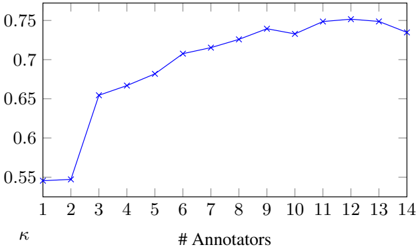
“We computed inter-annotator agreement calculated with Fleiss’ Kappa (Fleiss, 1971) on the dataset as an estimate for dataset quality, omitting datasets for which summaries only had a single annotator (Polytope and FactCC).”
MethodHuang, L., Yu, W., Ma, W., Zhong, W., Feng, Z., Wang, H., Chen, Q., Peng, W., Feng, X., Qin, B., et al. (2023) · arXiv · doi:10.48550/arxiv.2311.05232 · Cited by 2,516
“In line with this, numerous studies (Falke et al., 2019; Maynez et al., 2020) have trained classifiers on NLI datasets to identify factual inaccuracies, especially in the context of abstract summarization.”
Evaluation of Text Generation: A Survey
Celikyilmaz, A., Clark, E., & Gao, J. (2020) · arXiv · doi:10.48550/arxiv.2006.14799 · Cited by 207
Investigating Pretrained Language Models for Graph-to-Text Generation
Ribeiro, L. F. R., Schmitt, M., Schütze, H., & Gurevych, I. (2021) · Proceedings of the 3rd Workshop on Natural Language Processing for Conversational AI · doi:10.18653/v1/2021.nlp4convai-1.20 · Cited by 133
Self-citationUnderstanding Factuality in Abstractive Summarization with FRANK: A Benchmark for Factuality Metrics
Pagnoni, A., Balachandran, V., & Tsvetkov, Y. (2021) · Proceedings of the 2021 Conference of the North American Chapter of the Association for Computational Linguistics: Human Language Technologies · doi:10.18653/v1/2021.naacl-main.383 · Cited by 197
QuestEval: Summarization Asks for Fact-based Evaluation
Scialom, T., Dray, P.-A., Lamprier, S., Piwowarski, B., Staiano, J., Wang, A., & Gallinari, P. (2021) · Proceedings of the 2021 Conference on Empirical Methods in Natural Language Processing · doi:10.18653/v1/2021.emnlp-main.529 · Cited by 175
Optimizing the Factual Correctness of a Summary: A Study of Summarizing Radiology Reports
Zhang, Y., Merck, D., Tsai, E., Manning, C. D., & Langlotz, C. (2020) · Proceedings of the 58th Annual Meeting of the Association for Computational Linguistics · doi:10.18653/v1/2020.acl-main.458 · Cited by 171
Improving Factual Completeness and Consistency of Image-to-Text Radiology Report Generation
Miura, Y., Zhang, Y., Tsai, E., Langlotz, C., & Jurafsky, D. (2021) · Proceedings of the 2021 Conference of the North American Chapter of the Association for Computational Linguistics: Human Language Technologies · doi:10.18653/v1/2021.naacl-main.416 · Cited by 149
CLIFF: Contrastive Learning for Improving Faithfulness and Factuality in Abstractive Summarization
Cao, S., & Wang, L. (2021) · Proceedings of the 2021 Conference on Empirical Methods in Natural Language Processing · doi:10.18653/v1/2021.emnlp-main.532 · Cited by 132
“Neural abstractive summaries often contain unfaith-ful content with regard to the source (Falke et al., 2019).”
BackgroundA Culturally Sensitive Test to Evaluate Nuanced GPT Hallucination
McIntosh, T. R., Liu, T., Susnjak, T., Watters, P., Ng, A., & Halgamuge, M. N. (2024) · IEEE Transactions on Artificial Intelligence · doi:10.1109/tai.2023.3332837 · Cited by 145
“This underlines the need for culturally sensitive and adaptable GPT models and highlights that the evaluation of GPT hallucinations cannot rely solely on algorithmic methods (e.g., [16], [25], [26], [39], [40], [41], [42], [43]).”
MethodTowards trustworthy LLMs: a review on debiasing and dehallucinating in large language models
Lin, Z., Guan, S., Zhang, W., Zhang, H., Li, Y., & Zhang, H. (2024) · Artificial Intelligence Review · doi:10.1007/s10462-024-10896-y · Cited by 141
Factual Error Correction for Abstractive Summarization Models
Cao, M., Dong, Y., Wu, J., & Cheung, J. C. K. (2020) · Proceedings of the 2020 Conference on Empirical Methods in Natural Language Processing (EMNLP) · doi:10.18653/v1/2020.emnlp-main.506 · Cited by 132
Hallucination Detection: Robustly Discerning Reliable Answers in Large Language Models
Chen, Y., Fu, Q., Yuan, Y., Wen, Z., Fan, G., Liu, D., Zhang, D., Li, Z., & Xiao, Y. (2023) · Proceedings of the 32nd ACM International Conference on Information and Knowledge Management · doi:10.1145/3583780.3614905 · Cited by 94
“Model-based evaluation incorporates various metrics, including Information Extraction (IE)-based metrics, QA-based metrics [16, 63, 70], Natural Language Inference (NLI) metrics [17, 18, 25], Faithfulness Classification metrics [25, 41, 79], and LM-based metrics [19, 67].”
BackgroundEnhancing Factual Consistency of Abstractive Summarization
Zhu, C., Hinthorn, W., Xu, R., Zeng, Q., Zeng, M., Huang, X., & Jiang, M. (2021) · Proceedings of the 2021 Conference of the North American Chapter of the Association for Computational Linguistics: Human Language Technologies · doi:10.18653/v1/2021.naacl-main.58 · Cited by 127
“As shown in Table 7, on CNN/Daily Mail, our reproduced model achieves better accuracy than that in Kry´sci´nski et al. (2019b) on the human-labelled sentence-pair-ordering data (Falke et al., 2019).”
BackgroundMethodInfluentialUnsupervised Opinion Summarization as Copycat-Review Generation
Bražinskas, A., Lapata, M., & Titov, I. (2020) · Proceedings of the conference - Association for Computational Linguistics. Meeting · doi:10.18653/v1/2020.acl-main.461 · Cited by 175
“The ROUGE metric relies on unweighted n-gram overlap and can be insensitive to hallucinating facts and entities (Falke et al., 2019).”
BackgroundPlanning with Learned Entity Prompts for Abstractive Summarization
Narayan, S., Zhao, Y., Maynez, J., Simões, G., Nikolaev, V., & McDonald, R. (2021) · Transactions of the Association for Computational Linguistics · doi:10.1162/tacl_a_00438 · Cited by 182
“(2020) and report on textual entailment (Pasunuru and Bansal, 2018; Falke et al., 2019; Kryscinski et al., 2020).”
Hallucinations in Large Multilingual Translation Models
Guerreiro, N. M., Alves, D. M., Waldendorf, J., Haddow, B., Birch, A., Colombo, P., & Martins, A. F. T. (2023) · Transactions of the Association for Computational Linguistics · doi:10.1162/tacl_a_00615 · Cited by 124
Hallucinations in Large Multilingual Translation Models
Guerreiro, N. M., Alves, D., Waldendorf, J., Haddow, B., Birch, A., Colombo, P., & Martins, A. F. T. (2023) · arXiv · doi:10.48550/arxiv.2303.16104 · Cited by 124
Repairing the Cracked Foundation: A Survey of Obstacles in Evaluation Practices for Generated Text
Gehrmann, S., Clark, E., & Sellam, T. (2023) · Journal of Artificial Intelligence Research · doi:10.1613/jair.1.13715 · Cited by 123
MSˆ2: Multi-Document Summarization of Medical Studies
DeYoung, J., Beltagy, I., van Zuylen, M., Kuehl, B., & Wang, L. (2021) · Proceedings of the 2021 Conference on Empirical Methods in Natural Language Processing · doi:10.18653/v1/2021.emnlp-main.594 · Cited by 83
“…in summarization evaluation has high-lighted the weaknesses of ROUGE for capturing factuality of generated summaries, and has focused on developing automated metrics more closely correlated with human-assessed factuality and quality (Zhang* et al., 2020; Wang et al., 2020a; Falke et al., 2019).”
BackgroundQAFactEval: Improved QA-Based Factual Consistency Evaluation for Summarization
Fabbri, A., Wu, C.-S., Liu, W., & Xiong, C. (2022) · Proceedings of the 2022 Conference of the North American Chapter of the Association for Computational Linguistics: Human Language Technologies · doi:10.18653/v1/2022.naacl-main.187 · Cited by 119
TRUE: Re-evaluating Factual Consistency Evaluation
Honovich, O., Aharoni, R., Herzig, J., Taitelbaum, H., Kukliansy, D., Cohen, V., Scialom, T., Szpektor, I., Hassidim, A., & Matias, Y. (2022) · Proceedings of the 2022 Conference of the North American Chapter of the Association for Computational Linguistics: Human Language Technologies · doi:10.18653/v1/2022.naacl-main.287 · Cited by 58
Multi-Fact Correction in Abstractive Text Summarization
Dong, Y., Wang, S., Gan, Z., Cheng, Y., Cheung, J. C. K., & Liu, J. (2020) · Proceedings of the 2020 Conference on Empirical Methods in Natural Language Processing (EMNLP) · doi:10.18653/v1/2020.emnlp-main.749 · Cited by 98
Mind the Trade-off: Debiasing NLU Models without Degrading the In-distribution Performance
Utama, P. A., Moosavi, N. S., & Gurevych, I. (2020) · Proceedings of the conference - Association for Computational Linguistics. Meeting · doi:10.18653/v1/2020.acl-main.770 · Cited by 147
Self-citationAnnotating and Modeling Fine-grained Factuality in Summarization
Goyal, T., & Durrett, G. (2021) · Proceedings of the 2021 Conference of the North American Chapter of the Association for Computational Linguistics: Human Language Technologies · doi:10.18653/v1/2021.naacl-main.114 · Cited by 100
Reducing Quantity Hallucinations in Abstractive Summarization
Zhao, Z., Cohen, S. B., & Webber, B. (2020) · Findings of the Association for Computational Linguistics: EMNLP 2020 · doi:10.18653/v1/2020.findings-emnlp.203 · Cited by 99
Evaluating Factuality in Generation with Dependency-level Entailment
Goyal, T., & Durrett, G. (2020) · Findings of the Association for Computational Linguistics: EMNLP 2020 · doi:10.18653/v1/2020.findings-emnlp.322 · Cited by 93
Understanding Factual Errors in Summarization: Errors, Summarizers, Datasets, Error Detectors
Tang, L., Goyal, T., Fabbri, A. R., Laban, P., Xu, J., Yavuz, S., Kryściński, W., Rousseau, J. F., & Durrett, G. (2023) · Proceedings of the conference - Association for Computational Linguistics. Meeting · doi:10.18653/v1/2023.acl-long.650 · Cited by 178
Pan, L., Saxon, M., Xu, W., Nathani, D., Wang, X., & Wang, W. Y. (2024) · Transactions of the Association for Computational Linguistics · doi:10.1162/tacl_a_00660 · Cited by 86
“…1) training-time correction that imposes factuality constraints during training (Liu and Liu, 2021; Wan and Bansal, 2022; Scheurer et al., 2023), and 2) post-hoc correction that post-edits generated summaries to correct factual errors (Falke et al., 2019; Cao et al., 2020; Saunders et al., 2022).”
BackgroundTRUE: Re-evaluating Factual Consistency Evaluation
Honovich, O., Aharoni, R., Herzig, J., Taitelbaum, H., Kukliansy, D., Cohen, V., Scialom, T., Szpektor, I., Hassidim, A., & Matias, Y. (2022) · arXiv · doi:10.48550/arxiv.2204.04991 · Cited by 84
“Works are usually done in silo, introducing new datasets and methods that target a specific task or domain, such as summarization (Falke et al., 2019; Kryscinski et al., 2020; Wang et al., 2020; Scialom et al., 2021; Deutsch et al., 2021; Xie et al., 2021) or dialogue (Dziri et al., 2021; Honovich…”
BackgroundImproving Faithfulness in Abstractive Summarization with Contrast Candidate Generation and Selection
Chen, S., Zhang, F., Sone, K., & Roth, D. (2021) · Proceedings of the 2021 Conference of the North American Chapter of the Association for Computational Linguistics: Human Language Technologies · doi:10.18653/v1/2021.naacl-main.475 · Cited by 83
AlignScore: Evaluating factual consistency with a unified alignment function
Zha, Y., Yang, Y., Li, R., & Hu, Z. (2023) · Proceedings of the 61st Annual Meeting of the Association for Computational Linguistics (Volume 1: Long Papers) · doi:10.18653/v1/2023.acl-long.634 · Cited by 81
Evaluating Attribution in Dialogue Systems: The BEGIN Benchmark
Dziri, N., Rashkin, H., Linzen, T., & Reitter, D. (2022) · Transactions of the Association for Computational Linguistics · doi:10.1162/tacl_a_00506 · Cited by 47
“While hallucination is well studied in the context of summarization (Durmus et al., 2020; Maynez et al., 2020b; Nan et al., 2021; Falke et al., 2019), fewer researchers have looked into the problem of assessing hallucination in dialogue systems.”
BackgroundLi, W., Wu, W., Chen, M., Liu, J., Xiao, X., & Wu, H. (2022) · arXiv (Cornell University) · doi:10.48550/arxiv.2203.05227 · Cited by 99
“For example, the researches on abstractive text summarization show that about 30% of summaries generated by state-of-the-art models have faithfulness issues (Cao et al., 2017; Falke et al., 2019; Kryściński et al., 2019; Pagnoni et al., 2021).”
BackgroundMethodInfluentialA Comprehensive Survey of Abstractive Text Summarization Based on Deep Learning
Zhang, M., Zhou, G., Yu, W., Huang, N., & Liu, W. (2022) · Computational Intelligence and Neuroscience · doi:10.1155/2022/7132226 · Cited by 103
Hua, H.-U., Kaakour, A.-H., Rachitskaya, A., Srivastava, S., Sharma, S., & Mammo, D. A. (2023) · JAMA Ophthalmology · doi:10.1001/jamaophthalmol.2023.3119 · Cited by 76
GO FIGURE: A Meta Evaluation of Factuality in Summarization
Gabriel, S., Celikyilmaz, A., Jha, R., Choi, Y., & Gao, J. (2021) · Findings of the Association for Computational Linguistics: ACL-IJCNLP 2021 · doi:10.18653/v1/2021.findings-acl.42 · Cited by 75
“with up to 30% factual inconsistencies (Kryscinski et al., 2019; Falke et al., 2019a; Zhu et al., 2020).”
BackgroundIncreasing Faithfulness in Knowledge-Grounded Dialogue with Controllable Features
Rashkin, H., Reitter, D., Tomar, G. S., & Das, D. (2021) · Proceedings of the 59th Annual Meeting of the Association for Computational Linguistics and the 11th International Joint Conference on Natural Language Processing (Volume 1: Long Papers) · doi:10.18653/v1/2021.acl-long.58 · Cited by 74
“Many of these works focus on other generation tasks such as summarization (Maynez et al., 2020; Zhao et al., 2020; Cao et al., 2018; Falke et al., 2019) or data-to-text generation (Puduppully et al., 2019).”
BackgroundMethodA survey on Recognizing Textual Entailment as an NLP Evaluation
Poliak, A. (2020) · Proceedings of the First Workshop on Evaluation and Comparison of NLP Systems · doi:10.18653/v1/2020.eval4nlp-1.10 · Cited by 41
Enhancing Uncertainty-Based Hallucination Detection with Stronger Focus
Zhang, T., Qiu, L., Guo, Q., Deng, C., Zhang, Y., Zhang, Z., Zhou, C., Wang, X., & Fu, L. (2023) · Conference on Empirical Methods in Natural Language Processing (EMNLP) · doi:10.18653/v1/2023.emnlp-main.58 · Cited by 160
Few-Shot Learning for Opinion Summarization
Bražinskas, A., Lapata, M., & Titov, I. (2020) · Conference on Empirical Methods in Natural Language Processing (EMNLP) · doi:10.18653/v1/2020.emnlp-main.337 · Cited by 102
“Content Support As was observed by Falke et al. (2019); Tay et al. (2019); Bražinskas et al. (2020), the ROUGE metric can be insensitive to hallucinating facts and entities.”
MethodUnderstanding and Detecting Hallucinations in Neural Machine Translation via Model Introspection
Xu, W., Agrawal, S., Briakou, E., Martindale, M. J., & Carpuat, M. (2023) · Transactions of the Association for Computational Linguistics · doi:10.1162/tacl_a_00563 · Cited by 53
“While neural language generation models can generate high quality text in many settings, they also fail in counter-intuitive ways, for instance by “hallucinating” (Wiseman et al., 2017; Lee et al., 2018; Falke et al., 2019).”
BackgroundInfluentialFactPEGASUS: Factuality-Aware Pre-training and Fine-tuning for Abstractive Summarization
Wan, D., & Bansal, M. (2022) · Proceedings of the 2022 Conference of the North American Chapter of the Association for Computational Linguistics: Human Language Technologies · doi:10.18653/v1/2022.naacl-main.74 · Cited by 54
Can NLI Models Verify QA Systems’ Predictions?
Chen, J., Choi, E., & Durrett, G. (2021) · Findings of the Association for Computational Linguistics: EMNLP 2021 · doi:10.18653/v1/2021.findings-emnlp.324 · Cited by 47
A Token-level Reference-free Hallucination Detection Benchmark for Free-form Text Generation
Liu, T., Zhang, Y., Brockett, C., Mao, Y., Sui, Z., Chen, W., & Dolan, B. (2022) · Proceedings of the 60th Annual Meeting of the Association for Computational Linguistics (Volume 1: Long Papers) · doi:10.18653/v1/2022.acl-long.464 · Cited by 63
Factually Consistent Summarization via Reinforcement Learning with Textual Entailment Feedback
Roit, P., Ferret, J., Shani, L., Aharoni, R., Cideron, G., Dadashi, R., Geist, M., Girgin, S., Hussenot, L., Keller, O., et al. (2023) · Proceedings of the conference - Association for Computational Linguistics. Meeting · doi:10.18653/v1/2023.acl-long.344 · Cited by 126
The Factual Inconsistency Problem in Abstractive Text Summarization: A Survey
Huang, Y., Feng, X., Feng, X., & Qin, B. (2021) · arXiv · doi:10.48550/arxiv.2104.14839 · Cited by 62
Enhancing AMR-to-Text Generation with Dual Graph Representations
Ribeiro, L. F. R., Gardent, C., & Gurevych, I. (2019) · Conference on Empirical Methods in Natural Language Processing (EMNLP) · doi:10.18653/v1/d19-1314 · Cited by 84
“In a related text generation task, Falke et al. (2019) employ NLI models to rerank alternative predicted abstractive summaries.”
Self-citationDeng, M., Tan, B., Liu, Z., Xing, E., & Hu, Z. (2021) · Proceedings of the 2021 Conference on Empirical Methods in Natural Language Processing · doi:10.18653/v1/2021.emnlp-main.599 · Cited by 47
“…metrics (Scialom et al., 2019; Durmus et al., 2020; Wang et al., 2020) that compare the answers extracted from y and x by a Question-Answering system, and is more interpretable than the black-box consistency clas-sification models (Falke et al., 2019; Kry´sci´nski et al., 2019; Maynez et al., 2020).”
BackgroundMethodFactual consistency evaluation of summarization in the Era of large language models
Luo, Z., Xie, Q., & Ananiadou, S. (2024) · Expert Systems with Applications · doi:10.1016/j.eswa.2024.124456 · Cited by 80
Improving Abstractive Summarization of Legal Rulings through Textual Entailment
Feijo, D. D. V., & Moreira, V. P. (2023) · Artificial Intelligence and Law · doi:10.1007/s10506-021-09305-4 · Cited by 59
“The authors pointed out that this strategy is similar to the one proposed by Falke et al. (2019), which is applied at the sentence level.”
MethodWhat’s in a Summary? Laying the Groundwork for Advances in Hospital-Course Summarization
Adams, G., Alsentzer, E., Ketenci, M., Zucker, J., & Elhadad, N. (2021) · Proceedings of the 2021 Conference of the North American Chapter of the Association for Computational Linguistics: Human Language Technologies · doi:10.18653/v1/2021.naacl-main.382 · Cited by 44
TRUE: Re-evaluating Factual Consistency Evaluation
Honovich, O., Aharoni, R., Herzig, J., Taitelbaum, H., Kukliansy, D., Cohen, V., Scialom, T., Szpektor, I., Hassidim, A., & Matias, Y. (2022) · Proceedings of the Second DialDoc Workshop on Document-grounded Dialogue and Conversational Question Answering · doi:10.18653/v1/2022.dialdoc-1.19 · Cited by 56
“as summarization (Falke et al., 2019; Kryscinski et al., 2020; Wang et al., 2020; Scialom et al., 2021; Deutsch et al., 2021; Xie et al., 2021) or dialogue (Dziri et al.”
BackgroundMethodDelucionQA: Detecting Hallucinations in Domain-specific Question Answering
Sadat, M., Zhou, Z., Lange, L., Araki, J., Gundroo, A., Wang, B., Menon, R. R., Parvez, M. R., & Feng, Z. (2023) · Findings of the Association for Computational Linguistics: EMNLP (Findings of EMNLP) · doi:10.18653/v1/2023.findings-emnlp.59 · Cited by 98
“This is a long-standing problem in neural natural language generation and it is pervasive in all types of generation tasks ranging from QA (Su et al., 2022) to abstrac-tive summarization (Falke et al., 2019; Maynez et al., 2020).”
BackgroundFactGraph: Evaluating Factuality in Summarization with Semantic Graph Representations
Ribeiro, L., Liu, M., Gurevych, I., Dreyer, M., & Bansal, M. (2022) · Conference of the North American Chapter of the Association for Computational Linguistics: Human Language Technologies (NAACL-HLT) · doi:10.18653/v1/2022.naacl-main.236 · Cited by 100
Self-citationMENLI: Robust Evaluation Metrics from Natural Language Inference
Chen, Y., & Eger, S. (2023) · Transactions of the Association for Computational Linguistics · doi:10.1162/tacl_a_00576 · Cited by 115
“In summarization, system summaries are often factually inconsistent with source documents in terms of numbers, named entities and assigning quotations to a particular person, etc. (Falke et al., 2019; Kryscinski et al., 2020; Chen et al., 2021).”
BackgroundMethodChatGPT as a Factual Inconsistency Evaluator for Text Summarization
Luo, Z., Xie, Q., & Ananiadou, S. (2023) · arXiv · doi:10.48550/arxiv.2303.15621 · Cited by 53
Factual Consistency Evaluation for Text Summarization via Counterfactual Estimation
Xie, Y., Sun, F., Deng, Y., Li, Y., & Ding, B. (2021) · Findings of the Association for Computational Linguistics: EMNLP 2021 · doi:10.18653/v1/2021.findings-emnlp.10 · Cited by 41
Multilingual Summarization with Factual Consistency Evaluation
Aharoni, R., Narayan, S., Maynez, J., Herzig, J., Clark, E., & Lapata, M. (2023) · Findings of the Association for Computational Linguistics: ACL (Findings of ACL) · doi:10.18653/v1/2023.findings-acl.220 · Cited by 75
Evaluating Attribution in Dialogue Systems: The BEGIN Benchmark
Dziri, N., Rashkin, H., Linzen, T., & Reitter, D. (2021) · arXiv · doi:10.48550/arxiv.2105.00071 · Cited by 47
“While hallucination is well studied in the context of summarization (Durmus et al., 2020; Maynez et al., 2020b; Nan et al., 2021; Falke et al., 2019), fewer researchers have looked into the problem of assessing hallucination in dialogue systems.”
BackgroundLadhak, F., Durmus, E., He, H., Cardie, C., & McKeown, K. (2022) · Proceedings of the 60th Annual Meeting of the Association for Computational Linguistics (Volume 1: Long Papers) · doi:10.18653/v1/2022.acl-long.100 · Cited by 46
Faithfulness-Aware Decoding Strategies for Abstractive Summarization
Wan, D., Liu, M., McKeown, K. R., Dreyer, M., & Bansal, M. (2023) · Conference of the European Chapter of the Association for Computational Linguistics · doi:10.18653/v1/2023.eacl-main.210 · Cited by 77
Focus Attention: Promoting Faithfulness and Diversity in Summarization
Aralikatte, R., Narayan, S., Maynez, J., Rothe, S., & McDonald, R. (2021) · doi:10.18653/v1/2021.acl-long.474 · Cited by 65
“We evaluate FAME models on semantic inference metrics such as textual entailment (Pasunuru and Bansal, 2018; Welleck et al., 2019b; Falke et al., 2019; Kryscinski et al., 2019) and question answering (Arumae and Liu, 2019; Wang et al., 2020a).”
BackgroundMethodSummEdits: Measuring LLM Ability at Factual Reasoning Through The Lens of Summarization
Laban, P., Kryściński, W., Agarwal, D., Fabbri, A. R., Xiong, C., Joty, S., & Wu, C.-S. (2023) · Conference on Empirical Methods in Natural Language Processing (EMNLP) · doi:10.18653/v1/2023.emnlp-main.600 · Cited by 120
“Previous annotation efforts in factual consistency of summarization were in part collected to evaluate which summarization models are least likely to generate factual inconsistencies (Falke et al., 2019).”
BackgroundSelf-Supervised and Controlled Multi-Document Opinion Summarization
Elsahar, H., Coavoux, M., Rozen, J., & Gallé, M. (2021) · Conference of the European Chapter of the Association for Computational Linguistics · doi:10.18653/v1/2021.eacl-main.141 · Cited by 60
Improving Truthfulness of Headline Generation
Matsumaru, K., Takase, S., & Okazaki, N. (2020) · Proceedings of the 58th Annual Meeting of the Association for Computational Linguistics · doi:10.18653/v1/2020.acl-main.123 · Cited by 38
Text Generation: A Systematic Literature Review of Tasks, Evaluation, and Challenges
Becker, J., Wahle, J. P., Gipp, B., & Ruas, T. (2026) · Journal of Artificial Intelligence Research · doi:10.1613/jair.1.22258 · Cited by 43
Analyzing Sentence Fusion in Abstractive Summarization
Lebanoff, L., Muchovej, J., Dernoncourt, F., Kim, D. S., Kim, S., Chang, W. H., & Liu, F. (2019) · Workshop on New Frontiers in Summarization (NewSum) · doi:10.18653/v1/d19-5413 · Cited by 50
“The closest work to our human evaluation seems to be from Falke et al. (2019).”
BackgroundResultInfluentialConstrained Abstractive Summarization: Preserving Factual Consistency with Constrained Generation
Mao, Y., Ren, X., Ji, H., & Han, J. (2020) · arXiv (Cornell University) · doi:10.48550/arxiv.2010.12723 · Cited by 28
“As ROUGE (Lin, 2004) does not correlate well with factual consistency (Falke et al., 2019), model-based metrics learned by weak supervision (Goodrich et al.”
BackgroundResultInfluentialEvaluating Factuality in Text Simplification
Devaraj, A., Sheffield, W., Wallace, B., & Li, J. J. (2022) · Proceedings of the 60th Annual Meeting of the Association for Computational Linguistics (Volume 1: Long Papers) · doi:10.18653/v1/2022.acl-long.506 · Cited by 40
Self-Supervised and Controlled Multi-Document Opinion Summarization
Elsahar, H., Coavoux, M., Gallé, M., & Rozen, J. (2020) · arXiv · doi:10.48550/arxiv.2004.14754 · Cited by 40
“ch harder to detect. As mentioned by Kryscinski et al.(2019): “Neither of the methods explicitly examines the factual consistency of summaries, leaving this important dimension unchecked.” Inspired byFalke et al. (2019) we decided to focus the human evaluation on those aspects of the summarization evaluation in which…”
BackgroundMethodMishra, A., Patel, D., Vijayakumar, A., Li, X. L., Kapanipathi, P., & Talamadupula, K. (2021) · Proceedings of the 2021 Conference of the North American Chapter of the Association for Computational Linguistics: Human Language Technologies · doi:10.18653/v1/2021.naacl-main.104 · Cited by 39
“Note that a variable number of these five machine generated summaries can be factually correct (Falke et al., 2019).”
BackgroundMethodInfluentialLanguage Generation Models Can Cause Harm: So What Can We Do About It? An Actionable Survey
Kumar, S., Balachandran, V., Njoo, L., Anastasopoulos, A., & Tsvetkov, Y. (2023) · Proceedings of the 17th Conference of the European Chapter of the Association for Computational Linguistics · doi:10.18653/v1/2023.eacl-main.241 · Cited by 38
A Review of Faithfulness Metrics for Hallucination Assessment in Large Language Models
Malin, B., Kalganova, T., & Boulgouris, N. V. (2025) · IEEE Journal of Selected Topics in Signal Processing · doi:10.1109/jstsp.2025.3579203 · Cited by 47
“These issues regarding n-gram metrics have led to numerous authors stating that these approaches are insufficient at measuring the factual correctness of summaries and attain a poor correlation with human factuality judgements [9-11].”
Detecting and Mitigating Hallucinations in Multilingual Summarisation
Qiu, Y., Ziser, Y., Korhonen, A., Ponti, E. M., & Cohen, S. B. (2023) · Conference on Empirical Methods in Natural Language Processing (EMNLP) · doi:10.18653/v1/2023.emnlp-main.551 · Cited by 73
FAR-ASS: Fact-aware reinforced abstractive sentence summarization
Zhang, M., Zhou, G., Yu, W., & Liu, W. (2021) · Information Processing & Management · doi:10.1016/j.ipm.2020.102478 · Cited by 38
Learning to Revise References for Faithful Summarization
Adams, G., Shing, H.-C., Sun, Q., Winestock, C., McKeown, K. R., & Elhadad, N. (2022) · Findings of the Association for Computational Linguistics: EMNLP (Findings of EMNLP) · doi:10.18653/v1/2022.findings-emnlp.296 · Cited by 49
TrueTeacher: Learning Factual Consistency Evaluation with Large Language Models
Gekhman, Z., Herzig, J., Aharoni, R., Elkind, C., & Szpektor, I. (2023) · Proceedings of the 2023 Conference on Empirical Methods in Natural Language Processing · doi:10.18653/v1/2023.emnlp-main.127 · Cited by 33
Utama, P., Bambrick, J., Moosavi, N., & Gurevych, I. (2022) · Proceedings of the 2022 Conference of the North American Chapter of the Association for Computational Linguistics: Human Language Technologies · doi:10.18653/v1/2022.naacl-main.199 · Cited by 24
Self-citationToward Unifying Text Segmentation and Long Document Summarization
Cho, S., Song, K., Wang, X., Liu, F., & Yu, D. (2022) · Conference on Empirical Methods in Natural Language Processing (EMNLP) · doi:10.18653/v1/2022.emnlp-main.8 · Cited by 56
Zhang, S., Wan, D., & Bansal, M. (2023) · Proceedings of the 61st Annual Meeting of the Association for Computational Linguistics (Volume 1: Long Papers) · doi:10.18653/v1/2023.acl-long.120 · Cited by 10
King, D., Shen, Z., Subramani, N., Weld, D. S., Beltagy, I., & Downey, D. (2022) · Workshop on Generation, Evaluation and Metrics (GEM) · doi:10.18653/v1/2022.gem-1.51 · Cited by 48
When Do Pre-Training Biases Propagate to Downstream Tasks? A Case Study in Text Summarization
Ladhak, F., Durmus, E., Suzgun, M., Zhang, T., Jurafsky, D., McKeown, K., & Hashimoto, T. (2023) · Proceedings of the 17th Conference of the European Chapter of the Association for Computational Linguistics · doi:10.18653/v1/2023.eacl-main.234 · Cited by 30
“Despite the improved performance of text summarization systems, recent work has shown that they still suffer from generating text that is not consistent with the source article (i.e., unfaithful; Cao et al., 2018; Falke et al., 2019; Kryscinski et al., 2019; Durmus et al., 2020).”
BackgroundConditional Generation with a Question-Answering Blueprint
Narayan, S., Maynez, J., Amplayo, R. K., Ganchev, K., Louis, A. P., Huot, F., Sandholm, A., Das, D., & Lapata, M. (2023) · Transactions of the Association for Computational Linguistics · doi:10.1162/tacl_a_00583 · Cited by 67
“Following previous work (Maynez et al., 2020; Falke et al., 2019; Narayan et al., 2022; Honovich et al., 2022; Dušek and Kasner, 2020), we quantify the extent to which generated summaries are faithful to their input using textual entailment.”
MethodTODSum: Task-Oriented Dialogue Summarization with State TrackingPreprint
Zhao, L., Zheng, F., He, K., Zeng, W., Lei, Y., Jiang, H., Wu, W., Xu, W., Guo, J. Q., & Meng, F. (2021) · arXiv (Cornell University) · doi:10.48550/arxiv.2110.12680 · Cited by 39
“They are divided into 4 types: triple-based (Goodrich et al. 2019; Zhang et al. 2020b), textual entailment-based (Falke et al. 2019), QA-based (Wang, Cho, and Lewis 2020; Dur-mus, He, and Diab 2020), and pre-trained classifiers-based (Kryscinski et al. 2020).”
LongEval: Guidelines for Human Evaluation of Faithfulness in Long-form Summarization
Krishna, K., Bransom, E., Kuehl, B., Iyyer, M., Dasigi, P., Cohan, A., & Lo, K. (2023) · Proceedings of the 17th Conference of the European Chapter of the Association for Computational Linguistics · doi:10.18653/v1/2023.eacl-main.121 · Cited by 29
Metadata
- Authors
- Falke, T., Ribeiro, L. F. R., Utama, P. A., Dagan, I., & Gurevych, I.
- Affiliations
- Amazon (United States) (US)
- Technische Universität Darmstadt (DE)
- Bar-Ilan University (IL)
- Venue
- Proceedings of the 57th Annual Meeting of the Association for Computational Linguistics
- Published
- 2019
- Pages
- 2214-2220
- ISSN
- 0736-587X (ISSN-L)
- OpenAlex
- W2951211142
- Semantic Scholar
- 470c7c26f16bc52ea68a159c84f07b78d58fd02a
- Cited by
- 265
- References
- 28
- Citations by year
- 2026: 11 · 2025: 16 · 2024: 19 · 2023: 68 · 2022: 60 · 2021: 57 · 2020: 28 · 2019: 6
- FWCI
- 14.45
- Type
- conference paper
- Language
- en
- Open access
- hybrid
- doi.org
- Licence
- cc-by
- Locations
- Proceedings of the conference - Association for Computational Linguistics. Meeting (publishedVersion, cc-by)
- TUbilio (Technical University of Darmstadt) (acceptedVersion)
- TUbilio (Technical University of Darmstadt) (submittedVersion)
- Funders
- Deutsche Forschungsgemeinschaft (GRK 1994, GRK 1994/1, DA 1600/1-1, GU 798/17-1)
- Technische Universität Darmstadt
- Topics
- Physical Sciences › Computer Science › Artificial Intelligence › Topic Modeling
- Physical Sciences › Computer Science › Artificial Intelligence › Natural Language Processing Techniques
- Physical Sciences › Computer Science › Artificial Intelligence › Advanced Text Analysis Techniques
- Keywords
- abstractive summarization, factual errors, natural language inference, crowdsourced evaluation, external evaluation
About these checks
Registry, retraction, Cites and statistics results are computed, not judged, with one exception: a printed reference that no index lists is read once by a model before it counts as a citation error. Claims are extracted by a model and kept only when their quote appears verbatim in the text; each cited source is then checked, with a model’s help, for whether it says what the claim relies on. Those verdicts can be wrong — read the claim’s quote and the cited source before relying on one.
Statistics and arithmetic are recomputed, not judged.
Confidence bands are shown only for fields calibrated on our annotated test set. None is calibrated yet, so no band is shown.
What counts as a claim ›How we measure confidence ›How we check this ›
Are you an author, or do you see a problem with this page? Request a review
Data sources
Bibliographic data: Semantic Scholar, OpenAlex, Crossref.
Contains information from the Semantic Scholar Academic Graph Datasets, made available under the ODC Attribution License (ODC-BY 1.0).
Semantic Scholar’s data is described in: Kinney, R., et al. (2023). The Semantic Scholar Open Data Platform. arXiv:2301.10140.
