

How Multilingual is Multilingual BERT?
Open accessThe DOI matches its Crossref record; 19 of the 19 references it cites were found in a registry or an index.
Abstract
In this paper, we show that Multilingual BERT (M-BERT), released by Devlin et al. (2019) as a single language model pre-trained from monolingual corpora in 104 languages, is surprisingly good at zero-shot cross-lingual model transfer, in which task-specific annotations in one language are used to fine-tune the model for evaluation in another language.To understand why, we present a large number of probing experiments, showing that transfer is possible even to languages in different scripts, that transfer works best between typologically similar languages, that monolingual corpora can train models for code-switching, and that the model can find translation pairs.From these results, we can conclude that M-BERT does create multilingual representations, but that these representations exhibit systematic deficiencies affecting certain language pairs.
Overview
The claims and statistics of this paper haven’t been checked yet.
Free: it reads the open-access text and checks the first 5 claims that cite a source we can check. Create a free account to check every claim.
Integrity signals
Registry
Cites
Statistics
Figures
Verification
Claims the paper makes
The claims and statistics of this paper haven’t been checked yet.
Free: it reads the open-access text and checks the first 5 claims that cite a source we can check. Create a free account to check every claim.
Claims other papers make about this one
Each is checked against this paper’s own text: does it say what the citing paper says it does?
In the citing paper
“Reif et al. [128] explored the geometry of internal representations in BERT and find some evidence: 1) linguistic features seem to be represented in separate semantic and syntactic subspaces;”
From Pre-trained models for natural language processing: A survey (2020) · cites this paper as [128]
In the citing paper
“2) attention matrices contain grammatical representations;”
From Pre-trained models for natural language processing: A survey (2020) · cites this paper as [128]
In the citing paper
“3) BERT distinguishes word senses at a very fine level.”
From Pre-trained models for natural language processing: A survey (2020) · cites this paper as [128]
In the citing paper
“Experiments using and analyzing multilingual foundation models have shown that there is indeed a surprising amount of transfer between and parallel encoding of the different languages in multilingual foundation models [Wu and Dredze 2019; Choenni and Shutova 2020; Pires et al. 2019; Libovickỳ et al. 2019; Chi et al. 2020; Papadimitriou et al. 2021; Cao et al. 2019].”
From On the Opportunities and Risks of Foundation Models (2021) · cites this paper as Pires et al. 2019
Self-check
Percentages, sums and reported differences re-computed from the paper’s own numbers.
The self-check needs the paper’s full text.
Citations
Cites
BERT: Pre-training of Deep Bidirectional Transformers for Language Understanding
Devlin, J., Chang, M.-W., Lee, K., & Toutanova, K. (2018) · arXiv · doi:10.48550/arxiv.1810.04805 · Cited by 73,173 · cited 6×
“Deep, contextualized language models provide powerful, general-purpose linguistic representations that have enabled significant advances among a wide range of natural language processing tasks (Peters et al., 2018b; Devlin et al., 2019).”
BackgroundMethodInfluentialBERT: Pre-training of Deep Bidirectional Transformers for Language Understanding
Devlin, J., Chang, M.-W., Lee, K., & Toutanova, K. (2019) · Proceedings of the 2019 Conference of the North American Chapter of the Association for Computational Linguistics: Human Language Technologies, Volume 1 (Long and Short Papers) · doi:10.18653/v1/n19-1423 · Cited by 54,325 · cited 6×
“Deep, contextualized language models provide powerful, general-purpose linguistic representations that have enabled significant advances among a wide range of natural language processing tasks (Peters et al., 2018b; Devlin et al., 2019).”
BackgroundMethodInfluentialDeep Contextualized Word Representations
Peters, M., Neumann, M., Iyyer, M., Gardner, M., Clark, C., Lee, K., & Zettlemoyer, L. (2018) · Proceedings of the 2018 Conference of the North American Chapter of the Association for Computational Linguistics: Human Language Technologies, Volume 1 (Long Papers) · doi:10.18653/v1/n18-1202 · Cited by 11,983 · cited 13×
“However, cross-script transfer is less accurate for other pairs, such as English and Japanese, indicating that M-B ERT ’s multilingual representation is not able to generalize equally well in all cases.”
BackgroundInfluentialNeural Architectures for Named Entity Recognition
Lample, G., Ballesteros, M., Subramanian, S., Kawakami, K., & Dyer, C. (2016) · Proceedings of the 2016 Conference of the North American Chapter of the Association for Computational Linguistics: Human Language Technologies · doi:10.18653/v1/n16-1030 · Cited by 4,401
Introduction to the CoNLL-2003 Shared Task: Language-Independent Named Entity Recognition
Tjong Kim Sang, E. F., & De Meulder, F. (2003) · Proceedings of the seventh conference on Natural language learning at HLT-NAACL 2003 - · doi:10.3115/1119176.1119195 · Cited by 2,788
Cross-lingual Language Model Pretraining
Lample, G., & Conneau, A. (2019) · arXiv · doi:10.48550/arxiv.1901.07291 · Cited by 1,586
Introduction to the CoNLL-2002 Shared Task: Language-Independent Named Entity Recognition
Sang, E. T. K. (2002) · arXiv (Cornell University) · doi:10.48550/arxiv.cs/0209010 · Cited by 1,560 · cited 1×
“We perform NER experiments on two datasets: the publicly available CoNLL-2002 and -2003 sets, containing Dutch, Spanish, English, and German (Tjong Kim Sang, 2002; Sang and Meulder, 2003); and an in-house dataset with 16 languages, 2 using the same CoNLL categories.”
MethodBERT Rediscovers the Classical NLP Pipeline
Tenney, I., Das, D., & Pavlick, E. (2019) · Proceedings of the 57th Annual Meeting of the Association for Computational Linguistics · doi:10.18653/v1/p19-1452 · Cited by 1,307 · cited 1×
“Previous work on model probing has shown that these representations are able to encode, among other things, syntactic and named entity information, but they have heretofore focused on what models trained on English capture about English (Peters et al., 2018a; Tenney et al., 2019b,a).”
BackgroundUniversal Dependencies v1: A Multilingual Treebank Collection
Nivre, J., de Marneffe, M.-C., Ginter, F., Goldberg, Y., Hajič, J., Manning, C. D., McDonald, R., Petrov, S., Pyysalo, S., Silveira, N., et al. (2016) · Language Resources and Evaluation Conference (LREC) · doi:10.63317/2hnj7od8afy8 · Cited by 1,028 · cited 1×
“We perform POS experiments using Universal De-pendencies (UD) (Nivre et al., 2016) data for 41 languages.”
MethodMassively Multilingual Sentence Embeddings for Zero-Shot Cross-Lingual Transfer and Beyond
Artetxe, M., & Schwenk, H. (2019) · Transactions of the Association for Computational Linguistics · doi:10.1162/tacl_a_00288 · Cited by 791 · cited 1×
“will likely require the model to incorporate an explicit multilingual training objective, such as that used by Lample and Conneau (2019) or Artetxe and Schwenk (2018).”
Method
Research works printed but not linked: 1
- Matthew E. Peters, Mark Neumann, Mohit Iyyer, Matt Gardner, Christopher Clark, Kenton Lee, and Luke Zettlemoyer. 2018b. Deep contextualized word rep- resentations. In Proceedings of NAACL.
Cited by
Items 701–800 of 1,007
From Human Judgements to Predictive Models: Unravelling Acceptability in Code-Mixed Sentences
Kodali, P., Goel, A., Asapu, L., Bonagiri, V. K., Govil, A., Choudhury, M., Kumaraguru, P., & Shrivastava, M. (2025) · ACM Transactions on Asian and Low-Resource Language Information Processing · doi:10.1145/3748312 · Cited by 12
Clustering Research Papers Using Genetic Algorithm Optimized Self-Organizing Maps
Ahmed, R. F. M., Salama, C. R., & Mahdi, H. M. K. (2020) · International Conference on Computer Engineering & Systems (ICCES) · doi:10.1109/icces51560.2020.9334573 · Cited by 7
“There are many word embedding models such as Word2vec [ 9 ], Glove [10], BERT [11], fastText [12], and others.”
MethodAnalogy Training Multilingual Encoders
Garneau, N., Hartmann, M., Sandholm, A., Ruder, S., Vulić, I., & Søgaard, A. (2021) · Proceedings of the AAAI Conference on Artificial Intelligence · doi:10.1609/aaai.v35i14.17524 · Cited by 13
Masking and Transformer-based Models for Hyperpartisanship Detection in News
Universitat Politècnica de València, S., Sánchez-Junquera, J., Rosso, P., Universitat Politècnica de València, S., Montes-y-Gómez, M., Instituto Nacional de Astrofísica, Ó. Y. E., & Ponzetto, S. P. (2021) · International conference Recent advances in natural language processing · doi:10.26615/978-954-452-072-4_140 · Cited by 7
“…(M-BERT) (Devlin et al., 2018), which was pretrained on the concatenation of monolingual Wikipedia datasets from 104 languages (Wang et al., 2019; Pires et al., 2019); and XLM-RoBERTa, which was pretrained on 2.5TB of newly created clean CommonCrawl data in 100 languages (Ca˜nete et al., 2020).”
MethodFew-Shot Cross-lingual Transfer for Coarse-grained De-identification of Code-Mixed Clinical Texts
Amin, S., Goldstein, N. P., Wixted, M., García‐Rudolph, A., Martínez-Costa, C., & Neumann, G. (2022) · Workshop on Biomedical Language Processing (BioNLP) · doi:10.18653/v1/2022.bionlp-1.20 · Cited by 7
Analyzing Gender Representation in Multilingual Models
Gonen, H., Ravfogel, S., & Goldberg, Y. (2022) · Workshop on Representation Learning for NLP (RepL4NLP) · doi:10.18653/v1/2022.repl4nlp-1.8 · Cited by 17
Once Learning for Looking and Identifying Based on YOLO-v5 Object Detection
Althoff, L. D. S., Farias, M. C. Q., & Weigang, L. (2022) · Brazilian Symposium on Multimedia and the Web · doi:10.1145/3539637.3557929 · Cited by 8
“Moreover, the once learning mechanism flourished into methods, such as one-shot learning [4, 21], few-shot learning [18, 19], cross-lingual [10, 15, 24], and one stage object detection [27].”
BackgroundLi, X., Wang, W., Fang, J., Jin, L., Kang, H., & Liu, C. (2022) · Applied Sciences · doi:10.3390/app12199688 · Cited by 7
“LF-Aware Shared Encoding Layer We employ mBERT [38] as the shared encoder by extracting the [CLS] embedding token as the representation, where the [CLS] is a special classification token and the last hidden state of mBERT corresponding to this token (h[CLS]).”
MethodUBERT22: Unsupervised Pre-training of BERT for Low Resource Urdu Language
Tahir, B., & Mehmood, M. A. (2022) · International Conference on Open Source Systems and Technologies (ICOSST) · doi:10.1109/icosst57195.2022.10016821 · Cited by 7
“To the best of our knowledge, only multilingual and smallUrdu language BERT2 models are publicly available for Urdu language [8].”
BackgroundA Multi-Linguistic Fake news detector on Hindi, Marathi and Telugu
Thaokar, C. B., Rathod, M., Ahmed, S., Rout, J. K., & Rout, M. (2022) · OITS International Conference on Information Technology (OCIT) · doi:10.1109/ocit56763.2022.00068 · Cited by 9
“Over time BERT [18] has proven to be a state-of-the-art context representation of Natural Language Processing problems. mBERT [19] works on more than 100 languages giving it huge popularity because of its high accuracy in cross-lingual Natural Language Processing problems.”
BackgroundMultilingual Transformer Language Model for Speech Recognition in Low-resource Languages
Li, M., Wu, J., Behre, P., Chang, S., & Parthasarathy, S. (2022) · International Conference on Social Networks Analysis, Management and Security (SNAMS) · doi:10.1109/snams58071.2022.10062774 · Cited by 9
Adapters for Enhanced Modeling of Multilingual Knowledge and Text
Hou, Y., Jiao, W., Liu, M., Allen, C., Tu, Z., & Sachan, M. (2022) · Findings of the Association for Computational Linguistics: EMNLP (Findings of EMNLP) · doi:10.18653/v1/2022.findings-emnlp.287 · Cited by 12
On the Role of Parallel Data in Cross-lingual Transfer Learning
Reid, M., & Artetxe, M. (2023) · Findings of the Association for Computational Linguistics: ACL (Findings of ACL) · doi:10.18653/v1/2023.findings-acl.372 · Cited by 14
AlYami, R., & Al-Zaidy, R. A. (2022) · Arabic Natural Language Processing Workshop (WANLP) · doi:10.18653/v1/2022.wanlp-1.24 · Cited by 16
“Another approach uses meta-learning and few-shot learning models to improve results on tasks with small sets of annotated data (Pires et al., 2019; Artetxe et al., 2017).”
MethodMa, J.-Y., Chen, B., Gu, J.-C., Ling, Z.-H., Guo, W., Liu, Q., Chen, Z., & Liu, C. (2022) · Conference on Empirical Methods in Natural Language Processing (EMNLP) · doi:10.18653/v1/2022.emnlp-main.345 · Cited by 20
Liu, A., Guo, Y., Lyu, J., Xie, J., Feng, X., Lou, X., Yong, J., & Dai, Q. (2023) · Cell Reports Medicine · doi:10.1016/j.xcrm.2023.101164 · Cited by 10
Anditama, M. R., & Hidayanto, A. N. (2024) · Indonesian Journal of Computer Science · doi:10.33022/ijcs.v13i4.4239 · Cited by 12
“Models such as those used in ChatGPT and BERT are first pre-trained on large, unlabeled text datasets and then fine-tuned for more specific tasks using smaller datasets [16] .”
MethodHidayatullah, A. F. (2024) · International Conference on Information Technology and Digital Applications (ICITDA) · doi:10.1109/icitda64560.2024.10810037 · Cited by 10
Colla, D., Caselli, T., Basile, V., Mitrović, J., & Granitzer, M. (2020) · International Workshop on Semantic Evaluation (SemEval) · doi:10.18653/v1/2020.semeval-1.202 · Cited by 7
“The lack of monolingual BERT models for all the languages in the task 3 guided us to select multilingual BERT (mBERT) (Devlin et al., 2019; Pires et al., 2019). mBERT consists of 12 stacked transformers, with a hidden layer size of 768 and 12 self-attention heads, like its monolingual English…”
MethodBilingual alignment transfers to multilingual alignment for unsupervised parallel text mining
Tien, C.-C., & Steinert‐Threlkeld, S. (2022) · Proceedings of the conference - Association for Computational Linguistics. Meeting · doi:10.18653/v1/2022.acl-long.595 · Cited by 11
Do Multilingual Neural Machine Translation Models Contain Language Pair Specific Attention Heads?
Kim, Z. M., Besacier, L., Nikoulina, V., & Schwab, D. (2021) · Findings of the Association for Computational Linguistics: ACL (Findings of ACL) · doi:10.18653/v1/2021.findings-acl.250 · Cited by 16
CodemixedNLP: An Extensible and Open NLP Toolkit for Code-Mixing
Jayanthi, S. M., Nerella, K., Chandu, K. R., & Black, A. W. (2021) · Workshop on Computational Approaches to Code Switching · doi:10.18653/v1/2021.calcs-1.14 · Cited by 7
Constrained Labeled Data Generation for Low-Resource Named Entity Recognition
Guo, R., & Roth, D. (2021) · Findings of the Association for Computational Linguistics: ACL (Findings of ACL) · doi:10.18653/v1/2021.findings-acl.396 · Cited by 18
“Multilin-gual BERT (Devlin et al., 2019a; Pires et al., 2019) is trained on 104 languages and it can provide powerful cross-lingual contextual representations for many tasks.”
BackgroundContextualized Embeddings Encode Monolingual and Cross-lingual Knowledge of Idiomaticity
Fakharian, S., & Cook, P. F. (2021) · Workshop on Multiword Expressions (MWE) · doi:10.18653/v1/2021.mwe-1.4 · Cited by 17
Murugan, S., & Ramakrishnan, B. S. (2021) · Engineering Science and Technology an International Journal · doi:10.1016/j.jestch.2021.04.012 · Cited by 7
Substructure Distribution Projection for Zero-Shot Cross-Lingual Dependency Parsing
Shi, F., Gimpel, K., & Livescu, K. (2022) · Proceedings of the conference - Association for Computational Linguistics. Meeting · doi:10.18653/v1/2022.acl-long.452 · Cited by 7
Exploring Pre-Trained Transformers and Bilingual Transfer Learning for Arabic Coreference Resolution
Min, B. (2021) · Workshop on Computational Models of Reference, Anaphora and Coreference (CRAC) · doi:10.18653/v1/2021.crac-1.10 · Cited by 7
“Pires et al. (2019) show that M BERT is surprisingly good at cross-lingual transfer learning for several NLP tasks, in which the task-specific training data in one language is used to fine-tune the model and then evaluate in a zero-shot setting in a different 1 h…”
MethodA Stack-Propagation Framework for Low-Resource Personalized Dialogue Generation
Song, H., Zhang, W., Zhang, K., & Liu, T. (2023) · ACM Transactions on Information Systems · doi:10.1145/3563389 · Cited by 7
“However, the capabilities of such models’ encoder and decoder are highly coupled, and when expanding the capabilities, such as multilingual [31] and multimodal [53], both the encoder and decoder need to be re-pretrained.”
BackgroundNabiilah, G. Z., & Suhartono, D. (2023) · Revue d intelligence artificielle · doi:10.18280/ria.370110 · Cited by 8
ConfliBERT-Arabic: A Pre-trained Arabic Language Model for Politics, Conflicts and Violence
Alsarra, S., Abdeljaber, L., Yang, W., Zawad, N., Khan, L. R., Brandt, P. T., Osorio, J., & D'Orazio, V. J. (2023) · International conference Recent advances in natural language processing · doi:10.26615/978-954-452-092-2_011 · Cited by 8
“Multilingual BERT is an improved version of BERT that addresses the language dominance of the original model (Pires et al., 2019).”
BackgroundHoque, M. N., & Seddiqui, M. H. (2024) · International Conference on Advances in Computing, Communication, Electrical, and Smart Systems (iCACCESS) · doi:10.1109/icaccess61735.2024.10499469 · Cited by 9
“The mBERT [25] model resembles the original BERT [26] model.”
MethodIntent Classification from Code Mixed Input for Virtual Assistants
Mukherjee, S., Nediyanchath, A., Singh, A., Prasan, V., Gogoi, D. V., & Parmar, S. P. S. (2021) · IEEE International Conference on Semantic Computing (ICSC) · doi:10.1109/icsc50631.2021.00027 · Cited by 7
“We have compared our architecture with M-BERT model [12], which attains 69.2 % accuracy on CoMTIC dataset.”
ResultInfluentialThe Impact of Positional Encodings on Multilingual Compression
Ravishankar, V., & Søgaard, A. (2021) · Conference on Empirical Methods in Natural Language Processing (EMNLP) · doi:10.18653/v1/2021.emnlp-main.59 · Cited by 10
“Pires et al. (2019) show that although wordpiece overlap tends to improve cross-lingual transfer performance, even languages with different scripts (and no shared subwords) may enable zero-shot transfer.”
BackgroundMC-OCR Challenge 2021: A Multi-modal Approach for Mobile-Captured Vietnamese Receipts Recognition
Hieu, T. B., Viet, H. D., Hiep, N. M., Anh, P. N. B., Bao, H. G., Anh, N. D., Bui, H.-P., Nguyen, T.-H., Nguyen, P. L., & Le, T. (2021) · RIVF International Conference on Computing and Communication Technologies (RIVF) · doi:10.1109/rivf51545.2021.9642088 · Cited by 7
“In some specific circumstances (e.g. seller’s name and address are in the same line), we have integrated the named entity recognition (NER) using BERT for Vietnamese to obtain better results of the information extraction.”
MethodFQuAD2.0: French Question Answering and knowing that you know nothingPreprint
Heinrich, Q., Viaud, G., & Belblidia, W. (2021) · arXiv (Cornell University) · doi:10.48550/arxiv.2109.13209 · Cited by 9
Robust Optimization for Multilingual Translation with Imbalanced Data
Li, X., & Gong, H. (2021) · neural information processing systems · doi:10.48550/arxiv.2104.07639 · Cited by 14
“C L ] 3 0 N ov 2 Challenges were observed when training with imbalanced data [2, 26], which is common for multilingual NLP as only a few languages are rich in training data (high resource languages) while the rest of the languages in the world has zero or low training data (low resource languages) [24].”
InfluentialQuestion answering using deep learning in low resource Indian language MarathiPreprint
Amin, D., Govilkar, S. S., & Kulkarni, S. (2023) · arXiv (Cornell University) · doi:10.48550/arxiv.2309.15779 · Cited by 9
“…Pre-Trained Transformer (GPT) [19], Text-to-Text Transfer Transformer (T5) [21] and large multilingual models are also available like multilingual BERT (mBERT) [4], Multilingual Representations for Indian Languages (MuRIL) [5] and multilingual Text-to-Text Transfer Transformer (mT5) [20].”
BackgroundMOGAM: A Multimodal Object-oriented Graph Attention Model for Depression DetectionPreprint
Cha, J., Kim, S., Kim, D., & Park, E. (2024) · arXiv (Cornell University) · doi:10.48550/arxiv.2403.15485 · Cited by 9
“Note that if other multilingual language models such as M-BERT [Pires et al., 2019] or XLMs [Lample and Conneau, 2019] were adopted, MOGAM would be applicable to various languages.”
MethodSadjadi, S. M., Rajabi, Z., Rabiei, L., & Moin, M. (2024) · arXiv (Cornell University) · doi:10.48550/arxiv.2407.19173 · Cited by 7
“Multilingual BERT [19] is a Transformer-based model that is trained using Wikipedia data for 104 world languages.”
MethodAbdaoui, H., Barki, C., Dergaa, I., Tlili, K., Ceylan, H. İ., Bragazzi, N. L., de Giorgio, A., Ben Salah, R., & Rahmouni, H. B. (2025) · Bioengineering · doi:10.3390/bioengineering13010030 · Cited by 6
“Our French-language corpus may limit the direct applicability to other languages, though recent work on multilingual biomedical models suggests that cross-lingual transfer learning can partially mitigate this limitation [43].”
Review of Recent Trends in the Detection of Hate Speech and Offensive Language on Social Media
Sokolová, Z., Staš, J., & Juhár, J. (2022) · Acta Electrotechnica et Informatica · doi:10.2478/aei-2022-0018 · Cited by 6
“They also tried mBERT – Multilingual models of BERT [13].”
An analysis on language transfer of pre-trained language model with cross-lingual post-training
Son, S., Park, C., Lee, J., Shim, M., Lee, C., Jang, Y., Seo, J., Lim, J., & Lim, H. (2024) · Expert Systems with Applications · doi:10.1016/j.eswa.2024.125841 · Cited by 6
Chen, L., Guan, S., Huang, X., Wang, W., Xu, C. X., Guan, Z., & Zhao, W. Z. (2025) · Findings of the Association for Computational Linguistics: ACL (Findings of ACL) · doi:10.18653/v1/2025.findings-acl.338 · Cited by 16
“The baselines can be categorized into three groups: 1) multilingual baselines, including mBERT (Pires, 2019) , XLM-R (Con-neau, 2019) , and Llama 3.2 (Dubey et al., 2024) ; 2) multimodal baselines, comprising CLIP (Rad-ford et al., 2021) , BLIP-2 (Li et al., 2023a) and GPT-4o (2024) ; and 3) hybrid…”
InfluentialZhang, L., Lin, Q., Meng, F., Liang, S., Lu, J., Liu, С., Chen, K., & Zhan, Y. (2025) · Computers · doi:10.3390/computers14080338 · Cited by 8
Sentiment Analysis in Arabic Social Media Using Deep Learning Models
Yafoz, A., & Mouhoub, M. (2021) · Conference proceedings/Conference proceedings - IEEE International Conference on Systems, Man, and Cybernetics · doi:10.1109/smc52423.2021.9659245 · Cited by 9
“The multilingual BERT (M-BERT) is pre-trained on a sequence of corpora extracted from Wikipedia pages in 104 languages [20] (including the Arabic language) and Google Books [21].”
MethodStop Pre-Training: Adapt Visual-Language Models to Unseen Languages
Karoui, Y., Lebret, R., Foroutan, N., & Aberer, K. (2023) · Proceedings of the conference - Association for Computational Linguistics. Meeting · doi:10.18653/v1/2023.acl-short.32 · Cited by 7
Multilingual BERT Cross-Lingual Transferability with Pre-trained Representations on Tangut: A Survey
Lu, X.-M., Liu, W., Jiang, S., & Liu, C. (2023) · doi:10.1109/icnlp58431.2023.00048 · Cited by 6
Cross-Lingual Learning in Multilingual Scene Text Recognition
Baek, J., Matsui, Y., & Aizawa, K. (2024) · IEEE International Conference on Acoustics Speech and Signal Processing · doi:10.1109/icassp48485.2024.10445946 · Cited by 6
“…(b) CLL from a high-resource language English (ENG) to KOR leads to correct predictions. insights about CLL discussed in previous papers [12, 13]: (1) joint learning with high-and low-resource languages may reduce performance on low-resource languages [12], and (2) CLL works best between…”
BackgroundMethodInfluentialLanguage Models for Multi-Lingual Tasks - A Survey
Jafari, A. R., Heidary, B., Farahbakhsh, R., Salehi, M., & Crespi, N. (2024) · International Journal of Advanced Computer Science and Applications · doi:10.14569/ijacsa.2024.01506146 · Cited by 8
POS tagging of low-resource Pashto language: annotated corpus and BERT-based model
Haq, I., Zhang, Y., & Qadri, I. A. (2025) · Language Resources and Evaluation · doi:10.1007/s10579-025-09834-3 · Cited by 7
“To fill this gap, various multilingual models have been trained and made publicly available, such as mBERT (Pires et al., 2019), Muril (Khanuja et al., 2021), mGPT (Shliazhko et al., 2024), mT5 (Xue et al., 2020), and mBART (Liu et al., 2020), etc..”
Mishra, S., & Haghighi, A. (2021) · Workshop on Noisy User-generated Text (W-NUT) · doi:10.18653/v1/2021.wnut-1.42 · Cited by 6
Hande, A., Hegde, S. U., Sangeetha, S., Priyadharshini, R., & Chakravarthi, B. R. (2022) · Workshop on Language Technology for Equality, Diversity, Inclusion (LT-EDI) · doi:10.18653/v1/2022.ltedi-1.14 · Cited by 9
“(Pires et al., 2019), a multilingual version of BERT, is pretrained on publicly available Wikipedia dumps of the top 100 languages.”
Transformer-Based Multilingual Language Models in Cross-Lingual Plagiarism Detection
Ter-Hovhannisyan, T., & Avetisyan, K. (2022) · Ivannikov Memorial Workshop (IVMEM) · doi:10.1109/ivmem57067.2022.9983968 · Cited by 6
“Further, similar to [20] we computed the scores given by each model when trained on one language pair but tested on another (train and test languages were from the same language subgroup).”
BackgroundMethodA Knowledge Infusion Based Multitasking System for Sarcasm Detection in Meme
Bandyopadhyay, D., Kumari, G., Ekbal, A., Pal, S., Chatterjee, A., & Vinutha, B. N. (2023) · Lecture notes in computer science · doi:10.1007/978-3-031-28244-7_7 · Cited by 14
De-identification techniques to preserve privacy in medical records
Catelli, R., & Esposito, M. (2023) · Elsevier eBooks · doi:10.1016/b978-0-323-90531-2.00007-2 · Cited by 9
Arabic Grammatical Error Detection Using Transformers-based Pretrained Language Models
AlOyaynaa, S., & Kotb, Y. (2023) · ITM Web of Conferences · doi:10.1051/itmconf/20235604009 · Cited by 6
Popular Hooks: A Multimodal Dataset of Musical Hooks for Music Understanding and Generation
Wu, X., Wang, J., Yu, J., Zhang, T., & Zhang, K. (2024) · IEEE International Conference on Multimedia and Expo workshops · doi:10.1109/icmew63481.2024.10645427 · Cited by 6
“For lyrics, we fine-tune the Multilingual BERT (M-BERT) [24] on multiple emotion-labeled text datasets, including EmoBank [25], CVAT, and CVAS [26], achieving 66.7% accuracy on the test set.”
MethodInfluentialDSG-KD: Knowledge Distillation From Domain-Specific to General Language Models
Cho, S., Jeon, J., Lee, D., Lee, C., & Kim, J. (2024) · IEEE Access · doi:10.1109/access.2024.3457850 · Cited by 8
“This has led to the development of robust models capable of understanding the nuances of mixed languages to enhance the efficiency and accuracy of analyzing texts containing multiple languages [44].”
BackgroundBochtler, M. (2024) · BioEssays · doi:10.1002/bies.202400155 · Cited by 6
AFuNet: an attention-based fusion network to classify texts in a resource-constrained language
Hossain, M. R., Hoque, M. M., Dewan, M. A. A., Hoque, E., & Siddique, N. H. (2025) · Neural Computing and Applications · doi:10.1007/s00521-024-10953-1 · Cited by 6
“The remaining six models are multilingual, including MuRIL [23], DeBERTa [24], MBERT [25], XLMRoBerta [26], IndicBERT [27], and DistilBERT [28].”
Multilingual hope speech detection from tweets using transfer learning models
Ahmad, M., Ameer, I., Sharif, W., Usman, S., Muzamil, M., Hamza, A., Jalal, M., Batyrshin, I., & Sidorov, G. (2025) · Scientific Reports · doi:10.1038/s41598-025-88687-w · Cited by 6
Du, W., Li, J., Zhou, J., Lu, Q., & Sun, Y. (2025) · International Journal of Electronic Commerce · doi:10.1080/10864415.2025.2471673 · Cited by 6
“For example, the model can be adapted for multilingual fake reviews by using fine-tuning multilingual pre-trained models like mBERT [41] or XLM-R [9] on domain-specific datasets.”
Predicting potentially abusive clauses in Chilean terms of services with natural language processing
Löffler, C., Freile, A. M., & Pizarro, T. R. (2025) · Artificial Intelligence and Law · doi:10.1007/s10506-025-09462-w · Cited by 7
“We include it in our study because M-BERT generates multilingual representations that are easy to fine-tune and achieve excellent performance in Spanish-language tasks (Pires et al., 2019).”
Automatic learning of modality exclusivity norms with crosslingual word embeddings
Chersoni, E., Xiang, R., Lu, Q., & Huang, C. (2020) · PolyU Institutional Research Archive (Hong Kong Polytechnic University) · Cited by 6
COSY: COunterfactual SYntax for Cross-Lingual Understanding
Yu, S., Zhang, H., Niu, Y., Sun, Q., & Jiang, J. (2021) · Annual Meeting of the Association for Computational Linguistics · doi:10.18653/v1/2021.acl-long.48 · Cited by 8
“Recent studies (Lample and Conneau, 2019; Conneau et al., 2020a) extend the pre-trained language models to multilingual tasks and demonstrate their prominent capability on cross-lingual knowledge transfer, even under zero-shot scenario (Wu and Dredze, 2019; Pires et al., 2019; Hsu et al., 2019).”
BackgroundSoft Layer Selection with Meta-Learning for Zero-Shot Cross-Lingual Transfer
Xu, W., Haider, B. A., Krone, J., & Mansour, S. (2021) · doi:10.18653/v1/2021.metanlp-1.2 · Cited by 7
Nearest Neighbour Few-Shot Learning for Cross-lingual Classification
Bari, M. S., Haider, B. A., & Mansour, S. (2021) · Conference on Empirical Methods in Natural Language Processing (EMNLP) · doi:10.18653/v1/2021.emnlp-main.131 · Cited by 9
“…multilingual language models (LM)1 (Lample and Conneau, 2019; Conneau et al., 2020; Chi et al., 2020; Luo et al., 2020; Xue et al., 2020) has significantly improved cross-lingual generalization across many languages (Wu and Dredze, 2019; Pires et al., 2019; K et al., 2020; Keung et al., 2019).”
BackgroundTransfer Learning Approaches for Indonesian Biomedical Entity Recognition
Purwitasari, D., Abdillah, A. F., Juanita, S., & Purnomo, M. H. (2021) · International Conference on Information & Communication Technology and System (ICTS) · doi:10.1109/icts52701.2021.9608496 · Cited by 6
MultiEmo: Language-Agnostic Sentiment Analysis
Miłkowski, P., Gruza, M., Kazienko, P., Szołomicka, J., Woźniak, S., & Kocoń, J. (2022) · Lecture notes in computer science · doi:10.1007/978-3-031-08754-7_10 · Cited by 6
On Efficiently Acquiring Annotations for Multilingual Models
Moniz, J. R. A., Patra, B., & Gormley, M. (2022) · Proceedings of the conference - Association for Computational Linguistics. Meeting · doi:10.18653/v1/2022.acl-short.9 · Cited by 7
Word-order Typology in Multilingual BERT: A Case Study in Subordinate-Clause Detection
Nikolaev, D., & Padó, S. (2022) · Workshop on Research in Computational Linguistic Typology and Multilingual NLP (SIGTYP) · doi:10.18653/v1/2022.sigtyp-1.2 · Cited by 9
Multilingual Semantic Sourcing using Product Images for Cross-lingual Alignment
Mangrulkar, S., Ankith, M. S., & Sembium, V. (2022) · International World Wide Web Conference (WWW) · doi:10.1145/3487553.3524204 · Cited by 6
Video Summarization using Text Subjectivity Classification
Moraes, L. M. P., Marcacini, R. M., & Goularte, R. (2022) · Brazilian Symposium on Multimedia and the Web · doi:10.1145/3539637.3556998 · Cited by 8
“On the other hand, recent studies have introduced multilingual models to handle tasks with large numbers of different languages [33].”
BackgroundOlthof, A. W., van Ooijen, P. M. A., & Cornelissen, L. J. (2022) · Health Informatics Journal · doi:10.1177/14604582221131198 · Cited by 8
A Comparative Analysis of Clone Detection Techniques on SemanticCloneBench
Rabbani, S. M., Gulzar, N. A., Arshad, S., Abid, S., & Shamail, S. (2022) · IEEE International Workshop on Software Clones (IWSC) · doi:10.1109/iwsc55060.2022.00011 · Cited by 11
“CodeBERT was trained with the settings used for training multilingual BERT [22].”
MethodMultilingual Multiword Expression Identification Using Lateral Inhibition and Domain Adaptation
Avram, A.-M., Mititelu, V. B., Păiș, V., Cercel, D.-C., & Trăușan-Matu, Ș. (2023) · Mathematics · doi:10.3390/math11112548 · Cited by 8
“The central hypothesis is that using word pieces common to all languages, which must be mapped to a shared space, may lead to other co-occurring word pieces being mapped to this shared space [26].”
BackgroundCoCoa: An Encoder-Decoder Model for Controllable Code-switched Generation
Mondal, S., Ritika, R., Pathak, S. P., Jyothi, P., & Raghuveer, A. (2022) · Conference on Empirical Methods in Natural Language Processing (EMNLP) · doi:10.18653/v1/2022.emnlp-main.158 · Cited by 15
“We select sentiment analysis from the GLUECoS benchmark (Khanuja et al., 2020b) model (Pires et al., 2019) on this synthetic text followed by finetuning on the sentiment analysis data.”
MethodAre Multilingual Sentiment Models Equally Right for the Right Reasons?
Jørgensen, R., Caccavale, F., Igel, C., & Søgaard, A. (2022) · Proceedings of the Fifth BlackboxNLP Workshop on Analyzing and Interpreting Neural Networks for NLP · doi:10.18653/v1/2022.blackboxnlp-1.11 · Cited by 4
NepaliBERT: Pre-training of Masked Language Model in Nepali Corpus
Pudasaini, S., Shakya, S., Tamang, A., Adhikari, S., Thapa, S., & Lamichhane, S. (2023) · International Conference on I-SMAC (IoT in Social, Mobile, Analytics and Cloud) (I-SMAC) · doi:10.1109/i-smac58438.2023.10290690 · Cited by 14
“[20] & [21] trained Word2Vec in nepali for document classification and [22] also trained Word2Vec on nepali data for nepali news classification.”
MethodLee, M., Koh, H., Lee, K.-I., Zhang, D., Kim, M., & Jung, K. (2023) · Conference on Empirical Methods in Natural Language Processing (EMNLP) · doi:10.18653/v1/2023.emnlp-main.1046 · Cited by 18
Towards a Better Understanding of Variations in Zero-Shot Neural Machine Translation Performance
Tan, S., & Monz, C. (2023) · Conference on Empirical Methods in Natural Language Processing (EMNLP) · doi:10.18653/v1/2023.emnlp-main.836 · Cited by 20
Do, Q., Gaspers, J., Roeding, T., & Bradford, M. (2020) · International Conference on Computational Linguistics · doi:10.18653/v1/2020.coling-main.243 · Cited by 7
Zhang, D. Y., Hueser, J., Li, Y., & Campbell, S. (2021) · IEEE International Conference on Big Data (BigData) · doi:10.1109/bigdata52589.2021.9671571 · Cited by 6
Berend, G. (2022) · Conference of the North American Chapter of the Association for Computational Linguistics: Human Language Technologies (NAACL-HLT) · doi:10.18653/v1/2022.naacl-main.176 · Cited by 12
“The analysis and the investigation of the transfer capabilities of large pre-trained language models (such as mBERT or XLM) across languages has spurred significant research interest (Pires et al., 2019; Wu and Dredze, 2019, 2020; K et al., 2020).”
BackgroundLu, S.-E., Lu, B.-H., Lu, C., & Tsai, R. T. (2022) · Findings of the Association for Computational Linguistics: EMNLP (Findings of EMNLP) · doi:10.18653/v1/2022.findings-emnlp.469 · Cited by 6
How Language-Dependent is Emotion Detection? Evidence from Multilingual BERT
Bruyne, L. D., Singh, P., Clercq, O. D., Lefever, E., & Hoste, V. (2022) · Workshop on Multilingual Representation Learning (MRL) · doi:10.18653/v1/2022.mrl-1.7 · Cited by 17
“Pires et al. (2019) performed such probing experiments with mBERT (named entity recognition and part of speech tagging) and found that it has a robust ability to generalize cross-lingually, but that transfer works best between ty-pologically similar languages.”
MethodEvaluating Transformer-Based Multilingual Text ClassificationPreprint
Groenwold, S., Honnavalli, S., Ou, L., Parekh, A., Levy, S., Mirza, D., & Wang, W. Y. (2020) · arXiv (Cornell University) · doi:10.48550/arxiv.2004.13939 · Cited by 6
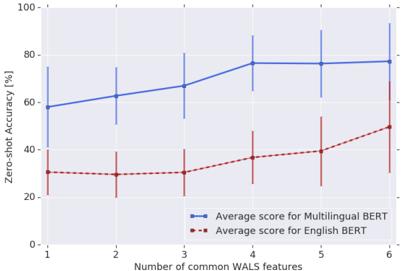
“We use the relevant features from the World Atlas of Language Structures, or WALS, where a feature is defined as a structural property of language that differs across languages (Dryer and Haspelmath, 2013).”
BackgroundMethodInfluentialTowards Fully Bilingual Deep Language ModelingPreprint
Chang, L., Pyysalo, S., Kanerva, J., & Ginter, F. (2020) · arXiv (Cornell University) · doi:10.48550/arxiv.2010.11639 · Cited by 7
“These efforts include work that proposes improvements and/or modifications to the training objectives (Liu et al., 2019; Lan et al., 2020), knowledge distillation (Sanh et al., 2019), multilinguality (Pires et al., 2019), and interpretation (Kovaleva et al., 2019), to name a few.”
BackgroundResultInfluentialFine-tuning BERT-based models for Plant Health Bulletin ClassificationPreprint
Jiang, S., Angarita, R., Cormier, S., & Rousseaux, F. (2021) · arXiv (Cornell University) · doi:10.48550/arxiv.2102.00838 · Cited by 6
“For the multi-label classification of the topic, we tested respectively the pretrained CamemBERT modelMartin et al. (2020) and BERT-Base, Multi-lingual Cased model Pires et al. (2019).”
MethodGraph-based Multilingual Product Retrieval in E-commerce SearchPreprint
Lu, H., Hu, Y., Zhao, T., Wu, T., Song, Y., & Yin, B. (2021) · arXiv (Cornell University) · doi:10.48550/arxiv.2105.02978 · Cited by 7
“…transformer-based models (Devlin et al., 2018; Yang et al., 2019b; Liu et al., 2019) such as Bidirectional Encoder Representations from Transformers (BERT) for natural language processing, multilingual BERT (M-BERT) has also demonstrated success for multilingual tasks (Pires et al., 2019).”
BackgroundMethodInfluentialOn the ability of monolingual models to learn language-agnostic representationsPreprint
de Souza, L. R., Nogueira, R. F., & Lotufo, R. (2021) · arXiv (Cornell University) · doi:10.48550/arxiv.2109.01942 · Cited by 8
“At first, it has been speculated that a shared vocabulary with common terms between languages would result in a shared input representation space, making it possible for the model to attain similar representations across languages (Pires et al., 2019).”
InfluentialProceedings of The 4th Workshop on e-Commerce and NLP
(2021) · doi:10.18653/v1/2021.ecnlp-1 · Cited by 8
Effective transfer learning for low-resource natural language understanding
Liu, Z. (2022) · doi:10.14711/thesis-991013106358603412 · Cited by 10
Understanding BLOOM: An empirical study on diverse NLP tasksPreprint
Dakle, P. P., Rallabandi, S. K., & Raghavan, P. (2022) · arXiv (Cornell University) · doi:10.48550/arxiv.2211.14865 · Cited by 9
“Pires et al. (2019) presented its superior zero-shot abilities for an NER task in Hinglish.”
MethodBangla_MER: A unique dataset for Bangla mathematical entity recognition
Aurpa, T. T., Jeba, S. M., Ahmed, M. S., Ullah, M. A., Mehzabin, M., & Anwar, M. M. (2024) · Data in Brief · doi:10.1016/j.dib.2024.110407 · Cited by 6
Understanding the role of FFNs in driving multilingual behaviour in LLMsPreprint
Bhattacharya, S., & Bojar, O. (2024) · arXiv (Cornell University) · doi:10.48550/arxiv.2404.13855 · Cited by 6
“The language agnosticity of the upper layers was also confirmed by (Liu et al., 2020; Pires et al., 2019).”
BackgroundShomikoron: Dataset to discover equations from Bangla Mathematical text
Aurpa, T. T., Fariha, K. N., & Hossain, K. (2024) · Data in Brief · doi:10.1016/j.dib.2024.110742 · Cited by 6
“Here we have used the multilingual BERT (mBERT) [ 3 ].”
MethodNUDGE: Lightweight Non-Parametric Fine-Tuning of Embeddings for Retrieval
Zeighami, S., Wellmer, Z., & Parameswaran, A. (2024) · International Conference on Learning Representations · doi:10.48550/arxiv.2409.02343 · Cited by 7
Breaking Language Barriers: A Question Answering Dataset for Hindi and MarathiPreprint
Sabane, M., Litake, O., & Chadha, A. R. (2023) · arXiv (Cornell University) · doi:10.13140/rg.2.2.29427.09760 · Cited by 6
Metadata
- Authors
- Pires, T., Schlinger, E., & Garrette, D.
- Affiliations
- Google (United States) (US)
- Venue
- Proceedings of the 57th Annual Meeting of the Association for Computational Linguistics
- Published
- 2019
- Pages
- 4996-5001
- ISSN
- 0736-587X (ISSN-L)
- OpenAlex
- W2952638691
- Cited by
- 1,351
- References
- 19
- Citations by year
- 2026: 133 · 2025: 174 · 2024: 132 · 2023: 245 · 2022: 221 · 2021: 247 · 2020: 176 · 2019: 23
- FWCI
- 63.81
- Type
- conference paper
- Language
- en
- Open access
- hybrid
- doi.org
- Licence
- cc-by
- Locations
- Proceedings of the conference - Association for Computational Linguistics. Meeting (publishedVersion, cc-by)
- arXiv (Cornell University) (submittedVersion)
- arXiv (Cornell University)
- Topics
- Physical Sciences › Computer Science › Artificial Intelligence › Topic Modeling
- Physical Sciences › Computer Science › Artificial Intelligence › Natural Language Processing Techniques
- Physical Sciences › Computer Science › Artificial Intelligence › Domain Adaptation and Few-Shot Learning
- Keywords
- multilingual BERT, zero-shot cross-lingual transfer, multilingual representations, typological similarity, code-switching, language model pretraining
About these checks
Registry, retraction, Cites and statistics results are computed, not judged, with one exception: a printed reference that no index lists is read once by a model before it counts as a citation error. Claims are extracted by a model and kept only when their quote appears verbatim in the text; each cited source is then checked, with a model’s help, for whether it says what the claim relies on. Those verdicts can be wrong — read the claim’s quote and the cited source before relying on one.
Statistics and arithmetic are recomputed, not judged.
Confidence bands are shown only for fields calibrated on our annotated test set. None is calibrated yet, so no band is shown.
What counts as a claim ›How we measure confidence ›How we check this ›
Are you an author, or do you see a problem with this page? Request a review
Data sources
Bibliographic data: Semantic Scholar, OpenAlex, Crossref.
Contains information from the Semantic Scholar Academic Graph Datasets, made available under the ODC Attribution License (ODC-BY 1.0).
Semantic Scholar’s data is described in: Kinney, R., et al. (2023). The Semantic Scholar Open Data Platform. arXiv:2301.10140.
