

Self-compassion mediates the perfectionism and depression link on Chinese undergraduates
Open accessThe DOI matches its Crossref record; 71 of the 73 references it cites were found in a registry or an index.
Abstract
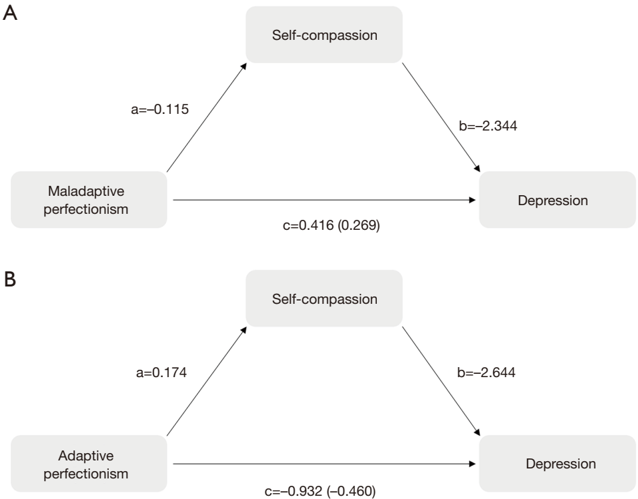
BACKGROUND: The prevalence of depression among Chinese college students tends to be higher in recent years, which has caused a series of negative effects in their lives. One of the factors is perfectionism, and few researches have been conducted to examine the role of self-compassion in perfectionism and depression link. The purpose of the study was to explore the relationships between perfectionism, self-compassion, and depression in the context of Chinese undergraduates. METHODS: The anonymous self-reported questionnaires including three scales on perfectionism, selfcompassion, and depression were utilized in the study. A total of 540 undergraduates were recruited from three universities in Nanjing and Xi'an by using convenient cluster sampling and were required to complete the questionnaires. Pearson correlation analysis was used to examine the correlation between variables. Multiple linear regression analysis was used to examine the predictive effects of perfectionism and selfcompassion on depression. Hierarchical multiple regression analysis was used to evaluate the mediating effect of self-compassion. RESULTS: Regression analyses demonstrated that the maladaptive perfectionism was positively associated with depression, while adaptive perfectionism and self-compassion were negatively associated with depression. The mediation tests showed that the self-compassion partially mediated the relationship between the two types of perfectionism and depression. CONCLUSIONS: This study revealed the mediating effect of self-compassion in the relation between perfectionism and depression in Chinese undergraduates. Self-compassion is likely to be an effective psychological intervention method to relieve the depressive symptoms in college students, and further study is needed to verify this possibility.
Overview
The claims and statistics of this paper haven’t been checked yet.
Free: it reads the open-access text and checks the first 5 claims that cite a source we can check. Create a free account to check every claim.
Integrity signals
Registry
Cites
Statistics
Figures
Verification
Claims the paper makes
The claims and statistics of this paper haven’t been checked yet.
Free: it reads the open-access text and checks the first 5 claims that cite a source we can check. Create a free account to check every claim.
Claims other papers make about this one
Each is checked against this paper’s own text: does it say what the citing paper says it does?
The source backs part of the claim, not all of it — or backs it for a different population, condition or comparison.
In the citing paper
“To our knowledge, only recently has research highlighted the mediating role of self-compassion in the relationship between adaptive perfectionism and psychological functioning [36,38].”
From The Influence of Positive and Negative Aspects of Perfectionism on Psychological Distress in Emerging Adulthood: Exploring the Mediating Role of Self-Compassion (2023) · cites this paper as [38]
Experimental — accuracy not yet measuredThe cited source says what the claim attributes to it.
In the citing paper
“Similarly, Wei et al. [38] confirmed that higher maladaptive perfectionism was linked to higher depression levels through self-compassion in Chinese students, while adaptive perfectionism was associated with increased self-compassion levels, which in turn mitigated the depressive mood.”
The cited source says what the claim attributes to it.
In the citing paper
“Similarly, Wei et al. [38] confirmed that higher maladaptive perfectionism was linked to higher depression levels through self-compassion in Chinese students, while adaptive perfectionism was associated with increased self-compassion levels, which in turn mitigated the depressive mood.”
Self-check
Percentages, sums and reported differences re-computed from the paper’s own numbers.
The self-check needs the paper’s full text.
Citations
Cites
SPSS and SAS procedures for estimating indirect effects in simple mediation models
Preacher, K. J., & Hayes, A. F. (2004) · Behavior Research Methods, Instruments, & Computers · doi:10.3758/bf03206553 · Cited by 17,383
A self-rating depression scale
ZUNG, W. W. K. (1965) · Archives of General Psychiatry · doi:10.1001/archpsyc.1965.01720310065008 · Cited by 9,813 · cited 1×
“Depression: the 20-item Self-rating Depression Scale (SDS) was used to measure depression (38).”
MethodThe Development and Validation of a Scale to Measure Self-Compassion
NEFF, K. D. (2003) · Self and Identity · doi:10.1080/15298860309027 · Cited by 6,436 · cited 4×
“According to Neff, self-compassion is comprised of three primary components which is self-kindness, common humanity, and mindfulness.”
MethodInfluentialSelf-Compassion: An Alternative Conceptualization of a Healthy Attitude Toward Oneself
NEFF, K. (2003) · Self and Identity · doi:10.1080/15298860309032 · Cited by 5,440 · cited 3×
“Remarkably, self-compassion is not only a psychological intervention method, but also a kind of personal skill that can be improved by practice (30).”
BackgroundMental health of young people: A global public-health challenge
Patel, V., Flisher, A. J., Hetrick, S., & McGorry, P. (2007) · The Lancet · doi:10.1016/s0140-6736(07)60368-7 · Cited by 3,126 · cited 1×
“These differences and changes in physiology, cognition, and environment may cause students’ psychological conflicts (47), which will further lead to poor academic performance, drug abuse, physical health problems, and behavior problems in adulthood and later life (48).”
BackgroundEffects of COVID-19 on College Students’ Mental Health in the United States: Interview Survey Study
Son, C., Hegde, S., Smith, A., Wang, X., & Sasangohar, F. (2020) · Journal of Medical Internet Research · doi:10.2196/21279 · Cited by 2,822 · cited 1×
“An Australian group has reported that a 6-week online self-compassion cultivation program can notably improve the self-compassion and happiness, as well as relieving the symptoms of depression, stress, and emotion regulation difficulties (71-73).”
BackgroundAuerbach, R. P., Collaborators, W. W.-I., Mortier, P., Bruffaerts, R., Alonso, J., Benjet, C., Cuijpers, P., Demyttenaere, K., Ebert, D. D., Green, J. G., et al. (2018) · Journal of Abnormal Psychology · doi:10.1037/abn0000362 · Cited by 2,522 · cited 1×
“It means that teenagers, especially adolescent university students are more likely to suffer from this negative mood because they are undergoing the growth phase (7).”
BackgroundA pilot study and randomized controlled trial of the mindful self-compassion program
Neff, K. D., & Germer, C. K. (2013) · Journal of Clinical Psychology · doi:10.1002/jclp.21923 · Cited by 2,253 · cited 1×
“In addition, the mindful self-compassion course based on Neff’s conceptualization can also improve self-compassion, and the symptoms of depression, anxiety, and stress are significantly decreased after 6 months (69).”
BackgroundA systematic review of studies of depression prevalence in university students
Ibrahim, A. K., Kelly, S. J., Adams, C. E., & Glazebrook, C. (2013) · Journal of Psychiatric Research · doi:10.1016/j.jpsychires.2012.11.015 · Cited by 1,988 · cited 2×
“About 30% of the university students worldwide reported depression, and the incidence rate of depression is 24% in Chinese university undergraduates (9,10).”
BackgroundExploring compassion: A meta-analysis of the association between self-compassion and psychopathology
MacBeth, A., & Gumley, A. (2012) · Clinical Psychology Review · doi:10.1016/j.cpr.2012.06.003 · Cited by 1,838 · cited 1×
“However, most of these researches focused on the adult, and the effects of self-compassion on adolescents, especially university undergraduates have been rarely reported (56,57).”
Background
Research works printed but not linked: 5
- Malhi GS, Mann JJ. Depression. Lancet 2018;392:2299-312.
- © Annals of Palliative Medicine. All rights reserved. Ann Palliat Med 2021;10(2):1950-1960 | http://dx.doi.org/10.21037/apm-20-1582
- Rotenstein LS, Ramos MA, Torre M, et al. Prevalence of Depression, Depressive Symptoms, and Suicidal Ideation Among Medical Students: A Systematic Review and Meta- Analysis. JAMA 2016;316:2214-36.
- Brewer MB, Cantor N, Kerr NL. Personality and social psychology review. Pers Soc Psychol Rev 1997;1:2.
- Lomax RG, Hahsvaughn DL. Statistical Concepts, 4th Edition. 2015.
Cited by
Pereira, A. T., Brito, M. J., Cabaços, C., Carneiro, M., Carvalho, F., Manão, A. A., Araújo, A. I., Pereira, D., & Macedo, A. (2022) · International Journal of Environmental Research and Public Health · doi:10.3390/ijerph19052740 · Cited by 66
Koutra, K., Mouatsou, C., & Psoma, S. (2023) · Behavioral Sciences · doi:10.3390/bs13110932 · Cited by 25
“To our knowledge, only recently has research highlighted the mediating role of self-compassion in the relationship between adaptive perfectionism and psychological functioning [36,38].”
BackgroundWell-Being and Perfectionism: Assessing the Mediational Role of Self-Compassion in Emerging Adults
Benedetto, L., Macidonio, S., & Ingrassia, M. (2024) · European Journal of Investigation in Health Psychology and Education · doi:10.3390/ejihpe14050091 · Cited by 41
“Specifically, in most studies [24,26,33,34] maladaptive perfectionism showed moderate-to-large associations with lower self-compassion levels.”
BackgroundTan, J. S. T. (2023) · Cogent Psychology · doi:10.1080/23311908.2023.2168424 · Cited by 27
“Self-compassion has been found to be a significant mediator between perfectionism and several mental health outcomes, including depression (Wei et al., 2021) and subjective wellbeing (SWB; Stoeber et al., 2020).”
BackgroundCabaços, C., Macedo, A., Carneiro, M., Brito, M. J., Amaral, A. P., Araújo, A., Correia, D. T., Novais, F., Vitória, P., & Pereira, A. T. (2023) · Personality and Individual Differences · doi:10.1016/j.paid.2023.112314 · Cited by 15
Metadata
- Authors
- Wei, S., Li, L., Shi, J., Liang, H., & Yang, X.
- Affiliations
- Renmin University of China (CN)
- Nanjing Drum Tower Hospital (CN)
- Nanjing Normal University (CN)
- Corresponding author
- Li, Lan
- Yang, Xianfeng
- Venue
- Annals of Palliative Medicine
- Publisher
- AME Publishing Company
- Published
- 2021-02
- Volume
- 10
- Issue
- 2
- Pages
- 1950-1960
- ISSN
- 2224-5820 (ISSN-L)
- 2224-5839
- OpenAlex
- W3113996885
- Cited by
- 24
- References
- 73
- Citations by year
- 2026: 4 · 2025: 3 · 2024: 5 · 2023: 9 · 2022: 2 · 2021: 1
- FWCI
- 2.90
- Type
- journal article
- Language
- en
- Open access
- diamond
- doi.org
- Licence
- cc-by-nc-nd
- Locations
- Annals of Palliative Medicine (publishedVersion, cc-by-nc-nd)
- PubMed (publishedVersion)
- Funders
- Massachusetts Department of Agricultural Resources
- Nanjing Normal University
- Renmin University of China
- Southeast University
- Topics
- Social Sciences › Psychology › Clinical Psychology › Perfectionism, Procrastination, Anxiety Studies
- Social Sciences › Psychology › Developmental and Educational Psychology › Student Stress and Coping
- Social Sciences › Psychology › Clinical Psychology › Mindfulness and Compassion Interventions
- Keywords
- self-compassion, perfectionism, depression, maladaptive perfectionism, adaptive perfectionism, mediation, university students, Chinese undergraduates, depressive symptoms
- MeSH terms
- Perfectionism, China, Depression, Empathy, Humans, Self Concept, Students
About these checks
Registry, retraction, Cites and statistics results are computed, not judged, with one exception: a printed reference that no index lists is read once by a model before it counts as a citation error. Claims are extracted by a model and kept only when their quote appears verbatim in the text; each cited source is then checked, with a model’s help, for whether it says what the claim relies on. Those verdicts can be wrong — read the claim’s quote and the cited source before relying on one.
Statistics and arithmetic are recomputed, not judged.
Confidence bands are shown only for fields calibrated on our annotated test set. None is calibrated yet, so no band is shown.
What counts as a claim ›How we measure confidence ›How we check this ›
Are you an author, or do you see a problem with this page? Request a review
Data sources
Bibliographic data: Semantic Scholar, OpenAlex, Crossref.
Contains information from the Semantic Scholar Academic Graph Datasets, made available under the ODC Attribution License (ODC-BY 1.0).
Semantic Scholar’s data is described in: Kinney, R., et al. (2023). The Semantic Scholar Open Data Platform. arXiv:2301.10140.
