

Self-compassion mediates the perfectionism and depression link on Chinese undergraduates
Open accessThe DOI matches its Crossref record; 71 of the 73 references it cites were found in a registry or an index.
Abstract
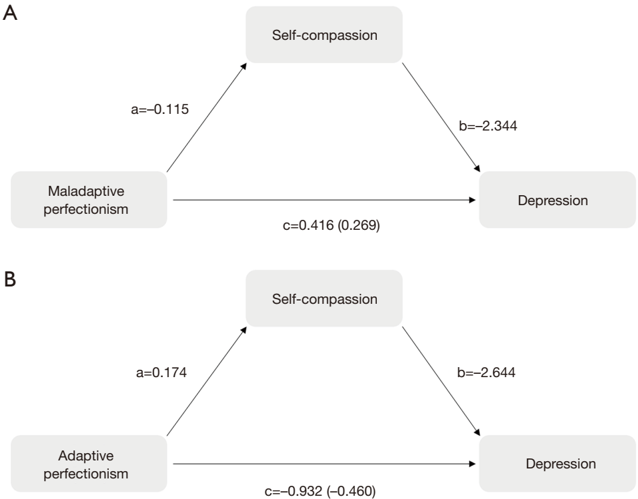
BACKGROUND: The prevalence of depression among Chinese college students tends to be higher in recent years, which has caused a series of negative effects in their lives. One of the factors is perfectionism, and few researches have been conducted to examine the role of self-compassion in perfectionism and depression link. The purpose of the study was to explore the relationships between perfectionism, self-compassion, and depression in the context of Chinese undergraduates. METHODS: The anonymous self-reported questionnaires including three scales on perfectionism, selfcompassion, and depression were utilized in the study. A total of 540 undergraduates were recruited from three universities in Nanjing and Xi'an by using convenient cluster sampling and were required to complete the questionnaires. Pearson correlation analysis was used to examine the correlation between variables. Multiple linear regression analysis was used to examine the predictive effects of perfectionism and selfcompassion on depression. Hierarchical multiple regression analysis was used to evaluate the mediating effect of self-compassion. RESULTS: Regression analyses demonstrated that the maladaptive perfectionism was positively associated with depression, while adaptive perfectionism and self-compassion were negatively associated with depression. The mediation tests showed that the self-compassion partially mediated the relationship between the two types of perfectionism and depression. CONCLUSIONS: This study revealed the mediating effect of self-compassion in the relation between perfectionism and depression in Chinese undergraduates. Self-compassion is likely to be an effective psychological intervention method to relieve the depressive symptoms in college students, and further study is needed to verify this possibility.
Overview
The claims and statistics of this paper haven’t been checked yet.
Free: it reads the open-access text and checks the first 5 claims that cite a source we can check. Create a free account to check every claim.
Integrity signals
Registry
Cites
Statistics
Figures
Verification
Claims the paper makes
The claims and statistics of this paper haven’t been checked yet.
Free: it reads the open-access text and checks the first 5 claims that cite a source we can check. Create a free account to check every claim.
Claims other papers make about this one
Each is checked against this paper’s own text: does it say what the citing paper says it does?
The source backs part of the claim, not all of it — or backs it for a different population, condition or comparison.
In the citing paper
“To our knowledge, only recently has research highlighted the mediating role of self-compassion in the relationship between adaptive perfectionism and psychological functioning [36,38].”
From The Influence of Positive and Negative Aspects of Perfectionism on Psychological Distress in Emerging Adulthood: Exploring the Mediating Role of Self-Compassion (2023) · cites this paper as [38]
Experimental — accuracy not yet measuredThe cited source says what the claim attributes to it.
In the citing paper
“Similarly, Wei et al. [38] confirmed that higher maladaptive perfectionism was linked to higher depression levels through self-compassion in Chinese students, while adaptive perfectionism was associated with increased self-compassion levels, which in turn mitigated the depressive mood.”
The cited source says what the claim attributes to it.
In the citing paper
“Similarly, Wei et al. [38] confirmed that higher maladaptive perfectionism was linked to higher depression levels through self-compassion in Chinese students, while adaptive perfectionism was associated with increased self-compassion levels, which in turn mitigated the depressive mood.”
Self-check
Percentages, sums and reported differences re-computed from the paper’s own numbers.
The self-check needs the paper’s full text.
Citations
Cites
SPSS and SAS procedures for estimating indirect effects in simple mediation models
Preacher, K. J., & Hayes, A. F. (2004) · Behavior Research Methods, Instruments, & Computers · doi:10.3758/bf03206553 · Cited by 17,383
A self-rating depression scale
ZUNG, W. W. K. (1965) · Archives of General Psychiatry · doi:10.1001/archpsyc.1965.01720310065008 · Cited by 9,813 · cited 1×
“Depression: the 20-item Self-rating Depression Scale (SDS) was used to measure depression (38).”
MethodThe Development and Validation of a Scale to Measure Self-Compassion
NEFF, K. D. (2003) · Self and Identity · doi:10.1080/15298860309027 · Cited by 6,436 · cited 4×
“According to Neff, self-compassion is comprised of three primary components which is self-kindness, common humanity, and mindfulness.”
MethodInfluentialSelf-Compassion: An Alternative Conceptualization of a Healthy Attitude Toward Oneself
NEFF, K. (2003) · Self and Identity · doi:10.1080/15298860309032 · Cited by 5,440 · cited 3×
“Remarkably, self-compassion is not only a psychological intervention method, but also a kind of personal skill that can be improved by practice (30).”
BackgroundMental health of young people: A global public-health challenge
Patel, V., Flisher, A. J., Hetrick, S., & McGorry, P. (2007) · The Lancet · doi:10.1016/s0140-6736(07)60368-7 · Cited by 3,126 · cited 1×
“These differences and changes in physiology, cognition, and environment may cause students’ psychological conflicts (47), which will further lead to poor academic performance, drug abuse, physical health problems, and behavior problems in adulthood and later life (48).”
BackgroundEffects of COVID-19 on College Students’ Mental Health in the United States: Interview Survey Study
Son, C., Hegde, S., Smith, A., Wang, X., & Sasangohar, F. (2020) · Journal of Medical Internet Research · doi:10.2196/21279 · Cited by 2,822 · cited 1×
“An Australian group has reported that a 6-week online self-compassion cultivation program can notably improve the self-compassion and happiness, as well as relieving the symptoms of depression, stress, and emotion regulation difficulties (71-73).”
BackgroundAuerbach, R. P., Collaborators, W. W.-I., Mortier, P., Bruffaerts, R., Alonso, J., Benjet, C., Cuijpers, P., Demyttenaere, K., Ebert, D. D., Green, J. G., et al. (2018) · Journal of Abnormal Psychology · doi:10.1037/abn0000362 · Cited by 2,522 · cited 1×
“It means that teenagers, especially adolescent university students are more likely to suffer from this negative mood because they are undergoing the growth phase (7).”
BackgroundA pilot study and randomized controlled trial of the mindful self-compassion program
Neff, K. D., & Germer, C. K. (2013) · Journal of Clinical Psychology · doi:10.1002/jclp.21923 · Cited by 2,253 · cited 1×
“In addition, the mindful self-compassion course based on Neff’s conceptualization can also improve self-compassion, and the symptoms of depression, anxiety, and stress are significantly decreased after 6 months (69).”
BackgroundA systematic review of studies of depression prevalence in university students
Ibrahim, A. K., Kelly, S. J., Adams, C. E., & Glazebrook, C. (2013) · Journal of Psychiatric Research · doi:10.1016/j.jpsychires.2012.11.015 · Cited by 1,988 · cited 2×
“About 30% of the university students worldwide reported depression, and the incidence rate of depression is 24% in Chinese university undergraduates (9,10).”
BackgroundExploring compassion: A meta-analysis of the association between self-compassion and psychopathology
MacBeth, A., & Gumley, A. (2012) · Clinical Psychology Review · doi:10.1016/j.cpr.2012.06.003 · Cited by 1,838 · cited 1×
“However, most of these researches focused on the adult, and the effects of self-compassion on adolescents, especially university undergraduates have been rarely reported (56,57).”
BackgroundThe Relationship Between Self‐Compassion and Well‐Being: A Meta‐Analysis
Zessin, U., Dickhäuser, O., & Garbade, S. (2015) · Applied Psychology: Health and Well-Being · doi:10.1111/aphw.12051 · Cited by 1,237
Self-compassion and Psychological Resilience Among Adolescents and Young Adults
Neff, K. D., & McGehee, P. (2010) · Self and Identity · doi:10.1080/15298860902979307 · Cited by 1,232 · cited 1×
“With the assistance of selfcompassion, it is easier for university undergraduates to build up self-recognition and mental resilience in their vital growth period of developing self-identification and self-efficacy (67).”
BackgroundHeim, C., & Binder, E. B. (2012) · Experimental Neurology · doi:10.1016/j.expneurol.2011.10.032 · Cited by 986 · cited 1×
“The incidence rate of this emotional disorder is significantly influenced by the social and cultural factors as well as the genomic and other biological factors (4).”
BackgroundPerfectionism as a transdiagnostic process: A clinical review
Egan, S. J., Wade, T. D., & Shafran, R. (2011) · Clinical Psychology Review · doi:10.1016/j.cpr.2010.04.009 · Cited by 961 · cited 2×
“Evidences have been presented to certify that perfectionism can predict the later episodes development of major depression, and later alternation in depression except neuroticism (17,65).”
BackgroundInterventions to reduce stress in university students: A review and meta-analysis
Regehr, C., Glancy, D., & Pitts, A. (2013) · Journal of Affective Disorders · doi:10.1016/j.jad.2012.11.026 · Cited by 956 · cited 1×
“Considering that the depression has induced abnormal social relationship, increased weariness, and even self-injury behavior, it is necessary to clarify the generative mechanism and find effective psychological interventions (46).”
BackgroundPathophysiology of depression: do we have any solid evidence of interest to clinicians?
HASLER, G. (2010) · World Psychiatry · doi:10.1002/j.2051-5545.2010.tb00298.x · Cited by 604
Profiles of adolescent stress: The development of the adolescent stress questionnaire (ASQ)
Byrne, D. G., Davenport, S. C., & Mazanov, J. (2007) · Journal of Adolescence · doi:10.1016/j.adolescence.2006.04.004 · Cited by 596 · cited 1×
“These differences and changes in physiology, cognition, and environment may cause students’ psychological conflicts (47), which will further lead to poor academic performance, drug abuse, physical health problems, and behavior problems in adulthood and later life (48).”
BackgroundZung, W. W. K. (2012) · PsycTESTS Dataset · doi:10.1037/t04095-000 · Cited by 596
Positive and negative perfectionism
Terry-Short, L. A., Owens, R. G., Slade, P. D., & Dewey, M. E. (1995) · Personality and Individual Differences · doi:10.1016/0191-8869(94)00192-u · Cited by 500 · cited 1×
“It may accelerate the progress of depression since maladaptive perfectionists prefer to pursue unrealistic goals and they’re motivated by avoiding failure (19,20).”
BackgroundLittle Emperors: Behavioral Impacts of China's One-Child Policy
Cameron, L., Erkal, N., Gangadharan, L., & Meng, X. (2013) · Science · doi:10.1126/science.1230221 · Cited by 392
Krieger, T., Altenstein, D., Baettig, I., Doerig, N., & Holtforth, M. G. (2013) · Behavior Therapy · doi:10.1016/j.beth.2013.04.004 · Cited by 374 · cited 1×
“Several studies have proved that self-compassion has advantages in improving mental health outcomes, including suicidal behavior, depression, and eating disorders (53-55).”
BackgroundPatel, V., Xiao, S., Chen, H., Hanna, F., Jotheeswaran, A. T., Luo, D., Parikh, R., Sharma, E., Usmani, S., Yu, Y., et al. (2016) · The Lancet · doi:10.1016/s0140-6736(16)00160-4 · Cited by 342
Lykes, V. A., & Kemmelmeier, M. (2014) · Journal of Cross-Cultural Psychology · doi:10.1177/0022022113509881 · Cited by 326 · cited 1×
“Therefore, when they leave home to start the college life, they’re more likely to feel lonely than their peers who have siblings (51).”
BackgroundPrevalence of Depression among Chinese University Students: A Meta-Analysis
Lei, X.-Y., Xiao, L.-M., Liu, Y.-N., & Li, Y.-M. (2016) · PLOS ONE · doi:10.1371/journal.pone.0153454 · Cited by 300 · cited 3×
“More importantly, high prevalence of depression has been proved to relate to high risk of suicidal ideation, substance abuse, and acute infectious illnesses (10).”
BackgroundFeng, Q., Zhang, Q.-L., Du, Y., Ye, Y.-L., & He, Q.-Q. (2014) · PLoS ONE · doi:10.1371/journal.pone.0100914 · Cited by 285 · cited 1×
“25 to achieve the Standard Scores, and the cut-off score of 53 is appropriate for Chinese populations (39,40).”
BackgroundBluth, K., Campo, R. A., Futch, W. S., & Gaylord, S. A. (2017) · Journal of Youth and Adolescence · doi:10.1007/s10964-016-0567-2 · Cited by 258 · cited 1×
“Several studies have demonstrated that there is an inverse relationship between self-compassion and depression (32-34).”
BackgroundPatsali, M. E., Mousa, D.-P. V., Papadopoulou, E. V. K., Papadopoulou, K. K. K., Kaparounaki, C. K., Diakogiannis, I., & Fountoulakis, K. N. (2020) · Psychiatry Research · doi:10.1016/j.psychres.2020.113298 · Cited by 249 · cited 1×
“An Australian group has reported that a 6-week online self-compassion cultivation program can notably improve the self-compassion and happiness, as well as relieving the symptoms of depression, stress, and emotion regulation difficulties (71-73).”
BackgroundBarry, C. T., Loflin, D. C., & Doucette, H. (2015) · Personality and Individual Differences · doi:10.1016/j.paid.2014.12.036 · Cited by 208 · cited 1×
“Several studies have demonstrated that there is an inverse relationship between self-compassion and depression (32-34).”
BackgroundSmith, M. M., Sherry, S. B., Rnic, K., Saklofske, D. H., Enns, M., & Gralnick, T. (2016) · European Journal of Personality · doi:10.1002/per.2053 · Cited by 197 · cited 1×
“Evidences have been presented to certify that perfectionism can predict the later episodes development of major depression, and later alternation in depression except neuroticism (17,65).”
BackgroundUsing acceptance and commitment therapy to increase self-compassion: A randomized controlled trial
Yadavaia, J. E., Hayes, S. C., & Vilardaga, R. (2014) · Journal of Contextual Behavioral Science · doi:10.1016/j.jcbs.2014.09.002 · Cited by 188 · cited 1×
“The acceptance and commitment therapy (ACT) has been proved effective in strengthening individual’s self-compassion, especially for patients with psychological distress, depression, and anxiety (68).”
BackgroundKelly, A. C., Vimalakanthan, K., & Miller, K. E. (2014) · Body Image · doi:10.1016/j.bodyim.2014.07.005 · Cited by 177
Self-compassion moderates the perfectionism and depression link in both adolescence and adulthood
Ferrari, M., Yap, K., Scott, N., Einstein, D. A., & Ciarrochi, J. (2018) · PLOS ONE · doi:10.1371/journal.pone.0192022 · Cited by 173 · cited 2×
“The results indicated that selfcompassion weakened the strength of the relationship between maladaptive perfectionism and depression in both adolescent and adult groups as a moderator (28).”
BackgroundPrevalence of Suicidal Ideation in Chinese College Students: A Meta-Analysis
Li, Z.-Z., Li, Y.-M., Lei, X.-Y., Zhang, D., Liu, L., Tang, S.-Y., & Chen, L. (2014) · PLoS ONE · doi:10.1371/journal.pone.0104368 · Cited by 161 · cited 1×
“This special parenting style directly leads to students’ inability to bear pressure or negative emotions, and consequently accelerates the occurrence of depression (12).”
BackgroundPerfectionism and the Five-factor Personality Traits as Predictors of Mortality in Older Adults
Fry, P. S., & Debats, D. L. (2009) · Journal of Health Psychology · doi:10.1177/1359105309103571 · Cited by 154 · cited 1×
“This situation will be gradually aggravated during the individual development (64).”
Background(2011) · Zhongguo linchuang xinlixue zazhi · Cited by 146
Finlay‐Jones, A., Kane, R., & Rees, C. (2017) · Journal of Clinical Psychology · doi:10.1002/jclp.22375 · Cited by 139 · cited 1×
“An Australian group has reported that a 6-week online self-compassion cultivation program can notably improve the self-compassion and happiness, as well as relieving the symptoms of depression, stress, and emotion regulation difficulties (71-73).”
BackgroundHow Do the Dimensions of Perfectionism Relate to Mental Health?
DiBartolo, P. M., Li, C. Y., & Frost, R. O. (2008) · Cognitive Therapy and Research · doi:10.1007/s10608-007-9157-7 · Cited by 134 · cited 1×
“However, the maladaptive perfectionists generally present high levels of self-criticism, suffering from negative evaluation, and concerning about mistakes, which results in a series of psychopathological changes (17,18).”
BackgroundTang, W., Hu, T., Yang, L., & Xu, J. (2020) · Personality and Individual Differences · doi:10.1016/j.paid.2020.110131 · Cited by 128 · cited 1×
“During pandemics, the incidence of depression in university students may increase due to the fear of the novel coronavirus infection (COVID-19) and the school closure (70).”
BackgroundPerceived Social Support as Moderator of Perfectionism, Depression, and Anxiety in College Students
Zhou, X., Zhu, H., Zhang, B., & Cai, T. (2013) · Social Behavior and Personality: an international journal · doi:10.2224/sbp.2013.41.7.1141 · Cited by 114 · cited 1×
“On the other hand, the moderators include life meaning, self-efficacy, self-compassion, and social support (26-29).”
BackgroundMaladaptive coping and self-esteem as mediators between perfectionism and psychological distress
Park, H.-J., Heppner, P. P., & Lee, D. (2010) · Personality and Individual Differences · doi:10.1016/j.paid.2009.11.024 · Cited by 110 · cited 1×
“Self-esteem, social support, optimism, rumination, immature defenses, self-compassion and maladaptive coping strategies have been respectively reported to be the role of mediator among perfectionism and depression (21-25).”
BackgroundMental health of young people: a global public‐health challenge
Reading, R. (2007) · Child: Care, Health and Development · doi:10.1111/j.1365-2214.2007.00778_2.x · Cited by 105
2614 – Interventions to Reduce Stress in University Students: A Review and Meta-Analysis
Regehr, C., Glancy, D., & Pitts, A. (2013) · European Psychiatry · doi:10.1016/s0924-9338(13)77263-8 · Cited by 98
Mehr, K. E., & Adams, A. C. (2016) · Journal of College Student Psychotherapy · doi:10.1080/87568225.2016.1140991 · Cited by 98 · cited 2×
“The existence of maladaptive perfectionism would induce the improper attitude towards these failures, such as extreme self-criticism, excessive personal standards, and dissatisfaction with their own performance, thereby further exacerbating the negative impacts of negative emotions (35,60).”
BackgroundManagement of Treatment-Resistant Depression in Children and Adolescents
DeFilippis, M., & Wagner, K. D. (2014) · Pediatric Drugs · doi:10.1007/s40272-014-0088-y · Cited by 89
Wang, Y.-H., Shi, Z.-T., & Luo, Q.-Y. (2017) · Medicine · doi:10.1097/md.0000000000006476 · Cited by 89
Perfectionism, Stressful Life Events, and the 1-Year Outcome of Depression
Enns, M. W., & Cox, B. J. (2005) · Cognitive Therapy and Research · doi:10.1007/s10608-005-2414-8 · Cited by 82 · cited 1×
“Studies on clinical and community samples have shown that there is a significant relationship between perfectionism and depression, and the occurrence of maladaptive perfectionism is usually earlier than depression (61-63).”
BackgroundZhang, N., Fan, F., Huang, S., & Rodriguez, M. A. (2018) · International Journal of Psychology · doi:10.1002/ijop.12394 · Cited by 82 · cited 1×
“Until the year of 2016, the One-Child Policy has been implemented for about 40 years, and it directly gave rise to the emergence of “the loneliest” generation (49).”
BackgroundLei, M., Li, C., Xiao, X., Qiu, J., Dai, Y., & Zhang, Q. (2011) · Comprehensive Psychiatry · doi:10.1016/j.comppsych.2011.08.007 · Cited by 80 · cited 1×
“25 to achieve the Standard Scores, and the cut-off score of 53 is appropriate for Chinese populations (39,40).”
BackgroundCastilho, P., Carvalho, S. A., Marques, S., & Pinto‐Gouveia, J. (2016) · Journal of Child and Family Studies · doi:10.1007/s10826-016-0613-4 · Cited by 80 · cited 1×
“Several studies have demonstrated that there is an inverse relationship between self-compassion and depression (32-34).”
BackgroundA systematic review of the relation between self‐compassion and depressive symptoms in adolescents
Pullmer, R., Chung, J., Samson, L., Balanji, S., & Zaitsoff, S. (2019) · Journal of Adolescence · doi:10.1016/j.adolescence.2019.06.006 · Cited by 75 · cited 2×
“As a potent factor to inhibit the development of depression and improve the depressive symptoms, selfcompassion plays an important role in the depression intervention of university undergraduates (58).”
BackgroundBlack, J. E., & Reynolds, W. M. (2012) · Personality and Individual Differences · doi:10.1016/j.paid.2012.10.012 · Cited by 74 · cited 1×
“Self-esteem, social support, optimism, rumination, immature defenses, self-compassion and maladaptive coping strategies have been respectively reported to be the role of mediator among perfectionism and depression (21-25).”
BackgroundIs perfect good? – Dimensions of perfectionism in newly admitted medical students
Seeliger, H., & Harendza, S. (2017) · BMC Medical Education · doi:10.1186/s12909-017-1034-9 · Cited by 70 · cited 1×
“It may accelerate the progress of depression since maladaptive perfectionists prefer to pursue unrealistic goals and they’re motivated by avoiding failure (19,20).”
BackgroundPerfectionism and negative mood: The mediating roles of validation from others versus self.
Wu, T.-F., & Wei, M. (2008) · Journal of Counseling Psychology · doi:10.1037/0022-0167.55.2.276 · Cited by 68 · cited 1×
“The existence of maladaptive perfectionism would induce the improper attitude towards these failures, such as extreme self-criticism, excessive personal standards, and dissatisfaction with their own performance, thereby further exacerbating the negative impacts of negative emotions (35,60).”
BackgroundSherry, S., Gautreau, C. M., Mushquash, A. R., Sherry, D. L., & Allen, S. L. (2014) · Personality and Individual Differences · doi:10.1016/j.paid.2014.04.035 · Cited by 66
Li, H., Fu, R., Zou, Y., & Cui, Y. (2017) · Frontiers in Psychology · doi:10.3389/fpsyg.2017.01550 · Cited by 57
Rabon, J. K., Sirois, F. M., & Hirsch, J. K. (2017) · Journal of American College Health · doi:10.1080/07448481.2017.1382498 · Cited by 55 · cited 1×
“Several studies have proved that self-compassion has advantages in improving mental health outcomes, including suicidal behavior, depression, and eating disorders (53-55).”
BackgroundMultidimensional perfectionism, depression, and anxiety: Tests of a social support mediation model
Gnilka, P. B., & Broda, M. (2018) · Personality and Individual Differences · doi:10.1016/j.paid.2018.11.031 · Cited by 50 · cited 1×
“Self-esteem, social support, optimism, rumination, immature defenses, self-compassion and maladaptive coping strategies have been respectively reported to be the role of mediator among perfectionism and depression (21-25).”
BackgroundModeration effects of perfectionism and meaning in life on depression
Park, H.-J., & Jeong, D. Y. (2016) · Personality and Individual Differences · doi:10.1016/j.paid.2016.03.073 · Cited by 45 · cited 1×
“On the other hand, the moderators include life meaning, self-efficacy, self-compassion, and social support (26-29).”
BackgroundMental Health Apps in China: Analysis and Quality Assessment
Shang, J., Wei, S., Jin, J., & Zhang, P. (2019) · JMIR mhealth and uhealth · doi:10.2196/13236 · Cited by 45 · cited 1×
“Worse still, mental disorder has been stigmatized in China for a long time, making patients refuse to ask for help (59).”
BackgroundThe mediating influence of hope on multidimensional perfectionism and depression
Mathew, J., Dunning, C., Coats, C., & Whelan, T. A. (2014) · Personality and Individual Differences · doi:10.1016/j.paid.2014.06.008 · Cited by 44 · cited 1×
“It helps people to set reachable targets and emphasize achieving success during the process, which will decrease the occurrence rate of depression (15,16).”
BackgroundFu, Z., Zhou, S., Burger, H., Bockting, C. L. H., & Williams, A. D. (2020) · Journal of Affective Disorders · doi:10.1016/j.jad.2019.11.058 · Cited by 44 · cited 1×
“These complex issues generally bring about intense pressure ranging from academic, economic, and interpersonal aspects, to the preoccupation with post-graduation life (8).”
BackgroundXu, Z. (2006) · Zhongguo linchuang xinlixue zazhi · Cited by 42
Buffering against Maladaptive Perfectionism in Bipolar Disorder: The Role of Self-Compassion
Fletcher, K., Yang, Y., Johnson, S. L., Berk, M., Perich, T., Cotton, S., Jones, S., Lapsley, S., Michalak, E., & Murray, G. (2019) · Journal of Affective Disorders · doi:10.1016/j.jad.2019.03.003 · Cited by 40 · cited 1×
“Self-esteem, social support, optimism, rumination, immature defenses, self-compassion and maladaptive coping strategies have been respectively reported to be the role of mediator among perfectionism and depression (21-25).”
BackgroundCompassion Focused Therapy for People with Bipolar Disorder
Lowens, I. (2010) · International Journal of Cognitive Therapy · doi:10.1521/ijct.2010.3.2.172 · Cited by 33 · cited 1×
“For the patients with depression induced by maladaptive perfectionism, the three dimensions of selfcompassion can buffer the stress, the harshness, and selfcriticism associated with maladaptive perfectionism by training self-kindness and self-acceptance (66).”
BackgroundSherry, S., Nealis, L. J., Macneil, M. A., Stewart, S. H., Sherry, D. L., & Smith, M. M. (2013) · Personality and Individual Differences · doi:10.1016/j.paid.2013.01.002 · Cited by 28 · cited 1×
“Studies on clinical and community samples have shown that there is a significant relationship between perfectionism and depression, and the occurrence of maladaptive perfectionism is usually earlier than depression (61-63).”
BackgroundLittle Emperors: Behavioral Impacts of China's One-Child Policy
Cameron, L., Erkal, N., Gangadharan, L., & Meng, X. (2013) · ICPSR Data Holdings · doi:10.3886/icpsr34521 · Cited by 26
Senra, C., Merino, H., & Ferreiro, F. (2018) · Journal of Clinical Psychology · doi:10.1002/jclp.22571 · Cited by 20 · cited 1×
“Self-esteem, social support, optimism, rumination, immature defenses, self-compassion and maladaptive coping strategies have been respectively reported to be the role of mediator among perfectionism and depression (21-25).”
BackgroundZhou, L., Chen, G., Yanghua, J., Liqiong, L., & Chen, J. (2017) · Psychological Reports · doi:10.1177/0033294117700857 · Cited by 19 · cited 2×
“, and the reliability and validity were confirmed (36,42).”
BackgroundThe dual model of perfectionism and depression among Chinese University students
Wang, Y., & Zhang, B. (2017) · South African Journal of Psychiatry · doi:10.4102/sajpsychiatry.v23i0.1025 · Cited by 16 · cited 1×
“It helps people to set reachable targets and emphasize achieving success during the process, which will decrease the occurrence rate of depression (15,16).”
BackgroundRisking existence: The experience and handling of depression
Bygstad‐Landro, M., & Giske, T. (2017) · Journal of Clinical Nursing · doi:10.1111/jocn.14056 · Cited by 14 · cited 1×
“According to the prediction of World Health Organization (WHO), this illness will be ranked as the first cause of burden of disease all over the world by 2030 (1).”
MethodMODERATING EFFECTS OF SELF-EFFICACY IN THE RELATIONS OF THE PERFECTIONISM AND DEPRESSION
Zhang, B., & Cai, T. (2012) · Studia Psychologica · Cited by 11
Research works printed but not linked: 5
- Malhi GS, Mann JJ. Depression. Lancet 2018;392:2299-312.
- © Annals of Palliative Medicine. All rights reserved. Ann Palliat Med 2021;10(2):1950-1960 | http://dx.doi.org/10.21037/apm-20-1582
- Rotenstein LS, Ramos MA, Torre M, et al. Prevalence of Depression, Depressive Symptoms, and Suicidal Ideation Among Medical Students: A Systematic Review and Meta- Analysis. JAMA 2016;316:2214-36.
- Brewer MB, Cantor N, Kerr NL. Personality and social psychology review. Pers Soc Psychol Rev 1997;1:2.
- Lomax RG, Hahsvaughn DL. Statistical Concepts, 4th Edition. 2015.
Cited by
Pereira, A. T., Brito, M. J., Cabaços, C., Carneiro, M., Carvalho, F., Manão, A. A., Araújo, A. I., Pereira, D., & Macedo, A. (2022) · International Journal of Environmental Research and Public Health · doi:10.3390/ijerph19052740 · Cited by 65
Koutra, K., Mouatsou, C., & Psoma, S. (2023) · Behavioral Sciences · doi:10.3390/bs13110932 · Cited by 25
“To our knowledge, only recently has research highlighted the mediating role of self-compassion in the relationship between adaptive perfectionism and psychological functioning [36,38].”
BackgroundWell-Being and Perfectionism: Assessing the Mediational Role of Self-Compassion in Emerging Adults
Benedetto, L., Macidonio, S., & Ingrassia, M. (2024) · European Journal of Investigation in Health Psychology and Education · doi:10.3390/ejihpe14050091 · Cited by 41
“Specifically, in most studies [24,26,33,34] maladaptive perfectionism showed moderate-to-large associations with lower self-compassion levels.”
BackgroundTan, J. S. T. (2023) · Cogent Psychology · doi:10.1080/23311908.2023.2168424 · Cited by 27
“Self-compassion has been found to be a significant mediator between perfectionism and several mental health outcomes, including depression (Wei et al., 2021) and subjective wellbeing (SWB; Stoeber et al., 2020).”
BackgroundCabaços, C., Macedo, A., Carneiro, M., Brito, M. J., Amaral, A. P., Araújo, A., Correia, D. T., Novais, F., Vitória, P., & Pereira, A. T. (2023) · Personality and Individual Differences · doi:10.1016/j.paid.2023.112314 · Cited by 15
Metadata
- Authors
- Wei, S., Li, L., Shi, J., Liang, H., & Yang, X.
- Affiliations
- Renmin University of China (CN)
- Nanjing Drum Tower Hospital (CN)
- Nanjing Normal University (CN)
- Corresponding author
- Li, Lan
- Yang, Xianfeng
- Venue
- Annals of Palliative Medicine
- Publisher
- AME Publishing Company
- Published
- 2021-02
- Volume
- 10
- Issue
- 2
- Pages
- 1950-1960
- ISSN
- 2224-5820 (ISSN-L)
- 2224-5839
- OpenAlex
- W3113996885
- Cited by
- 24
- References
- 73
- Citations by year
- 2026: 4 · 2025: 3 · 2024: 5 · 2023: 9 · 2022: 2 · 2021: 1
- FWCI
- 2.90
- Type
- journal article
- Language
- en
- Open access
- diamond
- doi.org
- Licence
- cc-by-nc-nd
- Locations
- Annals of Palliative Medicine (publishedVersion, cc-by-nc-nd)
- PubMed (publishedVersion)
- Funders
- Massachusetts Department of Agricultural Resources
- Nanjing Normal University
- Renmin University of China
- Southeast University
- Topics
- Social Sciences › Psychology › Clinical Psychology › Perfectionism, Procrastination, Anxiety Studies
- Social Sciences › Psychology › Developmental and Educational Psychology › Student Stress and Coping
- Social Sciences › Psychology › Clinical Psychology › Mindfulness and Compassion Interventions
- Keywords
- self-compassion, perfectionism, depression, maladaptive perfectionism, adaptive perfectionism, mediation, university students, Chinese undergraduates, depressive symptoms
- MeSH terms
- Perfectionism, China, Depression, Empathy, Humans, Self Concept, Students
About these checks
Registry, retraction, Cites and statistics results are computed, not judged, with one exception: a printed reference that no index lists is read once by a model before it counts as a citation error. Claims are extracted by a model and kept only when their quote appears verbatim in the text; each cited source is then checked, with a model’s help, for whether it says what the claim relies on. Those verdicts can be wrong — read the claim’s quote and the cited source before relying on one.
Statistics and arithmetic are recomputed, not judged.
Confidence bands are shown only for fields calibrated on our annotated test set. None is calibrated yet, so no band is shown.
What counts as a claim ›How we measure confidence ›How we check this ›
Are you an author, or do you see a problem with this page? Request a review
Data sources
Bibliographic data: Semantic Scholar, OpenAlex, Crossref.
Contains information from the Semantic Scholar Academic Graph Datasets, made available under the ODC Attribution License (ODC-BY 1.0).
Semantic Scholar’s data is described in: Kinney, R., et al. (2023). The Semantic Scholar Open Data Platform. arXiv:2301.10140.
