

The DOI matches its Crossref record; 1 of the 1 references it cites were found in a registry or an index.
A Newly Evolved Small Secretory Peptide Enhances Mechanical Properties of Spider Silk
Open accessPreprint — published as 10.1038/s41467-025-65026-1
Abstract
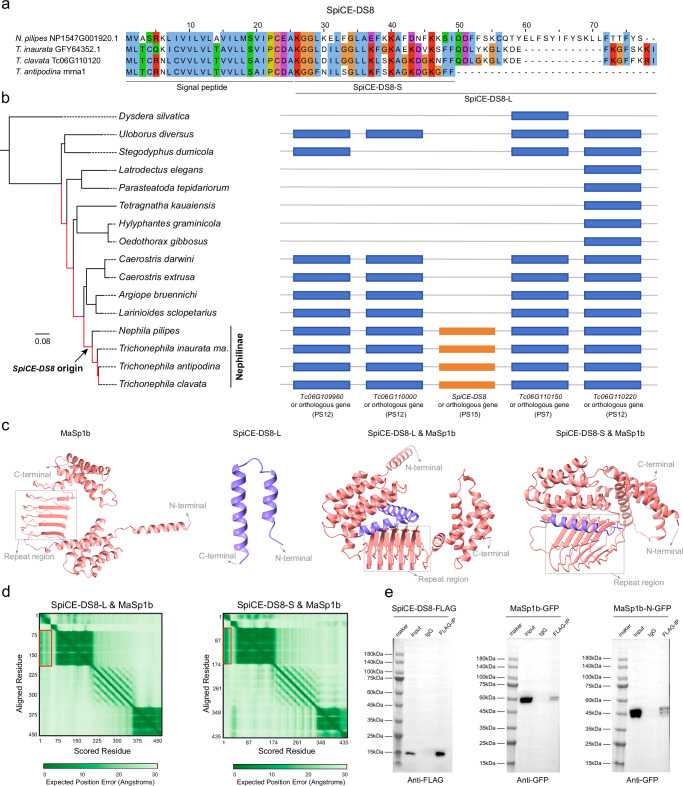
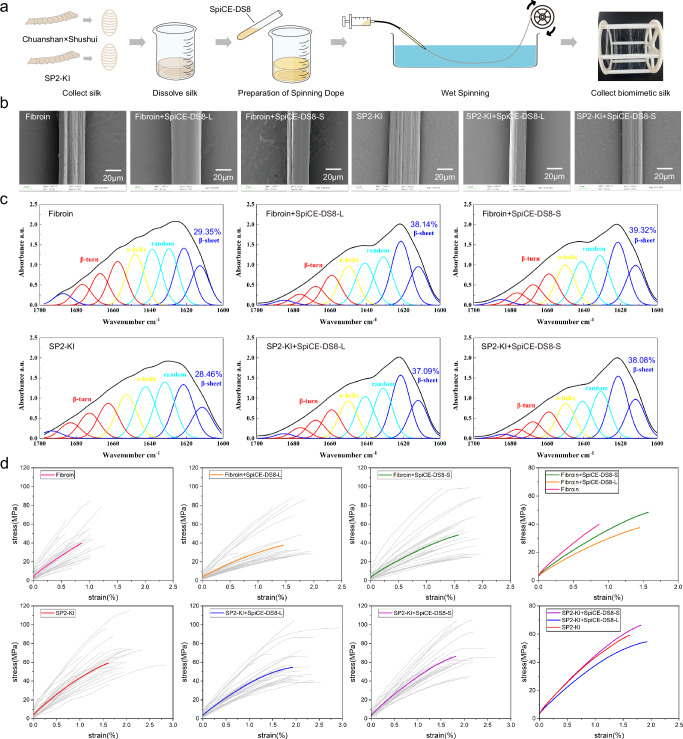
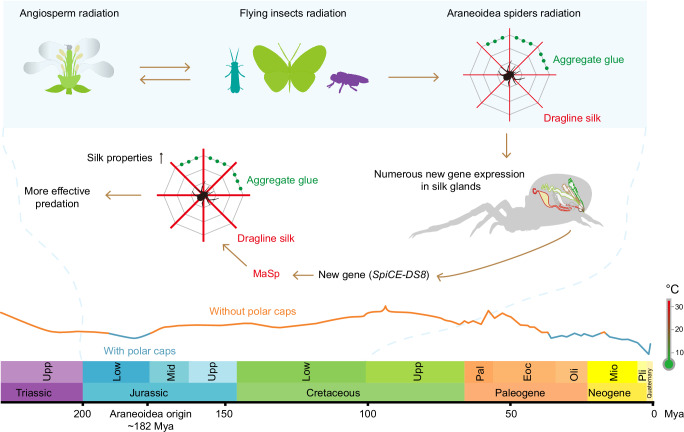
The ability of spiders to spin foraging webs by silk from specialized glands represents a remarkable evolutionary innovation, yet the molecular evolution of silk glands remains poorly understood. Herein, we explored the evolution of silk glands in Araneoidea spiders through comprehensive genomic and transcriptomic mining. Following the divergence of ancestral Araneoidea clades, numerous new genes with simplified structures and constrained expression patterns emerged, expressed predominantly in silk glands and coexpressed with ancient genes to drive the evolution of silk glands. Among these, SpiCE-DS8 is a newly evolved small secretory peptide, which is incorporated into dragline silk and is involved in the MaSp network. SpiCE-DS8 originated de novo from intergenic regions of ancient genes and is an orphan gene unique to the Nephilinae subfamily. It interacts with the N-terminal region of MaSp1b, potentially aiding in silk protein solidification. In vitro wet-spinning experiments demonstrated that SpiCE-DS8 significantly improved fiber properties, including the β-sheet content and mechanical strength, with the conserved SpiCE-DS8-S showing even more pronounced effects. The enhanced silk properties allow spiders to arm their foraging webs for more efficient prey capture. This study highlights the pivotal role of new lineage-specific genes in silk gland evolution, providing new insights into the evolutionary mechanisms associated with foraging webs and for advancing synthetic silk material development.
Overview
The claims and statistics of this paper haven’t been checked yet.
Run the check — free, no account needed. It reads the open-access text and checks the sources it cites.
Integrity signals
Registry
Cites
Statistics
Figures
Verification
Claims the paper makes
The claims and statistics of this paper haven’t been checked yet.
Run the check — free, no account needed. It reads the open-access text and checks the sources it cites.
Self-check
Percentages, sums and reported differences re-computed from the paper’s own numbers.
The self-check needs the paper’s full text.
Citations
Cites
Highly accurate protein structure prediction with AlphaFold
Jumper, J., Evans, R., Pritzel, A., Green, T., Figurnov, M., Ronneberger, O., Tunyasuvunakool, K., Bates, R., Žídek, A., Potapenko, A., et al. (2021) · Nature · doi:10.1038/s41586-021-03819-2 · Cited by 43,764
Research works printed but not linked: 93
- Averof M, Cohen SM (1997) Evolutionary origin of insect wings from ancestral gills. Nature 385:627–630 · DOI
- Prum RO, Brush AH (2002) The evolutionary origin and diversification of feathers. Q Rev Biol 77:261–295 · DOI · Paper page
- Harwood JD, Sunderland KD, Symondson WO (2003) C. Web-location by linyphiid spiders: prey‐specific aggregation and foraging strategies. J Anim Ecol 72:745–756 · DOI
- Uetz GW (1992) Foraging strategies of spiders. Trends Ecol Evol 7:155–159 · DOI
- Kallal RJ et al (2021) Converging on the orb: denser taxon sampling elucidates spider phylogeny and new analytical methods support repeated evolution of the orb web. Cladistics 37:298–316 · DOI
- Swanson BO, Blackledge TA, Summers AP, Hayashi C (2006) Y. Spider dragline silk: correlated and mosaic evolution in high-performance biological materials. Evolution 60:2539–2551 · DOI
- Papadopoulos P, Ene R, Weidner I, Kremer F (2009) Similarities in the structural organization of major and minor ampullate spider silk. Macromol Rapid Comm 30:851–857 · DOI
- Greving I et al (2020) Structural diversity of native major ampullate, minor ampullate, cylindriform, and flagelliform silk proteins in solution. Biomacromolecules 21:3387–3393 · DOI
- Choresh O, Bayarmagnai B, Lewis RV (2009) Spider web glue: two proteins expressed from opposite strands of the same DNA sequence. Biomacromolecules 10:2852–2856 · DOI
- Adrianos SL et al (2013) Nephila clavipes Flagelliform silk-like GGX motifs contribute to extensibility and spacer motifs contribute to strength in synthetic spider silk fibers. Biomacromolecules 14:1751–1760 · DOI
- Agnarsson I, Blackledge TA (2009) Can a spider web be too sticky? Tensile mechanics constrains the evolution of capture spiral stickiness in orb-weaving spiders. J Zool 278:134–140 · DOI
- Sensenig AT, Kelly SP, Lorentz KA, Lesher B, Blackledge TA (2013) Mechanical performance of spider orb webs is tuned for high-speed prey. J Exp Biol 216:3388–3394 · DOI
- Agnarsson I, Kuntner M, Blackledge TA (2010) Bioprospecting finds the toughest biological material: extraordinary silk from a giant riverine orb spider. PLoS ONE 5:e11234 · DOI
- Zhang J-Y, Zhou Q (2019) On the regulatory evolution of new genes throughout their life history. Mol Biol Evol 36:15–27 · DOI
- Cui X et al (2015) Young genes out of the male: an insight from evolutionary age analysis of the pollen transcriptome. Mol Plant 8:935–945 · DOI
- Jin G et al (2021) New genes interacted with recent whole-genome duplicates in the fast stem growth of bamboos. Mol Biol Evol 38:5752–5768 · DOI
- Domazet-Lošo T, Tautz D (2010) A phylogenetically based transcriptome age index mirrors ontogenetic divergence patterns. Nature 468:815–818 · DOI
- Wang J et al (2020) Evolutionary transcriptomics of metazoan biphasic life cycle supports a single intercalation origin of metazoan larvae. Nat Ecol Evol 4:725–736 · DOI
- Šestak MS, Domazet-Lošo T (2015) Phylostratigraphic profiles in zebrafish uncover chordate origins of the vertebrate brain. Mol Biol Evol 32:299–312 · DOI
- Ruprecht C et al (2017) Phylogenomic analysis of gene co-expression networks reveals the evolution of functional modules. Plant J 90:447–465 · DOI
- Correa-Garhwal SM, Baker RH, Clarke TH, Ayoub NA, Hayashi CY (2022) The evolutionary history of cribellate orb-weaver capture thread spidroins. BMC Ecol Evol 22:89 · DOI
- Arakawa K et al (2022) 1000 spider silkomes: Linking sequences to silk physical properties. Sci Adv 8:eabo6043 · DOI
- Babb PL et al (2017) The Nephila clavipes genome highlights the diversity of spider silk genes and their complex expression. Nat Genet 49:895–903 · DOI
- Sanggaard KW et al (2014) Spider genomes provide insight into composition and evolution of venom and silk. Nat Commun 5:3765 · DOI
- Pham T et al (2014) Dragline silk: a fiber assembled with low-molecular-weight cysteine-rich proteins. Biomacromolecules 15:4073–4081 · DOI
- Larracas C et al (2016) Comprehensive Proteomic Analysis of Spider Dragline Silk from Black Widows: A Recipe to Build Synthetic Silk Fibers. Int J Mol Sci 17:1537 · DOI
- Chaw RC, Correa-Garhwal SM, Clarke TH, Ayoub NA, Hayashi CY (2015) Proteomic Evidence for Components of Spider Silk Synthesis from Black Widow Silk Glands and Fibers. J Proteome Res 14:4223–4231 · DOI
- Hu W et al (2023) A molecular atlas reveals the tri-sectional spinning mechanism of spider dragline silk. Nat Commun 14:837 · DOI
- Ballesteros JA, Sharma PP (2019) A Critical Appraisal of the Placement of Xiphosura (Chelicerata) with Account of Known Sources of Phylogenetic Error. Syst Biol 68:896–917 · DOI
- Lozano-Fernandez J et al (2019) Increasing species sampling in chelicerate genomic-scale datasets provides support for monophyly of Acari and Arachnida. Nat commun 10:2295 · DOI
- Fernández R et al (2018) Phylogenomics, diversification dynamics, and comparative transcriptomics across the spider tree of life. Curr Biol 28:1489–1497e5 · DOI
- Ballesteros JA, Sharma PP (2019) A critical appraisal of the placement of Xiphosura (Chelicerata) with account of known sources of phylogenetic error. Syst Biol 68:896–917 · DOI
- Wheeler WC et al (2017) The spider tree of life: phylogeny of Araneae based on target-gene analyses from an extensive taxon sampling. Cladistics 33:574–616 · DOI
- Cantalapiedra CP, Hernández-Plaza A, Letunic I, Bork P, Huerta-Cepas (2021) J. eggNOG-mapper v2: functional annotation, orthology assignments, and domain prediction at the metagenomic scale. Mol Biol Evol 38:5825–5829 · DOI
- Zhang L et al (2019) Rapid evolution of protein diversity by de novo origination in Oryza. Nat Ecol Evol 3:679–690 · DOI · Paper page
- Sponner A, Unger E, Grosse F, Weisshart K (2005) Differential polymerization of the two main protein components of dragline silk during fibre spinning. Nat Mater 4:772–775 · DOI
- Sponner A et al (2005) Characterization of the protein components of Nephila clavipes dragline silk. Biochemistry 44:4727–4736 · DOI
- Kallal RJ, Dimitrov D, Arnedo MA, Giribet G, Hormiga G (2020) Monophyly, taxon sampling, and the nature of ranks in the classification of orb-weaving spiders (Araneae: Araneoidea). Syst Biol 69:401–411
- Dimitrov D, Benavides LR, Arnedo MA, Giribet G, Griswold CE, Scharff N, Hormiga G (2017) Rounding up the usual suspects: a standard target-gene approach for resolving the interfamilial phylogenetic relationships of ecribellate orb‐weaving spiders with a new family‐rank classification (Araneae, Araneoidea). Cladistics 33(3):221–250 · DOI
- Hancock REW, Scott MG (2000) The role of antimicrobial peptides in animal defenses. P Natl Acad Sci USA 97:8856–8861 · DOI
- Maróti G, Kereszt A, Kondorosi E, Mergaert P (2011) Natural roles of antimicrobial peptides in microbes, plants and animals. Res Microbiol 162:363–374 · DOI · Paper page
- Titos I et al (2023) A gut-secreted peptide suppresses arousability from sleep. Cell 186:1382–1397e21 · DOI
- Ruiz-Orera J et al (2015) Origins of de novo genes in human and chimpanzee. PLoS Genet 11:e1005721 · DOI · Paper page
- Zhang W, Landback P, Gschwend AR, Shen B, Long M (2015) New genes drive the evolution of gene interaction networks in the human and mouse genomes. Genome Biol 16:202 · DOI
- Mi J et al (2023) High-strength and ultra-tough whole spider silk fibers spun from transgenic silkworms. Matter 6:3661–3683 · DOI
- Li J et al (2022) Spider Silk-Inspired Artificial Fibers. Adv Sci 9:e2103965 · DOI
- Gaines WA, Sehorn MG, Marcotte WR (2010) Spidroin N-terminal Domain Promotes a pH-dependent Association of Silk Proteins during Self-assembly. J Biol Chem 285:40745–40753 · DOI
- Heiby JC, Goretzki B, Johnson CM, Hellmich UA, Neuweiler H (2019) Methionine in a protein hydrophobic core drives tight interactions required for assembly of spider silk. Nat Commun 10:4378 · DOI
- Wöltje M, Isenberg KL, Cherif C, Aibibu D (2023) Continuous wet spinning of regenerated silk fibers from spinning dopes containing 4% fibroin protein. Int J Mol Sci 24:13492 · DOI
- Yu Y et al (2024) Custom-designed, mass silk production in genetically engineered silkworms. Pnas nexus 3:pgae128 · DOI
- Schwager EE et al (2017) The house spider genome reveals an ancient whole-genome duplication during arachnid evolution. BMC Biol 15:62 · DOI
- Harmer AMT, Blackledge TA, Madin JS, Herberstein ME (2011) High-performance spider webs: integrating biomechanics, ecology and behaviour. J R Soc Interface 8:457–471 · DOI
- Blackledge TA (2012) Spider silk: a brief review and prospectus on research linking biomechanics and ecology in draglines and orb webs. J Arachnol 40:1–12 · DOI
- Dicko C, Knight D, Kenney JM, Vollrath F (2004) Secondary structures and conformational changes in flagelliform, cylindrical, major, and minor ampullate silk proteins. Temperature and concentration effects. Biomacromolecules 5:2105–2115 · DOI
- Jin H-J, Kaplan DL (2003) Mechanism of silk processing in insects and spiders. Nature 424:1057–1061 · DOI
- Kaplan D, Adams WW, Farmer B, Viney C (1994) Silk: biology, structure, properties, and genetics. ACS Publications 2–16
- Kono N et al (2021) Multicomponent nature underlies the extraordinary mechanical properties of spider dragline silk. P Natl Acad Sci USA 118:e2107065118 · DOI · Paper page
- Voosen P (2019) Project traces 500 million years of roller-coaster climate. Science 364:716–717 · DOI
- Gandolfo MA, Nixon KC, Crepet WL (2004) Cretaceous flowers of Nymphaeaceae and implications for complex insect entrapment pollination mechanisms in early angiosperms. P Natl Acad Sci USA 101:8056–8060 · DOI
- Bao T, Wang B, Li J, Dilcher D (2019) Pollination of Cretaceous flowers. P Natl Acad Sci USA 116:24707–24711 · DOI
- Leslie AB, Simpson C, Mander L (2021) Reproductive innovations and pulsed rise in plant complexity. Science 373:1368–1372 · DOI
- Xiao L, Labandeira C, Dilcher D, Ren D (2021) Florivory of early cretaceous flowers by functionally diverse insects: implications for early angiosperm pollination. Proc. Biol. Sci. 288, 20210320
- Penney D, Ortuño VM (2006) Oldest true orb-weaving spider (Araneae: Araneidae). Bio Lett 2:447–450 · DOI
- Kono N, Nakamura H, Mori M, Tomita M, Arakawa K (2020) Spidroin profiling of cribellate spiders provides insight into the evolution of spider prey capture strategies. Sci Rep 10:15721 · DOI
- Xia X-X et al (2010) Native-sized recombinant spider silk protein produced in metabolically engineered Escherichia coli results in a strong fiber. P Natl Acad Sci USA 107:14059–14063 · DOI
- Chen S, Zhou Y, Chen Y, Gu J (2018) fastp: an ultra-fast all-in-one FASTQ preprocessor. Bioinformatics 34:i884–i890 · DOI · Paper page
- Haas BJ et al (2013) De novo transcript sequence reconstruction from RNA-seq using the Trinity platform for reference generation and analysis. Nat Protoc 8:1494–1512 · DOI · Paper page
- Fu L, Niu B, Zhu Z, Wu S, Li W (2012) CD-HIT: accelerated for clustering the next-generation sequencing data. Bioinformatics 28:3150–3152 · DOI · Paper page
- Buchfink B, Xie C, Huson DH (2015) Fast and sensitive protein alignment using DIAMOND. Nat Methods 12:59–60 · DOI · Paper page
- Edgar RC (2004) MUSCLE: multiple sequence alignment with high accuracy and high throughput. Nucleic Acids Res 32:1792–1797 · DOI · Paper page
- Suyama M, Torrents D, Bork P (2006) PAL2NAL: robust conversion of protein sequence alignments into the corresponding codon alignments. Nucleic Acids Res 34:W609–612 · DOI
- Nguyen L-T, Schmidt HA, von Haeseler A, Minh BQ (2015) IQ-TREE: a fast and effective stochastic algorithm for estimating maximum-likelihood phylogenies. Mol Biol Evol 32:268–274 · DOI · Paper page
- Stamatakis A (2014) RAxML version 8: a tool for phylogenetic analysis and post-analysis of large phylogenies. Bioinformatics 30:1312–1313 · DOI · Paper page
- Ronquist F et al (2012) MrBayes 3.2: efficient Bayesian phylogenetic inference and model choice across a large model space. Syst Biol 61:539–542 · DOI
- Kalyaanamoorthy S, Minh BQ, Wong TKF, von Haeseler A, Jermiin LS (2017) ModelFinder: fast model selection for accurate phylogenetic estimates. Nat Methods 14:587–589 · DOI · Paper page
- Levine MT, Jones CD, Kern AD, Lindfors HA, Begun DJ (2006) Novel genes derived from noncoding DNA in Drosophila melanogaster are frequently X-linked and exhibit testis-biased expression. P Natl Acad Sci USA 103:9935–9939 · DOI
- McLysaght A, Hurst LD (2016) Open questions in the study of de novo genes: what, how and why. Nat Rev Genet 17:567–578 · DOI
- Kent WJ (2002) BLAT–the BLAST-like alignment tool. Genome Res 12:656–664
- Qiao X et al (2019) Gene duplication and evolution in recurring polyploidization-diploidization cycles in plants. Genome Biol 20:38 · DOI
- Tautz D, Domazet-Lošo T (2011) The evolutionary origin of orphan genes. Nat Rev Genet 12:692–702 · DOI · Paper page
- Wu TD, Watanabe CK (2005) GMAP: a genomic mapping and alignment program for mRNA and EST sequences. Bioinformatics 21:1859–1875 · DOI · Paper page
- Kim D, Langmead B, Salzberg SL (2015) HISAT: a fast spliced aligner with low memory requirements. Nat Methods 12:357–360 · DOI · Paper page
- Pertea M et al (2015) StringTie enables improved reconstruction of a transcriptome from RNA-seq reads. Nat Biotechnol 33:290–295 · DOI
- Cox J, Mann M (2008) MaxQuant enables high peptide identification rates, individualized p.p.b.-range mass accuracies and proteome-wide protein quantification. Nat Biotechnol 26:1367–1372 · DOI · Paper page
- Langfelder P, Horvath S (2008) WGCNA: an R package for weighted correlation network analysis. BMC Bioinformatics 9:559 · DOI · Paper page
- Morabito S, Reese F, Rahimzadeh N, Miyoshi E, Swarup V (2023) hdWGCNA identifies co-expression networks in high-dimensional transcriptomics data. Cell Rep Methods 3:100498 · DOI · Paper page
- Abramson J et al (2024) Accurate structure prediction of biomolecular interactions with AlphaFold 3. Nature 630:493–500 · DOI · Paper page
- Pettersen EF et al (2021) UCSF ChimeraX: Structure visualization for researchers, educators, and developers. Protein Sci 30:70–82 · DOI
- Sofia S, McCarthy MB, Gronowicz G, Kaplan DL (2001) Functionalized silk-based biomaterials for bone formation. J Biomed Mater Res 54:139–148 · DOI
- Rockwood DN et al (2011) Materials fabrication from Bombyx mori silk fibroin. Nat Protoc 6:1612–1631 · DOI
- Zheng Z et al (2016) Lithium-free processing of silk fibroin. J Biomater Appl 31:450–463 · DOI · Paper page
- Peng Z et al (2024) Overexpression of bond-forming active protein for efficient production of silk with structural changes and properties enhanced in silkworm. Int J Biol Macromol 264:129780 · DOI
- Kumar S et al (2022) TimeTree 5: An expanded resource for species divergence times. Mol Biol Evol 39:msac174 · DOI
Metadata
- Authors
- Wang, Y., Jia, A., Mao, Y., Yang, T., Zhang, G., Wang, Q., Hu, W., Dong, Z., Zhang, Z., & Ma, S.
- Affiliations
- Southwest University (CN)
- Southwest University
- Corresponding author
- Wang, Yi
- Ma, Sanyuan
- Venue
- Nature Communications
- Published
- 2025-04-18
- Volume
- 16
- Issue
- 1
- Pages
- 10071-10071
- ISSN
- 2041-1723 (ISSN-L)
- PMC
- PMC12627769
- OpenAlex
- W4416334188
- Cited by
- 1
- References
- 1
- Citations by year
- 2026: 1
- FWCI
- 0.21
- Type
- journal article
- Language
- en
- Open access
- gold
- doi.org
- Licence
- Locations
- Nature Communications (publishedVersion, cc-by-nc-nd)
- Research Square (acceptedVersion, cc-by)
- Europe PMC (PubMed Central) (publishedVersion, cc-by-nc-nd)
- PubMed (publishedVersion)
- DOAJ (DOAJ: Directory of Open Access Journals) (submittedVersion, cc-by-sa)
- Funders
- Jiangsu University
- Southwest University
- Jiangsu University of Science and Technology
- Centre Scientifique et Technique du Bâtiment
- National Key Research and Development Program of China (2023YFF0713900)
- Fundamental Research Funds for the Central Universities (Swu‐XDJH202309)
- Topics
- Physical Sciences › Materials Science › Biomaterials › Silk-based biomaterials and applications
- Life Sciences › Agricultural and Biological Sciences › Ecology, Evolution, Behavior and Systematics › Spider Taxonomy and Behavior Studies
- Life Sciences › Agricultural and Biological Sciences › Insect Science › Silkworms and Sericulture Research
- Keywords
- spider silk, Araneoidea, secretory peptides, spider dragline silk, silk mechanical properties, wet spinning, prey capture, synthetic silk, gene co-expression
- MeSH terms
- Amino Acid Sequence, Animals, Fibroins, Peptides, Phylogeny, Spiders, Evolution, Molecular, Silk, Transcriptome
About these checks
Registry, retraction, Cites and statistics results are computed, not judged, with one exception: a printed reference that no index lists is read once by a model before it counts as a citation error. Claims are extracted by a model and kept only when their quote appears verbatim in the text; each cited source is then checked, with a model’s help, for whether it says what the claim relies on. Those verdicts can be wrong — read the claim’s quote and the cited source before relying on one.
Statistics and arithmetic are recomputed, not judged.
Confidence bands are shown only for fields calibrated on our annotated test set. None is calibrated yet, so no band is shown.
What counts as a claim ›How we measure confidence ›How we check this ›
Are you an author, or do you see a problem with this page? Request a review
How to cite
Cite CoChat for the checks on this page, and the paper for its own findings.
- This page
- CoChat. (2026). Citation check: A Newly Evolved Small Secretory Peptide Enhances Mechanical Properties of Spider Silk. https://app.cochat.ai/papers/10.21203/rs.3.rs-6320776/v1
- The paper
- Wang, Y., Jia, A., Mao, Y., Yang, T., Zhang, G., Wang, Q., Hu, W., Dong, Z., Zhang, Z., & Ma, S. (2025). A Newly Evolved Small Secretory Peptide Enhances Mechanical Properties of Spider Silk. Nature Communications. https://doi.org/10.21203/rs.3.rs-6320776/v1
