

Mindfulness training for psychological stress in family caregivers of persons with dementia: a systematic review and meta-analysis of randomized controlled trials
Open accessThe DOI matches its Crossref record; 50 of the 53 references it cites were found in a registry or an index.
Abstract
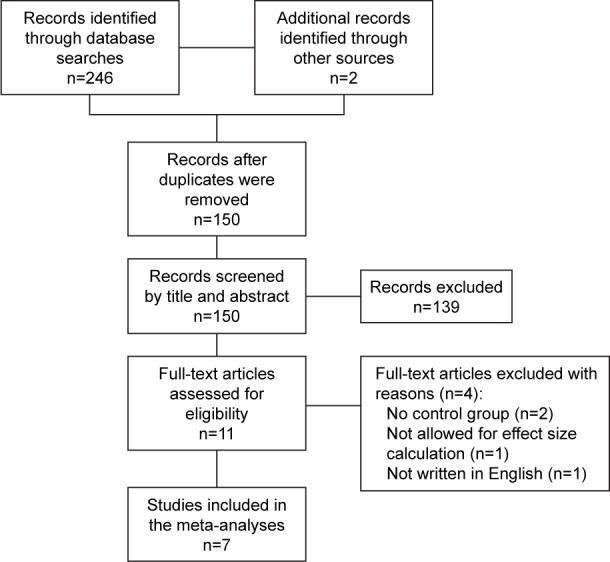
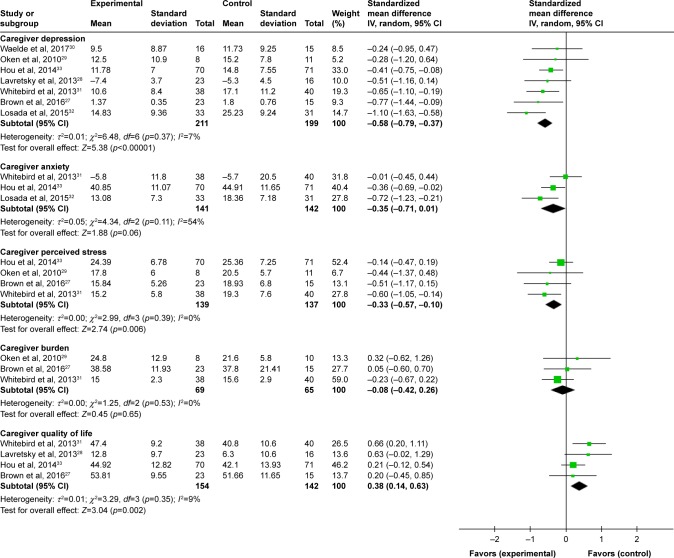
Caring for a relative with dementia is extremely challenging; conventional interventions may not be highly effective or easily available on some occasions. This study aimed to explore the efficacy of mindfulness training in improving stress-related outcomes in family caregivers of people with dementia using a meta-analytic review. We searched randomized controlled trials (RCT) through April 2017 from five electronic databases, and assessed the risk of bias using the Cochrane Collaboration tool. Seven RCTs were included in our review. Mindfulness interventions showed significant effects of improvement in depression (standardized mean difference: -0.58, [95% CI: -0.79 to -0.37]), perceived stress (-0.33, [-0.57 to -0.10]), and mental health-related quality of life (0.38 [0.14 to 0.63]) at 8 weeks post-treatment. Pooled evidence did not show a significant advantage of mindfulness training compared with control conditions in the alleviation of caregiver burden or anxiety. Future large-scale and rigorously designed trials are needed to confirm our findings. Clinicians may consider the mindfulness program as a promising alternative to conventional interventions.
Overview
The claims and statistics of this paper haven’t been checked yet.
Free: it reads the open-access text and checks the first 5 claims that cite a source we can check. Create a free account to check every claim.
Integrity signals
Registry
Cites
Statistics
Figures
Verification
Claims the paper makes
The claims and statistics of this paper haven’t been checked yet.
Free: it reads the open-access text and checks the first 5 claims that cite a source we can check. Create a free account to check every claim.
Claims other papers make about this one
Each is checked against this paper’s own text: does it say what the citing paper says it does?
The source backs part of the claim, not all of it — or backs it for a different population, condition or comparison.
In the citing paper
“Recent meta-analyses pooling data across multiple randomized controlled trials of mindfulness-based training interventions are consistent in reporting benefits in terms of reduced depression, burden, and perceived stress, and improved sleep quality and health-related quality of life among FCGs of PLwD [21–24].”
From Mindfulness and Care Experience in Family Caregivers of Persons Living with Dementia (2023) · cites this paper as [21]
Experimental — accuracy not yet measuredThe cited source says what the claim attributes to it.
In the citing paper
“Prior studies suggest that mindfulness effectively reduces caregiver perceived stress and depression [24], [27], [28]”
From A novel two-day intervention reduces stress in caregivers of persons with dementia (2018) · cites this paper as [28]
Self-check
Percentages, sums and reported differences re-computed from the paper’s own numbers.
The self-check needs the paper’s full text.
Citations
Cites
The Cochrane Collaboration's tool for assessing risk of bias in randomised trials
Higgins, J. P. T., Altman, D. G., Gotzsche, P. C., Juni, P., Moher, D., Oxman, A. D., Savovic, J., Schulz, K. F., Weeks, L., Sterne, J. A. C., et al. (2011) · BMJ · doi:10.1136/bmj.d5928 · Cited by 33,817
(1992) · PubMed · Cited by 33,716
Hamilton, M. (1960) · Journal of Neurology, Neurosurgery & Psychiatry · doi:10.1136/jnnp.23.1.56 · Cited by 32,817
A Global Measure of Perceived Stress
Cohen, S., Kamarck, T., & Mermelstein, R. (1983) · Journal of Health and Social Behavior · doi:10.2307/2136404 · Cited by 32,807
(1970) · Cited by 24,983
Dermyshi, E., Wang, Y., Yan, C., Hong, W., Qiu, G., Gong, X., & Zhang, T. (2017) · Neonatology · doi:10.1159/000454668 · Cited by 24,451
Mindfulness-based interventions in context: Past, present, and future
Kabat-Zinn, J. (2003) · Clinical Psychology: Science and Practice · doi:10.1093/clipsy.bpg016 · Cited by 8,615 · cited 1×
“Mindfulness is often operationally defined as “the awareness that emerges through paying attention on purpose, in the present moment, and non-judgmentally to the unfolding of experience”.(12) Mindfulness can be translated in various ways in the interventions such as the mindfulness-based stress reduction, yogic medita…”
Mindfulness-based interventions in context: Past, present, and future.
Kabat-Zinn, J. (2003) · Clinical Psychology: Science and Practice · doi:10.1093/clipsy/bpg016 · Cited by 8,612
Relatives of the Impaired Elderly: Correlates of Feelings of Burden
Zarit, S. H., Reever, K. E., & Bach-Peterson, J. (1980) · The Gerontologist · doi:10.1093/geront/20.6.649 · Cited by 5,810 · cited 1×
“One possibility is that caregiver burden is such a multicomponent measure (eg, the Zarit Burden Interview), 36 which includes both objective and subjective aspects of caregiving, that a brief intervention like mindfulness training can hardly target the multiple features represented by the concept…”
2016 Alzheimer's disease facts and figures
Alzheimer's Association (2016) · Alzheimer's & Dementia · doi:10.1016/j.jalz.2016.03.001 · Cited by 5,069
Cited by
Sun, Y., Ji, M., Leng, M., Li, X., Zhang, X., & Wang, Z. (2022) · International Journal of Nursing Studies · doi:10.1016/j.ijnurstu.2022.104204 · Cited by 176
Self-citationCheng, S.-T., & Zhang, F. (2020) · BMC Geriatrics · doi:10.1186/s12877-020-01547-2 · Cited by 166
Effects of mindfulness meditation interventions on depression in older adults: A meta-analysis
Reangsing, C., Rittiwong, T., & Schneider, J. K. (2021) · Aging & Mental Health · doi:10.1080/13607863.2020.1793901 · Cited by 114
“Those who did included small numbers of primary studies (s¼ 4-10) which prohibited moderator analysis (Kishita et al., 2017; Li & Bressington, 2019; Liu et al., 2017).”
BackgroundInfluentialSupporting Family Caregivers With Technology for Dementia Home Care: A Randomized Controlled Trial
Williams, K. N., Perkhounkova, Y., Shaw, C. A., Hein, M., Vidoni, E. D., & Coleman, C. (2019) · Innovation in Aging · doi:10.1093/geroni/igz037 · Cited by 75
Shim, M., Tilley, J. L., Im, S., Price, K., & Gonzalez, A. (2021) · Journal of Geriatric Psychiatry and Neurology · doi:10.1177/0891988720957104 · Cited by 67
Metadata
- Authors
- Liu, Z., Chen, Q. L., & Sun, Y.-Y.
- Affiliations
- Chinese University of Hong Kong (HK)
- Corresponding author
- Liu, Zheng
- ORCID
- Liu, Zheng
- Venue
- Clinical Interventions in Aging
- Publisher
- Informa UK Limited
- Published
- 2017-09
- Volume
- Volume 12
- Pages
- 1521-1529
- ISSN
- 1176-9092 (ISSN-L)
- 1178-1998
- PMC
- PMC5626236
- OpenAlex
- W2756674844
- Cited by
- 72
- References
- 53
- Citations by year
- 2026: 6 · 2025: 7 · 2024: 3 · 2023: 9 · 2022: 23 · 2021: 3 · 2020: 6 · 2019: 11 · 2018: 3
- FWCI
- 0.84
- Type
- journal article
- Language
- en
- Open access
- gold
- doi.org
- Licence
- Locations
- Clinical Interventions in Aging (publishedVersion, cc-by-nc)
- Europe PMC (PubMed Central) (publishedVersion, cc-by-nc)
- PubMed Central (publishedVersion, cc-by-nc)
- PubMed (publishedVersion)
- Dove Medical Press (Taylor and Francis Group) (submittedVersion, cc-by-nc)
- Topics
- Social Sciences › Psychology › Clinical Psychology › Mindfulness and Compassion Interventions
- Health Sciences › Nursing › Research and Theory › Nursing care and research
- Health Sciences › Medicine › Psychiatry and Mental health › Dementia and Cognitive Impairment Research
- Keywords
- mindfulness training, family caregivers, dementia, caregiver stress, depression, perceived stress, mental health-related quality of life, caregiver burden, anxiety, psychological intervention
- MeSH terms
- Adaptation, Psychological, Dementia, Female, Humans, Mental Health, Quality of Life, Stress, Psychological, Randomized Controlled Trials as Topic, Caregivers, Cost of Illness, Mindfulness
About these checks
Registry, retraction, Cites and statistics results are computed, not judged, with one exception: a printed reference that no index lists is read once by a model before it counts as a citation error. Claims are extracted by a model and kept only when their quote appears verbatim in the text; each cited source is then checked, with a model’s help, for whether it says what the claim relies on. Those verdicts can be wrong — read the claim’s quote and the cited source before relying on one.
Statistics and arithmetic are recomputed, not judged.
Confidence bands are shown only for fields calibrated on our annotated test set. None is calibrated yet, so no band is shown.
What counts as a claim ›How we measure confidence ›How we check this ›
Are you an author, or do you see a problem with this page? Request a review
How to cite
Cite CoChat for the checks on this page, and the paper for its own findings.
- This page
- CoChat. (2026). Citation check: Mindfulness training for psychological stress in family caregivers of persons with dementia: a systematic review and meta-analysis of randomized controlled trials. https://app.cochat.ai/papers/10.2147/cia.s146213
- The paper
- Liu, Z., Chen, Q. L., & Sun, Y.-Y. (2017). Mindfulness training for psychological stress in family caregivers of persons with dementia: a systematic review and meta-analysis of randomized controlled trials. Clinical Interventions in Aging. https://doi.org/10.2147/cia.s146213
Data sources
Bibliographic data: Semantic Scholar, OpenAlex, Crossref.
Contains information from the Semantic Scholar Academic Graph Datasets, made available under the ODC Attribution License (ODC-BY 1.0).
Semantic Scholar’s data is described in: Kinney, R., et al. (2023). The Semantic Scholar Open Data Platform. arXiv:2301.10140.
