

Mindfulness training for psychological stress in family caregivers of persons with dementia: a systematic review and meta-analysis of randomized controlled trials
Open accessThe DOI matches its Crossref record; 50 of the 53 references it cites were found in a registry or an index.
Abstract
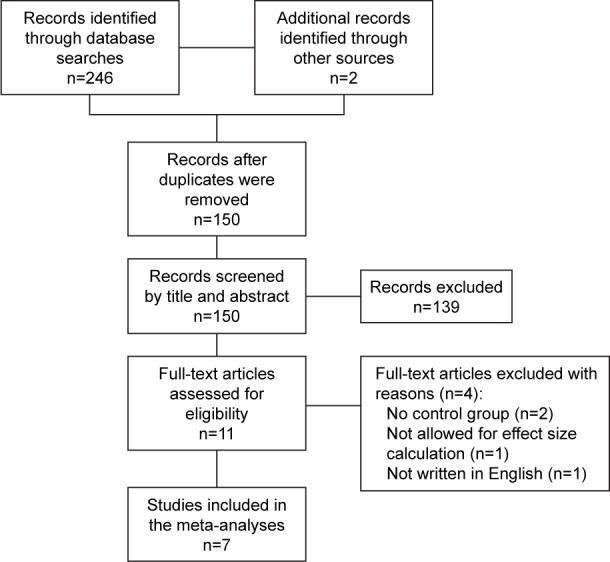
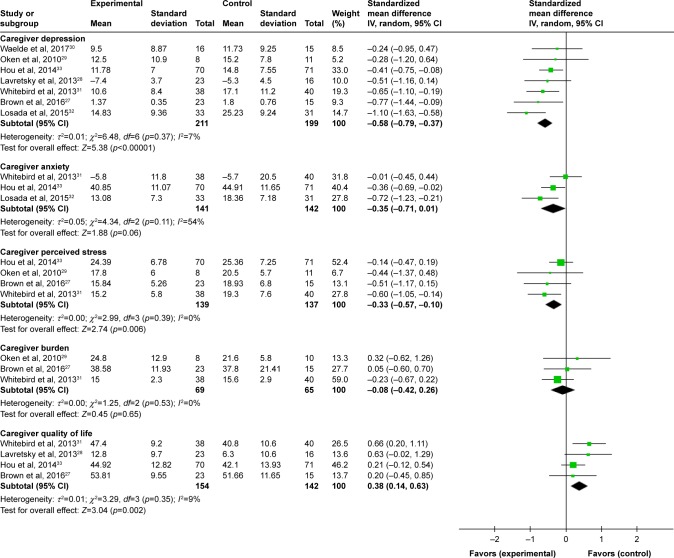
Caring for a relative with dementia is extremely challenging; conventional interventions may not be highly effective or easily available on some occasions. This study aimed to explore the efficacy of mindfulness training in improving stress-related outcomes in family caregivers of people with dementia using a meta-analytic review. We searched randomized controlled trials (RCT) through April 2017 from five electronic databases, and assessed the risk of bias using the Cochrane Collaboration tool. Seven RCTs were included in our review. Mindfulness interventions showed significant effects of improvement in depression (standardized mean difference: -0.58, [95% CI: -0.79 to -0.37]), perceived stress (-0.33, [-0.57 to -0.10]), and mental health-related quality of life (0.38 [0.14 to 0.63]) at 8 weeks post-treatment. Pooled evidence did not show a significant advantage of mindfulness training compared with control conditions in the alleviation of caregiver burden or anxiety. Future large-scale and rigorously designed trials are needed to confirm our findings. Clinicians may consider the mindfulness program as a promising alternative to conventional interventions.
Overview
The claims and statistics of this paper haven’t been checked yet.
Free: it reads the open-access text and checks the first 5 claims that cite a source we can check. Create a free account to check every claim.
Integrity signals
Registry
Cites
Statistics
Figures
Verification
Claims the paper makes
The claims and statistics of this paper haven’t been checked yet.
Free: it reads the open-access text and checks the first 5 claims that cite a source we can check. Create a free account to check every claim.
Claims other papers make about this one
Each is checked against this paper’s own text: does it say what the citing paper says it does?
The source backs part of the claim, not all of it — or backs it for a different population, condition or comparison.
In the citing paper
“Recent meta-analyses pooling data across multiple randomized controlled trials of mindfulness-based training interventions are consistent in reporting benefits in terms of reduced depression, burden, and perceived stress, and improved sleep quality and health-related quality of life among FCGs of PLwD [21–24].”
From Mindfulness and Care Experience in Family Caregivers of Persons Living with Dementia (2023) · cites this paper as [21]
Experimental — accuracy not yet measuredThe cited source says what the claim attributes to it.
In the citing paper
“Prior studies suggest that mindfulness effectively reduces caregiver perceived stress and depression [24], [27], [28]”
From A novel two-day intervention reduces stress in caregivers of persons with dementia (2018) · cites this paper as [28]
Self-check
Percentages, sums and reported differences re-computed from the paper’s own numbers.
The self-check needs the paper’s full text.
Citations
Cites
The Cochrane Collaboration's tool for assessing risk of bias in randomised trials
Higgins, J. P. T., Altman, D. G., Gotzsche, P. C., Juni, P., Moher, D., Oxman, A. D., Savovic, J., Schulz, K. F., Weeks, L., Sterne, J. A. C., et al. (2011) · BMJ · doi:10.1136/bmj.d5928 · Cited by 33,817
(1992) · PubMed · Cited by 33,716
Hamilton, M. (1960) · Journal of Neurology, Neurosurgery & Psychiatry · doi:10.1136/jnnp.23.1.56 · Cited by 32,817
A Global Measure of Perceived Stress
Cohen, S., Kamarck, T., & Mermelstein, R. (1983) · Journal of Health and Social Behavior · doi:10.2307/2136404 · Cited by 32,807
(1970) · Cited by 24,983
Dermyshi, E., Wang, Y., Yan, C., Hong, W., Qiu, G., Gong, X., & Zhang, T. (2017) · Neonatology · doi:10.1159/000454668 · Cited by 24,451
Mindfulness-based interventions in context: Past, present, and future
Kabat-Zinn, J. (2003) · Clinical Psychology: Science and Practice · doi:10.1093/clipsy.bpg016 · Cited by 8,615 · cited 1×
“Mindfulness is often operationally defined as “the awareness that emerges through paying attention on purpose, in the present moment, and non-judgmentally to the unfolding of experience”.(12) Mindfulness can be translated in various ways in the interventions such as the mindfulness-based stress reduction, yogic medita…”
Mindfulness-based interventions in context: Past, present, and future.
Kabat-Zinn, J. (2003) · Clinical Psychology: Science and Practice · doi:10.1093/clipsy/bpg016 · Cited by 8,612
Relatives of the Impaired Elderly: Correlates of Feelings of Burden
Zarit, S. H., Reever, K. E., & Bach-Peterson, J. (1980) · The Gerontologist · doi:10.1093/geront/20.6.649 · Cited by 5,810 · cited 1×
“One possibility is that caregiver burden is such a multicomponent measure (eg, the Zarit Burden Interview), 36 which includes both objective and subjective aspects of caregiving, that a brief intervention like mindfulness training can hardly target the multiple features represented by the concept…”
2016 Alzheimer's disease facts and figures
Alzheimer's Association (2016) · Alzheimer's & Dementia · doi:10.1016/j.jalz.2016.03.001 · Cited by 5,069
McHorney, C. A., Ware, J. E., Rachel Lu, J. F., & Sherbourne, C. D. (1994) · Medical Care · doi:10.1097/00005650-199401000-00004 · Cited by 4,458
Mindfulness-based stress reduction and health benefits
Grossman, P., Niemann, L., Schmidt, S., & Walach, H. (2004) · Journal of Psychosomatic Research · doi:10.1016/s0022-3999(03)00573-7 · Cited by 3,958
Caregiving as a Risk Factor for Mortality: The Caregiver Health Effects Study
Schulz, R., & Beach, S. R. (1999) · JAMA · doi:10.1001/jama.282.23.2215 · Cited by 3,340 · cited 1×
“High levels of stress are reported in virtually all dementia caregivers, predisposing this vulnerable population to develop psychological and physical morbidity,(4) and even resulting in early mortality.(5) The burden of caregiving can not only greatly impair the well-being and quality of life of dementia caregivers,…”
Meditation Programs for Psychological Stress and Well-being: A Systematic Review and Meta-analysis
Goyal, M., Singh, S., Sibinga, E. M. S., Gould, N. F., Rowland-Seymour, A., Sharma, R., Berger, Z., Sleicher, D., Maron, D. D., Shihab, H. M., et al. (2014) · JAMA Internal Medicine · doi:10.1001/jamainternmed.2013.13018 · Cited by 2,380
Mindfulness-based therapy: a comprehensive meta-analysis
Khoury, B., Lecomte, T., Fortin, G., Masse, M., Therien, P., Bouchard, V., Chapleau, M.-A., Paquin, K., & Hofmann, S. G. (2013) · Clinical Psychology Review · doi:10.1016/j.cpr.2013.05.005 · Cited by 2,003 · cited 1×
“15 Particularly, the individuals benefiting from mindfulness were mostly facing considerable stress in their lives; these individuals included organ transplant recipients, 16 patients with cancer, 17,18 HIV, 19 or psychological disorders.”
Schulz, R., O'Brien, A. T., Bookwala, J., & Fleissner, K. (1995) · The Gerontologist · doi:10.1093/geront/35.6.771 · Cited by 1,765
Mindfulness-based stress reduction and health benefits: A meta-analysis
Grossman, P., Niemann, L., Schmidt, S., & Walach, H. (2003) · Focus on Alternative and Complementary Therapies · doi:10.1111/j.2042-7166.2003.tb04008.x · Cited by 1,394
Assessment of behavioral problems in dementia: The Revised Memory and Behavior Problems Checklist.
Teri, L. L., Truax, P. A., Logsdon, R. G., Uomoto, J. M., & VITALIANO, P. P. (1992) · Psychology and Aging · doi:10.1037//0882-7974.7.4.622 · Cited by 1,125
Mechanisms of mindfulness training: Monitor and Acceptance Theory (MAT
Lindsay, E. K., & Creswell, J. D. (2017) · Clinical Psychology Review · doi:10.1016/j.cpr.2016.10.011 · Cited by 919 · cited 1×
“45 Non-judgmental acceptance, 46 an important element of mindfulness, can help participants “embrace” stressful caregiving as it is, but still enjoy a full and rich life.”
Pinquart, M., & Sorensen, S. (2006) · International Psychogeriatrics · doi:10.1017/s1041610206003462 · Cited by 827
Sterne, J. A., Egger, M., & Moher, D. (2008) · Cochrane Handbook for Systematic Reviews of Interventions · doi:10.1002/9780470712184.ch10 · Cited by 651
Is the standard SF-12 Health Survey valid and equivalent for a Chinese population?
Lam, C. L. K., Tse, E. Y. Y., & Gandek, B. (2005) · Quality of Life Research · doi:10.1007/s11136-004-0704-3 · Cited by 547
Evidence-based psychological treatments for distress in family caregivers of older adults.
Gallagher-Thompson, D., & Coon, D. W. (2007) · Psychology and Aging · doi:10.1037/0882-7974.22.1.37 · Cited by 358 · cited 1×
“…stronger empirical support, such as those relying on the cognitive behavioral therapy framework (not including mindfulness-based cognitive therapy) 9 and the recent ambitious interventions such as Resources for Enhancing Alzheimer’s Caregivers Health, 10,11 these programs are heavily dependent on…”
Lavretsky, H., Epel, E. S., Siddarth, P., Nazarian, N., Cyr, N. S., Khalsa, D. S., Lin, J., Blackburn, E., & Irwin, M. R. (2013) · International Journal of Geriatric Psychiatry · doi:10.1002/gps.3790 · Cited by 298 · cited 3×
“Among the four trials comparing the characteristics between completers and drop-outs,(26,28,30,31) two of them were assessed as having a high risk of bias.(26,28) More than half of the included trials conducted intention-to-treat analyses.”
Losada, A., Márquez-González, M., Romero-Moreno, R., Mausbach, B. T., López, J., Fernández-Fernández, V., & Nogales-González, C. (2015) · Journal of Consulting and Clinical Psychology · doi:10.1037/ccp0000028 · Cited by 255 · cited 4×
“Four trials employed a structured MBSR including six to eight weekly sessions lasting from 1.5 to 2.5 hours; 27,29,31,33 others used mindfulness programs focusing on acceptance and commitment therapy, 32 yogic meditation, 28 or a combination of mindfulness with mantra meditation.”
InfluentialMindfulness-based stress reduction for family caregivers: a randomized controlled trial.
Whitebird, R. R., Kreitzer, M., Crain, A. L., Lewis, B. A., Hanson, L. R., & Enstad, C. J. (2013) · The Gerontologist · doi:10.1093/geront/gns126 · Cited by 252 · cited 3×
“More than half of the included trials conducted intention-to-treat analyses.(27,30,31,33) Table 1 Characteristics of included studies”
Elliott, A. F., Burgio, L. D., & DeCoster, J. (2010) · Journal of the American Geriatrics Society · doi:10.1111/j.1532-5415.2009.02631.x · Cited by 237 · cited 1×
“…behavioral therapy framework (not including mindfulness-based cognitive therapy) 9 and the recent ambitious interventions such as Resources for Enhancing Alzheimer’s Caregivers Health, 10,11 these programs are heavily dependent on humans (ie, clinical psychologists) and/or economic resources.”
Henderson, V. P., Clemow, L., Massion, A. O., Hurley, T. G., Druker, S., & Hébert, J. R. (2012) · Breast Cancer Research and Treatment · doi:10.1007/s10549-011-1738-1 · Cited by 232
Pilot Controlled Trial of Mindfulness Meditation and Education for Dementia Caregivers
Oken, B. S., Fonareva, I., Haas, M., Wahbeh, H., Lane, J. B., Zajdel, D., & Amen, A. (2010) · The Journal of Alternative and Complementary Medicine · doi:10.1089/acm.2009.0733 · Cited by 232 · cited 1×
“Participants in another study learned to develop “an action plan” in the first class which encouraged them to practice activities following the intervention.(29) Of particular importance for future studies is to overcome the barriers of recruiting and retaining caregivers in novel interventions such as mindfulness tra…”
Gross, C. R., Kreitzer, M. J., Thomas, W., Reilly-Spong, M., Cramer–Bornemann, M., Nyman, J. A., Frazier, P. A., & Ibrahim, H. N. (2010) · PubMed · Cited by 186
The family caregiver's role in Alzheimer's disease
Haley, W. E. (1997) · Neurology · doi:10.1212/wnl.48.5_suppl_6.25s · Cited by 184 · cited 1×
“5 years.(3) High levels of stress are reported in virtually all dementia caregivers, predisposing this vulnerable population to develop psychological and physical morbidity,(4) and even resulting in early mortality.”
Hou, R. J., Wong, S. Y.-S., Yip, B. H.-K., Hung, A. T. F., Lo, H. H.-M., Chan, P. H. S., Lo, C. S. L., Kwok, T. C.-Y., Tang, W. K., Mak, W. W. S., et al. (2014) · Psychotherapy and Psychosomatics · doi:10.1159/000353278 · Cited by 150 · cited 5×
“Five included trials were conducted in the USA; the others were conducted in Spain(32) or Hong Kong.(33) The sample size of individual studies ranged from 19 to 141.”
InfluentialJensen, M., Agbata, I. N., Canavan, M., & McCarthy, G. (2015) · International Journal of Geriatric Psychiatry · doi:10.1002/gps.4208 · Cited by 144 · cited 1×
“6–8 Although some treatments enjoyed stronger empirical support, such as those relying on the cognitive behavioral therapy framework (not including mindfulness-based cognitive therapy) 9 and the recent ambitious interventions such as Resources for Enhancing Alzheimer’s Caregivers Health, 10,11…”
Brown, K. W., Coogle, C. L., & Wegelin, J. (2016) · Aging & Mental Health · doi:10.1080/13607863.2015.1065790 · Cited by 126 · cited 2×
“More than half of the included trials conducted intention-to-treat analyses.(27,30,31,33) Table 1 Characteristics of included studies”
Lee, S. H., Ahn, S. C., Lee, Y. J., Choi, T. K., Yook, K. H., & Suh, S. Y. (2007) · Journal of Psychosomatic Research · doi:10.1016/j.jpsychores.2006.09.009 · Cited by 126 · cited 1×
“Particularly, the individuals benefiting from mindfulness were mostly facing considerable stress in their lives; these individuals included organ transplant recipients,(16) patients with cancer,(17,18) HIV,(19) or psychological disorders.(20,21) Given the potentially positive effects of mindfulness for enhancing the a…”
Dharmawardene, M., Givens, J., Wachholtz, A., Makowski, S., & Tjia, J. (2016) · BMJ Supportive & Palliative Care · doi:10.1136/bmjspcare-2014-000819 · Cited by 110 · cited 3×
“Although one previous review assessed the effectiveness of mindfulness training by using a meta-analytic technique, this study did not exclusively focus on caregivers of persons with dementia.(23) In this systematic review and meta-analysis, we aimed to determine the efficacy of mindfulness training relative to contro…”
InfluentialThe Effects of Mindfulness-Based Stress Reduction for Family Caregivers: Systematic Review
Li, G., Yuan, H., & Zhang, W. (2015) · Archives of Psychiatric Nursing · doi:10.1016/j.apnu.2015.08.014 · Cited by 103 · cited 1×
“Yet, most previous reviews have synthesized the results narratively without using meta-analytic techniques.(22,24,25) Although one previous review assessed the effectiveness of mindfulness training by using a meta-analytic technique, this study did not exclusively focus on caregivers of persons with dementia.”
Nakamura, Y., Lipschitz, D. L., Kuhn, R., Kinney, A. Y., & Donaldson, G. W. (2013) · Journal of Cancer Survivorship · doi:10.1007/s11764-012-0252-8 · Cited by 102
Jaffray, L., Bridgman, H., Stephens, M., & Skinner, T. (2016) · Palliative Medicine · doi:10.1177/0269216315600331 · Cited by 88 · cited 1×
“Yet, most previous reviews have synthesized the results narratively without using meta-analytic techniques.(22,24,25) Although one previous review assessed the effectiveness of mindfulness training by using a meta-analytic technique, this study did not exclusively focus on caregivers of persons with dementia.”
Effects of behavioral stress reduction Transcendental Meditation intervention in persons with HIV
Chhatre, S., Metzger, D. S., Frank, I., Boyer, J., Thompson, E., Nidich, S., Montaner, L. J., & Jayadevappa, R. (2013) · AIDS Care · doi:10.1080/09540121.2013.764396 · Cited by 86 · cited 1×
“15 Particularly, the individuals benefiting from mindfulness were mostly facing considerable stress in their lives; these individuals included organ transplant recipients, 16 patients with cancer, 17,18 HIV, 19 or psychological disorders.”
Societal and Family Change in the Burden of Care
Montgomery, R. J. V., Borgatta, E. F., & Borgatta, M. L. (2000) · CO-PUBLISHED WITH SINGAPORE UNIVERSITY PRESS eBooks · doi:10.1142/9789812793591_0002 · Cited by 72
Chiesa, A., Mandelli, L., & Serretti, A. (2012) · The Journal of Alternative and Complementary Medicine · doi:10.1089/acm.2011.0407 · Cited by 64 · cited 1×
“Particularly, the individuals benefiting from mindfulness were mostly facing considerable stress in their lives; these individuals included organ transplant recipients,(16) patients with cancer,(17,18) HIV,(19) or psychological disorders.(20,21) Given the potentially positive effects of mindfulness for enhancing the a…”
Hurley, R. V. C., Patterson, T. G., & Cooley, S. J. (2014) · Aging & Mental Health · doi:10.1080/13607863.2013.837145 · Cited by 49 · cited 1×
“Yet, most previous reviews have synthesized the results narratively without using meta-analytic techniques.(22,24,25) Although one previous review assessed the effectiveness of mindfulness training by using a meta-analytic technique, this study did not exclusively focus on caregivers of persons with dementia.”
Randomized Controlled Trial of Inner Resources Meditation for Family Dementia Caregivers
Waelde, L. C., Meyer, H., Thompson, J. M., Thompson, L., & Gallagher‐Thompson, D. (2017) · Journal of Clinical Psychology · doi:10.1002/jclp.22470 · Cited by 46 · cited 5×
“+ waelde et al, 2017 30 ?”
InfluentialWhitebird, R. R., Kreitzer, M. J., Lewis, B. A., Hanson, L. R., Crain, A. L., Enstad, C. J., & Mehta, A. (2011) · Contemporary Clinical Trials · doi:10.1016/j.cct.2011.05.002 · Cited by 43 · cited 1×
“One included study arranged an orientation meeting to build enthusiasm at the beginning in addition to ongoing telephone calls and in-person contact throughout the intervention.(31,47) Participants in another study learned to develop “an action plan” in the first class which encouraged them to practice activities foll…”
Weinbrecht, A., Rieckmann, N., & Renneberg, B. (2016) · International Psychogeriatrics · doi:10.1017/s1041610216000806 · Cited by 31 · cited 1×
“6–8 Although some treatments enjoyed stronger empirical support, such as those relying on the cognitive behavioral therapy framework (not including mindfulness-based cognitive therapy) 9 and the recent ambitious interventions such as Resources for Enhancing Alzheimer’s Caregivers Health, 10,11…”
Belle, S. H., Burgio, L., Burns, R., Coon, D., Czaja, S. J., Gallagher-Thompson, D., Gitlin, L. N., Klinger, J., Koepke, K. M., Lee, C. C., et al. (2006) · Annals of Internal Medicine · doi:10.7326/0003-4819-145-10-200611210-00005 · Cited by 23
Mackenzie, C. S., & Poulin, P. A. (2006) · International Journal of Health Promotion and Education · doi:10.1080/14635240.2006.10708065 · Cited by 19 · cited 3×
“First, caregivers of persons with dementia, under chronic stress for several years, could have difficulties changing their automatic and habitual ways of responding to round-the-clock caregiving.(45) Mindfulness-based treatments provide an opportunity for caregivers to be aware of their unhelpful reactions or thought…”
Influential(2017) · Springer Publishing Company eBooks · doi:10.1891/9780826140531.0017 · Cited by 19
Belle, S. H. (n.d.) · UCLA - Biblioteca de Ciencias de la Salud · Cited by 16
Cited by
Sun, Y., Ji, M., Leng, M., Li, X., Zhang, X., & Wang, Z. (2022) · International Journal of Nursing Studies · doi:10.1016/j.ijnurstu.2022.104204 · Cited by 176
Self-citationCheng, S.-T., & Zhang, F. (2020) · BMC Geriatrics · doi:10.1186/s12877-020-01547-2 · Cited by 166
Effects of mindfulness meditation interventions on depression in older adults: A meta-analysis
Reangsing, C., Rittiwong, T., & Schneider, J. K. (2021) · Aging & Mental Health · doi:10.1080/13607863.2020.1793901 · Cited by 114
“Those who did included small numbers of primary studies (s¼ 4-10) which prohibited moderator analysis (Kishita et al., 2017; Li & Bressington, 2019; Liu et al., 2017).”
BackgroundInfluentialSupporting Family Caregivers With Technology for Dementia Home Care: A Randomized Controlled Trial
Williams, K. N., Perkhounkova, Y., Shaw, C. A., Hein, M., Vidoni, E. D., & Coleman, C. (2019) · Innovation in Aging · doi:10.1093/geroni/igz037 · Cited by 75
Shim, M., Tilley, J. L., Im, S., Price, K., & Gonzalez, A. (2021) · Journal of Geriatric Psychiatry and Neurology · doi:10.1177/0891988720957104 · Cited by 67
Metadata
- Authors
- Liu, Z., Chen, Q. L., & Sun, Y.-Y.
- Affiliations
- Chinese University of Hong Kong (HK)
- Corresponding author
- Liu, Zheng
- ORCID
- Liu, Zheng
- Venue
- Clinical Interventions in Aging
- Publisher
- Informa UK Limited
- Published
- 2017-09
- Volume
- Volume 12
- Pages
- 1521-1529
- ISSN
- 1176-9092 (ISSN-L)
- 1178-1998
- PMC
- PMC5626236
- OpenAlex
- W2756674844
- Cited by
- 72
- References
- 53
- Citations by year
- 2026: 6 · 2025: 7 · 2024: 3 · 2023: 9 · 2022: 23 · 2021: 3 · 2020: 6 · 2019: 11 · 2018: 3
- FWCI
- 0.84
- Type
- journal article
- Language
- en
- Open access
- gold
- doi.org
- Licence
- Locations
- Clinical Interventions in Aging (publishedVersion, cc-by-nc)
- Europe PMC (PubMed Central) (publishedVersion, cc-by-nc)
- PubMed Central (publishedVersion, cc-by-nc)
- PubMed (publishedVersion)
- Dove Medical Press (Taylor and Francis Group) (submittedVersion, cc-by-nc)
- Topics
- Social Sciences › Psychology › Clinical Psychology › Mindfulness and Compassion Interventions
- Health Sciences › Nursing › Research and Theory › Nursing care and research
- Health Sciences › Medicine › Psychiatry and Mental health › Dementia and Cognitive Impairment Research
- Keywords
- mindfulness training, family caregivers, dementia, caregiver stress, depression, perceived stress, mental health-related quality of life, caregiver burden, anxiety, psychological intervention
- MeSH terms
- Adaptation, Psychological, Dementia, Female, Humans, Mental Health, Quality of Life, Stress, Psychological, Randomized Controlled Trials as Topic, Caregivers, Cost of Illness, Mindfulness
About these checks
Registry, retraction, Cites and statistics results are computed, not judged, with one exception: a printed reference that no index lists is read once by a model before it counts as a citation error. Claims are extracted by a model and kept only when their quote appears verbatim in the text; each cited source is then checked, with a model’s help, for whether it says what the claim relies on. Those verdicts can be wrong — read the claim’s quote and the cited source before relying on one.
Statistics and arithmetic are recomputed, not judged.
Confidence bands are shown only for fields calibrated on our annotated test set. None is calibrated yet, so no band is shown.
What counts as a claim ›How we measure confidence ›How we check this ›
Are you an author, or do you see a problem with this page? Request a review
Data sources
Bibliographic data: Semantic Scholar, OpenAlex, Crossref.
Contains information from the Semantic Scholar Academic Graph Datasets, made available under the ODC Attribution License (ODC-BY 1.0).
Semantic Scholar’s data is described in: Kinney, R., et al. (2023). The Semantic Scholar Open Data Platform. arXiv:2301.10140.
