

Mindfulness training for psychological stress in family caregivers of persons with dementia: a systematic review and meta-analysis of randomized controlled trials
Open accessThe DOI matches its Crossref record; 50 of the 53 references it cites were found in a registry or an index.
Abstract
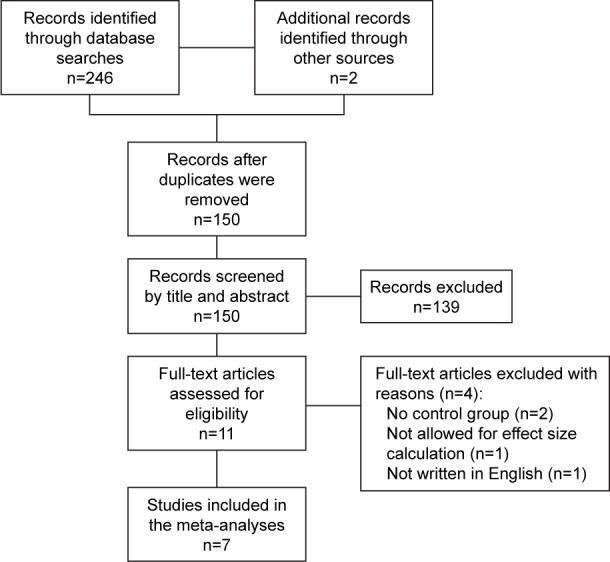
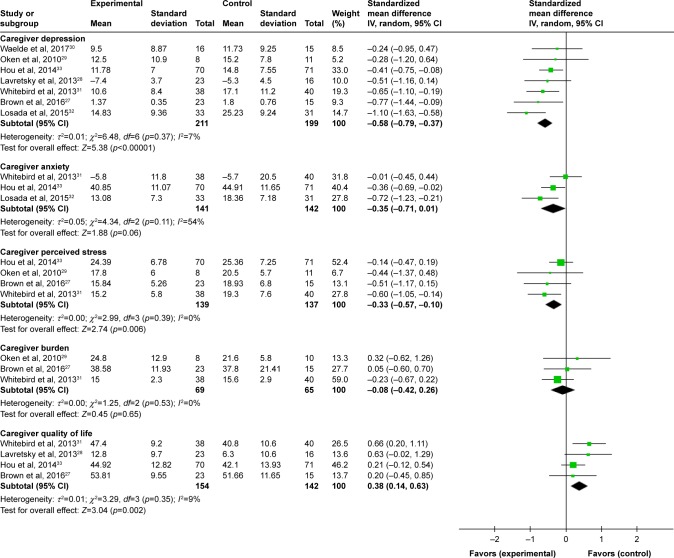
Caring for a relative with dementia is extremely challenging; conventional interventions may not be highly effective or easily available on some occasions. This study aimed to explore the efficacy of mindfulness training in improving stress-related outcomes in family caregivers of people with dementia using a meta-analytic review. We searched randomized controlled trials (RCT) through April 2017 from five electronic databases, and assessed the risk of bias using the Cochrane Collaboration tool. Seven RCTs were included in our review. Mindfulness interventions showed significant effects of improvement in depression (standardized mean difference: -0.58, [95% CI: -0.79 to -0.37]), perceived stress (-0.33, [-0.57 to -0.10]), and mental health-related quality of life (0.38 [0.14 to 0.63]) at 8 weeks post-treatment. Pooled evidence did not show a significant advantage of mindfulness training compared with control conditions in the alleviation of caregiver burden or anxiety. Future large-scale and rigorously designed trials are needed to confirm our findings. Clinicians may consider the mindfulness program as a promising alternative to conventional interventions.
Overview
The claims and statistics of this paper haven’t been checked yet.
Free: it reads the open-access text and checks the first 5 claims that cite a source we can check. Create a free account to check every claim.
Integrity signals
Registry
Cites
Statistics
Figures
Verification
Claims the paper makes
The claims and statistics of this paper haven’t been checked yet.
Free: it reads the open-access text and checks the first 5 claims that cite a source we can check. Create a free account to check every claim.
Claims other papers make about this one
Each is checked against this paper’s own text: does it say what the citing paper says it does?
The source backs part of the claim, not all of it — or backs it for a different population, condition or comparison.
In the citing paper
“Recent meta-analyses pooling data across multiple randomized controlled trials of mindfulness-based training interventions are consistent in reporting benefits in terms of reduced depression, burden, and perceived stress, and improved sleep quality and health-related quality of life among FCGs of PLwD [21–24].”
From Mindfulness and Care Experience in Family Caregivers of Persons Living with Dementia (2023) · cites this paper as [21]
Experimental — accuracy not yet measuredThe cited source says what the claim attributes to it.
In the citing paper
“Prior studies suggest that mindfulness effectively reduces caregiver perceived stress and depression [24], [27], [28]”
From A novel two-day intervention reduces stress in caregivers of persons with dementia (2018) · cites this paper as [28]
Self-check
Percentages, sums and reported differences re-computed from the paper’s own numbers.
The self-check needs the paper’s full text.
Citations
Cites
The Cochrane Collaboration's tool for assessing risk of bias in randomised trials
Higgins, J. P. T., Altman, D. G., Gotzsche, P. C., Juni, P., Moher, D., Oxman, A. D., Savovic, J., Schulz, K. F., Weeks, L., Sterne, J. A. C., et al. (2011) · BMJ · doi:10.1136/bmj.d5928 · Cited by 33,817
(1992) · PubMed · Cited by 33,716
Hamilton, M. (1960) · Journal of Neurology, Neurosurgery & Psychiatry · doi:10.1136/jnnp.23.1.56 · Cited by 32,817
A Global Measure of Perceived Stress
Cohen, S., Kamarck, T., & Mermelstein, R. (1983) · Journal of Health and Social Behavior · doi:10.2307/2136404 · Cited by 32,807
(1970) · Cited by 24,983
Dermyshi, E., Wang, Y., Yan, C., Hong, W., Qiu, G., Gong, X., & Zhang, T. (2017) · Neonatology · doi:10.1159/000454668 · Cited by 24,451
Mindfulness-based interventions in context: Past, present, and future
Kabat-Zinn, J. (2003) · Clinical Psychology: Science and Practice · doi:10.1093/clipsy.bpg016 · Cited by 8,615 · cited 1×
“Mindfulness is often operationally defined as “the awareness that emerges through paying attention on purpose, in the present moment, and non-judgmentally to the unfolding of experience”.(12) Mindfulness can be translated in various ways in the interventions such as the mindfulness-based stress reduction, yogic medita…”
Mindfulness-based interventions in context: Past, present, and future.
Kabat-Zinn, J. (2003) · Clinical Psychology: Science and Practice · doi:10.1093/clipsy/bpg016 · Cited by 8,612
Relatives of the Impaired Elderly: Correlates of Feelings of Burden
Zarit, S. H., Reever, K. E., & Bach-Peterson, J. (1980) · The Gerontologist · doi:10.1093/geront/20.6.649 · Cited by 5,810 · cited 1×
“One possibility is that caregiver burden is such a multicomponent measure (eg, the Zarit Burden Interview), 36 which includes both objective and subjective aspects of caregiving, that a brief intervention like mindfulness training can hardly target the multiple features represented by the concept…”
2016 Alzheimer's disease facts and figures
Alzheimer's Association (2016) · Alzheimer's & Dementia · doi:10.1016/j.jalz.2016.03.001 · Cited by 5,069
Cited by
Sun, Y., Ji, M., Leng, M., Li, X., Zhang, X., & Wang, Z. (2022) · International Journal of Nursing Studies · doi:10.1016/j.ijnurstu.2022.104204 · Cited by 176
Self-citationCheng, S.-T., & Zhang, F. (2020) · BMC Geriatrics · doi:10.1186/s12877-020-01547-2 · Cited by 166
Effects of mindfulness meditation interventions on depression in older adults: A meta-analysis
Reangsing, C., Rittiwong, T., & Schneider, J. K. (2021) · Aging & Mental Health · doi:10.1080/13607863.2020.1793901 · Cited by 114
“Those who did included small numbers of primary studies (s¼ 4-10) which prohibited moderator analysis (Kishita et al., 2017; Li & Bressington, 2019; Liu et al., 2017).”
BackgroundInfluentialSupporting Family Caregivers With Technology for Dementia Home Care: A Randomized Controlled Trial
Williams, K. N., Perkhounkova, Y., Shaw, C. A., Hein, M., Vidoni, E. D., & Coleman, C. (2019) · Innovation in Aging · doi:10.1093/geroni/igz037 · Cited by 75
Shim, M., Tilley, J. L., Im, S., Price, K., & Gonzalez, A. (2021) · Journal of Geriatric Psychiatry and Neurology · doi:10.1177/0891988720957104 · Cited by 67
Han, A., Yuen, H. K., Lee, H. Y., & Zhou, X. (2020) · Journal of Contextual Behavioral Science · doi:10.1016/j.jcbs.2020.10.004 · Cited by 39
Mindfulness- and compassion-based interventions for family carers of older adults: A scoping review.
Murfield, J., Moyle, W., & O'Donovan, A. (2021) · International Journal of Nursing Studies · doi:10.1016/j.ijnurstu.2019.103495 · Cited by 35
Pandya, S. P. (2019) · Journal of Gerontological Social Work · doi:10.1080/01634372.2019.1642278 · Cited by 32
“…for caregivers that suggests the intended outcomes as caregiving burden mitigation, improved self-efficacy and enhanced resilience (e.g. Kalomo et al., 2018; Milliken et al., 2018; Roth et al., 2005; Shi et al., 2017) and builds evidence for meditation as an intervention (see Liu et al., 2017).”
BackgroundPinto, C., Geraghty, A. W. A., McLoughlin, C., Pagnini, F., Yardley, L., & Dennison, L. (2022) · Health Psychology Review · doi:10.1080/17437199.2022.2073901 · Cited by 39
“For caregiver interventions, there is more evidence for the e ff ectiveness of psychological interventions for caregivers of people with dementia (Cheng et al., 2019; Liu et al., 2017; Selwood et al., 2007).”
Sikder, A. T., Yang, F. C., Schafer, R., Dowling, G. A., Traeger, L. N., & Jain, F. A. (2019) · JMIR Aging · doi:10.2196/12850 · Cited by 30
“Several studies and systematic meta-analyses have found that mindfulness and related guided imagery interventions, which have salutary effects on depression and anxiety [10,11], hold promise for improving the health of family AD and ADRD caregivers by reducing negative psychological symptoms and increasing quality of…”
BackgroundJain, F. A., Chernyak, S. V., Nickerson, L. D. H., Morgan, S. B., Schafer, R., Mischoulon, D., Bernard-Negron, R., Nyer, M., Cusin, C., Gomez, L. A. R., et al. (2022) · Psychotherapy and Psychosomatics · doi:10.1159/000521950 · Cited by 29
What Mindfulness, and for Whom? And Why Might it Work?
Sedlmeier, P. (2023) · Mindfulness · doi:10.1007/s12671-023-02218-0 · Cited by 30
“There is also some indication that people living in highly demanding settings, such as family caregivers of persons with dementia, might not profit so much from mindfulness practices (Liu et al., 2017).”
Effects of Mindfulness-based Interventions on Dementia Patients: A Meta-analysis
Wang, F. L., Tang, Q. Y., Zhang, L. L., Yang, J., Li, Y., Peng, H., & Wang, S. H. (2020) · Western Journal of Nursing Research · doi:10.1177/0193945920916750 · Cited by 26
“This is consistent with the findings by Liu et al. (2017), who reported significant effect of improvement in depression in family caregiver of persons with dementia.”
ResultSaragih, I. D., Batubara, S. O., Sharma, S. D., Saragih, I. S., & Chou, F. (2023) · Worldviews on Evidence-Based Nursing · doi:10.1111/wvn.12690 · Cited by 21
Oliveira, D., da Mata, F. A. F., & Aubeeluck, A. (2023) · British Medical Bulletin · doi:10.1093/bmb/ldad029 · Cited by 26
Mindfulness based stress reduction in people with Parkinson's disease and their care partners
Shah-Zamora, D., Allen, A. M., Rardin, L., Ivancic, M., Durham, K., Hickey, P., Cooney, J. W., Scott, B. L., & Mantri, S. (2021) · Complementary Therapies in Clinical Practice · doi:10.1016/j.ctcp.2021.101377 · Cited by 19
Activity patterns related to depression symptoms in stressed dementia caregivers
Smagula, S. F., Hasler, B. P., Schulz, R., Graves, J., Reynolds, C. F., Aizenstein, H. J., Buysse, D. J., Krafty, R. T., & Hall, M. H. (2019) · International Psychogeriatrics · doi:10.1017/s1041610219001601 · Cited by 22
“Existing interventions targeting psychosocial factors in dCGs (e.g., Cheng et al. (2016); Collins and Kishita (2018); Liu et al. (2017)) may yield additional benefits if they were to address the potential perpetuating effects of morning inactivity on depression.”
BackgroundYüce, G. E., Döner, A., Bilgin, A., & Muz, G. (2024) · Worldviews on Evidence-Based Nursing · doi:10.1111/wvn.12736 · Cited by 29
Grief, Mindfulness and Neural Predictors of Improvement in Family Dementia Caregivers
Jain, F. A., Connolly, C. G., Moore, L. C., Leuchter, A. F., Abrams, M., Ben-Yelles, R. W., Chang, S. E., Ramirez Gomez, L. A., Huey, N., Lavretsky, H., et al. (2019) · Frontiers in Human Neuroscience · doi:10.3389/fnhum.2019.00155 · Cited by 18
Grief, Mindfulness and Neural Predictors of Improvement in Family Dementia Caregivers
Jain, F. A., Connolly, C. G., Christov-Moore, L., Leuchter, A. F., Abrams, M., Ben-Yelles, R. W., Chang, S., Gomez, L. A. R., Huey, N. D., Lavretsky, H., et al. (2018) · doi:10.31231/osf.io/kqje7 · Cited by 18
Mindfulness and Care Experience in Family Caregivers of Persons Living with Dementia
Tolea, M. I., Camacho, S., Cohen, I. R., & Galvin, J. E. (2023) · Journal of Alzheimer's Disease Reports · doi:10.3233/adr-220069 · Cited by 17
Baumbusch, J., Cooke, H. A., Seetharaman, K., Khan, A., & Khan, K. B. (2022) · Journal of Family Nursing · doi:10.1177/10748407221100284 · Cited by 17
“…that mindfulness-based interventions (e.g., sitting/walking meditation, deep breathing, mindful movement, and visualization) have the potential to reduce stress, depressive symptoms, and anger and improve self-efficacy and quality of life over the short-term (Liu et al., 2017; Shim et al., 2021).”
BackgroundMoberg, C., Grundberg, Å., Konradsen, H., Kallström, A. P., Leung, A. Y. M., & Kabir, Z. N. (2022) · Dementia · doi:10.1177/14713012211065313 · Cited by 18
Meditation-Based Interventions for Adults With Dementia: A Scoping Review
Hoffman, L., Hutt, R., Tsui, C. K. Y., Zorokong, K., & Marfeo, E. E. (2020) · American Journal of Occupational Therapy · doi:10.5014/ajot.2020.037820 · Cited by 16
“…are interested in the many potential bene fi ts of mindfulness to reduce stress in caregivers, most of whom tend to experience high levels of stress (Liu et al., 2017 QOL bene fi ts for people with dementia who undertake mindfulness practices, especially considering the study ’ s use of…”
Yang, F. C., Zamaria, J. A., Morgan, S. B., Lin, E. C., Leuchter, A. F., Abrams, M., Chang, S. E., Mischoulon, D., Pedrelli, P., Fisher, L. B., et al. (2022) · Professional Psychology Research and Practice · doi:10.1037/pro0000388 · Cited by 17
A novel two-day intervention reduces stress in caregivers of persons with dementia
Spalding‐Wilson, K. N., Guzmán‐Vélez, E., Angelica, J., Wiggs, K., Savransky, A., & Tranel, D. (2018) · Alzheimer's & Dementia: Translational Research & Clinical Interventions · doi:10.1016/j.trci.2018.08.004 · Cited by 13
“Furthermore, nonjudgmental acceptance, a key element of mindfulness, may also help caregivers engage in a full and rich life despite the stress and demands associated with caregiving for someone with a neurodegenerative disease [28,29].”
BackgroundJain, F. A., Chernyak, S. V., Nickerson, L. D. H., Abrams, M., Iacoboni, M., Christov‐Moore, L., Connolly, C. G., Fisher, L. B., Sakurai, H., Bentley, K. H., et al. (2021) · Journal of Affective Disorders Reports · doi:10.1016/j.jadr.2021.100155 · Cited by 14
Mallya, S., & Fiocco, A. J. (2019) · Mindfulness · doi:10.1007/s12671-019-01155-1 · Cited by 14
Padci pri starejših in vpliv pandemije covida-19
Simon, M. R., & Kralj, M. (2022) · ZRC SAZU, Založba ZRC eBooks · doi:10.3986/9789610506966_09 · Cited by 10
Beng, T. S., Ching, H. C., Chia, Y. L., Yee, A. H. A., Ng, C. G., Hasan, M. S., Lim, K. S., Ahmad, S. B., Capelle, D. P., Loh, E. C., et al. (2019) · American Journal of Hospice and Palliative Medicine® · doi:10.1177/1049909119894507 · Cited by 12
Martis, C. S., Chandrababu, R., Ravishankar, N., Bhandary, R. P., Mohammed, C. A., Tolson, D., & Devi, E. S. (2022) · Clinical Epidemiology and Global Health · doi:10.1016/j.cegh.2022.101192 · Cited by 16
Maximiano‐Barreto, M. A., Luchesi, B. M., Matias, M., & Chagas, M. H. N. (2024) · Geriatric Nursing · doi:10.1016/j.gerinurse.2024.02.024 · Cited by 12
Zhou, W., Song, X. Y., Si, H., Bian, Y., Liu, Q., Li, Y., Yu, J., & Wang, C. (2024) · Journal of Advanced Nursing · doi:10.1111/jan.16314 · Cited by 12
Gaylord, S. A., Faurot, K. R., Shafer, J. S., Harr, E. D., Lathren, C., Roth, I., Giscombé, K., Sheffield-Abdullah, K. M., & Williams, S. (2022) · Contemporary Clinical Trials Communications · doi:10.1016/j.conctc.2022.101031 · Cited by 10
Huang, J., Wei, W., Zheng, P., Tang, T., Zhang, P. X., Long, M.-Y., Li, M., Ning, X.-Y., Tian, Y., Cheng, Y., et al. (2021) · Brain and Behavior · doi:10.1002/brb3.2229 · Cited by 8
“Since the number of items in each dimension is different, and in order to standardize the score, the score of each dimension was divided by the number of items to obtain the standardized average score and total average score (Liu et al., 2017).”
BackgroundKeune, P. M., Bernard, F., Meister, R., Keune, J., Springer, R., Arlt, R., Holmerová, I., Auer, S., Oschmann, P., & Hansen, S. (2023) · Mindfulness · doi:10.1007/s12671-023-02192-7 · Cited by 6
Pandya, S. P. (2019) · Social Work in Mental Health · doi:10.1080/15332985.2019.1676364 · Cited by 8
“Overall, in line with existing research on mindfulness-based interventions for family caregivers (e.g., Dharmawardene et al., 2016; Liu et al., 2017), the results of this study support the effectiveness of the internet-based meditation program for the target group within the stress reduction frame…”
ResultFiocco, A. J., & Hytman, L. (2022) · Mindfulness · doi:10.1007/s12671-022-02005-3 · Cited by 5
Plys, E., Seward, M., Allen, E. M., Tatar, R., Huberty, J., & Vranceanu, A. (2025) · The Gerontologist · doi:10.1093/geront/gnaf047 · Cited by 7
A Pilot Randomized Controlled Trial of a Mindfulness-Based Intervention for Caregivers of Veterans
Lara-Cinisomo, S., Santens, R. L., & Fujimoto, E. M. (2019) · Mindfulness · doi:10.1007/s12671-019-01131-9 · Cited by 5
Sapra, M., Hagemann, L., Luci, K., & Savla, J. T. (2025) · Alzheimer s & Dementia Translational Research & Clinical Interventions · doi:10.1002/trc2.70064 · Cited by 5
Muñoz-Padros, J., Garolera, M., Bartes-Plans, A., Anderson, S. M., Contreras-Briñez, F., Jimenez-Fuentes, S., Plana, Y., & Boreu, Q. F. (2023) · International Journal of Clinical Trials · doi:10.18203/2349-3259.ijct20232195 · Cited by 3
Epidemiološke ocene prevalence demence v Sloveniji
Lovrečić, B., & Lovrečić, M. (2022) · ZRC SAZU, Založba ZRC eBooks · doi:10.3986/9789610506966_01 · Cited by 3
Touron, E., Gonneaud, J., Paly, L., Delarue, M., Hébert, O., Mézenge, F., Fauvel, S., Vivien, D., Sayette, V. D. L., Poisnel, G., et al. (2025) · Scientific Reports · doi:10.1038/s41598-025-99059-9 · Cited by 2
Langé, A. (2020) · University of Surrey Open Research repository · doi:10.15126/thesis.00852508 · Cited by 2
Jacobs, M. L., Smith, K., Durkin, D. W., Hulse, P. R. B., Snow, A. L., Alexander, K., & Hilgeman, M. M. (2025) · Clinical Gerontologist · doi:10.1080/07317115.2025.2572803 · Cited by 1
“Consistent with existing literature, our study found that mindfulness was related to better mental health and quality of life and less caregiver burden among caregivers (Han, 2022; Klietz et al., 2020; Liu et al., 2017; Tkatch et al., 2017; Weisman de Mamani et al., 2018).”
Cohen, L., Suberry, A., Sun, P. C., Ulitsa, N., Roy, S., & Ayalon, L. (2025) · Sage Open Aging · doi:10.1177/30495334251406040 · Cited by 1
“Among family caregivers of people with dementia, a meta-analysis found that mindfulness led to significant reductions in depression and perceived stress, along with improved mood (Liu et al., 2017).”
Psychological Flexibility in Dementia Caregiving: The Adaptive Support Model
Green, G., Batura, J., Kelley, H. H., Bradford, K. P., & Fauth, E. B. (2026) · Journal of Family Theory & Review · doi:10.1111/jftr.70054 · Cited by 1
Harris, M., Houtven, C. H. V., & Hastings, S. N. (2022) · JMIR Research Protocols · doi:10.2196/43098 · Cited by 1
“Few studies have combined such tools to best meet the needs of PLWD and their care partners and few tool-based interventions have been designed with ongoing, iterative feedback from this population which will be essential for optimizing delivery and facilitating broad uptake [21,22].”
BackgroundBamber, M. D., Solatikia, F., Gaillard, P., & Spratling, R. G. (2023) · Journal of Psychopathology and Behavioral Assessment · doi:10.1007/s10862-023-10081-5 · Cited by 1
Current management tactics for patients with dementia
Medvedeva, A. V., Kosivtsova, O. V., & Алексеевич, М. К. (2018) · Neurology neuropsychiatry Psychosomatics · doi:10.14412/2074-2711-2018-2-102-108
Colín, S. T. (2019) · Buleria (Universidad de León) · doi:10.18002/10612/11774
Blázquez, M. (2002) · Dialnet (Universidad de la Rioja)
Harris, M., Houtven, C. H. V., & Hastings, S. N. (2022) · doi:10.2196/preprints.43098
Depressive Disorders Among Family Caregivers of People Living with Dementia
Miranda‐Castillo, C., Tapia‐Muñoz, T., Oliveira, D., & Sáez, S. (2022) · Depression and personality · doi:10.1007/978-3-031-13029-8_10 · Cited by 1
Dolgotrajni covid-19/postcovidni sindrom in kognitivne motnje
Lovrečić, B., Lovrečić, M., & Grkman, L. (2022) · ZRC SAZU, Založba ZRC eBooks · doi:10.3986/9789610506966_06
(2022) · ZRC SAZU, Založba ZRC eBooks · doi:10.3986/9789610506966_00
Breme neformalnih oskrbovalcev oseb z demenco v času covida-19
Lovrečić, B., Lovrečić, M., & Mavrič, N. (2022) · ZRC SAZU, Založba ZRC eBooks · doi:10.3986/9789610506966_08
Dinamika nevropsihiatričnih simptomov pri osebah z demenco v povezavi s pandemijo in covidom-19
Lovrečić, B., Lovrečić, M., & Grkman, L. (2022) · ZRC SAZU, Založba ZRC eBooks · doi:10.3986/9789610506966_05
Duševno zdravje neformalnih družinskih oskrbovalcev oseb z demenco
Lovrečić, B., Lovrečić, M., & Cizl, M. (2022) · ZRC SAZU, Založba ZRC eBooks · doi:10.3986/9789610506966_07
Javnozdravstveni izzivi demence
Lovrečić, B., Lovrečić, M., Sambt, J., Grkman, L., Simon, M. R., Mavrič, N., Sedlak, S., Jelenc, M., Cizl, M., Kralj, M., et al. (2022) · ZRC SAZU, Založba ZRC eBooks · doi:10.3986/9789610506966 · Cited by 2
Poznavanje demence med splošno javnostjo
Lovrečić, B., Lovrečić, M., & Mavrič, N. (2022) · ZRC SAZU, Založba ZRC eBooks · doi:10.3986/9789610506966_02
Dolgotrajna oskrba ljudi z demenco
Mali, J. (2022) · ZRC SAZU, Založba ZRC eBooks · doi:10.3986/9789610506966_03
Ekonomsko breme demence v Sloveniji glede na rutinske podatkovne zbirke zdravstvenega varstva
Lovrečić, B., Sambt, J., Sedlak, S., & Jelenc, M. (2022) · ZRC SAZU, Založba ZRC eBooks · doi:10.3986/9789610506966_04
การบำบัดโดยใช้การเจริญสติเป็นฐานสำหรับผู้ป่วยโรคสมองเสื่อม
แย้มรัตนกุล, ว. (2023) · Siriraj Medical Bulletin · doi:10.33192/smb.v15i1.254071
Janghorbani, M., Omranifard, V., & Mansourzadeh, A. (2023) · Research Square · doi:10.21203/rs.3.rs-2257540/v1
Faurot, K. R., Roth, I., Harr, E. D., Shafer, J. S., Giscombé, K., Sheffield-Abdullah, K. M., Lathren, C., Brantley, M. M., Williams, S. W., & Gaylord, S. A. (2025) · Global Advances in Integrative Medicine and Health · doi:10.1177/27536130251347944
“2 In another review, including a network meta-analysis, researchers found that mindfulness-based interventions were associated with a moderate effect on perceived caregiver burden.”
Liu, X., Bian, J., Mitani, S., Doorenbos, A. Z., Yoshinaga, N., & Fukahori, H. (2025) · Aging & Mental Health · doi:10.1080/13607863.2025.2568160 · Cited by 1
“People with dementia need increasing care from caregivers (Liu et al., 2017), since dementia is one of the leading causes of disability and dependency in older adults worldwide (O’Connor, 2019).”
Williams, M. P., Seward, M., Allen, E. M., Tatar, R., Simon, D. M., Huberty, J., Vranceanu, A., & Plys, E. (2026) · Aging & Mental Health · doi:10.1080/13607863.2026.2662514
Kor, P. P. K., Tsang, A. P. L., Cheung, D. S. K., Zarit, S. H., Xie, H., Qian, M., Tan, K. C., Zheng, Y., Chu, A. M. Y., & Chou, K. (2026) · JMIR Aging · doi:10.2196/87316 · Cited by 2
“The primary effectiveness outcome was perceived stress, with an effect size of d =0.33 drawn from a prior meta-analysis of MBIs for caregivers of people with dementia [31].”
InfluentialFebvre-Richards, E., Rodriguez, C. R., Carter, T., Fromings, E., Cheung, G., & Gee, S. (2026) · Journal of dementia and Alzheimer's disease · doi:10.3390/jdad3030039
Elliott, L., Post, E., McClendon, A., & Singer, J. (2026) · Journal of Alzheimer s Disease · doi:10.1177/13872877261476965
“There are approximately 11.5 million family caregivers for persons with AD/ADRD, making up 48% of all caregivers in the US.”
InfluentialBano, B., Cristofalo, D., Prina, E., Patania, F., Mazzé, F., Ostuzzi, G., Barbui, C., Albanese, E., & Purgato, M. (2026) · Clinical Psychology Review · doi:10.1016/j.cpr.2026.102804
Metadata
- Authors
- Liu, Z., Chen, Q. L., & Sun, Y.-Y.
- Affiliations
- Chinese University of Hong Kong (HK)
- Corresponding author
- Liu, Zheng
- ORCID
- Liu, Zheng
- Venue
- Clinical Interventions in Aging
- Publisher
- Informa UK Limited
- Published
- 2017-09
- Volume
- Volume 12
- Pages
- 1521-1529
- ISSN
- 1176-9092 (ISSN-L)
- 1178-1998
- PMC
- PMC5626236
- OpenAlex
- W2756674844
- Cited by
- 72
- References
- 53
- Citations by year
- 2026: 6 · 2025: 7 · 2024: 3 · 2023: 9 · 2022: 23 · 2021: 3 · 2020: 6 · 2019: 11 · 2018: 3
- FWCI
- 0.84
- Type
- journal article
- Language
- en
- Open access
- gold
- doi.org
- Licence
- Locations
- Clinical Interventions in Aging (publishedVersion, cc-by-nc)
- Europe PMC (PubMed Central) (publishedVersion, cc-by-nc)
- PubMed Central (publishedVersion, cc-by-nc)
- PubMed (publishedVersion)
- Dove Medical Press (Taylor and Francis Group) (submittedVersion, cc-by-nc)
- Topics
- Social Sciences › Psychology › Clinical Psychology › Mindfulness and Compassion Interventions
- Health Sciences › Nursing › Research and Theory › Nursing care and research
- Health Sciences › Medicine › Psychiatry and Mental health › Dementia and Cognitive Impairment Research
- Keywords
- mindfulness training, family caregivers, dementia, caregiver stress, depression, perceived stress, mental health-related quality of life, caregiver burden, anxiety, psychological intervention
- MeSH terms
- Adaptation, Psychological, Dementia, Female, Humans, Mental Health, Quality of Life, Stress, Psychological, Randomized Controlled Trials as Topic, Caregivers, Cost of Illness, Mindfulness
About these checks
Registry, retraction, Cites and statistics results are computed, not judged, with one exception: a printed reference that no index lists is read once by a model before it counts as a citation error. Claims are extracted by a model and kept only when their quote appears verbatim in the text; each cited source is then checked, with a model’s help, for whether it says what the claim relies on. Those verdicts can be wrong — read the claim’s quote and the cited source before relying on one.
Statistics and arithmetic are recomputed, not judged.
Confidence bands are shown only for fields calibrated on our annotated test set. None is calibrated yet, so no band is shown.
What counts as a claim ›How we measure confidence ›How we check this ›
Are you an author, or do you see a problem with this page? Request a review
Data sources
Bibliographic data: Semantic Scholar, OpenAlex, Crossref.
Contains information from the Semantic Scholar Academic Graph Datasets, made available under the ODC Attribution License (ODC-BY 1.0).
Semantic Scholar’s data is described in: Kinney, R., et al. (2023). The Semantic Scholar Open Data Platform. arXiv:2301.10140.
