

Potential Roles of Glucagon-Like Peptide-1 and Its Analogues in Dementia Targeting Impaired Insulin Secretion and Neurodegeneration
Open accessThe DOI matches its Crossref record; 240 of the 240 references it cites were found in a registry or an index.
Abstract
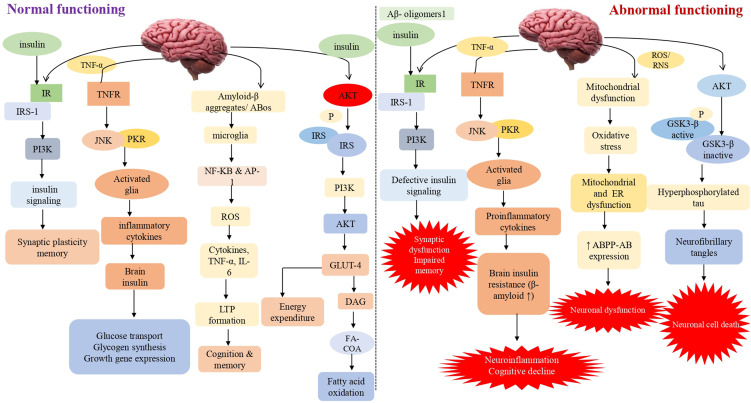
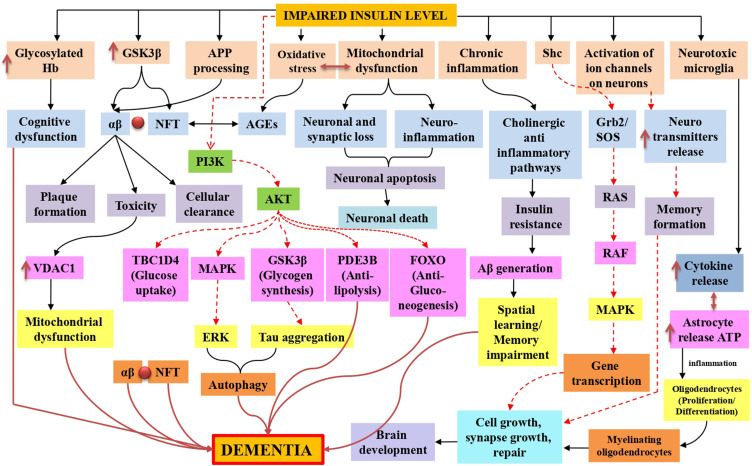
Dementia is a chronic, irreversible condition marked by memory loss, cognitive decline, and mental instability. It is clinically related to various progressive neurological diseases, including Parkinson's disease, Alzheimer's disease, and Huntington's. The primary cause of neurological disorders is insulin desensitization, demyelination, oxidative stress, and neuroinflammation accompanied by various aberrant proteins such as amyloid-β deposits, Lewy bodies accumulation, tau formation leading to neurofibrillary tangles. Impaired insulin signaling is directly associated with amyloid-β and α-synuclein deposition, as well as specific signaling cascades involved in neurodegenerative diseases. Insulin dysfunction may initiate various intracellular signaling cascades, including phosphoinositide 3-kinase (PI3K), c-Jun N-terminal kinases (JNK), and mitogen-activated protein kinase (MAPK). Neuronal death, inflammation, neuronal excitation, mitochondrial malfunction, and protein deposition are all influenced by insulin. Recent research has focused on GLP-1 receptor agonists as a potential therapeutic target. They increase glucose-dependent insulin secretion and are beneficial in neurodegenerative diseases by reducing oxidative stress and cytokine production. They reduce the deposition of abnormal proteins by crossing the blood-brain barrier. The purpose of this article is to discuss the role of insulin dysfunction in the pathogenesis of neurological diseases, specifically dementia. Additionally, we reviewed the therapeutic target (GLP-1) and its receptor activators as a possible treatment of dementia.
Overview
The claims and statistics of this paper haven’t been checked yet.
Free: it reads the open-access text and checks the first 5 claims that cite a source we can check. Create a free account to check every claim.
Integrity signals
Registry
Cites
Statistics
Figures
Verification
Claims the paper makes
The claims and statistics of this paper haven’t been checked yet.
Free: it reads the open-access text and checks the first 5 claims that cite a source we can check. Create a free account to check every claim.
Claims other papers make about this one
Each is checked against this paper’s own text: does it say what the citing paper says it does?
The source backs part of the claim, not all of it — or backs it for a different population, condition or comparison.
In the citing paper
“Exenatide has been shown to mitigate the phosphorylation of insulin receptor substrates and the accumulation of monomeric α-synuclein.414”
From Glucagon-like peptide-1 receptor: mechanisms and advances in therapy (2024) · cites this paper as [414]
Experimental — accuracy not yet measuredThe source backs part of the claim, not all of it — or backs it for a different population, condition or comparison.
In the citing paper
“Furthermore, GLP-1 signaling indirectly enhances and restores the insulin signaling pathway in neurons, leading to a reduction in the phosphorylation of insulin receptor substrates and the burden caused by monomeric α-synuclein.414”
From Glucagon-like peptide-1 receptor: mechanisms and advances in therapy (2024) · cites this paper as [414]
Experimental — accuracy not yet measured
Self-check
Percentages, sums and reported differences re-computed from the paper’s own numbers.
The self-check needs the paper’s full text.
Citations
Cites
2 retracted
DeVisser, A., Yang, C., Herring, A., Martinez, J. A., Rosales-Hernandez, A., Poliakov, I., Ayer, A. B., Garven, A., Zaver, S., Rincon, N., et al. (2011) · Neurobiology of Disease · doi:10.1016/j.nbd.2011.06.005 · Cited by 47
RetractedYang, C., DeVisser, A., Martinez, J. A., Poliakov, I., Rosales-Hernandez, A., Ayer, A. B., Garven, A., Zaver, S., Rincon, N., Xu, K., et al. (2011) · Neurobiology of Disease · doi:10.1016/j.nbd.2011.02.007 · Cited by 29 · cited 1×
“149 It has been suggested that GLP-1 analogues inhibit the expression of the AGE receptor, which could be used to mitigate the effect of AGEs on neuronal cell death.”
RetractedMcKhann, G. M., Knopman, D. S., Chertkow, H., Hyman, B. T., Jack, C. R., Kawas, C. H., Klunk, W. E., Koroshetz, W. J., Manly, J. J., Mayeux, R., et al. (2011) · Alzheimer's & Dementia · doi:10.1016/j.jalz.2011.03.005 · Cited by 18,657 · cited 1×
“30 Dementia is a type of memory loss distinct from other types of memory loss.”
Ror2 signaling regulates Golgi structure and transport through IFT20 for tumor invasiveness
Nishita, M., Park, S.-Y., Nishio, T., Kamizaki, K., Wang, Z., Tamada, K., Takumi, T., Hashimoto, R., Otani, H., Pazour, G. J., et al. (2017) · Scientific Reports · doi:10.1038/s41598-016-0028-x · Cited by 15,947
Apoptosis in the Pathogenesis and Treatment of Disease
Thompson, C. B. (1995) · Science · doi:10.1126/science.7878464 · Cited by 6,524 · cited 1×
“It has been linked to type 1 diabetes, 91 diabetic retinopathy, 92 and nephropathy.”
The cholinergic hypothesis of geriatric memory dysfunction
Bartus, R. T., Dean, R. L., Beer, B., & Lippa, A. S. (1982) · Science · doi:10.1126/science.7046051 · Cited by 5,545 · cited 1×
“81–83 According to studies, decreased neurotransmitter activity does not always correlate with the severity of Lewy body pathology.”
Querfurth, H. W., & LaFerla, F. M. (2010) · New England Journal of Medicine · doi:10.1056/nejmra0909142 · Cited by 4,569
Normalizing mitochondrial superoxide production blocks three pathways of hyperglycaemic damage
Nishikawa, T., Edelstein, D., Du, X. L., Yamagishi, S.-I., Matsumura, T., Kaneda, Y., Yorek, M. A., Beebe, D., Oates, P. J., Hammes, H.-P., et al. (2000) · Nature · doi:10.1038/35008121 · Cited by 4,277 · cited 2×
“Glucotoxicity is reported to be exerted by increased intracellular glucose oxidation in neurons.(67) Insulin resistance causes cognitive issues in type 2 diabetes.”
Hearing loss and cognitive decline in older adults
Lin, F. R., Yaffe, K., Xia, J., Xue, Q.-L., Harris, T. B., Purchase-Helzner, E., Satterfield, S., Ayonayon, H. N., Ferrucci, L., Simonsick, E. M., et al. (2013) · JAMA Internal Medicine · doi:10.1001/jamainternmed.2013.1868 · Cited by 4,017
The Blood-Brain Barrier in Health and Chronic Neurodegenerative Disorders
Zlokovic, B. V. (2008) · Neuron · doi:10.1016/j.neuron.2008.01.003 · Cited by 3,280 · cited 1×
“113,115 Alterations in insulin-associated inflammation, aberrant endoplasmic reticulum-stress modulation, excitotoxicity, and lipotoxicity have all been identified as possible biochemical mechanisms of insulin resistance.”
Research works printed but not linked: 2
- Auer RN. Hypoglycemic brain damage. In: Acute Neuronal Injury; 2018: 175– 188.
- Freeman AM, Pennings N. Insulin resistance. In: StatPearls [Internet]; 2021. 29939616
Cited by
Glucagon-like peptide-1 receptor: mechanisms and advances in therapy
Zheng, Z., Zong, Y., Ma, Y., Tian, Y., Pang, Y., Zhang, C., & Gao, J. (2024) · Signal Transduction and Targeted Therapy · doi:10.1038/s41392-024-01931-z · Cited by 1,036
“414 By activating the GLP-1 signaling pathway, exenatide exhibits neuroprotective effects and safeguards dopaminergic neurons.”
BackgroundMapping the effectiveness and risks of GLP-1 receptor agonists
Xie, Y., Choi, T., & Al-Aly, Z. (2025) · Nature Medicine · doi:10.1038/s41591-024-03412-w · Cited by 300
Pathobiology of the Klotho Antiaging Protein and Therapeutic Considerations
Prud’homme, G. J., Kurt, M., & Wang, Q. (2022) · Frontiers in Aging · doi:10.3389/fragi.2022.931331 · Cited by 219
Oxidative stress–mediated neuroinflammation in Alzheimer’s disease
Firdous, S. M., Khan, S. A., & Maity, A. (2024) · Naunyn-Schmiedeberg s Archives of Pharmacology · doi:10.1007/s00210-024-03188-3 · Cited by 100
“Metformin, known for increasing insulin sensitivity in the body and commonly prescribed as a first-line therapy for type 2 diabetes, may potentially reduce cognitive decline in individuals with amnestic mild cognitive impairment (aMCI) and prevent dementia in obese individuals by improving glucose metabolism within CN…”
InfluentialTirzepatide prevents neurodegeneration through multiple molecular pathways
Fontanella, R. A., Ghosh, P., Pesapane, A., Taktaz, F., Puocci, A., Franzese, M., Feliciano, M. F., Tortorella, G., Scisciola, L., Sommella, E., et al. (2024) · Journal of Translational Medicine · doi:10.1186/s12967-024-04927-z · Cited by 67
“Surprisingly, incretins showed the most promising neuroprotective effect [10], decreasing neuronal apoptosis, oxidative stress, beta-amyloid accumulation, and tau-induced neurofibrillary tangle formation [11].”
Background
Metadata
- Authors
- Mehan, S., Bhalla, S., Siddiqui, E. M., Sharma, N., Shandilya, A., & Khan, A.
- Affiliations
- Indo Soviet Friendship College of Pharmacy (IN)
- Jazan University (SA)
- Corresponding author
- Mehan, Sidharth
- ORCID
- Venue
- Degenerative Neurological and Neuromuscular Disease
- Publisher
- Informa UK Limited
- Published
- 2022-03
- Volume
- Volume 12
- Pages
- 31-59
- ISSN
- 1179-9900 (ISSN-L)
- PMC
- PMC8921673
- OpenAlex
- W4220688736
- Cited by
- 29
- References
- 240
- Citations by year
- 2026: 1 · 2025: 9 · 2024: 9 · 2023: 5 · 2022: 5
- FWCI
- 0.96
- Type
- journal article
- Language
- en
- Open access
- diamond
- doi.org
- Licence
- Locations
- Degenerative Neurological and Neuromuscular Disease (publishedVersion, cc-by-nc)
- PubMed Central (publishedVersion, cc-by-nc)
- PubMed (publishedVersion)
- Dove Medical Press (Taylor and Francis Group) (submittedVersion, cc-by-nc)
- Funders
- Israel Science Foundation
- Topics
- Life Sciences › Neuroscience › Cellular and Molecular Neuroscience › Alzheimer's disease research and treatments
- Health Sciences › Medicine › Endocrinology, Diabetes and Metabolism › Diabetes Treatment and Management
- Life Sciences › Neuroscience › Neurology › Neuroinflammation and Neurodegeneration Mechanisms
- Keywords
- glucagon-like peptide-1, GLP-1 receptor agonists, dementia, insulin resistance, impaired insulin secretion, neurodegeneration, Alzheimer's disease, Parkinson's disease, Huntington's disease, amyloid-beta, alpha-synuclein, tau protein, oxidative stress, neuroinflammation, PI3K signaling, MAPK signaling, JNK signaling, blood-brain barrier, neuroprotection
About these checks
Registry, retraction, Cites and statistics results are computed, not judged, with one exception: a printed reference that no index lists is read once by a model before it counts as a citation error. Claims are extracted by a model and kept only when their quote appears verbatim in the text; each cited source is then checked, with a model’s help, for whether it says what the claim relies on. Those verdicts can be wrong — read the claim’s quote and the cited source before relying on one.
Statistics and arithmetic are recomputed, not judged.
Confidence bands are shown only for fields calibrated on our annotated test set. None is calibrated yet, so no band is shown.
What counts as a claim ›How we measure confidence ›How we check this ›
Are you an author, or do you see a problem with this page? Request a review
How to cite
Cite CoChat for the checks on this page, and the paper for its own findings.
- This page
- CoChat. (2026). Citation check: Potential Roles of Glucagon-Like Peptide-1 and Its Analogues in Dementia Targeting Impaired Insulin Secretion and Neurodegeneration. https://app.cochat.ai/papers/10.2147/dnnd.s247153
- The paper
- Mehan, S., Bhalla, S., Siddiqui, E. M., Sharma, N., Shandilya, A., & Khan, A. (2022). Potential Roles of Glucagon-Like Peptide-1 and Its Analogues in Dementia Targeting Impaired Insulin Secretion and Neurodegeneration. Degenerative Neurological and Neuromuscular Disease. https://doi.org/10.2147/dnnd.s247153
Data sources
Bibliographic data: Semantic Scholar, OpenAlex, Crossref.
Contains information from the Semantic Scholar Academic Graph Datasets, made available under the ODC Attribution License (ODC-BY 1.0).
Semantic Scholar’s data is described in: Kinney, R., et al. (2023). The Semantic Scholar Open Data Platform. arXiv:2301.10140.
