

Stress, the Autonomic Nervous System, and the Immune-kynurenine Pathway in the Etiology of Depression
Open accessThe DOI matches its Crossref record; 109 of the 109 references it cites were found in a registry or an index.
Abstract
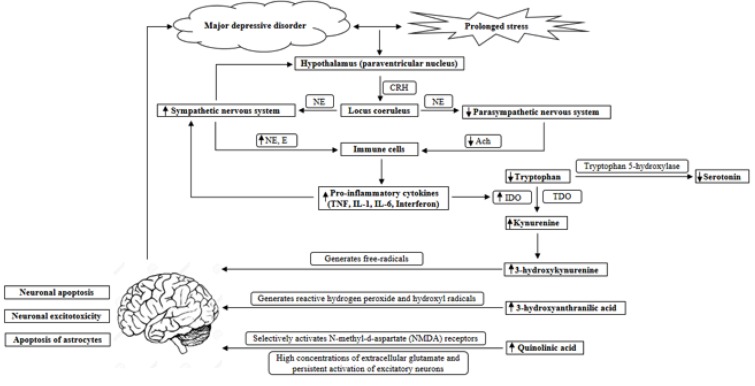
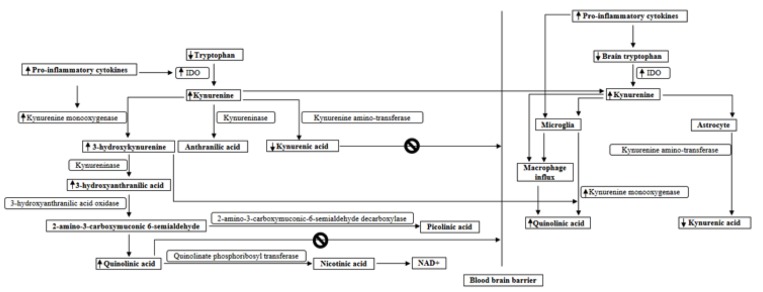
The autonomic nervous system is one of the major neural pathways activated by stress. In situations that are often associated with chronic stress, such as major depressive disorder, the sympathetic nervous system can be continuously activated without the normal counteraction of the parasympathetic nervous system. As a result, the immune system can be activated with increased levels of proinflammatory cytokines. These inflammatory conditions have been repeatedly observed in depression. In the search for the mechanism by which the immune system might contribute to depression, the enhanced activity of indoleamine 2,3- dioxygenase by pro-inflammatory cytokines has been suggested to play an important role. Indoleamine 2,3-dioxygenase is the first enzyme in the kynurenine pathway that converts tryptophan to kynurenine. Elevated activity of this enzyme can cause imbalances in downstream kynurenine metabolites. This imbalance can induce neurotoxic changes in the brain and create a vulnerable glial-neuronal network, which may render the brain susceptible to depression. This review focuses on the interaction between stress, the autonomic nervous system and the immune system which can cause imbalances in the kynurenine pathway, which may ultimately lead to major depressive disorder.
Overview
The claims and statistics of this paper haven’t been checked yet.
Free: it reads the open-access text and checks the first 5 claims that cite a source we can check. Create a free account to check every claim.
Integrity signals
Registry
Cites
Statistics
Figures
Verification
Claims the paper makes
The claims and statistics of this paper haven’t been checked yet.
Free: it reads the open-access text and checks the first 5 claims that cite a source we can check. Create a free account to check every claim.
Claims other papers make about this one
Each is checked against this paper’s own text: does it say what the citing paper says it does?
The source backs part of the claim, not all of it — or backs it for a different population, condition or comparison.
In the citing paper
“As neurons in the PVH and LC project to sympathetic centres in the brain stem and spinal cord, it is possible that elevated sympathetic tone arising from the activation of these brain regions during chronic stress drives these HSC and leukocyte dynamics in the bone marrow66–68.”
From Central regulation of stress-evoked peripheral immune responses (2023) · cites this paper as [66]
Experimental — accuracy not yet measuredThe source backs part of the claim, not all of it — or backs it for a different population, condition or comparison.
In the citing paper
“Briefly, responding to social stress, neurons in the hypothalamus release corticotropin‐releasing hormone (CRH) directly into the spinal cord and brain stem, sparking the additional release of CRH and quick release of epinephrine and norepinephrine from the adrenal glands (reviewed in (Won & Kim, 2016).”
From On race, human variation, and who gets and dies of sepsis (2022) · cites this paper as Won & Kim, 2016
Experimental — accuracy not yet measured
Self-check
Percentages, sums and reported differences re-computed from the paper’s own numbers.
The self-check needs the paper’s full text.
Citations
Cites
Correspondence - Tranexamic acid for traumatic brain injury
(2005) · London School of Economics and Political Science Theses Online (London School of Economics and Political Science) · doi:10.1016/s0140-6736 · Cited by 11,894
Vagus nerve stimulation attenuates the systemic inflammatory response to endotoxin
Borovikova, L. V., Ivanova, S., Zhang, M., Yang, H., Botchkina, G. I., Watkins, L. R., Wang, H., Abumrad, N., Eaton, J. W., & Tracey, K. J. (2000) · Nature · doi:10.1038/35013070 · Cited by 4,211 · cited 1×
“In contrast, ACh has been reported to dose-dependently inhibit the release of TNF, along with other proinflammatory cytokines such as IL-1, IL-6, and IL-18 [40].”
BackgroundThe Concepts of Stress and Stress System Disorders: Overview of Physical and Behavioral Homeostasis
Chrousos, G. P. (1992) · JAMA · doi:10.1001/jama.1992.03480090092034 · Cited by 2,689 · cited 2×
“Stress is defined as a state of threatened homeostasis following exposure to extrinsic or intrinsic adverse forces [9].”
BackgroundInfluentialElenkov, I. J., Wilder, R. L., Chrousos, G. P., & Vizi, E. S. (2000) · Pharmacological Reviews · doi:10.1016/s0031-6997(24)01470-4 · Cited by 2,252 · cited 1×
“Although stress initially activates both the ANS and the HPA axis, this review will focus on the role of the ANS, which has received much less attention than the HPA axis [22].”
BackgroundRajkowska, G., Miguel-Hidalgo, J. J., Wei, J., Dilley, G., Pittman, S. D., Meltzer, H. Y., Overholser, J. C., Roth, B. L., & Stockmeier, C. A. (1999) · Biological Psychiatry · doi:10.1016/s0006-3223(99)00041-4 · Cited by 1,477 · cited 13×
“As we consider inflammatory conditions to be caused by an over-driven SNS together with an under-driven PNS induced by stress, treatments that increase the parasympathetic tone and hence strengthen the cholinergic anti-inflammatory pathway [102] may be useful in treating MDD.”
ResultInfluentialCytokine-Associated Emotional and Cognitive Disturbances in Humans
Reichenberg, A., Yirmiya, R., Schuld, A., Kraus, T., Haack, M., Morag, A., & Pollmächer, T. (2001) · Archives of General Psychiatry · doi:10.1001/archpsyc.58.5.445 · Cited by 1,365 · cited 7×
“As a result, pro-inflammatory cytokines, such as TNF, IL-1, and IL-6, can increase in prolonged stressful situations such as depression.”
BackgroundInfluentialStress, depression, the immune system, and cancer
Reiche, E. M. V., Nunes, S. O. V., & Morimoto, H. K. (2004) · The Lancet Oncology · doi:10.1016/s1470-2045(04)01597-9 · Cited by 1,364 · cited 1×
“The activation of the SNS in turn stimulates the release of CRH by the hypothalamus, creating a positive bidirectional feedback loop [29].”
BackgroundO'Connor, J. C., Lawson, M. A., André, C., Moreau, M., Lestage, J., Castanon, N., Kelley, K. W., & Dantzer, R. (2009) · Molecular Psychiatry · doi:10.1038/sj.mp.4002148 · Cited by 1,278 · cited 1×
“The authors confirm that this article content has no conflict of interest.”
BackgroundThe increasing burden of depression
Briley, M., & Lépine (2011) · Neuropsychiatric Disease and Treatment · doi:10.2147/ndt.s19617 · Cited by 1,211
The global burden of women's cancers: a grand challenge in global health
Ginsburg, O., Bray, F., Coleman, M. P., Vanderpuye, V., Eniu, A., Kotha, S. R., Sarker, M., Huong, T. T., Allemani, C., Dvaladze, A., et al. (2017) · The Lancet · doi:10.1016/s0140-6736(16)31392-7 · Cited by 1,127
Cited by
Items 301–330 of 330
Chubar, V. (2026) · Lirias (KU Leuven)
del Valle, U., Alvarez, G. R., Ramírez-Scarpetta, J. M., del Valle, U., Rosero, E., del Valle, U., & Albán, C. A. L. (2025) · Revista Mexicana de Ingeniería Biomédica · doi:10.17488/rmib.46.3.1502
Wang, C., Zhou, T., Yu, Y., Tang, K., Luo, X., Shi, W., Yu, X., Luo, J., Cai, Y., Lu, X., et al. (2026) · Advances in Ophthalmology Practice and Research · doi:10.1016/j.aopr.2026.01.005
“49 If POAG contributes to chronic stress, a self-reinforcing feedback loop may be established, wherein the disease state perpetuates the neuroendocrine and hemodynamic disturbances that indirectly promote RVO.”
Chen, S., Cheng, M., Fang, X., Tang, Z., Wang, X., & Guan, N. (2026) · Acta Neuropsychiatrica · doi:10.1017/neu.2026.10064
“…nervous system (ANS) is involved in the physiological progress of mood, and various depressive symptoms are associated with ANS dysfunction, particularly somatic symptoms such as pain, palpitations, bloating, and sleep disturbances (Otte et al ., 2016; Won & Kim, 2016; Park et al ., 2019).”
Tomohiro, U. E. N. O., Ikeda, A., Sato, S., Charvat, H., Suzuki, Y., Maruyama, K., Miyachi, N., Wada, H., Koyama, Y., & Tanigawa, T. (2026) · Industrial Health · doi:10.2486/indhealth.2025-0114
Rodríguez‐Hernández, R., Herrera‐Sánchez, M. P., Suárez-Mesa, R., Oviedo-Rondon, E. O., & Rondón‐Barragán, I. S. (2026) · Animals · doi:10.3390/ani16040671
“Activation of the autonomic nervous system during stress prepares the animal for the fight-or-flight response [40,41].”
Wünsch, M. (2025) · Electronic Theses of LMU Munich (Ludwig-Maximilians-Universität München) · doi:10.5282/edoc.36647
Sex-specific Differences in Heart Rate Variability in Bipolar Disorder
Yang, D. (2023) · TSpace (University of Toronto)
A Hybrid Deep Learning and Machine Learning Approach for Text-Based Stress Classification
Karunamoorthi, R., Akshay, K., Dhayabaran, J., Dilip, N., & R, A. P. (2025) · IEEE International Conference on Innovations in Engineering and Next-Generation Technologies for Sustainability (ICINVENTS) · doi:10.1109/icinvents64613.2025.11402534
Physical Activity, Metabolic Risk and the Primary Allostatic Load Mediators: An Explorative Study
Osei, F., Wippert, P., & Block, A. (2026) · Sports · doi:10.3390/sports14030107
Purawijaya, D. (2021) · Bristol Research (University of Bristol)
Conradi, C. (2026) · Carl von Ossiezky University of Oldenburg
Petitfils, C. (2021) · theses.fr (ABES) · doi:10.70675/bc778947z305ez4f0cz8866z05cc7ee3d466 · Cited by 1
Risques psychosociaux, biomarqueurs du stress et sédentarité au travail
Clinchamps, M. (2024) · theses.fr (ABES) · doi:10.70675/f7fded06zbd50z4b94za835zaceb55c78968
A feasibility study exploring precarious employment and stress-related health among women
Oddo, V. M., Andrea, S. B., Winkler, M. R., Ahonen, E. Q., Bammler, T. K., Tussing-Humphreys, L. M., & Hajat, A. (2026) · BMC Public Health · doi:10.1186/s12889-026-27366-5
Just breathe! The impact of a slow-paced breathing intervention for teachers
Carroll, T., Piggott, B., Conlon, J. A., Cripps, A. J., Bloomfield, L., & Newton, M. (2026) · Teaching and Teacher Education · doi:10.1016/j.tate.2026.105564
Cuevas, A. G., Miller, G., Rodrigues, M., Bather, J. R., Crump, A. A., Eckert, N., & Cole, S. W. (2026) · Social and Personality Psychology Compass · doi:10.1111/spc3.70146
Deep Learning-Based Heartbeat Detection from 3D Seismocardiography for Robust Heart Rate Monitoring
Rana, S., Lipponen, J. A., & Tarvainen, M. P. (2026) · Sensors · doi:10.3390/s26103254
Li, A., He, Y., Gao, T., Liu, X., Wang, J., Xian, J., Peng, Y., Xiao, F., Yan, Y., Wang, L., et al. (2026) · Research Square · doi:10.21203/rs.3.rs-9436157/v1
Priya, V., & Chaudhary, R. (2026) · International Journal of Drug Delivery Technology · doi:10.25258/ijddt.16.56s.156
Lu, Y., Yao, J., Ke-sheng, G., Wu, A., Yang, X., Wu, H., Xiao, L., & Zhang, J. (2026) · Depression and Anxiety · doi:10.1155/da/4189470
“It is also released by the sympathetic nervous system [33].”
Targeting the Organ‐Brain Axis: The Modulatory Role of Peripheral Organs in Depression
Han, J., Zhang, W., Zhang, Y., & Ding, J. (2026) · Comprehensive physiology · doi:10.1002/cph4.70216
“In patients with depression, reduced KYNA and increased QA/3-HK levels in the brain lead to neuronal apoptosis and impaired synaptic plasticity in the hippocampus and prefrontal cortex, which in turn contribute to persistent low mood and cognitive dysfunction (Müller and Schwarz 2008; Rajkowska et al. 1999).”
InfluentialTumor associated depression, gut microbiota, and immune checkpoint inhibitor sensitivity
Wang, J. (2026) · Psycho-Oncologie · doi:10.18282/po5751
Gut microbiota-driven metabolites modulate the development of stress-related mental disorders
Yuan, M., Qin, F., Wu, L., Jiang, N., Du, J., Yang, B., & Zhang, W. (2026) · Translational Psychiatry · doi:10.1038/s41398-026-04154-8
“The MGB axis interacts with the HPA axis dysregulation [30, 31], the ANS dysregulation [30 – 32], neurotransmitter systems [24, 34], epigenetic regulation [39], and in fl ammatory response pathways [22, 28, 35, 41], leading to stress-related mental disorders.”
Integrative Treatment Approaches for MOG-associated Optic Neuritis: A Case Report
Vanra, S. N., Jogdand, R. P., Chandrashekhar, R., Chaudhary, S., Dongre, S., & Nagarathna, R. (2025) · Integrative Medicine Case Reports · doi:10.5005/imcr-11021-0015
Examining the Effects of Metabolism on Antidepressant Outcomes in Transcranial Magnetic Stimulation
Silver, D. R. (2026) · TSpace (University of Toronto)
Saillart, E., Jacobs, K., Claes, S. J., & Vergaelen, E. (2026) · Brain Behavior & Immunity - Health · doi:10.1016/j.bbih.2026.101334
“While NE is predominantly released from sympathetic nerve endings, E is primarily secreted into the bloodstream by the adrenal medulla in response to sympathetic activation caused by stressful conditions (Esler et al., 1990; Won and Kim, 2016).”
Yao, K., Zhao, F., Yang, Z., Wang, Z., Yang, J., & Sun, F. (2026) · BMC Psychology · doi:10.1186/s40359-026-05933-0
A virtual reality approach to improving public speaking skills
Arushi (2025) · ResearchOnline at James Cook University (James Cook University) · doi:10.25903/fc1w-d353
(2020) · PubMed
Metadata
- Authors
- Won, E., & Kim, Y.-K.
- Affiliations
- Korea University (KR)
- Korea University Ansan Hospital (KR)
- Corresponding author
- Kim, Yong-Ku
- Venue
- Current Neuropharmacology
- Publisher
- Bentham Science Publishers Ltd.
- Published
- 2016-08-26
- Volume
- 14
- Issue
- 7
- Pages
- 665-673
- ISSN
- 1570-159X (ISSN-L)
- PMC
- PMC5050399
- OpenAlex
- W2312140404
- Cited by
- 300
- References
- 109
- Citations by year
- 2026: 16 · 2025: 35 · 2024: 39 · 2023: 55 · 2022: 49 · 2021: 46 · 2020: 21 · 2019: 17 · 2018: 10 · 2017: 8 · 2016: 4
- FWCI
- 0.78
- Type
- journal article
- Language
- en
- Open access
- bronze
- doi.org
- Locations
- Current Neuropharmacology (publishedVersion)
- PubMed Central (publishedVersion, cc-by-nc)
- PubMed (publishedVersion)
- Topics
- Life Sciences › Neuroscience › Biological Psychiatry › Tryptophan and brain disorders
- Life Sciences › Neuroscience › Behavioral Neuroscience › Stress Responses and Cortisol
- Health Sciences › Medicine › Pharmacology (medical) › Treatment of Major Depression
- Keywords
- depression, chronic stress, autonomic nervous system, sympathetic nervous system, parasympathetic nervous system, indoleamine 2,3-dioxygenase, kynurenine metabolites, inflammatory cytokines, neuroinflammation, tryptophan metabolism, neurotoxicity
- MeSH terms
- Animals, Autonomic Nervous System, Major Depressive Disorder, Depressive Disorder, Major, Humans, Kynurenine, Stress, Psychological, Tryptophan
About these checks
Registry, retraction, Cites and statistics results are computed, not judged, with one exception: a printed reference that no index lists is read once by a model before it counts as a citation error. Claims are extracted by a model and kept only when their quote appears verbatim in the text; each cited source is then checked, with a model’s help, for whether it says what the claim relies on. Those verdicts can be wrong — read the claim’s quote and the cited source before relying on one.
Statistics and arithmetic are recomputed, not judged.
Confidence bands are shown only for fields calibrated on our annotated test set. None is calibrated yet, so no band is shown.
What counts as a claim ›How we measure confidence ›How we check this ›
Are you an author, or do you see a problem with this page? Request a review
Data sources
Bibliographic data: Semantic Scholar, OpenAlex, Crossref.
Contains information from the Semantic Scholar Academic Graph Datasets, made available under the ODC Attribution License (ODC-BY 1.0).
Semantic Scholar’s data is described in: Kinney, R., et al. (2023). The Semantic Scholar Open Data Platform. arXiv:2301.10140.
