

The Role of LRRK2 in Neurodegeneration of Parkinson Disease
Open accessThe DOI matches its Crossref record; 116 of the 116 references it cites were found in a registry or an index.
Abstract
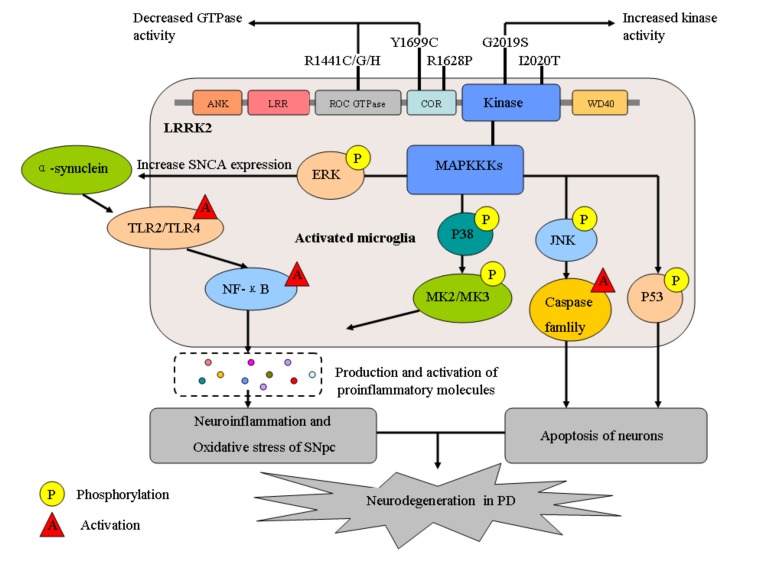
The leucine-rich repeat kinase 2 (LRRK2) gene and α-synuclein gene (SNCA) are the key influencing factors of Parkinson's disease (PD). It is reported that dysfunction of LRRK2 may influence the accumulation of α-synuclein and its pathology to alter cellular functions and signaling pathways by the kinase activation of LRRK2. The accumulation of α-synuclein is one of the main stimulants of microglial activation. Microglia are macrophages that reside in the brain, and activation of microglia is believed to contribute to neuroinflammation and neuronal death in PD. Therefore, clarifying the complex relationship among LRRK2, α-synuclein and microglials could offer targeted clinical therapies for PD. Here, we provide an updated review focused on the discussion of the evidence supporting some of the key mechanisms that are important for LRRK2-dependent neurodegeneration in PD.
Overview
The claims and statistics of this paper haven’t been checked yet.
Free: it reads the open-access text and checks the first 5 claims that cite a source we can check. Create a free account to check every claim.
Integrity signals
Registry
Cites
Statistics
Figures
Verification
Claims the paper makes
The claims and statistics of this paper haven’t been checked yet.
Free: it reads the open-access text and checks the first 5 claims that cite a source we can check. Create a free account to check every claim.
Claims other papers make about this one
Each is checked against this paper’s own text: does it say what the citing paper says it does?
The source backs part of the claim, not all of it — or backs it for a different population, condition or comparison.
In the citing paper
“Emerging evidence has shown that the LRRK2 gene is associated with both α-syn accumulation and PC [144].”
From The Impact of Neurotoxin Proteins Trafficked by Primary Cilia and Extracellular Vesicles in Neurodegenerative Diseases (2025) · cites this paper as [144]
Experimental — accuracy not yet measured
Self-check
Percentages, sums and reported differences re-computed from the paper’s own numbers.
The self-check needs the paper’s full text.
Citations
Cites
Yaşlı Kadınlarda Üreme Sağlığı
Kokanalı, D., & Engin Üstün, Y. (n.d.) · DergiPark (Istanbul University) · Cited by 170,090
Yaşlı Kadınlarda Üreme Sağlığı
Kokanalı, D., & Üstün, Y. E. (2019) · Jinekoloji-Obstetrik ve Neonatoloji Tıp Dergisi · Cited by 169,629
Mutation in the α-Synuclein Gene Identified in Families with Parkinson's Disease
Polymeropoulos, M. H., Lavedan, C., Leroy, E., Ide, S. E., Dehejia, A., Dutra, A., Pike, B., Root, H., Rubenstein, J., Boyer, R., et al. (1997) · Science · doi:10.1126/science.276.5321.2045 · Cited by 8,240
Taming Black Swans: Challenges for Sustainable Strategic Crisis Management: Plenary Session
Pelletier, P. (2021) · HAL (Le Centre pour la Communication Scientifique Directe) · doi:10.1111/j.1468 · Cited by 6,460
Dauer, W., & Przedborski, S. (2003) · Neuron · doi:10.1016/s0896-6273(03)00568-3 · Cited by 5,469
Colman (2022) · doi:10.1073/pnas · Cited by 4,370
AlaSOPro mutation in the gene encoding α-synuclein in Parkinson's disease
Krüger, R., Kuhn, W., Müller, T., Woitalla, D., Graeber, M., Kösel, S., Przuntek, H., Epplen, J. T., Schols, L., & Riess, O. (1998) · Nature Genetics · doi:10.1038/ng0298-106 · Cited by 3,836
Role of Adaptor TRIF in the MyD88-Independent Toll-Like Receptor Signaling Pathway
Yamamoto, M., Sato, S., Hemmi, H., Hoshino, K., Kaisho, T., Sanjo, H., Takeuchi, O., Sugiyama, M., Okabe, M., Takeda, K., et al. (2003) · Science · doi:10.1126/science.1087262 · Cited by 3,235
Mutations in LRRK2 Cause Autosomal-Dominant Parkinsonism with Pleomorphic Pathology
Zimprich, A., Biskup, S., Leitner, P., Lichtner, P., Farrer, M., Lincoln, S., Kachergus, J., Hulihan, M., Uitti, R. J., Calne, D. B., et al. (2004) · Neuron · doi:10.1016/j.neuron.2004.11.005 · Cited by 3,005
The new mutation, E46K, of α‐synuclein causes parkinson and Lewy body dementia
Zarranz, J. J., Alegre, J., Gómez‐Esteban, J. C., Lezcano, E., Ros, R., Ampuero, I., Vidal, L., Hoenicka, J., Rodriguez, O., Atarés, B., et al. (2004) · Annals of Neurology · doi:10.1002/ana.10795 · Cited by 2,737
Cited by
Items 201–224 of 224
Moran, P. (2021) · University of Hertfordshire Research Archive (University of Hertfordshire) · doi:10.18745/th.25245
Hok‐A‐Hin, Y. S., Vermunt, L., de Jong, N., del Campo, M., Vijverberg, E. G. B., Lemstra, A. W., Pijnenburg, Y. A. L., van Harten, A. C., & Teunissen, C. E. (2026) · Alzheimer s & Dementia · doi:10.1002/alz.71866
Wallis, R., Simmonite, E., Cooper, H., Cracknell, O., Kaur, A., New, E. J., Aasly, J., Bandmann, O., & Mortiboys, H. (2026) · Scientific Reports · doi:10.1038/s41598-026-58797-0
Defining Endogenous LRRK2 Kinase Regulators and Binding Partners in Relevance to Parkinson’s Disease
Tseng, C.-H. (2023) · eScholarship (California Digital Library)
Genetic and Environmental Factors Behind Predisposition to Parkinson's Disease
Ganesh, J., Peddapalli, V., & Boyd, J. (2024) · Journal of Student Research · doi:10.47611/jsrhs.v13i4.7674
Pulok, M. M. H., Akter, F., Islam, M. T., Kumar, P., Enan, M. E., Bhuiyan, A. F. M. K., Azmi, A. M., Ahammed, T., Billah, M. M., Das, S. K., et al. (2026) · Journal of Molecular Graphics and Modelling · doi:10.1016/j.jmgm.2026.109319
Moeketsi, D. S. (2025) · Nelson Mandela University Research Repository
Tanaka, D. (2026) · Institutional Repositories DataBase (IRDB) · doi:10.14943/doctoral.k16903
Taraz, A., Moghadasi, M., Mosalanezhad, Z., & Rashidfard, S. (2025) · ماهنامه علمی پژوهشی دانشگاه علوم پزشکی شهید صدوقی یزد · doi:10.18502/ssu.v33i5.19326
Neuronal circuits underlying prodromal gait disturbances of Parkinson's Disease
Niedermeier, K. M., Wurst, W., & München, T. U. (2024) · mediaTUM (Technical University of Munich)
Xác định đột biến trên gen SNCA, PARK2, PARK7 và LRRK2 ở bệnh nhân Parkinson
Trần, T. N., Thịnh, T. H., Việt, N. H., & Khánh, T. V. (2023) · Tạp chí Nghiên cứu Y học · doi:10.52852/tcncyh.v160i12v2.1391
Exploring Parkinson's disease: Insights from genetic biomarkers and protein-protein interactions
Parani, Z., Sorayaei, Y., Shokrzadeh, M., Abdali, N., & Rismani, E. (2025) · Human Gene · doi:10.1016/j.humgen.2025.201523
Belickienė, V. (2024) · Lithuanian University of Health Sciences
Papagora, L. E., & Cochrane, S. A. (2026) · RSC Chemical Biology · doi:10.1039/d6cb00048g
Progress in Pathogenesis of Parkinson’s Disease
Zhang, L. (2025) · Advances in biological sciences research/Advances in Biological Sciences Research · doi:10.2991/978-94-6463-910-0_26
Xác định đột biến xóa đoạn trên gen park2 ở bệnh nhân Parkinson
Lam, N. T., Tuấn, P. L. A., Trần, T. N., Phương, L. T. H., Việt, N. H., Nhi, B. T. T., Thịnh, T. H., & Khánh, T. V. (2023) · Tạp chí Nghiên cứu Y học · doi:10.52852/tcncyh.v167i6.1546
Xác định đột biến gen EIF4G1 trên bệnh nhân Parkinson
Chinh, V. T., Tuấn, P. L. A., Hải, L. H. L., Việt, N. H., Hằng, T. N. T., Thịnh, T. H., & Khánh, T. V. (2024) · Tạp chí Nghiên cứu Y học · doi:10.52852/tcncyh.v180i7.2466
Lopes, L. C. S. (2022) · Portuguese National Funding Agency for Science, Research and Technology (RCAAP Project by FCT) · doi:10.34626/hk97-5q19
DiRoma, P. J. (2023) · Digital Access to Scholarship at Harvard (DASH) (Harvard University)
Agrawal, D., Chand, K., & Rajawat, N. K. (2026) · Toxicology in Vitro · doi:10.1016/j.tiv.2026.106292
Foell, A., Rivet-Noor, C., & Bramante, A. (2026) · Journal of Emerging Investigators · doi:10.59720/25-105
LRRK2-mediated phosphorylation of exocytic RABs disrupts neurotrophin/neuropeptide secretion
Murphy, F. H., Abramian, A., Baginska, U., Klaassen, R. V., Koopmans, F., van Geest, N., Saarloos, I., Smit, A. B., Toonen, R. F. G., & Verhage, M. (2026) · Nature Communications · doi:10.1038/s41467-026-77820-6
Metadata
- Authors
- Rui, Q., Ni, H., Li, D., Gao, R., & Chen, G.
- Affiliations
- Department of Laboratory, The First People's Hospital of Zhangjiagang City, Suzhou, Jiangsu, China
- Zhangjiagang First People's Hospital (CN)
- First Affiliated Hospital of Soochow University (CN)
- Corresponding author
- Gao, Rong
- Venue
- Current Neuropharmacology
- Publisher
- Bentham Science Publishers Ltd.
- Published
- 2018-10-05
- Volume
- 16
- Issue
- 9
- Pages
- 1348-1357
- ISSN
- 1570-159X (ISSN-L)
- PMC
- PMC6251048
- OpenAlex
- W2792312976
- Semantic Scholar
- 4f6a10e0c07dd573a7b55cd961a6f73cabae0071
- Cited by
- 196
- References
- 113
- Citations by year
- 2026: 30 · 2025: 32 · 2024: 49 · 2023: 27 · 2022: 22 · 2021: 24 · 2020: 8 · 2019: 3 · 2018: 1
- FWCI
- 1.41
- Type
- journal article
- Language
- en
- Open access
- bronze
- doi.org
- Locations
- Current Neuropharmacology (publishedVersion)
- PubMed Central (publishedVersion, cc-by-nc)
- PubMed (publishedVersion)
- Topics
- Health Sciences › Medicine › Clinical Neurology › Parkinson's Disease Mechanisms and Treatments
- Life Sciences › Biochemistry, Genetics and Molecular Biology › Molecular Biology › Nuclear Receptors and Signaling
- Life Sciences › Neuroscience › Neurology › Neuroinflammation and Neurodegeneration Mechanisms
- Keywords
- LRRK2, Parkinson's disease, alpha-synuclein, microglial activation, neuroinflammation, neurodegeneration, kinase activation, neuronal cell death, LRRK2 inhibitors
- MeSH terms
- Leucine-Rich Repeat Serine-Threonine Protein Kinase-2, Animals, Humans, Nerve Degeneration, Parkinsonian Disorders
About these checks
Registry, retraction, Cites and statistics results are computed, not judged, with one exception: a printed reference that no index lists is read once by a model before it counts as a citation error. Claims are extracted by a model and kept only when their quote appears verbatim in the text; each cited source is then checked, with a model’s help, for whether it says what the claim relies on. Those verdicts can be wrong — read the claim’s quote and the cited source before relying on one.
Statistics and arithmetic are recomputed, not judged.
Confidence bands are shown only for fields calibrated on our annotated test set. None is calibrated yet, so no band is shown.
What counts as a claim ›How we measure confidence ›How we check this ›
Are you an author, or do you see a problem with this page? Request a review
Data sources
Bibliographic data: Semantic Scholar, OpenAlex, Crossref.
Contains information from the Semantic Scholar Academic Graph Datasets, made available under the ODC Attribution License (ODC-BY 1.0).
Semantic Scholar’s data is described in: Kinney, R., et al. (2023). The Semantic Scholar Open Data Platform. arXiv:2301.10140.
