

Theories Predicting End-User Acceptance of Telemedicine Use: Systematic Review
Open accessPublished version of a preprint
The DOI matches its Crossref record; 82 of the 82 references it cites were found in a registry or an index.
Abstract
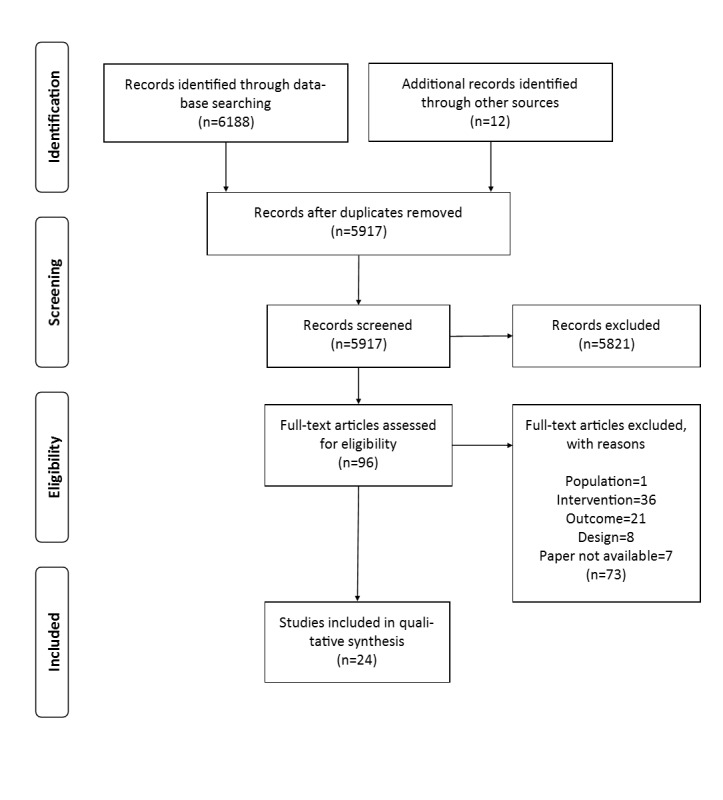
BACKGROUND: Only a few telemedicine applications have made their way into regular care. One reason is the lack of acceptance of telemedicine by potential end users. OBJECTIVE: The aim of this systematic review was to identify theoretical predictors that influence the acceptance of telemedicine. METHODS: An electronic search was conducted in PubMed and PsycINFO in June 2018 and supplemented by a hand search. Articles were identified using predefined inclusion and exclusion criteria. In total, two reviewers independently assessed the title, abstract, and full-text screening and then individually performed a quality assessment of all included studies. RESULTS: Out of 5917 potentially relevant titles (duplicates excluded), 24 studies were included. The Axis Tool for quality assessment of cross-sectional studies revealed a high risk of bias for all studies except for one study. The most commonly used models were the Technology Acceptance Model (n=11) and the Unified Theory of Acceptance and Use of Technology (n=9). The main significant predictors of acceptance were perceived usefulness (n=11), social influences (n=6), and attitude (n=6). The results show a superiority of technology acceptance versus original behavioral models. CONCLUSIONS: The main finding of this review is the applicability of technology acceptance models and theories on telemedicine adoption. Characteristics of the technology, such as its usefulness, as well as attributes of the individual, such as his or her need for social support, inform end-user acceptance. Therefore, in the future, requirements of the target group and the group's social environment should already be taken into account when planning telemedicine applications. The results support the importance of theory-guided user-centered design approaches to telemedicine development.
Overview
The claims and statistics of this paper haven’t been checked yet.
Free: it reads the open-access text and checks the first 5 claims that cite a source we can check. Create a free account to check every claim.
Integrity signals
Registry
Cites
Statistics
Figures
Verification
Claims the paper makes
The claims and statistics of this paper haven’t been checked yet.
Free: it reads the open-access text and checks the first 5 claims that cite a source we can check. Create a free account to check every claim.
Claims other papers make about this one
Each is checked against this paper’s own text: does it say what the citing paper says it does?
The source backs part of the claim, not all of it — or backs it for a different population, condition or comparison.
In the citing paper
“Compared with other traditional behavioral theories (eg, Theory of Planned Behavior, Health Belief Model), the UTAUT seems to have stronger explanatory power for understanding people’s intentions to use telehealth [11].”
From Applying the Unified Theory of Acceptance and Use of Technology to Identify Factors Associated With Intention to Use Teledelivered Supportive Care Among Recently Diagnosed Breast Cancer Survivors During COVID-19 in Hong Kong: Cross-Sectional Survey (2024) · cites this paper as [11]
Experimental — accuracy not yet measuredThe source backs part of the claim, not all of it — or backs it for a different population, condition or comparison.
In the citing paper
“Acceptance, describing attitudes toward and perception of a service or product and their relation to its adaptation (Venkatesh et al., 2003), has been shown to influence actual uptake of new digital interventions, both in industry (Venkatesh et al., 2003) and in (mental) health care (Harst et al., 2019; Philippi et al., 2021; Sora et al., 2021) settings.”
From How to promote usage of telehealth interventions for farmers' mental health? A qualitative study on supporting and hindering aspects for acceptance and satisfaction with a personalized telephone coaching for depression prevention (2023) · cites this paper as Harst et al., 2019
Experimental — accuracy not yet measured
Self-check
Percentages, sums and reported differences re-computed from the paper’s own numbers.
The self-check needs the paper’s full text.
Citations
Cites
Preferred Reporting Items for Systematic Reviews and Meta-Analyses: the PRISMA statement
Moher, D., Liberati, A., Tetzlaff, J., Altman, D. G., & for the PRISMA Group (2009) · BMJ · doi:10.1136/bmj.b2535 · Cited by 83,823
Perceived usefulness, perceived ease of use, and user acceptance of information technology
Davis, F. D. (1989) · MIS Quarterly · doi:10.2307/249008 · Cited by 68,483 · cited 3×
“Although in the TAM, acceptance is defined as “actual system use” [26], in the UTAUT, it is defined as “use behavior” [28].”
BackgroundMethodUser Acceptance of Information Technology: Toward A Unified View1
Venkatesh, V., Morris, M. G., Davis, G. B., & Davis, F. D. (2003) · MIS Quarterly · doi:10.2307/30036540 · Cited by 45,035 · cited 6×
“Although in the TAM, acceptance is defined as “actual system use” [26], in the UTAUT, it is defined as “use behavior” [28].”
BackgroundMethodInfluentialPreferred reporting items for systematic reviews and meta-analyses: the PRISMA Statement.
(2009) · PubMed Central · Cited by 44,859
(1975) · PhilPapers (PhilPapers Foundation) · Cited by 36,737
A Theoretical Extension of the Technology Acceptance Model: Four Longitudinal Field Studies
Venkatesh, V., & Davis, F. D. (2000) · Management Science · doi:10.1287/mnsc.46.2.186.11926 · Cited by 23,066 · cited 5×
“Contradictory to that, the TAM still has the highest amount of variance explained among all the models included in this review: A median R² of 0.68 is achieved by the TAM, compared with an R² of 0.59 for the UTAUT.”
MethodInfluential(1985) · Medical Entomology and Zoology · Cited by 19,180
From Intentions to Actions: A Theory of Planned Behavior
Ajzen, I. (1985) · Action Control · doi:10.1007/978-3-642-69746-3_2 · Cited by 19,057 · cited 8×
“Effect strength and significanceaComponents of the model or theory with significant explanatory power Theoretical model or theoryAuthor (year); Journal Health care provider Original Technology Acceptance Model: PU: ORg 5.28h (95% CI 3.14 to 10.01); PEOU: OR 1.93i (95% CI 1.11 PUe (TAM); PEOUf (TAM); Extended TAM: Comp…”
BackgroundInfluentialHistorical Origins of the Health Belief Model
Rosenstock, I. M. (1974) · Health Education Monographs · doi:10.1177/109019817400200403 · Cited by 6,116 · cited 1×
“The oldest yet still widely used model for health behavior change is the Health Belief Model (HBM) that focuses on the individual assessment of vulnerability, outcomes and costs of behavior change, and external cues toward behavior change [20].”
MethodCochrane Handbook for Systematic Reviews of Interventions
Tarsilla, M. (2010) · Journal of MultiDisciplinary Evaluation · doi:10.56645/jmde.v6i14.284 · Cited by 5,178
Research works printed but not linked: 4
- Atlas of eHealth country profiles. The use of eHealth in support of universal health coverage 2015 Global Observatory for eHealth 2015 Geneva, Switzerland World Health Organisation (WHO)
- Global diffusion of eHealth. Making universal health coverage achievable Global Observatory for eHealth 2015 Geneva, Switzerland World Health Organisation (WHO)
- Hastall M Dockweiler C Mühlhaus J Achieving end user acceptance: Building blocks for an evidence-based user-centered framework for health technology development and assessment 2017 11th International Conference on Universal Access in Human-Computer Interaction UAHCI July 9–14, 2017 Vancouver, BC, Canada Cham, Switzerland Springer 13 25
- Field A Discovering Statistics Using IBM SPSS Statistics: North American Edition 2018 Los Angeles Sage Publications Ltd 1025
Cited by
Items 301–375 of 375
Werner, A. T., Gunga, H., & Küpper, T. (2023) · Preprints.org · doi:10.20944/preprints202308.0097.v1
Eze, C. E. (2023) · Deep Blue (University of Michigan) · doi:10.7302/8358
Privacy and Security in Digital Health in the Western Balkans During the COVID-19 Pandemic
Lukovic, V. (2023) · Contributions to management science · doi:10.1007/978-3-031-43114-2_17
Behavioural aspects of the use of telemedicine systems in healthcare entities
(2022) · Scientific Papers of Silesian University of Technology Organization and Management Series · doi:10.29119/1641-3466.2022.167.19
Buba, M., Dulude, C., O’Donnell, R., Rowan-Legg, A., Sloan, M., Nelson, M., & King, W. J. (2023) · Figshare · doi:10.6084/m9.figshare.23512697
Kiburi, S. K., Paruk, S., & Chiliza, B. (2024) · African journal of alcohol and drug abuse. · doi:10.4314/ajada.v11i1.1
Transforming the pre-anaesthesia health assessment with digital health
Osman, T. O. M. (2024) · DR-NTU (Nanyang Technological University) · doi:10.32657/10356/178852
Arensman, R. M. (2024) · Utrecht University Repository (Utrecht University) · doi:10.33540/2478
Experience and attitudes in relation to telepsychiatry use among non-consultant doctors
Rowntree, R., & Behan, C. L. (2024) · Irish Journal of Psychological Medicine · doi:10.1017/ipm.2024.64
“Telemedicine utilises technologies and telecommunications to deliver healthcare where patients are geographically separated from providers (Harst et al .”
Werner, A. T., Gunga, H., & Küpper, T. (2024) · ASEAN Journal of Psychiatry · doi:10.54615/2231-7805.18.s10.001
Okoli, C. T. C., Almogheer, Z. S., Seng, S., Wang, T., Abufarsakh, B., Koyagi, E., Stith, H., & Makowski, A. (2025) · Journal of the American Psychiatric Nurses Association · doi:10.1177/10783903251362488
High School Students' Intentions Regarding Telemedicine for Mental Health Consultations
Rohmah, N., Nurrachmawati, A., Agustini, R. T., Permana, L., & Anwar, S. (2025) · Social medicine · doi:10.71164/socialmedicine.v18i3.2025.1767
Ajaz, A., & Memon, S. I. (2025) · Pakistan BioMedical Journal · doi:10.54393/pbmj.v8i8.1210
Timpel, P., Mäder, M., Harst, L., Heinrich, R., Schönfelder, T., & Scheibe, M. (2025) · Springer eBooks · doi:10.1007/978-3-662-71034-0_13
Self-citationEvaluating Current Perceptions of Digital Healthcare in Indonesia: Post-COVID-19 Realities
Supardjo, W., Abadat, S. B., Wang, Q., & Hendijani, R. B. (2025) · International Conference on Information Management and Technology (ICIMTech) · doi:10.1109/icimtech67074.2025.11264998
“The results for Performance Expectancy's relationship with Intention of Acceptance (H1) align with previous studies conducted by Dwivedi et al. [24], Philippi et al. [23], and Harst et al. [25] which all have the same positive result.”
Additional file 1 of Acceptance of a digital therapy recommender system for psoriasis
Graf, L., Tesch, F., Gräßer, F., Harst, L., Siegels, D., Schmitt, J., & Abraham, S. (2024) · Figshare · doi:10.6084/m9.figshare.26608512
Self-citationLaursen, S. H., Giese, I. E., Udsen, F. W., Hejlesen, O. K., Barington, P. F., Ohrt, M., Vestergaard, P., & Hangaard, S. (2024) · Figshare · doi:10.6084/m9.figshare.25884932
The Economic Analysis of Online and Offline Healthcare
Wu, Y. (2023) · ANU Open Research (Australian National University) · doi:10.25911/v93w-dp36
Buba, M., Dulude, C., O’Donnell, R., Rowan-Legg, A., Sloan, M., Nelson, M., & King, W. J. (2023) · Figshare · doi:10.6084/m9.figshare.23512694
Buba, M., Dulude, C., O’Donnell, R., Rowan-Legg, A., Sloan, M., Nelson, M., & King, W. J. (2023) · Figshare · doi:10.6084/m9.figshare.23512700
Additional file 2 of Acceptance of a digital therapy recommender system for psoriasis
Graf, L., Tesch, F., Gräßer, F., Harst, L., Siegels, D., Schmitt, J., & Abraham, S. (2024) · Figshare · doi:10.6084/m9.figshare.26608515
Self-citationVejbrink Kildal, H., & Fisshatzion, A. (2024) · Uppsala University Publications (Uppsala University)
Green, N. J. (2020) · Massey Research Online (Massey University)
Organizational Strategies and Best Practices for Telehealth Delivery during COVID-19
MEJIA, M. D. (2023) · ScholarWorks (Walden University)
Podiatrists' Experiences with Telemedicine During COVID-19
Inniss, J. (2024) · ScholarWorks (Walden University)
Brooks, K. G. (2023) · ScholarWorks (Walden University)
Badriah Mousa, I. M., Jomin, G., & Jenkins, J. (2024) · Umsida Repository (Universitas Muhammadiyah Sidoarjo)
artens, E. W., Laugwitz, K.-L., & München, T. U. (2024)
Savage, S. V., Ownsworth, T., Hawgood, J. L., Ray, M. K., & Clough, B. A. (2025) · Journal of Technology in Behavioral Science · doi:10.1007/s41347-025-00557-4
“…Theory of Planned Behaviour (Chau & Hu, 2002) and the Technology Acceptance Model (Sugarhood et al., 2013) emphasise that attitudes strongly predict technology adoption through factors such as perceived ease of use, behavioural control and social norms (Dolezel & Smutny, 2023; Harst et al., 2019).”
Ascari, M. (2025) · Dublin City University Open Access Institutional Repository (Dublin City University)
Schlieter, H., Kählig, M., Hickmann, E., Fürstenau, D., Sunyaev, A., Richter, P., Breitschwerdt, R., Thielscher, C., Gersch, M., Maaß, W., et al. (2023) · Qucosa (Saxon State and University Library Dresden)
Perspectives on integrating an oral health helpline into a dental and dental hygiene school
Johnson, V. M.-A. (2025) · cIRcle (University of British Columbia)
Doutor, você me escuta, você me vê? Uma abordagem da aceitação e uso da teleconsulta no Brasil
Soares, R. A. R. (2023) · LA Referencia (Red Federada de Repositorios Institucionales de Publicaciones Científicas)
Fässler, L., Ersöz, B., Hahne, I. M., Koop, S., & Böge, K. (2026) · Frontiers in Psychology · doi:10.3389/fpsyg.2025.1727156
“Previous studies showed that significant predictors for acceptance of mHealth devices are the usefulness, attributes of users, and the need for social support (Harst et al., 2019).”
From Constraint to Strategy: A Necessity-Based Perspective on Telemedicine Usage in Japan and China
HANSHU, W., Shinoda, K., & Gu, X. (2026) · Telemedicine Journal and e-Health · doi:10.1177/15305627261421484
“Together with consistency with prior literature, 5,38,39 these results support the construct validity of the eight-factor structure.”
Qin, Y., Oliveros, D., Qiu, Y., Sabri, N., Ponticiello, M. N., Nizamuddin, K. S., Saifi, R. A., Shenoi, S., Salleh, N. A. M., Earnshaw, V. A., et al. (2026) · International Journal of Drug Policy · doi:10.1016/j.drugpo.2026.105199
Roba, A. A., Shah, G. H., Mase, W. A., & Apenteng, B. A. (2026) · Research Square · doi:10.21203/rs.3.rs-8942270/v1
Alenzi, S., Al-haimi, B., Jusoh, N. M., Zakaria, N. H., & Alruwaili, K. (2026) · International Journal of Academic Research in Business and Social Sciences · doi:10.6007/ijarbss/v16-i3/27798
Harris, M., Taylor, G., Pikkemaat, M., Thulesius, H. O., & Nymberg, V. M. (2026) · JMIR Human Factors · doi:10.2196/73609
“Another definition is “health care service delivered by health care providers in a patient-centered manner, from a geographical distance using ICT (information and communication technology)” [10].”
Towards co-located multi-user mixed reality exposure therapy for anxiety disorders
Schier, F., Badeja, D., Hoyer, J., & McGinity, M. (2026) · Virtual Reality · doi:10.1007/s10055-025-01279-x
“" Useful" indexes performance expectancy, consistently one of the strongest acceptance predictors (Harst et al. 2019 ; Tamil-mani et al. 2020 ; Braun et al. 2022 ).”
Piccardo, M. A., Bernuzzi, C., & Guglielmetti, C. (2026) · Humanities and Social Sciences Communications · doi:10.1057/s41599-026-06729-8
“These insights are particularly relevant for telemedicine, where maintaining active patient engagement is essential to ensure long-term participation in digitally mediated care and promote patient health and well-being (Chan et al., 2021; Harst et al., 2019).”
Bouix‐Picasso, J. (2023) · theses.fr (ABES) · doi:10.70675/62875347z83b9z4cf4z99f6zc4f1a6725d5b
Mesure de la fragilité par capteurs embarqués chez les aînés : enjeux et réception
Prud’homm, J. (2024) · theses.fr (ABES) · doi:10.70675/e1929601zed2az4a1czb9d7z23c12c697592
Evaluation of the Barriers to Digital Transformation in Healthcare Organizations With AHP Method
Köse, İ., ŞAHİN, K., & Gedıklı, E. (2026) · IGI Global eBooks · doi:10.4018/979-8-2600-1026-6.ch005
van Tonder, G., Pentz, C. D., & Preez, R. D. (2026) · African Journal of Primary Health Care & Family Medicine · doi:10.4102/phcfm.v18i1.5191
“25,26,27 Thus, once again, acceptance reflects actual use given that (technology) innovation diffusion can only occur once innovators, early adopters, and early-majority individuals decide to use the innovation (or the service delivered by means of the technology innovation) and continue to use it.”
Cabredo, F. M., & Ebardo, R. A. (2026) · Lecture notes in computer science · doi:10.1007/978-981-95-6304-3_11
Pernambuco, C. M., Martins, H. D. D., Carvalho, L. I. D. M., de Araújo, E. G. O., Dias, L. M. R. P., de Lucena, E. H. G., Bonan, P. R. F., & dos Reis, L. A. (2026) · Telemedicine Journal and e-Health · doi:10.1177/15305627261453253
Giese, I. E., Laursen, S. H., Barington, P. F., Vestergaard, P., & Hangaard, S. (2026) · JMIR Formative Research · doi:10.2196/89964
“This suggests that telemonitoring interventions must consider not only clinical validity but also users’ subjective experience of relevance [41,42].”
Distrust and familiarity: a quantitative exploration of patients' intention to use telemedicine
Russell-Wood, K., & D’Innocenzo, L. (2026) · iDEA - Drexel University Institutional Repository · doi:10.17918/00011386
Mouloudj, K., Njoku, A. U., Bouarar, A. C., Asanza, D. M., Evans, M. A., & Baviskar, S. S. (2026) · Geriatrics · doi:10.3390/geriatrics11040076
“For healthcare professionals, the PU of telemedicine relate to its effectiveness in simplifying diagnosis, monitoring diseases, and improving treatment outcomes [7,22,57,58].”
Alshehre, Y. M. (2026) · Healthcare · doi:10.3390/healthcare14142036
“Based on the data set, the questionnaire yielded scores for knowledge (4 points), attitudes (11 points), and barriers (5 points) [25,26].”
Predicting User Acceptance of Solar-Powered Vending Machines Based on Quality Dimensions
Lindo, G. S. (2026) · ASEAN Journal of Scientific and Technological Reports · doi:10.55164/ajstr.v29i8.262407
A model for cloud based electronic health adoption among it professionals in Saudi Arabia Hospitals
Jebril, I. A. M. (2025) · UUM Electronic Theses and Dissertation [eTheses] (Northern University of Malaysia)
Prasetya, M. R. A., & Mustikasari, F. (2026) · International Conference on Industrial Engineering and Operations Management (IEOM) · doi:10.46254/af07.20260390
Xu, H. H., Nayyar, C., Hilbers, D., Avery, J., Raman, S., Bates, A. T., Conati, C., Fayaz-Bakhsh, A., & Nuñez, J.-J. (2026) · Implementation Science Communications · doi:10.1186/s43058-026-01075-x
Rothert-Schnell, K. C. (2026) · Institutional Repository of Leibniz Universität Hannover (Leibniz Universität Hannover) · doi:10.15488/22539
Lucazeau, B., & Heilporn, G. (2026) · Facteurs humains : · doi:10.62920/m0cttk18
“L’environnement culturel, les inégalités d’accès, les compétences numériques et les conditions de soutien institutionnel demeurent des modérateurs déterminants pour comprendre la diversité des usages (Gatzioufa et Saprikis, 2023 ; Harst et al., 2019).”
Lezcano, M., Pasini, M., Romá, V. G., Palma, M., & Landuzzi, M. G. (2026) · Safety Science · doi:10.1016/j.ssci.2026.107453
Usability and Acceptability of a Symptom Checker App by Patients Seeking Urgent Care
Fraser, H., Bacher, I., Khatri, I. S., Raman, S., Nagle, D., Crossland, D., Madsen, T., & Hilliard, R. (2026) · Applied Clinical Informatics · doi:10.1055/a-2962-9261
Duka, B., Biring-Pani, M., Mane, F., Çini, J., Zylfo, A., Vakëflliu, K., & Notarnicola, I. (2026) · Nursing Reports · doi:10.3390/nursrep16100350
“Sustainable implementation also depends on professional preparedness, compatibility with clinical workflows, organizational support, governance arrangements, financing, privacy and data protection, and the perceived value of digital care for patients and professionals [28–33].”
The Impact of Health Care Technology on Patient-Nurse Relationships
al, A. A. A. A.-B. E. (2024) · Letters in High Energy Physics
The Perception And Intention Of Practice Telemedicine At Primary Care
Mariatul Farhana Abdul Manaf, N. W. L. (2025) · Frontiers in Health Informatics
นวัตกรรมการบริการเพื่อยกระดับคุณภาพในบริบทวิถีใหม่ของคลินิกทันตกรรม
Keeratipongpakdee, W., Satieramas, S., & Thongraw, C. (2026) · วารสารการบริหารการปกครองและนวัตกรรมท้องถิ่น
การบูรณาการการแพทย์ทางไกลในระบบบริการปฐมภูมิ: กรณีศึกษาปัจจัยที่มีอิทธิพลต่อความตั้งใจในการใช้งาน
Saelim, P., Leelaphaibun, J., & Sangkaew, S. (2025) · Journal of Primary Care and Family Medicine (PCFM)
Natek, I. (2026) · Repository of the University of Ljubljana (University of Ljubljana)
Wijaya, E. B., Thu, P.-W., & Chen, P. (2026) · Frontiers in Rehabilitation Sciences · doi:10.3389/fresc.2026.1942904
Chen, K., Yu, T., Zhang, C., Zhao, L., & Liu, L. (2026) · Journal of Medical Internet Research · doi:10.2196/87578
“…technology acceptance model and the unified theory of acceptance and use of technology to examine how technology acceptance–related factors, such as perceived usefulness, perceived ease of use, social influence, and facilitating conditions, are associated with patients’ WTU telemedicine [22,23].”
Katz, C. (2026) · Tesis Doctorals en Xarxa (Consorci de Serveis Universitaris de Catalunya)
Burgert, S., Raab, N., Kornfeld, T., Knitza, J., Boy, K., Schwarz, J., May, S., Heinze, M., & Mühlensiepen, F. (2026) · BMC Musculoskeletal Disorders · doi:10.1186/s12891-026-10550-4
(2026) · Frontiers research topics · doi:10.3389/978-2-8325-8956-4
Dania, S., Joshi, G., & Bhatt, Y. C. (2026) · The BRICS Health Journal · doi:10.47093/3034-4700.2026.3.3.28-48
Gebang, W. N., Iswanti, D. I., & Sonhaji, S. (2026) · Journal Of Nursing Practice · doi:10.30994/jnp.v10i1.1222
Metadata
- Authors
- Harst, L., Lantzsch, H., & Scheibe, M.
- Affiliations
- University Hospital Carl Gustav Carus (DE)
- Technische Universität Dresden (DE)
- Corresponding author
- Harst, Lorenz
- Venue
- Journal of Medical Internet Research
- Publisher
- JMIR Publications Inc.
- Published
- 2019-05-21
- Volume
- 21
- Issue
- 5
- Pages
- e13117
- ISSN
- 1438-8871 (ISSN-L)
- PMC
- PMC6547771
- OpenAlex
- W2927203543
- Cited by
- 320
- References
- 81
- Citations by year
- 2026: 30 · 2025: 42 · 2024: 40 · 2023: 54 · 2022: 52 · 2021: 58 · 2020: 31 · 2019: 12
- FWCI
- 6.25
- Type
- journal article
- Language
- en
- Open access
- gold
- doi.org
- Licence
- cc-by
- Locations
- Journal of Medical Internet Research (publishedVersion, cc-by)
- PubMed Central (publishedVersion, cc-by)
- PubMed (publishedVersion)
- Funders
- Freistaat Sachsen
- European Social Fund (100310385)
- Topics
- Health Sciences › Medicine › Public Health, Environmental and Occupational Health › Telemedicine and Telehealth Implementation
- Social Sciences › Decision Sciences › Information Systems and Management › Technology Adoption and User Behaviour
- Health Sciences › Medicine › Geriatrics and Gerontology › Technology Use by Older Adults
- Keywords
- telemedicine, end-user acceptance, technology acceptance model, UTAUT, perceived usefulness, social influence, user attitudes, technology adoption, user-centered design, social support
- MeSH terms
- Cross-Sectional Studies, Female, Humans, Male, Patient Compliance, Telemedicine
About these checks
Registry, retraction, Cites and statistics results are computed, not judged, with one exception: a printed reference that no index lists is read once by a model before it counts as a citation error. Claims are extracted by a model and kept only when their quote appears verbatim in the text; each cited source is then checked, with a model’s help, for whether it says what the claim relies on. Those verdicts can be wrong — read the claim’s quote and the cited source before relying on one.
Statistics and arithmetic are recomputed, not judged.
Confidence bands are shown only for fields calibrated on our annotated test set. None is calibrated yet, so no band is shown.
What counts as a claim ›How we measure confidence ›How we check this ›
Are you an author, or do you see a problem with this page? Request a review
Data sources
Bibliographic data: Semantic Scholar, OpenAlex, Crossref.
Contains information from the Semantic Scholar Academic Graph Datasets, made available under the ODC Attribution License (ODC-BY 1.0).
Semantic Scholar’s data is described in: Kinney, R., et al. (2023). The Semantic Scholar Open Data Platform. arXiv:2301.10140.
