

The DOI matches its Crossref record; 109 of the 109 references it cites were found in a registry or an index.
Machine Learning and Natural Language Processing in Mental Health: Systematic Review
Open accessPublished version of a preprint
Abstract
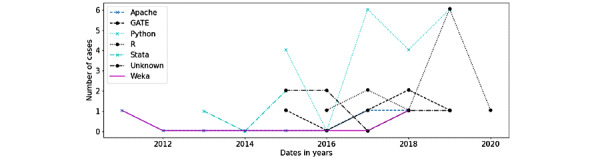
BACKGROUND: Machine learning systems are part of the field of artificial intelligence that automatically learn models from data to make better decisions. Natural language processing (NLP), by using corpora and learning approaches, provides good performance in statistical tasks, such as text classification or sentiment mining. OBJECTIVE: The primary aim of this systematic review was to summarize and characterize, in methodological and technical terms, studies that used machine learning and NLP techniques for mental health. The secondary aim was to consider the potential use of these methods in mental health clinical practice. METHODS: This systematic review follows the PRISMA (Preferred Reporting Items for Systematic Review and Meta-analysis) guidelines and is registered with PROSPERO (Prospective Register of Systematic Reviews; number CRD42019107376). The search was conducted using 4 medical databases (PubMed, Scopus, ScienceDirect, and PsycINFO) with the following keywords: machine learning, data mining, psychiatry, mental health, and mental disorder. The exclusion criteria were as follows: languages other than English, anonymization process, case studies, conference papers, and reviews. No limitations on publication dates were imposed. RESULTS: A total of 327 articles were identified, of which 269 (82.3%) were excluded and 58 (17.7%) were included in the review. The results were organized through a qualitative perspective. Although studies had heterogeneous topics and methods, some themes emerged. Population studies could be grouped into 3 categories: patients included in medical databases, patients who came to the emergency room, and social media users. The main objectives were to extract symptoms, classify severity of illness, compare therapy effectiveness, provide psychopathological clues, and challenge the current nosography. Medical records and social media were the 2 major data sources. With regard to the methods used, preprocessing used the standard methods of NLP and unique identifier extraction dedicated to medical texts. Efficient classifiers were preferred rather than transparent functioning classifiers. Python was the most frequently used platform. CONCLUSIONS: Machine learning and NLP models have been highly topical issues in medicine in recent years and may be considered a new paradigm in medical research. However, these processes tend to confirm clinical hypotheses rather than developing entirely new information, and only one major category of the population (ie, social media users) is an imprecise cohort. Moreover, some language-specific features can improve the performance of NLP methods, and their extension to other languages should be more closely investigated. However, machine learning and NLP techniques provide useful information from unexplored data (ie, patients' daily habits that are usually inaccessible to care providers). Before considering It as an additional tool of mental health care, ethical issues remain and should be discussed in a timely manner. Machine learning and NLP methods may offer multiple perspectives in mental health research but should also be considered as tools to support clinical practice.
Overview
The claims and statistics of this paper haven’t been checked yet.
Run the check — free, no account needed. It reads the open-access text and checks the sources it cites.
Integrity signals
Registry
Cites
Statistics
Figures
Verification
Claims the paper makes
The claims and statistics of this paper haven’t been checked yet.
Run the check — free, no account needed. It reads the open-access text and checks the sources it cites.
Self-check
Percentages, sums and reported differences re-computed from the paper’s own numbers.
The self-check needs the paper’s full text.
Citations
Cites
Shamseer, L., Moher, D., Clarke, M., Ghersi, D., Liberati, A., Petticrew, M., Shekelle, P., Stewart, L. A., & the PRISMA-P Group (2015) · BMJ · doi:10.1136/bmj.g7647 · Cited by 13,120
Foundations of statistical natural language processing
Manning, C. D., & Schütze, H. (1999) · Cited by 9,816
Insel, T., Cuthbert, B., Garvey, M., Heinssen, R., Pine, D. S., Quinn, K., Sanislow, C., & Wang, P. (2010) · American Journal of Psychiatry · doi:10.1176/appi.ajp.2010.09091379 · Cited by 7,067 · cited 2×
“The former includes data on genetics and neuroscience in its classification of mental health disorders, whereas the latter is solely based on clinical data [107].”
An introduction to latent semantic analysis
Landauer, T. K., Foltz, P. W., & Laham, D. (1998) · Discourse Processes · doi:10.1080/01638539809545028 · Cited by 4,880 · cited 1×
“…new matrix represent aggregates of words and aggregates of documents where each dimension is not interpretable per se, but when words or documents are represented as vectors in this new latent system of coordinates, the scalar product of vectors can be used as a semantic relatedness measure [34].”
Artificial intelligence in healthcare: past, present and future
Jiang, F., Jiang, Y., Zhi, H., Dong, Y., Li, H., Ma, S., Wang, Y., Dong, Q., Shen, H., & Wang, Y. (2017) · Stroke and Vascular Neurology · doi:10.1136/svn-2017-000101 · Cited by 4,837 · cited 1×
“Indeed, ML is widely used in critical disease models in cardiology, neurology, and diabetes research [6] to automatically identify heart disease risk factors [7], to classify primary progressive aphasia subtypes [8], and for the characterization and diagnosis of cognitive impairments [9], diabetes,…”
Harris, Z. S. (1954) · WORD · doi:10.1080/00437956.1954.11659520 · Cited by 4,807
Motivational Interviewing: Helping People Change
Tober, G. (2013) · Alcohol and Alcoholism · doi:10.1093/alcalc/agt010 · Cited by 4,267
Deo, R. C. (2015) · Circulation · doi:10.1161/circulationaha.115.001593 · Cited by 3,466 · cited 1×
“At the same time, even though thousands of papers have been published using medical data, very few have made meaningful contributions to clinical practices [111].”
Machine Learning Applications in Cancer Prognosis and Prediction
Kourou, K., Exarchos, T. P., Exarchos, K. P., Karamouzis, M. V., & Fotiadis, D. I. (2015) · Computational and Structural Biotechnology Journal · doi:10.1016/j.csbj.2014.11.005 · Cited by 3,338
A few useful things to know about machine learning
Domingos, P. (2012) · Communications of the ACM · doi:10.1145/2347736.2347755 · Cited by 3,326
Research works printed but not linked: 7
- GauthierEBrissonLLencaPRagusaSBreast Cancer Risk Score: a Data Mining Approach to Improve ReadabilityThe International Conference on Data Mining2011CDM'11June 23-27, 2011Las Vegas, United States1521
- GauthierEBrissonLLencaPClavel-ChapelonFRagusaSChallenges to Building a Platform for a Breast Cancer Risk ScoreSixth International Conference on Research Challenges in Information Science201205RCIS'12June 1-7, 2012Valencia, Spain
- Bughin, J, 2017, McKinsey Global Institute, 80
- Hays, DG, 1967, Introduction to Computational Linguistics, Mathematical Linguistics and Automatic Language Processing
- Chollet, F, 2017, Deep Learning with Python
- Sarasohn-Kahn, J, 2008, Technical report, California HealthCare Foundation
- Ross, J, 2015, Stud Health Technol Inform, 216, 736
Cited by
Sorted by citations
Alqahtani, T., Badreldin, H. A., Alrashed, M., Alshaya, A. I., Alghamdi, S. S., bin Saleh, K., Alowais, S. A., Alshaya, O. A., Rahman, I., Al Yami, M. S., et al. (2023) · Research in Social and Administrative Pharmacy · doi:10.1016/j.sapharm.2023.05.016 · Cited by 565
Machine learning-based approach: global trends, research directions, and regulatory standpoints
Pugliese, R., Regondi, S., & Marini, R. (2021) · Data Science and Management · doi:10.1016/j.dsm.2021.12.002 · Cited by 425
Large Language Models for Mental Health Applications: Systematic Review
Guo, Z., Lai, A., Thygesen, J. H., Farrington, J., Keen, T., & Li, K. (2024) · JMIR Mental Health · doi:10.2196/57400 · Cited by 269
“The existing literature includes a review of the application of machine learning and NLP in mental health [47], analyses of LLMs in medicine [32], and a scoping review of LLMs in mental health.”
BackgroundMethodTimmons, A. C., Duong, J. B., Simo Fiallo, N., Lee, T., Vo, H. P. Q., Ahle, M. W., Comer, J. S., Brewer, L. C., Frazier, S. L., & Chaspari, T. (2023) · Perspectives on Psychological Science · doi:10.1177/17456916221134490 · Cited by 263
Modern views of machine learning for precision psychiatry
Chen, Z. S., Kulkarni, P., Galatzer‐Levy, I. R., Bigio, B., Nasca, C., & Zhang, Y. (2022) · Patterns · doi:10.1016/j.patter.2022.100602 · Cited by 241
“Language is not only one of the primary expressions of human behavior that carries a variety of implicit and explicit markers relevant to mental health [193, 194], but also more abundantly available compared to speech data.”
Background
Metadata
- Authors
- Le Glaz, A., Haralambous, Y., Kim-Dufor, D.-H., Lenca, P., Billot, R., Ryan, T. C., Marsh, J., DeVylder, J., Walter, M., Berrouiguet, S., & Lemey, C.
- Affiliations
- Centre National de la Recherche Scientifique (FR)
- Centre Hospitalier Régional Universitaire de Brest (FR)
- Johns Hopkins University (US)
- Fordham University (US)
- Université de Bretagne Occidentale (FR)
- Corresponding author
- Lemey, Christophe
- ORCID
- Venue
- Journal of Medical Internet Research
- Publisher
- JMIR Publications Inc.
- Published
- 2021-05-04
- Volume
- 23
- Issue
- 5
- Pages
- e15708
- ISSN
- 1438-8871 (ISSN-L)
- PMC
- PMC8132982
- OpenAlex
- W3089862415
- Cited by
- 576
- References
- 109
- Citations by year
- 2026: 102 · 2025: 155 · 2024: 144 · 2023: 105 · 2022: 57 · 2021: 13
- FWCI
- 7.06
- Type
- journal article
- Language
- en
- Open access
- gold
- doi.org
- Licence
- cc-by
- Locations
- Journal of Medical Internet Research (publishedVersion, cc-by)
- PubMed Central (publishedVersion, cc-by)
- PubMed (publishedVersion)
- HAL (submittedVersion, cc-by)
- DOAJ (DOAJ: Directory of Open Access Journals) (submittedVersion, cc-by-sa)
- Oskar-Bordeaux (Universite de Bordeaux) (submittedVersion, cc-by)
- Funders
- Agence Nationale de la Recherche (ANR-18-RHUS-0014, ANR18)
- Topics
- Social Sciences › Psychology › Social Psychology › Mental Health via Writing
- Health Sciences › Health Professions › Health Information Management › Artificial Intelligence in Healthcare
- Physical Sciences › Computer Science › Artificial Intelligence › Sentiment Analysis and Opinion Mining
- Keywords
- machine learning, natural language processing, mental health, mental illness, symptom extraction, treatment effectiveness, social media, electronic health records, clinical practice, artificial intelligence in psychiatry, language-specific features, nosography, clinical decision support
- MeSH terms
- Machine Learning, Data Management, Artificial Intelligence, Humans, Mental Health, Natural Language Processing
About these checks
Registry, retraction, Cites and statistics results are computed, not judged, with one exception: a printed reference that no index lists is read once by a model before it counts as a citation error. Claims are extracted by a model and kept only when their quote appears verbatim in the text; each cited source is then checked, with a model’s help, for whether it says what the claim relies on. Those verdicts can be wrong — read the claim’s quote and the cited source before relying on one.
Statistics and arithmetic are recomputed, not judged.
Confidence bands are shown only for fields calibrated on our annotated test set. None is calibrated yet, so no band is shown.
What counts as a claim ›How we measure confidence ›How we check this ›
Are you an author, or do you see a problem with this page? Request a review
