

Web-Based Independent Versus Laboratory-Based Stop-Signal Task Performance: Within-Subjects Counterbalanced Comparison Study
Open accessPublished version of a preprint
The DOI matches its Crossref record; 64 of the 64 references it cites were found in a registry or an index.
Abstract
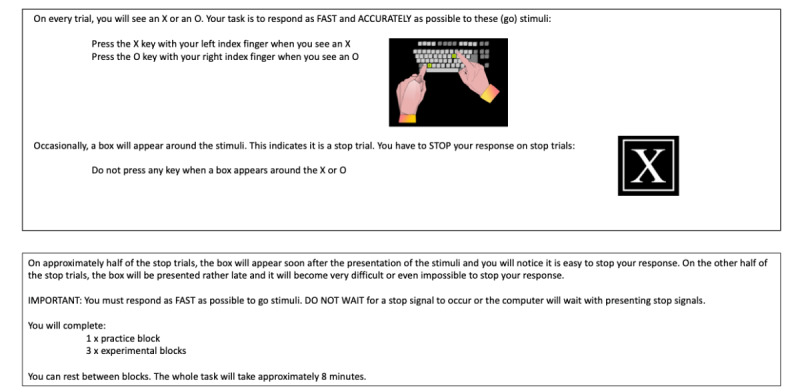
Background: Considered a facet of behavioral impulsivity, response inhibition facilitates adaptive and goal-directed behavior. It is often assessed using the Stop-Signal Task (SST), which is presented on stand-alone computers under controlled laboratory conditions. Sample size may consequently be a function of cost or time and sample diversity constrained to those willing or able to attend the laboratory. Statistical power and generalizability of results might, in turn, be impacted. Such limitations may potentially be overcome via the implementation of web-based testing. Objective: The aim of this study was to investigate if there were differences between variables derived from a web-based SST when it was undertaken independently—that is, outside the laboratory, on any computer, and in the absence of researchers—versus when it was performed under laboratory conditions. Methods: We programmed a web-based SST in HTML and JavaScript and employed a counterbalanced design. A total of 166 individuals (mean age 19.72, SD 1.85, range 18-36 years; 146/166, 88% female) were recruited. Of them, 79 undertook the independent task prior to visiting the laboratory and 78 completed the independent task following their laboratory visit. The average time between SST testing was 3.72 (SD 2.86) days. Dependent samples and Bayesian paired samples t tests were used to examine differences between laboratory-based and independent SST variables. Correlational analyses were conducted on stop-signal reaction times (SSRT). Results: After exclusions, 123 participants (mean age 19.73, SD 1.97 years) completed the SST both in the laboratory and independently. While participants were less accurate on go trials and exhibited reduced inhibitory control when undertaking the independent—compared to the laboratory-based—SST, there was a positive association between the SSRT of each condition (r=.48; P<.001; 95% CI 0.33-0.61). Conclusions: Findings suggest a web-based SST, which participants undertake on any computer, at any location, and in the absence of the researcher, is a suitable measure of response inhibition.
Overview
The claims and statistics of this paper haven’t been checked yet.
Free: it reads the open-access text and checks the first 5 claims that cite a source we can check. Create a free account to check every claim.
Integrity signals
Registry
Cites
Statistics
Figures

Verification
Claims the paper makes
The claims and statistics of this paper haven’t been checked yet.
Free: it reads the open-access text and checks the first 5 claims that cite a source we can check. Create a free account to check every claim.
Claims other papers make about this one
Each is checked against this paper’s own text: does it say what the citing paper says it does?
The source backs part of the claim, not all of it — or backs it for a different population, condition or comparison.
In the citing paper
“The classic stop-signal task is a validated tool to measure inhibitory control [8], [56] and online versions of the task have shown similar high reliability [56], [57].”
From The rollercoaster of obsessive-compulsive disorder: How chronotype and time of day affect behavioral inhibition in adults with OCD (2025) · cites this paper as [57]
Experimental — accuracy not yet measured
Self-check
Percentages, sums and reported differences re-computed from the paper’s own numbers.
The self-check needs the paper’s full text.
Citations
Cites
Statistical power analyses using G∗Power 3.1: tests for correlation and regression analyses
Faul, F., Erdfelder, E., Buchner, A., & Lang, A.-G. (2009) · Behavior Research Methods · doi:10.3758/brm.41.4.1149 · Cited by 37,615 · cited 1×
“1 [36] indicated a total sample size of 115 was required to achieve a power of 80%.”
BackgroundMiyake, A., Friedman, N. P., Emerson, M. J., Witzki, A. H., Howerter, A., & Wager, T. D. (2000) · Cognitive Psychology · doi:10.1006/cogp.1999.0734 · Cited by 15,798 · cited 1×
“Considered a facet of behavioral impulsivity, response inhibition refers to the capacity to withhold, interrupt, or delay a prepotent behavioral response and is a key element of executive function [1-4].”
BackgroundSAUNDERS, J. B., AASLAND, O. G., BABOR, T. F., DE LA FUENTE, J. R., & GRANT, M. (1993) · Addiction · doi:10.1111/j.1360-0443.1993.tb02093.x · Cited by 13,597 · cited 1×
“Participants completed the Alcohol Use Disorders Identification Test (AUDIT), which assesses alcohol intake, problems, and dependence with reference to the preceding 6 months [33].”
MethodDiamond, A. (2013) · Annual Review of Psychology · doi:10.1146/annurev-psych-113011-143750 · Cited by 13,268 · cited 1×
“Also termed “inhibitory control” or cognitive control,” it facilitates adaptive and goal-directed behavior [5].”
BackgroundBayesian t tests for accepting and rejecting the null hypothesis
Rouder, J. N., Speckman, P. L., Sun, D., Morey, R. D., & Iverson, G. (2009) · Psychonomic Bulletin & Review · doi:10.3758/pbr.16.2.225 · Cited by 3,688 · cited 1×
“Bayesian paired samples t testing was additionally conducted to determine the probability of the alternative hypothesis [39].”
MethodGosling, S. D., Vazire, S., Srivastava, S., & John, O. P. (2004) · American Psychologist · doi:10.1037/0003-066x.59.2.93 · Cited by 2,932 · cited 2×
“Web-based survey–based psychological assessment has been recognized as a cost-effective, efficient, and psychometrically sound means of recruiting large, diverse samples [26,28,44-48].”
BackgroundOn the ability to inhibit thought and action: a theory of an act of control
Logan, G. D., & Cowan, W. B. (1984) · Psychological Review · doi:10.1037/0033-295x.91.3.295 · Cited by 2,590 · cited 10×
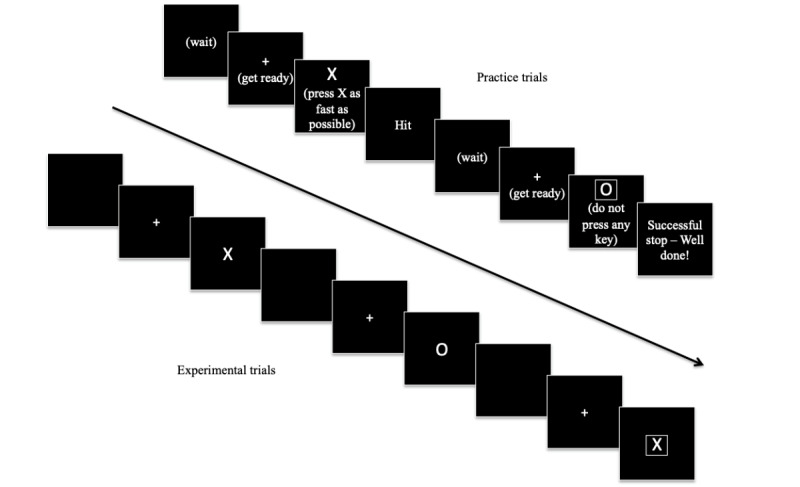
“The initial SSD is set at 250 milliseconds and adjusts dynamically as a function of the participant response; successful inhibitions result in a 50-millisecond increase in the SSD, while unsuccessful inhibitions decrease it by 50 milliseconds.”
BackgroundInfluentialGroup, W. A. W. (2002) · Addiction · doi:10.1046/j.1360-0443.2002.00185.x · Cited by 1,982
Friedman, N. P., & Miyake, A. (2017) · Cortex · doi:10.1016/j.cortex.2016.04.023 · Cited by 1,834
Bayesian Cognitive Modeling: A Practical Course
Lee, M. D., & Wagenmakers, E.-J. (2014) · doi:10.1017/cbo9781139087759 · Cited by 1,795
Research works printed but not linked: 2
- 10.1037//0096-1523.10.2.276 · DOI · Paper page
- Cohen, J, 1988, Statistical Power Analysis for the Behavioral Sciences (2nd edition)
Cited by
Guo, Z., Liang, S., Ren, L., Yang, T., Qiu, R., He, Y., & Zhu, X. (2022) · Frontiers in Psychiatry · doi:10.3389/fpsyt.2022.993328 · Cited by 63
“Prior studies have shown that response inhibition is closely associated with motor impulsivity (96, 97).”
BackgroundGuo, Z., He, Y., Yang, T., Ren, L., Qiu, R., Zhu, X., & Wu, S. (2022) · Frontiers in Public Health · doi:10.3389/fpubh.2022.1014548 · Cited by 35
Gallagher, R. A., Kessler, K., Bramham, J., Dechant, M., & Friehs, M. A. (2023) · Frontiers in Psychology · doi:10.3389/fpsyg.2023.1068229 · Cited by 20
Wolff, B., Franco, V. R., Magiati, I., Pestell, C., & Glasson, E. J. (2023) · Journal of Clinical and Experimental Neuropsychology · doi:10.1080/13803395.2023.2259042 · Cited by 13
Dali, G., Poulton, A., Chen, L. P. E., & Hester, R. (2024) · Journal of Clinical and Experimental Neuropsychology · doi:10.1080/13803395.2024.2364396 · Cited by 7
“SST sessions were excluded if they did not meet inclusion criteria required for validity (Poulton et al., 2022; see details below).”
Self-citationKalanthroff, E., Seror, Y., Sagi, N., Hochman, S., Linkovski, O., Naftalovich, H., & Simpson, H. B. (2025) · Journal of Mood & Anxiety Disorders · doi:10.1016/j.xjmad.2025.100113 · Cited by 2
“The classic stop-signal task is a validated tool to measure inhibitory control [8,56] and online versions of the task have shown similar high reliability [56,57].”
Poulton, A., Dali, G., McGinness, C., Clarke, S. T., Turner, T., Liu, J., Giggins, J., Marcuson, R., & Hester, R. (2023) · Alcoholism Clinical and Experimental Research · doi:10.1111/acer.15098 · Cited by 3
Self-citationPoulton, A., Gauci, N., Khalifa, H., Hibbert, E., & Poulton, A. S. (2024) · Brain Sciences · doi:10.3390/brainsci14121274
Self-citationChen, S., Wang, X., Jia, Y., Jiang, Z., & Cui, Q. (2025) · Quarterly Journal of Experimental Psychology · doi:10.1177/17470218251397806
“This conservative oversampling approach is consistent with prior response-inhibition studies that adopted similar procedures to compensate for expected exclusions (e.g., Coccaro et al., 2024; Poulton et al., 2022).”
Non-reinforced Preference Change
Cantor, A., Or, M. B., Itzkovitch, A., & Schönberg, T. (2026) · Springer eBooks · doi:10.1007/978-3-032-02925-6_13
Poulton, A., Bowen, J., Dali, G., Chew, C., Prior, K., Devine, E. K., Birrell, L., Stapinski, L. A., & Hester, R. (2026) · Journal of Medical Internet Research · doi:10.2196/87393
“The task, which has been fully described in previous work, consists of a practice block of 32 trials and 3 blocks of 64 experimental trials [46].”
Self-citation
Metadata
- Authors
- Poulton, A., Chen, L. P. E., Dali, G., Fox, M., & Hester, R.
- Affiliations
- The University of Melbourne (AU)
- Corresponding author
- Poulton, Antoinette
- Venue
- Journal of Medical Internet Research
- Publisher
- JMIR Publications Inc.
- Published
- 2022-05-30
- Volume
- 24
- Issue
- 5
- Pages
- e32922
- ISSN
- 1438-8871 (ISSN-L)
- PMC
- PMC9153905
- OpenAlex
- W4250820269
- Cited by
- 11
- References
- 64
- Citations by year
- 2026: 2 · 2025: 2 · 2024: 2 · 2023: 3 · 2022: 2
- FWCI
- 1.16
- Type
- journal article
- Language
- en
- Open access
- gold
- doi.org
- Licence
- cc-by
- Locations
- Journal of Medical Internet Research (publishedVersion, cc-by)
- PubMed Central (publishedVersion, cc-by)
- PubMed (publishedVersion)
- DOAJ (DOAJ: Directory of Open Access Journals) (submittedVersion)
- Minerva Access (University of Melbourne) (submittedVersion, cc-by)
- Funders
- Medical Research Council
- Australian Research Council (FT110100088)
- National Health and Medical Research Council (1050766)
- Topics
- Life Sciences › Neuroscience › Cognitive Neuroscience › Neural and Behavioral Psychology Studies
- Social Sciences › Psychology › Clinical Psychology › Historical and Modern Theater Studies
- Social Sciences › Psychology › Experimental and Cognitive Psychology › Cognitive Abilities and Testing
- Keywords
- stop-signal task, web-based testing, response inhibition, impulsivity, inhibitory control, stop-signal reaction time, remote cognitive assessment
- MeSH terms
- Adolescent, Adult, Bayes Theorem, Female, Humans, Inhibition, Psychological, Male, Psychomotor Performance, Reaction Time, Internet, Young Adult
About these checks
Registry, retraction, Cites and statistics results are computed, not judged, with one exception: a printed reference that no index lists is read once by a model before it counts as a citation error. Claims are extracted by a model and kept only when their quote appears verbatim in the text; each cited source is then checked, with a model’s help, for whether it says what the claim relies on. Those verdicts can be wrong — read the claim’s quote and the cited source before relying on one.
Statistics and arithmetic are recomputed, not judged.
Confidence bands are shown only for fields calibrated on our annotated test set. None is calibrated yet, so no band is shown.
What counts as a claim ›How we measure confidence ›How we check this ›
Are you an author, or do you see a problem with this page? Request a review
Data sources
Bibliographic data: Semantic Scholar, OpenAlex, Crossref.
Contains information from the Semantic Scholar Academic Graph Datasets, made available under the ODC Attribution License (ODC-BY 1.0).
Semantic Scholar’s data is described in: Kinney, R., et al. (2023). The Semantic Scholar Open Data Platform. arXiv:2301.10140.
