

An Acceptance and Commitment Therapy Prototype Mobile Program for Individuals With a Visible Difference: Mixed Methods Feasibility Study
Open accessPublished version of a preprint
The DOI matches its Crossref record; 66 of the 66 references it cites were found in a registry or an index; 26 of the 51 sources its claims cite were checked for support.
Abstract
Background: Mobile apps may offer a valuable platform for delivering evidence-based psychological interventions for individuals with atypical appearances, or visible differences, who experience psychosocial appearance concerns such as appearance-based social anxiety and body dissatisfaction. Before this study, researchers and stakeholders collaboratively designed an app prototype based on acceptance and commitment therapy (ACT), an evidence-based form of cognitive behavioral therapy that uses strategies such as mindfulness, clarification of personal values, and value-based goal setting. The intervention also included social skills training, an established approach for increasing individuals’ confidence in managing social interactions, which evoke appearance-based anxiety for many. Objective: In this study, the authors aim to evaluate the feasibility of an ACT-based app prototype via the primary objectives of user engagement and acceptability and the secondary feasibility objective of clinical safety and preliminary effectiveness. Methods: To address the feasibility objectives, the authors used a single-group intervention design with mixed methods in a group of 36 participants who have a range of visible differences. The authors collected quantitative data via measures of program use, satisfaction ratings, and changes over 3 time points spanning 12 weeks in outcomes, including selected ACT process measures (experiential avoidance, cognitive defusion, and valued action), scales of appearance concerns (appearance-based life disengagement, appearance-fixing behaviors, appearance self-evaluation, and fear of negative appearance evaluation), and clinical well-being (depression and anxiety). Semistructured exit interviews with a subsample of 12 participants provided qualitative data to give a more in-depth understanding of participants’ views and experiences of the program. Results: In terms of user engagement, adherence rates over 6 sessions aligned with the upper boundary of those reported across mobile mental health apps, with over one-third of participants completing all sessions over 12 weeks, during which a steady decline in adherence was observed. Time spent on sessions matched design intentions, and engagement frequencies highlighted semiregular mindfulness practice, mixed use of value-based goal setting, and high engagement with social skills training. The findings indicate a good overall level of program acceptability via satisfaction ratings, and qualitative interview findings offer positive feedback as well as valuable directions for revisions. Overall, testing for clinical safety and potential effectiveness showed encouraging changes over time, including favorable changes in appearance-related life disengagement, appearance-fixing behaviors, and selected ACT measures. No iatrogenic effects were indicated for depression or anxiety. Conclusions: An ACT-based mobile program for individuals struggling with visible differences shows promising proof of concept in addressing appearance concerns, although further revisions and development are required before further development and more rigorous evaluation. ©Fabio Zucchelli, Olivia Donnelly, Emma Rush, Paul White, Holly Gwyther, Heidi Williamson, The VTCT Foundation Research Team at the Centre for Appearance Research.
Overview
CoChat Summary
## TL;DR
This mixed methods feasibility study found that the ACT It Out mobile program was promising for adults with visible differences, with acceptable engagement, positive user feedback, and no signs of iatrogenic harm. The authors conclude it shows proof of concept, but needs further revision before a larger randomized trial.
## Key findings
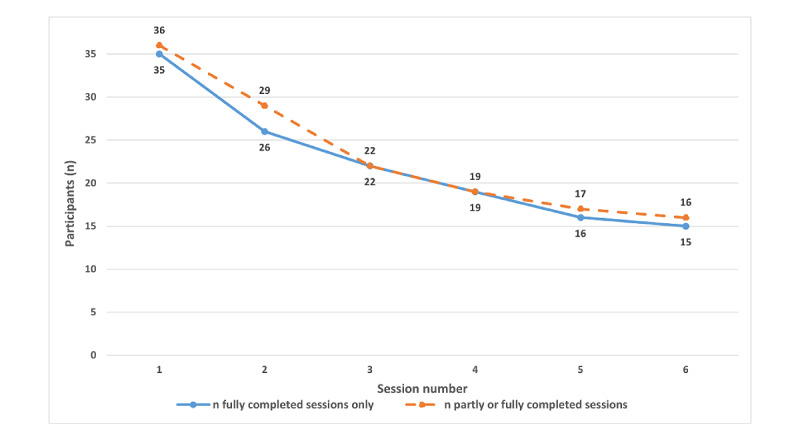
- Engagement was moderate to strong: participants completed an average of 3.32 (SD 1.85) of 6 sessions by week 8 and 3.72 (SD 2.11) by week 12; 16/36 (42%) completed all 6 sessions, and 19/36 (53%) completed at least 4 sessions.
- Session use averaged 25.7 (SD 14.67) minutes per session and 317.65 (SD 74.10) minutes total over 6.9 (SD 3.84) weeks.
- The regression model predicting completion from age and education was significant (χ²2 = 12.5; P = .002), explaining 39.6% of the variance; higher age predicted completion, and participants with high school/vocational education had 9.01 times higher odds of completion than those with university education.
- Clinical outcomes showed encouraging change: appearance fixing significantly decreased at 8 weeks, ACT measures were significantly favorable across analyses except valued action from baseline to week 12, and depression/anxiety did not worsen; baseline HADS caseness included 5/36 (14%) mild and 5/36 (14%) moderate depression, and 3/36 (8%) severe, 11/36 (31%) mild, and 7/36 (19%) moderate anxiety.
## Methods
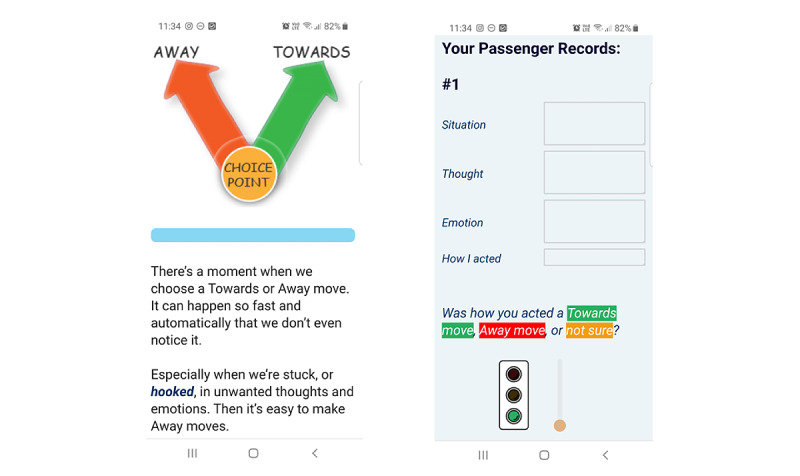
- Single-group mixed methods feasibility design evaluating a self-guided ACT-based prototype mobile program (“ACT It Out”) delivered through a mobile-optimized Qualtrics web app.
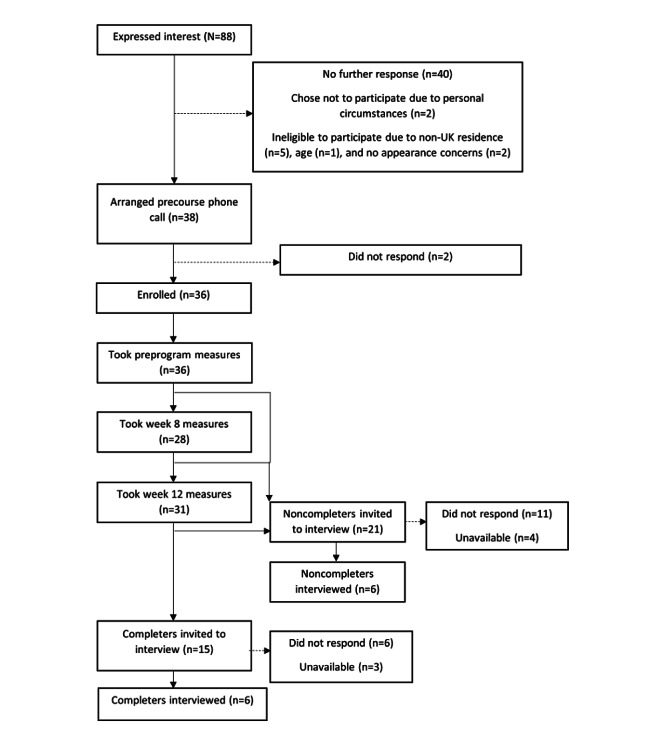
- Sample: 36 adults with self-reported visible differences and appearance concerns, recruited in the UK between July and November 2020; 12 participated in semistructured exit interviews.
- Quantitative analysis used descriptive statistics, binomial logistic regression for completion predictors, t tests and Pearson correlations for acceptability comparisons, and mixed model repeated measures (MMRM) with Hedge g for change over 3 time points (baseline, 8 weeks, 12 weeks). Qualitative data were analyzed thematically from a primarily deductive approach.
## Limitations
- The paper states that the study coincided with the COVID-19 pandemic, which may have confounded adherence and outcomes; the exact impact is described as difficult to determine, and some outcome measures may have been adversely affected.
- The sample was predominantly White females, and scarring was underrepresented, limiting generalizability; the interview subsample was self-selecting, which may affect validity, although half were noncompleters.
- Evident from the design: this was a single-group study with a small sample size and short-term measurement, so effects may reflect demand characteristics and cannot establish causal efficacy.
Model-written summary. Check it against the paper before relying on it.
Integrity signals
Registry
Cites
Statistics
Figures
Verification
Claims the paper makes
23 Valid · 2 Not valid · 16 Not checked · 115 Own results and interpretations
The cited sources support only part of this claim — read each source’s verdict below.
In the paper
“In the context of heightened conspicuousness and common reports of negative social reactions [3], there is a marked prevalence of appearance-related distress, most commonly in the form of anxiety (particularly social anxiety, marked by a fear of negative appearance evaluation and social withdrawal), depression, and body dissatisfaction, across a range of appearance-affecting conditions [4-6].”
§ An Acceptance and Commitment Therapy Prototype Mobile Program for Individuals With a Visible Difference: Mixed Methods Feasibility Study > Introduction > Background
What the sources say
- Partly supportedcites [4] sourceExperimental — accuracy not yet measured
The Discussion (page unavailable) reports higher rates of clinical anxiety and depression among dermatology patients than controls, supporting psychological distress across several skin conditions. The Questionnaires section (page unavailable) shows that the study measured general anxiety and depression, not body dissatisfaction or specifically social anxiety, fear of negative appearance evaluation, or social withdrawal. It therefore does not establish all the forms of appearance-related distress attributed to it. (LLM, conf=0.88)
- Not checked — no full text of the sourcecites [5] source
- Partly supportedcites [6] sourceExperimental — accuracy not yet measured
The Discussion (page unavailable) reports elevated anxiety and depression in alopecia areata and describes similar psychiatric comorbidities in several other chronic skin conditions. The Results (page unavailable) also report embarrassment and impaired social interaction in alopecia areata. The paper does not establish body dissatisfaction as a commonly prevalent form of distress across those conditions, or specifically characterize the anxiety as social anxiety driven by fear of negative appearance evaluation. (LLM, conf=0.86)
plain- Asserted: passes — The authors put it forward as true.
- Checkable: passes — It can be checked against evidence.
- Load-bearing: passes — The paper’s conclusions depend on it.
- Based: passes — The paper gives a reason why it holds.
- Partly supported
The sources with a verdict support this claim; the rest weren’t checked yet, have no full text we could read, or their verdicts aren’t rated yet.
In the paper
“Although many adjust well to having a visible difference, samples of individuals with visible differences commonly show significantly higher rates of appearance-based anxiety and depression across cultures (eg, in adults with acne [7] and alopecia [8]) when compared with matched controls.”
§ An Acceptance and Commitment Therapy Prototype Mobile Program for Individuals With a Visible Difference: Mixed Methods Feasibility Study > Introduction > Background
What the sources say
- Supportedcites [7] source
The Results report significantly higher social appearance anxiety and depression scores in adults with acne than in healthy controls (p<0.05). The Abstract says the controls were matched for age, gender and education. This supports the acne example for which this source is cited; it does not need to establish the separate alopecia or cross-cultural examples. (LLM, conf=0.93)
- Not checked — no full text of the sourcecites [8] source
plainstates an association- Asserted: passes — The authors put it forward as true.
- Checkable: passes — It can be checked against evidence.
- Load-bearing: passes — The paper’s conclusions depend on it.
- Based: passes — The paper gives a reason why it holds.
- Supported
The sources with a verdict support this claim; the rest weren’t checked yet, have no full text we could read, or their verdicts aren’t rated yet.
In the paper
“Equally, in the field of ACT self-help studies, evidence for the superiority of guided interventions is equivocal.”
§ An Acceptance and Commitment Therapy Prototype Mobile Program for Individuals With a Visible Difference: Mixed Methods Feasibility Study > Introduction > Mobile Delivery
What the sources say
- Supportedcites [18] source
The Introduction describes evidence on guided versus pure self-help as inconsistent. In the General discussion, this ACT-based self-help study reports no significant difference between guided and pure self-help, while acknowledging previous findings favoring guidance. Together, these passages support describing the evidence for superiority as equivocal. (LLM, conf=0.88)
- Not checked — no full text of the sourcecites [30] source
plain- Asserted: passes — The authors put it forward as true.
- Checkable: passes — It can be checked against evidence.
- Load-bearing: passes — The paper’s conclusions depend on it.
- Based: passes — The paper gives a reason why it holds.
- Supported
Every source the paper cites for this claim was checked and supports it.
In the paper
“The 11-item modified version of the 10-item original version that includes a population-specific item (use public transport) has been used in a previous study with visibly different participants, showing good reliability [14].”
§ An Acceptance and Commitment Therapy Prototype Mobile Program for Individuals With a Visible Difference: Mixed Methods Feasibility Study > Methods > Measures
What the sources say
- Supportedcites [14] source
Section 2.3.4 (Behavioural avoidance) describes a 10-item questionnaire to which the authors added a “use public transport” item for participants with visible differences. It reports that the addition improved internal consistency from α = .91 to α = .92, supporting the claim of good reliability. (LLM, conf=0.94)
plain- Asserted: passes — The authors put it forward as true.
- Checkable: passes — It can be checked against evidence.
- Load-bearing: unclear — It is unclear whether the paper’s conclusions depend on it.
- Based: passes — The paper gives a reason why it holds.
- Supported
The cited sources support only part of this claim — read each source’s verdict below.
In the paper
“With minimal specialist psychological provision available (eg, across Europe [9]), the development and testing of specialist self-help interventions are warranted.”
§ An Acceptance and Commitment Therapy Prototype Mobile Program for Individuals With a Visible Difference: Mixed Methods Feasibility Study > Introduction > Background
What the sources say
- Partly supportedcites [9] sourceExperimental — accuracy not yet measured
The Conclusions (section 5; page not provided) report disparities in availability and a need to increase access to specialist support for people with visible differences. But the Results (section 3.3; page not provided) say more than half of respondents considered access easy in both inpatient and outpatient settings. The paper supports gaps in provision, not the unqualified description of provision across Europe as minimal. (LLM, conf=0.86)
plain- Asserted: passes — The authors put it forward as true.
- Checkable: passes — It can be checked against evidence.
- Load-bearing: passes — The paper’s conclusions depend on it.
- Based: passes — The paper gives a reason why it holds.
- Partly supported
74 more claims · 4 with their cited sources checked
Create a free account to see all 156 claims and every source verdict.
- Probably not a substantial claim. 49
- It may state two separate claims as one. 43
- Borderline: one of the tests for a substantial claim is unclear. 1
Citations
Cites
Using thematic analysis in psychology
Braun, V., & Clarke, V. (2006) · Qualitative Research in Psychology · doi:10.1191/1478088706qp063oa · Cited by 194,414
Statistical Power Analysis for the Behavioral Sciences
Muller, K. (1989) · Technometrics · doi:10.1080/00401706.1989.10488618 · Cited by 99,167
The Hospital Anxiety and Depression Scale
Zigmond, A. S., & Snaith, R. P. (1983) · Acta Psychiatrica Scandinavica · doi:10.1111/j.1600-0447.1983.tb09716.x · Cited by 47,139 · cited 1×
“The 14-item Hospital Anxiety and Depression Scale (HADS [52]) measured depression and anxiety in participants, with 7 items for each subscale.”
MethodReflecting on reflexive thematic analysis
Braun, V., & Clarke, V. (2019) · Qualitative Research in Sport, Exercise and Health · doi:10.1080/2159676x.2019.1628806 · Cited by 19,677 · cited 2×
“The first author (FZ) followed the Braun and Clarke [57] six-step procedure, with minor modifications recommended by Braun and Clarke [58], as follows: (1) data familiarization through transcription, reading, and rereading; (2) generating initial codes across the entire data set; (3) generating draft themes; (4) revie…”
MethodDepression and quality of life in older persons: A review
Sivertsen, H., Bjørkløf, G. H., Engedal, K., Selbæk, G., & Helvik, A.-S. (2015) · Dementia and Geriatric Cognitive Disorders · doi:10.1159/000437299 · Cited by 14,152
Developing and evaluating complex interventions: the new Medical Research Council guidance
Craig, P., Dieppe, P., Macintyre, S., Michie, S., Nazareth, I., & Petticrew, M. (2008) · BMJ · doi:10.1136/bmj.a1655 · Cited by 10,995
Quality criteria were proposed for measurement properties of health status questionnaires
Terwee, C. B., Bot, S. D. M., de Boer, M. R., van der Windt, D. A. W. M., Knol, D. L., Dekker, J., Bouter, L. M., & de Vet, H. C. W. (2007) · Journal of Clinical Epidemiology · doi:10.1016/j.jclinepi.2006.03.012 · Cited by 10,764 · cited 2×
“This indicates potential concern with its content validity and responsiveness in the target population [55] and hence requires careful consideration for use in future RCTs.”
BackgroundThe validity of the Hospital Anxiety and Depression Scale
Bjelland, I., Dahl, A. A., Haug, T. T., & Neckelmann, D. (2002) · Journal of Psychosomatic Research · doi:10.1016/s0022-3999(01)00296-3 · Cited by 9,779
(1999) · Cited by 5,934
Orne, M. T. (1962) · American Psychologist · doi:10.1037/h0043424 · Cited by 4,041
Cited by
Tunç, H., Morris, P. G., Kyranides, M. N., McArdle, A., McConachie, D., & Williams, J. (2023) · Journal of Contextual Behavioral Science · doi:10.1016/j.jcbs.2023.02.004 · Cited by 40
Zucchelli, F., van Dalen, M., Bhatia, R., White, P., Hamlet, C., & Harcourt, D. M. (2023) · Body Image · doi:10.1016/j.bodyim.2023.03.016 · Cited by 16
Self-citationPowell, L. D., Vasiliou, V. S., & Thompson, A. R. (2023) · Body Image · doi:10.1016/j.bodyim.2023.101637 · Cited by 11
Guest, E., Halliwell, E., Mathews, A., Alleva, J. M., & Harcourt, D. M. (2024) · Health Psychology and Behavioral Medicine · doi:10.1080/21642850.2024.2349004 · Cited by 12
“…with coping skills using techniques such as Cognitive Behavioural Therapy (CBT; Bessell et al., 2012; Clarke et al., 2013; Van Dalen et al., 2021), Social Skills Training (SST; Robinson et al., 1996), and Acceptance and Commitment Therapy (ACT; Powell et al., 2023; Zucchelli et al., 2021, 2022).”
The Psychosocial Impact of Alopecia in Men: A Mixed-Methods Survey Study
Zucchelli, F., Mathews, A., Sharratt, N., Montgomery, K., & Chambers, J. (2024) · Skin Health and Disease · doi:10.1002/ski2.420 · Cited by 9
Self-citationDring, J. A. E., Reeves, E., & Hotton, M. (2025) · British Journal of Health Psychology · doi:10.1111/bjhp.70018 · Cited by 7
Shipowick, T., Austin, J., Sudiacal, N., Miller, S., Pereira, J. A., & Bundy, C. (2025) · JEADV Clinical Practice · doi:10.1002/jvc2.606 · Cited by 7
A Mixed-Methods Analysis of Mobile ACT Responses From Two Cohorts
Hoel, S., Victory, A., Sagorac Gruichich, T., Stowe, Z. N., McInnis, M. G., Cochran, A., & Thomas, E. B. K. (2022) · Frontiers in Digital Health · doi:10.3389/fdgth.2022.869143 · Cited by 4
Ruan, J., Huo, T., Zhang, Y., Ruan, Q., Xi, M., Ru, T. F., & Liu, S. (2025) · Burns · doi:10.1016/j.burns.2025.107630 · Cited by 4
Supporting individuals with a visible difference: A UK survey of needs and preferences
Clement, C., Roberts-Mills, W. M. C., Thorton, M., Clarke, A. M., Mathews, A., Zucchelli, F., White, P., Slater, A., & Harcourt, D. M. (2024) · Body Image · doi:10.1016/j.bodyim.2024.101840 · Cited by 7
Self-citationKeeling, M., Harcourt, D. M., White, P., Evans, S., V., V. S. W., Kiff, J. D., & Williamson, H. (2025) · PLoS ONE · doi:10.1371/journal.pone.0305022 · Cited by 6
Self-citationPeer-Recommended Coping Strategies for Individuals Living With Alopecia Areata
Huck, G. E., Brickham, D., & Shelton, S. (2024) · European Journal of Health Psychology · doi:10.1027/2512-8442/a000141 · Cited by 1
Thapar, S., Quesada, D., & Knaüper, B. (2025) · JMIR Formative Research · doi:10.2196/69532 · Cited by 3
“Among the existing ACT apps, few have incorporated participatory approaches during development [41-43,52 ,54], such as co-design”
Johns, A. L., Zukin, J., Fong, C., et al. (2026) · Journal of Craniofacial Surgery · doi:10.1097/scs.0000000000012935 · Cited by 1
Social Appearance Anxiety in Visible and Stigmatizing Diseases
de Vries, H., & de Reviers, B. (2024) · Springer eBooks · doi:10.1007/978-3-031-32046-0_155-1
Social Appearance Anxiety in Visible and Stigmatizing Diseases
de Vries, H., & de Reviers, B. (2025) · Springer eBooks · doi:10.1007/978-3-031-73363-5_155
Johns, A. L., Zukin, J., Yen, L., et al. (2026) · The Cleft Palate-Craniofacial Journal · doi:10.1177/10556656261457188
Thornton, M., Waite, E., White, P., Zarola, A., Antoniou, N., Clarke, A. M., & Harcourt, D. M. (2026) · Journal of Pediatric Psychology · doi:10.1093/jpepsy/jsag043
“This supports findings that digital ACT-based interventions are acceptable to the visible difference population (Zucchelli et al., 2022).”
Self-citationThornton, M., Waite, E., White, P., Zarola, A., Vizinho, Y., Clarke, A. M., & Harcourt, D. M. (2026) · British Journal of Health Psychology · doi:10.1111/bjhp.70096
“Several ACT-based interventions have been found to be acceptable including an app (‘ACT It Out’) for adults with visible differences of any kind (Zucchelli et al., 2022) and an early intervention to support adults in adjusting to appearance changes following a burn injury (Shepherd et al., 2026).”
Self-citation
Metadata
- Authors
- Zucchelli, F., Donnelly, O., Rush, E., White, P., Gwyther, H., Williamson, H., & The VTCT Foundation Research Team at the Centre for Appearance Research
- Affiliations
- University of the West of England (GB)
- National Health Service (GB)
- Corresponding author
- Zucchelli, Fabio
- Venue
- JMIR Formative Research
- Publisher
- JMIR Publications Inc.
- Published
- 2022-01-21
- Volume
- 6
- Issue
- 1
- Pages
- e33449
- ISSN
- 2561-326X (ISSN-L)
- PMC
- PMC8817209
- OpenAlex
- W3217722124
- Cited by
- 22
- References
- 65
- Citations by year
- 2026: 5 · 2025: 6 · 2024: 7 · 2023: 3 · 2022: 1
- FWCI
- 2.31
- Type
- journal article
- Language
- en
- Open access
- gold
- doi.org
- Licence
- cc-by
- Locations
- JMIR Formative Research (publishedVersion, cc-by)
- PubMed Central (publishedVersion, cc-by)
- PubMed (publishedVersion)
- UWE Research Repository (UWE Bristol) (submittedVersion, cc-by)
- DOAJ (DOAJ: Directory of Open Access Journals) (submittedVersion)
- Topics
- Social Sciences › Psychology › Applied Psychology › Digital Mental Health Interventions
- Social Sciences › Psychology › Clinical Psychology › Mindfulness and Compassion Interventions
- Social Sciences › Psychology › Clinical Psychology › Body Image and Dysmorphia Studies
- Keywords
- acceptance and commitment therapy, mental health apps, visible difference, appearance concerns, body dissatisfaction, social skills training, experiential avoidance, cognitive defusion, valued action, user engagement, program acceptability, clinical safety, depression, anxiety, mindfulness, stakeholder collaboration
About these checks
Registry, retraction, Cites and statistics results are computed, not judged, with one exception: a printed reference that no index lists is read once by a model before it counts as a citation error. Claims are extracted by a model and kept only when their quote appears verbatim in the text; each cited source is then checked, with a model’s help, for whether it says what the claim relies on. Those verdicts can be wrong — read the claim’s quote and the cited source before relying on one.
The claim verdicts this report counts are experimental: their accuracy is not yet measured.
A language model drew the claims from the paper on 2026-10-11, under version 3 of the claim definition (model deepseek-v4.1-flash, prompt extract-v3).
A second model labelled each claim on 2026-10-11 (model jev-1.13-20260917, definition revision gold-guideline-v0.2).
Cited sources are checked with a language model’s help (gpt-6-sol).
Statistics and arithmetic are recomputed, not judged.
Confidence bands are shown only for fields calibrated on our annotated test set. None is calibrated yet, so no band is shown.
What counts as a claim ›How we measure confidence ›How we check this ›
Are you an author, or do you see a problem with this page? Request a review
Data sources
Bibliographic data: Semantic Scholar, OpenAlex, Crossref.
Contains information from the Semantic Scholar Academic Graph Datasets, made available under the ODC Attribution License (ODC-BY 1.0).
Semantic Scholar’s data is described in: Kinney, R., et al. (2023). The Semantic Scholar Open Data Platform. arXiv:2301.10140.
