

Effectiveness of an Internet-Based Acceptance and Commitment Therapy Intervention for Reducing Psychological Distress in Health Care Professionals: Randomized Controlled Trial
Open accessPublished version of a preprint
The DOI matches its Crossref record; 64 of the 64 references it cites were found in a registry or an index; 14 of the 29 sources its claims cite were checked for support.
Abstract
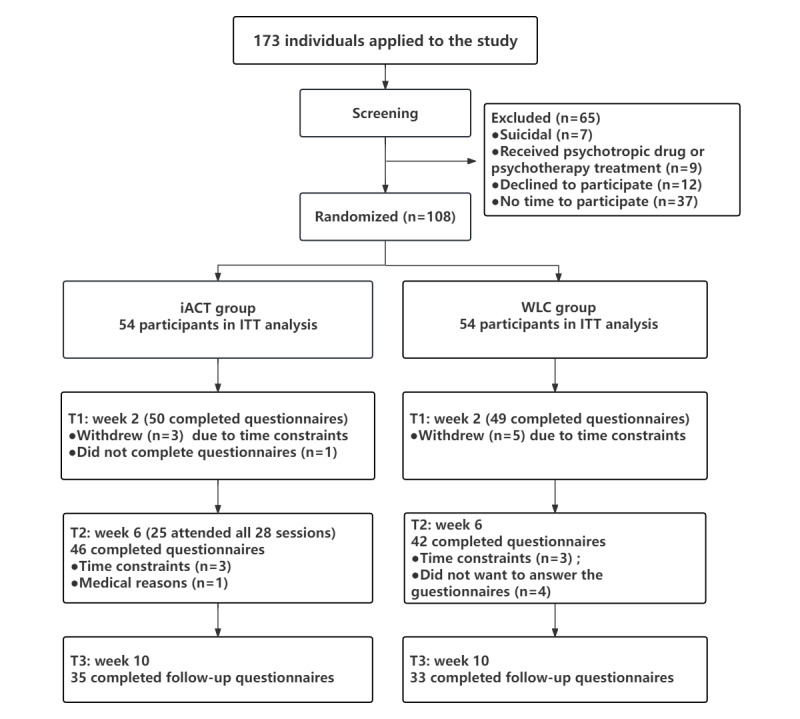
Background: Psychological distress is prevalent among health care professionals and can lead to poor-quality patient care. Internet-based acceptance and commitment therapy (iACT) is a promising intervention for improving mental health due to its low cost and easy access. However, there is limited evidence of its effectiveness in reducing health care professionals’ psychological distress. Objective: This study aims to examine the effects of iACT on psychological distress (stress, anxiety, and depression) among health care professionals in China. Methods: From October 2022 to February 2023, a total of 108 health care professionals were recruited via WeChat and randomized into a 6-week iACT intervention program with therapist support (n=54) or waitlist control group (n=54). The intervention included 21 self-guided sessions combining teaching videos, mindfulness practices, and journal writing, followed by 7 live conferences to share experiences and discuss questions, all conducted via WeChat. Primary outcomes (stress, anxiety, and depression) and secondary outcomes (burnout and psychological flexibility) were collected using the Sojump platform, the most popular web-based survey platform in China. Generalized estimating equations were used to compare the outcomes between groups and assess the effects of group, time, and group-by-time interaction. Subgroup and sensitive analyses were performed to test the robustness of our findings across various groups. Results: Among the 108 health care professionals, 68 (63%) completed the follow-up assessment at week 10, including 35 (64.8%) in the iACT group and 33 (61.1%) in the waitlist control group. Of the 54 participants in the iACT group, all attended at least 2 sessions, and 25 attended all 28 sessions. On average, participants attended 20 (71%) sessions. The iACT group showed significant improvement in the Depression Anxiety and Stress Scales-21 total score (d=0.82, 95% CI 0.39-1.26), and the effects were sustained for 4 weeks after the intervention (d=1.08, 95% CI 0.57-1.59). Compared to the control group, the iACT group showed significantly lower scores in burnout at week 6 (d=1.42, 95% CI 0.95-1.89) and week 10 (d=1.52, 95% CI 0.98-2.06). The iACT group showed significantly higher psychological flexibility at week 6 (d=1.23, 95% CI 0.77-1.69) and week 10 (d=1.15, 95% CI 0.64-1.66). Conclusions: The iACT effectively decreased health care professionals’ psychological distress and burnout and improved their psychological flexibility. Our findings provide implications and guidance for the development and broad implementation of iACT in health care settings to improve the mental health of health care professionals. ©Lin Zhang, Shuang Huang, Sha Liu, Yuanxiu Huang, Shan Chen, Jinsong Hu, Mingzhong Xu.
Overview
CoChat Summary
TL;DR
This parallel randomized controlled trial tested a 6-week internet-based ACT program for health care professionals in Hunan, China, and found it reduced psychological distress and burnout while improving psychological flexibility versus waitlist control. Effects were sustained 4 weeks after the intervention.
Key findings
- Of 173 recruited professionals, 108 were randomized 1:1 to iACT or waitlist control; 68 (63%) completed the week 10 follow-up, and in the iACT group all 54 participants attended at least 2 sessions, with an average attendance of 20/28 sessions (71%).
- The iACT group had a significant group effect and group-by-time interaction on DASS-21 total score (P<.001 and P=.04), with greater reductions at weeks 2, 6, and 10 (β=–3.85, –6.36, –7.50); effect sizes were 0.82 at week 6 and 1.08 at week 10.
- Compared with waitlist control, iACT also produced lower depression (β=–1.24, –2.42, –2.87), anxiety (β=–1.25, –2.00, –2.12), and stress (β=–1.42, –1.98, –2.59) scores at weeks 2, 6, and 10, all P<.05.
- Secondary outcomes improved as well: burnout effect sizes were 1.42 at week 6 and 1.52 at week 10, and psychological flexibility effect sizes were 1.23 at week 6 and 1.15 at week 10; in the higher-distress subgroup, 77% of iACT participants vs 64% of waitlist participants no longer met the DASS-21 distress criterion at follow-up.
Methods
- Parallel RCT with 4 repeated measures conducted in Hunan province from October 2022 to February 2023; participants were health care professionals aged ≥18 years with at least 1 year of work experience and internet/WeChat access.
- 108 participants were randomized 1:1 to a 6-week iACT program with therapist support or waitlist control; the intervention included 21 self-guided sessions plus 7 live conferences delivered via WeChat.
- Outcomes were measured at baseline, week 2, week 6, and week 10 using DASS-21, MBI-GS, and CompACT; generalized estimating equations were the main analysis, with subgroup and sensitivity analyses.
Limitations
- The paper states that the sample was predominantly female, which may limit generalization to males; it also notes potential sampling bias from self-selected web-based recruitment, self-report outcome bias, and attrition-related bias.
- The paper states follow-up lasted only 4 weeks after the intervention, which may limit external validity for long-term effects.
- The paper states intervention fidelity and interventionists’ abilities were not assessed; evident from the text: the study was conducted in one province (Hunan) and in a waitlist-controlled web-based format, so generalizability to other settings or comparators is limited.
Model-written summary. Check it against the paper before relying on it.
Integrity signals
Registry
Cites
Statistics
Figures
Verification
Claims the paper makes
13 Valid · 1 Not valid · 9 Not checked · 54 Own results and interpretations
At least one cited source doesn’t support this claim or points to a different paper, and none confirmed it — see the verdicts below.
In the paper
“However, the change in the DASS-21 total score from baseline to post-assessment (–6.36) in our study was more significant than in the Levin study (–4.59).”
§ Effectiveness of an Internet-Based Acceptance and Commitment Therapy Intervention for Reducing Psychological Distress in Health Care Professionals: Randomized Controlled Trial > Discussion > Principal Findings
What the sources say
- Disputedcites [53] sourceExperimental — accuracy not yet measured
The Methods > Measures passage says the DASS-21 subscales cannot be calculated as an overall total score. The Results > Between Group Analyses instead report depression, anxiety, and stress separately; our copy does not report a −4.59 change in a DASS-21 total score for the comparison claimed. (LLM, conf=0.88)
Checked by a reasoning model — may be wrong.
plain- Asserted: passes — The authors put it forward as true.
- Checkable: passes — It can be checked against evidence.
- Load-bearing: unclear — It is unclear whether the paper’s conclusions depend on it.
- Based: passes — The paper gives a reason why it holds.
- Disputed
The cited sources support only part of this claim — read each source’s verdict below.
In the paper
“However, the health benefits of the intervention may not last over an extended period after the intervention is terminated, raising concerns about sustainability [63].”
§ Effectiveness of an Internet-Based Acceptance and Commitment Therapy Intervention for Reducing Psychological Distress in Health Care Professionals: Randomized Controlled Trial > Discussion > Principal Findings
What the sources say
- Partly supportedcites [63] sourceExperimental — accuracy not yet measured
The Background (page unavailable) says sustaining evidence-based interventions in community settings remains a major challenge, and the Results’ conceptualization of sustainability considers benefits months after the last intervention contact. But the paper does not directly say that health benefits may fade after the intervention itself is terminated; its termination example concerns external support. (LLM, conf=0.78)
hedgedstates a possible cause- Asserted: passes — The authors put it forward as true.
- Checkable: passes — It can be checked against evidence.
- Load-bearing: passes — The paper’s conclusions depend on it.
- Based: passes — The paper gives a reason why it holds.
- Partly supported
A result the paper reports from its own data — it cites no other source for it, so there is none to check. The quote shows it is in the paper.
In the paper
“The iACT group showed significantly higher psychological flexibility at week 6 (d=1.23, 95% CI 0.77-1.69) and week 10 (d=1.15, 95% CI 0.64-1.66).”
§ Effectiveness of an Internet-Based Acceptance and Commitment Therapy Intervention for Reducing Psychological Distress in Health Care Professionals: Randomized Controlled Trial > Abstract > Results
plainn = 54 ·- Asserted: passes — The authors put it forward as true.
- Checkable: passes — It can be checked against evidence.
- Load-bearing: passes — The paper’s conclusions depend on it.
- Based: passes — The paper gives a reason why it holds.
A result the paper reports from its own data — it cites no other source for it, so there is none to check. The quote shows it is in the paper.
In the paper
“Compared to the control group, the iACT group showed significantly lower scores in burnout at week 6 (d=1.42, 95% CI 0.95-1.89) and week 10 (d=1.52, 95% CI 0.98-2.06).”
§ Effectiveness of an Internet-Based Acceptance and Commitment Therapy Intervention for Reducing Psychological Distress in Health Care Professionals: Randomized Controlled Trial > Abstract > Results
plain- Asserted: passes — The authors put it forward as true.
- Checkable: passes — It can be checked against evidence.
- Load-bearing: passes — The paper’s conclusions depend on it.
- Based: passes — The paper gives a reason why it holds.
A result the paper reports from its own data — it cites no other source for it, so there is none to check. The quote shows it is in the paper.
In the paper
“Compared to the control group, the iACT group showed significantly lower scores in burnout at week 6 (d=1.42, 95% CI 0.95-1.89) and week 10 (d=1.52, 95% CI 0.98-2.06).”
§ Effectiveness of an Internet-Based Acceptance and Commitment Therapy Intervention for Reducing Psychological Distress in Health Care Professionals: Randomized Controlled Trial > Abstract > Results
plainstates a cause- Asserted: passes — The authors put it forward as true.
- Checkable: passes — It can be checked against evidence.
- Load-bearing: passes — The paper’s conclusions depend on it.
- Based: passes — The paper gives a reason why it holds.
24 more claims
Create a free account to see all 77 claims and every source verdict.
- Probably not a substantial claim. 25
- It may state two separate claims as one. 31
- The quote only partly states this claim. 1
Self-check
Percentages, sums and reported differences re-computed from the paper’s own numbers.
Each contradiction between two passages listed here was confirmed by an independent check.
Rated minor: it would not touch a result — a value no result rests on, a p-value that stays on the same side of the significance level, or a conflict that is clerical, resolved elsewhere in the paper, or outside its own findings.
In the paper
§ Effectiveness of an Internet-Based Acceptance and Commitment Therapy Intervention for Reducing Psychological Distress in Health Care Professionals: Randomized Controlled Trial > Introduction
“Thus, this study aims to examine the effectiveness of an iACT intervention program in reducing psychological distress (stress, anxiety, and depression) and burnout and improving psychological reflexibility among health care professionals in China.”
§ Effectiveness of an Internet-Based Acceptance and Commitment Therapy Intervention for Reducing Psychological Distress in Health Care Professionals: Randomized Controlled Trial > Abstract > Conclusions
“The iACT effectively decreased health care professionals’ psychological distress and burnout and improved their psychological flexibility.”
Citations
Cites
Acceptance and commitment therapy: model, processes and outcomes
Hayes, S. C., Luoma, J. B., Bond, F. W., Masuda, A., & Lillis, J. (2006) · Behaviour Research and Therapy · doi:10.1016/j.brat.2005.06.006 · Cited by 6,587
Pappa, S., Ntella, V., Giannakas, T., Giannakoulis, V. G., Papoutsi, E., & Katsaounou, P. (2020) · Brain Behavior and Immunity · doi:10.1016/j.bbi.2020.05.026 · Cited by 3,617
Hayes, S. C., Wilson, K. G., Gifford, E. V., Follette, V. M., & Strosahl, K. (1996) · Journal of Consulting and Clinical Psychology · doi:10.1037//0022-006x.64.6.1152 · Cited by 3,595
The answer is 17 years, what is the question: understanding time lags in translational research
Morris, Z. S., Wooding, S., & Grant, J. (2011) · Journal of the Royal Society of Medicine · doi:10.1258/jrsm.2011.110180 · Cited by 3,340
Bellg, A. J., Treatment Fidelity Workgroup of the NIH Behavior Change Consortium, Borrelli, B., Resnick, B., Hecht, J., Minicucci, D. S., Ory, M., Ogedegbe, G., Orwig, D., Ernst, D., et al. (2004) · Health Psychology · doi:10.1037/0278-6133.23.5.443 · Cited by 2,620
Burnout: A Review of Theory and Measurement
Edú-Valsania, S., Laguía, A., & Moriano, J. A. (2022) · International Journal of Environmental Research and Public Health · doi:10.3390/ijerph19031780 · Cited by 845
Burnout in Healthcare Workers: Prevalence, Impact and Preventative Strategies
De Hert, S. (2020) · Local and Regional Anesthesia · doi:10.2147/lra.s240564 · Cited by 746
Acceptance and Commitment Therapy as a Unified Model of Behavior Change
Hayes, S. C., Pistorello, J., & Levin, M. E. (2012) · The Counseling Psychologist · doi:10.1177/0011000012460836 · Cited by 718
Clinic, M., Dyrbye, L. N., Shanafelt, T. D., Clinic, M., Sinsky, C. A., American Medical Association, Cipriano, P. F., American Nurses Association, Bhatt, J., American Hospital Association, et al. (2017) · NAM Perspectives · doi:10.31478/201707b · Cited by 709
The empirical status of acceptance and commitment therapy: A review of meta-analyses
Gloster, A. T., Walder, N., Levin, M. E., Twohig, M. P., & Karekla, M. (2020) · Journal of Contextual Behavioral Science · doi:10.1016/j.jcbs.2020.09.009 · Cited by 622
Research works printed but not linked: 5
- Siau, CS, 2018, Malays J Public Health Med, 1, 125
- Hayes, SC, 2011, Acceptance and Commitment Therapy: The Process and Practice of Mindful Change
- Hayes, SC, 2005, Get Out of Your Mind and Into Your Life : The New Acceptance and Commitment Therapy
- Maslach, C, 1986, Maslach Burnout Inventory
- Li, CP, 2003, Acta Psychologica Sinica, 35, 677
Cited by
Lampinen, V. S., Kämper, E., Balla, V. R., Katajavuori, N., & Asikainen, H. (2026) · Internet Interventions · doi:10.1016/j.invent.2026.100909 · Cited by 4
Greville-Harris, M., Wezyk, A. B., Thomas, K., Richer, S., Bolderston, H., Purchase, N., McDougall, S. J. P., & Turner, K. (2025) · BMC Surgery · doi:10.1186/s12893-025-03059-5 · Cited by 2
Watanabe, T., Sakai, M., Yoshimura, K., Takakuwa, O., & Akechi, T. (2025) · BMJ Open · doi:10.1136/bmjopen-2025-106542
Lai, Y., Gu, Y., Chen, Y., Hu, Z., & Zheng, W. (2026) · Behavioral Sciences · doi:10.3390/bs16030374
Muñoz-Palacio, F. A., Álvarez, H. E. L., Villacreses-Añazco, M. V., & Macias-Salinas, V. A. (2026) · Innova Science Journal · doi:10.63618/omd/isj/v4/n2/279 · Cited by 1
Artificial intelligence in psychotherapy and counseling
Bhatt, S., & Dandona, A. (2026) · Elsevier eBooks · doi:10.1016/b978-0-443-43934-6.00019-5
Workplace Mental Health Programs for Healthcare Workers: A Systematic Review
Jacob, J., Malaiyappan, P., Arul, V., Kaur, T., Vijayaraman, S., Antony, G., Ramesh, K., Dasari, M. R., & Ganesan, B. (2026) · International Journal of Environmental Research and Public Health · doi:10.3390/ijerph23081002 · Cited by 1
Yang, Y., Wen, J., Wan, H., Yang, Q., Guan, J., Min, L., Jia, S., Wang, Z., & Gary, J. (2026) · Frontiers in Public Health · doi:10.3389/fpubh.2026.1879258
Características y Eficacia de Intervenciones de ACT en Línea en Trabajadores: Revisión Sistemática
López, L. S. B., Santana-Cárdenas, S., Ramírez-Cruz, J. C., & Contreras, H. R. (2026) · PSICUMEX · doi:10.36793/psicumex.v16i1.829
Metadata
- Authors
- Zhang, L., Huang, S., Liu, S., Huang, Y., Chen, S., Hu, J., & Xu, M.
- Corresponding author
- Xu, Mingzhong
- Venue
- Journal of Medical Internet Research
- Publisher
- JMIR Publications Inc.
- Published
- 2024-12-18
- Volume
- 26
- Pages
- e59093
- ISSN
- 1438-8871 (ISSN-L)
- PMC
- PMC11694045
- OpenAlex
- W4404237852
- Semantic Scholar
- 341b975a5a9c59179803d0faa9e10f495d7b1f81
- Cited by
- 9
- References
- 63
- Citations by year
- 2026: 7 · 2025: 2
- FWCI
- 4.49
- Type
- journal article
- Language
- en
- Open access
- gold
- doi.org
- Licence
- cc-by
- Locations
- Journal of Medical Internet Research (publishedVersion, cc-by)
- PubMed Central (publishedVersion, cc-by)
- PubMed (publishedVersion)
- DOAJ (DOAJ: Directory of Open Access Journals) (submittedVersion, cc-by-sa)
- Topics
- Social Sciences › Psychology › Clinical Psychology › Mindfulness and Compassion Interventions
- Social Sciences › Psychology › Applied Psychology › Digital Mental Health Interventions
- Health Sciences › Health Professions › General Health Professions › Healthcare professionals’ stress and burnout
- Keywords
- psychological distress, healthcare workers, burnout, depression, anxiety, stress, psychological flexibility, mindfulness, self-guided intervention, therapist support, digital mental health interventions, China, WeChat, DASS-21, subgroup analysis, sensitivity analysis, quality of life, quality of care, workplace mental health
- MeSH terms
- Psychological Distress, Internet-Based Intervention, Adult, Anxiety, China, Depression, Female, Health Personnel, Humans, Male, Middle Aged, Stress, Psychological, Internet, Acceptance and Commitment Therapy
About these checks
Registry, retraction, Cites and statistics results are computed, not judged, with one exception: a printed reference that no index lists is read once by a model before it counts as a citation error. Claims are extracted by a model and kept only when their quote appears verbatim in the text; each cited source is then checked, with a model’s help, for whether it says what the claim relies on. Those verdicts can be wrong — read the claim’s quote and the cited source before relying on one.
The claim verdicts this report counts are experimental: their accuracy is not yet measured.
A language model drew the claims from the paper on 2026-10-11, under version 3 of the claim definition (model deepseek-v4.1-flash, prompt extract-v3).
A second model labelled each claim on 2026-10-11 (model jev-1.13-20260917, definition revision gold-guideline-v0.2).
Cited sources are checked with a language model’s help (gpt-6-sol).
Statistics and arithmetic are recomputed, not judged.
Confidence bands are shown only for fields calibrated on our annotated test set. None is calibrated yet, so no band is shown.
What counts as a claim ›How we measure confidence ›How we check this ›
Are you an author, or do you see a problem with this page? Request a review
Data sources
Bibliographic data: Semantic Scholar, OpenAlex, Crossref.
Contains information from the Semantic Scholar Academic Graph Datasets, made available under the ODC Attribution License (ODC-BY 1.0).
Semantic Scholar’s data is described in: Kinney, R., et al. (2023). The Semantic Scholar Open Data Platform. arXiv:2301.10140.
