

The DOI matches its Crossref record; 35 of the 37 references it cites were found in a registry or an index; none of the 31 sources its claims cite is checked for support yet.
Disseminating Self-Help: Positive Psychology Exercises in an Online Trial
Open accessAbstract
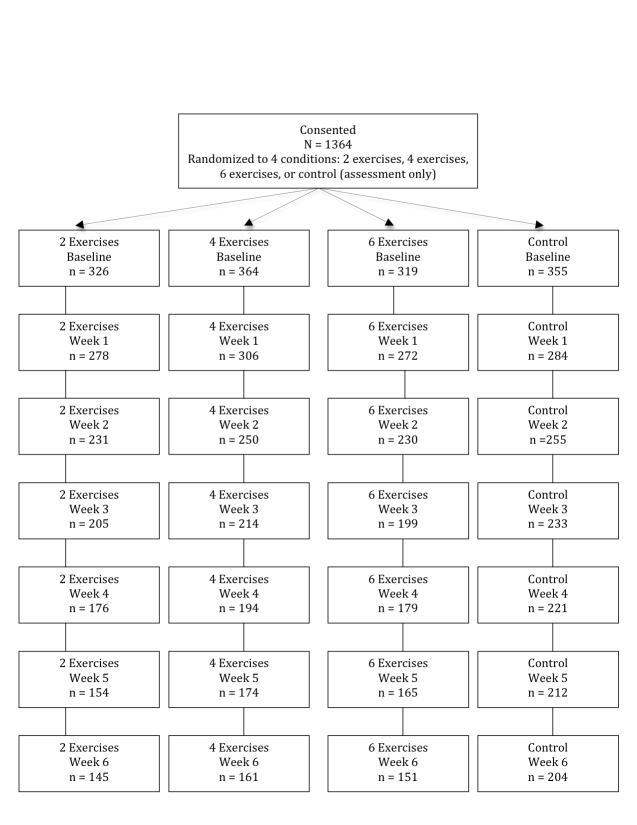
BACKGROUND: The recent growth of positive psychology has led to a proliferation in exercises to increase positive thoughts, behaviors, and emotions. Preliminary evidence suggests that these exercises hold promise as an approach for reducing depressive symptoms. These exercises are typically researched in isolation as single exercises. The current study examined the acceptability of several multi-exercise packages using online dissemination. OBJECTIVE: The purpose of this study was to investigate methods of dissemination that could increase the acceptability and effectiveness of positive psychology exercises. To achieve this goal, we compared the use of positive psychology exercises when delivered in packages of 2, 4, or 6 exercises. METHODS: Self-help-seeking participants enrolled in this study by visiting an online research portal. Consenting participants were randomly assigned to receive 2, 4, or 6 positive psychology exercises (or assessments only) over a 6-week period. These exercises drew from the content of group positive psychotherapy. Participants visited an automated website that distributed exercise instructions, provided email reminders, and contained the baseline and follow-up assessments. Following each exercise, participants rated their enjoyment of the exercise, answered how often they had used each technique, and completed outcome measures. RESULTS: In total, 1364 individuals consented to participate. Attrition rates across the 2-, 4-, and 6-exercise conditions were similar at 55.5% (181/326), 55.8% (203/364), and 52.7% (168/319) respectively but were significantly greater than the attrition rate of 42.5% (151/355) for the control condition (χ(2)(3) = 16.40, P < .001). Participants in the 6-exercise condition were significant more likely than participants in the 4-exercise condition to use both the third (F(1,312) = 5.61, P = .02) and fourth (F(1,313 )= 6.03, P = .02) exercises. For 5 of the 6 exercises, enjoyment was related to continued use of the exercise at 6-week follow-up (r's = .12 to .39). All conditions produced significant reductions in depressive symptoms (F(1,656) = 94.71, P < .001); however, a significant condition by time interaction (F(3,656) = 4.77, P = .003) indicated that this reduction was larger in the groups that received 2 or 4 exercises compared with the 6-exercise or control condition. CONCLUSION: Increasing the number of exercises presented to participants increased the use of the techniques and did not increase dropout. Participants may be more likely to use these skills when presented with a variety of options. Increasing the number of exercises delivered to participants produced a curvilinear relationship with those in the 2- and 4-exercise conditions reporting larger decreases in depressive symptoms than participants in the 6-exercise or control conditions. Although research generally offers a single exercise to test isolate effects, this study supports that studying variability in dissemination can produce important findings.
Overview
AI snapshot
Written from the paper’s full text.
TL;DR
This online randomized trial compared dissemination of 2, 4, or 6 positive psychology exercises versus assessment-only control over 6 weeks. More exercises increased use without increasing dropout, but depressive symptom reductions were larger in the 2- and 4-exercise conditions than in the 6-exercise or control conditions.
Key findings
- Of 1364 consenting participants, attrition was similar across active conditions—55.5% (181/326) for 2 exercises, 55.8% (203/364) for 4 exercises, and 52.7% (168/319) for 6 exercises—but significantly greater than the 42.5% (151/355) control attrition (χ²₃=16.40, P<.001).
- Participants in the 6-exercise condition were significantly more likely than those in the 4-exercise condition to use the third (F₁,₃₁₂=5.61, P=.02) and fourth (F₁,₃₁₃=6.03, P=.02) exercises; mean usage days were 6.1 (SD 3.56), 7.94 (SD 4.77), and 12.1 (SD 7.36) for the 2-, 4-, and 6-exercise conditions.
- For 5 of the 6 exercises, enjoyment was related to continued use at 6-week follow-up (r’s=.12 to .39, P’s<.05).
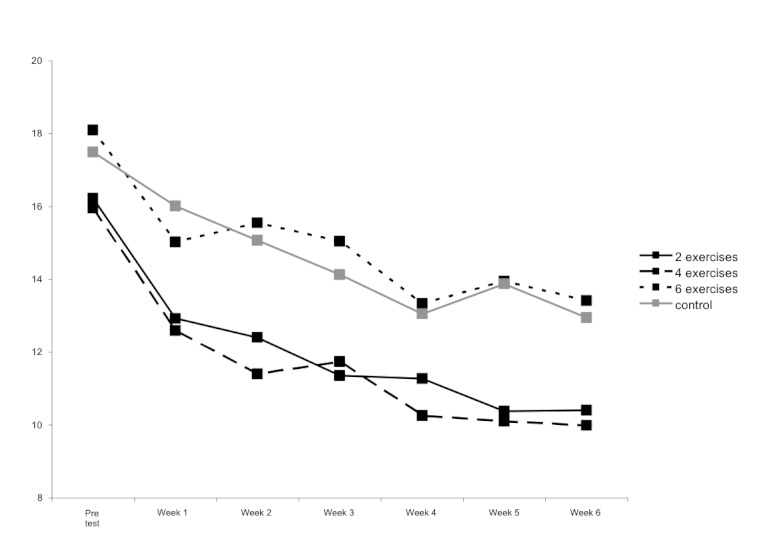
- All conditions produced significant reductions in depressive symptoms (F₁,₆₅₆=94.71, P<.001), but a significant condition-by-time interaction (F₃,₆₅₆=4.77, P=.003) indicated larger reductions in the 2- and 4-exercise conditions than in the 6-exercise or control conditions; estimated marginal CES-D means were 12.31, 11.95, 15.89, and 14.53 for the 2-, 4-, 6-exercise, and control groups.
Methods
- Self-help–seeking participants enrolled through an online research portal associated with the University of Pennsylvania’s Positive Psychology Center and Seligman’s *Authentic Happiness*; 1364 consented and were randomly assigned to receive 2, 4, or 6 positive psychology exercises or assessments only over 6 weeks.
- Exercises were drawn from group positive psychotherapy and delivered in a fixed order: three good things, strengths, gratitude visit, savoring, active-constructive responding, and life summary; participants completed baseline and weekly assessments, including the 20-item CES-D.
- Analyses included chi-square tests comparing attrition across conditions, repeated measures ANCOVA on completers controlling for baseline depressive symptoms, and regressions testing whether days of exercise use mediated changes in depressive symptoms.
Limitations
- Stated: the sample was overwhelmingly female, highly affluent, and well educated, and was not representative of the world population; recruitment through a positive psychology book website and the University of Pennsylvania Positive Psychology Center may have contributed to this.
- Stated: because content was delivered through an automated system, the authors could not be sure participants actually read and understood the instructions; exercises were also delivered one per week over subsequent weeks, whereas real-world users may receive several activities at once and use them at will.
- Evident from the text: high attrition and the use of completer-only efficacy analyses may bias results, and adherence was based on self-report rather than objective tracking.
Model-written summary. Check it against the paper before relying on it.
Integrity signals
Registry
Cites
Statistics
Figures
Verification
Claims the paper makes
29 Not checked yet · 23 Own result · 17 Own interpretation · 4 Own method
A result the paper reports from its own data — it cites no other source for it, so there is none to check. The quote shows it is in the paper.
In the paper
“All conditions produced significant reductions in depressive symptoms (F 1,656 = 94.71, P < .001); however, a significant condition by time interaction (F 3,656 = 4.77, P = .003) indicated that this reduction was larger in the groups that received 2 or 4 exercises compared with the 6-exercise or control condition.”
§ Disseminating Self-Help: Positive Psychology Exercises in an Online Trial > Abstract > Results
plaindirect- Asserted: passes — The authors put it forward as true.
- Checkable: passes — It can be checked against evidence.
- Load-bearing: passes — The paper’s conclusions depend on it.
- Based: passes — The paper gives a reason why it holds.
A result the paper reports from its own data — it cites no other source for it, so there is none to check. The quote shows it is in the paper.
In the paper
“All conditions produced significant reductions in depressive symptoms (F 1,656 = 94.71, P < .001); however, a significant condition by time interaction (F 3,656 = 4.77, P = .003) indicated that this reduction was larger in the groups that received 2 or 4 exercises compared with the 6-exercise or control condition.”
§ Disseminating Self-Help: Positive Psychology Exercises in an Online Trial > Abstract > Results
hedgedcorrelationaln = 1,364 ·- Asserted: passes — The authors put it forward as true.
- Checkable: passes — It can be checked against evidence.
- Load-bearing: passes — The paper’s conclusions depend on it.
- Based: passes — The paper gives a reason why it holds.
A result the paper reports from its own data — it cites no other source for it, so there is none to check. The quote shows it is in the paper.
In the paper
“For 5 of the 6 exercises, enjoyment was related to continued use of the exercise at 6-week follow-up (r’s = .12 to .39).”
§ Disseminating Self-Help: Positive Psychology Exercises in an Online Trial > Abstract > Results
plaincorrelational- Asserted: passes — The authors put it forward as true.
- Checkable: passes — It can be checked against evidence.
- Load-bearing: unclear — It is unclear whether the paper’s conclusions depend on it.
- Based: passes — The paper gives a reason why it holds.
A result the paper reports from its own data — it cites no other source for it, so there is none to check. The quote shows it is in the paper.
In the paper
“Estimated marginal means in the CES-D were 12.31, 11.95, 15.89, and 14.53 for the 2-, 4-, and 6-exercise groups and control condition, respectively.”
§ Disseminating Self-Help: Positive Psychology Exercises in an Online Trial > Results > Efficacy of Exercises
hedged- Asserted: passes — The authors put it forward as true.
- Checkable: passes — It can be checked against evidence.
- Load-bearing: passes — The paper’s conclusions depend on it.
- Based: passes — The paper gives a reason why it holds.
- Rests on an assumption: The completers (participants who completed the pretest and posttest measures) are representative of the randomized sample, so that analyses of completers yield unbiased estimates of intervention effects.
A result the paper reports from its own data — it cites no other source for it, so there is none to check. The quote shows it is in the paper.
In the paper
“At baseline, the average scores on the CES-D were consistent with mild-to-moderate levels of depressive symptoms (mean 16.93, SD 12.64).”
§ Disseminating Self-Help: Positive Psychology Exercises in an Online Trial > Results > Efficacy of Exercises
plain- Asserted: passes — The authors put it forward as true.
- Checkable: passes — It can be checked against evidence.
- Load-bearing: unclear — It is unclear whether the paper’s conclusions depend on it.
- Based: passes — The paper gives a reason why it holds.
A result the paper reports from its own data — it cites no other source for it, so there is none to check. The quote shows it is in the paper.
In the paper
“For 5 of the 6 exercises (all of the 6 with exception of the life summary), enjoyment was related to continued use of the exercise at the 6-week follow-up (r’s = .12 to .39, P’s < .05).”
§ Disseminating Self-Help: Positive Psychology Exercises in an Online Trial > Results > Use of Exercises
plaincorrelational- Asserted: passes — The authors put it forward as true.
- Checkable: passes — It can be checked against evidence.
- Load-bearing: unclear — It is unclear whether the paper’s conclusions depend on it.
- Based: passes — The paper gives a reason why it holds.
A result the paper reports from its own data — it cites no other source for it, so there is none to check. The quote shows it is in the paper.
In the paper
“There were no significant differences between the 6 exercises on use of the techniques.”
§ Disseminating Self-Help: Positive Psychology Exercises in an Online Trial > Results > Use of Exercises
plain- Asserted: passes — The authors put it forward as true.
- Checkable: passes — It can be checked against evidence.
- Load-bearing: unclear — It is unclear whether the paper’s conclusions depend on it.
- Based: passes — The paper gives a reason why it holds.
A result the paper reports from its own data — it cites no other source for it, so there is none to check. The quote shows it is in the paper.
In the paper
“Of the 1364 participants who consented to participate, 1140 (83.6%), 966 (70.8%), 851 (62.4%), 770 (56.4%), 705 (51.7%), and 661 (48.4%) completed measures each week at the week 1 through week 6 assessments respectively.”
§ Disseminating Self-Help: Positive Psychology Exercises in an Online Trial > Results > Attrition
plaincorrelationaln = 1,364- Asserted: passes — The authors put it forward as true.
- Checkable: passes — It can be checked against evidence.
- Load-bearing: unclear — It is unclear whether the paper’s conclusions depend on it.
- Based: passes — The paper gives a reason why it holds.
A result the paper reports from its own data — it cites no other source for it, so there is none to check. The quote shows it is in the paper.
In the paper
“At the end of the 6 weeks, the three active conditions differed significantly on the number of days that the techniques were used (F 2,358 = 33.84, P < .001).”
§ Disseminating Self-Help: Positive Psychology Exercises in an Online Trial > Results > Use of Exercises
plain- Asserted: passes — The authors put it forward as true.
- Checkable: passes — It can be checked against evidence.
- Load-bearing: unclear — It is unclear whether the paper’s conclusions depend on it.
- Based: passes — The paper gives a reason why it holds.
A result the paper reports from its own data — it cites no other source for it, so there is none to check. The quote shows it is in the paper.
In the paper
“A significant main effect of time (F 1,656 = 94.71, P < .001) demonstrates that depression scores dropped over time in all conditions.”
§ Disseminating Self-Help: Positive Psychology Exercises in an Online Trial > Results > Efficacy of Exercises
boostedcorrelational- Asserted: passes — The authors put it forward as true.
- Checkable: passes — It can be checked against evidence.
- Load-bearing: unclear — It is unclear whether the paper’s conclusions depend on it.
- Based: passes — The paper gives a reason why it holds.
- Rests on an assumption: The completers (participants who completed the pretest and posttest measures) are representative of the randomized sample, so that analyses of completers yield unbiased estimates of intervention effects.
A result the paper reports from its own data — it cites no other source for it, so there is none to check. The quote shows it is in the paper.
In the paper
“Furthermore, a significant condition by time interaction (F 3,656 = 4.77, P = .003) indicates that these decreases differed across the conditions.”
§ Disseminating Self-Help: Positive Psychology Exercises in an Online Trial > Results > Efficacy of Exercises
hedgedcorrelational- Asserted: passes — The authors put it forward as true.
- Checkable: passes — It can be checked against evidence.
- Load-bearing: passes — The paper’s conclusions depend on it.
- Based: passes — The paper gives a reason why it holds.
- Rests on an assumption: The completers (participants who completed the pretest and posttest measures) are representative of the randomized sample, so that analyses of completers yield unbiased estimates of intervention effects.
A result the paper reports from its own data — it cites no other source for it, so there is none to check. The quote shows it is in the paper.
In the paper
“Depressive symptoms reported by participants in the 6-exercise condition did not differ significantly from those reported by participants in the control condition.”
§ Disseminating Self-Help: Positive Psychology Exercises in an Online Trial > Results > Efficacy of Exercises
plain- Asserted: passes — The authors put it forward as true.
- Checkable: passes — It can be checked against evidence.
- Load-bearing: passes — The paper’s conclusions depend on it.
- Based: passes — The paper gives a reason why it holds.
- Rests on an assumption: The completers (participants who completed the pretest and posttest measures) are representative of the randomized sample, so that analyses of completers yield unbiased estimates of intervention effects.
A conclusion the paper draws from its own results — it cites no other source for it, so there is none to check. The quote shows it is in the paper.
In the paper
“Increasing the number of exercises delivered to participants produced a curvilinear relationship with those in the 2- and 4-exercise conditions reporting larger decreases in depressive symptoms than participants in the 6-exercise or control conditions.”
§ Disseminating Self-Help: Positive Psychology Exercises in an Online Trial > Abstract > Conclusion
plaindirect- Asserted: passes — The authors put it forward as true.
- Checkable: passes — It can be checked against evidence.
- Load-bearing: passes — The paper’s conclusions depend on it.
- Based: passes — The paper gives a reason why it holds.
In the paper
“Experimental and longitudinal studies have found that increased positive emotions lead to social, occupational, and health benefits [9].”
§ Disseminating Self-Help: Positive Psychology Exercises in an Online Trial > Introduction > The Potential of Positive Psychology
What the sources say
- Not checked yetcites [9] source
plaindirect- Asserted: passes — The authors put it forward as true.
- Checkable: passes — It can be checked against evidence.
- Load-bearing: passes — The paper’s conclusions depend on it.
- Based: passes — The paper gives a reason why it holds.
In the paper
“In a 12-week trial, individual PPT compared with eclectic counseling or eclectic counseling plus medication led to greater improvements in symptoms of depression at the end of treatment [24].”
§ Disseminating Self-Help: Positive Psychology Exercises in an Online Trial > Introduction > The Efficacy of Positive Interventions
What the sources say
- Not checked yetcites [24] source
plaindirect- Asserted: passes — The authors put it forward as true.
- Checkable: passes — It can be checked against evidence.
- Load-bearing: passes — The paper’s conclusions depend on it.
- Based: passes — The paper gives a reason why it holds.
A conclusion the paper draws from its own results — it cites no other source for it, so there is none to check. The quote shows it is in the paper.
In the paper
“These studies indicate the feasibility of these techniques to reduce depressive symptoms in individuals with clinical and subclinical levels of depression.”
§ Disseminating Self-Help: Positive Psychology Exercises in an Online Trial > Introduction > The Efficacy of Positive Interventions
hedgeddirect- Asserted: passes — The authors put it forward as true.
- Checkable: passes — It can be checked against evidence.
- Load-bearing: passes — The paper’s conclusions depend on it.
- Based: passes — The paper gives a reason why it holds.
A conclusion the paper draws from its own results — it cites no other source for it, so there is none to check. The quote shows it is in the paper.
In the paper
“Participants may be more likely to use these skills when presented with a variety of options.”
§ Disseminating Self-Help: Positive Psychology Exercises in an Online Trial > Abstract > Conclusion
hedgedconditional- Asserted: passes — The authors put it forward as true.
- Checkable: passes — It can be checked against evidence.
- Load-bearing: passes — The paper’s conclusions depend on it.
- Based: passes — The paper gives a reason why it holds.
In the paper
“a recent study showed that increased psychological well-being is a significant protective factor from the occurrence of future episodes of major depression [15].”
§ Disseminating Self-Help: Positive Psychology Exercises in an Online Trial > Introduction > The Potential of Positive Psychology
What the sources say
- Not checked yetcites [15] source
plaindirect- Asserted: passes — The authors put it forward as true.
- Checkable: passes — It can be checked against evidence.
- Load-bearing: passes — The paper’s conclusions depend on it.
- Based: passes — The paper gives a reason why it holds.
In the paper
“moderation analysis revealed higher effect sizes associated with “shotgun” approaches, that is, packages that incorporate multiple positive psychology strategies.”
§ Disseminating Self-Help: Positive Psychology Exercises in an Online Trial > Introduction > The Efficacy of Positive Interventions
What the sources say
- Not checked yetcites [23] source
plaincorrelational- Asserted: passes — The authors put it forward as true.
- Checkable: passes — It can be checked against evidence.
- Load-bearing: passes — The paper’s conclusions depend on it.
- Based: passes — The paper gives a reason why it holds.
In the paper
“In a study of an online body dissatisfaction intervention, participants who completed a gratitude diary were twice as likely to complete the intervention compared with a thought-monitoring and cognitive-restructuring group [31].”
§ Disseminating Self-Help: Positive Psychology Exercises in an Online Trial > Introduction > Taking Positive Psychology Online
What the sources say
- Not checked yetcites [31] source
plaindirect- Asserted: passes — The authors put it forward as true.
- Checkable: passes — It can be checked against evidence.
- Load-bearing: passes — The paper’s conclusions depend on it.
- Based: passes — The paper gives a reason why it holds.
In the paper
“Participants who completed more activities within the app reported larger boosts in well-being than those who used the app less frequently.”
§ Disseminating Self-Help: Positive Psychology Exercises in an Online Trial > Introduction > Taking Positive Psychology Online
What the sources say
- Not checked yetcites [30] Parks, AC, 2012, Emotion, in press
plaincorrelational- Asserted: passes — The authors put it forward as true.
- Checkable: passes — It can be checked against evidence.
- Load-bearing: unclear — It is unclear whether the paper’s conclusions depend on it.
- Based: passes — The paper gives a reason why it holds.
In the paper
“In a naturalistic evaluation, participants who used the app reported increases in their mood and happiness throughout a 2-week period [30].”
§ Disseminating Self-Help: Positive Psychology Exercises in an Online Trial > Introduction > Taking Positive Psychology Online
What the sources say
- Not checked yetcites [30] Parks, AC, 2012, Emotion, in press
plaindirect- Asserted: passes — The authors put it forward as true.
- Checkable: passes — It can be checked against evidence.
- Load-bearing: unclear — It is unclear whether the paper’s conclusions depend on it.
- Based: passes — The paper gives a reason why it holds.
In the paper
“A further investigation of gratitude journaling found that participants benefited more when completing longer weekly entries as opposed to shorter more frequent entries [19].”
§ Disseminating Self-Help: Positive Psychology Exercises in an Online Trial > Introduction > Positive Psychology Interventions
What the sources say
- Not checked yetcites [19] source
plaindirect- Asserted: passes — The authors put it forward as true.
- Checkable: passes — It can be checked against evidence.
- Load-bearing: unclear — It is unclear whether the paper’s conclusions depend on it.
- Based: passes — The paper gives a reason why it holds.
In the paper
“A meta-analysis of the school-based Penn Resiliency Program found that only trials delivered by highly trained research team providers produced significant gains [27].”
§ Disseminating Self-Help: Positive Psychology Exercises in an Online Trial > Introduction > The Efficacy of Positive Interventions
What the sources say
- Not checked yetcites [27] source
plaindirect- Asserted: passes — The authors put it forward as true.
- Checkable: passes — It can be checked against evidence.
- Load-bearing: passes — The paper’s conclusions depend on it.
- Based: passes — The paper gives a reason why it holds.
In the paper
“Consistent with the results of the current study, however, participants who were allowed complete freedom to create new acts each week actually did worse than those who varied the acts but used the previously generated list.”
§ Disseminating Self-Help: Positive Psychology Exercises in an Online Trial > Discussion
What the sources say
- Not checked yetcites [36] Tkach, CT, 2006, Dissertation Abstracts International: Section B: The Sciences and Engineering
plaindirect- Asserted: passes — The authors put it forward as true.
- Checkable: passes — It can be checked against evidence.
- Load-bearing: passes — The paper’s conclusions depend on it.
- Based: passes — The paper gives a reason why it holds.
A conclusion the paper draws from its own results — it cites no other source for it, so there is none to check. The quote shows it is in the paper.
In the paper
“Second, receiving more exercises corresponded to higher use of these exercises.”
§ Disseminating Self-Help: Positive Psychology Exercises in an Online Trial > Discussion
plaincorrelational- Asserted: passes — The authors put it forward as true.
- Checkable: passes — It can be checked against evidence.
- Load-bearing: passes — The paper’s conclusions depend on it.
- Based: passes — The paper gives a reason why it holds.
In the paper
“This course led to significant improvements in happiness compared with a placebo control condition.”
§ Disseminating Self-Help: Positive Psychology Exercises in an Online Trial > Introduction > Positive Psychology Interventions
What the sources say
- Not checked yetcites [17] source
plaindirect- Asserted: passes — The authors put it forward as true.
- Checkable: passes — It can be checked against evidence.
- Load-bearing: unclear — It is unclear whether the paper’s conclusions depend on it.
- Based: passes — The paper gives a reason why it holds.
What the paper did — it cites no source for this, so there is none to check. The quote shows it is in the paper.
In the paper
“There were no significant differences between the groups on baseline levels of depressive symptoms: means were 16.22, 15.95, and 18.10 for participants in the 2-, 4-, and 6-exercise conditions respectively, while the mean for those in the control condition was 17.49.”
§ Disseminating Self-Help: Positive Psychology Exercises in an Online Trial > Results > Efficacy of Exercises
plain- Asserted: passes — The authors put it forward as true.
- Checkable: passes — It can be checked against evidence.
- Load-bearing: unclear — It is unclear whether the paper’s conclusions depend on it.
- Based: passes — The paper gives a reason why it holds.
A conclusion the paper draws from its own results — it cites no other source for it, so there is none to check. The quote shows it is in the paper.
In the paper
“Although this study was an open trial and participants throughout the world could (and did) visit the website, the sample was not representative of the world population.”
§ Disseminating Self-Help: Positive Psychology Exercises in an Online Trial > Discussion
plain- Asserted: passes — The authors put it forward as true.
- Checkable: passes — It can be checked against evidence.
- Load-bearing: unclear — It is unclear whether the paper’s conclusions depend on it.
- Based: passes — The paper gives a reason why it holds.
A conclusion the paper draws from its own results — it cites no other source for it, so there is none to check. The quote shows it is in the paper.
In the paper
“Despite other research that has demonstrated a relationship between adherence to the intervention and efficacy [34,35], this study found that participants who received less content actually made larger gains than participants who received more content.”
§ Disseminating Self-Help: Positive Psychology Exercises in an Online Trial > Discussion
plaincorrelational- Asserted: passes — The authors put it forward as true.
- Checkable: passes — It can be checked against evidence.
- Load-bearing: passes — The paper’s conclusions depend on it.
- Based: passes — The paper gives a reason why it holds.
- Rests on an assumption: The completers (participants who completed the pretest and posttest measures) are representative of the randomized sample, so that analyses of completers yield unbiased estimates of intervention effects.
A conclusion the paper draws from its own results — it cites no other source for it, so there is none to check. The quote shows it is in the paper.
In the paper
“Positive psychology techniques might be more enjoyable and acceptable than other interventions.”
§ Disseminating Self-Help: Positive Psychology Exercises in an Online Trial > Introduction > Taking Positive Psychology Online
hedgedconditional- Asserted: passes — The authors put it forward as true.
- Checkable: passes — It can be checked against evidence.
- Load-bearing: passes — The paper’s conclusions depend on it.
- Based: passes — The paper gives a reason why it holds.
In the paper
“Although the application was not evaluated for efficacy, availability through a Facebook application did lead to increased usage.”
§ Disseminating Self-Help: Positive Psychology Exercises in an Online Trial > Introduction > Taking Positive Psychology Online
What the sources say
- Not checked yetcites [29] source
plaindirect- Asserted: passes — The authors put it forward as true.
- Checkable: passes — It can be checked against evidence.
- Load-bearing: unclear — It is unclear whether the paper’s conclusions depend on it.
- Based: passes — The paper gives a reason why it holds.
In the paper
“In one such study, participants who were allowed to vary acts of kindness from a previously specified list over a 10-week period received greater gains in happiness compared with participants who were required to repeat the same acts of kindness each week [36].”
§ Disseminating Self-Help: Positive Psychology Exercises in an Online Trial > Discussion
What the sources say
- Not checked yetcites [36] Tkach, CT, 2006, Dissertation Abstracts International: Section B: The Sciences and Engineering
plaindirect- Asserted: passes — The authors put it forward as true.
- Checkable: passes — It can be checked against evidence.
- Load-bearing: passes — The paper’s conclusions depend on it.
- Based: passes — The paper gives a reason why it holds.
A conclusion the paper draws from its own results — it cites no other source for it, so there is none to check. The quote shows it is in the paper.
In the paper
“Participants who received 2 or 4 exercises, on the other hand, both experienced significant reductions compared with participants in the control group and those in the 6-exercise condition.”
§ Disseminating Self-Help: Positive Psychology Exercises in an Online Trial > Discussion
plaindirect- Asserted: passes — The authors put it forward as true.
- Checkable: passes — It can be checked against evidence.
- Load-bearing: passes — The paper’s conclusions depend on it.
- Based: passes — The paper gives a reason why it holds.
- Rests on an assumption: The completers (participants who completed the pretest and posttest measures) are representative of the randomized sample, so that analyses of completers yield unbiased estimates of intervention effects.
In the paper
“A program that encouraged people to set aside 10 minutes twice a day for one week to reflect on positive moments in their life showed that this led to improved mood compared with individuals who thought about current interests or concerns [22].”
§ Disseminating Self-Help: Positive Psychology Exercises in an Online Trial > Introduction > Positive Psychology Interventions
What the sources say
- Not checked yetcites [22] source
plaindirect- Asserted: passes — The authors put it forward as true.
- Checkable: passes — It can be checked against evidence.
- Load-bearing: unclear — It is unclear whether the paper’s conclusions depend on it.
- Based: passes — The paper gives a reason why it holds.
A conclusion the paper draws from its own results — it cites no other source for it, so there is none to check. The quote shows it is in the paper.
In the paper
“First, increasing the amount and variety of content did not lead to differences in attrition rates.”
§ Disseminating Self-Help: Positive Psychology Exercises in an Online Trial > Discussion
plain- Asserted: passes — The authors put it forward as true.
- Checkable: passes — It can be checked against evidence.
- Load-bearing: passes — The paper’s conclusions depend on it.
- Based: passes — The paper gives a reason why it holds.
What the paper did — it cites no source for this, so there is none to check. The quote shows it is in the paper.
In the paper
“Another limitation is that although this study did experimentally manipulate the amount of content participants were offered, the content was presented through an automated system, and thus we cannot be sure whether participants actually read and understood the instructions.”
§ Disseminating Self-Help: Positive Psychology Exercises in an Online Trial > Discussion
plain- Asserted: passes — The authors put it forward as true.
- Checkable: passes — It can be checked against evidence.
- Load-bearing: unclear — It is unclear whether the paper’s conclusions depend on it.
- Based: passes — The paper gives a reason why it holds.
A conclusion the paper draws from its own results — it cites no other source for it, so there is none to check. The quote shows it is in the paper.
In the paper
“This did not support our hypothesis that providing more exercises would lead to increased benefits.”
§ Disseminating Self-Help: Positive Psychology Exercises in an Online Trial > Discussion
plain- Asserted: passes — The authors put it forward as true.
- Checkable: passes — It can be checked against evidence.
- Load-bearing: passes — The paper’s conclusions depend on it.
- Based: passes — The paper gives a reason why it holds.
- Rests on an assumption: The completers (participants who completed the pretest and posttest measures) are representative of the randomized sample, so that analyses of completers yield unbiased estimates of intervention effects.
- It may state two separate claims as one. 27
- Probably not a substantial claim. 15
A result the paper reports from its own data — it cites no other source for it, so there is none to check. The quote shows it is in the paper.
In the paper
“Attrition rates across the 2-, 4-, and 6-exercise conditions were similar at 55.5% (181/326), 55.8% (203/364), and 52.7% (168/319) respectively but were significantly greater than the attrition rate of 42.5% (151/355) for the control condition (χ2 3 = 16.40, P < .001).”
§ Disseminating Self-Help: Positive Psychology Exercises in an Online Trial > Abstract > Results
plainn = 1,364- Asserted: passes — The authors put it forward as true.
- Checkable: passes — It can be checked against evidence.
- Load-bearing: unclear — It is unclear whether the paper’s conclusions depend on it.
- Based: passes — The paper gives a reason why it holds.
It may state two separate claims as one.
A result the paper reports from its own data — it cites no other source for it, so there is none to check. The quote shows it is in the paper.
In the paper
“Participants in the 6-exercise condition were significant more likely than participants in the 4-exercise condition to use both the third (F 1,312 = 5.61, P = .02) and fourth (F 1,313 = 6.03, P = .02) exercises.”
§ Disseminating Self-Help: Positive Psychology Exercises in an Online Trial > Abstract > Results
plaindirect- Asserted: passes — The authors put it forward as true.
- Checkable: passes — It can be checked against evidence.
- Load-bearing: unclear — It is unclear whether the paper’s conclusions depend on it.
- Based: passes — The paper gives a reason why it holds.
It may state two separate claims as one.
A result the paper reports from its own data — it cites no other source for it, so there is none to check. The quote shows it is in the paper.
In the paper
“This was a highly educated sample with 77.2% (1053/1364) of participants reporting they had received a bachelor’s degree or higher.”
§ Disseminating Self-Help: Positive Psychology Exercises in an Online Trial > Results > Sample
plain- Asserted: passes — The authors put it forward as true.
- Checkable: passes — It can be checked against evidence.
- Load-bearing: fails — The paper’s conclusions may not depend on it.
- Based: passes — The paper gives a reason why it holds.
Probably not a substantial claim. The paper’s conclusions may not depend on it.
A result the paper reports from its own data — it cites no other source for it, so there is none to check. The quote shows it is in the paper.
In the paper
“Neither term was significant, suggesting that the number of days of engagement did not relate to changes in depressive symptoms.”
§ Disseminating Self-Help: Positive Psychology Exercises in an Online Trial > Results > Efficacy of Exercises
hedged- Asserted: passes — The authors put it forward as true.
- Checkable: passes — It can be checked against evidence.
- Load-bearing: unclear — It is unclear whether the paper’s conclusions depend on it.
- Based: passes — The paper gives a reason why it holds.
It may state two separate claims as one.
- Rests on an assumption: The completers (participants who completed the pretest and posttest measures) are representative of the randomized sample, so that analyses of completers yield unbiased estimates of intervention effects.
A result the paper reports from its own data — it cites no other source for it, so there is none to check. The quote shows it is in the paper.
In the paper
“Individuals in the 6-exercise condition were significant more likely than participants in the 4-exercise condition to use both the third (F 1,312 = 5.61, P = .02) and fourth (F 1,313 = 6.03, P = .02) exercises.”
§ Disseminating Self-Help: Positive Psychology Exercises in an Online Trial > Results > Use of Exercises
plaincorrelational- Asserted: passes — The authors put it forward as true.
- Checkable: passes — It can be checked against evidence.
- Load-bearing: unclear — It is unclear whether the paper’s conclusions depend on it.
- Based: passes — The paper gives a reason why it holds.
It may state two separate claims as one.
A result the paper reports from its own data — it cites no other source for it, so there is none to check. The quote shows it is in the paper.
In the paper
“For the 2-exercise condition, mean usage was 6.1 days (SD 3.56); for the 4-exercise condition, mean usage was 7.94 days (SD 4.77); and for the 6-exercise condition, mean usage was 12.1 days (SD 7.36).”
§ Disseminating Self-Help: Positive Psychology Exercises in an Online Trial > Results > Use of Exercises
plain- Asserted: passes — The authors put it forward as true.
- Checkable: passes — It can be checked against evidence.
- Load-bearing: unclear — It is unclear whether the paper’s conclusions depend on it.
- Based: passes — The paper gives a reason why it holds.
It may state two separate claims as one.
A result the paper reports from its own data — it cites no other source for it, so there is none to check. The quote shows it is in the paper.
In the paper
“These analyses showed that at the end of the intervention period, participants in both the 2-exercise condition and the 4-exercise condition reported significantly fewer depressive symptoms than those in the 6-exercise condition and numerically (but not significantly) lower than participants in the control condition.”
§ Disseminating Self-Help: Positive Psychology Exercises in an Online Trial > Results > Efficacy of Exercises
plain- Asserted: passes — The authors put it forward as true.
- Checkable: passes — It can be checked against evidence.
- Load-bearing: passes — The paper’s conclusions depend on it.
- Based: passes — The paper gives a reason why it holds.
It may state two separate claims as one.
- Rests on an assumption: The completers (participants who completed the pretest and posttest measures) are representative of the randomized sample, so that analyses of completers yield unbiased estimates of intervention effects.
A result the paper reports from its own data — it cites no other source for it, so there is none to check. The quote shows it is in the paper.
In the paper
“Participants were predominantly women (1038/1364, 76.1%) and middle aged with a mean age of 42.38 years (SD 12.08).”
§ Disseminating Self-Help: Positive Psychology Exercises in an Online Trial > Results > Sample
plain- Asserted: passes — The authors put it forward as true.
- Checkable: passes — It can be checked against evidence.
- Load-bearing: fails — The paper’s conclusions may not depend on it.
- Based: passes — The paper gives a reason why it holds.
Probably not a substantial claim. The paper’s conclusions may not depend on it. It may state two separate claims as one.
A result the paper reports from its own data — it cites no other source for it, so there is none to check. The quote shows it is in the paper.
In the paper
“At the end of the 6-week assessment period, attrition rates across the active treatment conditions were similar, that is, 55.5% (181/326) for 2 exercises, 55.8% (203/364) for 4 exercises, and 52.7% (168/319) for 6 exercises, but all were significantly greater than the 42.5% (151/355) attrition rate for the control condition (χ2 3 = 16.40, P < .001).”
§ Disseminating Self-Help: Positive Psychology Exercises in an Online Trial > Results > Attrition
plainn = 1,364- Asserted: passes — The authors put it forward as true.
- Checkable: passes — It can be checked against evidence.
- Load-bearing: unclear — It is unclear whether the paper’s conclusions depend on it.
- Based: passes — The paper gives a reason why it holds.
It may state two separate claims as one.
A result the paper reports from its own data — it cites no other source for it, so there is none to check. The quote shows it is in the paper.
In the paper
“The largest proportion of participants lived in the United States (743/1364, 54.5%), although many participants were from other countries (621/1364, 45.5%).”
§ Disseminating Self-Help: Positive Psychology Exercises in an Online Trial > Results > Sample
plain- Asserted: passes — The authors put it forward as true.
- Checkable: passes — It can be checked against evidence.
- Load-bearing: fails — The paper’s conclusions may not depend on it.
- Based: passes — The paper gives a reason why it holds.
Probably not a substantial claim. The paper’s conclusions may not depend on it. It may state two separate claims as one.
A result the paper reports from its own data — it cites no other source for it, so there is none to check. The quote shows it is in the paper.
In the paper
“Income was generally high as 24.7% (337/1364) reported earning over US $99,000, and only 11.7% (160/1364) reported earning under US $20,000.”
§ Disseminating Self-Help: Positive Psychology Exercises in an Online Trial > Results > Sample
plain- Asserted: passes — The authors put it forward as true.
- Checkable: passes — It can be checked against evidence.
- Load-bearing: fails — The paper’s conclusions may not depend on it.
- Based: passes — The paper gives a reason why it holds.
Probably not a substantial claim. The paper’s conclusions may not depend on it. It may state two separate claims as one.
In the paper
“Compared with students assigned to an assessment-only control group, students assigned to group PPT experienced significantly greater symptom reduction and improvements in life satisfaction, and these improvements remained at the 1-year follow-up [24].”
§ Disseminating Self-Help: Positive Psychology Exercises in an Online Trial > Introduction > The Efficacy of Positive Interventions
What the sources say
- Not checked yetcites [24] source
plaindirect- Asserted: passes — The authors put it forward as true.
- Checkable: passes — It can be checked against evidence.
- Load-bearing: passes — The paper’s conclusions depend on it.
- Based: passes — The paper gives a reason why it holds.
Probably not a substantial claim. It may state two separate claims as one.
A conclusion the paper draws from its own results — it cites no other source for it, so there is none to check. The quote shows it is in the paper.
In the paper
“Increasing the number of exercises presented to participants increased the use of the techniques and did not increase dropout.”
§ Disseminating Self-Help: Positive Psychology Exercises in an Online Trial > Abstract > Conclusion
plaindirect- Asserted: passes — The authors put it forward as true.
- Checkable: passes — It can be checked against evidence.
- Load-bearing: passes — The paper’s conclusions depend on it.
- Based: passes — The paper gives a reason why it holds.
It may state two separate claims as one.
- Rests on an assumption: The attrition rates in the exercise conditions being similar to each other, despite being higher than the control condition, can be interpreted as increasing the number of exercises did not increase dropout.
In the paper
“A recent meta-analysis demonstrated that compared with control conditions, positive interventions lead to reliable and moderate boosts in well-being and improvements in depressive symptoms [23].”
§ Disseminating Self-Help: Positive Psychology Exercises in an Online Trial > Introduction > The Efficacy of Positive Interventions
What the sources say
- Not checked yetcites [23] source
boosteddirect- Asserted: passes — The authors put it forward as true.
- Checkable: passes — It can be checked against evidence.
- Load-bearing: passes — The paper’s conclusions depend on it.
- Based: passes — The paper gives a reason why it holds.
It may state two separate claims as one.
In the paper
“Indeed, this effect remained even when controlling for baseline levels of depressive symptoms, suggesting that positive mental health is different from merely the absence of psychological distress [16].”
§ Disseminating Self-Help: Positive Psychology Exercises in an Online Trial > Introduction > The Potential of Positive Psychology
What the sources say
- Not checked yetcites [16] Keyes, CL, 2002, J Health Soc Behav source
hedgeddirect- Asserted: passes — The authors put it forward as true.
- Checkable: passes — It can be checked against evidence.
- Load-bearing: passes — The paper’s conclusions depend on it.
- Based: passes — The paper gives a reason why it holds.
It may state two separate claims as one.
In the paper
“The gratitude visit produced the largest initial gains in happiness; however, at three months, these participants were no happier than they had been at baseline.”
§ Disseminating Self-Help: Positive Psychology Exercises in an Online Trial > Introduction > Positive Psychology Interventions
What the sources say
- Not checked yetcites [20] source
plain- Asserted: passes — The authors put it forward as true.
- Checkable: passes — It can be checked against evidence.
- Load-bearing: passes — The paper’s conclusions depend on it.
- Based: passes — The paper gives a reason why it holds.
It may state two separate claims as one.
A conclusion the paper draws from its own results — it cites no other source for it, so there is none to check. The quote shows it is in the paper.
In the paper
“Thus, increasing well-being might not only increase positive factors but also reduce negative states and psychopathology.”
§ Disseminating Self-Help: Positive Psychology Exercises in an Online Trial > Introduction > The Potential of Positive Psychology
hedgedconditional- Asserted: passes — The authors put it forward as true.
- Checkable: passes — It can be checked against evidence.
- Load-bearing: passes — The paper’s conclusions depend on it.
- Based: passes — The paper gives a reason why it holds.
It may state two separate claims as one.
In the paper
“Participants who practiced using their signature strengths each day showed increase happiness and decreased depressive symptoms compared with participants in a placebo control group that wrote about early memories.”
§ Disseminating Self-Help: Positive Psychology Exercises in an Online Trial > Introduction > Positive Psychology Interventions
What the sources say
- Not checked yetcites [20] source
plaindirect- Asserted: passes — The authors put it forward as true.
- Checkable: passes — It can be checked against evidence.
- Load-bearing: unclear — It is unclear whether the paper’s conclusions depend on it.
- Based: passes — The paper gives a reason why it holds.
It may state two separate claims as one.
In the paper
“The gratitude journaling or the three good things exercise did not display benefits for participants until one month after the intervention, but these participants maintained these gains at 3- and 6-month follow-ups.”
§ Disseminating Self-Help: Positive Psychology Exercises in an Online Trial > Introduction > Positive Psychology Interventions
What the sources say
- Not checked yetcites [20] source
plain- Asserted: passes — The authors put it forward as true.
- Checkable: passes — It can be checked against evidence.
- Load-bearing: unclear — It is unclear whether the paper’s conclusions depend on it.
- Based: passes — The paper gives a reason why it holds.
It may state two separate claims as one.
In the paper
“Gratitude, for example, promotes both the formation and the upkeep of friendships [10].”
§ Disseminating Self-Help: Positive Psychology Exercises in an Online Trial > Introduction > The Potential of Positive Psychology
What the sources say
- Not checked yetcites [10] source
plaindirect- Asserted: passes — The authors put it forward as true.
- Checkable: passes — It can be checked against evidence.
- Load-bearing: fails — The paper’s conclusions may not depend on it.
- Based: passes — The paper gives a reason why it holds.
Probably not a substantial claim. The paper’s conclusions may not depend on it. It may state two separate claims as one.
A conclusion the paper draws from its own results — it cites no other source for it, so there is none to check. The quote shows it is in the paper.
In the paper
“Although research generally offers a single exercise to test isolate effects, this study supports that studying variability in dissemination can produce important findings.”
§ Disseminating Self-Help: Positive Psychology Exercises in an Online Trial > Abstract > Conclusion
plain- Asserted: passes — The authors put it forward as true.
- Checkable: passes — It can be checked against evidence.
- Load-bearing: passes — The paper’s conclusions depend on it.
- Based: passes — The paper gives a reason why it holds.
It may state two separate claims as one.
In the paper
“College students who noted good things reported increased levels of positive affect, increased levels of exercise, better sleep quality, and fewer physical symptoms compared with a control condition where participants wrote about daily hassles.”
§ Disseminating Self-Help: Positive Psychology Exercises in an Online Trial > Introduction > Positive Psychology Interventions
What the sources say
- Not checked yetcites [18] Emmons, RA, 2003, J Pers Soc Psychol source
plaindirect- Asserted: passes — The authors put it forward as true.
- Checkable: passes — It can be checked against evidence.
- Load-bearing: unclear — It is unclear whether the paper’s conclusions depend on it.
- Based: passes — The paper gives a reason why it holds.
It may state two separate claims as one.
In the paper
“The three good things exercise was even integrated into Facebook through an application that provided users with tools to complete the gratitude journaling online and share with friends in their network [29].”
§ Disseminating Self-Help: Positive Psychology Exercises in an Online Trial > Introduction > Taking Positive Psychology Online
What the sources say
- Not checked yetcites [29] source
plain- Asserted: passes — The authors put it forward as true.
- Checkable: passes — It can be checked against evidence.
- Load-bearing: fails — The paper’s conclusions may not depend on it.
- Based: passes — The paper gives a reason why it holds.
Probably not a substantial claim. The paper’s conclusions may not depend on it.
In the paper
“People who tended to reflect on the positive moments of their life reported increased ability to savor life and had higher levels of positive emotions [22].”
§ Disseminating Self-Help: Positive Psychology Exercises in an Online Trial > Introduction > Positive Psychology Interventions
What the sources say
- Not checked yetcites [22] source
plaincorrelational- Asserted: passes — The authors put it forward as true.
- Checkable: passes — It can be checked against evidence.
- Load-bearing: fails — The paper’s conclusions may not depend on it.
- Based: passes — The paper gives a reason why it holds.
Probably not a substantial claim. The paper’s conclusions may not depend on it. It may state two separate claims as one.
In the paper
“Indeed, the vast literature on choice suggests that although multiple options are beneficial, the relationship between choice and human happiness is curvilinear with too many options actually leading to various psychological and economic factors (time trade-offs, remorse, rumination, etc) that decrease psychological well-being [37].”
§ Disseminating Self-Help: Positive Psychology Exercises in an Online Trial > Discussion
What the sources say
- Not checked yetcites [37] Schwartz, B, 2002, J Pers Soc Psychol source
hedgeddirect- Asserted: passes — The authors put it forward as true.
- Checkable: passes — It can be checked against evidence.
- Load-bearing: passes — The paper’s conclusions depend on it.
- Based: passes — The paper gives a reason why it holds.
It may state two separate claims as one.
A conclusion the paper draws from its own results — it cites no other source for it, so there is none to check. The quote shows it is in the paper.
In the paper
“Disseminating these programs, however, is limited by the need to train personnel and the ability of the programs to reach others.”
§ Disseminating Self-Help: Positive Psychology Exercises in an Online Trial > Introduction > The Efficacy of Positive Interventions
plaindirect- Asserted: passes — The authors put it forward as true.
- Checkable: passes — It can be checked against evidence.
- Load-bearing: passes — The paper’s conclusions depend on it.
- Based: passes — The paper gives a reason why it holds.
It may state two separate claims as one.
A conclusion the paper draws from its own results — it cites no other source for it, so there is none to check. The quote shows it is in the paper.
In the paper
“This suggests a curvilinear relationship such that some exercises are better than none but that 6 exercises was associated with fewer gains.”
§ Disseminating Self-Help: Positive Psychology Exercises in an Online Trial > Discussion
hedgedcorrelational- Asserted: passes — The authors put it forward as true.
- Checkable: passes — It can be checked against evidence.
- Load-bearing: passes — The paper’s conclusions depend on it.
- Based: passes — The paper gives a reason why it holds.
It may state two separate claims as one.
- Rests on an assumption: The completers (participants who completed the pretest and posttest measures) are representative of the randomized sample, so that analyses of completers yield unbiased estimates of intervention effects.
In the paper
“Reminiscence interventions lead to a variety of emotional benefits, especially among elderly individuals.”
§ Disseminating Self-Help: Positive Psychology Exercises in an Online Trial > Introduction > Positive Psychology Interventions
What the sources say
- Not checked yetcites [22] source
plaindirect- Asserted: passes — The authors put it forward as true.
- Checkable: passes — It can be checked against evidence.
- Load-bearing: fails — The paper’s conclusions may not depend on it.
- Based: passes — The paper gives a reason why it holds.
Probably not a substantial claim. The paper’s conclusions may not depend on it.
A conclusion the paper draws from its own results — it cites no other source for it, so there is none to check. The quote shows it is in the paper.
In the paper
“The Internet allows dissemination of these techniques throughout the world, anywhere participants have Web access, rather than having to rely on trained professionals to provide access to these techniques.”
§ Disseminating Self-Help: Positive Psychology Exercises in an Online Trial > Introduction > Taking Positive Psychology Online
plaindirect- Asserted: passes — The authors put it forward as true.
- Checkable: passes — It can be checked against evidence.
- Load-bearing: passes — The paper’s conclusions depend on it.
- Based: fails — The paper may give no reason why it holds.
Probably not a substantial claim. The paper may give no reason why it holds.
None of the sources cited for this claim have been checked yet.
In the paper
“Past research in positive psychology interventions has found that variety is an important moderator of intervention gains and that several techniques are more effective than a single technique [23,36].”
§ Disseminating Self-Help: Positive Psychology Exercises in an Online Trial > Discussion
What the sources say
- Not checked yetcites [23] source
- Not checked yetcites [36] Tkach, CT, 2006, Dissertation Abstracts International: Section B: The Sciences and Engineering
plaindirect- Asserted: passes — The authors put it forward as true.
- Checkable: passes — It can be checked against evidence.
- Load-bearing: passes — The paper’s conclusions depend on it.
- Based: passes — The paper gives a reason why it holds.
It may state two separate claims as one.
A conclusion the paper draws from its own results — it cites no other source for it, so there is none to check. The quote shows it is in the paper.
In the paper
“Positive psychology techniques also lend themselves to Internet research, as these techniques might be less stigmatizing than other interventions that deal with difficulties and deficits.”
§ Disseminating Self-Help: Positive Psychology Exercises in an Online Trial > Introduction > Taking Positive Psychology Online
hedgedconditional- Asserted: passes — The authors put it forward as true.
- Checkable: fails — It may be too vague to check against evidence.
- Load-bearing: fails — The paper’s conclusions may not depend on it.
- Based: fails — The paper may give no reason why it holds.
Probably not a substantial claim. It may be too vague to check against evidence. The paper’s conclusions may not depend on it. The paper may give no reason why it holds.
What the paper did — it cites no source for this, so there is none to check. The quote shows it is in the paper.
In the paper
“After completing the baseline questionnaires that assessed demographics as well as mood and depressive symptoms, participants were randomly assigned to one of the four groups.”
§ Disseminating Self-Help: Positive Psychology Exercises in an Online Trial > Methods > Study Procedures
plain- Asserted: passes — The authors put it forward as true.
- Checkable: passes — It can be checked against evidence.
- Load-bearing: passes — The paper’s conclusions depend on it.
- Based: passes — The paper gives a reason why it holds.
Probably not a substantial claim.
None of the sources cited for this claim have been checked yet.
In the paper
“Other programs that have combined content from individual exercises into longer and more involved intervention packages have been delivered in a variety of settings including schools and have also been delivered to military personnel [25,26].”
§ Disseminating Self-Help: Positive Psychology Exercises in an Online Trial > Introduction > The Efficacy of Positive Interventions
plain- Asserted: passes — The authors put it forward as true.
- Checkable: passes — It can be checked against evidence.
- Load-bearing: fails — The paper’s conclusions may not depend on it.
- Based: passes — The paper gives a reason why it holds.
Probably not a substantial claim. The paper’s conclusions may not depend on it.
In the paper
“During the baseline assessment and at each weekly follow-up, participants also completed the Center for Epidemiological Studies-Depression scale (CES-D), a 20-item self-report scale designed to measure the current level of depressive symptoms [33].”
§ Disseminating Self-Help: Positive Psychology Exercises in an Online Trial > Methods > Measures
What the sources say
- Not checked yetcites [33] source
plain- Asserted: passes — The authors put it forward as true.
- Checkable: passes — It can be checked against evidence.
- Load-bearing: fails — The paper’s conclusions may not depend on it.
- Based: passes — The paper gives a reason why it holds.
Probably not a substantial claim. The paper’s conclusions may not depend on it.
What the paper did — it cites no source for this, so there is none to check. The quote shows it is in the paper.
In the paper
“Furthermore, instructions were delivered over subsequent weeks, and participants were asked to use one activity per week although in the real world, participants are more likely to receive several potential activities at once and use them at will.”
§ Disseminating Self-Help: Positive Psychology Exercises in an Online Trial > Discussion
hedged- Asserted: passes — The authors put it forward as true.
- Checkable: passes — It can be checked against evidence.
- Load-bearing: fails — The paper’s conclusions may not depend on it.
- Based: fails — The paper may give no reason why it holds.
Probably not a substantial claim. The paper’s conclusions may not depend on it. The paper may give no reason why it holds. It may state two separate claims as one.
The paper relies on this without support.
The positive psychology exercises used in group PPT can be effectively translated to an online self-help format.
“The design of the investigation that we report in this paper translated the individual exercises used in group PPT for online dissemination.”
The paper relies on this without support.
Self-help-seeking participants who enroll via an online research portal are an appropriate population for testing the acceptability and effectiveness of positive psychology exercises.
“Self-help–seeking participants enrolled in this study by visiting an online research portal.”
The paper relies on this without support.
The meta-analysis finding that packages with multiple positive psychology strategies have higher effect sizes applies to online self-help positive psychology exercises.
“consistent with the findings of the meta-analysis of positive interventions, we predicted that participants receiving more exercises would experience greater benefits.”
The paper relies on this without support.
The attrition rates in the exercise conditions being similar to each other, despite being higher than the control condition, can be interpreted as increasing the number of exercises did not increase dropout.
“Attrition rates across the 2-, 4-, and 6-exercise conditions were similar at 55.5% (181/326), 55.8% (203/364), and 52.7% (168/319) respectively but were significantly greater than the attrition rate of 42.5% (151/355) for the control condition (χ2 3 = 16.40, P < .001).”
The paper relies on this without support.
The package of positive psychology exercises used in the study had been previously validated.
“The main aim of this study was to translate a previously validated package of positive psychology exercises for online dissemination.”
The paper relies on this without support.
The completers (participants who completed the pretest and posttest measures) are representative of the randomized sample, so that analyses of completers yield unbiased estimates of intervention effects.
“Given the high rates of attrition in Internet-based studies, we conducted analyses of the completers, that is, participants who completed the pretest and posttest measures.”
Claims other papers make about this one
Each is checked against this paper’s own text: does it say what the citing paper says it does?
In the citing paper
“Importantly, positive psychological states are not simply the flipside of depression.”
From Positive Psychological Interventions for Patients with Type 2 Diabetes: Rationale, Theoretical Model, and Intervention Development (2015) · cites this paper as [34]
In the citing paper
“Constructs like optimism (r = 0.3) and gratitude (r = 0.2–0.3) are only somewhat correlated with depression [34, 35]”
From Positive Psychological Interventions for Patients with Type 2 Diabetes: Rationale, Theoretical Model, and Intervention Development (2015) · cites this paper as [34]
In the citing paper
“In contrast to complex multicomponent health behavior or psychology interventions, PP exercises are simple, can be delivered remotely (e.g., by phone), and require minimal training of providers [34, 41, 42].”
From Positive Psychological Interventions for Patients with Type 2 Diabetes: Rationale, Theoretical Model, and Intervention Development (2015) · cites this paper as [34]
In the citing paper
“Participants had relatively low baseline optimism (LOT-R = 13.0 ± 6.8, compared to general population mean of 15.2 ± 3.8 [34])”
From Positive Psychological Interventions for Patients with Type 2 Diabetes: Rationale, Theoretical Model, and Intervention Development (2015) · cites this paper as [34]
Self-check
Percentages, sums and reported differences re-computed from the paper’s own numbers.
Each contradiction between two passages listed here was confirmed by an independent check.
Rated major: it would touch a result — a value a result rests on, reported and recomputed p-values on opposite sides of the significance level, two passages that conflict with no sign which is right, or a cited work retracted before this paper was published.
In the paper
§ Disseminating Self-Help: Positive Psychology Exercises in an Online Trial > Discussion
“Participants who received 2 or 4 exercises, on the other hand, both experienced significant reductions compared with participants in the control group and those in the 6-exercise condition.”
§ Disseminating Self-Help: Positive Psychology Exercises in an Online Trial > Results > Efficacy of Exercises
“These analyses showed that at the end of the intervention period, participants in both the 2-exercise condition and the 4-exercise condition reported significantly fewer depressive symptoms than those in the 6-exercise condition and numerically (but not significantly) lower than participants in the control condition.”
Citations
Cites
The CES-D Scale: A Self-Report Depression Scale for Research in the General Population
Radloff, L. S. (1977) · Applied Psychological Measurement · doi:10.1177/014662167700100306 · Cited by 53,267
Positive psychology: An introduction.
Seligman, M. E. P., & Csikszentmihalyi, M. (2000) · American Psychologist · doi:10.1037/0003-066x.55.1.5 · Cited by 11,351 · cited 1×
“Positive psychology focuses on factors that help promote optimal well-being and investigates the functional consequences of these states [7].”
BackgroundSocial Relationships and Mortality Risk: A Meta-analytic Review
Holt-Lunstad, J., Smith, T. B., & Layton, J. B. (2010) · PLoS Medicine · doi:10.1371/journal.pmed.1000316 · Cited by 7,272 · cited 1×
“Consistent findings suggest that stronger social relationships reduce mortality and help us cope with life stressors [12].”
BackgroundThe benefits of frequent positive affect: Does happiness lead to success?
Lyubomirsky, S., King, L., & Diener, E. (2005) · Psychological Bulletin · doi:10.1037/0033-2909.131.6.803 · Cited by 7,143 · cited 1×
“Experimental and longitudinal studies have found that increased positive emotions lead to social, occupational, and health benefits [9].”
BackgroundCharacter Strengths and Virtues: A Handbook and Classification
Morrow, C. E. (2004) · Choice Reviews Online · doi:10.5860/choice.42-0624 · Cited by 6,166 · cited 1×
“” A signature strength is based on a classification of positive characteristics of individuals that are morally valued in general, that are fulfilling, and that are trait-like [21].”
BackgroundPositive Psychology Progress: Empirical Validation of Interventions.
Seligman, M. E. P., Steen, T. A., Park, N., & Peterson, C. (2005) · American Psychologist · doi:10.1037/0003-066x.60.5.410 · Cited by 5,947 · cited 4×
“One study comparing five different positive psychology exercises head-to-head used two different gratitude-boosting strategies [20].”
BackgroundInfluentialFlourish: A Visionary New Understanding of Happiness and Well-Being
(2011) · Choice Reviews Online · doi:10.5860/choice.48-7217 · Cited by 5,543
The mental health continuum: from languishing to flourishing in life.
Keyes, C. L. M. (2002) · Journal of Health and Social Behavior · doi:10.2307/3090197 · Cited by 5,133 · cited 1×
“Indeed, this effect remained even when controlling for baseline levels of depressive symptoms, suggesting that positive mental health is different from merely the absence of psychological distress [16].”
BackgroundResilient Individuals Use Positive Emotions to Bounce Back From Negative Emotional Experiences.
Tugade, M. M., & Fredrickson, B. L. (2004) · Journal of Personality and Social Psychology · doi:10.1037/0022-3514.86.2.320 · Cited by 3,947 · cited 1×
“Furthermore, psychological well-being in general, and positive emotion in particular, appear to promote meaning-making in stressful situations, which in turn leads to more effective coping [13].”
BackgroundEmmons, R. A., & McCullough, M. E. (2003) · Journal of Personality and Social Psychology · doi:10.1037//0022-3514.84.2.377 · Cited by 3,826 · cited 1×
“One exercise designed to increase gratitude asks participants to reflect each day on three good things that happened by writing these things down in a journal [18].”
Background
Research works printed but not linked: 3
- Seligman, ME, 2002, Authentic Happiness: Using the New Positive Psychology to Realize Your Potential for Lasting Fulfillment
- Parks, AC, 2012, Emotion, in press
- Tkach, CT, 2006, Dissertation Abstracts International: Section B: The Sciences and Engineering
Cited by
Sorted by citations
Positive psychology interventions: a meta-analysis of randomized controlled studies
Bolier, L., Haverman, M., Westerhof, G. J., Riper, H., Smit, F., & Bohlmeijer, E. (2013) · BMC Public Health · doi:10.1186/1471-2458-13-119 · Cited by 1,996
How Do Simple Positive Activities Increase Well-Being?
Lyubomirsky, S., & Layous, K. (2013) · Current Directions in Psychological Science · doi:10.1177/0963721412469809 · Cited by 1,197
“…participants in the naturalistic study reported performing almost eight different positive activities simultaneously (Parks et al., 2012), and participants in a Web-based study obtained the biggest benefits when practicing two or four positive activities concurrently (Schueller & Parks, 2012).”
BackgroundPositive Affect and Health: What Do We Know and Where Next Should We Go?
Pressman, S. D., Jenkins, B. N., & Moskowitz, J. T. (2019) · Annual Review of Psychology · doi:10.1146/annurev-psych-010418-102955 · Cited by 452
Howells, A., Ivtzan, I., & Eiroa-Orosa, F. J. (2016) · Journal of Happiness Studies · doi:10.1007/s10902-014-9589-1 · Cited by 407
“The potential exists to transport contemporary web-based delivery (e.g. Schueller and Parks 2012; Mitchell et al. 2010; Schueller 2010) to an even more accessible, cost-effective and user-friendly platform.”
BackgroundGarrido, S., Millington, C., Cheers, D., Boydell, K., Schubert, E., Meade, T., & Nguyen, Q. V. (2019) · Frontiers in Psychiatry · doi:10.3389/fpsyt.2019.00759 · Cited by 400
“Burckhardt and colleagues (2015) suggested that more structured settings and dose effects may have contributed to their negative results, since other studies have found that the number of activities participants are required to do can reach a saturation point (77).”
Background
Metadata
- Authors
- Schueller, S. M., & Parks, A. C.
- Affiliations
- University of Pennsylvania (US)
- Hiram College (US)
- Corresponding author
- Schueller, Stephen M
- Venue
- Journal of Medical Internet Research
- Publisher
- JMIR Publications Inc.
- Published
- 2012-06-25
- Volume
- 14
- Issue
- 3
- Pages
- e63
- ISSN
- 1438-8871 (ISSN-L)
- PMC
- PMC3414858
- OpenAlex
- W2084068173
- Semantic Scholar
- 2dda3ab86fbc9b438f331e01cd997bd1a766165d
- Cited by
- 246
- References
- 37
- Citations by year
- 2026: 4 · 2025: 9 · 2024: 8 · 2023: 3 · 2022: 6 · 2021: 48 · 2020: 17 · 2019: 15 · 2018: 47 · 2017: 19 · 2016: 19 · 2015: 14 · 2014: 20 · 2013: 15 · 2012: 2
- FWCI
- 23.47
- Type
- journal article
- Language
- en
- Open access
- gold
- doi.org
- Licence
- cc-by
- Locations
- Journal of Medical Internet Research (publishedVersion, cc-by)
- PubMed Central (publishedVersion, cc-by)
- PubMed (publishedVersion)
- DOAJ (DOAJ: Directory of Open Access Journals) (submittedVersion, cc-by-sa)
- Funders
- University of Pennsylvania
- University of California, San Francisco
- Topics
- Social Sciences › Psychology › Applied Psychology › Digital Mental Health Interventions
- Social Sciences › Psychology › Social Psychology › Psychological Well-being and Life Satisfaction
- Social Sciences › Psychology › Clinical Psychology › Mindfulness and Compassion Interventions
- Keywords
- self-help, digital dissemination, depressive symptoms, attrition, exercise enjoyment, digital mental health interventions, dissemination of evidence-based interventions, email reminders, exercise duration, exercise frequency
- MeSH terms
- Online Systems, Psychology, Self Care
About these checks
Registry, retraction, Cites and statistics results are computed, not judged, with one exception: a printed reference that no index lists is read once by a model before it counts as a citation error. Claims are extracted by a model and kept only when their quote appears verbatim in the text; each cited source is then checked, with a model’s help, for whether it says what the claim relies on. Those verdicts can be wrong — read the claim’s quote and the cited source before relying on one.
A language model drew the claims from the paper on 2026-10-09, under version 3 of the claim definition (model deepseek-v4.1-flash, prompt extract-v3).
A second model labelled each claim on 2026-10-09 (model jev-1.13-20260917, definition revision gold-guideline-v0.2).
Statistics and arithmetic are recomputed, not judged.
Confidence bands are shown only for fields calibrated on our annotated test set. None is calibrated yet, so no band is shown.
What counts as a claim ›How we measure confidence ›How we check this ›
Are you an author, or do you see a problem with this page? Request a review
