

The DOI matches its Crossref record; 45 of the 45 references it cites were found in a registry or an index.
The Development of a Mobile Monitoring and Feedback Tool to Stimulate Physical Activity of People With a Chronic Disease in Primary Care: A User-Centered Design
Open accessAbstract
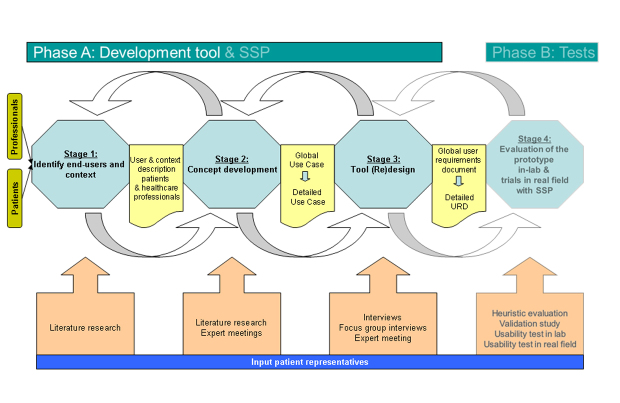
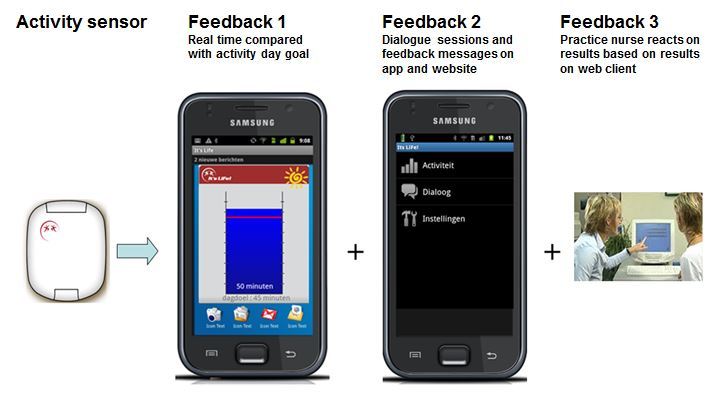
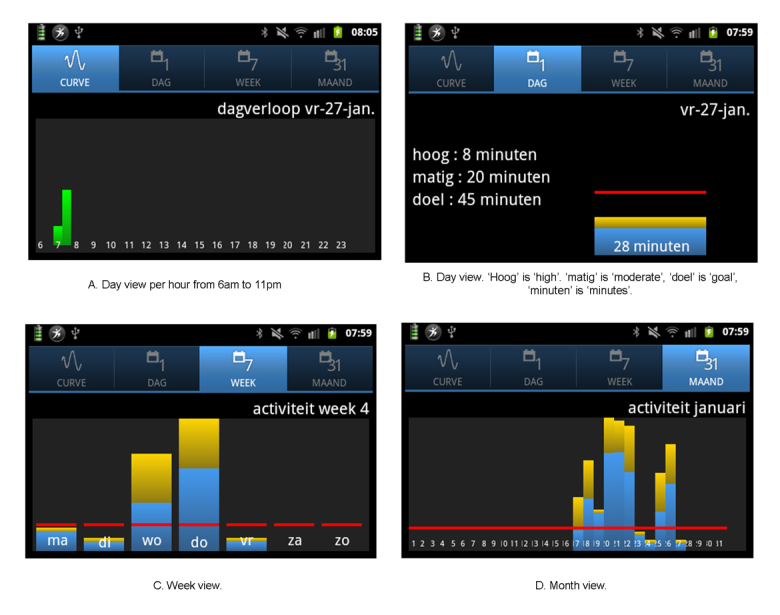
BACKGROUND: Physical activity is an important aspect in the treatment of patients with chronic obstructive pulmonary disease or type-2 diabetes. A monitoring and feedback tool combined with guidance by a primary care provider might be a successful method to enhance the level of physical activity in these patients. As a prerequisite for useful technology, it is important to involve the end-users in the design process from an early stage. OBJECTIVE: The aim of this study was to investigate the user requirements for a tool to stimulate physical activity, embedded in primary care practice. The leading principle of this tool is to change behavior by self-monitoring, goal-setting, and feedback. METHODS: The research team collected qualitative data among 15 patients, 16 care professionals, and several experts. A prototype was developed in three stages. In stage 1, the literature was searched to identify end-users and context. In stage 2, the literature, experts and patient representatives were consulted to set up a use case with the general idea of the innovation. In stage 3, individual interviews and focus groups were held to identify the end-user requirements. Based on these requirements a prototype was built by the engineering team. RESULTS: The development process has led to a tool that generally meets the requirements of the end-users. A tri-axial activity sensor, worn on the hip, is connected by Bluetooth to a smartphone. In an app, quantitative feedback is given about the amount of activity and goals reached by means of graphical visualization, and an image shows a sun when the goal is reached. Overviews about activity per half an hour, per day, week, and month are provided. In the menu of the app and on a secured website, patients can enter information in individual sessions or read feedback messages generated by the system. The practice nurse can see the results of all patients on a secure webpage and can then discuss the results and set personalized goals in consultation with the patient. CONCLUSIONS: This study demonstrates that a user-centered approach brings in valuable details (such as the requirements for feedback in activity minutes per day) to improve the fit between the user, technology, and the organization of care, which is important for the usability and acceptability of the tool. The tool embedded in primary care will be evaluated in a randomized controlled trial.
Overview
The claims and statistics of this paper haven’t been checked yet.
Run the check — free, no account needed. It reads the open-access text and checks the sources it cites.
Integrity signals
Registry
Cites
Statistics
Figures
Verification
Claims the paper makes
The claims and statistics of this paper haven’t been checked yet.
Run the check — free, no account needed. It reads the open-access text and checks the sources it cites.
Claims other papers make about this one
Each is checked against this paper’s own text: does it say what the citing paper says it does?
The source backs part of the claim, not all of it — or backs it for a different population, condition or comparison.
In the citing paper
“In this sense, digital wearable devices contribute not only by recording or prompting exercise, but also by embedding behavior regulation into everyday life and supporting the initiation, adjustment, and maintenance of exercise behaviors (14, 15).”
From Behavior change pathways by which digital wearable devices support exercise self-management in type 2 diabetes: a scoping review with machine learning–assisted text mining (2026) · cites this paper as [14]
Experimental — accuracy not yet measuredThe source backs part of the claim, not all of it — or backs it for a different population, condition or comparison.
In the citing paper
“Goal setting also seems central, as devices can translate broad recommendations into specific and feasible targets, such as daily step goals or activity thresholds (14, 17, 21).”
From Behavior change pathways by which digital wearable devices support exercise self-management in type 2 diabetes: a scoping review with machine learning–assisted text mining (2026) · cites this paper as [14]
Experimental — accuracy not yet measuredThe source backs part of the claim, not all of it — or backs it for a different population, condition or comparison.
In the citing paper
“while family involvement, peer comparison, clinician interaction, and remote feedback may broaden the social context of exercise behavior (14, 15, 19).”
From Behavior change pathways by which digital wearable devices support exercise self-management in type 2 diabetes: a scoping review with machine learning–assisted text mining (2026) · cites this paper as [14]
Experimental — accuracy not yet measuredThe source backs part of the claim, not all of it — or backs it for a different population, condition or comparison.
In the citing paper
“Over time, repeated goal attainment and visible progress may strengthen patients' sense of mastery and self-efficacy, thereby facilitating a shift from externally prompted behavior to proactive self-management (14, 17, 20, 25, 26).”
From Behavior change pathways by which digital wearable devices support exercise self-management in type 2 diabetes: a scoping review with machine learning–assisted text mining (2026) · cites this paper as [14]
Experimental — accuracy not yet measuredThe source backs part of the claim, not all of it — or backs it for a different population, condition or comparison.
In the citing paper
“Compared with traditional approaches that rely on recall or paper-based records, digital wearable devices provide continuous and objective tracking of step counts, activity duration, heart rate, and energy expenditure, thereby converting exercise behavior into visible and quantifiable information (14, 16–18).”
From Behavior change pathways by which digital wearable devices support exercise self-management in type 2 diabetes: a scoping review with machine learning–assisted text mining (2026) · cites this paper as [14]
Experimental — accuracy not yet measured
The source backs part of the claim, not all of it — or backs it for a different population, condition or comparison.
In the citing paper
“Features such as individualized goals, progress visualization, reward feedback, family involvement, peer comparison, and clinician interaction may help address these psychological needs (14, 19, 20).”
From Behavior change pathways by which digital wearable devices support exercise self-management in type 2 diabetes: a scoping review with machine learning–assisted text mining (2026) · cites this paper as [14]
Experimental — accuracy not yet measuredThe source backs part of the claim, not all of it — or backs it for a different population, condition or comparison.
In the citing paper
“Self-monitoring, real-time feedback, and goal setting align closely with Social Cognitive Theory and self-regulation perspectives, as digital wearable devices support a closed-loop process of self-observation, comparison with goals, and behavioral adjustment (14, 17, 20, 27).”
From Behavior change pathways by which digital wearable devices support exercise self-management in type 2 diabetes: a scoping review with machine learning–assisted text mining (2026) · cites this paper as [14]
Experimental — accuracy not yet measuredThe cited source says what the claim attributes to it.
In the citing paper
“Such data may strengthen patients' awareness of their behavioral status and provide a basis for behavioral adjustment (14, 17, 19, 20).”
Self-check
Percentages, sums and reported differences re-computed from the paper’s own numbers.
The self-check needs the paper’s full text.
Citations
Cites
Stages and processes of self-change of smoking: Toward an integrative model of change.
Prochaska, J. O., & DiClemente, C. C. (1983) · Journal of Consulting and Clinical Psychology · doi:10.1037/0022-006x.51.3.390 · Cited by 9,098
(2016) · Andalas University Repository (Andalas University) · Cited by 8,424
Nursing Research Generating and Assessing Evidence for Nursing Practice
Timmins, F. (2013) · Nurse Education in Practice · doi:10.1016/j.nepr.2013.04.001 · Cited by 5,510
Implementation intentions: Strong effects of simple plans.
Gollwitzer, P. M. (1999) · American Psychologist · doi:10.1037/0003-066x.54.7.493 · Cited by 5,478
Object Oriented Software Engineering: A Use Case Driven Approach
Jacobson, I. (1992) · CERN Document Server (European Organization for Nuclear Research) · Cited by 2,937
Predicting and Changing Behavior
Fishbein, M., & Ajzen, I. (2011) · doi:10.4324/9780203838020 · Cited by 2,807
A behavior model for persuasive design
Fogg, B. (2009) · Proceedings of the 4th International Conference on Persuasive Technology · doi:10.1145/1541948.1541999 · Cited by 2,328
Using Pedometers to Increase Physical Activity and Improve Health: A Systematic Review
Bravata, D. M., Smith-Spangler, C., Sundaram, V., Gienger, A. L., Lin, N., Lewis, R., Stave, C. D., Olkin, I., & Sirard, J. R. (2007) · JAMA · doi:10.1001/jama.298.19.2296 · Cited by 2,064
Object-oriented software engineering: a use case driven approach
Marshall, L. (1992) · Information and Software Technology · doi:10.1016/0950-5849(92)90126-a · Cited by 1,495
Self-regulation through goal setting
Latham, G. P., & Locke, E. A. (1991) · Organizational Behavior and Human Decision Processes · doi:10.1016/0749-5978(91)90021-k · Cited by 1,373
Sniehotta, F. F., Scholz, U., & Schwarzer, R. (2005) · Psychology & Health · doi:10.1080/08870440512331317670 · Cited by 1,350
Consolvo, S., McDonald, D. W., Toscos, T., Chen, M. Y., Froehlich, J. E., Harrison, B. L., Klasnja, P., LaMarca, A., LeGrand, L., Libby, R., et al. (2008) · CHI Conference on Human Factors in Computing Systems · doi:10.1145/1357054.1357335 · Cited by 1,133
A Holistic Framework to Improve the Uptake and Impact of eHealth Technologies
van Gemert-Pijnen, J. E., Nijland, N., van Limburg, M., Ossebaard, H. C., Kelders, S. M., Eysenbach, G., & Seydel, E. R. (2011) · Journal of Medical Internet Research · doi:10.2196/jmir.1672 · Cited by 1,126
A Review of Accelerometry-Based Wearable Motion Detectors for Physical Activity Monitoring
Yang, C.-C., & Hsu, Y.-L. (2010) · Sensors · doi:10.3390/s100807772 · Cited by 1,058
The International Prevalence Study on Physical Activity: results from 20 countries
Bauman, A. E., Bull, F., Chey, T., Craig, C. L., Ainsworth, B. E., Sallis, J. F., Bowles, H. R., Hagströmer, M., Sjöstróm, M., Pratt, M., et al. (2009) · International Journal of Behavioral Nutrition and Physical Activity · doi:10.1186/1479-5868-6-21 · Cited by 934
Abras, C. N., Maloney-Krichmar, D., & Preece, J. J. (2004) · Cited by 853
Design requirements for technologies that encourage physical activity
Consolvo, S., Everitt, K., Smith, I., & Landay, J. A. (2006) · Proceedings of the SIGCHI Conference on Human Factors in Computing Systems · doi:10.1145/1124772.1124840 · Cited by 801
Comparative Effectiveness of Weight-Loss Interventions in Clinical Practice
Appel, L. J., Clark, J. M., Yeh, H.-C., Wang, N.-Y., Coughlin, J. W., Daumit, G., Miller, E. R., Dalcin, A., Jerome, G. J., Geller, S., et al. (2011) · New England Journal of Medicine · doi:10.1056/nejmoa1108660 · Cited by 783
Marshall, S. J., & Biddle, S. (2001) · Annals of Behavioral Medicine · doi:10.1207/s15324796abm2304_2 · Cited by 691
Theory-driven design strategies for technologies that support behavior change in everyday life
Consolvo, S., McDonald, D. W., & Landay, J. A. (2009) · CHI Conference on Human Factors in Computing Systems · doi:10.1145/1518701.1518766 · Cited by 594
Worldwide Variability in Physical Inactivity
Guthold, R., Ono, T., Strong, K., Chatterji, S., & Morabia, A. (2008) · American Journal of Preventive Medicine · doi:10.1016/j.amepre.2008.02.013 · Cited by 537
Shilts, M. K., Horowitz, M., & Townsend, M. S. (2004) · American Journal of Health Promotion · doi:10.4278/0890-1171-19.2.81 · Cited by 378
Daily physical activity assessment with accelerometers: new insights and validation studies
Plasqui, G., Bonomi, A. G., & Westerterp, K. R. (2013) · Obesity Reviews · doi:10.1111/obr.12021 · Cited by 345
Stewart, A. L., Hays, R. D., Wells, K. B., Rogers, W. H., Spritzer, K. L., & Greenfield, S. (1994) · Journal of Clinical Epidemiology · doi:10.1016/0895-4356(94)90169-4 · Cited by 296
Validity of activity monitors in health and chronic disease: a systematic review
Remoortel, H. V., Giavedoni, S., Raste, Y., Burtin, C., Louvaris, Z., Gimeno‐Santos, E., Langer, D., Glendenning, G. A., Hopkinson, N. S., Vogiatzis, I., et al. (2012) · International Journal of Behavioral Nutrition and Physical Activity · doi:10.1186/1479-5868-9-84 · Cited by 286
Shah, S. G. S., Robinson, I., & AlShawi, S. (2009) · International Journal of Technology Assessment in Health Care · doi:10.1017/s0266462309990328 · Cited by 237
de Vries, H., Kremers, S., Smeets, T., Brug, J., & Eijmael, K. (2008) · American Journal of Health Promotion · doi:10.4278/ajhp.22.6.417 · Cited by 215
Tudor-Locke, C. E., & Lutes, L. D. (2009) · Sports Medicine · doi:10.2165/11319600-000000000-00000 · Cited by 208
van Achterberg, T., Waal, G. H., Ketelaar, N. A. B. M., Oostendorp, R. A. B., Jacobs, J., & Wollersheim, H. C. H. (2010) · Health Promotion International · doi:10.1093/heapro/daq050 · Cited by 202
Berkshire encyclopedia of human-computer interaction
(2005) · Choice Reviews Online · doi:10.5860/choice.42-3146 · Cited by 195
JafariNaimi, N., Forlizzi, J., Hurst, A. K., & Zimmerman, J. (2005) · CHI Conference Extended Abstracts on Human Factors in Computing Systems (CHI EA) · doi:10.1145/1056808.1057063 · Cited by 190
Langer, D., Hendriks, E., Burtin, C., Probst, V., van der Schans, C. P., Paterson, W., Wijk, M. C. E. V.-D., Straver, R., Klaassen, M. P. M., Troosters, T., et al. (2009) · Clinical Rehabilitation · doi:10.1177/0269215509103507 · Cited by 119
Effects of Computer Feedback on Adherence to Exercise
Annesi, J. J. (1998) · Perceptual and Motor Skills · doi:10.2466/pms.1998.87.2.723 · Cited by 116
Klasnja, P., Consolvo, S., McDonald, D. W., Landay, J. A., & Pratt, W. (2009) · PubMed Central · Cited by 100
van Stralen, M. M., Kok, G., de Vries, H., Mudde, A. N., Bolman, C. A. W., & Lechner, L. (2008) · BMC Public Health · doi:10.1186/1471-2458-8-399 · Cited by 93
Uptake of a technology‐assisted home‐care cardiac rehabilitation program
Varnfield, M., Karunanithi, M., Särelä, A., Garcia, E., Fairfull, A., Oldenburg, B. F., & Walters, D. (2011) · The Medical Journal of Australia · doi:10.5694/j.1326-5377.2011.tb02937.x · Cited by 76
Miller, Y. D., & Dunstan, D. W. (2004) · Journal of science and medicine in sport · doi:10.1016/s1440-2440(04)80278-0 · Cited by 72
A methodology for shifting the focus of e-health support design onto user needs
De Rouck, S., Jacobs, A., & Leys, M. (2008) · International Journal of Medical Informatics · doi:10.1016/j.ijmedinf.2007.11.004 · Cited by 70
Annegarn, J., Spruit, M. A., Uszko‐Lencer, N. H. M. K., Vanbelle, S., Savelberg, H. H. C. M., Schols, A. M. W. J., Wouters, E. F. �., & Meijer, K. (2011) · Archives of Physical Medicine and Rehabilitation · doi:10.1016/j.apmr.2011.06.021 · Cited by 69
Making pulmonary rehabilitation a success in COPD
Bourbeau, J. (2010) · Swiss Medical Weekly · doi:10.4414/smw.2010.13067 · Cited by 57
Lindberg, R. (2000) · Journal of the American Dietetic Association · doi:10.1016/s0002-8223(00)00251-0 · Cited by 53
Leemrijse, C. J., van Dijk, L., Jorstad, H. T., Peters, R. J. G., & Veenhof, C. (2012) · BMC Cardiovascular Disorders · doi:10.1186/1471-2261-12-47 · Cited by 28
Corcoran, K., Jowsey, T., & Leeder, S. (2012) · Australian Health Review · doi:10.1071/ah11092 · Cited by 23
A system for monitoring physical activity data among people with type 2 diabetes.
Årsand, E., Olsen, O. A., Varmedal, R., Mortensen, W., & Hartvigsen, G. (2008) · PubMed · Cited by 11
Evaluation of a Computer-tailored Lifestyle Modification Support Tool for Employees in Japan
FUJII, H., Nakade, M., Haruyama, Y., Fukuda, H., Hashimoto, M., IKUYAMA, T., Kaburagi, H., MURAI, E., OKUMURA, M., Sairenchi, T., et al. (2009) · Industrial Health · doi:10.2486/indhealth.47.333 · Cited by 11
Research works printed but not linked: 9
- 2010, Global Recommendations on Physical Activity for Health
- Ursum, J, 2011, Summary studies: Care for the chronically ill, the organisation of care, self-management, self-reliance and participation
- Arsand, E, 2008, Stud Health Technol Inform, 136, 113
- Varnfield, M, 2011, Med J Aust, 194, S15
- 1999, ISO 13407: Human-centered design processes for interactive systems
- 2010, Ergonomics of human-system interaction -- Part 210: Human-centred design for interactive systems
- Klasnja, P, 2009, AMIA Annu Symp Proc, 2009, 338
- JafarinaimiNForlizziJHurstAZimmermanJeditorsBreakaway: an ambient display designed to change human behavior2005CHI Conference on factors in computing systems2-7 April 2005Portland, Oregon, USANew YorkACM
- LinJMamykinaLLindtnerSDelajouxGStrubHEncouraging physical activity with an interactive computer game2006The 8th international conference on Ubiquitous Computing17-21 September 2006Orange County, California, USAHeidelbergSpringer-Verlag Berlin
Cited by
Sorted by citations
Smith, S. M., Wallace, E., O’Dowd, T., & Fortin, M. (2016) · Cochrane Database of Systematic Reviews · doi:10.1002/14651858.cd006560.pub3 · Cited by 921
Design Thinking in Health Care
Altman, M., Huang, T. T. K., & Breland, J. Y. (2018) · Preventing Chronic Disease · doi:10.5888/pcd15.180128 · Cited by 548
Behavior Change Techniques in Top-Ranked Mobile Apps for Physical Activity
Conroy, D. E., Yang, C., & Maher, J. P. (2014) · American Journal of Preventive Medicine · doi:10.1016/j.amepre.2014.01.010 · Cited by 466
Mercer, K., Giangregorio, L., Schneider, E., Chilana, P., Li, M., & Grindrod, K. (2016) · JMIR mHealth and uHealth · doi:10.2196/mhealth.4225 · Cited by 419
Harte, R., Glynn, L., Rodríguez-Molinero, A., Baker, P. M., Scharf, T., Quinlan, L. R., & ÓLaighin, G. (2017) · JMIR Human Factors · doi:10.2196/humanfactors.5443 · Cited by 399
Metadata
- Authors
- van der Weegen, S., Verwey, R., Spreeuwenberg, M., Tange, H., van der Weijden, T., & de Witte, L.
- Affiliations
- Zuyd University of Applied Sciences (NL)
- Maastricht University (NL)
- Venue
- JMIR mhealth and uhealth
- Publisher
- JMIR Publications Inc.
- Published
- 2013-07-02
- Volume
- 1
- Issue
- 2
- Pages
- e8
- ISSN
- 2291-5222 (ISSN-L)
- PMC
- PMC4114510
- OpenAlex
- W2143825555
- Cited by
- 128
- References
- 45
- Citations by year
- 2026: 3 · 2025: 4 · 2024: 5 · 2023: 4 · 2022: 8 · 2021: 14 · 2020: 12 · 2019: 19 · 2018: 14 · 2017: 10 · 2016: 13 · 2015: 10 · 2014: 10 · 2013: 2
- FWCI
- 21.13
- Type
- journal article
- Language
- en
- Open access
- gold
- doi.org
- Licence
- cc-by
- Locations
- JMIR mhealth and uhealth (publishedVersion, cc-by)
- Europe PMC (PubMed Central) (publishedVersion, cc-by)
- PubMed Central (publishedVersion, cc-by)
- PubMed (publishedVersion)
- DOAJ (DOAJ: Directory of Open Access Journals) (submittedVersion, cc-by-sa)
- Funders
- ZonMw
- Nederlandse Organisatie voor Wetenschappelijk Onderzoek
- Maastricht Universitair Medisch Centrum
- Topics
- Health Sciences › Health Professions › General Health Professions › Mobile Health and mHealth Applications
- Physical Sciences › Computer Science › Computer Vision and Pattern Recognition › Context-Aware Activity Recognition Systems
- Physical Sciences › Computer Science › Human-Computer Interaction › Innovative Human-Technology Interaction
- Keywords
- physical activity promotion, chronic disease, chronic obstructive pulmonary disease, type 2 diabetes, mobile health apps, self-monitoring, goal setting, feedback, user-centered design, user requirements, primary care, practice nurses, behavior change, wearable sensors, mobile application
About these checks
Registry, retraction, Cites and statistics results are computed, not judged, with one exception: a printed reference that no index lists is read once by a model before it counts as a citation error. Claims are extracted by a model and kept only when their quote appears verbatim in the text; each cited source is then checked, with a model’s help, for whether it says what the claim relies on. Those verdicts can be wrong — read the claim’s quote and the cited source before relying on one.
Statistics and arithmetic are recomputed, not judged.
Confidence bands are shown only for fields calibrated on our annotated test set. None is calibrated yet, so no band is shown.
What counts as a claim ›How we measure confidence ›How we check this ›
Are you an author, or do you see a problem with this page? Request a review
