

The DOI matches its Crossref record; 37 of the 37 references it cites were found in a registry or an index.
Review and Evaluation of Mindfulness-Based iPhone Apps
Open accessAbstract
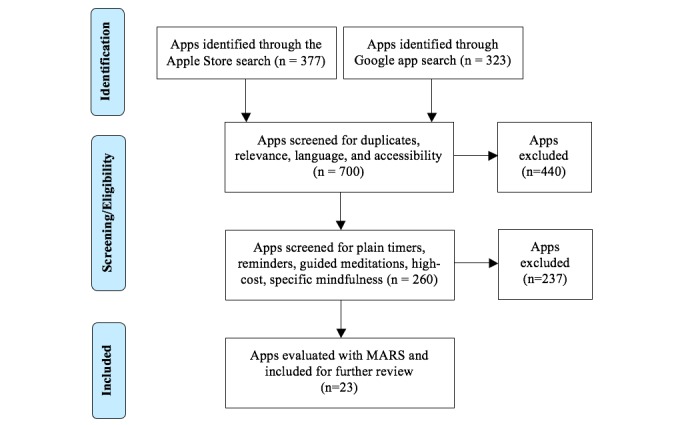
BACKGROUND: There is growing evidence for the positive impact of mindfulness on wellbeing. Mindfulness-based mobile apps may have potential as an alternative delivery medium for training. While there are hundreds of such apps, there is little information on their quality. OBJECTIVE: This study aimed to conduct a systematic review of mindfulness-based iPhone mobile apps and to evaluate their quality using a recently-developed expert rating scale, the Mobile Application Rating Scale (MARS). It also aimed to describe features of selected high-quality mindfulness apps. METHODS: A search for "mindfulness" was conducted in iTunes and Google Apps Marketplace. Apps that provided mindfulness training and education were included. Those containing only reminders, timers or guided meditation tracks were excluded. An expert rater reviewed and rated app quality using the MARS engagement, functionality, visual aesthetics, information quality and subjective quality subscales. A second rater provided MARS ratings on 30% of the apps for inter-rater reliability purposes. RESULTS: The "mindfulness" search identified 700 apps. However, 94 were duplicates, 6 were not accessible and 40 were not in English. Of the remaining 560, 23 apps met inclusion criteria and were reviewed. The median MARS score was 3.2 (out of 5.0), which exceeded the minimum acceptable score (3.0). The Headspace app had the highest average score (4.0), followed by Smiling Mind (3.7), iMindfulness (3.5) and Mindfulness Daily (3.5). There was a high level of inter-rater reliability between the two MARS raters. CONCLUSIONS: Though many apps claim to be mindfulness-related, most were guided meditation apps, timers, or reminders. Very few had high ratings on the MARS subscales of visual aesthetics, engagement, functionality or information quality. Little evidence is available on the efficacy of the apps in developing mindfulness.
Overview
The claims and statistics of this paper haven’t been checked yet.
Run the check — free, no account needed. It reads the open-access text and checks the sources it cites.
Integrity signals
Registry
Cites
Statistics
Figures
Verification
Claims the paper makes
The claims and statistics of this paper haven’t been checked yet.
Run the check — free, no account needed. It reads the open-access text and checks the sources it cites.
Claims other papers make about this one
Each is checked against this paper’s own text: does it say what the citing paper says it does?
The source backs part of the claim, not all of it — or backs it for a different population, condition or comparison.
In the citing paper
“First, at the commencement of the study it held the highest Mobile Application Rating Scale42 rating of all available mindfulness apps.26”
From Randomized, wait-list–controlled pilot study of app-delivered mindfulness for patients reporting chronic pain (2021) · cites this paper as [26]
Experimental — accuracy not yet measuredThe source backs part of the claim, not all of it — or backs it for a different population, condition or comparison.
In the citing paper
“Smartphone-based meditation interventions have almost exclusively focused on mindfulness training [30,62], although several studies have investigated internet-based interventions that include connection-related practices [63-65].”
From Testing the efficacy of a multicomponent, self-guided, smartphone-based meditation app: Three-armed randomized controlled trial (2020) · cites this paper as [62]
Experimental — accuracy not yet measured
Self-check
Percentages, sums and reported differences re-computed from the paper’s own numbers.
The self-check needs the paper’s full text.
Citations
Cites
Mindfulness-based interventions in context: Past, present, and future
Kabat-Zinn, J. (2003) · Clinical Psychology: Science and Practice · doi:10.1093/clipsy.bpg016 · Cited by 8,615
Mindfulness-based interventions in context: Past, present, and future.
Kabat-Zinn, J. (2003) · Clinical Psychology: Science and Practice · doi:10.1093/clipsy/bpg016 · Cited by 8,612
Mindfulness-based stress reduction and health benefits
Grossman, P., Niemann, L., Schmidt, S., & Walach, H. (2004) · Journal of Psychosomatic Research · doi:10.1016/s0022-3999(03)00573-7 · Cited by 3,958
Mindfulness: Theoretical Foundations and Evidence for its Salutary Effects
Brown, K. W., Ryan, R. M., & Creswell, J. D. (2007) · Psychological Inquiry · doi:10.1080/10478400701598298 · Cited by 3,654
Effects of mindfulness on psychological health: A review of empirical studies
Keng, S.-L., Smoski, M. J., & Robins, C. J. (2011) · Clinical Psychology Review · doi:10.1016/j.cpr.2011.04.006 · Cited by 2,687 · cited 1×
“Mindfulness has grown in popularity in the last two decades, and there is growing evidence for its positive impact on well-being [1,2].”
BackgroundMobile app rating scale: a new tool for assessing the quality of health mobile apps
Stoyanov, S. R., Hides, L., Kavanagh, D. J., Zelenko, O., Tjondronegoro, D., & Mani, M. (2015) · JMIR mHealth and uHealth · doi:10.2196/mhealth.3422 · Cited by 2,233
Self-citationMindfulness-based therapy: a comprehensive meta-analysis
Khoury, B., Lecomte, T., Fortin, G., Masse, M., Therien, P., Bouchard, V., Chapleau, M.-A., Paquin, K., & Hofmann, S. G. (2013) · Clinical Psychology Review · doi:10.1016/j.cpr.2013.05.005 · Cited by 2,003
Free, C., Phillips, G., Galli, L., Watson, L., Felix, L., Edwards, P., Patel, V., & Haines, A. (2013) · PLoS Medicine · doi:10.1371/journal.pmed.1001362 · Cited by 1,766 · cited 1×
“The majority of mHealth apps developed to date have focused on physical health and lifestyle domains rather than mental health [38,39].”
BackgroundMindfulness-based stress reduction and health benefits: A meta-analysis
Grossman, P., Niemann, L., Schmidt, S., & Walach, H. (2003) · Focus on Alternative and Complementary Therapies · doi:10.1111/j.2042-7166.2003.tb04008.x · Cited by 1,394
Free, C., Phillips, G., Watson, L., Galli, L., Felix, L., Edwards, P., Patel, V., & Haines, A. (2013) · PLoS Medicine · doi:10.1371/journal.pmed.1001363 · Cited by 1,187
Langer, E. J., & Moldoveanu, M. (2000) · Journal of Social Issues · doi:10.1111/0022-4537.00148 · Cited by 1,048
Design aesthetics leading to m-loyalty in mobile commerce
Cyr, D., Head, M. M., & Ivanov, A. (2006) · Information & Management · doi:10.1016/j.im.2006.08.009 · Cited by 838
(2014) · Choice Reviews Online · doi:10.5860/choice.51-3535 · Cited by 763
Mental illness and well-being: the central importance of positive psychology and recovery approaches
Slade, M. (2010) · BMC Health Services Research · doi:10.1186/1472-6963-10-26 · Cited by 754
What Do We Really Know About Mindfulness-Based Stress Reduction?
Bishop, S. R. (2002) · Psychosomatic Medicine · doi:10.1097/00006842-200201000-00010 · Cited by 748
Gunaratana, H. (1992) · Medical Entomology and Zoology · Cited by 713
(2004) · Cited by 673
Chiesa, A., & Serretti, A. (2011) · Psychiatry Research · doi:10.1016/j.psychres.2010.08.011 · Cited by 650
Clinical handbook of mindfulness
(2009) · doi:10.1007/978-0-387-09593-6 · Cited by 543
Irving, J. A., Dobkin, P. L., & Park, J. (2009) · Complementary Therapies in Clinical Practice · doi:10.1016/j.ctcp.2009.01.002 · Cited by 531
Novel Models for Delivering Mental Health Services and Reducing the Burdens of Mental Illness
Kazdin, A. E., & Rabbitt, S. M. (2013) · Clinical Psychological Science · doi:10.1177/2167702612463566 · Cited by 465 · cited 1×
“The global prevalence and burden of mental disorders is substantial, and delivering mental health services effectively to millions in need remains a challenge [11].”
BackgroundMatters of mind: Mindfulness/mindlessness in perspective
Langer, E. J. (1992) · Consciousness and Cognition · doi:10.1016/1053-8100(92)90066-j · Cited by 443 · cited 1×
“The benefits of present-centered attention and acceptance of experience that can be achieved through mindfulness include enhanced awareness, greater self-regulation, greater openness and acceptance to experiences, and the development of new perspectives on the context and content of information [4].”
BackgroundCoffey, K. A., Hartman, M., & Fredrickson, B. L. (2010) · Mindfulness · doi:10.1007/s12671-010-0033-2 · Cited by 428
Howells, A., Ivtzan, I., & Eiroa-Orosa, F. J. (2016) · Journal of Happiness Studies · doi:10.1007/s10902-014-9589-1 · Cited by 407
Everyday mindfulness and mindfulness meditation: Overlapping constructs or not?
Thompson, B. L., & Waltz, J. A. (2007) · Personality and Individual Differences · doi:10.1016/j.paid.2007.06.017 · Cited by 343
Traditional and Contemporary Mindfulness: Finding the Middle Path in the Tangle of Concerns
Monteiro, L. M., Musten, R. F., & Compson, J. (2015) · Mindfulness · doi:10.1007/s12671-014-0301-7 · Cited by 284
mHealth and Mobile Medical Apps: A Framework to Assess Risk and Promote Safer Use
Lewis, T., & Wyatt, J. C. (2014) · Journal of Medical Internet Research · doi:10.2196/jmir.3133 · Cited by 281
Boudreaux, E. D., Waring, M. E., Hayes, R. B., Sadasivam, R. S., Mullen, S. P., & Pagoto, S. (2014) · Translational Behavioral Medicine · doi:10.1007/s13142-014-0293-9 · Cited by 281
Mobile mental health: Review of the emerging field and proof of concept study
Harrison, V., Proudfoot, J., Wee, P. P., Parker, G., Pavlovic, D. H., & Manicavasagar, V. (2011) · Journal of Mental Health · doi:10.3109/09638237.2011.608746 · Cited by 267
The internet as a setting for mental health service utilisation by young people
Burns, J. M., Davenport, T. A., Durkin, L. A., Luscombe, G. M., & Hickie, I. B. (2010) · Medical Journal of Australia · doi:10.5694/j.1326-5377.2010.tb03688.x · Cited by 257 · cited 2×
“An implication of this wide acceptance of e-technologies is that they may offer a medium to improve the well-being of young people by supporting the development of mindfulness [18,19].”
BackgroundContinuous Evaluation of Evolving Behavioral Intervention Technologies
Mohr, D. C., Cheung, K., Schueller, S. M., Brown, C. H., & Duan, N. (2013) · American Journal of Preventive Medicine · doi:10.1016/j.amepre.2013.06.006 · Cited by 171
Geraghty, A. W. A., Torres, L. D., Leykin, Y., Pérez‐Stable, E. J., & Muñoz, R. F. (2012) · Health Promotion International · doi:10.1093/heapro/das029 · Cited by 136
Digital health communities: The effect of their motivation mechanisms
Ba, S., & Wang, L. (2013) · Decision Support Systems · doi:10.1016/j.dss.2013.01.003 · Cited by 124
Using e‐health applications to deliver new mental health services
Christensen, H. M., & Hickie, I. B. (2010) · The Medical Journal of Australia · doi:10.5694/j.1326-5377.2010.tb03695.x · Cited by 102
mHealth and global mental health: still waiting for the mH2 wedding?
Farrington, C., Aristidou, A., & Ruggeri, K. (2014) · Globalization and Health · doi:10.1186/1744-8603-10-17 · Cited by 52
Maghnati, F., & Ling, K. C. (2013) · International Journal of Business and Management · doi:10.5539/ijbm.v8n4p1 · Cited by 50
Olendzki, A. (2008) · Springer eBooks · doi:10.1007/978-0-387-09593-6_3 · Cited by 30
Research works printed but not linked: 2
- Burns, Jane M, 2010, Med J Aust, 192, S22
- Christensen, H, 2010, Med J Aust, 192, S53
Cited by
Sorted by citations
Hollis, C., Falconer, C. J., Martin, J. L., Whittington, C., Stockton, S., Glazebrook, C., & Davies, E. B. (2017) · Journal of Child Psychology and Psychiatry · doi:10.1111/jcpp.12663 · Cited by 846
Torous, J., Nicholas, J., Larsen, M. E., Firth, J., & Christensen, H. (2018) · Evidence Based Mental Health · doi:10.1136/eb-2018-102891 · Cited by 790
Development and validation of the user version of the Mobile application rating scale (uMARS)
Stoyanov, S. R., Hides, L., Kavanagh, D. J., & Wilson, H. (2016) · JMIR mhealth and uhealth · doi:10.2196/mhealth.5849 · Cited by 872
Firth, J., Torous, J., Nicholas, J., Carney, R., Rosenbaum, S., & Sarris, J. (2017) · Journal of Affective Disorders · doi:10.1016/j.jad.2017.04.046 · Cited by 675
Goldberg, S. B., Riordan, K. M., Sun, S., & Davidson, R. J. (2022) · Perspectives on Psychological Science · doi:10.1177/1745691620968771 · Cited by 520
“Hundreds of smartphone applications offer mindfulness-related content (Mani et al., 2015).”
Background
Metadata
- Authors
- Mani, M., Kavanagh, D. J., Hides, L., & Stoyanov, S. R.
- Affiliations
- Queensland University of Technology (AU)
- Corresponding author
- Mani, Madhavan
- Venue
- JMIR mHealth and uHealth
- Publisher
- JMIR Publications Inc.
- Published
- 2015-08-19
- Volume
- 3
- Issue
- 3
- Pages
- e82
- ISSN
- 2291-5222 (ISSN-L)
- PMC
- PMC4705029
- OpenAlex
- W1748592323
- Cited by
- 495
- References
- 36
- Citations by year
- 2026: 19 · 2025: 25 · 2024: 32 · 2023: 60 · 2022: 65 · 2021: 65 · 2020: 58 · 2019: 59 · 2018: 64 · 2017: 30 · 2016: 16 · 2015: 1
- FWCI
- 45.88
- Type
- journal article
- Language
- en
- Open access
- gold
- doi.org
- Licence
- cc-by
- Locations
- JMIR mhealth and uhealth (publishedVersion, cc-by)
- PubMed Central (publishedVersion, cc-by)
- PubMed (publishedVersion)
- QUT ePrints (Queensland University of Technology) (submittedVersion)
- DOAJ (DOAJ: Directory of Open Access Journals) (submittedVersion, cc-by-sa)
- Faculty of Health; Institute of Health and Biomedical Innovation
- Funders
- Australian Government
- Young and Well Cooperative Research Centre
- Topics
- Social Sciences › Psychology › Clinical Psychology › Mindfulness and Compassion Interventions
- Social Sciences › Psychology › Applied Psychology › Digital Mental Health Interventions
- Health Sciences › Health Professions › General Health Professions › Mobile Health and mHealth Applications
- Keywords
- mindfulness, mobile application, iOS app, app quality, Mobile App Rating Scale, expert ratings, guided meditation, headspace, inter-rater reliability, digital mental health interventions
About these checks
Registry, retraction, Cites and statistics results are computed, not judged, with one exception: a printed reference that no index lists is read once by a model before it counts as a citation error. Claims are extracted by a model and kept only when their quote appears verbatim in the text; each cited source is then checked, with a model’s help, for whether it says what the claim relies on. Those verdicts can be wrong — read the claim’s quote and the cited source before relying on one.
Statistics and arithmetic are recomputed, not judged.
Confidence bands are shown only for fields calibrated on our annotated test set. None is calibrated yet, so no band is shown.
What counts as a claim ›How we measure confidence ›How we check this ›
Are you an author, or do you see a problem with this page? Request a review
