

An Adaptive Optimizer for Measurement-Frugal Variational Algorithms
Open accessThe DOI matches its Crossref record; 68 of the 68 references it cites were found in a registry or an index.
Abstract
Variational hybrid quantum-classical algorithms (VHQCAs) have the potential to be useful in the era of near-term quantum computing. However, recently there has been concern regarding the number of measurements needed for convergence of VHQCAs. Here, we address this concern by investigating the classical optimizer in VHQCAs. We introduce a novel optimizer called individual Coupled Adaptive Number of Shots (iCANS). This adaptive optimizer frugally selects the number of measurements (i.e., number of shots) both for a given iteration and for a given partial derivative in a stochastic gradient descent. We numerically simulate the performance of iCANS for the variational quantum eigensolver and for variational quantum compiling, with and without noise. In all cases, and especially in the noisy case, iCANS tends to out-perform state-of-the-art optimizers for VHQCAs. We therefore believe this adaptive optimizer will be useful for realistic VHQCA implementations, where the number of measurements is limited.
Overview
The claims and statistics of this paper haven’t been checked yet.
Free: it reads the open-access text and checks the first 5 claims that cite a source we can check. Create a free account to check every claim.
Integrity signals
Registry
Cites
Statistics
Figures
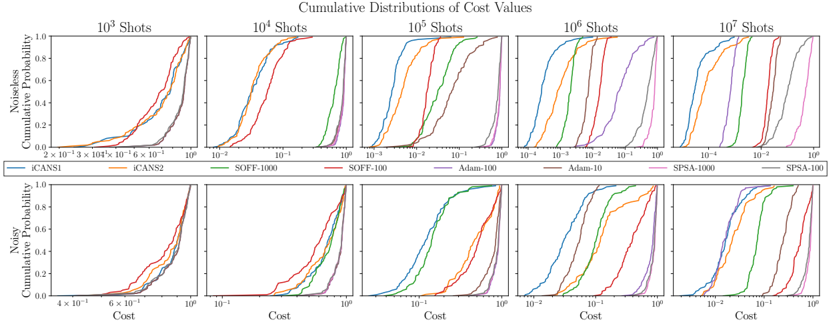
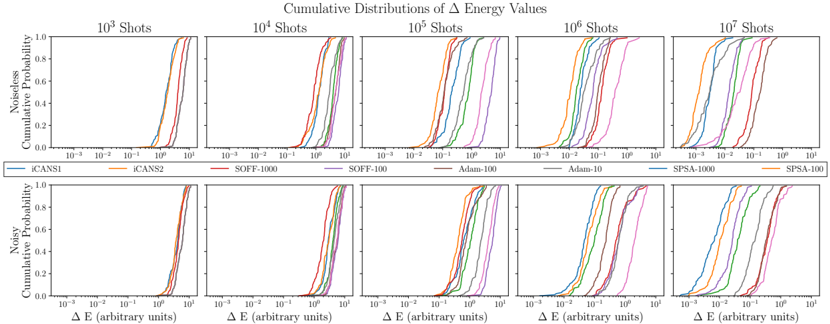
Verification
Claims the paper makes
The claims and statistics of this paper haven’t been checked yet.
Free: it reads the open-access text and checks the first 5 claims that cite a source we can check. Create a free account to check every claim.
Claims other papers make about this one
Each is checked against this paper’s own text: does it say what the citing paper says it does?
The source backs part of the claim, not all of it — or backs it for a different population, condition or comparison.
In the citing paper
“We remark that the cost function in (1) contains as special cases many relevant applications.For instance, in a binary classification problem the cost function is given by the mean squarederror C(θ) = x (y x -y(θ, ρ x )) 2 [16,17,39,40].”
From Effect of barren plateaus on gradient-free optimization (2021) · cites this paper as [40]
Experimental — accuracy not yet measuredThe check wasn’t confident either way, so it gives no verdict — never disputed.
In the citing paper
“Symmetry verification is especially useful for ansatze that preserve symmetries such as particle and spin number [11, 243, 244].”
From Variational quantum algorithms (2021) · cites this paper as [11]
Experimental — accuracy not yet measuredThe check wasn’t confident either way, so it gives no verdict — never disputed.
In the citing paper
“Indeed, GD is the default optimizer used in most quantum machine learning software frameworks [21-25].”
From Estimating the gradient and higher-order derivatives on quantum hardware (2021) · cites this paper as [22]
Experimental — accuracy not yet measuredThe check wasn’t confident either way, so it gives no verdict — never disputed.
In the citing paper
“One of the main advantages of the hardware efficient ansatz is its versatility, as it can accommodate encoding symmetries [10, 11] and bringing correlated qubits closer for depth reduction [12], as well as being especially useful to study Hamiltonians that are similar to the device's interactions [13].”
From Variational quantum algorithms (2021) · cites this paper as [11]
Experimental — accuracy not yet measured
Self-check
Percentages, sums and reported differences re-computed from the paper’s own numbers.
The self-check needs the paper’s full text.
Citations
Cites
LeCun, Y., Bengio, Y., & Hinton, G. (2015) · Nature · doi:10.1038/nature14539 · Cited by 84,126
Quantum Computing in the NISQ era and beyond
Preskill, J. (2018) · Quantum · doi:10.22331/q-2018-08-06-79 · Cited by 8,830
Powell, M. J. D. (1964) · The Computer Journal · doi:10.1093/comjnl/7.2.155 · Cited by 4,632 · cited 2×
“Now we discuss two instances of this approach: the famous Powell method [50] as well as a recently proposed method specialized to VHCQAs [33, 34].”
MethodA variational eigenvalue solver on a photonic quantum processor
Peruzzo, A., McClean, J., Shadbolt, P., Yung, M.-H., Zhou, X.-Q., Love, P. J., Aspuru-Guzik, A., & O’Brien, J. L. (2014) · Nature Communications · doi:10.1038/ncomms5213 · Cited by 4,552 · cited 8×
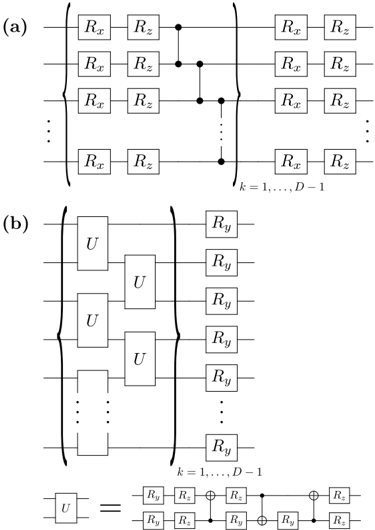
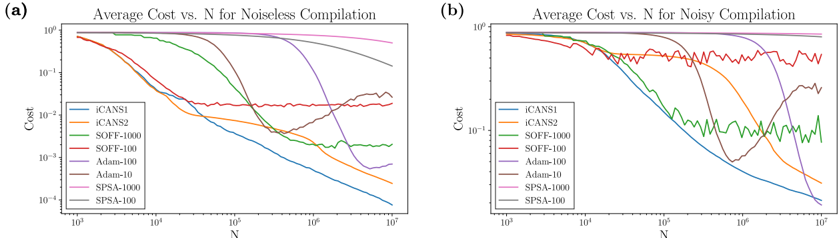
“In order to compare the performance of iCANS1 and iCANS2 to established methods, we consider two optimization tasks: variational quantum compiling with a fixed input state [14–17] and a variational quantum eigensolver (VQE) [3] for a Heisenberg spin chain.”
MethodInfluentialHardware-efficient variational quantum eigensolver for small molecules and quantum magnets
Kandala, A., Mezzacapo, A., Temme, K., Takita, M., Brink, M., Chow, J. M., & Gambetta, J. M. (2017) · Nature · doi:10.1038/nature23879 · Cited by 2,982 · cited 2×
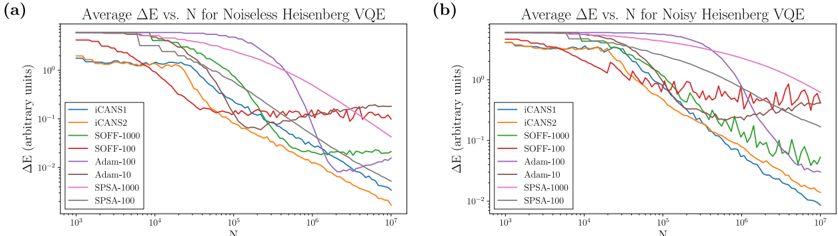
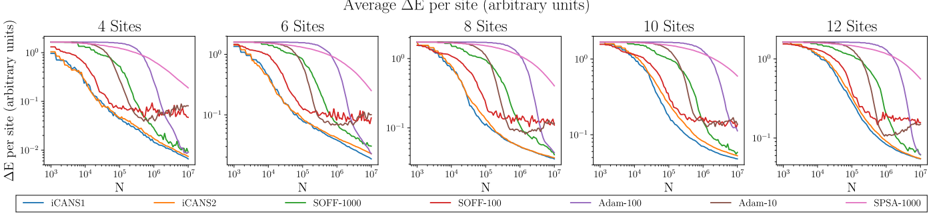
“For our second optimization task, we follow [49] in considering the Heisenberg spin chain with wrapped boundary conditions and the Hamiltonian:”
BackgroundMethodMultivariate stochastic approximation using a simultaneous perturbation gradient approximation
Spall, J. C. (1992) · IEEE Transactions on Automatic Control · doi:10.1109/9.119632 · Cited by 2,283 · cited 10×
“Using IBM’s simulator [37], we implement iCANS and other state-of-the-art optimizers such as Adam [38], SPSA [39], and sequential gate optimization [33, 34] for both the variational quantum eigensolver [3] and variational quantum compiling [14–17].”
BackgroundMethodInfluentialThe theory of variational hybrid quantum-classical algorithms
McClean, J. R., Romero, J., Babbush, R., & Aspuru-Guzik, A. (2016) · New Journal of Physics · doi:10.1088/1367-2630/18/2/023023 · Cited by 2,227
A Quantum Approximate Optimization Algorithm
Farhi, E., Goldstone, J., & Gutmann, S. (2014) · arXiv · doi:10.48550/arxiv.1411.4028 · Cited by 1,789
Mitarai, K., Negoro, M., Kitagawa, M., & Fujii, K. (2018) · Physical Review A · doi:10.1103/physreva.98.032309 · Cited by 1,639
Quantum computational chemistry
McArdle, S., Endo, S., Aspuru-Guzik, A., Benjamin, S. C., & Yuan, X. (2020) · Reviews of Modern Physics · doi:10.1103/revmodphys.92.015003 · Cited by 1,621 · cited 1×
“A concern about VHQCAs is that they might require prohibitively many quantum measurements (shots) in order to achieve convergence of the cost function [21], especially for applications like quantum chemistry that require chemical accuracy [22, 23].”
Background
Research works printed but not linked: 3
- L. Balles, J. Romero, and P. Hennig, in Pro- ceedings of the Thirty-Third Conference on Uncertainty in Artificial Intelligence (UAI) (2017) pp. 410-419.
- D. P. Kingma and J. Ba, in Proceedings of the 3rd International Conference on Learn- ing Representations (ICLR) (2015).
- J. S. Bergstra, R. Bardenet, Y. Bengio, and B. Kégl, in Advances in Neural Informa- tion Processing Systems 24 (2011) pp. 2546- 2554.
Cited by
Items 101–148 of 148
Pauli String Partitioning Algorithm with the Ising Model for Simultaneous Measurements
Kurita, T., Morita, M., Oshima, H., & Sato, S. (2023) · The Journal of Physical Chemistry A · doi:10.1021/acs.jpca.2c06453 · Cited by 18
“Some methods have been proposed to suppress an increase in the number of measurements [10-18].”
Shuffle-QUDIO: accelerate distributed VQE with trainability enhancement and measurement reduction
Qian, Y., Du, Y., & Tao, D. (2024) · Quantum Machine Intelligence · doi:10.1007/s42484-024-00167-y · Cited by 10
“…(Zhang et al. 2022), as well as reducing the required num-Fig et al. 2021; Verteletskyi et al. 2020; Zhao et al. 2020; Gokhale et al. 2019; Arrasmith et al. 2020; van Straaten and Koczor 2021; Gu et al. 2021; Kübler et al. 2020; Menickelly et al. 2022; Huang et al. 2020; Had-field et al. 2022).”
Multi-variable integration with a variational quantum circuit
Cruz-Martinez, J. M., Robbiati, M., & Carrazza, S. (2024) · Quantum Science and Technology · doi:10.1088/2058-9565/ad5866 · Cited by 24
“For example, by doing simulation of a VQC, a natural choice is to select a well known gradient-based optimizer [46–51] or some meta-heuristic algorithm like evolutionary strategies [52], simulated annealing [53], etc.”
MethodOptimizing parametrized quantum circuits via noise-induced breaking of symmetriesPreprint
Fontana, E., Cerezo, M., Arrasmith, A., Rungger, I., & Coles, P. J. (2020) · arXiv (Cornell University) · Cited by 15
Self-citationSchuld, M., & Petruccione, F. (2023) · Springer eBooks · doi:10.1007/978-1-4899-7502-7_913-2 · Cited by 10
Automated Risk Prediction by Measuring Pneumothorax Size using Deep Learning
Islam, M. S., Rehana, H., Asaduzzaman, S., Hossen, S. M., Hossain, R., Bhuiyan, T., Uddin, M. S., & Akter, N. (2020) · IEEE Region 10 Symposium (TENSYMP) · doi:10.1109/tensymp50017.2020.9230840 · Cited by 7
“Recently, the new optimizer Rectified Adam (Radam) [26] has outperformed Adam in terms of better accuracy for few epochs than standard Adam.”
MethodMeta-optimization of resources on quantum computers
Mohammad, I. A., Pivoluska, M., & Plesch, M. (2024) · Scientific Reports · doi:10.1038/s41598-024-59618-y · Cited by 10
“This is often circumvented by evaluating it in the end using classical means 18,19,22 , which is not feasible in scenarios with moderately large inputs.”
BackgroundBenchmarking Metaheuristic-Integrated QAOA Against Quantum Annealing
Mazumder, A. R., Sen, A., & Sen, U. (2024) · Lecture notes in networks and systems · doi:10.1007/978-3-031-62269-4_42 · Cited by 12
“Future research can seek to improve upon the metaheuristics through the usage of adaptive algorithms which change their parameters depending on the problem landscape [25].”
BackgroundUniversal noise-precision relations in variational quantum algorithms
Ito, K., Mizukami, W., & Fujii, K. (2023) · Physical Review Research · doi:10.1103/physrevresearch.5.023025 · Cited by 13
“Since ∑L l=1E0,l ≤ C(~θ) ≤ ∑L l=1 Emax,l holds for any parameter ~θ, we obtain [61] |DC(~θ)| ≤ ∑L l=1(Emax,l − E0,l) 2 .”
Hybrid Quantum Algorithms and Quantum Software Development FrameworksPreprint
Ramouthar, R., & Şeker, H. (2023) · doi:10.14293/pr2199.000298.v1 · Cited by 7
Bayesian Inference with Engineered Likelihood Functions for Robust Amplitude Estimation
Wang, G., Koh, D. E., Johnson, P. D., & Cao, Y. (2020) · Cited by 9
Tamiya, S., & Yamasaki, H. (2021) · arXiv (Cornell University) · Cited by 5
Computing electronic correlation energies using linear depth quantum circuits
Chee, C. H., Mak, A. M., Leykam, D., Barkoutsos, P. K., & Angelakis, D. G. (2024) · Quantum Science and Technology · doi:10.1088/2058-9565/ad1f3a · Cited by 7
“Despite recent progress in developing strategies to reduce the number of measurements [26, 33] and classical parameters [23, 55], VQA implementations for calculating molecular energy suffer from quantum noise, limiting quantum circuits to at most linear depth.”
BackgroundDistribution-adaptive dynamic shot optimization for variational quantum algorithms
Kim, Y., Jang, E., Kim, H. J., Choi, S., Lee, C., Kim, D., Kyoung, W., Shin, K., & Ro, W. W. (2025) · Physical Review Research · doi:10.1103/vwhk-22b8 · Cited by 10
Advancing quantum machine learning from conceptual design to practical use
Tera, S. P., Chinthaginjala, R., Zhao, X., & Hamdi, M. (2026) · Expert Systems with Applications · doi:10.1016/j.eswa.2026.132127 · Cited by 5
A Novel Noise-Aware Classical Optimizer for Variational Quantum Algorithms
Larson, J. M., Menickelly, M., & Shi, J. (2024) · INFORMS journal on computing · doi:10.1287/ijoc.2024.0578 · Cited by 14
Hao, T., He, Z., Shaydulin, R., Larson, J. M., & Pistoia, M. (2025) · Physical Review Research · doi:10.1103/24gg-7p8z · Cited by 34
“As a consequence of these challenges and despite the recent progress [31–41], the problem of optimizing parameterized quantum circuits with a small number of shots remains open.”
Surrogate optimization of variational quantum circuits
Gustafson, E., Tiihonen, J., Chamaki, D., Sorourifar, F., Mullinax, J. W., Li, A. C. Y., Maciejewski, F. B., Sawaya, N. P. D., Krogel, J. T., Bernal, D. E., et al. (2025) · Proceedings of the National Academy of Sciences · doi:10.1073/pnas.2408530122 · Cited by 7
Parent Hamiltonian as a benchmark problem for variational quantum eigensolvers
Kobayashi, F., Mitarai, K., & Fujii, K. (2022) · Physical Review A · doi:10.1103/physreva.105.052415 · Cited by 4
A Monte Carlo Tree Search approach to QAOA: finding a needle in the haystack
Agirre, A., van Nieuwenburg, E., & Wauters, M. M. (2025) · New Journal of Physics · doi:10.1088/1367-2630/adc765 · Cited by 9
“Furthermore, with single-shot measurements, sampling the ground state with high probability does not require perfect fidelity with the final variational state.”
Dzahini, K. J., Larson, J. M., Menickelly, M., & Wild, S. M. (2025) · IEEE International Conference on Quantum Computing and Engineering (QCE) · doi:10.1109/qce65121.2025.00013 · Cited by 5
“Some researchers have attempted to adaptively select shot counts in the computation of such noisy gradients [14], [15].”
A novel approach to reduce derivative costs in variational quantum algorithms
Minuto, G., Melegari, D., Caletti, S., & Solinas, P. (2025) · Journal of Physics A Mathematical and Theoretical · doi:10.1088/1751-8121/adcf62 · Cited by 3
Variational quantum algorithm based on Lagrange polynomial encoding to solve differential equations
Hunout, J., Laizet, S., & Iannucci, L. (2025) · Physical Review A · doi:10.1103/physreva.111.062404 · Cited by 11
“Another adaptive and SGD-based approach for VQA is to variate the number of shots required to determine the loss function gradient, that is, its precision, throughout the optimization process to significantly reduce the complexity of the optimization [42,43].”
Perspectives on Utilization of Measurements in Quantum Algorithms
Uotila, V., Salmenperä, I., Becker, L., de Griend, A. M.-V., Shinde, A. R., & Nurminen, J. K. (2025) · IEEE International Conference on Quantum Software (QSW) · doi:10.1109/qsw67625.2025.00016 · Cited by 12
A Case for Noisy Shallow Gate-based Circuits in Quantum Machine Learning
Selig, P., Murphy, N., Ashwin Sundareswaran, R., Redmond, D., & Caton, S. J. (2021) · IEEE International Conference on Rebooting Computing (ICRC) · doi:10.1109/icrc53822.2021.00015 · Cited by 5
Learning the N-Input Parity Function with a Single-Qubit and Single-Measurement Sampling
Tsili, A., Maragkopoulos, G., Mandilara, A., & Syvridis, D. (2025) · Electronics · doi:10.3390/electronics14050901 · Cited by 1
Comparative studies of optimizer performance in a variational quantum eigensolver
Lü, Q. (2025) · The Journal of Chemical Physics · doi:10.1063/5.0305677 · Cited by 1
How Many Shots Are Enough for a Quantum Circuit?
Bisicchia, G., Bocci, A., Pimentel, E., & Antonio Brogi, A. (2026) · ACM Transactions on Quantum Computing · doi:10.1145/3841468 · Cited by 1
Variational preparation of quantum many-body scars with shallow circuits
Carolan, E., Keenan, N., Cenedese, G., & Benenti, G. (2026) · Physical Review A · doi:10.1103/5l8p-42fv · Cited by 2
A Quantum Variational Approach to Debugging Combinational Logic Circuits
Demetriou, P., Haupt, C. J., & Nixon, K. J. (2021) · IEEE Computer Society Annual Symposium on VLSI · doi:10.1109/isvlsi51109.2021.00083 · Cited by 1
“Variational algorithms may require many measurements to optimize the objective function, and can, therefore, take a long time to find approximate solutions [14].”
BackgroundMethodMitigating Noise-Induced Gradient Vanishing in Variational Quantum Algorithm TrainingPreprint
Wu, A., Li, G., Ding, Y., & Xie, Y. (2021) · arXiv (Cornell University) · doi:10.48550/arxiv.2111.13209 · Cited by 8
“These techniques include parameter initialization [10], pre-training [11], layer-wise training [12], changing optimizer [13], and variational quantum circuit architecture design [14, 15, 16, 17].”
Hybrid Quantum Algorithms and Quantum Software Development FrameworksPreprint
Ramouthar, R., & Şeker, H. (2023) · AfricArXiv (OSF Preprints) · doi:10.31730/osf.io/fsw24 · Cited by 1
Scoggins, M. T., & Rahmani, A. (2021) · Physical Review Research · doi:10.1103/physrevresearch.3.043165 · Cited by 1
Variational Quantum Search with Exponential SpeedupPreprint
Zhan, J. (2022) · Research Square · doi:10.21203/rs.3.rs-2388911/v1 · Cited by 1
Compilation Optimizations to Enhance Resilience of Big Data Programs and Quantum Processors
LeCompte, T. (2022) · Louisiana State University · doi:10.31390/gradschool_dissertations.5996
Quantum optimization algorithms: Energetic implications
Enriquez, R. P. H., Badia, R. M., Chapman, B., Bresniker, K., Pakin, S., Mishra, A., Bruel, P., Dhakal, A., Rattihalli, G., Hogade, N., et al. (2024) · Concurrency and Computation Practice and Experience · doi:10.1002/cpe.8121 · Cited by 3
“31 There are several ways in which shots could be redistributed to sample the variables ⟨ h i ⟩ although not all of them will lead to an unbiased estimation of ⟨ H ⟩ and its variance.”
BackgroundShallow-Depth Quantum Circuit for Unstructured Database Search
Zhan, J. (2024) · Quantum Reports · doi:10.3390/quantum6040037
Ding, X., & Clark, B. K. (2024) · Physical Review A · doi:10.1103/physreva.110.062403
A Recursive Estimation Algorithm for Fast Variational Quantum Algorithms
Kahani, S. S., & Nobakhti, A. (2025) · Lecture notes in networks and systems · doi:10.1007/978-3-031-92602-0_1
Ikhtiarudin, A., Sunnardianto, G. K., Fathurrahman, F., Agusta, M. K., & Dipojono, H. K. (2026) · Physica Scripta · doi:10.1088/1402-4896/ae784b · Cited by 11
Quantum Convolutional Neural Networks with Residual Learning: Advancing Quantum Model Architectures
Verma, M., Arora, K., Kumar, P., Trivedi, K., Yadav, J., & Pandey, S. K. (2026) · Communications in computer and information science · doi:10.1007/978-3-032-08511-5_33 · Cited by 2
Jagannathan, S. K., Thomas Abraham, J. V., Yogesh, C., & Franklin Joel Benedict, T. (2026) · EPJ Web of Conferences · doi:10.1051/epjconf/202636001029 · Cited by 2
Sampling Noise and Optimized Measurement Distribution in Imaginary‐Time Quantum Dynamics Simulations
Zhang, F., Gomes, N., Aftergood, J., Iadecola, T., Yao, Y., & Orth, P. P. (2026) · Advanced Quantum Technologies · doi:10.1002/qute.70418
Adaptive V16: Cost-Aware Reinforcement Learning Control for Robust NISQ Variational Optimization
Sivaparvathi, K., & Prabhavathi, C. (2026) · International Conference on Knowledge Engineering and Communication Systems (ICKECS) · doi:10.1109/ickecs70176.2026.11527763
“Finally, a growing body of work explores adaptivity in the hybrid loop, including shot-frugal optimizers that dynamically allocate measurement effort to updates (e.g., iCANS) [12].”
A review of variational quantum algorithms: Insights into fault-tolerant quantum computing
Wang, Z., Huang, J., Ye, R., Li, Q., Ding, Q.-M., Huang, Y., Zhang, T., Zeng, Y., Gao, J., Yuan, X., et al. (2026) · Frontiers of Physics · doi:10.15302/frontphys.2027.023301 · Cited by 7
Local-observable-guided generative quantum circuits for degenerate ground spaces
Anonymous, Zhang, L., Zhu, Y., Yang, K., Zeng, X., & Wang, Z. (2026) · Physical Review A · doi:10.1103/yc8j-sp2z
“…existing finite-shot optimization methods, which mainly address the convergence of single-state variational objectives under limited measurements [ 32–34 ] , our results indicate that the generative framework remains effective in recovering the full ground space even with a reduced measurement…”
Quantum Attention Mechanisms: Architectures, Measurement Overhead, and Empirical Evidence
Sithamparanathan, L., & Kumar, S. (2026) · IEEE Access · doi:10.1109/access.2026.3721090
“Adaptive shot allocation [60] is one such route, discussed in Section VII-B.”
Formalising the incremental execution of static quantum circuits
Bocci, A., Bisicchia, G., Pimentel, E., & Antonio Brogi, A. (2026) · Journal of Logical and Algebraic Methods in Programming · doi:10.1016/j.jlamp.2026.101174 · Cited by 1
Metadata
- Authors
- Kübler, J. M., Arrasmith, A., Cincio, L., & Coles, P. J.
- Affiliations
- Los Alamos National Laboratory (US)
- Venue
- Quantum
- Published
- 2020-05-11
- Volume
- 4
- Pages
- 263
- ISSN
- 2521-327X (ISSN-L)
- OpenAlex
- W2974883009
- Cited by
- 141
- References
- 45
- Citations by year
- 2026: 13 · 2025: 16 · 2024: 19 · 2023: 15 · 2022: 31 · 2021: 28 · 2020: 18
- FWCI
- 9.03
- Type
- journal article
- Language
- en
- Open access
- gold
- doi.org
- Locations
- Quantum (publishedVersion, cc-by)
- arXiv (Cornell University) (submittedVersion)
- OSTI OAI (U.S. Department of Energy Office of Scientific and Technical Information) (submittedVersion, cc-by)
- DOAJ (DOAJ: Directory of Open Access Journals) (submittedVersion, cc-by-sa)
- arXiv (Cornell University) (cc-by)
- Funders
- U.S. Department of Energy (#89233218CNA000001)
- Office of Science (89233218CNA000001)
- National Nuclear Security Administration (89233218C-NA000001)
- Advanced Scientific Computing Research (89233218CNA000001)
- Laboratory Directed Research and Development (89233218CNA000001)
- Los Alamos National Laboratory (89233218CNA 000001)
- Topics
- Physical Sciences › Computer Science › Artificial Intelligence › Quantum Computing Algorithms and Architecture
- Physical Sciences › Physics and Astronomy › Atomic and Molecular Physics, and Optics › Quantum many-body systems
- Physical Sciences › Physics and Astronomy › Atomic and Molecular Physics, and Optics › Quantum Mechanics and Applications
- Keywords
- adaptive optimization algorithm, number of shots, stochastic gradient descent, variational quantum eigensolver, noisy quantum hardware, classical optimization
About these checks
Registry, retraction, Cites and statistics results are computed, not judged, with one exception: a printed reference that no index lists is read once by a model before it counts as a citation error. Claims are extracted by a model and kept only when their quote appears verbatim in the text; each cited source is then checked, with a model’s help, for whether it says what the claim relies on. Those verdicts can be wrong — read the claim’s quote and the cited source before relying on one.
Statistics and arithmetic are recomputed, not judged.
Confidence bands are shown only for fields calibrated on our annotated test set. None is calibrated yet, so no band is shown.
What counts as a claim ›How we measure confidence ›How we check this ›
Are you an author, or do you see a problem with this page? Request a review
Data sources
Bibliographic data: Semantic Scholar, OpenAlex, Crossref.
Contains information from the Semantic Scholar Academic Graph Datasets, made available under the ODC Attribution License (ODC-BY 1.0).
Semantic Scholar’s data is described in: Kinney, R., et al. (2023). The Semantic Scholar Open Data Platform. arXiv:2301.10140.
