

An Adaptive Optimizer for Measurement-Frugal Variational Algorithms
Open accessThe DOI matches its Crossref record; 68 of the 68 references it cites were found in a registry or an index.
Abstract
Variational hybrid quantum-classical algorithms (VHQCAs) have the potential to be useful in the era of near-term quantum computing. However, recently there has been concern regarding the number of measurements needed for convergence of VHQCAs. Here, we address this concern by investigating the classical optimizer in VHQCAs. We introduce a novel optimizer called individual Coupled Adaptive Number of Shots (iCANS). This adaptive optimizer frugally selects the number of measurements (i.e., number of shots) both for a given iteration and for a given partial derivative in a stochastic gradient descent. We numerically simulate the performance of iCANS for the variational quantum eigensolver and for variational quantum compiling, with and without noise. In all cases, and especially in the noisy case, iCANS tends to out-perform state-of-the-art optimizers for VHQCAs. We therefore believe this adaptive optimizer will be useful for realistic VHQCA implementations, where the number of measurements is limited.
Overview
The claims and statistics of this paper haven’t been checked yet.
Free: it reads the open-access text and checks the first 5 claims that cite a source we can check. Create a free account to check every claim.
Integrity signals
Registry
Cites
Statistics
Figures
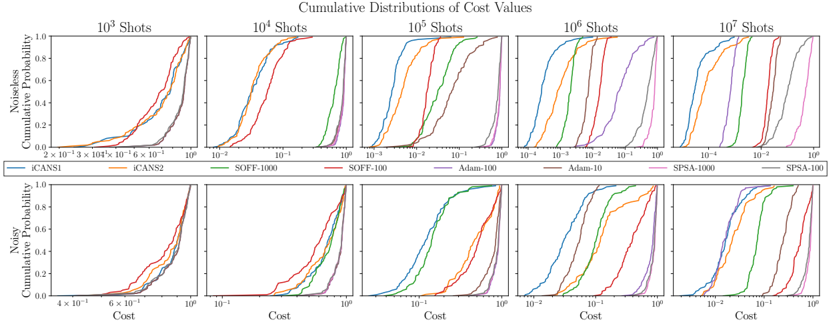
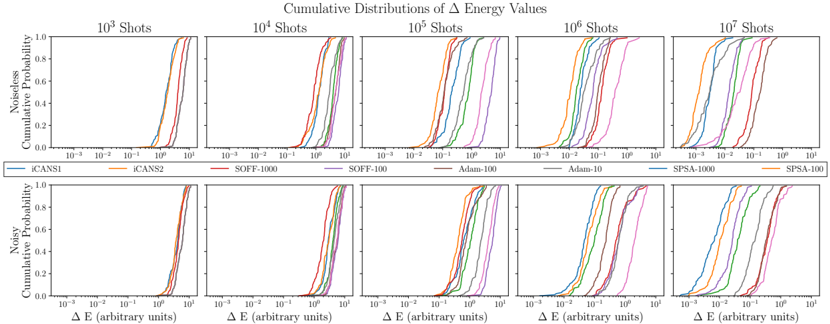
Verification
Claims the paper makes
The claims and statistics of this paper haven’t been checked yet.
Free: it reads the open-access text and checks the first 5 claims that cite a source we can check. Create a free account to check every claim.
Claims other papers make about this one
Each is checked against this paper’s own text: does it say what the citing paper says it does?
The source backs part of the claim, not all of it — or backs it for a different population, condition or comparison.
In the citing paper
“We remark that the cost function in (1) contains as special cases many relevant applications.For instance, in a binary classification problem the cost function is given by the mean squarederror C(θ) = x (y x -y(θ, ρ x )) 2 [16,17,39,40].”
From Effect of barren plateaus on gradient-free optimization (2021) · cites this paper as [40]
Experimental — accuracy not yet measuredThe check wasn’t confident either way, so it gives no verdict — never disputed.
In the citing paper
“Symmetry verification is especially useful for ansatze that preserve symmetries such as particle and spin number [11, 243, 244].”
From Variational quantum algorithms (2021) · cites this paper as [11]
Experimental — accuracy not yet measuredThe check wasn’t confident either way, so it gives no verdict — never disputed.
In the citing paper
“Indeed, GD is the default optimizer used in most quantum machine learning software frameworks [21-25].”
From Estimating the gradient and higher-order derivatives on quantum hardware (2021) · cites this paper as [22]
Experimental — accuracy not yet measuredThe check wasn’t confident either way, so it gives no verdict — never disputed.
In the citing paper
“One of the main advantages of the hardware efficient ansatz is its versatility, as it can accommodate encoding symmetries [10, 11] and bringing correlated qubits closer for depth reduction [12], as well as being especially useful to study Hamiltonians that are similar to the device's interactions [13].”
From Variational quantum algorithms (2021) · cites this paper as [11]
Experimental — accuracy not yet measured
Self-check
Percentages, sums and reported differences re-computed from the paper’s own numbers.
The self-check needs the paper’s full text.
Citations
Cites
LeCun, Y., Bengio, Y., & Hinton, G. (2015) · Nature · doi:10.1038/nature14539 · Cited by 84,126
Quantum Computing in the NISQ era and beyond
Preskill, J. (2018) · Quantum · doi:10.22331/q-2018-08-06-79 · Cited by 8,830
Powell, M. J. D. (1964) · The Computer Journal · doi:10.1093/comjnl/7.2.155 · Cited by 4,632 · cited 2×
“Now we discuss two instances of this approach: the famous Powell method [50] as well as a recently proposed method specialized to VHCQAs [33, 34].”
MethodA variational eigenvalue solver on a photonic quantum processor
Peruzzo, A., McClean, J., Shadbolt, P., Yung, M.-H., Zhou, X.-Q., Love, P. J., Aspuru-Guzik, A., & O’Brien, J. L. (2014) · Nature Communications · doi:10.1038/ncomms5213 · Cited by 4,552 · cited 8×
“In order to compare the performance of iCANS1 and iCANS2 to established methods, we consider two optimization tasks: variational quantum compiling with a fixed input state [14–17] and a variational quantum eigensolver (VQE) [3] for a Heisenberg spin chain.”
MethodInfluentialHardware-efficient variational quantum eigensolver for small molecules and quantum magnets
Kandala, A., Mezzacapo, A., Temme, K., Takita, M., Brink, M., Chow, J. M., & Gambetta, J. M. (2017) · Nature · doi:10.1038/nature23879 · Cited by 2,982 · cited 2×
“For our second optimization task, we follow [49] in considering the Heisenberg spin chain with wrapped boundary conditions and the Hamiltonian:”
BackgroundMethodMultivariate stochastic approximation using a simultaneous perturbation gradient approximation
Spall, J. C. (1992) · IEEE Transactions on Automatic Control · doi:10.1109/9.119632 · Cited by 2,283 · cited 10×
“Using IBM’s simulator [37], we implement iCANS and other state-of-the-art optimizers such as Adam [38], SPSA [39], and sequential gate optimization [33, 34] for both the variational quantum eigensolver [3] and variational quantum compiling [14–17].”
BackgroundMethodInfluentialThe theory of variational hybrid quantum-classical algorithms
McClean, J. R., Romero, J., Babbush, R., & Aspuru-Guzik, A. (2016) · New Journal of Physics · doi:10.1088/1367-2630/18/2/023023 · Cited by 2,227
A Quantum Approximate Optimization Algorithm
Farhi, E., Goldstone, J., & Gutmann, S. (2014) · arXiv · doi:10.48550/arxiv.1411.4028 · Cited by 1,789
Mitarai, K., Negoro, M., Kitagawa, M., & Fujii, K. (2018) · Physical Review A · doi:10.1103/physreva.98.032309 · Cited by 1,639
Quantum computational chemistry
McArdle, S., Endo, S., Aspuru-Guzik, A., Benjamin, S. C., & Yuan, X. (2020) · Reviews of Modern Physics · doi:10.1103/revmodphys.92.015003 · Cited by 1,621 · cited 1×
“A concern about VHQCAs is that they might require prohibitively many quantum measurements (shots) in order to achieve convergence of the cost function [21], especially for applications like quantum chemistry that require chemical accuracy [22, 23].”
BackgroundQuantum Chemistry in the Age of Quantum Computing
Cao, Y., Romero, J., Olson, J. P., Degroote, M., Johnson, P. D., Kieferová, M., Kivlichan, I. D., Menke, T., Peropadre, B., Sawaya, N. P. D., et al. (2019) · Chemical Reviews · doi:10.1021/acs.chemrev.8b00803 · Cited by 1,560 · cited 1×
“A concern about VHQCAs is that they might require prohibitively many quantum measurements (shots) in order to achieve convergence of the cost function [21], especially for applications like quantum chemistry that require chemical accuracy [22, 23].”
BackgroundQiskit: An Open-source Framework for Quantum Computing
Aleksandrowicz, G., Alexander, T., Barkoutsos, P. K., Bello, L., Ben-Haim, Y., Bucher, D., Cabrera-Hernández, F. J., Carballo-Franquis, J., Chen, A., Chen, C.-F., et al. (2019) · Zenodo (CERN European Organization for Nuclear Research) · doi:10.5281/zenodo.2562110 · Cited by 1,434
Improved SCF convergence acceleration
Pulay, P. (1982) · Journal of Computational Chemistry · doi:10.1002/jcc.540030413 · Cited by 1,323
Qiskit: An Open-source Framework for Quantum Computing
Aleksandrowicz, G., Alexander, T., Barkoutsos, P. K., et al. (2019) · Zenodo (CERN European Organization for Nuclear Research) · doi:10.5281/zenodo.2562111 · Cited by 1,314
Evaluating analytic gradients on quantum hardware
Schuld, M., Bergholm, V., Gogolin, C., Izaac, J., & Killoran, N. (2019) · Physical Review A · doi:10.1103/physreva.99.032331 · Cited by 1,072 · cited 1×
“In VHQCAs there exist similar scenarios where it is possible to analytically compute the gradients [45–47].”
BackgroundIterative Procedures for Nonlinear Integral Equations
Anderson, D. G. (1965) · Journal of the ACM · doi:10.1145/321296.321305 · Cited by 979
Implementation of the simultaneous perturbation algorithm for stochastic optimization
Spall, J. C. (1998) · IEEE Transactions on Aerospace and Electronic Systems · doi:10.1109/7.705889 · Cited by 797
PennyLane: Automatic differentiation of hybrid quantum-classical computations
Bergholm, V., Izaac, J., Schuld, M., Gogolin, C., Ahmed, S., Ajith, V., Alam, M. S., Alonso-Linaje, G., AkashNarayanan, B., Asadi, A., et al. (2018) · arXiv · doi:10.48550/arxiv.1811.04968 · Cited by 732
Progress towards practical quantum variational algorithms
Wecker, D., Hastings, M. B., & Troyer, M. (2015) · Physical Review A · doi:10.1103/physreva.92.042303 · Cited by 716 · cited 1×
“A concern about VHQCAs is that they might require prohibitively many quantum measurements (shots) in order to achieve convergence of the cost function [25], especially for applications like quantum chemistry that require chemical accuracy [26, 27].”
BackgroundEfficient Variational Quantum Simulator Incorporating Active Error Minimization
Li, Y., & Benjamin, S. C. (2017) · Physical Review X · doi:10.1103/physrevx.7.021050 · Cited by 686
On the Variance of the Adaptive Learning Rate and Beyond
Liu, L., Jiang, H., He, P., Chen, W., Liu, X., Gao, J., & Han, J. (2019) · arXiv (Cornell University) · doi:10.48550/arxiv.1908.03265 · Cited by 595
Self-verifying variational quantum simulation of lattice models
Kokail, C., Maier, C., van Bijnen, R., Brydges, T., Joshi, M. K., Jurcevic, P., Muschik, C. A., Silvi, P., Blatt, R., Roos, C. F., et al. (2019) · Nature · doi:10.1038/s41586-019-1177-4 · Cited by 594
Quantum autoencoders for efficient compression of quantum data
Romero, J., Olson, J. P., & Aspuru-Guzik, A. (2017) · Quantum Science and Technology · doi:10.1088/2058-9565/aa8072 · Cited by 559 · cited 1×
“VHQCAs have been proposed for many applications including ground-state preparation, optimization, data compression, simulation, compiling, factoring, diagonalization, and others [3–24].”
MethodVariational ansatz-based quantum simulation of imaginary time evolution
McArdle, S., Jones, T., Endo, S., Li, Y., Benjamin, S. C., & Yuan, X. (2019) · npj Quantum Information · doi:10.1038/s41534-019-0187-2 · Cited by 557
Stokes, J., Izaac, J., Killoran, N., & Carleo, G. (2020) · Quantum · doi:10.22331/q-2020-05-25-269 · Cited by 473
Theory of variational quantum simulation
Yuan, X., Endo, S., Zhao, Q., Li, Y., & Benjamin, S. C. (2019) · Quantum · doi:10.22331/q-2019-10-07-191 · Cited by 458 · cited 1×
“VHQCAs have been proposed for many applications including ground-state preparation, optimization, data compression, simulation, compiling, factoring, diagonalization, and others [3–24].”
MethodQuantum-assisted quantum compiling
Khatri, S., LaRose, R., Poremba, A., Cincio, L., Sornborger, A. T., & Coles, P. J. (2019) · Quantum · doi:10.22331/q-2019-05-13-140 · Cited by 382 · cited 2×
“In order to compare the performance of iCANS1 and iCANS2 to established methods, we consider two optimization tasks: variational quantum compiling with a fixed input state [14–16 , 18] and a for a Heisenberg spin chain.”
MethodSelf-citationVariational Quantum Linear Solver
Bravo-Prieto, C., LaRose, R., Cerezo, M., Subasi, Y., Cincio, L., & Coles, P. J. (2019) · arXiv · doi:10.48550/arxiv.1909.05820 · Cited by 284
Self-citationVariational quantum algorithms for discovering Hamiltonian spectra
Jones, T., Endo, S., McArdle, S., Yuan, X., & Benjamin, S. C. (2019) · Physical Review A · doi:10.1103/physreva.99.062304 · Cited by 256 · cited 1×
“VHQCAs have been proposed for many applications including ground-state preparation, optimization, data compression, simulation, compiling, factoring, diagonalization, and others [3–24].”
MethodVariational Quantum Simulation of General Processes
Endo, S., Sun, J., Li, Y., Benjamin, S. C., & Yuan, X. (2020) · Physical Review Letters · doi:10.1103/physrevlett.125.010501 · Cited by 237
Variational fast forwarding for quantum simulation beyond the coherence time
Cîrstoiu, C., Holmes, Z., Iosue, J., Cincio, L., Coles, P. J., & Sornborger, A. (2020) · npj Quantum Information · doi:10.1038/s41534-020-00302-0 · Cited by 232
Self-citationSequential minimal optimization for quantum-classical hybrid algorithms
Nakanishi, K. M., Fujii, K., & Todo, S. (2020) · Physical Review Research · doi:10.1103/physrevresearch.2.043158 · Cited by 221
Stochastic gradient descent for hybrid quantum-classical optimization
Sweke, R., Wilde, F., Meyer, J., Schuld, M., Faehrmann, P. K., Meynard-Piganeau, B., & Eisert, J. (2020) · Quantum · doi:10.22331/q-2020-08-31-314 · Cited by 219
Variational quantum state diagonalization
LaRose, R., Tikku, A., O’Neel-Judy, É., Cincio, L., & Coles, P. J. (2019) · npj Quantum Information · doi:10.1038/s41534-019-0167-6 · Cited by 199 · cited 1×
“However, one can apply our optimizer to VHQCAs that do not involve the measurement of Pauli operator sets (e.g., the VHQCAs in [7–9]).”
MethodSelf-citationNoise resilience of variational quantum compiling
Sharma, K., Khatri, S., Cerezo, M., & Coles, P. J. (2020) · New Journal of Physics · doi:10.1088/1367-2630/ab784c · Cited by 196 · cited 3×
“In order to compare the performance of iCANS1 and iCANS2 to established methods, we consider two optimization tasks: variational quantum compiling with a fixed input state [14–16 , 18] and a for a Heisenberg spin chain.”
BackgroundMethodSelf-citationEfficient quantum measurement of Pauli operators in the presence of finite sampling error
Crawford, O., Straaten, B. V., Wang, D., Parks, T., Campbell, E., & Brierley, S. (2021) · Quantum · doi:10.22331/q-2021-01-20-385 · Cited by 188
Yen, T.-C., Verteletskyi, V., & Izmaylov, A. F. (2020) · Journal of Chemical Theory and Computation · doi:10.1021/acs.jctc.0c00008 · Cited by 178
Izmaylov, A. F., Yen, T.-C., Lang, R. A., & Verteletskyi, V. (2020) · Journal of Chemical Theory and Computation · doi:10.1021/acs.jctc.9b00791 · Cited by 171
Variational Quantum Fidelity Estimation
Cerezo, M., Poremba, A., Cincio, L., & Coles, P. J. (2020) · Quantum · doi:10.22331/q-2020-03-26-248 · Cited by 116
Self-citation$O(N^3)$ Measurement Cost for Variational Quantum Eigensolver on Molecular Hamiltonians
Gokhale, P., Angiuli, O., Ding, Y., Gui, K., Tomesh, T., Suchara, M., Martonosi, M., & Chong, F. T. (2020) · IEEE Transactions on Quantum Engineering · doi:10.1109/tqe.2020.3035814 · Cited by 104
$O(N^3)$ Measurement Cost for Variational Quantum Eigensolver on Molecular Hamiltonians
Gokhale, P., & Chong, F. T. (2019) · arXiv · doi:10.48550/arxiv.1908.11857 · Cited by 104
Practical optimization for hybrid quantum-classical algorithms
Guerreschi, G. G., & Smelyanskiy, M. (2017) · arXiv · doi:10.48550/arxiv.1701.01450 · Cited by 99
Optimizing quantum heuristics with meta-learning
Wilson, M., Stromswold, R., Wudarski, F., Hadfield, S., Tubman, N. M., & Rieffel, E. G. (2021) · Quantum Machine Intelligence · doi:10.1007/s42484-020-00022-w · Cited by 79
Optimizing quantum heuristics with meta-learning
Wilson, M., Stromswold, S., Wudarski, F., Hadfield, S., Tubman, N. M., & Rieffel, E. (2019) · arXiv · doi:10.48550/arxiv.1908.03185 · Cited by 77
Gokhale, P., Angiuli, O., Ding, Y., Gui, K., Tomesh, T., Suchara, M., Martonosi, M., & Chong, F. T. (2019) · arXiv (Cornell University) · doi:10.48550/arxiv.1907.13623 · Cited by 76
Learning to learn with quantum neural networks via classical neural networks
Verdon, G., Broughton, M., McClean, J. R., Sung, K. J., Babbush, R., Zhang, J., Neven, H., & Mohseni, M. (2019) · arXiv (Cornell University) · doi:10.48550/arxiv.1907.05415 · Cited by 73
Variational consistent histories as a hybrid algorithm for quantum foundations
Arrasmith, A., Cincio, L., Sornborger, A. T., Zurek, W. H., & Coles, P. J. (2019) · Nature Communications · doi:10.1038/s41467-019-11417-0 · Cited by 66
Self-citationVariational quantum algorithm for nonequilibrium steady states
Yoshioka, N., Nakagawa, Y. O., Mitarai, K., & Fujii, K. (2020) · Physical Review Research · doi:10.1103/physrevresearch.2.043289 · Cited by 54
Robust quantum compilation and circuit optimisation via energy minimisation
Jones, T., & Benjamin, S. C. (2018) · arXiv · doi:10.48550/arxiv.1811.03147 · Cited by 54
QVECTOR: an algorithm for device-tailored quantum error correction
Johnson, P. D., Romero, J., Olson, J., Cao, Y., & Aspuru-Guzik, A. (2017) · arXiv · doi:10.48550/arxiv.1711.02249 · Cited by 50
Variational Quantum Gate Optimization
Heya, K., Suzuki, Y., Nakamura, Y., & Fujii, K. (2018) · arXiv · doi:10.48550/arxiv.1810.12745 · Cited by 41
Pauli Partitioning with Respect to Gate Sets
Jena, A., Genin, S. N., & Mosca, M. (2019) · arXiv (Cornell University) · doi:10.48550/arxiv.1907.07859 · Cited by 26
Parrish, R. M., Iosue, J. T., Ozaeta, A., & McMahon, P. L. (2019) · arXiv (Cornell University) · doi:10.48550/arxiv.1904.03206 · Cited by 17
Variational Fast Forwarding for Quantum Simulation Beyond the Coherence TimePreprint
Cîrstoiu, C., Holmes, Z., Iosue, J. T., Cincio, Ł., Coles, P. J., & Sornborger, A. T. (2019) · arXiv (Cornell University) · doi:10.48550/arxiv.1910.04292 · Cited by 7
Self-citationVariational Quantum Unsampling on a Programmable Nanophotonic Processor
Carolan, J., Mosheni, M., Olson, J. P., Prabhu, M., Chen, C., Bunandar, D., Harris, N. C., Wong, F. N. C., Hochberg, M., Lloyd, S., et al. (2019) · Conference on Lasers and Electro-Optics · doi:10.1364/cleo_qels.2019.fth3a.3 · Cited by 1
Harrow, A., & Napp, J. (2019) · arXiv · doi:10.48550/arxiv.1901.05374
Variational algorithms for linear algebra
Xu, X., Sun, J., Endo, S., et al. (2019) · arXiv · doi:10.48550/arxiv.1909.03898
Efficient quantum measurement of Pauli operators in the presence of finite sampling error
Crawford, O., van Straaten, B., Wang, D., et al. (2019) · arXiv · doi:10.48550/arxiv.1908.06942
Efficient and Noise Resilient Measurements for Quantum Chemistry on Near-Term Quantum Computers
Huggins, W. J., McClean, J., Rubin, N., et al. (2019) · arXiv · doi:10.48550/arxiv.1907.13117
Izmaylov, A. F., Yen, T.-C., Lang, R. A., & Verteletskyi, V. (2019) · arXiv · doi:10.48550/arxiv.1907.09040
Variational quantum simulation of general processes
Endo, S., Sun, J., Li, Y., Benjamin, S., & Yuan, X. (2018) · arXiv · doi:10.48550/arxiv.1812.08778
Sequential minimal optimization for quantum-classical hybrid algorithms
Nakanishi, K. M., Fujii, K., & Todo, S. (2019) · arXiv · doi:10.48550/arxiv.1903.12166
Stokes, J., Izaac, J., Killoran, N., & Carleo, G. (2019) · arXiv · doi:10.48550/arxiv.1909.02108
Stochastic gradient descent for hybrid quantum-classical optimization
Sweke, R., Wilde, F., Meyer, J., Schuld, M., Faehrmann, P. K., Meynard-Piganeau, B., & Eisert, J. (2019) · arXiv · doi:10.48550/arxiv.1910.01155
Yen, T.-C., Verteletskyi, V., & Izmaylov, A. F. (2019) · arXiv · doi:10.48550/arxiv.1907.09386
Quantum computational chemistry
McArdle, S., Endo, S., Aspuru-Guzik, A., Benjamin, S., & Yuan, X. (2018) · arXiv · doi:10.48550/arxiv.1808.10402
Variational Quantum Algorithm for Non-equilibrium Steady States
Yoshioka, N., Nakagawa, Y. O., Mitarai, K., & Fujii, K. (2019) · arXiv · doi:10.48550/arxiv.1908.09836
Variational Quantum Unsampling on a Quantum Photonic Processor
Carolan, J., Mohseni, M., Olson, J. P., Prabhu, M., Chen, C., Bunandar, D., Harris, N. C., Wong, F. N. C., Hochberg, M., Lloyd, S., et al. (2019) · arXiv · doi:10.48550/arxiv.1904.10463
Research works printed but not linked: 3
- L. Balles, J. Romero, and P. Hennig, in Pro- ceedings of the Thirty-Third Conference on Uncertainty in Artificial Intelligence (UAI) (2017) pp. 410-419.
- D. P. Kingma and J. Ba, in Proceedings of the 3rd International Conference on Learn- ing Representations (ICLR) (2015).
- J. S. Bergstra, R. Bardenet, Y. Bengio, and B. Kégl, in Advances in Neural Informa- tion Processing Systems 24 (2011) pp. 2546- 2554.
Cited by
Variational quantum algorithms
Cerezo, M., Arrasmith, A., Babbush, R., Benjamin, S. C., Endo, S., Fujii, K., McClean, J. R., Mitarai, K., Yuan, X., Cincio, L., et al. (2021) · Nature Reviews Physics · doi:10.1038/s42254-021-00348-9 · Cited by 3,385
“For example, it was heuristically observed that the noise-free cost achieves lower values with noise-free training than with noisy training [79, 195, 201].”
BackgroundSelf-citationNoisy intermediate-scale quantum algorithms
Bharti, K., Cervera-Lierta, A., Kyaw, T. H., Haug, T., Alperin-Lea, S., Anand, A., Degroote, M., Heimonen, H., Kottmann, J. S., Menke, T., et al. (2022) · Reviews of Modern Physics · doi:10.1103/revmodphys.94.015004 · Cited by 2,231
Cost function dependent barren plateaus in shallow parametrized quantum circuits
Cerezo, M., Sone, A., Volkoff, T., Cincio, L., & Coles, P. J. (2021) · Nature Communications · doi:10.1038/s41467-021-21728-w · Cited by 1,047
Self-citationThe Variational Quantum Eigensolver: A review of methods and best practices
Tilly, J., Chen, H., Cao, S., Picozzi, D., Setia, K., Li, Y., Grant, E., Wossnig, L., Rungger, I., Booth, G. H., et al. (2022) · Physics Reports · doi:10.1016/j.physrep.2022.08.003 · Cited by 1,031
Noise-Induced Barren Plateaus in Variational Quantum Algorithms
Wang, S., Fontana, E., Cerezo, M., Sharma, K., Sone, A., Cincio, L., & Coles, P. J. (2020) · arXiv · doi:10.48550/arxiv.2007.14384 · Cited by 791
Self-citation
Metadata
- Authors
- Kübler, J. M., Arrasmith, A., Cincio, L., & Coles, P. J.
- Affiliations
- Los Alamos National Laboratory (US)
- Venue
- Quantum
- Published
- 2020-05-11
- Volume
- 4
- Pages
- 263
- ISSN
- 2521-327X (ISSN-L)
- OpenAlex
- W2974883009
- Cited by
- 141
- References
- 45
- Citations by year
- 2026: 13 · 2025: 16 · 2024: 19 · 2023: 15 · 2022: 31 · 2021: 28 · 2020: 18
- FWCI
- 9.03
- Type
- journal article
- Language
- en
- Open access
- gold
- doi.org
- Locations
- Quantum (publishedVersion, cc-by)
- arXiv (Cornell University) (submittedVersion)
- OSTI OAI (U.S. Department of Energy Office of Scientific and Technical Information) (submittedVersion, cc-by)
- DOAJ (DOAJ: Directory of Open Access Journals) (submittedVersion, cc-by-sa)
- arXiv (Cornell University) (cc-by)
- Funders
- U.S. Department of Energy (#89233218CNA000001)
- Office of Science (89233218CNA000001)
- National Nuclear Security Administration (89233218C-NA000001)
- Advanced Scientific Computing Research (89233218CNA000001)
- Laboratory Directed Research and Development (89233218CNA000001)
- Los Alamos National Laboratory (89233218CNA 000001)
- Topics
- Physical Sciences › Computer Science › Artificial Intelligence › Quantum Computing Algorithms and Architecture
- Physical Sciences › Physics and Astronomy › Atomic and Molecular Physics, and Optics › Quantum many-body systems
- Physical Sciences › Physics and Astronomy › Atomic and Molecular Physics, and Optics › Quantum Mechanics and Applications
- Keywords
- adaptive optimization algorithm, number of shots, stochastic gradient descent, variational quantum eigensolver, noisy quantum hardware, classical optimization
About these checks
Registry, retraction, Cites and statistics results are computed, not judged, with one exception: a printed reference that no index lists is read once by a model before it counts as a citation error. Claims are extracted by a model and kept only when their quote appears verbatim in the text; each cited source is then checked, with a model’s help, for whether it says what the claim relies on. Those verdicts can be wrong — read the claim’s quote and the cited source before relying on one.
Statistics and arithmetic are recomputed, not judged.
Confidence bands are shown only for fields calibrated on our annotated test set. None is calibrated yet, so no band is shown.
What counts as a claim ›How we measure confidence ›How we check this ›
Are you an author, or do you see a problem with this page? Request a review
Data sources
Bibliographic data: Semantic Scholar, OpenAlex, Crossref.
Contains information from the Semantic Scholar Academic Graph Datasets, made available under the ODC Attribution License (ODC-BY 1.0).
Semantic Scholar’s data is described in: Kinney, R., et al. (2023). The Semantic Scholar Open Data Platform. arXiv:2301.10140.
