

An Adaptive Optimizer for Measurement-Frugal Variational Algorithms
Open accessThe DOI matches its Crossref record; 68 of the 68 references it cites were found in a registry or an index.
Abstract
Variational hybrid quantum-classical algorithms (VHQCAs) have the potential to be useful in the era of near-term quantum computing. However, recently there has been concern regarding the number of measurements needed for convergence of VHQCAs. Here, we address this concern by investigating the classical optimizer in VHQCAs. We introduce a novel optimizer called individual Coupled Adaptive Number of Shots (iCANS). This adaptive optimizer frugally selects the number of measurements (i.e., number of shots) both for a given iteration and for a given partial derivative in a stochastic gradient descent. We numerically simulate the performance of iCANS for the variational quantum eigensolver and for variational quantum compiling, with and without noise. In all cases, and especially in the noisy case, iCANS tends to out-perform state-of-the-art optimizers for VHQCAs. We therefore believe this adaptive optimizer will be useful for realistic VHQCA implementations, where the number of measurements is limited.
Overview
The claims and statistics of this paper haven’t been checked yet.
Free: it reads the open-access text and checks the first 5 claims that cite a source we can check. Create a free account to check every claim.
Integrity signals
Registry
Cites
Statistics
Figures
Verification
Claims the paper makes
The claims and statistics of this paper haven’t been checked yet.
Free: it reads the open-access text and checks the first 5 claims that cite a source we can check. Create a free account to check every claim.
Claims other papers make about this one
Each is checked against this paper’s own text: does it say what the citing paper says it does?
The source backs part of the claim, not all of it — or backs it for a different population, condition or comparison.
In the citing paper
“We remark that the cost function in (1) contains as special cases many relevant applications.For instance, in a binary classification problem the cost function is given by the mean squarederror C(θ) = x (y x -y(θ, ρ x )) 2 [16,17,39,40].”
From Effect of barren plateaus on gradient-free optimization (2021) · cites this paper as [40]
Experimental — accuracy not yet measuredThe check wasn’t confident either way, so it gives no verdict — never disputed.
In the citing paper
“Symmetry verification is especially useful for ansatze that preserve symmetries such as particle and spin number [11, 243, 244].”
From Variational quantum algorithms (2021) · cites this paper as [11]
Experimental — accuracy not yet measuredThe check wasn’t confident either way, so it gives no verdict — never disputed.
In the citing paper
“Indeed, GD is the default optimizer used in most quantum machine learning software frameworks [21-25].”
From Estimating the gradient and higher-order derivatives on quantum hardware (2021) · cites this paper as [22]
Experimental — accuracy not yet measuredThe check wasn’t confident either way, so it gives no verdict — never disputed.
In the citing paper
“One of the main advantages of the hardware efficient ansatz is its versatility, as it can accommodate encoding symmetries [10, 11] and bringing correlated qubits closer for depth reduction [12], as well as being especially useful to study Hamiltonians that are similar to the device's interactions [13].”
From Variational quantum algorithms (2021) · cites this paper as [11]
Experimental — accuracy not yet measured
Self-check
Percentages, sums and reported differences re-computed from the paper’s own numbers.
The self-check needs the paper’s full text.
Citations
Cites
LeCun, Y., Bengio, Y., & Hinton, G. (2015) · Nature · doi:10.1038/nature14539 · Cited by 84,126
Quantum Computing in the NISQ era and beyond
Preskill, J. (2018) · Quantum · doi:10.22331/q-2018-08-06-79 · Cited by 8,830
Powell, M. J. D. (1964) · The Computer Journal · doi:10.1093/comjnl/7.2.155 · Cited by 4,632 · cited 2×
“Now we discuss two instances of this approach: the famous Powell method [50] as well as a recently proposed method specialized to VHCQAs [33, 34].”
MethodA variational eigenvalue solver on a photonic quantum processor
Peruzzo, A., McClean, J., Shadbolt, P., Yung, M.-H., Zhou, X.-Q., Love, P. J., Aspuru-Guzik, A., & O’Brien, J. L. (2014) · Nature Communications · doi:10.1038/ncomms5213 · Cited by 4,552 · cited 8×
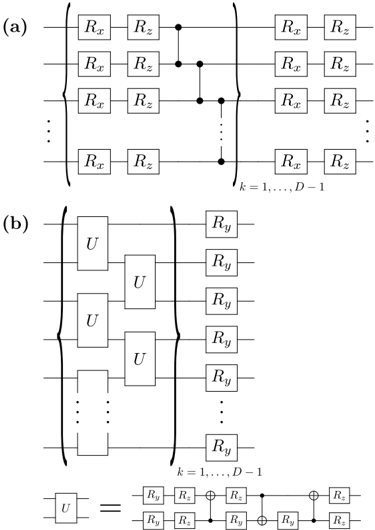
“In order to compare the performance of iCANS1 and iCANS2 to established methods, we consider two optimization tasks: variational quantum compiling with a fixed input state [14–17] and a variational quantum eigensolver (VQE) [3] for a Heisenberg spin chain.”
MethodInfluentialHardware-efficient variational quantum eigensolver for small molecules and quantum magnets
Kandala, A., Mezzacapo, A., Temme, K., Takita, M., Brink, M., Chow, J. M., & Gambetta, J. M. (2017) · Nature · doi:10.1038/nature23879 · Cited by 2,982 · cited 2×
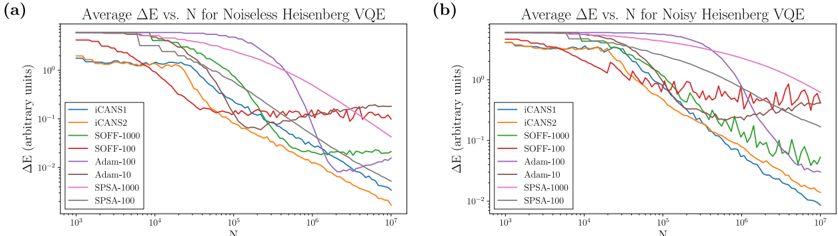
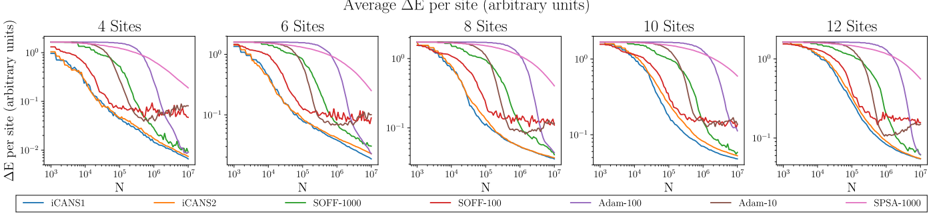
“For our second optimization task, we follow [49] in considering the Heisenberg spin chain with wrapped boundary conditions and the Hamiltonian:”
BackgroundMethodMultivariate stochastic approximation using a simultaneous perturbation gradient approximation
Spall, J. C. (1992) · IEEE Transactions on Automatic Control · doi:10.1109/9.119632 · Cited by 2,283 · cited 10×
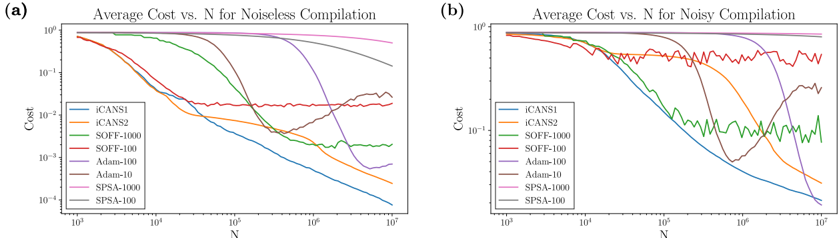
“Using IBM’s simulator [37], we implement iCANS and other state-of-the-art optimizers such as Adam [38], SPSA [39], and sequential gate optimization [33, 34] for both the variational quantum eigensolver [3] and variational quantum compiling [14–17].”
BackgroundMethodInfluentialThe theory of variational hybrid quantum-classical algorithms
McClean, J. R., Romero, J., Babbush, R., & Aspuru-Guzik, A. (2016) · New Journal of Physics · doi:10.1088/1367-2630/18/2/023023 · Cited by 2,227
A Quantum Approximate Optimization Algorithm
Farhi, E., Goldstone, J., & Gutmann, S. (2014) · arXiv · doi:10.48550/arxiv.1411.4028 · Cited by 1,789
Mitarai, K., Negoro, M., Kitagawa, M., & Fujii, K. (2018) · Physical Review A · doi:10.1103/physreva.98.032309 · Cited by 1,639
Quantum computational chemistry
McArdle, S., Endo, S., Aspuru-Guzik, A., Benjamin, S. C., & Yuan, X. (2020) · Reviews of Modern Physics · doi:10.1103/revmodphys.92.015003 · Cited by 1,621 · cited 1×
“A concern about VHQCAs is that they might require prohibitively many quantum measurements (shots) in order to achieve convergence of the cost function [21], especially for applications like quantum chemistry that require chemical accuracy [22, 23].”
Background
Research works printed but not linked: 3
- L. Balles, J. Romero, and P. Hennig, in Pro- ceedings of the Thirty-Third Conference on Uncertainty in Artificial Intelligence (UAI) (2017) pp. 410-419.
- D. P. Kingma and J. Ba, in Proceedings of the 3rd International Conference on Learn- ing Representations (ICLR) (2015).
- J. S. Bergstra, R. Bardenet, Y. Bengio, and B. Kégl, in Advances in Neural Informa- tion Processing Systems 24 (2011) pp. 2546- 2554.
Cited by
Variational quantum algorithms
Cerezo, M., Arrasmith, A., Babbush, R., Benjamin, S. C., Endo, S., Fujii, K., McClean, J. R., Mitarai, K., Yuan, X., Cincio, L., et al. (2021) · Nature Reviews Physics · doi:10.1038/s42254-021-00348-9 · Cited by 3,385
“For example, it was heuristically observed that the noise-free cost achieves lower values with noise-free training than with noisy training [79, 195, 201].”
BackgroundSelf-citationNoisy intermediate-scale quantum algorithms
Bharti, K., Cervera-Lierta, A., Kyaw, T. H., Haug, T., Alperin-Lea, S., Anand, A., Degroote, M., Heimonen, H., Kottmann, J. S., Menke, T., et al. (2022) · Reviews of Modern Physics · doi:10.1103/revmodphys.94.015004 · Cited by 2,231
Cost function dependent barren plateaus in shallow parametrized quantum circuits
Cerezo, M., Sone, A., Volkoff, T., Cincio, L., & Coles, P. J. (2021) · Nature Communications · doi:10.1038/s41467-021-21728-w · Cited by 1,047
Self-citationThe Variational Quantum Eigensolver: A review of methods and best practices
Tilly, J., Chen, H., Cao, S., Picozzi, D., Setia, K., Li, Y., Grant, E., Wossnig, L., Rungger, I., Booth, G. H., et al. (2022) · Physics Reports · doi:10.1016/j.physrep.2022.08.003 · Cited by 1,031
Noise-Induced Barren Plateaus in Variational Quantum Algorithms
Wang, S., Fontana, E., Cerezo, M., Sharma, K., Sone, A., Cincio, L., & Coles, P. J. (2020) · arXiv · doi:10.48550/arxiv.2007.14384 · Cited by 791
Self-citationNoise-induced barren plateaus in variational quantum algorithms
Wang, S., Fontana, E., Cerezo, M., Sharma, K., Sone, A., Cincio, L., & Coles, P. J. (2021) · Nature Communications · doi:10.1038/s41467-021-27045-6 · Cited by 773
Self-citationChallenges and opportunities in quantum machine learning
Cerezo, M., Verdon, G., Huang, H.-Y., Cincio, L., & Coles, P. J. (2022) · Nature Computational Science · doi:10.1038/s43588-022-00311-3 · Cited by 689
“For example, shot-frugal optimizers [51–54] can employ stochastic gradient descent while adapting the number of shots (or measurements) needed at each iteration, so as not to waste too many shots during the optimization.”
BackgroundSelf-citationGeneralization in quantum machine learning from few training data
Caro, M. C., Huang, H.-Y., Cerezo, M., Sharma, K., Sornborger, A., Cincio, L., & Coles, P. J. (2022) · Nature Communications · doi:10.1038/s41467-022-32550-3 · Cited by 476
Self-citationVariational Quantum Linear Solver
Bravo-Prieto, C., LaRose, R., Cerezo, M., Subasi, Y., Cincio, L., & Coles, P. J. (2019) · arXiv · doi:10.48550/arxiv.1909.05820 · Cited by 284
Self-citationVariational Quantum Linear Solver
Bravo-Prieto, C., LaRose, R., Cerezo, M., Subasi, Y., Cincio, L., & Coles, P. J. (2023) · Quantum · doi:10.22331/q-2023-11-22-1188 · Cited by 260
“In addition, there has been an increasing interest in gradient-based methods for VHQCAs [54–56] as it has been shown that the first-order gradient information can be directly measured [57, 58] and can lead to faster rates of convergences to the optimum [59].”
Self-citationEffect of barren plateaus on gradient-free optimization
Arrasmith, A., Cerezo, M., Czarnik, P., Cincio, L., & Coles, P. J. (2021) · Quantum · doi:10.22331/q-2021-10-05-558 · Cited by 248
Self-citationVariational fast forwarding for quantum simulation beyond the coherence time
Cîrstoiu, C., Holmes, Z., Iosue, J., Cincio, L., Coles, P. J., & Sornborger, A. (2020) · npj Quantum Information · doi:10.1038/s41534-020-00302-0 · Cited by 232
Self-citationStochastic gradient descent for hybrid quantum-classical optimization
Sweke, R., Wilde, F., Meyer, J., Schuld, M., Faehrmann, P. K., Meynard-Piganeau, B., & Eisert, J. (2020) · Quantum · doi:10.22331/q-2020-08-31-314 · Cited by 219
Diagnosing Barren Plateaus with Tools from Quantum Optimal Control
Larocca, M., Czarnik, P., Sharma, K., Muraleedharan, G., Coles, P. J., & Cerezo, M. (2022) · Quantum · doi:10.22331/q-2022-09-29-824 · Cited by 214
“[34] Jonas M Kübler, Andrew Arrasmith, Lukasz Cincio, and Patrick J Coles.”
BackgroundSelf-citationIs Quantum Advantage the Right Goal for Quantum Machine Learning?
Schuld, M., & Killoran, N. (2022) · PRX Quantum · doi:10.1103/prxquantum.3.030101 · Cited by 207
Noise resilience of variational quantum compiling
Sharma, K., Khatri, S., Cerezo, M., & Coles, P. J. (2020) · New Journal of Physics · doi:10.1088/1367-2630/ab784c · Cited by 196
Self-citationStochastic gradient descent for hybrid quantum-classical optimization
Sweke, R., Sweke, R., Meyer, J. J., Meyer, J. J., Faehrmann, P. K., Meynard-Piganeau, B., & Eisert, J. (2020) · Refubium (Universitätsbibliothek der Freien Universität Berlin) · doi:10.17169/refubium-28427 · Cited by 194
Efficient quantum measurement of Pauli operators in the presence of finite sampling error
Crawford, O., Straaten, B. V., Wang, D., Parks, T., Campbell, E., & Brierley, S. (2021) · Quantum · doi:10.22331/q-2021-01-20-385 · Cited by 188
“There have also been interesting developments [47, 48] on measurement reduction in VQE focusing on designing classical optimisers that intelligently choose how many measurements to use at each iteration – for example, fewer measurements may be used near the start versus near the end.”
BackgroundSolving nonlinear differential equations with differentiable quantum circuits
Kyriienko, O., Paine, A. E., & Elfving, V. E. (2021) · Physical Review A · doi:10.1103/physreva.103.052416 · Cited by 185
Solving nonlinear differential equations with differentiable quantum circuits
Kyriienko, O., Paine, A. E., & Elfving, V. E. (2020) · arXiv · doi:10.48550/arxiv.2011.10395 · Cited by 185
Strategies for solving the Fermi-Hubbard model on near-term quantum computers
Cade, C., Mineh, L., Montanaro, A., & Stanisic, S. (2020) · Physical Review B · doi:10.1103/physrevb.102.235122 · Cited by 178
“It is plausible that the optimisers used here could be combined or modified to improve their performance, and other methods that have been studied contemporaneously with this work include adaptive optimisation algorithms [60] and techniques based on machine learning or “meta-learning” [20, 41].”
MethodEmerging quantum computing algorithms for quantum chemistry
Motta, M., & Rice, J. E. (2022) · WIREs Computational Molecular Science · doi:10.1002/wcms.1580 · Cited by 173
Trainability of Dissipative Perceptron-Based Quantum Neural Networks
Sharma, K., Cerezo, M., Cincio, L., & Coles, P. J. (2022) · Physical Review Letters · doi:10.1103/physrevlett.128.180505 · Cited by 159
Self-citationNoise resilience of variational quantum compiling
Sharma, K., Khatri, S., Cerezo, M., & Coles, P. J. (2020) · Civil War Book Review · Cited by 184
Self-citationEstimating the gradient and higher-order derivatives on quantum hardware
Mari, A., Bromley, T. R., & Killoran, N. (2021) · Physical Review A · doi:10.1103/physreva.103.012405 · Cited by 159
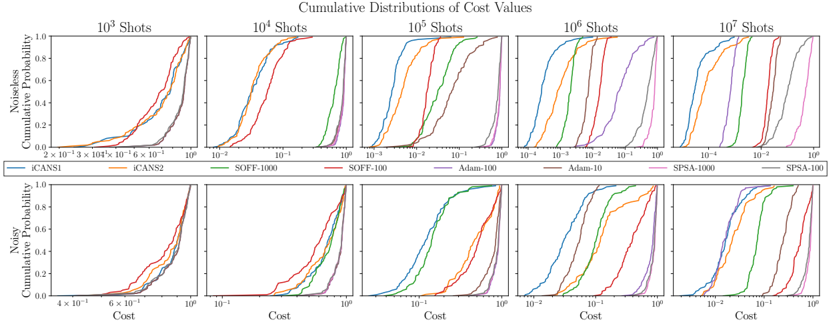
“This suggests that an adaptive shot number N may be useful in practice with a low shot number initially and an increase in N as the optimizer approaches a minimum, as has been discussed in recent works [33–35].”
ResultFermionic Partial Tomography via Classical Shadows
Zhao, A., Rubin, N. C., & Miyake, A. (2021) · Physical Review Letters · doi:10.1103/physrevlett.127.110504 · Cited by 144
“[39–43].”
Large gradients via correlation in random parameterized quantum circuits
Volkoff, T., & Coles, P. J. (2021) · Quantum Science and Technology · doi:10.1088/2058-9565/abd891 · Cited by 143
Self-citationVariational quantum state eigensolver
Cerezo, M., Sharma, K., Arrasmith, A., & Coles, P. J. (2022) · npj Quantum Information · doi:10.1038/s41534-022-00611-6 · Cited by 136
Self-citationEquivalence of quantum barren plateaus to cost concentration and narrow gorges
Arrasmith, A., Holmes, Z., Cerezo, M., & Coles, P. J. (2022) · Quantum Science and Technology · doi:10.1088/2058-9565/ac7d06 · Cited by 137
“[21] Jonas M Kübler, Andrew Arrasmith, Lukasz Cincio, and Patrick J Coles, “An adaptive optimizer for measurement-frugal variational algorithms,” Quantum 4, 263 (2020).”
Self-citationHarrow, A. W., & Napp, J. C. (2021) · Physical Review Letters · doi:10.1103/physrevlett.126.140502 · Cited by 121
Classical Optimizers for Noisy Intermediate-Scale Quantum Devices
Lavrijsen, W., Tudor, A., Muller, J., Iancu, C., & de Jong, W. (2020) · 2020 IEEE International Conference on Quantum Computing and Engineering (QCE) · doi:10.1109/qce49297.2020.00041 · Cited by 97
“Evaluation of, and comparison with, gradient-based and gradient-approximating methods [19][8] is worthy of a study of its own.”
ResultClassical Optimizers for Noisy Intermediate-Scale Quantum Devices
Lavrijsen, W., Tudor, A., Müller, J., Iancu, C., & de Jong, W. (2020) · arXiv · doi:10.48550/arxiv.2004.03004 · Cited by 103
“Evaluation of, and comparison with, gradient-based and gradient-approximating methods [19][8] is worthy of a study of its own.”
ResultVariational-state quantum metrology
Koczor, B., Endo, S., Jones, T., Matsuzaki, Y., & Benjamin, S. C. (2020) · New Journal of Physics · doi:10.1088/1367-2630/ab965e · Cited by 101
“[58]) was recently proven to converge when assuming only a finite number of measurements for determining the gradient vector [59, 60].”
BackgroundScaling of the quantum approximate optimization algorithm on superconducting qubit based hardware
Weidenfeller, J., Valor, L. C., Gacon, J., Tornow, C., Bello, L., Woerner, S., & Egger, D. J. (2022) · Quantum · doi:10.22331/q-2022-12-07-870 · Cited by 98
“Recently, optimizers that scale the number of shots based on the magnitude of the gradient have been developed to reduce the shot cost [70].”
BackgroundSimultaneous Perturbation Stochastic Approximation of the Quantum Fisher Information
Gacon, J., Zoufal, C., Carleo, G., & Woerner, S. (2021) · Quantum · doi:10.22331/q-2021-10-20-567 · Cited by 94
Universal discriminative quantum neural networks
Chen, H., Wossnig, L., Severini, S., Neven, H., & Mohseni, M. (2021) · Quantum Machine Intelligence · doi:10.1007/s42484-020-00025-7 · Cited by 89
Universal discriminative quantum neural networks
Chen, H., Wossnig, L., Severini, S., Neven, H., & Mohseni, M. (2018) · arXiv · doi:10.48550/arxiv.1805.08654 · Cited by 89
Biology and medicine in the landscape of quantum advantages
Cordier, B. A., Sawaya, N. P. D., Guerreschi, G. G., & McWeeney, S. K. (2022) · Journal of The Royal Society Interface · doi:10.1098/rsif.2022.0541 · Cited by 87
Analyzing the barren plateau phenomenon in training quantum neural networks with the ZX-calculus
Zhao, C., & Gao, X.-S. (2021) · Quantum · doi:10.22331/q-2021-06-04-466 · Cited by 130
“Some of these are gradient-based [14–16] and some are not [17, 18].”
BackgroundGujju, Y., Matsuo, A., & Raymond, R. (2024) · Physical Review Applied · doi:10.1103/physrevapplied.21.067001 · Cited by 138
Using models to improve optimizers for variational quantum algorithms
Sung, K. J., Yao, J., Harrigan, M. P., Rubin, N. C., Jiang, Z., Lin, L., Babbush, R., & McClean, J. R. (2020) · Quantum Science and Technology · doi:10.1088/2058-9565/abb6d9 · Cited by 66
“While some past works do account for the effect of stochastic noise [20, 21, 25, 26], in this work we additionally incorporate other experimental parameters into our cost models.”
MethodMinimizing Estimation Runtime on Noisy Quantum Computers
Wang, G., Koh, D. E., Johnson, P. D., & Cao, Y. (2021) · PRX Quantum · doi:10.1103/prxquantum.2.010346 · Cited by 77
“[42] Jonas M Kübler, Andrew Arrasmith, Lukasz Cincio, and Patrick J Coles.”
BackgroundTkachenko, N. V., Sud, J., Zhang, Y., Tretiak, S., Anisimov, P. M., Arrasmith, A. T., Coles, P. J., Cincio, L., & Dub, P. A. (2021) · PRX Quantum · doi:10.1103/prxquantum.2.020337 · Cited by 73
Self-citationCan Error Mitigation Improve Trainability of Noisy Variational Quantum Algorithms?
Wang, S., Czarnik, P., Arrasmith, A., Cerezo, M., Cincio, Ł., & Coles, P. J. (2024) · Quantum · doi:10.22331/q-2024-03-14-1287 · Cited by 133
“This has led to the development of several quantum-aware optimizers that are frugal in the number of shots [62–64].”
BackgroundSelf-citationAdaptive pruning-based optimization of parameterized quantum circuits
Sim, S., Romero, J., Gonthier, J. F., & Kunitsa, A. A. (2021) · Quantum Science and Technology · doi:10.1088/2058-9565/abe107 · Cited by 56
Adaptive pruning-based optimization of parameterized quantum circuits
Sim, S., Romero, J., Gonthier, J. F., & Kunitsa, A. A. (2020) · arXiv · doi:10.48550/arxiv.2010.00629 · Cited by 66
Space-efficient binary optimization for variational quantum computing
Glos, A., Krawiec, A., & Zimborás, Z. (2022) · npj Quantum Information · doi:10.1038/s41534-022-00546-y · Cited by 65
“…an ansatz U ( θ ) which, after fi xing the parameter θ , produces a state Q The vector θ is optimized using classical optimization procedure like gradient descent, simultaneous perturbation stochastic approximation (SPSA), and other 12,13 , so that θ j i will be localized at high-quality answer.”
MethodQuantum singular value decomposer
Bravo-Prieto, C., García-Martín, D., & Latorre, J. I. (2020) · Physical Review A · doi:10.1103/physreva.101.062310 · Cited by 64
A semi-agnostic ansatz with variable structure for variational quantum algorithms
Bilkis, M., Cerezo, M., Verdon, G., Coles, P. J., & Cincio, L. (2023) · Quantum Machine Intelligence · doi:10.1007/s42484-023-00132-1 · Cited by 58
“For instance, when employing the Variational Quantum Eigensolver (VQE) algorithm we have f i ( x ) = x and the cost function reduces to C ( k , θ ) = Tr[ HU ( k , θ ) ρU † ( k , θ )] , where ρ is the input state (and the only state in the training set) and H is the Hamiltonian whose ground state…”
Self-citationRobust quantum compilation and circuit optimisation via energy minimisation
Jones, T., & Benjamin, S. C. (2018) · arXiv · doi:10.48550/arxiv.1811.03147 · Cited by 54
Robust quantum compilation and circuit optimisation via energy minimisation
Jones, T., & Benjamin, S. C. (2022) · Quantum · doi:10.22331/q-2022-01-24-628 · Cited by 121
Operator Sampling for Shot-frugal Optimization in Variational Algorithms
Arrasmith, A., Cincio, L., Somma, R. D., & Coles, P. J. (2020) · arXiv · doi:10.48550/arxiv.2004.06252 · Cited by 53
“Specifically, we introduced an optimizer, called iCANS (individual Coupled Adaptive Number of Shots), which outperformed off-the-shelf classical optimizers such as Adam [52] for variational quantum compiling and VQE tasks [46].”
BackgroundMethodResultInfluentialSelf-citationQuantum versus classical generative modelling in finance
Coyle, B., Henderson, M., Le, J. C. J., Kumar, N., Paini, M., & Kashefi, E. (2021) · Quantum Science and Technology · doi:10.1088/2058-9565/abd3db · Cited by 88
Koczor, B., & Benjamin, S. C. (2022) · Physical Review Research · doi:10.1103/physrevresearch.4.023017 · Cited by 50
“One can certainly increase the efficiency of simple gradient descent by adaptively setting the gradient precision [54] or using ADAM or SPSPA variants.”
MethodGraph neural network initialisation of quantum approximate optimisation
Jain, N., Coyle, B., Kashefi, E., & Kumar, N. (2022) · Quantum · doi:10.22331/q-2022-11-17-861 · Cited by 78
Quantum computing algorithms: getting closer to critical problems in computational biology
Marchetti, L., Nifosì, R., Martelli, P. L., Da Pozzo, E., Cappello, V., Banterle, F., Trincavelli, M. L., Martini, C., & D’Elia, M. (2022) · Briefings in Bioinformatics · doi:10.1093/bib/bbac437 · Cited by 47
Detecting and quantifying entanglement on near-term quantum devices
Wang, K., Song, Z., Zhao, X., Wang, Z., & Wang, X. (2022) · npj Quantum Information · doi:10.1038/s41534-022-00556-w · Cited by 58
MoG-VQE: Multiobjective genetic variational quantum eigensolver
Сергеевич, Ч. Д., Samarin, A., Игоревич, У. В., Iorsh, I. V., Оганов, А. Р., & Kyriienko, O. (2020) · arXiv (Cornell University) · doi:10.48550/arxiv.2007.04424 · Cited by 40
“[47] J.”
BackgroundMicrocanonical and finite-temperature ab initio molecular dynamics simulations on quantum computers
Sokolov, I. O., Barkoutsos, P. K., Moeller, L., Suchsland, P., Mazzola, G., & Tavernelli, I. (2021) · Physical Review Research · doi:10.1103/physrevresearch.3.013125 · Cited by 57
“[34] J.”
BackgroundApplying quantum approximate optimization to the heterogeneous vehicle routing problem
Fitzek, D., Ghandriz, T., Laine, L., Granath, M., & Kockum, A. F. (2024) · Scientific Reports · doi:10.1038/s41598-024-76967-w · Cited by 80
Variational quantum eigensolvers by variance minimization
Zhang, D.-B., Chen, B.-L., Yuan, Z.-H., & Yin, T. (2022) · Chinese Physics B · doi:10.1088/1674-1056/ac8a8d · Cited by 81
“[51] Jonas M.”
BackgroundQian, W., Basili, R., Eshaghian‐Wilner, M. M., Khokhar, A., Luecke, G. R., & Vary, J. P. (2023) · Entropy · doi:10.3390/e25081238 · Cited by 73
QSAN: A Near-Term Achievable Quantum Self-Attention Network
Shi, J., Zhao, R.-X., Wang, W., Zhang, S., & Li, X. (2024) · IEEE Transactions on Neural Networks and Learning Systems · doi:10.1109/tnnls.2024.3504828 · Cited by 72
“Currently, methods for optimizing (9) include individual coupled adaptive number of shots (iCANS) [39], stochastic gradient descent [40], and quantum natural gradient [41].”
Optimal Quantum Control with Poor Statistics
Sauvage, F., & Mintert, F. (2020) · PRX Quantum · doi:10.1103/prxquantum.1.020322 · Cited by 52
Solving hadron structures using the basis light-front quantization approach on quantum computers
Qian, W., Basili, R., Pal, S., Luecke, G. R., & Vary, J. P. (2022) · Physical Review Research · doi:10.1103/physrevresearch.4.043193 · Cited by 55
Long-time simulations for fixed input states on quantum hardware
Gibbs, J., Gili, K., Holmes, Z., Commeau, B., Arrasmith, A., Cincio, Ł., Coles, P. J., & Sornborger, A. T. (2022) · npj Quantum Information · doi:10.1038/s41534-022-00625-0 · Cited by 100
Self-citationHamiltonian operator approximation for energy measurement and ground state preparation
(21925472), T. B., & Kyriienko, O. (2025) · Figshare · Cited by 39
Non-trivial symmetries in quantum landscapes and their resilience to quantum noise
Fontana, E., Cerezo, M., Arrasmith, A., Rungger, I., & Coles, P. J. (2022) · Quantum · doi:10.22331/q-2022-09-15-804 · Cited by 67
“[38, 39, 40, 26, 41, 42, 43, 44], to construct optimizers that search for minima that achieve lower costs by lowering the impact of noise.”
BackgroundSelf-citationQuantum natural gradient generalised to non-unitary circuitsPreprint
Koczor, B., & Benjamin, S. C. (2019) · arXiv (Cornell University) · Cited by 35
Non-trivial symmetries in quantum landscapes and their resilience to quantum noise
Fontana, E., Cerezo, M., Arrasmith, A., Rungger, I., & Coles, P. J. (2020) · arXiv · doi:10.48550/arxiv.2011.08763 · Cited by 32
“Important contributions include the development of analytical expressions for gradients of all orders [19– 23], bounds on those derivatives [24], and even explicit functional forms for the expectation values computed with PQCs [25].”
BackgroundSelf-citationTamiya, S., & Yamasaki, H. (2022) · npj Quantum Information · doi:10.1038/s41534-022-00592-6 · Cited by 57
“The choice of step size in Adam is known to work well for many applications in the field of machine learning, but for VQAs, the required number of measurement shots for the optimization with Adam has been still prohibitively large [34].”
BackgroundMethodResultInfluentialHamiltonian Operator Approximation for Energy Measurement and Ground-State Preparation
Bespalova, T. A., & Kyriienko, O. (2021) · PRX Quantum · doi:10.1103/prxquantum.2.030318 · Cited by 56
“[35] J.”
Long-time simulations with high fidelity on quantum hardware
Gibbs, J., Gili, K., Holmes, Z., Commeau, B., Arrasmith, A., Cincio, L., Coles, P. J., & Sornborger, A. (2021) · arXiv · doi:10.48550/arxiv.2102.04313 · Cited by 28
“[52–54].”
Self-citationEzzell, N., Ball, E. M., Siddiqui, A. U., Wilde, M. M., Sornborger, A. T., Coles, P. J., & Holmes, Z. (2023) · Quantum Science and Technology · doi:10.1088/2058-9565/acc4e3 · Cited by 35
“[66] Jonas M Kübler, Andrew Arrasmith, Lukasz Cincio, and Patrick J Coles, “An adaptive optimizer for measurement-frugal variational algorithms,” Quantum 4, 263 (2020).”
Self-citationNoise-assisted variational quantum thermalization
Foldager, J., Pesah, A. C., & Hansen, L. K. (2022) · Scientific Reports · doi:10.1038/s41598-022-07296-z · Cited by 34
“Using variational circuits to prepare a thermal state presents two challenges specific to this task: (1) finding an ansatz that can prepare mixed states, (2) finding a scalable optimization strategy.”
BackgroundInfluentialUnitary block optimization for variational quantum algorithms
Slattery, L., Villalonga, B., & Clark, B. K. (2022) · Physical Review Research · doi:10.1103/physrevresearch.4.023072 · Cited by 34
Surrogate-based optimization for variational quantum algorithms
Shaffer, R., Kocia, L., & Sarovar, M. (2023) · Physical Review A · doi:10.1103/physreva.107.032415 · Cited by 38
“There have been several recent efforts to develop custom optimizers for VQAs [6–11], including: variations of stochastic gradient descent that adapt the number of experimental circuit evaluations (shots) to manage the tradeoff between cost function and gradient estimation quality and experimental burden [8, 9, 11], an…”
BackgroundClustering and enhanced classification using a hybrid quantum autoencoder
Srikumar, M., Hill, C. D., & Hollenberg, L. C. L. (2021) · Quantum Science and Technology · doi:10.1088/2058-9565/ac3c53 · Cited by 38
“This has given rise to works suggesting opti-misers that are aware of the underlying quantum structure of quantum states [16–18].”
Post-Hartree–Fock method in quantum chemistry for quantum computer
Shikano, Y., Watanabe, H. C., Nakanishi, K. M., & Ohnishi, Y. (2021) · The European Physical Journal Special Topics · doi:10.1140/epjs/s11734-021-00087-z · Cited by 29
Toward Cosmological Simulations of Dark Matter on Quantum Computers
Mocz, P., & Szasz, A. (2021) · The Astrophysical Journal · doi:10.3847/1538-4357/abe6ac · Cited by 38
Quantum generative learning for high-resolution medical image generation
Khatun, A., Aydeniz, K. Y., Weinstein, Y. S., & Usman, M. (2025) · Machine Learning Science and Technology · doi:10.1088/2632-2153/add1a9 · Cited by 31
“Further efficiency gains can be achieved through adaptive measurement protocols [48], which dynamically allocate measurement resources based on training progress, focusing computational effort where it is most needed.”
Latency considerations for stochastic optimizers in variational quantum algorithms
Menickelly, M., Ha, Y., & Otten, M. (2023) · Quantum · doi:10.22331/q-2023-03-16-949 · Cited by 29
“Methods such as iCANS [22] are also based on the stochastic gradient iteration and thus are susceptible to the same worst-case performance.”
MethodInfluentialHuang, Y., Shao, Y., Ren, W., Sun, J., & Lv, D. (2023) · Journal of Chemical Theory and Computation · doi:10.1021/acs.jctc.3c00071 · Cited by 29
“[37] Jonas M Kübler, Andrew Arrasmith, Lukasz Cincio, and Patrick J Coles.”
BackgroundOptimizing Shot Assignment in Variational Quantum Eigensolver Measurement
Zhu, L., Liang, S., Yang, C., & Li, X. (2024) · Journal of Chemical Theory and Computation · doi:10.1021/acs.jctc.3c01113 · Cited by 42
“21 To reduce the error of energy estimation, a large number of measurements (shots) are needed.”
BackgroundMethodAccelerated variational quantum eigensolver with joint Bell measurement
Cao, C., Yano, H., & Nakagawa, Y. O. (2024) · Physical Review Research · doi:10.1103/physrevresearch.6.013205 · Cited by 19
“For example, sophisticated optimizers like Adam [40] or the ones more tailored for VQE [41, 42] can be used in JBM-VQE although we employ the plain-vanilla gradient decent in the numerical simulations.”
MethodError-Mitigation-Aided Optimization of Parameterized Quantum Circuits: Convergence Analysis
Jose, S. T., & Simeone, O. (2022) · IEEE Transactions on Quantum Engineering · doi:10.1109/tqe.2022.3229747 · Cited by 26
“RELATED WORKS 1) IMPACT OF QUANTUM GATE NOISE Recent works [19], [20] provide numerical evidence for the detrimental impact of the quantum gate noise on the trainability of PQCs.”
BackgroundState Preparation in Quantum Algorithms for Fragment-Based Quantum Chemistry
D’Cunha, R., Otten, M., Hermes, M. R., Gagliardi, L., & Gray, S. K. (2024) · Journal of Chemical Theory and Computation · doi:10.1021/acs.jctc.3c01283 · Cited by 22
Guaranteed efficient energy estimation of quantum many-body Hamiltonians using ShadowGrouping
Gresch, A., & Kliesch, M. (2025) · Nature Communications · doi:10.1038/s41467-024-54859-x · Cited by 46
“58,59 may be useful to adapt ShadowGrouping to it.”
A hybrid quantum–classical neural network for learning transferable visual representation
Wang, R., Richerme, P., & Chen, F. (2023) · Quantum Science and Technology · doi:10.1088/2058-9565/acf1c7 · Cited by 18
“Third , QML models are typically implemented as parameterized quantum circuits [43–50] consisting of a classical-to-quantum data encoder and repeated layers of a variational quantum circuit (VQC).”
MethodFitzek, D., Jonsson, R., Dobrautz, W., & Schäfer, C. (2024) · Quantum · doi:10.22331/q-2024-04-09-1313 · Cited by 29
“[23, 92] for a detailed discussion and possible improvements.”
BackgroundSolving constrained optimization problems via the variational quantum eigensolver with constraints
Le, T. V., & Kekatos, V. (2024) · Physical Review A · doi:10.1103/physreva.110.022430 · Cited by 30
Backpropagation scaling in parameterised quantum circuits
Bowles, J., Wierichs, D., & Park, C.-Y. (2025) · Quantum · doi:10.22331/q-2025-10-02-1873 · Cited by 54
“…quantum algorithms–and in particular quantum machine learning algorithms–are in dire need of ansätze that allow for faster gradient estimation than with the parameter-shift rule, and a number of works have explored other methods [9, 10, 11, 12, 13, 14, 15, 16] and frameworks [17] to this end.”
Shot Optimization in Quantum Machine Learning Architectures to Accelerate Training
Phalak, K., & Ghosh, S. (2023) · IEEE Access · doi:10.1109/access.2023.3270419 · Cited by 23
“Rosalin and iCANS methods are used to find the ground state energies of LiH , H2 and BeH2 compounds where both Rosalin and iCANS use 107 shots and Rosalin gives better ground state energy.”
MethodInfluentialAccelerating Noisy VQE Optimization with Gaussian Processes
Müller, J., Lavrijsen, W., Iancu, C., & de Jong, W. A. (2022) · IEEE International Conference on Quantum Computing and Engineering (QCE) · doi:10.1109/qce53715.2022.00041 · Cited by 26
“Si-multaneous perturbation stochastic approximation (SPSA [34]) is a stochastic gradient-free optimization method that is also commonly used because of its application to VQE in Qiskit examples [13] and in comparisons with other optimizers [15].”
MethodJena, A., Genin, S. N., & Mosca, M. (2022) · Physical Review A · doi:10.1103/physreva.106.042443 · Cited by 17
Markov-chain Monte Carlo method enhanced by a quantum alternating operator ansatz
Nakano, Y., Hakoshima, H., Mitarai, K., & Fujii, K. (2024) · Physical Review Research · doi:10.1103/physrevresearch.6.033105 · Cited by 20
“Furthermore, since optimization using the expected value is performed iteratively, the total runtime can be prohibitively large [9–11].”
VQE-generated quantum circuit dataset for machine learning
Nakayama, A., Mitarai, K., Placidi, L., Sugimoto, T., & Fujii, K. (2025) · Physical Review Research · doi:10.1103/c43x-9866 · Cited by 31
Hybrid Oscillator-Qubit Quantum Processors: Simulating Fermions, Bosons, and Gauge Fields
Crane, E., Smith, K. C., Tomesh, T., Eickbusch, A., Martyn, J. M., Kühn, S., Funcke, L., DeMarco, M. A., Chuang, I. L., Wiebe, N., et al. (2026) · Physical Review X · doi:10.1103/s5bn-z4jq · Cited by 100
Resource frugal optimizer for quantum machine learning
Moussa, C., Gordon, M. H., Bączyk, M., Cerezo, M., Cincio, Ł., & Coles, P. J. (2023) · Quantum Science and Technology · doi:10.1088/2058-9565/acef55 · Cited by 18
Self-citationOPTIC: A Practical Quantum Binary Classifier for Near-Term Quantum Computers
Patel, T., Silver, D., & Tiwari, D. (2022) · Design, Automation, and Test in Europe · doi:10.23919/date54114.2022.9774707 · Cited by 14
Metadata
- Authors
- Kübler, J. M., Arrasmith, A., Cincio, L., & Coles, P. J.
- Affiliations
- Los Alamos National Laboratory (US)
- Venue
- Quantum
- Published
- 2020-05-11
- Volume
- 4
- Pages
- 263
- ISSN
- 2521-327X (ISSN-L)
- OpenAlex
- W2974883009
- Cited by
- 141
- References
- 45
- Citations by year
- 2026: 13 · 2025: 16 · 2024: 19 · 2023: 15 · 2022: 31 · 2021: 28 · 2020: 18
- FWCI
- 9.03
- Type
- journal article
- Language
- en
- Open access
- gold
- doi.org
- Locations
- Quantum (publishedVersion, cc-by)
- arXiv (Cornell University) (submittedVersion)
- OSTI OAI (U.S. Department of Energy Office of Scientific and Technical Information) (submittedVersion, cc-by)
- DOAJ (DOAJ: Directory of Open Access Journals) (submittedVersion, cc-by-sa)
- arXiv (Cornell University) (cc-by)
- Funders
- U.S. Department of Energy (#89233218CNA000001)
- Office of Science (89233218CNA000001)
- National Nuclear Security Administration (89233218C-NA000001)
- Advanced Scientific Computing Research (89233218CNA000001)
- Laboratory Directed Research and Development (89233218CNA000001)
- Los Alamos National Laboratory (89233218CNA 000001)
- Topics
- Physical Sciences › Computer Science › Artificial Intelligence › Quantum Computing Algorithms and Architecture
- Physical Sciences › Physics and Astronomy › Atomic and Molecular Physics, and Optics › Quantum many-body systems
- Physical Sciences › Physics and Astronomy › Atomic and Molecular Physics, and Optics › Quantum Mechanics and Applications
- Keywords
- adaptive optimization algorithm, number of shots, stochastic gradient descent, variational quantum eigensolver, noisy quantum hardware, classical optimization
About these checks
Registry, retraction, Cites and statistics results are computed, not judged, with one exception: a printed reference that no index lists is read once by a model before it counts as a citation error. Claims are extracted by a model and kept only when their quote appears verbatim in the text; each cited source is then checked, with a model’s help, for whether it says what the claim relies on. Those verdicts can be wrong — read the claim’s quote and the cited source before relying on one.
Statistics and arithmetic are recomputed, not judged.
Confidence bands are shown only for fields calibrated on our annotated test set. None is calibrated yet, so no band is shown.
What counts as a claim ›How we measure confidence ›How we check this ›
Are you an author, or do you see a problem with this page? Request a review
Data sources
Bibliographic data: Semantic Scholar, OpenAlex, Crossref.
Contains information from the Semantic Scholar Academic Graph Datasets, made available under the ODC Attribution License (ODC-BY 1.0).
Semantic Scholar’s data is described in: Kinney, R., et al. (2023). The Semantic Scholar Open Data Platform. arXiv:2301.10140.
