

A review of Quantum Cellular Automata
Open accessThe DOI matches its Crossref record; 168 of the 169 references it cites were found in a registry or an index, and 1 are not checked yet.
Abstract
Discretizing spacetime is often a natural step towards modelling physical systems. For quantum systems, if we also demand a strict bound on the speed of information propagation, we get quantum cellular automata (QCAs). These originally arose as an alternative paradigm for quantum computation, though more recently they have found application in understanding topological phases of matter and have} been proposed as models of periodically driven (Floquet) quantum systems, where QCA methods were used to classify their phases. QCAs have also been used as a natural discretization of quantum field theory, and some interesting examples of QCAs have been introduced that become interacting quantum field theories in the continuum limit. This review discusses all of these applications, as well as some other interesting results on the structure of quantum cellular automata, including the tensor-network unitary approach, the index theory and higher dimensional classifications of QCAs.
Overview
The claims and statistics of this paper haven’t been checked yet.
Free: it reads the open-access text and checks the first 5 claims that cite a source we can check. Create a free account to check every claim.
Integrity signals
Registry
Cites
Statistics
Figures
Verification
Claims the paper makes
The claims and statistics of this paper haven’t been checked yet.
Free: it reads the open-access text and checks the first 5 claims that cite a source we can check. Create a free account to check every claim.
Self-check
Percentages, sums and reported differences re-computed from the paper’s own numbers.
The self-check needs the paper’s full text.
Citations
Cites
Quantum Computation and Quantum Information: 10th Anniversary Edition
Nielsen, M. A., & Chuang, I. L. (2012) · doi:10.1017/cbo9780511976667 · Cited by 8,436
Simulating physics with computers
Feynman, R. P. (1982) · International Journal of Theoretical Physics · doi:10.1007/bf02650179 · Cited by 7,691
Anyons in an exactly solved model and beyond
Kitaev, A. (2006) · Annals of Physics · doi:10.1016/j.aop.2005.10.005 · Cited by 5,245 · cited 1×
“This was inspired by an analogous index for quantum walks [88, 89], which was called the flow in [89].”
MethodThe Lattice Boltzmann Equation for Fluid Dynamics and Beyond
Succi, S. (2001) · doi:10.1093/oso/9780198503989.001.0001 · Cited by 4,188
Statistical mechanics of cellular automata
Wolfram, S. (1983) · Reviews of Modern Physics · doi:10.1103/revmodphys.55.601 · Cited by 3,114 · cited 1×
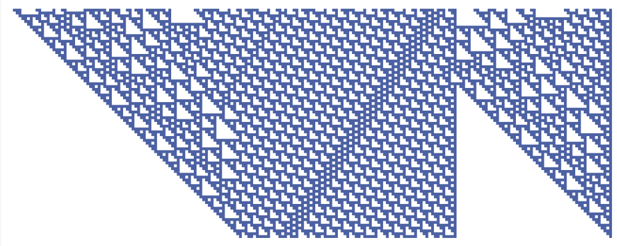
“best summarized by the table below. Initial state of a bit and its neighbours 111 110 101 100 011 010 001 000 New state of middle bit 0 1 1 0 1 1 1 0 The name comes from the result of the update rule [5]. Treating 01101110, which is the bottom row of the table above specifying the update rule, as binary and converting…”
BackgroundOperator Algebras and Quantum Statistical Mechanics
Bratteli, O., & Robinson, D. W. (1997) · Springer eBooks · doi:10.1007/978-3-662-03444-6 · Cited by 2,985
�ber das Paulische �quivalenzverbot
Jordan, P., & Wigner, E. (1928) · Zeitschrift f�r Physik · doi:10.1007/bf01331938 · Cited by 2,597 · cited 1×
“3 Fermionic index theory We might guess that, via the Jordan-Wigner transformation [92, 93], an index for fermionic QCAs should basically be the same as for qudit QCAs.”
Haag, R. (1996) · doi:10.1007/978-3-642-61458-3 · Cited by 2,443
On the product of semi-groups of operators
Trotter, H. F. (1959) · Proceedings of the American Mathematical Society · doi:10.1090/s0002-9939-1959-0108732-6 · Cited by 2,282 · cited 1×
“1 QCAs vs Hamiltonian dynamics We can simulate the dynamics of continuous-time systems on lattices with local Hamiltonians by using the Suzuki-Trotter decomposition [16, 101, 102].”
MethodLent, C. S., Tougaw, P. D., Porod, W., & Bernstein, G. H. (1993) · Nanotechnology · doi:10.1088/0957-4484/4/1/004 · Cited by 1,793 · cited 1×
“f the one-particle sector of a QCA [18, 30], which is something we will return to in section 6.3. Another potential source of confusion are quantum dot cellular automata, which were rst introduced in [40, 41]. These were originally referred to as quantum cellular automata, and, while the name quantum dot cellular auto…”
BackgroundInfluential
Research works printed but not linked: 18
- J. von Neumann. Theory of Self-Reproducing Automata. University of Illinois Press, Cham- paign, Illinois, 1966.
- In M. Bugliesi, B. Preneel, V. Sassone, and I. Wegener, editors, Automata, Languages and Programming, pages 132-143, Berlin, Heidelberg, 2006. Springer. DOI: ht- tps://doi.org/10.1007/11786986˙13. · doi:10.1007/11786986˙13
- J. Haah, L. Fidkowski, and M. B. Hastings. Nontrivial Quantum Cellular Automata in Higher Dimensions. arXiv:1812.01625, 2018. · arXiv
- B. Aoun and M. Tarifi. Introduction to Quantum Cellular Automata. arXiv:quant- ph/0401123, 2004.
- W. van Dam. Quantum cellular automata. Master's thesis, University of Nijmegen, 1996.
- C. A. Pérez Delgado. Quantum Cellular Automata: Theory and Applications. PhD thesis, University of Waterloo, 2007. · DOI · Paper page
- P. Arrighi. Quantum cellular automata. Habilitation thesis, Université de Grenoble, 2009.
- J. Gütschow. Quantum information processing with Clifford quantum cellular automata. PhD thesis, Leibniz Universität Hannover, 2012.
- C. A. Pérez-Delgado and D. Cheung. Models of Quantum Cellular Automata. arXiv:quant- ph/0508164, 2005.
- N. Margolus. Parallel quantum computation. In W. H. Zurek, editor, Complexity, Entropy, and the Physics of Information, page 273, Redwood City, CA, 1991. Addison Wesley.
- P. Arrighi and V. Nesme. Quantization of cellular automata. JAC 2008, pages 204-215, 2008.
- A. Shakeel. Quantum Cellular Automata: Schrödinger and Heisenberg Pictures. arXiv:1807.01192v1, 2018. · arXiv
- J. Haah. Clifford quantum cellular automata: Trivial group in 2d and Witt group in 3d. arXiv:1907.02075, 2019. · arXiv
- M. Freedman, J. Haah, and M. B. Hastings. The group structure of quantum cellular auto- mata. arXiv:1910.07998, 2019. · arXiv
- A. H. Werner H. Wilming. Finite group velocity implies locality of interactions. arXiv:2006.10062, 2020. · arXiv
- Z. Zimborás, T. Farrelly, S. Farkas, and L. Masanes. Does causal dynamics imply local interactions? arXiv:2006.10707, 2020. · arXiv
- M. Creutz. Quarks, Gluons and Lattices. Cambridge Monographs on Mathematical Physics. Cambridge University Press, 1983.
- M. McGuigan. Quantum Cellular Automata from Lattice Field Theories. arXiv:quant- ph/0307176, 2003.
Cited by
Piroli, L., Styliaris, G., & Cirac, J. I. (2021) · Physical Review Letters · doi:10.1103/physrevlett.127.220503 · Cited by 211
Emerging Two-Dimensional Gauge Theories in Rydberg Configurable Arrays
Celi, A., Vermersch, B., Viyuela, O., Pichler, H., Lukin, M. D., & Zoller, P. (2020) · Physical Review X · doi:10.1103/physrevx.10.021057 · Cited by 117
An overview of quantum cellular automata
Arrighi, P. J. (2019) · Natural Computing · doi:10.1007/s11047-019-09762-6 · Cited by 169
Lieb-Schultz-Mattis anomalies as obstructions to gauging (non-on-site) symmetries
Seifnashri, S. (2024) · SciPost Physics · doi:10.21468/scipostphys.16.4.098 · Cited by 120
“, [83, 84] for the definition of finite-depth circuits).”
BackgroundSequential quantum circuits as maps between gapped phases
Chen, X., Dua, A., Hermele, M., Stephen, D. T., Tantivasadakarn, N., Vanhove, R., & Zhao, J. (2024) · Physical review. B./Physical review. B · doi:10.1103/physrevb.109.075116 · Cited by 87
Metadata
- Authors
- Farrelly, T.
- Affiliations
- Leibniz University Hannover (DE)
- Corresponding author
- Farrelly, Terry
- ORCID
- Farrelly, Terry
- Venue
- Quantum
- Published
- 2020-11-30
- Volume
- 4
- Pages
- 368
- ISSN
- 2521-327X (ISSN-L)
- OpenAlex
- W2943005320
- Cited by
- 138
- References
- 158
- Citations by year
- 2026: 21 · 2025: 32 · 2024: 20 · 2023: 21 · 2022: 25 · 2021: 15 · 2020: 2
- FWCI
- 6.41
- Type
- journal article
- Language
- en
- Open access
- gold
- doi.org
- Locations
- Quantum (publishedVersion, cc-by)
- arXiv (Cornell University) (submittedVersion)
- DOAJ (DOAJ: Directory of Open Access Journals) (submittedVersion, cc-by-sa)
- arXiv (Cornell University)
- Funders
- Australian Research Council (CE170100009, EQUS CE170100009)
- Topics
- Physical Sciences › Physics and Astronomy › Atomic and Molecular Physics, and Optics › Quantum many-body systems
- Physical Sciences › Computer Science › Computational Theory and Mathematics › Cellular Automata and Applications
- Physical Sciences › Computer Science › Artificial Intelligence › Quantum Computing Algorithms and Architecture
- Keywords
- quantum cellular automata, quantum computing, topological phases, periodically driven systems, periodically driven quantum systems, interacting quantum field theory, index theory
About these checks
Registry, retraction, Cites and statistics results are computed, not judged, with one exception: a printed reference that no index lists is read once by a model before it counts as a citation error. Claims are extracted by a model and kept only when their quote appears verbatim in the text; each cited source is then checked, with a model’s help, for whether it says what the claim relies on. Those verdicts can be wrong — read the claim’s quote and the cited source before relying on one.
Statistics and arithmetic are recomputed, not judged.
Confidence bands are shown only for fields calibrated on our annotated test set. None is calibrated yet, so no band is shown.
What counts as a claim ›How we measure confidence ›How we check this ›
Are you an author, or do you see a problem with this page? Request a review
Data sources
Bibliographic data: Semantic Scholar, OpenAlex, Crossref.
Contains information from the Semantic Scholar Academic Graph Datasets, made available under the ODC Attribution License (ODC-BY 1.0).
Semantic Scholar’s data is described in: Kinney, R., et al. (2023). The Semantic Scholar Open Data Platform. arXiv:2301.10140.
