

A review of Quantum Cellular Automata
Open accessThe DOI matches its Crossref record; 168 of the 169 references it cites were found in a registry or an index, and 1 are not checked yet.
Abstract
Discretizing spacetime is often a natural step towards modelling physical systems. For quantum systems, if we also demand a strict bound on the speed of information propagation, we get quantum cellular automata (QCAs). These originally arose as an alternative paradigm for quantum computation, though more recently they have found application in understanding topological phases of matter and have} been proposed as models of periodically driven (Floquet) quantum systems, where QCA methods were used to classify their phases. QCAs have also been used as a natural discretization of quantum field theory, and some interesting examples of QCAs have been introduced that become interacting quantum field theories in the continuum limit. This review discusses all of these applications, as well as some other interesting results on the structure of quantum cellular automata, including the tensor-network unitary approach, the index theory and higher dimensional classifications of QCAs.
Overview
The claims and statistics of this paper haven’t been checked yet.
Free: it reads the open-access text and checks the first 5 claims that cite a source we can check. Create a free account to check every claim.
Integrity signals
Registry
Cites
Statistics
Figures
Verification
Claims the paper makes
The claims and statistics of this paper haven’t been checked yet.
Free: it reads the open-access text and checks the first 5 claims that cite a source we can check. Create a free account to check every claim.
Self-check
Percentages, sums and reported differences re-computed from the paper’s own numbers.
The self-check needs the paper’s full text.
Citations
Cites
Quantum Computation and Quantum Information: 10th Anniversary Edition
Nielsen, M. A., & Chuang, I. L. (2012) · doi:10.1017/cbo9780511976667 · Cited by 8,436
Simulating physics with computers
Feynman, R. P. (1982) · International Journal of Theoretical Physics · doi:10.1007/bf02650179 · Cited by 7,691
Anyons in an exactly solved model and beyond
Kitaev, A. (2006) · Annals of Physics · doi:10.1016/j.aop.2005.10.005 · Cited by 5,245 · cited 1×
“This was inspired by an analogous index for quantum walks [88, 89], which was called the flow in [89].”
MethodThe Lattice Boltzmann Equation for Fluid Dynamics and Beyond
Succi, S. (2001) · doi:10.1093/oso/9780198503989.001.0001 · Cited by 4,188
Statistical mechanics of cellular automata
Wolfram, S. (1983) · Reviews of Modern Physics · doi:10.1103/revmodphys.55.601 · Cited by 3,114 · cited 1×
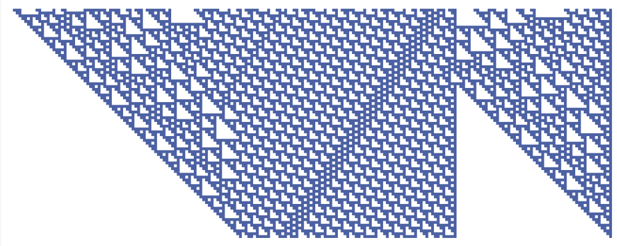
“best summarized by the table below. Initial state of a bit and its neighbours 111 110 101 100 011 010 001 000 New state of middle bit 0 1 1 0 1 1 1 0 The name comes from the result of the update rule [5]. Treating 01101110, which is the bottom row of the table above specifying the update rule, as binary and converting…”
BackgroundOperator Algebras and Quantum Statistical Mechanics
Bratteli, O., & Robinson, D. W. (1997) · Springer eBooks · doi:10.1007/978-3-662-03444-6 · Cited by 2,985
�ber das Paulische �quivalenzverbot
Jordan, P., & Wigner, E. (1928) · Zeitschrift f�r Physik · doi:10.1007/bf01331938 · Cited by 2,597 · cited 1×
“3 Fermionic index theory We might guess that, via the Jordan-Wigner transformation [92, 93], an index for fermionic QCAs should basically be the same as for qudit QCAs.”
Haag, R. (1996) · doi:10.1007/978-3-642-61458-3 · Cited by 2,443
On the product of semi-groups of operators
Trotter, H. F. (1959) · Proceedings of the American Mathematical Society · doi:10.1090/s0002-9939-1959-0108732-6 · Cited by 2,282 · cited 1×
“1 QCAs vs Hamiltonian dynamics We can simulate the dynamics of continuous-time systems on lattices with local Hamiltonians by using the Suzuki-Trotter decomposition [16, 101, 102].”
MethodLent, C. S., Tougaw, P. D., Porod, W., & Bernstein, G. H. (1993) · Nanotechnology · doi:10.1088/0957-4484/4/1/004 · Cited by 1,793 · cited 1×
“f the one-particle sector of a QCA [18, 30], which is something we will return to in section 6.3. Another potential source of confusion are quantum dot cellular automata, which were rst introduced in [40, 41]. These were originally referred to as quantum cellular automata, and, while the name quantum dot cellular auto…”
BackgroundInfluential
Research works printed but not linked: 18
- J. von Neumann. Theory of Self-Reproducing Automata. University of Illinois Press, Cham- paign, Illinois, 1966.
- In M. Bugliesi, B. Preneel, V. Sassone, and I. Wegener, editors, Automata, Languages and Programming, pages 132-143, Berlin, Heidelberg, 2006. Springer. DOI: ht- tps://doi.org/10.1007/11786986˙13. · doi:10.1007/11786986˙13
- J. Haah, L. Fidkowski, and M. B. Hastings. Nontrivial Quantum Cellular Automata in Higher Dimensions. arXiv:1812.01625, 2018. · arXiv
- B. Aoun and M. Tarifi. Introduction to Quantum Cellular Automata. arXiv:quant- ph/0401123, 2004.
- W. van Dam. Quantum cellular automata. Master's thesis, University of Nijmegen, 1996.
- C. A. Pérez Delgado. Quantum Cellular Automata: Theory and Applications. PhD thesis, University of Waterloo, 2007. · DOI · Paper page
- P. Arrighi. Quantum cellular automata. Habilitation thesis, Université de Grenoble, 2009.
- J. Gütschow. Quantum information processing with Clifford quantum cellular automata. PhD thesis, Leibniz Universität Hannover, 2012.
- C. A. Pérez-Delgado and D. Cheung. Models of Quantum Cellular Automata. arXiv:quant- ph/0508164, 2005.
- N. Margolus. Parallel quantum computation. In W. H. Zurek, editor, Complexity, Entropy, and the Physics of Information, page 273, Redwood City, CA, 1991. Addison Wesley.
- P. Arrighi and V. Nesme. Quantization of cellular automata. JAC 2008, pages 204-215, 2008.
- A. Shakeel. Quantum Cellular Automata: Schrödinger and Heisenberg Pictures. arXiv:1807.01192v1, 2018. · arXiv
- J. Haah. Clifford quantum cellular automata: Trivial group in 2d and Witt group in 3d. arXiv:1907.02075, 2019. · arXiv
- M. Freedman, J. Haah, and M. B. Hastings. The group structure of quantum cellular auto- mata. arXiv:1910.07998, 2019. · arXiv
- A. H. Werner H. Wilming. Finite group velocity implies locality of interactions. arXiv:2006.10062, 2020. · arXiv
- Z. Zimborás, T. Farrelly, S. Farkas, and L. Masanes. Does causal dynamics imply local interactions? arXiv:2006.10707, 2020. · arXiv
- M. Creutz. Quarks, Gluons and Lattices. Cambridge Monographs on Mathematical Physics. Cambridge University Press, 1983.
- M. McGuigan. Quantum Cellular Automata from Lattice Field Theories. arXiv:quant- ph/0307176, 2003.
Cited by
Piroli, L., Styliaris, G., & Cirac, J. I. (2021) · Physical Review Letters · doi:10.1103/physrevlett.127.220503 · Cited by 211
Emerging Two-Dimensional Gauge Theories in Rydberg Configurable Arrays
Celi, A., Vermersch, B., Viyuela, O., Pichler, H., Lukin, M. D., & Zoller, P. (2020) · Physical Review X · doi:10.1103/physrevx.10.021057 · Cited by 117
An overview of quantum cellular automata
Arrighi, P. J. (2019) · Natural Computing · doi:10.1007/s11047-019-09762-6 · Cited by 169
Lieb-Schultz-Mattis anomalies as obstructions to gauging (non-on-site) symmetries
Seifnashri, S. (2024) · SciPost Physics · doi:10.21468/scipostphys.16.4.098 · Cited by 120
“, [83, 84] for the definition of finite-depth circuits).”
BackgroundSequential quantum circuits as maps between gapped phases
Chen, X., Dua, A., Hermele, M., Stephen, D. T., Tantivasadakarn, N., Vanhove, R., & Zhao, J. (2024) · Physical review. B./Physical review. B · doi:10.1103/physrevb.109.075116 · Cited by 87
Exactly solvable lattice Hamiltonians and gravitational anomalies
Chen, Y.-A., & Hsin, P.-S. (2023) · SciPost Physics · doi:10.21468/scipostphys.14.5.089 · Cited by 79
“Quantum cellular automata (QCA) can characterize non-trivial topological phases of matter [ 47,54,55 ] , such as the Floquet topological phases [ 55,56 ] .”
BackgroundUnitary and Nonunitary Quantum Cellular Automata with Rydberg Arrays
Wintermantel, T. M., Wang, Y., Lochead, G., Shevate, S., Brennen, G. K., & Whitlock, S. (2020) · Physical Review Letters · doi:10.1103/physrevlett.124.070503 · Cited by 83
Quantum Cellular Automata, Tensor Networks, and Area Laws
Piroli, L., & Cirac, J. I. (2020) · Physical Review Letters · doi:10.1103/physrevlett.125.190402 · Cited by 76
Three-Dimensional Quantum Cellular Automata from Chiral Semion Surface Topological Order and beyond
Shirley, W. E., Chen, Y.-A., Dua, A., Ellison, T. D., Tantivasadakarn, N., & Williamson, D. J. (2022) · PRX Quantum · doi:10.1103/prxquantum.3.030326 · Cited by 76
Bounds in nonequilibrium quantum dynamics
Gong, Z., & Hamazaki, R. (2022) · International Journal of Modern Physics B · doi:10.1142/s0217979222300079 · Cited by 68
Jonay, C., Khemani, V., & Ippoliti, M. (2021) · Physical Review Research · doi:10.1103/physrevresearch.3.043046 · Cited by 63
Exactly solvable quantum many-body dynamics from space-time duality
Bertini, B., Claeys, P. W., & Prosen, T. (2026) · Reviews of Modern Physics · doi:10.1103/yx73-dk86 · Cited by 60
Many-body quantum chaos and dual-unitarity round-a-face
Prosen, T. (2021) · Chaos An Interdisciplinary Journal of Nonlinear Science · doi:10.1063/5.0056970 · Cited by 57
Superintegrable cellular automata and dual unitary gates from Yang-Baxter maps
Gombor, T., & Pozsgay, B. (2022) · SciPost Physics · doi:10.21468/scipostphys.12.3.102 · Cited by 54
Nonequilibrium Dynamics of Charged Dual-Unitary Circuits
Foligno, A., Calabrese, P., & Bertini, B. (2025) · PRX Quantum · doi:10.1103/prxquantum.6.010324 · Cited by 62
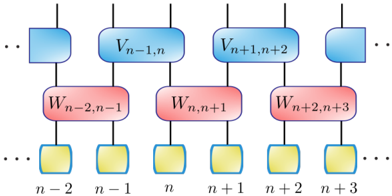
“In passing we note that unitary transformations with different (but isomorphic) domain and codomain can be used to define quantum cellular automata generalising the concept of brickwork quantum circuits [82].”
Mixed Multi-Chaos Quantum Image Encryption Scheme Based on Quantum Cellular Automata (QCA)
Mohamed, N. A. E.-S., El‐sayed, H. S., & Youssif, A. A. A. (2023) · Fractal and Fractional · doi:10.3390/fractalfract7100734 · Cited by 43
A Converse to Lieb–Robinson Bounds in One Dimension Using Index Theory
Ranard, D., Walter, M., & Witteveen, F. (2022) · Annales Henri Poincaré · doi:10.1007/s00023-022-01193-x · Cited by 49
“The same material is also covered in the review [19].”
BackgroundEntangled quantum cellular automata, physical complexity, and Goldilocks rules
Hillberry, L. E., Jones, M. T., Vargas, D. L., Rall, P., Halpern, N. Y., Bao, N., Notarnicola, S., Montangero, S., & Carr, L. D. (2021) · Quantum Science and Technology · doi:10.1088/2058-9565/ac1c41 · Cited by 39
“We emphasize physical complexity in our work because many early QCA studies spotlighted single-particle or semiclassical approximations [1, 20–22] or weak correlations at the level of density functional theory [23, 24].”
Anomalies of Global Symmetries on the Lattice
Tu, Y.-T., Long, D. M., & Else, D. V. (2026) · Physical Review X · doi:10.1103/m188-w1ct · Cited by 42
An overview of Quantum Cellular AutomataPreprint
Arrighi, P. J. (2019) · arXiv (Cornell University) · doi:10.48550/arxiv.1904.12956 · Cited by 44
Gillman, E., Carollo, F., & Lesanovsky, I. (2020) · Physical Review Letters · doi:10.1103/physrevlett.125.100403 · Cited by 41
Anomaly diagnosis via symmetry restriction in two-dimensional lattice systemsPreprint
Kawagoe, K., & Shirley, W. E. (2025) · arXiv (Cornell University) · doi:10.48550/arxiv.2507.07430 · Cited by 34
“In this setting, a unitary operator that strictly preserves locality is referred to as a quantum cellular automaton (QCA) [32].”
Disentangling Anomaly-Free Symmetries of Quantum Spin Chains
Seifnashri, S., & Shirley, W. E. (2026) · Physical Review Letters · doi:10.1103/bscj-r5tg · Cited by 33
Fermionic quantum cellular automata and generalized matrix-product unitaries
Piroli, L., Turzillo, A., Shukla, S. K., & Cirac, J. I. (2021) · Journal of Statistical Mechanics Theory and Experiment · doi:10.1088/1742-5468/abd30f · Cited by 38
Liu, R., Yi, J., Zhou, S., & Zou, L. (2025) · Physical review. B./Physical review. B · doi:10.1103/2jgh-nrj1 · Cited by 32
Discretizing quantum field theories for quantum simulationPreprint
Farrelly, T., & Streich, J. (2020) · arXiv (Cornell University) · doi:10.48550/arxiv.2002.02643 · Cited by 30
“These quantum-circuits are also quantum cellular automata, which are discrete spacetime quantum systems where information propagates at a bounded speed [24, 25].”
BackgroundSelf-citationTopological Lower Bound on Quantum Chaos by Entanglement Growth
Gong, Z., Piroli, L., & Cirac, J. I. (2021) · Physical Review Letters · doi:10.1103/physrevlett.126.160601 · Cited by 32
Sommers, G. M., Huse, D. A., & Gullans, M. J. (2023) · PRX Quantum · doi:10.1103/prxquantum.4.030313 · Cited by 33
“In the present work, with spacetime translation invariance, our circuits can be interpreted as quantum cellular automata (QCA) [48, 49], and restricting to Clifford gates allows us complement the exact methods for treating dual-unitary circuits with the tools of symplectic cellular automata [50–52].”
BackgroundMethodA Panorama Of Physical Mathematics c. 2022Preprint
Bah, I., Freed, D. S., Moore, G. W., Nekrasov, N. A., Razamat, S. S., & Schäfer‐Nameki, S. (2022) · arXiv (Cornell University) · doi:10.48550/arxiv.2211.04467 · Cited by 34
Mixed-valence realizations of quantum dot cellular automata
Macrae, R. M. (2023) · Journal of Physics and Chemistry of Solids · doi:10.1016/j.jpcs.2023.111303 · Cited by 26
Ternary Unitary Quantum Lattice Models and Circuits in 2+1 Dimensions
Milbradt, R. M., Scheller, L., Aßmus, C., & Mendl, C. B. (2023) · Physical Review Letters · doi:10.1103/physrevlett.130.090601 · Cited by 29
Many-Body Entropies and Entanglement from Polynomially Many Local Measurements
Vermersch, B., Ljubotina, M., Cirac, J. I., Zoller, P., Serbyn, M., & Piroli, L. (2024) · Physical Review X · doi:10.1103/physrevx.14.031035 · Cited by 42
“The strategies developed so far rely on exact factorization conditions on the system density matrix, which are related to the sharp light-cone structure of correlation functions in FDQC states [110,133,134].”
MethodDynamics of pseudoentanglement
Feng, X., & Ippoliti, M. (2025) · Journal of High Energy Physics · doi:10.1007/jhep02(2025)128 · Cited by 27
Small-world complex network generation on a digital quantum processor
Jones, E. B., Hillberry, L. E., Jones, M. T., Fasihi, M., Roushan, P., Zhang, J., Ho, A., Neill, C., Ostby, E. P., Graf, P. A., et al. (2022) · Nature Communications · doi:10.1038/s41467-022-32056-y · Cited by 29
Exploring Cell Migration Mechanisms in Cancer: From Wound Healing Assays to Cellular Automata Models
Migliaccio, G., Ferraro, R., Wang, Z., Vittorio Cristini, C., Dogra, P., & Caserta, S. (2023) · Cancers · doi:10.3390/cancers15215284 · Cited by 24
“CA, celebrated for their simplicity, find application across diverse domains, spanning from urban system evolution [36,37] to material erosion and various biological processes [38–40], including the dynamics of the epithelial system [41], wound repair [42], viral infections [43], tumor response to…”
BackgroundQuantum cellular automata and quantum field theory in two spatial dimensions
Brun, T. A., & Mlodinow, L. D. (2020) · Physical Review A · doi:10.1103/physreva.102.062222 · Cited by 25
“Being immune to ultraviolet divergences, QCAs may be of use in regularizing the corresponding QFT, and some authors emphasize their potential as algorithms for simulating the dynamics of QFTs on a quantum computer [43].”
BackgroundQuantum Cellular Automata and Categorical Dualities of Spin Chains
Jones, C., Schatz, K., & Williamson, D. J. (2026) · Communications in Mathematical Physics · doi:10.1007/s00220-026-05571-y · Cited by 29
“Quantum cellular automata (QCA) are a class of quantum operations that capture the fundamental properties of unitarity and locality [Wat95, Far20, Arr19].”
Prosen, T. (2021) · arXiv (Cornell University) · doi:10.48550/arxiv.2106.01292 · Cited by 21
“(ii) When fkl ∈ U(2) are unitary, also the many body map (1) is unitary and corresponds to a unitary quantum local Floquet circuit or quantum cellular automaton (QCA) [38], see e.g. [39, 40] for recent discussion of QCA of this type.”
BackgroundEntanglement in the quantum Game of Life
Ney, P.-M., Notarnicola, S., Montangero, S., & Morigi, G. (2022) · Physical Review A · doi:10.1103/physreva.105.012416 · Cited by 19
“[27] Terry Farrelly, “A review of Quantum Cellular Automata,” Quantum 4, 368 (2020).”
BackgroundExact link between nonlocal nonstabilizerness and operator entanglement
Andreadakis, F., & Zanardi, P. (2026) · Physical Review A · doi:10.1103/9x56-2b45 · Cited by 22
Operator dynamics and entanglement in space-time dual Hadamard lattices
Claeys, P. W., & Lamacraft, A. (2024) · Journal of Physics A Mathematical and Theoretical · doi:10.1088/1751-8121/ad776a · Cited by 19
“They are an example of Clifford cellular automata (CCAs) [54], a particular class of quantum cellular automata (see [55] for a recent review).”
Quantum Many-Body Spin Ratchets
Zadnik, L., Ljubotina, M., Krajnik, Ž., Ilievski, E., & Prosen, T. (2024) · PRX Quantum · doi:10.1103/prxquantum.5.030356 · Cited by 21
A comparative study of universal quantum computing models: Toward a physical unification
Wang, D. (2021) · Quantum Engineering · doi:10.1002/que2.85 · Cited by 23
“QCA also has a rather long history in quantum computing [42, 43, 85].”
BackgroundDual-unitary shadow tomography
Akhtar, A. A., Anand, N., Marshall, J., & You, Y. (2025) · Quantum · doi:10.22331/q-2025-07-29-1816 · Cited by 19
“7 a-c) inherits a light-cone structure [68].”
Quantum Cellular Automata on Symmetric Subalgebras
Ma, R., Li, Y., & Cheng, M. (2026) · Quantum · doi:10.22331/q-2026-06-01-2123 · Cited by 23
Integrable spin chains and the Clifford group
Jones, N. G., & Linden, N. (2022) · Journal of Mathematical Physics · doi:10.1063/5.0095870 · Cited by 18
Integrable nonunitary quantum circuits
Su, L., & Martin, I. (2022) · Physical review. B./Physical review. B · doi:10.1103/physrevb.106.134312 · Cited by 16
Numerical simulation of quantum nonequilibrium phase transitions without finite-size effects
Gillman, E., Carollo, F., & Lesanovsky, I. (2021) · Physical Review A · doi:10.1103/physreva.103.l040201 · Cited by 17
Coarse-Grained Entanglement and Operator Growth in Anomalous Dynamics
Gong, Z., Nahum, A., & Piroli, L. (2022) · Physical Review Letters · doi:10.1103/physrevlett.128.080602 · Cited by 24
Does causal dynamics imply local interactions?
Zimborás, Z., Farrelly, T., Farkas, S., & Masanes, L. (2022) · Quantum · doi:10.22331/q-2022-06-29-748 · Cited by 16
“QCAs can also be understood as the many-body generalization or “second quantization” of quantum walks [3].”
BackgroundMethodInfluentialSelf-citationTan, J., Zhang, M., & Liu, F. (2023) · Applied Mathematics and Computation · doi:10.1016/j.amc.2023.128320 · Cited by 14
Mixing and localization in random time-periodic quantum circuits of Clifford unitaries
Farshi, T., Toniolo, D., González-Guillén, C. E., Alhambra, A. M., & Masanes, L. (2022) · Journal of Mathematical Physics · doi:10.1063/5.0054863 · Cited by 16
Quantum and Classical Temporal Correlations in (1+1)D Quantum Cellular Automata
Gillman, E., Carollo, F., & Lesanovsky, I. (2021) · Physical Review Letters · doi:10.1103/physrevlett.127.230502 · Cited by 14
Cellular automata in operational probabilistic theories
Perinotti, P. (2020) · Quantum · doi:10.22331/q-2020-07-09-294 · Cited by 15
Gioia, L., Moudgalya, S., & Motrunich, O. I. (2025) · arXiv (Cornell University) · doi:10.48550/arxiv.2510.24713 · Cited by 17
“Strict QCAs are unitary operations on the full Hilbert space that map strictly local (finite-range) operators to strictly local operators within a uniformly bounded neighbourhood of the original operator [69–72].”
Generalized hydrodynamics of integrable quantum circuits
Hübner, F., Vernier, E., & Piroli, L. (2025) · SciPost Physics · doi:10.21468/scipostphys.18.4.135 · Cited by 16
“Motivated by this picture, the past few years have witnessed growing interest in genuinely discrete dynamics where the Trotter time τ is not small [7, 8].”
Scattering and Perturbation Theory for Discrete-Time Dynamics
Bisio, A., Mosco, N., & Perinotti, P. (2021) · Physical Review Letters · doi:10.1103/physrevlett.126.250503 · Cited by 14
Gillman, E., Carollo, F., & Lesanovsky, I. (2023) · Physical review. E · doi:10.1103/physreve.107.l022102 · Cited by 16
Absence of Localization in Two-Dimensional Clifford Circuits
Farshi, T., Richter, J., Toniolo, D., Pal, A., & Masanes, L. (2023) · PRX Quantum · doi:10.1103/prxquantum.4.030302 · Cited by 15
“This quantum circuit with local interactions is an example of a quantum cellular automaton (QCA) [11,73– 75].”
MethodMlodinow, L. D., & Brun, T. A. (2020) · Physical Review A · doi:10.1103/physreva.102.042211 · Cited by 14
Liu, R., Yi, J., & Else, D. V. (2026) · arXiv (Cornell University) · doi:10.48550/arxiv.2605.28925 · Cited by 13
“For some of our results (Theorem II.1), it will be helpful to impose a stricter notion of locality [78, 79]: , one says α is a QCA if there exists r α > 0 such that for any local operator x ∈ A X , we have α ( x ) ∈ A B ( X,r α ) , where B ( X, r α ) := { p ∈ Λ : dist( p, X ) ⩽ r α } .”
An Index for Quantum Cellular Automata on Fusion Spin Chains
Jones, C., & Lim, J. (2024) · Annales Henri Poincaré · doi:10.1007/s00023-024-01429-y · Cited by 19
Topological phases of many-body localized systems: Beyond eigenstate order
Long, D. M., & Else, D. V. (2025) · Physical review. B./Physical review. B · doi:10.1103/77j6-g4jz · Cited by 13
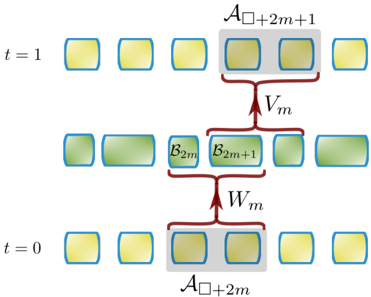
“The swindle map S : QCA d 1 → ΩQCA d demonstrates that 1 is true. v − Given some ∈ QCA d 1 , the swindle S ( v, t ) ∈ ΩQCA d pumps v to the edge. construct We can the swindle through a finite depth quantum circuit as follows [59, 60, 100, 108] (Fig.”
Mlodinow, L. D., & Brun, T. A. (2021) · Physical Review A · doi:10.1103/physreva.103.052203 · Cited by 13
Remarks on non-invertible symmetries on a tensor product Hilbert space in 1+1 dimensions
Inamura, K. (2026) · SciPost Physics · doi:10.21468/scipostphys.21.4.088 · Cited by 11
Scrambling in quantum cellular automata
Kent, B., Racz, S., & Shashi, S. (2023) · Physical review. B./Physical review. B · doi:10.1103/physrevb.107.144306 · Cited by 11
Universal resources for quantum computing
Wang, D. (2023) · Communications in Theoretical Physics · doi:10.1088/1572-9494/ad07d6 · Cited by 12
Quantum Cellular Automata for Quantum Error Correction and Density Classification
Guedes, T. L. M., Winter, D., & Müller, M. (2024) · Physical Review Letters · doi:10.1103/physrevlett.133.150601 · Cited by 21
“This means that local operators are mapped into quasi-local operators at each step [25, 29–31].”
InfluentialFonio, N., Sagaut, P., & Molfetta, G. D. (2025) · Computers & Fluids · doi:10.1016/j.compfluid.2025.106688 · Cited by 13
“First, they can be seen as a subclass of quantum cellular autoamata (QCA) [26], considering qubits instead of bits.”
Lieb-Robinson bounds imply locality of interactions
Wilming, H., & Werner, A. H. (2022) · Physical review. B./Physical review. B · doi:10.1103/physrevb.105.125101 · Cited by 12
“[40–42], this is not the case; there exist strictly local unitary dynamics in discrete time which cannot be generated by quasilocal Hamiltonians, despite the fact that they can always be generated by local, finite depth quantum circuits [43].”
BackgroundEntanglement dynamics and ergodicity breaking in a quantum cellular automaton
Sellapillay, K., Verga, A., & Molfetta, G. D. (2022) · Physical review. B./Physical review. B · doi:10.1103/physrevb.106.104309 · Cited by 11
“A quantum cellular automaton can be viewed as a model of quantum computing, as well as an out of equilibrium system evolving in discrete space-time [1, 2].”
BackgroundQuantum circuits for discrete-time quantum walks with position-dependent coin operator
Nzongani, U., Zylberman, J., Doncecchi, C.-E., Pérez, A., Debbasch, F., & Arnault, P. (2023) · Quantum Information Processing · doi:10.1007/s11128-023-03957-8 · Cited by 12
“Multiparticle DQWs are known as quantum cellular automata [51, 52], and they have been used to build certain simple models of lattice”
BackgroundCoarse-grained quantum cellular automata
Duranthon, O., & Molfetta, G. D. (2021) · Physical Review A · doi:10.1103/physreva.103.032224 · Cited by 10
Many-Body Quantum Catalysts for Transforming Between Phases of Matter
Stephen, D. T., Nandkishore, R., & Zhang, J.-H. (2025) · PRX Quantum · doi:10.1103/prxquantum.6.020353 · Cited by 10
Causal Decompositions of 1D Quantum Cellular AutomataPreprint
Vanrietvelde, A., Mestoudjian, O., & Arrighi, P. J. (2025) · arXiv (Cornell University) · doi:10.48550/arxiv.2506.22219 · Cited by 11
“Quantum Cellular Automata (QCAs) [9, 10] form an important class of quantum dynamics singled out by their causal structure (see the reviews [11, 12]).”
Construction and simulability of quantum circuits with free fermions in disguise
Szász-Schagrin, D., Cristani, D., Piroli, L., & Vernier, E. (2026) · Quantum Science and Technology · doi:10.1088/2058-9565/ae390d · Cited by 13
“In addition, its brickwork structure guarantees that correlation functions are contained in a lightcone— models with this property are called quantum cellular automata [75, 76], and are particularly interesting as they mimic many features of local-Hamiltonian dynamics.”
Asynchronism and nonequilibrium phase transitions in (1+1) -dimensional quantum cellular automata
Gillman, E., Carollo, F., & Lesanovsky, I. (2022) · Physical review. E · doi:10.1103/physreve.106.l032103 · Cited by 9
Stephen, D. T., Dua, A., Lavasani, A., & Nandkishore, R. (2024) · PRX Quantum · doi:10.1103/prxquantum.5.010304 · Cited by 10
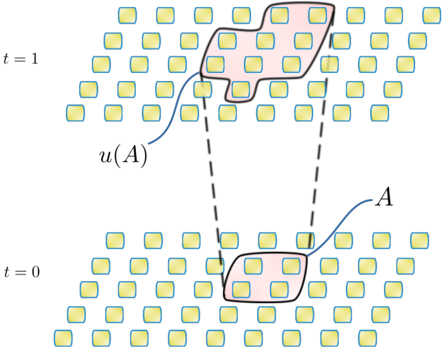
“Then we have [62, 63], where , Since S i is a local operator and Q is locality-preserving, V i is a local operator.”
BackgroundMethodWhich Number System Is “Best” for Describing Empirical Reality?
Visser, M. (2022) · Mathematics · doi:10.3390/math10183340 · Cited by 9
Quantum Cellular Automata, Black Hole Thermodynamics and the Laws of Quantum Complexity
Shah, R., & Gorard, J. (2019) · Complex Systems · doi:10.25088/complexsystems.28.4.393 · Cited by 12
“When attempting to make a physical theory computable, a very natural first step is to discretize the underlying spacetime[1][2][3].”
BackgroundNon-Invertible Symmetries on Tensor-Product Hilbert Spaces and Quantum Cellular AutomataPreprint
Wen, R., Inamura, K., & Schäfer‐Nameki, S. (2026) · arXiv (Cornell University) · doi:10.48550/arxiv.2605.15194 · Cited by 9
“See [43, 44] for reviews on this subject.”
Breaking global symmetries with locality-preserving operations
Mazzoni, M., Capizzi, L., & Piroli, L. (2025) · Physical Review Research · doi:10.1103/gcjj-88j6 · Cited by 11
Mi, G., Sun, Y., Sun, R., Li, P., Sui, N., He, L., & Dong, F. (2025) · Materials & Design · doi:10.1016/j.matdes.2025.115381 · Cited by 8
Generative Music with Partitioned Quantum Cellular Automata
Miranda, E. R., & Shaji, H. V. (2023) · Applied Sciences · doi:10.3390/app13042401 · Cited by 8
Universal and Reversible Gate Design in Quantum-dot Cellular Automata Nanotechnology
Sharma, V. K., & Riyaz, S. (2023) · Micro and Nanosystems · doi:10.2174/0118764029270222231123071138 · Cited by 8
Brick wall quantum circuits with global fermionic symmetry
Richelli, P., Schoutens, K., & Zorzato, A. (2024) · SciPost Physics · doi:10.21468/scipostphys.17.3.087 · Cited by 8
“Thus, the boundary reflection operators commute with the sum of the left and right supercharges.”
BackgroundGoing beyond gadgets: the importance of scalability for analogue quantum simulators
Harley, D., Datta, I., Klausen, F. R., Blühm, A., França, D. S., Werner, A. H., & Christandl, M. (2024) · Nature Communications · doi:10.1038/s41467-024-50744-9 · Cited by 16
Matrix-product unitaries: Beyond quantum cellular automata
Styliaris, G., Trivedi, R., Pérez-García, D., & Cirac, J. I. (2025) · Quantum · doi:10.22331/q-2025-02-25-1645 · Cited by 19
“Quantum cellular automata (QCA) are unitaries that capture the notion of a causal evolution [17].”
An algorithm to factorize quantum walks into shift and coin operations
Cedzich, C., Geib, T., & Werner, R. F. (2022) · Letters in Mathematical Physics · doi:10.1007/s11005-022-01578-3 · Cited by 8
“One can hope for an extension of our results to the QCA setting which would make do without such additional workspace.”
BackgroundAnonymous, Chen, X., & Ban, Y. (2026) · Physical Review Letters · doi:10.1103/j35s-xv5k · Cited by 13
Nonuniversality from conserved superoperators in unitary circuits
Lastres, M., Pollmann, F., & Moudgalya, S. (2025) · Physical review. B./Physical review. B · doi:10.1103/8jfm-l4ml · Cited by 8
Fedchenko, D. P., Kim, P. N., & Timofeev, I. V. (2022) · Symmetry · doi:10.3390/sym14122673 · Cited by 7
Boneberg, M., Carollo, F., & Lesanovsky, I. (2023) · New Journal of Physics · doi:10.1088/1367-2630/aceff4 · Cited by 9
Fermion Doubling in Quantum Cellular AutomataPreprint
Bakircioglu, D., Arnault, P., & Arrighi, P. J. (2025) · arXiv (Cornell University) · doi:10.48550/arxiv.2505.07900 · Cited by 7
“Quantum Cellular Automata (QCAs) are shift-invariant, causal and unitary operators over spatial lattices of quantum systems [1, 2].”
Integrability of Goldilocks quantum cellular automata
Hillberry, L. E., Piroli, L., Vernier, E., Halpern, N. Y., Prosen, T., & Carr, L. D. (2026) · Quantum Science and Technology · doi:10.1088/2058-9565/ae57d5 · Cited by 6
“Classical CA generalize to quantum cellular automata (QCA), defined axiomatically as the unitary discrete dynamics that satisfy certain locality conditions [6, 7].”
BackgroundSymmetries of the Dirac quantum walk and emergence of the de Sitter group
Apadula, L., Bisio, A., D’Ariano, G. M., & Perinotti, P. (2020) · Journal of Mathematical Physics · doi:10.1063/1.5144731 · Cited by 6
Exotic equilibration dynamics on a 1-D quantum CNOT gate latticePreprint
Berenstein, D. E., & Zhao, J. (2021) · arXiv (Cornell University) · doi:10.48550/arxiv.2102.05745 · Cited by 6
“A recent review of quantum cellular automata can be found in [12].”
BackgroundLiu, R., Yi, J., & Zou, L. (2025) · SSRN Electronic Journal · doi:10.2139/ssrn.5778903 · Cited by 6
Anomalies in quantum spin systems and Nielsen-Ninomiya type TheoremsPreprint
Liu, R. (2026) · arXiv (Cornell University) · doi:10.48550/arxiv.2602.13948 · Cited by 6
“[41, 42] for reviews).”
The advent of quantum computer music: mapping the field
Miranda, E. R. (2024) · Reports on Progress in Physics · doi:10.1088/1361-6633/ad627a · Cited by 7
“Please, refer to [38] for a theoretical discussion about QCA and universal computation.”
Metadata
- Authors
- Farrelly, T.
- Affiliations
- Leibniz University Hannover (DE)
- Corresponding author
- Farrelly, Terry
- ORCID
- Farrelly, Terry
- Venue
- Quantum
- Published
- 2020-11-30
- Volume
- 4
- Pages
- 368
- ISSN
- 2521-327X (ISSN-L)
- OpenAlex
- W2943005320
- Cited by
- 138
- References
- 158
- Citations by year
- 2026: 21 · 2025: 32 · 2024: 20 · 2023: 21 · 2022: 25 · 2021: 15 · 2020: 2
- FWCI
- 6.41
- Type
- journal article
- Language
- en
- Open access
- gold
- doi.org
- Locations
- Quantum (publishedVersion, cc-by)
- arXiv (Cornell University) (submittedVersion)
- DOAJ (DOAJ: Directory of Open Access Journals) (submittedVersion, cc-by-sa)
- arXiv (Cornell University)
- Funders
- Australian Research Council (CE170100009, EQUS CE170100009)
- Topics
- Physical Sciences › Physics and Astronomy › Atomic and Molecular Physics, and Optics › Quantum many-body systems
- Physical Sciences › Computer Science › Computational Theory and Mathematics › Cellular Automata and Applications
- Physical Sciences › Computer Science › Artificial Intelligence › Quantum Computing Algorithms and Architecture
- Keywords
- quantum cellular automata, quantum computing, topological phases, periodically driven systems, periodically driven quantum systems, interacting quantum field theory, index theory
About these checks
Registry, retraction, Cites and statistics results are computed, not judged, with one exception: a printed reference that no index lists is read once by a model before it counts as a citation error. Claims are extracted by a model and kept only when their quote appears verbatim in the text; each cited source is then checked, with a model’s help, for whether it says what the claim relies on. Those verdicts can be wrong — read the claim’s quote and the cited source before relying on one.
Statistics and arithmetic are recomputed, not judged.
Confidence bands are shown only for fields calibrated on our annotated test set. None is calibrated yet, so no band is shown.
What counts as a claim ›How we measure confidence ›How we check this ›
Are you an author, or do you see a problem with this page? Request a review
Data sources
Bibliographic data: Semantic Scholar, OpenAlex, Crossref.
Contains information from the Semantic Scholar Academic Graph Datasets, made available under the ODC Attribution License (ODC-BY 1.0).
Semantic Scholar’s data is described in: Kinney, R., et al. (2023). The Semantic Scholar Open Data Platform. arXiv:2301.10140.
