

A review of Quantum Cellular Automata
Open accessThe DOI matches its Crossref record; 168 of the 169 references it cites were found in a registry or an index, and 1 are not checked yet.
Abstract
Discretizing spacetime is often a natural step towards modelling physical systems. For quantum systems, if we also demand a strict bound on the speed of information propagation, we get quantum cellular automata (QCAs). These originally arose as an alternative paradigm for quantum computation, though more recently they have found application in understanding topological phases of matter and have} been proposed as models of periodically driven (Floquet) quantum systems, where QCA methods were used to classify their phases. QCAs have also been used as a natural discretization of quantum field theory, and some interesting examples of QCAs have been introduced that become interacting quantum field theories in the continuum limit. This review discusses all of these applications, as well as some other interesting results on the structure of quantum cellular automata, including the tensor-network unitary approach, the index theory and higher dimensional classifications of QCAs.
Overview
The claims and statistics of this paper haven’t been checked yet.
Free: it reads the open-access text and checks the first 5 claims that cite a source we can check. Create a free account to check every claim.
Integrity signals
Registry
Cites
Statistics
Figures
Verification
Claims the paper makes
The claims and statistics of this paper haven’t been checked yet.
Free: it reads the open-access text and checks the first 5 claims that cite a source we can check. Create a free account to check every claim.
Self-check
Percentages, sums and reported differences re-computed from the paper’s own numbers.
The self-check needs the paper’s full text.
Citations
Cites
Quantum Computation and Quantum Information: 10th Anniversary Edition
Nielsen, M. A., & Chuang, I. L. (2012) · doi:10.1017/cbo9780511976667 · Cited by 8,436
Simulating physics with computers
Feynman, R. P. (1982) · International Journal of Theoretical Physics · doi:10.1007/bf02650179 · Cited by 7,691
Anyons in an exactly solved model and beyond
Kitaev, A. (2006) · Annals of Physics · doi:10.1016/j.aop.2005.10.005 · Cited by 5,245 · cited 1×
“This was inspired by an analogous index for quantum walks [88, 89], which was called the flow in [89].”
MethodThe Lattice Boltzmann Equation for Fluid Dynamics and Beyond
Succi, S. (2001) · doi:10.1093/oso/9780198503989.001.0001 · Cited by 4,188
Statistical mechanics of cellular automata
Wolfram, S. (1983) · Reviews of Modern Physics · doi:10.1103/revmodphys.55.601 · Cited by 3,114 · cited 1×
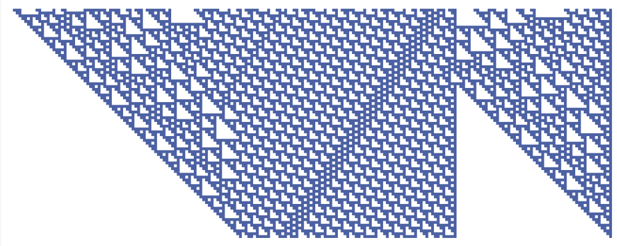
“best summarized by the table below. Initial state of a bit and its neighbours 111 110 101 100 011 010 001 000 New state of middle bit 0 1 1 0 1 1 1 0 The name comes from the result of the update rule [5]. Treating 01101110, which is the bottom row of the table above specifying the update rule, as binary and converting…”
BackgroundOperator Algebras and Quantum Statistical Mechanics
Bratteli, O., & Robinson, D. W. (1997) · Springer eBooks · doi:10.1007/978-3-662-03444-6 · Cited by 2,985
�ber das Paulische �quivalenzverbot
Jordan, P., & Wigner, E. (1928) · Zeitschrift f�r Physik · doi:10.1007/bf01331938 · Cited by 2,597 · cited 1×
“3 Fermionic index theory We might guess that, via the Jordan-Wigner transformation [92, 93], an index for fermionic QCAs should basically be the same as for qudit QCAs.”
Haag, R. (1996) · doi:10.1007/978-3-642-61458-3 · Cited by 2,443
On the product of semi-groups of operators
Trotter, H. F. (1959) · Proceedings of the American Mathematical Society · doi:10.1090/s0002-9939-1959-0108732-6 · Cited by 2,282 · cited 1×
“1 QCAs vs Hamiltonian dynamics We can simulate the dynamics of continuous-time systems on lattices with local Hamiltonians by using the Suzuki-Trotter decomposition [16, 101, 102].”
MethodLent, C. S., Tougaw, P. D., Porod, W., & Bernstein, G. H. (1993) · Nanotechnology · doi:10.1088/0957-4484/4/1/004 · Cited by 1,793 · cited 1×
“f the one-particle sector of a QCA [18, 30], which is something we will return to in section 6.3. Another potential source of confusion are quantum dot cellular automata, which were rst introduced in [40, 41]. These were originally referred to as quantum cellular automata, and, while the name quantum dot cellular auto…”
BackgroundInfluentialThe renormalization group and critical phenomena
Wilson, K. G. (1983) · Reviews of Modern Physics · doi:10.1103/revmodphys.55.583 · Cited by 1,671 · cited 1×
“um simulations of quantum eld theory. Indeed, much progress was made in understanding quantum eld theory in the 70s by Wilson, who was trying to understand how to simulate QFT on a classical computer [21]. Recently, in condensed matter physics, QCAs have been proposed as models for quantum lattice systems evolving via…”
BackgroundString-net condensation: A physical mechanism for topological phases
Levin, M. A., & Wen, X.-G. (2005) · Physical Review B · doi:10.1103/physrevb.71.045110 · Cited by 1,470 · cited 1×
“In two dimensions, there is no full classification, but there are examples of Hamiltonians displaying non-trivial topological order, such as Levin-Wen models [126].”
MethodThe finite group velocity of quantum spin systems
Lieb, E. H., & Robinson, D. W. (1972) · Communications in Mathematical Physics · doi:10.1007/bf01645779 · Cited by 1,463 · cited 2×
“A different approach uses Lieb-Robinson bounds [22] to ensure that we can approximate continuous-time dynamics with high accuracy using a QCA [103, 104].”
BackgroundMethodLogical devices implemented using quantum cellular automata
Tougaw, P. D., & Lent, C. S. (1994) · Journal of Applied Physics · doi:10.1063/1.356375 · Cited by 1,276 · cited 1×
“f the one-particle sector of a QCA [18, 30], which is something we will return to in section 6.3. Another potential source of confusion are quantum dot cellular automata, which were rst introduced in [40, 41]. These were originally referred to as quantum cellular automata, and, while the name quantum dot cellular auto…”
BackgroundInfluentialTopological characterization of periodically driven quantum systems
Kitagawa, T., Berg, E., Rudner, M., & Demler, E. (2010) · Physical Review B · doi:10.1103/physrevb.82.235114 · Cited by 1,239 · cited 1×
“To answer this question, dynamical topological phases have been introduced and classified in Floquet systems [110–113] for non-interacting particles.”
BackgroundBravyi, S. B., & Kitaev, A. Y. (2002) · Annals of Physics · doi:10.1006/aphy.2002.6254 · Cited by 1,033 · cited 2×
“For the quantum circuit model, it was shown in [78] that quantum computers using qubits can efficiently simulate quantum computers composed of fermions and vice versa.”
MethodLattice Gas Cellular Automata and Lattice Boltzmann Models
Wolf-Gladrow, D. A. (2000) · Lecture Notes in Mathematics · doi:10.1007/b72010 · Cited by 991 · cited 1×
“usion systems [8]. A special case of CAs are lattice gas cellular automata, which were used to model uid dynamics, and indeed, with the right choice of model, one recovers the Navier-Stokes equation [9, 10]. These have been replaced by lattice Boltzmann models [9, 10], which use continuous functions instead of discret…”
MethodQuantum walks: a comprehensive review
Venegas-Andraca, S. E. (2012) · Quantum Information Processing · doi:10.1007/s11128-012-0432-5 · Cited by 934 · cited 1×
“, [34]; the symmetry-protected topological phases of these models can be classified [116–119]; and they also have more direct applications in quantum computing [120].”
BackgroundRudner, M. S., Lindner, N. H., Berg, E., & Levin, M. (2013) · Physical Review X · doi:10.1103/physrevx.3.031005 · Cited by 911 · cited 1×
“To answer this question, dynamical topological phases have been introduced and classified in Floquet systems [110–113] for non-interacting particles.”
BackgroundColloquium : Zoo of quantum-topological phases of matter
Wen, X.-G. (2017) · Reviews of Modern Physics · doi:10.1103/revmodphys.89.041004 · Cited by 878 · cited 1×
“2 Topological phases in Floquet systems In general, topological phases of matter are phases that do not fit well into the classification of phases in terms of symmetry breaking [108].”
BackgroundSuzuki, M. (1990) · Physics Letters A · doi:10.1016/0375-9601(90)90962-n · Cited by 853 · cited 1×
“1 QCAs vs Hamiltonian dynamics We can simulate the dynamics of continuous-time systems on lattices with local Hamiltonians by using the Suzuki-Trotter decomposition [16, 101, 102].”
MethodHaag, R. (1992) · doi:10.1007/978-3-642-97306-2 · Cited by 694
Universality in Elementary Cellular Automata
Department of Computation and Neural Systems, C., & Cook, M. (2004) · Complex Systems · doi:10.25088/complexsystems.15.1.1 · Cited by 681 · cited 1×
“This CA can simulate a Turing machine [6], and it was shown later that this can even be done efficiently (with only polynomial overhead) [7].”
MethodBurks, A. W. (1970) · Medical Entomology and Zoology · Cited by 663
A Potentially Realizable Quantum Computer
Lloyd, S. (1993) · Science · doi:10.1126/science.261.5128.1569 · Cited by 649 · cited 2×
“e-qubit gates. This is often put forward as an advantage, as single-site addressability can be harder in practice [80]. One interesting possibility, rst proposed in one of the earliest papers on QCAs [14], is to arrange three types of atomic species periodically in an :::ABCABC:::pattern. Each species can be addressed…”
BackgroundFrom quantum cellular automata to quantum lattice gases
Meyer, D. A. (1996) · Journal of Statistical Physics · doi:10.1007/bf02199356 · Cited by 556 · cited 1×
“As an aside, it is also possible to construct the Feynman propagator in some cases for quantum walks [131]. 6.3.1 Lattice gases The study of quantum lattice gases dates back to the early days of QCAs [39, 132{135], and a nice discussion can be found in [136]. The dynamics, which is generally taken to be translationall…”
BackgroundInfluentialExploring topological phases with quantum walks
Kitagawa, T., Rudner, M. S., Berg, E., & Demler, E. (2010) · Physical Review A · doi:10.1103/physreva.82.033429 · Cited by 534 · cited 1×
“, [34]; the symmetry-protected topological phases of these models can be classified [116–119]; and they also have more direct applications in quantum computing [120].”
BackgroundQuantum Algorithms for Quantum Field Theories
Jordan, S. P., Lee, K. S. M., & Preskill, J. (2012) · Science · doi:10.1126/science.1217069 · Cited by 517 · cited 2×
“Recently, several quantum algorithms have been proposed that efficiently simulate some quantum field theories (φ theory [148] and the Gross-Niveau model [149]).”
BackgroundMethodQuantum Transport and Dissipation
Dittrich, T., Peter Hänggi, A., & Ingold, G. (1998) · Cited by 471
Testing whether all eigenstates obey the eigenstate thermalization hypothesis
Kim, H., Ikeda, T. N., & Huse, D. A. (2014) · Physical Review E · doi:10.1103/physreve.90.052105 · Cited by 409 · cited 1×
“But on the other hand, there is evidence that periodically driven Hamiltonian systems satisfy the hypothesis [69], and QCAs are a useful approximate model for such systems, something we will discuss further in section 6.”
BackgroundHand-waving and interpretive dance: an introductory course on tensor networks
Bridgeman, J. C., & Chubb, C. T. (2017) · Journal of Physics A: Mathematical and Theoretical · doi:10.1088/1751-8121/aa6dc3 · Cited by 407 · cited 2×
“(For a good review of tensor network methods, see [99].”
Invertible cellular automata: A review
Toffoli, T., & Margolus, N. H. (1990) · Physica D: Nonlinear Phenomena · doi:10.1016/0167-2789(90)90185-r · Cited by 376 · cited 1×
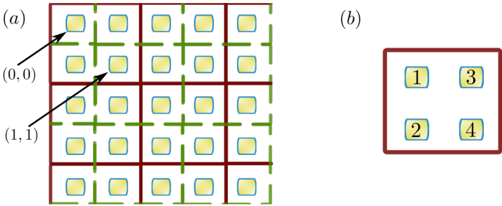
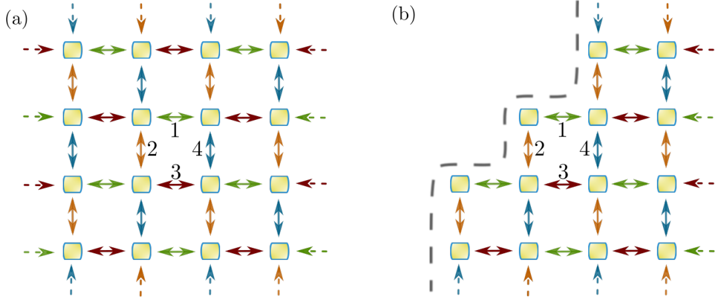
“) First, we introduce a generalized Margolus partitioning (given in [18] and generalized from [96]).”
MethodThe Cellular Automaton Interpretation of Quantum Mechanics
't Hooft, G. (2016) · Fundamental Theories of Physics · doi:10.1007/978-3-319-41285-6 · Cited by 355 · cited 1×
“amiltonians in continuous time, though they are an interesting model of quantum computation. QCAs are also not to be confused with attempts to replace quantum mechanics by classical cellular automata [46], which is referred to as the cellular automaton interpretation of quantum mechanics. It is worth mentioning that t…”
BackgroundOn the Product of Semi-Groups of Operators
Trotter, H. F. (1959) · Proceedings of the American Mathematical Society · doi:10.2307/2033649 · Cited by 322
(3+1)-TQFTs and topological insulators
Walker, K., & Wang, Z. (2012) · Frontiers of Physics · doi:10.1007/s11467-011-0194-z · Cited by 298 · cited 1×
“One such example in three dimensions, where QCAs play a role, is a specific case of the Walker-Wang model [127, 128].”
BackgroundLie Groups, Lie Algebras, and Representations
Hall, B. C. (2013) · Graduate Texts in Mathematics · doi:10.1007/978-1-4614-7116-5_16 · Cited by 290
Disorder-Induced Floquet Topological Insulators
Titum, P., Lindner, N. H., Rechtsman, M. C., & Refael, G. (2015) · Physical Review Letters · doi:10.1103/physrevlett.114.056801 · Cited by 258 · cited 1×
“To answer this question, dynamical topological phases have been introduced and classified in Floquet systems [110–113] for non-interacting particles.”
BackgroundAnomalous Floquet-Anderson Insulator as a Nonadiabatic Quantized Charge Pump
Titum, P., Berg, E., Rudner, M. S., Refael, G., & Lindner, N. H. (2016) · Physical Review X · doi:10.1103/physrevx.6.021013 · Cited by 256 · cited 1×
“To answer this question, dynamical topological phases have been introduced and classified in Floquet systems [110–113] for non-interacting particles.”
BackgroundJones, V., & Sunder, V. S. (1997) · Cambridge University Press eBooks · doi:10.1017/cbo9780511566219 · Cited by 252 · cited 1×
“nd is also needed to prove some properties of the index in [88]. It is worth mentioning that there is yet another formula for the QCA index, which is in terms of the Jones index [30]. The Jones index [91] essentially quanties the multiplicity of one C*-subalgebra Bin a larger algebra C. To be precise, Band Cmust be ty…”
BackgroundThe vacuum violates Bell's inequalities
Summers, S. J., & Werner, R. (1985) · Physics Letters A · doi:10.1016/0375-9601(85)90093-3 · Cited by 229 · cited 2×
“in mind is that the discrete analogue of the physical ground state is not the state j0iannihilated by all the annihilation operators n. This is because the vacuum in QFT is a highly entangled state [62], and the QCA must reproduce this entanglement in the continuum limit. Even in non-interacting QFTs, there is vacuum…”
BackgroundLattice Boltzmann equation for quantum mechanics
Succi, S., & Benzi, R. (1993) · Physica D: Nonlinear Phenomena · doi:10.1016/0167-2789(93)90096-j · Cited by 217 · cited 1×
“1 Lattice gases The study of quantum lattice gases dates back to the early days of QCAs [39, 132–135], and a nice discussion can be found in [136].”
BackgroundStabilizing quantum information
Zanardi, P. (2000) · Physical Review A · doi:10.1103/physreva.63.012301 · Cited by 207 · cited 1×
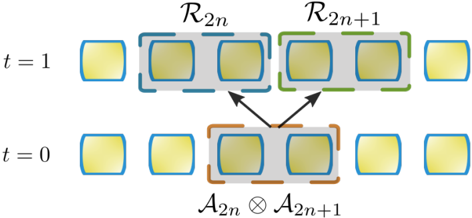
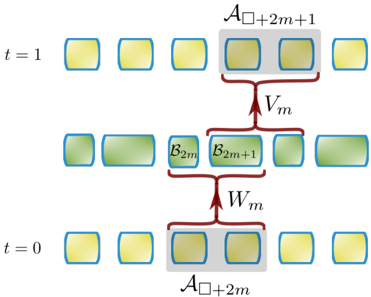
“for all nfor a one-dimensional system. Then B nare the cell algebras for the new regrouped system, each of which contain two cells of the original system. Let us start by introducing support algebras [18, 90]. The intuition underlying support algebras is that they describe, in some sense, the extent to which one algeb…”
BackgroundWeyl, Dirac, and Maxwell equations on a lattice as unitary cellular automata
Bialynicki-Birula, I. (1994) · Physical Review D · doi:10.1103/physrevd.49.6920 · Cited by 195
Ludwig, A. W. W. (2015) · Physica Scripta · doi:10.1088/0031-8949/2015/t168/014001 · Cited by 191
Jones, J. A. (2011) · Progress in Nuclear Magnetic Resonance Spectroscopy · doi:10.1016/j.pnmrs.2010.11.001 · Cited by 185 · cited 1×
“uces for universal quantum computation. (In fact, even a single species should be sucient [73, 81].) These kinds of models are what some authors mean by the name quantum cellular automata (e.g., in [82]), whereas, from our point of view, a better name would be classically controlled QCAs, as they typically involve die…”
BackgroundQuantum Algorithms for Fermionic Quantum Field TheoriesPreprint
Jordan, S. P., Lee, K. S. M., & Preskill, J. P. (2014) · arXiv (Cornell University) · doi:10.48550/arxiv.1404.7115 · Cited by 181 · cited 2×
“Recently, several quantum algorithms have been proposed that efficiently simulate some quantum field theories (φ(4) theory [148] and the Gross-Niveau model [149]).”
BackgroundMethodThree-dimensional topological lattice models with surface anyons
von Keyserlingk, C. W., Burnell, F. J., & Simon, S. H. (2013) · Physical Review B · doi:10.1103/physrevb.87.045107 · Cited by 175 · cited 1×
“One such example in three dimensions, where QCAs play a role, is a specific case of the Walker-Wang model [127, 128].”
BackgroundThe Statistical Mechanics of Lattice Gases, Volume I
Simon, B. (1993) · Princeton University Press eBooks · doi:10.1515/9781400863433 · Cited by 174
An overview of quantum cellular automata
Arrighi, P. J. (2019) · Natural Computing · doi:10.1007/s11047-019-09762-6 · Cited by 169 · cited 1×
“Coincidentally, another review was written at the same time as this one [33], which is quite complementary to this one, as it has a detailed discussion of intrinsic universality, a topic that is mentioned only briefly here in section 4.”
BackgroundMatrix product unitaries: structure, symmetries, and topological invariants
Cirac, J. I., Pérez-García, D., Schuch, N., & Verstraete, F. (2017) · Journal of Statistical Mechanics Theory and Experiment · doi:10.1088/1742-5468/aa7e55 · Cited by 169
Towards a fullerene-based quantum computer
Benjamin, S. C., Ardavan, A., Briggs, G. A. D., Britz, D. A., Gunlycke, D., Jefferson, J., Jones, M. A. G., Leigh, D. F., Lovett, B. W., Khlobystov, A. N., et al. (2006) · Journal of Physics: Condensed Matter · doi:10.1088/0953-8984/18/21/s12 · Cited by 169 · cited 1×
“kyballs) that have, e.g., an atom trapped inside the cage formed by the carbon atoms. And the idea of using these molecules as parts of a quantum computer met with a degree of experimental success in [86]. In that case, Nitrogen atoms were trapped in the fullerenes and the levels considered arose from a spin 3=2 elect…”
BackgroundChiral Floquet Phases of Many-Body Localized Bosons
Po, H. C., Fidkowski, L., Morimoto, T., Potter, A. C., & Vishwanath, A. (2016) · Physical Review X · doi:10.1103/physrevx.6.041070 · Cited by 168 · cited 4×
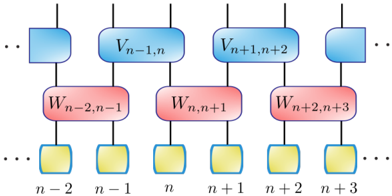
“peration. The motivation for this decomposition of QCAs in terms of tensor networks is that it is useful for characterizing symmetries of QCAs [97, 100], and also topological phases of Floquet models [23]. First, let us introduce translationally invariant matrix product unitaries. (Note that we work in the Schrodinger…”
BackgroundMethodInfluentialLight-cone lattice approach to fermionic theories in 2D
Destri, C., & De Vega, H. J. (1987) · Nuclear Physics B · doi:10.1016/0550-3213(87)90193-3 · Cited by 162 · cited 2×
“How one shows this is given in detail in [151], though the evolution operator for the QCA is slightly different in that case, but the basic idea is the same.”
BackgroundMethodEfficient Approximation of the Dynamics of One-Dimensional Quantum Spin Systems
Osborne, T. J. (2006) · Physical Review Letters · doi:10.1103/physrevlett.97.157202 · Cited by 161 · cited 3×
“A different approach uses Lieb-Robinson bounds [22] to ensure that we can approximate continuous-time dynamics with high accuracy using a QCA [103, 104].”
BackgroundMethodOn one-dimensional quantum cellular automata
Watrous, J. (2002) · Proceedings of IEEE 36th Annual Foundations of Computer Science · doi:10.1109/sfcs.1995.492583 · Cited by 157 · cited 5×
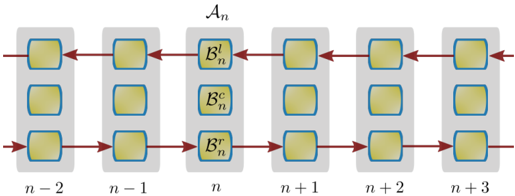
“B c n ˙(Br n ) = B r n 1 : (19) This particular conditional shift (we could dene more general versions, particularly in higher lattice dimensions) is useful for constructing the partitioned QCAs in [15, 28], which are usually referred to as Watrous partitioned QCAs. After applying ˙, we may also apply an automorphism…”
BackgroundMethodInfluentialIndex Theory of One Dimensional Quantum Walks and Cellular Automata
Gross, D., Nesme, V., Vogts, H., & Werner, R. F. (2012) · Communications in Mathematical Physics · doi:10.1007/s00220-012-1423-1 · Cited by 155 · cited 5×
“B 1) is generated by all b1 i arising in this way. Two algebras Aand Bcommute, if each element a2Aand each element b2Bcommute. If this is the case, we write [A;B] = 0. The following lemma (see, e.g., [88] for a simple proof) is a useful result, which shows that, if two algebras commute, their support algebras also com…”
BackgroundMethodInfluentialP-completeness of Cellular Automaton Rule 110
Neary, T., & Woods, D. (2006) · Lecture notes in computer science · doi:10.1007/11786986_13 · Cited by 152 · cited 1×
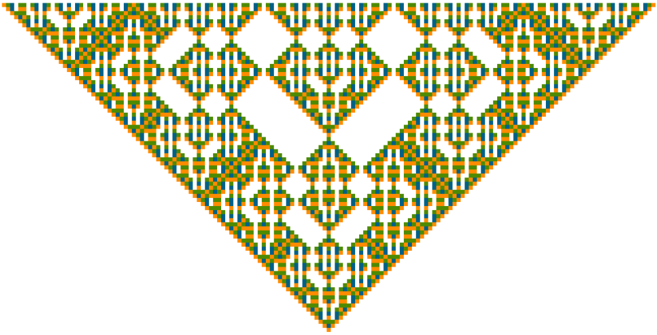
“the update rule, as binary and converting to decimal gives 110. This CA can simulate a Turing machine [6], and it was shown later that this can even be done eciently (with only polynomial overhead) [7]. Figure 1: An example of a CA evolution for the rule 110 CA, with time going up. Bits with value 1 are represented by…”
MethodLectures on the Quantum Hall Effect
Tong, D. (2016) · arXiv · doi:10.48550/arxiv.1606.06687 · Cited by 144
Quantum-cellular-automata quantum computing with endohedral fullerenes
Twamley, J. (2003) · Physical Review A · doi:10.1103/physreva.67.052318 · Cited by 134 · cited 1×
“This scheme was studied further in [83, 84], and in [85] an implementation of this idea using endohedral fullerenes was analyzed theoretically.”
MethodSubsystem symmetries, quantum cellular automata, and computational phases of quantum matter
Stephen, D. T., Nautrup, H. P., Bermejo-Vega, J., Eisert, J., & Raussendorf, R. (2019) · Quantum · doi:10.22331/q-2019-05-20-142 · Cited by 131
Quantum computing with quantum-dot cellular automata
Tóth, G., & Lent, C. S. (2001) · Physical Review A · doi:10.1103/physreva.63.052315 · Cited by 124 · cited 1×
“mputing using quantum dots instead of conventional semiconductor-based integrated circuits. However, a proposal has also been made to use such an array of quantum dots to implement a quantum computer [42], though the idea here is to use the circuit model of quantum computation, which typically uses many dierent few-qu…”
MethodTrabesinger, A. H. (2012) · Nature Physics · doi:10.1038/nphys2258 · Cited by 123
Simulating quantum mechanics on a quantum computer
Boghosian, B. M., & Taylor, W. (1998) · Physica D: Nonlinear Phenomena · doi:10.1016/s0167-2789(98)00042-6 · Cited by 120 · cited 1×
“1 Lattice gases The study of quantum lattice gases dates back to the early days of QCAs [39, 132–135], and a nice discussion can be found in [136].”
BackgroundStrauch, F. W. (2006) · Physical Review A · doi:10.1103/physreva.73.054302 · Cited by 115 · cited 2×
“e last line above corresponding to evolution via the one-dimensional Dirac equation with Hamiltonian H= P˙ z+ m˙ x. A lot of interesting work has been done using this simple yet powerful quantum walk [35, 121, 122]. This includes studying, e.g., how mass mixes chiralities and Zitterbewegung [123]. We can also construc…”
BackgroundMethodThe Dirac equation as a quantum walk: higher dimensions, observational convergence
Arrighi, P., Nesme, V., & Forets, M. (2014) · Journal of Physics A: Mathematical and Theoretical · doi:10.1088/1751-8113/47/46/465302 · Cited by 114
Reversible quantum cellular automata
Schumacher, B., & Werner, R. F. (2004) · arXiv · doi:10.48550/arxiv.quant-ph/0405174 · Cited by 113
On the absence of homogeneous scalar unitary cellular automata
Meyer, D. A. (1996) · Physics Letters A · doi:10.1016/s0375-9601(96)00745-1 · Cited by 112
Facilitated quantum cellular automata as simple models with non-thermal eigenstates and dynamics
Gopalakrishnan, S., & Zakirov, B. (2018) · Quantum Science and Technology · doi:10.1088/2058-9565/aad759 · Cited by 110 · cited 1×
“slationally invariant stabilizer state in one dimension can be generated by the action of a Cliord QCA acting on a product state. More recently, the eigenstates of Cliord QCAs have been analysed in [68], where it was seen that the eigenstate thermalization hypothesis does not apply to these models. The eigenstate ther…”
BackgroundFermion-to-qubit mappings with varying resource requirements for quantum simulation
Steudtner, M., & Wehner, S. (2018) · New Journal of Physics · doi:10.1088/1367-2630/aac54f · Cited by 104 · cited 1×
“s for quantum computation instead of qubit circuits [78]. Also, the opposite direction, simulating fermionic systems with qubit quantum circuits, is highly relevant for quantum simulations of physics [79]. For the quantum circuit model, it was shown in [78] that quantum computers using qubits can eciently simulate qua…”
ResultUnitarity plus causality implies localizability
Arrighi, P., Nesme, V., & Werner, R. (2011) · Journal of Computer and System Sciences · doi:10.1016/j.jcss.2010.05.004 · Cited by 99 · cited 5×
“.1 Systems QCAs are dened on quantum lattice systems, meaning we have a discrete spatial lattice with quantum systems at each lattice site (or cell). Some authors consider more general graphs, e.g., [19], but we will stick with lattices here. The lattices we consider may be innite, i.e., Zd, or nite, possibly with per…”
BackgroundInfluentialQuantum walk of two interacting bosons
Lahini, Y., Verbin, M., Huber, S. D., Bromberg, Y., Pugatch, R., & Silberberg, Y. (2012) · Physical Review A · doi:10.1103/physreva.86.011603 · Cited by 99 · cited 1×
“For other studies of interacting two-particle quantum walks, see [160, 161].”
BackgroundQuantum Spin Systems on Infinite Lattices: A Concise Introduction
Naaijkens, P. (2017) · Lecture notes in physics · doi:10.1007/978-3-319-51458-1 · Cited by 99
Molecular binding in interacting quantum walks
Ahlbrecht, A., Alberti, A., Meschede, D., Scholz, V. B., Werner, A. H., & Werner, R. F. (2012) · New Journal of Physics · doi:10.1088/1367-2630/14/7/073050 · Cited by 96 · cited 1×
“This is essentially a second-quantized version of the interacting quantum walks considered in [141, 142].”
BackgroundQuantum walks as massless Dirac fermions in curved space-time
Di Molfetta, G., Brachet, M., & Debbasch, F. (2013) · Physical Review A · doi:10.1103/physreva.88.042301 · Cited by 94 · cited 1×
“, Dirac or Weyl particles in curved spacetime [126–128] or in external gauge fields [36, 129] or both [130], and so these models can also be upgraded to QCAs.”
BackgroundPropagation of Quantum Walks in Electric Fields
Cedzich, C., Rybár, T., Werner, A. H., Alberti, A., Genske, M., & Werner, R. F. (2013) · Physical Review Letters · doi:10.1103/physrevlett.111.160601 · Cited by 94 · cited 2×
“, [35, 36]).”
BackgroundQuantum walks in artificial electric and gravitational fields
Di Molfetta, G., Brachet, M., & Debbasch, F. (2014) · Physica A: Statistical Mechanics and its Applications · doi:10.1016/j.physa.2013.11.036 · Cited by 93 · cited 1×
“, Dirac or Weyl particles in curved spacetime [126–128] or in external gauge fields [36, 129] or both [130], and so these models can also be upgraded to QCAs.”
BackgroundThe Topological Classification of One-Dimensional Symmetric Quantum Walks
Cedzich, C., Geib, T., Grünbaum, F. A., Stahl, C., Velázquez, L., Werner, A. H., & Werner, R. F. (2017) · Annales Henri Poincaré · doi:10.1007/s00023-017-0630-x · Cited by 85 · cited 1×
“, [34]; the symmetry-protected topological phases of these models can be classified [116–119]; and they also have more direct applications in quantum computing [120].”
BackgroundAn Introduction to Cellular Automata: Some basic definitions and concepts
Delorme, M. (1999) · Springer eBooks · doi:10.1007/978-94-015-9153-9_1 · Cited by 84 · cited 1×
“ften see the emergence of highly complex behaviour. CAs were rst introduced by von Neumann [1, 2], who wanted to nd a model that was universal for computation and could in some sense replicate itself [3]. Building on a suggestion by Ulam, von Neumann considered systems with discrete variables on a two-dimensional latt…”
BackgroundSchemes for parallel quantum computation without local control of qubits
Benjamin, S. C. (2000) · Physical Review A · doi:10.1103/physreva.61.020301 · Cited by 83 · cited 2×
“be implemented.) With various dierent combinations of pulses, one can implement various dierent gates. The input and readout of data occurs only on the end qubits of the line. Later it was shown in [80] that two species in an :::ABAB:::pattern suces for universal quantum computation. (In fact, even a single species sh…”
BackgroundUnitary and Nonunitary Quantum Cellular Automata with Rydberg Arrays
Wintermantel, T. M., Wang, Y., Lochead, G., Shevate, S., Brennen, G. K., & Whitlock, S. (2020) · Physical Review Letters · doi:10.1103/physrevlett.124.070503 · Cited by 83 · cited 1×
“Most recently, a proposal has been made to use ultracold atoms excited to Rydberg states to implement QCAs in practice [95].”
BackgroundQuantum field as a quantum cellular automaton: The Dirac free evolution in one dimension
Bisio, A., D’Ariano, G. M., & Tosini, A. (2015) · Annals of Physics · doi:10.1016/j.aop.2014.12.016 · Cited by 81
Quantum Computing Without Local Control of Qubit-Qubit Interactions
Benjamin, S. C. (2001) · Physical Review Letters · doi:10.1103/physrevlett.88.017904 · Cited by 80 · cited 1×
“n [82]), whereas, from our point of view, a better name would be classically controlled QCAs, as they typically involve dierent unitaries applied at each timestep. This scheme was studied further in [83, 84], and in [85] an implementation of this idea using endohedral fullerenes was analyzed theoretically. Endohedral…”
BackgroundQuantum Cellular Automata, Tensor Networks, and Area Laws
Piroli, L., & Cirac, J. I. (2020) · Physical Review Letters · doi:10.1103/physrevlett.125.190402 · Cited by 76
Interacting invariants for Floquet phases of fermions in two dimensions
Fidkowski, L., Po, H. C., Potter, A. C., & Vishwanath, A. (2019) · Physical Review B · doi:10.1103/physrevb.99.085115 · Cited by 75 · cited 5×
“component of the denition of a QCA, but because of Lieb-Robinson bounds [22], they do approximately. In this context, QCA techniques have been useful for classifying chiral phases of Floquet systems [23, 24]. The key to this is the index theory for one-dimensional QCAs, which allows one to assign a number to one-dimen…”
BackgroundMethodInfluentialRevisiting the simulation of quantum Turing machines by quantum circuits
Molina, A., & Watrous, J. (2019) · Proceedings of the Royal Society A Mathematical Physical and Engineering Sciences · doi:10.1098/rspa.2018.0767 · Cited by 70 · cited 1×
“upon. In particular, at time t= 0 column 0 has the initial input data for the quantum algorithm. 6Of course, another way to see this is by using a quantum circuit to simulate a quantum Turing machine [70] that in turn simulates a QCA. This would work in one dimension at least, since quantum Turing machines can simulat…”
MethodAn efficient and accurate quantum lattice-gas model for the many-body Schrödinger wave equation
Yepez, J., & Boghosian, B. M. (2002) · Computer Physics Communications · doi:10.1016/s0010-4655(02)00419-8 · Cited by 70
Quantum walking in curved spacetime
Arrighi, P., Facchini, S., & Forets, M. (2016) · Quantum Information Processing · doi:10.1007/s11128-016-1335-7 · Cited by 63 · cited 1×
“, Dirac or Weyl particles in curved spacetime [126–128] or in external gauge fields [36, 129] or both [130], and so these models can also be upgraded to QCAs.”
BackgroundEntanglement dynamics in one-dimensional quantum cellular automata
Brennen, G. K., & Williams, J. E. (2003) · Physical Review A · doi:10.1103/physreva.68.042311 · Cited by 63 · cited 5×
“e for, e.g., the use of QCAs as toy models for understanding Floquet topological phases in section 6.2. 3.What can be said about irreversible QCAs, which have only received little attention in, e.g., [17, 49]. At the moment, there are only constructive denitions. For example, it makes sense to give examples of irrever…”
BackgroundMethodInfluentialA quantum cellular automaton for one-dimensional QED
Arrighi, P. J., Bény, C., & Farrelly, T. (2020) · Quantum Information Processing · doi:10.1007/s11128-019-2555-4 · Cited by 63 · cited 1×
“an interacting quantum field theory, in this case quantum electrodynamics in one spatial dimension, was given in [158].”
Self-citationFree-Dirac-particle evolution as a quantum random walk
Bracken, A. J., Ellinas, D., & Smyrnakis, I. (2007) · Physical Review A · doi:10.1103/physreva.75.022322 · Cited by 60 · cited 1×
“A lot of interesting work has been done using this simple yet powerful quantum walk [35, 121, 122].”
BackgroundDiscrete-time quantum walks: Continuous limit and symmetries
di Molfetta, G., & Debbasch, F. (2012) · Journal of Mathematical Physics · doi:10.1063/1.4764876 · Cited by 60 · cited 1×
“A lot of interesting work has been done using this simple yet powerful quantum walk [35, 121, 122].”
BackgroundClassification of Quantum Cellular Automata
Freedman, M., & Hastings, M. B. (2020) · Communications in Mathematical Physics · doi:10.1007/s00220-020-03735-y · Cited by 60 · cited 3×
“First, we need to discuss the notion of equivalence used in [53].”
BackgroundInfluentialDiscrete Lorentz covariance for quantum walks and quantum cellular automata
Arrighi, P. J., Facchini, S., & Forets, M. (2014) · New Journal of Physics · doi:10.1088/1367-2630/16/9/093007 · Cited by 58 · cited 1×
“Nevertheless, some attempts have been made to introduce a discrete version of Lorentz symmetry for QCAs [143].”
BackgroundTime asymptotics and entanglement generation of Clifford quantum cellular automata
Gütschow, J., Uphoff, S., Werner, R. F., & Zimborás, Z. (2010) · Journal of Mathematical Physics · doi:10.1063/1.3278513 · Cited by 58 · cited 3×
“Additionally, entanglement generation in Clifford QCAs was studied in [65, 66].”
BackgroundMethodBulk-edge correspondence of one-dimensional quantum walks
Cedzich, C., Grünbaum, F. A., Stahl, C., Velázquez, L., Werner, A. H., & Werner, R. F. (2016) · Journal of Physics A: Mathematical and Theoretical · doi:10.1088/1751-8113/49/21/21lt01 · Cited by 57
One-Dimensional Quantum Cellular Automata over Finite, Unbounded Configurations
Arrighi, P. J., Nesme, V., & Werner, R. F. (2008) · Lecture notes in computer science · doi:10.1007/978-3-540-88282-4_8 · Cited by 57
Quantum cellular automaton for universal quantum computation
Raussendorf, R. (2005) · Physical Review A · doi:10.1103/physreva.72.022301 · Cited by 56 · cited 4×
“e j1istate, the unitary U 1 is applied to qubit 1, and if it is in the j0istate, the identity is applied. H 1 is the Hadamard gate applied to qubit 1, i.e., H 1 = (X 1 + Z 1)= p 2. The choice made in [71] for the gates U 1 and R 12 is U 1 = exp i ˇ 8 Z 1 R 12 = C 1[Z 2]; (22) so R 12 is simply a Pauli Z operator on qu…”
MethodInfluentialHamiltonian quantum cellular automata in one dimension
Nagaj, D., & Wocjan, P. (2008) · Physical Review A · doi:10.1103/physreva.78.032311 · Cited by 56 · cited 1×
“rred to in [42] as a coherent quantum dot cellular automata. Another similar-sounding but dierent model are continuous-time quantum cellular automata [43]. These also go by the name Hamiltonian QCAs [44] or continuous cellular automata [45]. These do not t our denition of quantum cellular automata because they evolve…”
BackgroundQuantum walks in external gauge fields
Cedzich, C., Geib, T., Werner, A. H., & Werner, R. F. (2019) · Journal of Mathematical Physics · doi:10.1063/1.5054894 · Cited by 56 · cited 1×
“, Dirac or Weyl particles in curved spacetime [141–144] or in external gauge fields [39, 145, 146] or both [147], and so these models can also be upgraded to QCAs.”
BackgroundQuantum computation via translation-invariant operations on a chain of qubits
Raussendorf, R. (2005) · Physical Review A · doi:10.1103/physreva.72.052301 · Cited by 55 · cited 1×
“rs only on the end qubits of the line. Later it was shown in [80] that two species in an :::ABAB:::pattern suces for universal quantum computation. (In fact, even a single species should be sucient [73, 81].) These kinds of models are what some authors mean by the name quantum cellular automata (e.g., in [82]), wherea…”
BackgroundMatrix product representation of locality preserving unitaries
Şahinoglu, M., Shukla, S. K., Bi, F., & Chen, X. (2018) · Physical review. B./Physical review. B · doi:10.1103/physrevb.98.245122 · Cited by 55 · cited 1×
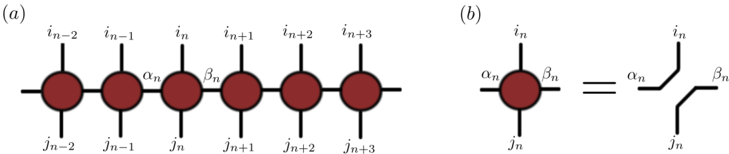
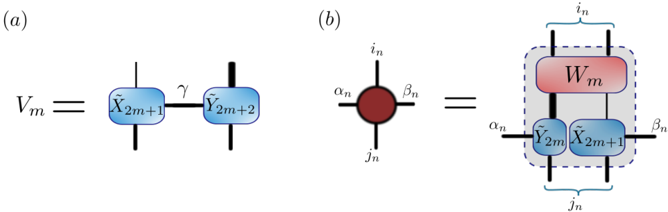
“It turns out that translationally invariant QCAs in one dimension are actually equivalent to a type of tensor network known as matrix product unitaries [97, 98].”
BackgroundWinning Ways for Your Mathematical Plays, Volume 2
Berlekamp, E. R., Conway, J. H., & Guy, R. K. (2018) · A K Peters/CRC Press eBooks · doi:10.1201/9780429487323 · Cited by 55
Quantum Simulators, Continuous-Time Automata, and Translationally Invariant Systems
Vollbrecht, K. G. H., & Cirac, J. I. (2008) · Physical Review Letters · doi:10.1103/physrevlett.100.010501 · Cited by 54 · cited 1×
“dot cellular automata. Another similar-sounding but dierent model are continuous-time quantum cellular automata [43]. These also go by the name Hamiltonian QCAs [44] or continuous cellular automata [45]. These do not t our denition of quantum cellular automata because they evolve via Hamiltonians in continuous time, t…”
BackgroundQuantum computing in arrays coupled by “always-on” interactions
Benjamin, S. C., & Bose, S. (2004) · Physical Review A · doi:10.1103/physreva.70.032314 · Cited by 54 · cited 1×
“n [82]), whereas, from our point of view, a better name would be classically controlled QCAs, as they typically involve dierent unitaries applied at each timestep. This scheme was studied further in [83, 84], and in [85] an implementation of this idea using endohedral fullerenes was analyzed theoretically. Endohedral…”
BackgroundClassification of Matrix-Product Unitaries with Symmetries
Gong, Z., Sünderhauf, C., Schuch, N., & Cirac, J. I. (2020) · Physical Review Letters · doi:10.1103/physrevlett.124.100402 · Cited by 53 · cited 3×
“These MPUs can be further classified in the presence of on-site unitary symmetries [100].”
BackgroundMethodInfluentialCellular Automata Modeling of Physical Systems
Bastien Chopard, B. (2009) · Springer eBooks · doi:10.1007/978-1-4939-8700-9_57 · Cited by 53
Algebraic Methods for Quantum Codes on Lattices
Haah, J. (2017) · Revista Colombiana de Matemáticas · doi:10.15446/recolma.v50n2.62214 · Cited by 52 · cited 1×
“And Clifford QCAs play a role in understanding the properties of stabilizer codes in more general systems [73].”
BackgroundOn the structure of Clifford quantum cellular automata
Schlingemann, D.-M., Vogts, H., & Werner, R. F. (2008) · Journal of Mathematical Physics · doi:10.1063/1.3005565 · Cited by 52 · cited 4×
“Remarkably, the QCAs in equation (9) for different values of l, together with on-site Clifford operations and the shift generate all possible translationally invariant Clifford QCAs in one dimension [64].”
BackgroundMethodInfluentialErgodicity of quantum cellular automata
Richter, S., & Werner, R. F. (1996) · Journal of Statistical Physics · doi:10.1007/bf02179798 · Cited by 51 · cited 5×
“As an aside, it would also be interesting to consider irreversible QCAs, as in [17, 49], though not much work has been done in this direction.”
BackgroundInfluentialUniversally Programmable Quantum Cellular Automaton
Shepherd, D. J., Franz, T., & Werner, R. F. (2006) · Physical Review Letters · doi:10.1103/physrevlett.97.020502 · Cited by 50 · cited 2×
“ult to do in a laboratory, so it may be more desirable for practical reasons to work with a one-dimensional QCA. That quantum circuits can be eciently simulated by a one-dimensional QCA was shown in [72], which gave a construction for a universal one-dimensional QCA with 12 dimensional quantum systems at each cell. A…”
BackgroundPartitioned quantum cellular automata are intrinsically universal
Arrighi, P. J., & Grattage, J. (2011) · Natural Computing · doi:10.1007/s11047-011-9277-6 · Cited by 49 · cited 1×
“This has been studied in detail in [74–77], where n-dimensional intrinsically universal QCAs were found [75, 76].”
Quantum walks and Dirac cellular automata on a programmable trapped-ion quantum computer
Huerta Alderete, C., Singh, S., Nguyen, N. H., Zhu, D., Balu, R., Monroe, C., Chandrashekar, C. M., & Linke, N. M. (2020) · Nature Communications · doi:10.1038/s41467-020-17519-4 · Cited by 48
Local unitary quantum cellular automata
Pérez-Delgado, C. A., & Cheung, D. (2007) · Physical Review A · doi:10.1103/physreva.76.032320 · Cited by 46 · cited 3×
“, local unitary QCAs [50].”
BackgroundMethodInfluentialDirac Cellular Automaton from Split-step Quantum Walk
Mallick, A., & Chandrashekar, C. M. (2016) · Scientific Reports · doi:10.1038/srep25779 · Cited by 45
Complete homotopy invariants for translation invariant symmetric quantum walks on a chain
Cedzich, C., Geib, T., Stahl, C., Velázquez, L., Werner, A. H., & Werner, R. F. (2018) · Quantum · doi:10.22331/q-2018-09-24-95 · Cited by 45
Doubly special relativity from quantum cellular automata
Bibeau-Delisle, A., Bisio, A., D’Ariano, G. M., Perinotti, P., & Tosini, A. (2015) · Europhysics Letters (EPL) · doi:10.1209/0295-5075/109/50003 · Cited by 44
Quantum cellular automaton theory of light
Bisio, A., D’Ariano, G. M., & Perinotti, P. (2016) · Annals of Physics · doi:10.1016/j.aop.2016.02.009 · Cited by 44
Exactly solvable model for a 4+1D beyond-cohomology symmetry-protected topological phase
Fidkowski, L., Haah, J., & Hastings, M. B. (2020) · Physical review. B./Physical review. B · doi:10.1103/physrevb.101.155124 · Cited by 44
Quantum Lattice Gases and Their Invariants
Meyer, D. A. (1997) · International Journal of Modern Physics C · doi:10.1142/s0129183197000618 · Cited by 43 · cited 1×
“1 Lattice gases The study of quantum lattice gases dates back to the early days of QCAs [39, 132–135], and a nice discussion can be found in [136].”
BackgroundThirring quantum cellular automaton
Bisio, A., D’Ariano, G. M., Perinotti, P., & Tosini, A. (2018) · Physical Review A · doi:10.1103/physreva.97.032132 · Cited by 43
Quantum walking in curved spacetime: (3+1) dimensions, and beyond
Arrighi, P. J., & Facchini, S. (2017) · Quantum Information and Computation · doi:10.26421/qic17.9-10-4 · Cited by 43
Quantum cellular automata and free quantum field theory
D’Ariano, G. M., & Perinotti, P. (2016) · Frontiers of Physics · doi:10.1007/s11467-016-0616-z · Cited by 41 · cited 1×
“More recently, there has been much work on discretizing non-interacting fermionic fields by QCAs [58, 150, 152–156], which consider Dirac and Weyl QCAs in higher dimensional spaces.”
BackgroundCausal fermions in discrete space-time
Farrelly, T., & Short, A. J. (2014) · Physical Review A · doi:10.1103/physreva.89.012302 · Cited by 40 · cited 4×
“consequence of which was that there is a choice of QCA vacuum that converges to the quantum eld vacuum. More recently, there has been much work on discretizing non-interacting fermionic elds by QCAs [58, 150, 152{156], which consider Dirac and Weyl QCAs in higher dimensional spaces. Furthermore, the one-dimensional Di…”
BackgroundMethodInfluentialSelf-citationArrighi, P. J., & Martiel, S. (2017) · Physical review. D/Physical review. D. · doi:10.1103/physrevd.96.024026 · Cited by 40 · cited 1×
“he minimum depth circuit is then given by max ~njN B(~n)j+ 1. Here N B(~n) denotes the neighbourhood of site ~nwith respect to the unitary U B. The result was later generalized to dynamical graphs in [87], where the QCA neighbourhood scheme could change over time. This was done with a view towards discrete models of q…”
InfluentialMARGOLUS, N. (1986) · Annals of the New York Academy of Sciences · doi:10.1111/j.1749-6632.1986.tb12451.x · Cited by 38 · cited 1×
“QCAs include reversible CAs as a subset [14, 54], which may be a useful fact, in analogy to how models in classical statistical physics are special cases of quantum systems and are often in the same universality classes as physical materials.”
BackgroundFermionic quantum cellular automata and generalized matrix-product unitaries
Piroli, L., Turzillo, A., Shukla, S. K., & Cirac, J. I. (2021) · Journal of Statistical Mechanics Theory and Experiment · doi:10.1088/1742-5468/abd30f · Cited by 38 · cited 2×
“This is trickier than in the qudit case: a very natural definition for fermionic matrix product states was shown not to capture all fermionic QCAs [110].”
BackgroundLimits on Efficient Computation in the Physical WorldPreprint
Aaronson, S. (2004) · arXiv (Cornell University) · doi:10.48550/arxiv.quant-ph/0412143 · Cited by 38 · cited 1×
“Describing physics (and specifically quantum physics) by classical cellular automata was also proposed in [47], though this also has problems in describing entanglement [48].”
BackgroundClassifying quantum phases with the Kirby torus trick
Hastings, M. B. (2013) · Physical Review B · doi:10.1103/physrevb.88.165114 · Cited by 37 · cited 1×
“The main result of [108] is that one-dimensional matrix product unitaries are completely classified by (i) the QCA index and (ii) the cohomology class of the representation of the symmetry group acting on the bond indices, as conjectured in [109].”
BackgroundThe quantum field as a quantum computer
D’Ariano, G. M. (2011) · Physics Letters A · doi:10.1016/j.physleta.2011.12.021 · Cited by 36
Discrete spacetime and relativistic quantum particles
Farrelly, T. C., & Short, A. J. (2014) · Physical Review A · doi:10.1103/physreva.89.062109 · Cited by 34 · cited 1×
“We can also construct quantum walks in higher dimensional spaces that give rise to relativistic particles in the continuum limit [34], which is in some sense generic [124].”
BackgroundSelf-citationReversible universal quantum computation within translation-invariant systems
Vollbrecht, K. G. H., & Cirac, J. I. (2006) · Physical Review A · doi:10.1103/physreva.73.012324 · Cited by 33 · cited 2×
“(In fact, even a single species should be sufficient [73, 81].”
BackgroundRelativistic effects in quantum walks: Klein's paradox and zitterbewegung
Kurzyński, P. (2008) · Physics Letters A · doi:10.1016/j.physleta.2008.08.017 · Cited by 31 · cited 1×
“, how mass mixes chiralities and Zitterbewegung [123].”
BackgroundIntrinsically universal n-dimensional quantum cellular automata
Arrighi, P. J., & Grattage, J. (2012) · Journal of Computer and System Sciences · doi:10.1016/j.jcss.2011.12.008 · Cited by 31
Structures in quantum cellular automata
Grössing, G., & Zeilinger, A. (1988) · Physica B+C · doi:10.1016/0378-4363(88)90196-9 · Cited by 31
Discretizing quantum field theories for quantum simulationPreprint
Farrelly, T., & Streich, J. (2020) · arXiv (Cornell University) · doi:10.48550/arxiv.2002.02643 · Cited by 30 · cited 3×
“Furthermore, for interacting bosonic quantum field theories, such as φ4 theory and non-abelian gauge theories, the discrete-time path integral from lattice QFT is actually exactly equivalent to a QCA [22].”
BackgroundMethodInfluentialSelf-citationSimulating Dirac Hamiltonian in curved space-time by split-step quantum walk
Mallick, A., Mandal, S., Karan, A., & Chandrashekar, C. M. (2019) · Journal of Physics Communications · doi:10.1088/2399-6528/aafe2f · Cited by 29
DeMarco, M., & Wen, X.-G. (2017) · arXiv (Cornell University) · doi:10.48550/arxiv.1706.04648 · Cited by 28
Entanglement generation of Clifford quantum cellular automata
Gütschow, J. (2009) · Applied Physics B · doi:10.1007/s00340-009-3840-1 · Cited by 27 · cited 3×
“The fractal structure in spacetime plots of fractal Clifford QCAs was studied in further detail in [66, 67].”
BackgroundMethodBisio, A., D’Ariano, G. M., Perinotti, P., & Tosini, A. (2015) · Foundations of Physics · doi:10.1007/s10701-015-9927-0 · Cited by 26
Electric quantum walks in two dimensions
Bru, L. A., Hinarejos, M., Silva, F., de Valcárcel, G. J., & Roldán, E. (2016) · Physical Review A · doi:10.1103/physreva.93.032333 · Cited by 25
Special relativity in a discrete quantum universe
Bisio, A., D'Ariano, G. M., & Perinotti, P. (2016) · Physical Review A · doi:10.1103/physreva.94.042120 · Cited by 25
Bisio, A., D’Ariano, G. M., Perinotti, P., & Tosini, A. (2015) · Foundations of Physics · doi:10.1007/s10701-015-9934-1 · Cited by 25
Quantum lattice gas algorithmic representation of gauge field theory
Yepez, J. (2016) · Proceedings of SPIE, the International Society for Optical Engineering/Proceedings of SPIE · doi:10.1117/12.2246702 · Cited by 24 · cited 1×
“Finally, it is worth mentioning that a general proposal for discretizing fermions interacting with gauge fields via quantum lattice gases was given in [138, 139].”
BackgroundWhen is a quantum cellular automaton (QCA) a quantum lattice gas automaton (QLGA)?
Shakeel, A., & Love, P. J. (2013) · Journal of Mathematical Physics · doi:10.1063/1.4821640 · Cited by 24 · cited 2×
“a way similar to quantum lattice gases also appeared in [18, 30, 137]. It is also interesting to look at this from a dierent perspective: we may ask when are QCAs equivalent to quantum lattice gases [63], in other words, when do they allow a particle interpretation in the way we have described here? It has been shown…”
BackgroundInfluentialIntrinsically Universal One-dimensional Quantum Cellular Automata in Two Flavours
Arrighi, P. J., Fargetton, R., & Wang, Z. (2009) · Fundamenta Informaticae · doi:10.3233/fi-2009-0041 · Cited by 24 · cited 1×
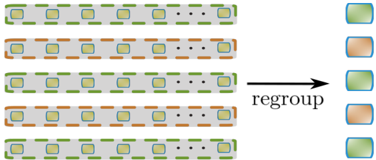
“s this amounts to nding a QCA that, after some regrouping of cells, can simulate any other QCA. This has been studied in detail in [74{77], where n-dimensional intrinsically universal QCAs were found [75, 76]. One might speculate on the possibility of using fermionic QCAs as quantum computers instead of qudit QCAs. Th…”
MethodInteracting quantum walkers: two-body bosonic and fermionic bound states
Krapivsky, P. L., Luck, J. M., & Mallick, K. (2015) · Journal of Physics A Mathematical and Theoretical · doi:10.1088/1751-8113/48/47/475301 · Cited by 22 · cited 1×
“For other studies of interacting two-particle quantum walks, see [160, 161].”
BackgroundContinuum Limits of Quantum Lattice SystemsPreprint
Osborne, T. J. (2019) · arXiv (Cornell University) · doi:10.48550/arxiv.1901.06124 · Cited by 22 · cited 1×
“Is there any analogue of this for QCAs? Another idea would be to use the framework for general continuum limits from [163].”
BackgroundThe fractal structure of cellular automata on abelian groups
Gütschow, J., Nesme, V., & Werner, R. F. (2010) · Discrete Mathematics & Theoretical Computer Science · doi:10.46298/dmtcs.2759 · Cited by 22
Solutions of a Two-Particle Interacting Quantum Walk
Bisio, A., D’Ariano, G. M., Mosco, N., Perinotti, P., & Tosini, A. (2018) · Entropy · doi:10.3390/e20060435 · Cited by 21
Applying Causality Principles to the Axiomatization of Probabilistic Cellular Automata
Arrighi, P. J., Fargetton, R., Nesme, V., & Thierry, É. (2011) · Lecture notes in computer science · doi:10.1007/978-3-642-21875-0_1 · Cited by 21 · cited 1×
“But is there any reasonable axiomatization that seems physically motivated and which also allows useful structure theorems? Even for probabilistic classical cellular automata, this is not at all straightforward [161].”
BackgroundQuantum walks via quantum cellular automata
Costa, P. C. S., Portugal, R., & de Melo, F. (2018) · Quantum Information Processing · doi:10.1007/s11128-018-1983-x · Cited by 20
Discrete Time Quantum Lattice Systems
Vogts, H. (2009) · Digitale Bibliothek Braunschweig (Verbundzentrale Göttingen (VZG)) · doi:10.24355/dbbs.084-200909221038-0 · Cited by 19
Discrete Feynman propagator for the Weyl quantum walk in 2 + 1 dimensions
D’Ariano, G. M., Mosco, N., Perinotti, P., & Tosini, A. (2015) · Europhysics Letters (EPL) · doi:10.1209/0295-5075/109/40012 · Cited by 18 · cited 1×
“As an aside, it is also possible to construct the Feynman propagator in some cases for quantum walks [131].”
BackgroundTracking the quantized information transfer at the edge of a chiral Floquet phase
Duschatko, B., Dumitrescu, P. T., & Potter, A. C. (2018) · Physical review. B./Physical review. B · doi:10.1103/physrevb.98.054309 · Cited by 18 · cited 1×
“A proposal for actually measuring the index characterizing information flow along the boundary of a two-dimensional Floquet system has been made [114].”
BackgroundWiesner, K. (2013) · Springer eBooks · doi:10.1007/978-3-642-27737-5_426-4 · Cited by 17
Arrighi, P., & Grattage, J. (2012) · Physics World · doi:10.1088/2058-7058/25/06/37 · Cited by 16
Insights from Quantum Information into Fundamental PhysicsPreprint
Farrelly, T. (2017) · arXiv (Cornell University) · doi:10.48550/arxiv.1708.08897 · Cited by 16 · cited 4×
“cs We can simulate the dynamics of continuous-time systems on lattices with local Hamiltonians by using the Suzuki-Trotter decomposition [16, 101, 102]. By ordering the unitary gates in the right way [54], we get a QCA. A dierent approach uses Lieb-Robinson bounds [22] to ensure that we can approximate continuous-time…”
BackgroundMethodInfluentialSelf-citationFunctorial Evolution of Quantum Fields
Gogioso, S., Stasinou, M. E., & Coecke, B. (2021) · Frontiers in Physics · doi:10.3389/fphy.2021.534265 · Cited by 14 · cited 1×
“Also interesting in this regard are the coherent families of [103], or the more abstract generalization of QCAs [185].”
BackgroundPhysics as quantum information processing: Quantum fields as quantum automata
D’Ariano, G. M. (2012) · AIP conference proceedings · doi:10.1063/1.3688990 · Cited by 12
Tong, D. (2012) · Scientific American · doi:10.1038/scientificamerican1212-46 · Cited by 12 · cited 1×
“Whether or not physics can truly be discretized is a nontrivial and interesting question in its own right [20].”
BackgroundA Simple n-Dimensional Intrinsically Universal Quantum Cellular Automaton
Arrighi, P. J., & Grattage, J. (2010) · Lecture notes in computer science · doi:10.1007/978-3-642-13089-2_6 · Cited by 12 · cited 1×
“This has been studied in detail in [74–77], where n-dimensional intrinsically universal QCAs were found [75, 76].”
Quantum cellular automata without particles
Meyer, D., & Shakeel, A. (2016) · Physical Review A · doi:10.1103/physreva.93.012333 · Cited by 10 · cited 3×
“1 Lattice gases The study of quantum lattice gases dates back to the early days of QCAs [39, 132–135], and a nice discussion can be found in [136].”
BackgroundHooft, G. ’. (2016) · Fundamental theories of physics · doi:10.1007/978-3-319-41285-6_21 · Cited by 9
Bounds on the speedup in quantum signaling
Arrighi, P. J., Nesme, V., & Werner, R. F. (2017) · Physical Review A · doi:10.1103/physreva.95.012331 · Cited by 6 · cited 1×
“As stated in section 1, defining QCAs is nontrivial, and naive quantization of CAs [51] can oddly lead to faster-than-classical signalling [52].”
BackgroundScalar fermionic cellular automata on finite Cayley graphs
Perinotti, P., & Poggiali, L. (2018) · Physical Review A · doi:10.1103/physreva.98.052337 · Cited by 6 · cited 1×
“This was recently generalized to fermions in [59].”
BackgroundQuantum computational representation of gauge field theoryPreprint
Yepez, J. (2016) · arXiv (Cornell University) · doi:10.48550/arxiv.1612.09291 · Cited by 4 · cited 1×
“Finally, it is worth mentioning that a general proposal for discretizing fermions interacting with gauge fields via quantum lattice gases was given in [138, 139].”
BackgroundEfficient certification and simulation of local quantum many-body HamiltoniansPreprint
Holzäpfel, M., & Plenio, M. B. (2017) · arXiv (Cornell University) · doi:10.48550/arxiv.1712.04396 · Cited by 4
Gaussian Quantum Cellular Automata
Krüger, O., & Werner, R. F. (2007) · IMPERIAL COLLEGE PRESS eBooks · doi:10.1142/9781860948169_0005 · Cited by 3 · cited 1×
“However, QCAs of continuous variable systems were considered in [55].”
BackgroundQuantum spin systems on infinite latticesPreprint
Naaijkens, P. (2013) · arXiv (Cornell University) · doi:10.48550/arxiv.1311.2717
Research works printed but not linked: 18
- J. von Neumann. Theory of Self-Reproducing Automata. University of Illinois Press, Cham- paign, Illinois, 1966.
- In M. Bugliesi, B. Preneel, V. Sassone, and I. Wegener, editors, Automata, Languages and Programming, pages 132-143, Berlin, Heidelberg, 2006. Springer. DOI: ht- tps://doi.org/10.1007/11786986˙13. · doi:10.1007/11786986˙13
- J. Haah, L. Fidkowski, and M. B. Hastings. Nontrivial Quantum Cellular Automata in Higher Dimensions. arXiv:1812.01625, 2018. · arXiv
- B. Aoun and M. Tarifi. Introduction to Quantum Cellular Automata. arXiv:quant- ph/0401123, 2004.
- W. van Dam. Quantum cellular automata. Master's thesis, University of Nijmegen, 1996.
- C. A. Pérez Delgado. Quantum Cellular Automata: Theory and Applications. PhD thesis, University of Waterloo, 2007. · DOI · Paper page
- P. Arrighi. Quantum cellular automata. Habilitation thesis, Université de Grenoble, 2009.
- J. Gütschow. Quantum information processing with Clifford quantum cellular automata. PhD thesis, Leibniz Universität Hannover, 2012.
- C. A. Pérez-Delgado and D. Cheung. Models of Quantum Cellular Automata. arXiv:quant- ph/0508164, 2005.
- N. Margolus. Parallel quantum computation. In W. H. Zurek, editor, Complexity, Entropy, and the Physics of Information, page 273, Redwood City, CA, 1991. Addison Wesley.
- P. Arrighi and V. Nesme. Quantization of cellular automata. JAC 2008, pages 204-215, 2008.
- A. Shakeel. Quantum Cellular Automata: Schrödinger and Heisenberg Pictures. arXiv:1807.01192v1, 2018. · arXiv
- J. Haah. Clifford quantum cellular automata: Trivial group in 2d and Witt group in 3d. arXiv:1907.02075, 2019. · arXiv
- M. Freedman, J. Haah, and M. B. Hastings. The group structure of quantum cellular auto- mata. arXiv:1910.07998, 2019. · arXiv
- A. H. Werner H. Wilming. Finite group velocity implies locality of interactions. arXiv:2006.10062, 2020. · arXiv
- Z. Zimborás, T. Farrelly, S. Farkas, and L. Masanes. Does causal dynamics imply local interactions? arXiv:2006.10707, 2020. · arXiv
- M. Creutz. Quarks, Gluons and Lattices. Cambridge Monographs on Mathematical Physics. Cambridge University Press, 1983.
- M. McGuigan. Quantum Cellular Automata from Lattice Field Theories. arXiv:quant- ph/0307176, 2003.
Cited by
Piroli, L., Styliaris, G., & Cirac, J. I. (2021) · Physical Review Letters · doi:10.1103/physrevlett.127.220503 · Cited by 211
Emerging Two-Dimensional Gauge Theories in Rydberg Configurable Arrays
Celi, A., Vermersch, B., Viyuela, O., Pichler, H., Lukin, M. D., & Zoller, P. (2020) · Physical Review X · doi:10.1103/physrevx.10.021057 · Cited by 117
An overview of quantum cellular automata
Arrighi, P. J. (2019) · Natural Computing · doi:10.1007/s11047-019-09762-6 · Cited by 169
Lieb-Schultz-Mattis anomalies as obstructions to gauging (non-on-site) symmetries
Seifnashri, S. (2024) · SciPost Physics · doi:10.21468/scipostphys.16.4.098 · Cited by 120
“, [83, 84] for the definition of finite-depth circuits).”
BackgroundSequential quantum circuits as maps between gapped phases
Chen, X., Dua, A., Hermele, M., Stephen, D. T., Tantivasadakarn, N., Vanhove, R., & Zhao, J. (2024) · Physical review. B./Physical review. B · doi:10.1103/physrevb.109.075116 · Cited by 87
Metadata
- Authors
- Farrelly, T.
- Affiliations
- Leibniz University Hannover (DE)
- Corresponding author
- Farrelly, Terry
- ORCID
- Farrelly, Terry
- Venue
- Quantum
- Published
- 2020-11-30
- Volume
- 4
- Pages
- 368
- ISSN
- 2521-327X (ISSN-L)
- OpenAlex
- W2943005320
- Cited by
- 138
- References
- 158
- Citations by year
- 2026: 21 · 2025: 32 · 2024: 20 · 2023: 21 · 2022: 25 · 2021: 15 · 2020: 2
- FWCI
- 6.41
- Type
- journal article
- Language
- en
- Open access
- gold
- doi.org
- Locations
- Quantum (publishedVersion, cc-by)
- arXiv (Cornell University) (submittedVersion)
- DOAJ (DOAJ: Directory of Open Access Journals) (submittedVersion, cc-by-sa)
- arXiv (Cornell University)
- Funders
- Australian Research Council (CE170100009, EQUS CE170100009)
- Topics
- Physical Sciences › Physics and Astronomy › Atomic and Molecular Physics, and Optics › Quantum many-body systems
- Physical Sciences › Computer Science › Computational Theory and Mathematics › Cellular Automata and Applications
- Physical Sciences › Computer Science › Artificial Intelligence › Quantum Computing Algorithms and Architecture
- Keywords
- quantum cellular automata, quantum computing, topological phases, periodically driven systems, periodically driven quantum systems, interacting quantum field theory, index theory
About these checks
Registry, retraction, Cites and statistics results are computed, not judged, with one exception: a printed reference that no index lists is read once by a model before it counts as a citation error. Claims are extracted by a model and kept only when their quote appears verbatim in the text; each cited source is then checked, with a model’s help, for whether it says what the claim relies on. Those verdicts can be wrong — read the claim’s quote and the cited source before relying on one.
Statistics and arithmetic are recomputed, not judged.
Confidence bands are shown only for fields calibrated on our annotated test set. None is calibrated yet, so no band is shown.
What counts as a claim ›How we measure confidence ›How we check this ›
Are you an author, or do you see a problem with this page? Request a review
Data sources
Bibliographic data: Semantic Scholar, OpenAlex, Crossref.
Contains information from the Semantic Scholar Academic Graph Datasets, made available under the ODC Attribution License (ODC-BY 1.0).
Semantic Scholar’s data is described in: Kinney, R., et al. (2023). The Semantic Scholar Open Data Platform. arXiv:2301.10140.
