

An efficient quantum algorithm for the time evolution of parameterized circuits
Open accessThe DOI matches its Crossref record; 67 of the 67 references it cites were found in a registry or an index.
Abstract
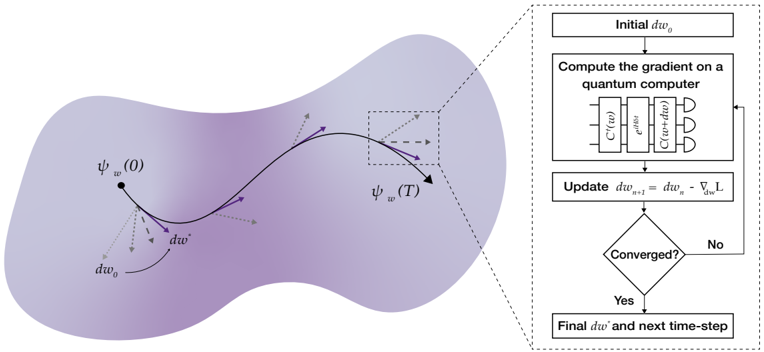
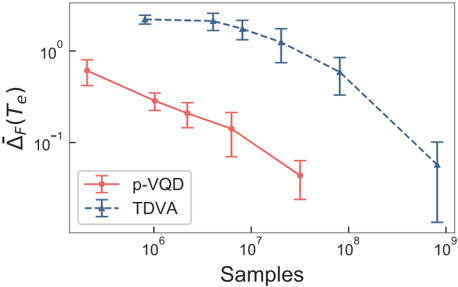
We introduce a novel hybrid algorithm to simulate the real-time evolution of quantum systems using parameterized quantum circuits. The method, named "projected – Variational Quantum Dynamics" (p-VQD) realizes an iterative, global projection of the exact time evolution onto the parameterized manifold. In the small time-step limit, this is equivalent to the McLachlan's variational principle. Our approach is efficient in the sense that it exhibits an optimal linear scaling with the total number of variational parameters. Furthermore, it is global in the sense that it uses the variational principle to optimize all parameters at once. The global nature of our approach then significantly extends the scope of existing efficient variational methods, that instead typically rely on the iterative optimization of a restricted subset of variational parameters. Through numerical experiments, we also show that our approach is particularly advantageous over existing global optimization algorithms based on the time-dependent variational principle that, due to a demanding quadratic scaling with parameter numbers, are unsuitable for large parameterized quantum circuits.
Overview
The claims and statistics of this paper haven’t been checked yet.
Free: it reads the open-access text and checks the first 5 claims that cite a source we can check. Create a free account to check every claim.
Integrity signals
Registry
Cites
Statistics
Figures
Verification
Claims the paper makes
The claims and statistics of this paper haven’t been checked yet.
Free: it reads the open-access text and checks the first 5 claims that cite a source we can check. Create a free account to check every claim.
Claims other papers make about this one
Each is checked against this paper’s own text: does it say what the citing paper says it does?
The cited source says what the claim attributes to it.
In the citing paper
“If one wants to avoid optimizing with respect to a projector onto a single state, one can instead use a local observable that also becomes maximal for the target state, namely ˆ O = 1 N ∑ N k = 1 ∣ 0 k ⟩ ⟨ 0 k ∣ ⊗ I ¯ k , where I ¯ k is the identity matrix for all qubits except k and ∣ 0 k ⟩ is the zero state for qubit k (Barison et al. , 2021; Cerezo et al. , 2021).”
From Noisy intermediate-scale quantum algorithms (2022) · cites this paper as Barison et al., 2021
The cited source says what the claim attributes to it.
In the citing paper
“Alternatively, the projected - Variational Quantum Dynamics method (p-VQD) has been proposed to bypass the measurement of aforementioned matrices (Barison et al. , 2021; Otten et al. , 2019).”
From Noisy intermediate-scale quantum algorithms (2022) · cites this paper as Barison et al. , 2021
Self-check
Percentages, sums and reported differences re-computed from the paper’s own numbers.
The self-check needs the paper’s full text.
Citations
Cites
Algorithms for quantum computation: discrete logarithms and factoring
Shor, P. W. (2002) · Proceedings 35th Annual Symposium on Foundations of Computer Science · doi:10.1109/sfcs.1994.365700 · Cited by 8,713 · cited 2×
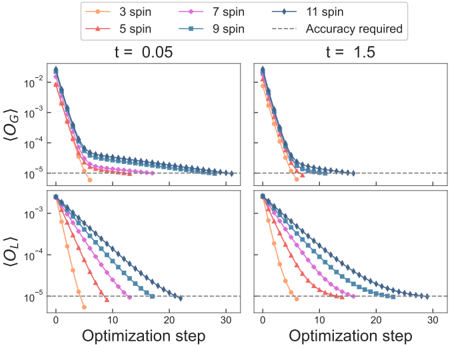
“6 we show the minimisation of both cost functions for different time steps and increasing number of spins N ∈ [3, 11], obtained using the exact state-vector simulator.”
MethodQuantum supremacy using a programmable superconducting processor
Arute, F., Arya, K., Babbush, R., Bacon, D., Bardin, J. C., Barends, R., Biswas, R., Boixo, S., Brandao, F. G. S. L., Buell, D. A., et al. (2019) · Nature · doi:10.1038/s41586-019-1666-5 · Cited by 7,720 · cited 1×
“Among all experimental platforms, the number of addressable qubits has increased remarkably: both Google [1] and IBM [2] have reported superconducting circuits chips with ≈ 50 qubits and according to their public timelines they expect to build 1000-qubit devices within the next 2 years.”
BackgroundBiamonte, J., Wittek, P., Pancotti, N., Rebentrost, P., Wiebe, N., & Lloyd, S. (2017) · Nature · doi:10.1038/nature23474 · Cited by 4,779 · cited 1×
“Quantum circuits can be used as the model of a machine-learning problem [14, 15], such as a quantum classifiers [16, 17], quantum kernel machines [18, 19, 20], quantum Boltzmann machines [21] or convolutional networks [22] to name a few.”
MethodA variational eigenvalue solver on a photonic quantum processor
Peruzzo, A., McClean, J., Shadbolt, P., Yung, M.-H., Zhou, X.-Q., Love, P. J., Aspuru-Guzik, A., & O’Brien, J. L. (2014) · Nature Communications · doi:10.1038/ncomms5213 · Cited by 4,552 · cited 1×
“To circumvent the problem, current generations of quantum algorithms rely on a hybrid classicalquantum approach [8, 9, 10, 11, 12, 13].”
MethodVariational quantum algorithms
Cerezo, M., Arrasmith, A., Babbush, R., Benjamin, S. C., Endo, S., Fujii, K., McClean, J. R., Mitarai, K., Yuan, X., Cincio, L., et al. (2021) · Nature Reviews Physics · doi:10.1038/s42254-021-00348-9 · Cited by 3,385 · cited 1×
“To circumvent the problem, current generations of quantum algorithms rely on a hybrid classicalquantum approach [8, 9, 10, 11, 12, 13].”
MethodNote on Exchange Phenomena in the Thomas Atom
Dirac, P. A. M. (1930) · Mathematical Proceedings of the Cambridge Philosophical Society · doi:10.1017/s0305004100016108 · Cited by 3,302 · cited 1×
“This method, based on a reformulation of the DiracFrenkel and McLachlan variational principle [34, 35, 36], encodes the state into a variational circuit and iteratively updates the parameters by solving a EulerLagrange equation of motion.”
MethodHardware-efficient variational quantum eigensolver for small molecules and quantum magnets
Kandala, A., Mezzacapo, A., Temme, K., Takita, M., Brink, M., Chow, J. M., & Gambetta, J. M. (2017) · Nature · doi:10.1038/nature23879 · Cited by 2,982 · cited 1×
“Quantum circuits can also be used to directly approximate the state of an interacting quantum system [23, 24, 25].”
BackgroundGeorgescu, I. M., Ashhab, S., & Nori, F. (2014) · Reviews of Modern Physics · doi:10.1103/revmodphys.86.153 · Cited by 2,932 · cited 1×
“Algorithms such as Shor’s [3], Quantum-Fourier Transform [4] or general Quantum Simulators [5, 6, 7] require a number of operations (gates) at least polynomial in the qubit number.”
MethodSupervised learning with quantum-enhanced feature spaces
Havlíček, V., Córcoles, A. D., Temme, K., Harrow, A. W., Kandala, A., Chow, J. M., & Gambetta, J. M. (2019) · Nature · doi:10.1038/s41586-019-0980-2 · Cited by 2,572 · cited 1×
“Quantum circuits can be used as the model of a machine-learning problem [14, 15], such as a quantum classifiers [16, 17], quantum kernel machines [18, 19, 20], quantum Boltzmann machines [21] or convolutional networks [22] to name a few.”
MethodBarren plateaus in quantum neural network training landscapes
McClean, J. R., Boixo, S., Smelyanskiy, V. N., Babbush, R., & Neven, H. (2018) · Nature Communications · doi:10.1038/s41467-018-07090-4 · Cited by 2,329
Research works printed but not linked: 6
- Iordanis Kerenidis et al. "q-means: A quantum algorithm for unsupervised machine learning". In: Advances in Neural Information Processing Systems. Ed. by H. Wallach et al. Vol. 32. Cur- ran Associates, Inc., 2019, pp. 4134-4144. url: https : / / proceedings . neurips . cc / paper / 2019/file/16026d60ff9b54410b3435b403afd 226-Paper.pdf.
- Benjamin Commeau et al. Variational Hamil- tonian Diagonalization for Dynamical Quan- tum Simulation. 2020. arXiv: 2009 . 02559 [quant-ph].
- Jacov Frenkel. Wave Mechanics: Advanced Gen- eral Theory. London: Oxford University Press, 1934.
- Daniel Gottesman and Isaac Chuang. Quantum Digital Signatures. May 2001. arXiv: quant-ph/ 0105032 [quant-ph].
- Gavin E. Crooks. Gradients of parameterized quantum gates using the parameter-shift rule and gate decomposition. 2019. arXiv: 1905 . 13311 [quant-ph].
- Carlos Bravo-Prieto et al. Variational Quan- tum Linear Solver. 2020. arXiv: 1909 . 05820 [quant-ph].
Cited by
Items 101–124 of 124
Classical Variational Optimization of Gate Sequences for Time Evolution of Large Quantum SystemsPreprint
Mansuroglu, R., Wilkinson, S. A., Nützel, L., & Hartmann, M. J. (2021) · arXiv (Cornell University) · Cited by 2
Many-body time evolution from a correlation-efficient quantum algorithm
Rose, M., & Mazziotti, D. A. (2026) · Physical Review A · doi:10.1103/n2vx-xj7g · Cited by 1
Quantum optimization algorithms for strongly correlated many-body systems
Pexe, G. E. L., Rattighieri, L. A. M., Prado, P. B. B., Fritsch, A. R., & Fanchini, F. F. (2026) · Journal of Physics Condensed Matter · doi:10.1088/1361-648x/ae9dd5 · Cited by 1
Miessen, A. (2025) · arXiv (Cornell University) · doi:10.48550/arxiv.2508.21504 · Cited by 2
Report on scipost_202105_00027v2
Lau, J. W. Z., Haug, T., Kwek, L. C., et al. (2021) · SciPost Physics · doi:10.21468/scipost.report.3904
Report on scipost_202105_00027v2
Lau, J. W. Z., Haug, T., Kwek, L. C., et al. (2021) · SciPost Physics · doi:10.21468/scipost.report.3818
Report on scipost_202105_00027v1
(2021) · SciPost Physics · doi:10.21468/scipost.report.3124
Neural Quantum States for Scientific Computing: Applications to Computational Chemistry and Finance
Zhao, T. (2022) · Deep Blue (University of Michigan) · doi:10.7302/5954
Report on scipost_202205_00013v1
(2022) · SciPost Physics · doi:10.21468/scipost.report.5820
Report on scipost_202205_00013v1
(2022) · SciPost Physics · doi:10.21468/scipost.report.5327
Cao, Z. (2023) · Advanced Quantum Technologies · doi:10.1002/qute.202300033
Report on scipost_202211_00047v1
Erbanni, R., Bharti, K., Kwek, L. C., et al. (2023) · SciPost Physics · doi:10.21468/scipost.report.6592
Report on scipost_202211_00047v1
Erbanni, R., Bharti, K., Kwek, L. C., et al. (2023) · SciPost Physics · doi:10.21468/scipost.report.6495
Simulation of time-dependent quantum dynamics using quantum computers
Lötstedt, E., Nishi, T., & Yamanouchi, K. (2024) · Advances in atomic, molecular, and optical physics · doi:10.1016/bs.aamop.2024.05.002 · Cited by 1
Dechant, D., Markovich, L. A., Dunjko, V., & Tura, J. (2026) · Journal of Mathematical Physics · doi:10.1063/5.0258074 · Cited by 1
Exponential separation criteria for quantum iterative power algorithms
Czégel, A., & G.-Tóth, B. (2026) · EPJ Quantum Technology · doi:10.1140/epjqt/s40507-026-00466-2
“In general, they describe the process of evolving a quantum state over time under some Hamiltonian H [3, 11].”
Guo, Y., Yu, J., & Gao, X. B. (2025) · Chinese Journal of Chemical Physics · doi:10.1063/1674-0068/cjcp2505077
Exploring Variational Entanglement Hamiltonians
Kind, Y. S., & Fauseweh, B. (2026) · Quantum · doi:10.22331/q-2026-06-12-2133
“Potential applications include the preparation of ground [17–20], excited [21–23], time-evolved [24–26], and Flo-quet states [27, 28].”
Exploring the Potential of the Filtering Variational Quantum Eigensolver
Sajko, W. (2023) · elib (German Aerospace Center)
Solving Quantum Many-Body Problems on Quantum Computers
Martin, B. A. (2023) · theses.fr (ABES) · doi:10.70675/911dc194ze97bz42d2z8611z3daf90a7419c · Cited by 2
Sampling Noise and Optimized Measurement Distribution in Imaginary‐Time Quantum Dynamics Simulations
Zhang, F., Gomes, N., Aftergood, J., Iadecola, T., Yao, Y., & Orth, P. P. (2026) · Advanced Quantum Technologies · doi:10.1002/qute.70418
Quantum-Classical Synergies for Simulations of Quantum Systems
Gentinetta, G. (2026) · Infoscience (Ecole Polytechnique Fédérale de Lausanne) · doi:10.5075/epfl-thesis-12057
Quantum algorithmic improvements for noisy intermediate scale quantum computers
Slattery, L. (2023) · Illinois Digital Environment for Access to Learning and Scholarship (University of Illinois at Urbana-Champaign)
Metadata
- Authors
- Barison, S., Vicentini, F., & Carleo, G.
- Affiliations
- École Polytechnique Fédérale de Lausanne (CH)
- Venue
- Quantum
- Published
- 2021-07-28
- Volume
- 5
- Pages
- 512
- ISSN
- 2521-327X (ISSN-L)
- OpenAlex
- W3120410077
- Cited by
- 110
- References
- 58
- Citations by year
- 2026: 6 · 2025: 19 · 2024: 24 · 2023: 30 · 2022: 21 · 2021: 10
- FWCI
- 7.51
- Type
- journal article
- Language
- en
- Open access
- gold
- doi.org
- Locations
- Quantum (publishedVersion, cc-by)
- arXiv (Cornell University) (submittedVersion)
- DOAJ (DOAJ: Directory of Open Access Journals) (submittedVersion, cc-by-sa)
- Infoscience (Ecole Polytechnique Fédérale de Lausanne) (submittedVersion, cc-by-nc-nd)
- arXiv (Cornell University) (cc-by)
- Topics
- Physical Sciences › Computer Science › Artificial Intelligence › Quantum Computing Algorithms and Architecture
- Physical Sciences › Physics and Astronomy › Atomic and Molecular Physics, and Optics › Quantum many-body systems
- Physical Sciences › Mathematics › Numerical Analysis › Numerical Solvers for Ordinary Differential Equations
- Keywords
- variational quantum circuits, time-dependent variational principle, hybrid quantum-classical algorithms
About these checks
Registry, retraction, Cites and statistics results are computed, not judged, with one exception: a printed reference that no index lists is read once by a model before it counts as a citation error. Claims are extracted by a model and kept only when their quote appears verbatim in the text; each cited source is then checked, with a model’s help, for whether it says what the claim relies on. Those verdicts can be wrong — read the claim’s quote and the cited source before relying on one.
Statistics and arithmetic are recomputed, not judged.
Confidence bands are shown only for fields calibrated on our annotated test set. None is calibrated yet, so no band is shown.
What counts as a claim ›How we measure confidence ›How we check this ›
Are you an author, or do you see a problem with this page? Request a review
Data sources
Bibliographic data: Semantic Scholar, OpenAlex, Crossref.
Contains information from the Semantic Scholar Academic Graph Datasets, made available under the ODC Attribution License (ODC-BY 1.0).
Semantic Scholar’s data is described in: Kinney, R., et al. (2023). The Semantic Scholar Open Data Platform. arXiv:2301.10140.
