

An efficient quantum algorithm for the time evolution of parameterized circuits
Open accessThe DOI matches its Crossref record; 67 of the 67 references it cites were found in a registry or an index.
Abstract
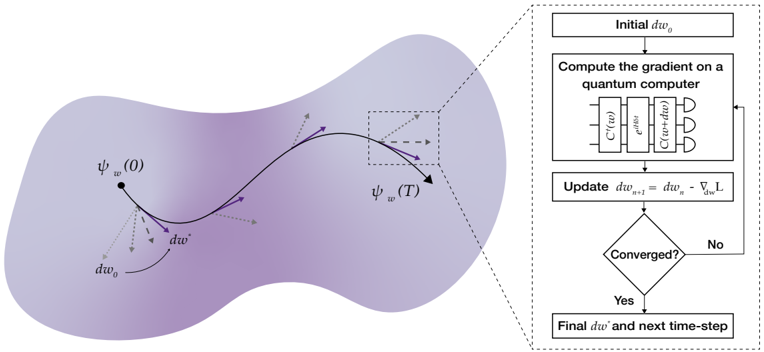
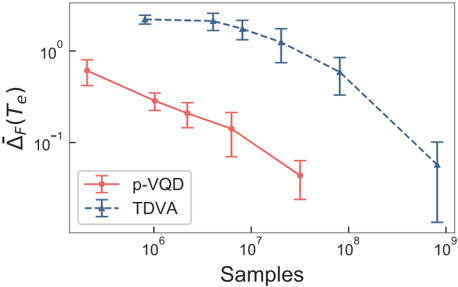
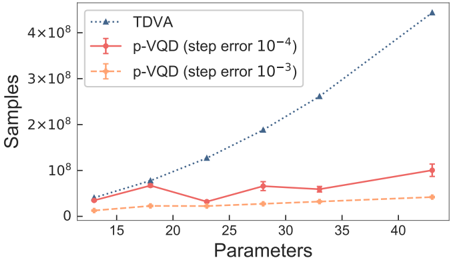
We introduce a novel hybrid algorithm to simulate the real-time evolution of quantum systems using parameterized quantum circuits. The method, named "projected – Variational Quantum Dynamics" (p-VQD) realizes an iterative, global projection of the exact time evolution onto the parameterized manifold. In the small time-step limit, this is equivalent to the McLachlan's variational principle. Our approach is efficient in the sense that it exhibits an optimal linear scaling with the total number of variational parameters. Furthermore, it is global in the sense that it uses the variational principle to optimize all parameters at once. The global nature of our approach then significantly extends the scope of existing efficient variational methods, that instead typically rely on the iterative optimization of a restricted subset of variational parameters. Through numerical experiments, we also show that our approach is particularly advantageous over existing global optimization algorithms based on the time-dependent variational principle that, due to a demanding quadratic scaling with parameter numbers, are unsuitable for large parameterized quantum circuits.
Overview
The claims and statistics of this paper haven’t been checked yet.
Free: it reads the open-access text and checks the first 5 claims that cite a source we can check. Create a free account to check every claim.
Integrity signals
Registry
Cites
Statistics
Figures
Verification
Claims the paper makes
The claims and statistics of this paper haven’t been checked yet.
Free: it reads the open-access text and checks the first 5 claims that cite a source we can check. Create a free account to check every claim.
Claims other papers make about this one
Each is checked against this paper’s own text: does it say what the citing paper says it does?
The cited source says what the claim attributes to it.
In the citing paper
“If one wants to avoid optimizing with respect to a projector onto a single state, one can instead use a local observable that also becomes maximal for the target state, namely ˆ O = 1 N ∑ N k = 1 ∣ 0 k ⟩ ⟨ 0 k ∣ ⊗ I ¯ k , where I ¯ k is the identity matrix for all qubits except k and ∣ 0 k ⟩ is the zero state for qubit k (Barison et al. , 2021; Cerezo et al. , 2021).”
From Noisy intermediate-scale quantum algorithms (2022) · cites this paper as Barison et al., 2021
The cited source says what the claim attributes to it.
In the citing paper
“Alternatively, the projected - Variational Quantum Dynamics method (p-VQD) has been proposed to bypass the measurement of aforementioned matrices (Barison et al. , 2021; Otten et al. , 2019).”
From Noisy intermediate-scale quantum algorithms (2022) · cites this paper as Barison et al. , 2021
Self-check
Percentages, sums and reported differences re-computed from the paper’s own numbers.
The self-check needs the paper’s full text.
Citations
Cites
Algorithms for quantum computation: discrete logarithms and factoring
Shor, P. W. (2002) · Proceedings 35th Annual Symposium on Foundations of Computer Science · doi:10.1109/sfcs.1994.365700 · Cited by 8,713 · cited 2×
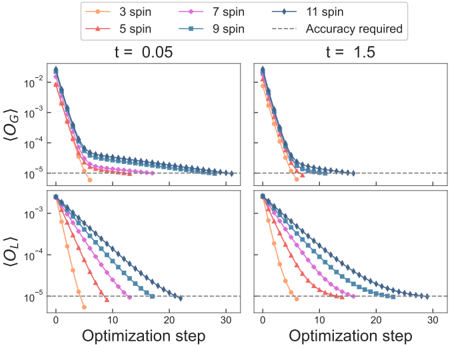
“6 we show the minimisation of both cost functions for different time steps and increasing number of spins N ∈ [3, 11], obtained using the exact state-vector simulator.”
MethodQuantum supremacy using a programmable superconducting processor
Arute, F., Arya, K., Babbush, R., Bacon, D., Bardin, J. C., Barends, R., Biswas, R., Boixo, S., Brandao, F. G. S. L., Buell, D. A., et al. (2019) · Nature · doi:10.1038/s41586-019-1666-5 · Cited by 7,720 · cited 1×
“Among all experimental platforms, the number of addressable qubits has increased remarkably: both Google [1] and IBM [2] have reported superconducting circuits chips with ≈ 50 qubits and according to their public timelines they expect to build 1000-qubit devices within the next 2 years.”
BackgroundBiamonte, J., Wittek, P., Pancotti, N., Rebentrost, P., Wiebe, N., & Lloyd, S. (2017) · Nature · doi:10.1038/nature23474 · Cited by 4,779 · cited 1×
“Quantum circuits can be used as the model of a machine-learning problem [14, 15], such as a quantum classifiers [16, 17], quantum kernel machines [18, 19, 20], quantum Boltzmann machines [21] or convolutional networks [22] to name a few.”
MethodA variational eigenvalue solver on a photonic quantum processor
Peruzzo, A., McClean, J., Shadbolt, P., Yung, M.-H., Zhou, X.-Q., Love, P. J., Aspuru-Guzik, A., & O’Brien, J. L. (2014) · Nature Communications · doi:10.1038/ncomms5213 · Cited by 4,552 · cited 1×
“To circumvent the problem, current generations of quantum algorithms rely on a hybrid classicalquantum approach [8, 9, 10, 11, 12, 13].”
MethodVariational quantum algorithms
Cerezo, M., Arrasmith, A., Babbush, R., Benjamin, S. C., Endo, S., Fujii, K., McClean, J. R., Mitarai, K., Yuan, X., Cincio, L., et al. (2021) · Nature Reviews Physics · doi:10.1038/s42254-021-00348-9 · Cited by 3,385 · cited 1×
“To circumvent the problem, current generations of quantum algorithms rely on a hybrid classicalquantum approach [8, 9, 10, 11, 12, 13].”
MethodNote on Exchange Phenomena in the Thomas Atom
Dirac, P. A. M. (1930) · Mathematical Proceedings of the Cambridge Philosophical Society · doi:10.1017/s0305004100016108 · Cited by 3,302 · cited 1×
“This method, based on a reformulation of the DiracFrenkel and McLachlan variational principle [34, 35, 36], encodes the state into a variational circuit and iteratively updates the parameters by solving a EulerLagrange equation of motion.”
MethodHardware-efficient variational quantum eigensolver for small molecules and quantum magnets
Kandala, A., Mezzacapo, A., Temme, K., Takita, M., Brink, M., Chow, J. M., & Gambetta, J. M. (2017) · Nature · doi:10.1038/nature23879 · Cited by 2,982 · cited 1×
“Quantum circuits can also be used to directly approximate the state of an interacting quantum system [23, 24, 25].”
BackgroundGeorgescu, I. M., Ashhab, S., & Nori, F. (2014) · Reviews of Modern Physics · doi:10.1103/revmodphys.86.153 · Cited by 2,932 · cited 1×
“Algorithms such as Shor’s [3], Quantum-Fourier Transform [4] or general Quantum Simulators [5, 6, 7] require a number of operations (gates) at least polynomial in the qubit number.”
MethodSupervised learning with quantum-enhanced feature spaces
Havlíček, V., Córcoles, A. D., Temme, K., Harrow, A. W., Kandala, A., Chow, J. M., & Gambetta, J. M. (2019) · Nature · doi:10.1038/s41586-019-0980-2 · Cited by 2,572 · cited 1×
“Quantum circuits can be used as the model of a machine-learning problem [14, 15], such as a quantum classifiers [16, 17], quantum kernel machines [18, 19, 20], quantum Boltzmann machines [21] or convolutional networks [22] to name a few.”
MethodBarren plateaus in quantum neural network training landscapes
McClean, J. R., Boixo, S., Smelyanskiy, V. N., Babbush, R., & Neven, H. (2018) · Nature Communications · doi:10.1038/s41467-018-07090-4 · Cited by 2,329
On the product of semi-groups of operators
Trotter, H. F. (1959) · Proceedings of the American Mathematical Society · doi:10.1090/s0002-9939-1959-0108732-6 · Cited by 2,282 · cited 2×
“The time evolution operator e−iĤδt is encoded in the form of a Trotter-Suzuki decomposition [26, 27].”
MethodSolving the quantum many-body problem with artificial neural networks
Carleo, G., & Troyer, M. (2017) · Science · doi:10.1126/science.aag2302 · Cited by 2,215 · cited 1×
“In this sense, having an efficient quantum algorithm to perform variational time evolution is essential to compare to classical results obtained with variational states either based on tensor networks [65, 66, 67], or neural networks [68, 69].”
MethodSelf-citationQuantum Machine Learning in Feature Hilbert Spaces
Schuld, M., & Killoran, N. (2019) · Physical Review Letters · doi:10.1103/physrevlett.122.040504 · Cited by 1,840 · cited 1×
“Quantum circuits can be used as the model of a machine-learning problem [14, 15], such as a quantum classifiers [16, 17], quantum kernel machines [18, 19, 20], quantum Boltzmann machines [21] or convolutional networks [22] to name a few.”
MethodEfficient Simulation of One-Dimensional Quantum Many-Body Systems
Vidal, G. (2004) · Physical Review Letters · doi:10.1103/physrevlett.93.040502 · Cited by 1,779 · cited 1×
“In this sense, having an efficient quantum algorithm to perform variational time evolution is essential to compare to classical results obtained with variational states either based on tensor networks [65, 66, 67], or neural networks [68, 69].”
MethodMitarai, K., Negoro, M., Kitagawa, M., & Fujii, K. (2018) · Physical Review A · doi:10.1103/physreva.98.032309 · Cited by 1,639 · cited 1×
“In this case, the gradient can be computed exactly in a hardwarefriendly way using the parameter shift rule [51, 53, 54, 55, 56, 57], obtaining”
MethodQuantum convolutional neural networks
Cong, I., Choi, S., & Lukin, M. D. (2019) · Nature Physics · doi:10.1038/s41567-019-0648-8 · Cited by 1,517 · cited 1×
“Quantum circuits can be used as the model of a machine-learning problem [14, 15], such as a quantum classifiers [16, 17], quantum kernel machines [18, 19, 20], quantum Boltzmann machines [21] or convolutional networks [22] to name a few.”
MethodQiskit: An Open-source Framework for Quantum Computing
Aleksandrowicz, G., Alexander, T., Barkoutsos, P. K., Bello, L., Ben-Haim, Y., Bucher, D., Cabrera-Hernández, F. J., Carballo-Franquis, J., Chen, A., Chen, C.-F., et al. (2019) · Zenodo (CERN European Organization for Nuclear Research) · doi:10.5281/zenodo.2562110 · Cited by 1,434
Real-Time Evolution Using the Density Matrix Renormalization Group
White, S. R., & Feiguin, A. E. (2004) · Physical Review Letters · doi:10.1103/physrevlett.93.076401 · Cited by 1,398 · cited 1×
“In this sense, having an efficient quantum algorithm to perform variational time evolution is essential to compare to classical results obtained with variational states either based on tensor networks [65, 66, 67], or neural networks [68, 69].”
MethodBuhrman, H., Cleve, R., Watrous, J., & de Wolf, R. (2001) · Physical Review Letters · doi:10.1103/physrevlett.87.167902 · Cited by 1,190 · cited 1×
“Another method that can be considered to measure the overlap between |ψw+dw〉 and |φ(δt)〉 is the SWAP test [49, 50], although it requires ancillary qubits and long range gates.”
MethodTime-dependent density-matrix renormalization-group using adaptive effective Hilbert spaces
Daley, A. J., Kollath, C., Schollwöck, U., & Vidal, G. (2004) · Journal of Statistical Mechanics: Theory and Experiment · doi:10.1088/1742-5468/2004/04/p04005 · Cited by 1,160
Evaluating analytic gradients on quantum hardware
Schuld, M., Bergholm, V., Gogolin, C., Izaac, J., & Killoran, N. (2019) · Physical Review A · doi:10.1103/physreva.99.032331 · Cited by 1,072 · cited 2×
“In general, the gradient of a quantum expectation value involving parameterized quantum circuits can be determined using finite differences [51] or simultaneous perturbation techniques [52].”
BackgroundMethodScalable Quantum Simulation of Molecular Energies
O’Malley, P. J. J., Babbush, R., Kivlichan, I. D., Romero, J., McClean, J. R., Barends, R., Kelly, J., Roushan, P., Tranter, A., Ding, N., et al. (2016) · Physical Review X · doi:10.1103/physrevx.6.031007 · Cited by 1,059 · cited 1×
“Quantum circuits can also be used to directly approximate the state of an interacting quantum system [23, 24, 25].”
BackgroundCircuit-centric quantum classifiers
Schuld, M., Bocharov, A., Svore, K. M., & Wiebe, N. (2020) · Physical Review A · doi:10.1103/physreva.101.032308 · Cited by 1,057 · cited 1×
“Quantum circuits can be used as the model of a machine-learning problem [14, 15], such as a quantum classifiers [16, 17], quantum kernel machines [18, 19, 20], quantum Boltzmann machines [21] or convolutional networks [22] to name a few.”
MethodCost function dependent barren plateaus in shallow parametrized quantum circuits
Cerezo, M., Sone, A., Volkoff, T., Cincio, L., & Coles, P. J. (2021) · Nature Communications · doi:10.1038/s41467-021-21728-w · Cited by 1,047
Time-Dependent Variational Principle for Quantum Lattices
Haegeman, J., Cirac, J. I., Osborne, T. J., Pižorn, I., Verschelde, H., & Verstraete, F. (2011) · Physical Review Letters · doi:10.1103/physrevlett.107.070601 · Cited by 865 · cited 1×
“The approach is conceptually close to the study of quantum dynamics using classically parameterized many-body wave functions [37, 38, 39, 40].”
BackgroundQuantum Algorithms for Quantum Chemistry and Quantum Materials Science
Bauer, B., Bravyi, S., Motta, M., & Chan, G. K.-L. (2020) · Chemical Reviews · doi:10.1021/acs.chemrev.9b00829 · Cited by 848 · cited 1×
“Quantum circuits can also be used to directly approximate the state of an interacting quantum system [23, 24, 25].”
BackgroundUnifying time evolution and optimization with matrix product states
Haegeman, J., Lubich, C., Oseledets, I., Vandereycken, B., & Verstraete, F. (2016) · Physical Review B · doi:10.1103/physrevb.94.165116 · Cited by 804 · cited 1×
“The approach is conceptually close to the study of quantum dynamics using classically parameterized many-body wave functions [37, 38, 39, 40].”
BackgroundImplementation of the simultaneous perturbation algorithm for stochastic optimization
Spall, J. C. (1998) · IEEE Transactions on Aerospace and Electronic Systems · doi:10.1109/7.705889 · Cited by 797
Suzuki, M. (1991) · Journal of Mathematical Physics · doi:10.1063/1.529425 · Cited by 762 · cited 2×
“The time evolution operator e−iĤδt is encoded in the form of a Trotter-Suzuki decomposition [26, 27].”
MethodSimulation of Many-Body Fermi Systems on a Universal Quantum Computer
Abrams, D. S., & Lloyd, S. (1997) · Physical Review Letters · doi:10.1103/physrevlett.79.2586 · Cited by 745 · cited 1×
“For quantum simulation, several variational, resource friendly alternatives to Trotterization [26, 27, 28, 29] have been proposed [9, 30, 31, 32, 33].”
Motta, M., Sun, C., Tan, A. T. K., O’Rourke, M. J., Ye, E., Minnich, A. J., Brandão, F. G. S. L., & Chan, G. K.-L. (2020) · Nature Physics · doi:10.1038/s41567-019-0704-4 · Cited by 709 · cited 2×
“6 we show the minimisation of both cost functions for different time steps and increasing number of spins N ∈ [3 , 11] , obtained using the exact state-vector simulator.”
MethodEfficient Variational Quantum Simulator Incorporating Active Error Minimization
Li, Y., & Benjamin, S. C. (2017) · Physical Review X · doi:10.1103/physrevx.7.021050 · Cited by 686 · cited 3×
“Among those, an interesting approach introduced in 2017 [9] is the The Time-Dependent Variational Algorithm (TDVA).”
BackgroundMethodA variational solution of the time-dependent Schrodinger equation
McLachlan, A. D. (1964) · Molecular Physics · doi:10.1080/00268976400100041 · Cited by 616 · cited 2×
“(10) This expression for dw coincides with that given by the McLachlan’s variational principle [36, 30] (considering also a time-dependent global phase on the ansatz state).”
MethodQuantum autoencoders for efficient compression of quantum data
Romero, J., Olson, J. P., & Aspuru-Guzik, A. (2017) · Quantum Science and Technology · doi:10.1088/2058-9565/aa8072 · Cited by 559 · cited 1×
“Quantum circuits can be used as the model of a machine-learning problem [14, 15], such as a quantum classifiers [16, 17], quantum kernel machines [18, 19, 20], quantum Boltzmann machines [21] or convolutional networks [22] to name a few.”
MethodAmin, M. H., Andriyash, E., Rolfe, J., Kulchytskyy, B., & Melko, R. (2018) · Physical Review X · doi:10.1103/physrevx.8.021050 · Cited by 520 · cited 1×
“Quantum circuits can be used as the model of a machine-learning problem [14, 15], such as a quantum classifiers [16, 17], quantum kernel machines [18, 19, 20], quantum Boltzmann machines [21] or convolutional networks [22] to name a few.”
MethodStokes, J., Izaac, J., Killoran, N., & Carleo, G. (2020) · Quantum · doi:10.22331/q-2020-05-25-269 · Cited by 473
Self-citationTheory of variational quantum simulation
Yuan, X., Endo, S., Zhao, Q., Li, Y., & Benjamin, S. C. (2019) · Quantum · doi:10.22331/q-2019-10-07-191 · Cited by 458 · cited 5×
“(10) This expression for dw coincides with that given by the McLachlan’s variational principle [36, 30] (considering also a time-dependent global phase on the ansatz state).”
BackgroundMethodInfluentialAn initialization strategy for addressing barren plateaus in parametrized quantum circuits
Grant, E., Wossnig, L., Ostaszewski, M., & Benedetti, M. (2019) · Quantum · doi:10.22331/q-2019-12-09-214 · Cited by 406 · cited 1×
“Barren plateaus are usually recognized by measuring the variance of the components of the gradient [58, 59, 60, 61, 62].”
BackgroundPolynomial-time quantum algorithm for the simulation of chemical dynamics
Kassal, I., Jordan, S. P., Love, P. J., Mohseni, M., & Aspuru-Guzik, A. (2008) · Proceedings of the National Academy of Sciences · doi:10.1073/pnas.0808245105 · Cited by 385 · cited 1×
“Algorithms such as Shor’s [3], Quantum-Fourier Transform [4] or general Quantum Simulators [5, 6, 7] require a number of operations (gates) at least polynomial in the qubit number.”
MethodOptimization using quantum mechanics: quantum annealing through adiabatic evolution
Santoro, G. E., & Tosatti, E. (2006) · Journal of Physics A: Mathematical and General · doi:10.1088/0305-4470/39/36/r01 · Cited by 354
Quantum algorithms for fermionic simulations
Ortiz, G., Gubernatis, J. E., Knill, E., & Laflamme, R. (2001) · Physical Review A · doi:10.1103/physreva.64.022319 · Cited by 347 · cited 1×
“For quantum simulation, several variational, resource friendly alternatives to Trotterization [26, 27, 28, 29] have been proposed [9, 30, 31, 32, 33].”
An approximate Fourier transform useful in quantum factoring
Coppersmith, D. (2002) · arXiv · doi:10.48550/arxiv.quant-ph/0201067 · Cited by 343 · cited 1×
“Algorithms such as Shor’s [3], Quantum-Fourier Transform [4] or general Quantum Simulators [5, 6, 7] require a number of operations (gates) at least polynomial in the qubit number.”
MethodGeometry and non-adiabatic response in quantum and classical systems
Kolodrubetz, M., Sels, D., Mehta, P., & Polkovnikov, A. (2017) · Physics Reports · doi:10.1016/j.physrep.2017.07.001 · Cited by 326
On condition numbers and the distance to the nearest ill-posed problem
Demmel, J. W. (1987) · Numerische Mathematik · doi:10.1007/bf01400115 · Cited by 302 · cited 1×
“The matrices of the Euler-Lagrange equations often show high condition number [64], in particular those generated by the time-dependent variational principle [30].”
BackgroundVariational Quantum Linear Solver
Bravo-Prieto, C., LaRose, R., Cerezo, M., Subasi, Y., Cincio, L., & Coles, P. J. (2019) · arXiv · doi:10.48550/arxiv.1909.05820 · Cited by 284
Variational fast forwarding for quantum simulation beyond the coherence time
Cîrstoiu, C., Holmes, Z., Iosue, J., Cincio, L., Coles, P. J., & Sornborger, A. (2020) · npj Quantum Information · doi:10.1038/s41534-020-00302-0 · Cited by 232 · cited 1×
“For quantum simulation, several variational, resource friendly alternatives to Trotterization [26, 27, 28, 29] have been proposed [9, 30, 31, 32, 33].”
Quantum Many-Body Dynamics in Two Dimensions with Artificial Neural Networks
Schmitt, M., & Heyl, M. (2020) · Physical Review Letters · doi:10.1103/physrevlett.125.100503 · Cited by 221 · cited 1×
“In this sense, having an efficient quantum algorithm to perform variational time evolution is essential to compare to classical results obtained with variational states either based on tensor networks [65, 66, 67], or neural networks [68, 69].”
MethodLocalization and Glassy Dynamics Of Many-Body Quantum Systems
Carleo, G., Becca, F., Schiró, M., & Fabrizio, M. (2012) · Scientific Reports · doi:10.1038/srep00243 · Cited by 211 · cited 1×
“The approach is conceptually close to the study of quantum dynamics using classically parameterized many-body wave functions [37, 38, 39, 40].”
BackgroundSelf-citationReal- and Imaginary-Time Evolution with Compressed Quantum Circuits
Lin, S.-H., Dilip, R., Green, A. G., Smith, A., & Pollmann, F. (2021) · PRX Quantum · doi:10.1103/prxquantum.2.010342 · Cited by 206
Quantum equation of motion for computing molecular excitation energies on a noisy quantum processor
Ollitrault, P. J., Kandala, A., Chen, C.-F., Barkoutsos, P. K., Mezzacapo, A., Pistoia, M., Sheldon, S., Woerner, S., Gambetta, J. M., & Tavernelli, I. (2020) · Physical Review Research · doi:10.1103/physrevresearch.2.043140 · Cited by 200 · cited 1×
“To circumvent the problem, current generations of quantum algorithms rely on a hybrid classical-quantum approach [8, 9, 10, 11, 12, 13].”
MethodHardware-efficient variational quantum algorithms for time evolution
Benedetti, M., Fiorentini, M., & Lubasch, M. (2020) · arXiv · doi:10.48550/arxiv.2009.12361 · Cited by 176 · cited 1×
“To alleviate this issue, new variational methods based on partial, local optimisations of the variational parameters have been recently proposed [43, 44, 45].”
MethodHardware-efficient variational quantum algorithms for time evolution
Benedetti, M., Fiorentini, M., & Lubasch, M. (2021) · Physical Review Research · doi:10.1103/physrevresearch.3.033083 · Cited by 161 · cited 1×
“To alleviate this issue, new variational methods based on partial, local optimisations of the variational parameters have been recently proposed [43, 44, 45].”
MethodEstimating the gradient and higher-order derivatives on quantum hardware
Mari, A., Bromley, T. R., & Killoran, N. (2021) · Physical Review A · doi:10.1103/physreva.103.012405 · Cited by 159 · cited 1×
“In this case, the gradient can be computed exactly in a hardwarefriendly way using the parameter shift rule [51, 53, 54, 55, 56, 57], obtaining”
MethodLight-cone effect and supersonic correlations in one- and two-dimensional bosonic superfluids
Carleo, G., Becca, F., Sanchez-Palencia, L., Sorella, S., & Fabrizio, M. (2014) · Physical Review A · doi:10.1103/physreva.89.031602 · Cited by 145 · cited 1×
“The approach is conceptually close to the study of quantum dynamics using classically parameterized many-body wave functions [37, 38, 39, 40].”
BackgroundSelf-citationGeometric Speed Limit of Accessible Many-Body State Preparation
Bukov, M., Sels, D., & Polkovnikov, A. (2019) · Physical Review X · doi:10.1103/physrevx.9.011034 · Cited by 144 · cited 1×
“At variance with the classical many-body counterparts, the computational cost of the TDVA approach is dominated by the stochastic estimation of the Quantum Geometric Tensor [41, 42] and its inversion, resulting in an expensive quadratic cost in the total number of variational parameters.”
BackgroundParallel quantum simulation of large systems on small NISQ computers
Barratt, F., Dborin, J., Bal, M., Stojevic, V., Pollmann, F., & Green, A. G. (2021) · npj Quantum Information · doi:10.1038/s41534-021-00420-3 · Cited by 111
Measuring Analytic Gradients of General Quantum Evolution with the Stochastic Parameter Shift Rule
Banchi, L., & Crooks, G. E. (2020) · arXiv · doi:10.48550/arxiv.2005.10299 · Cited by 107
Measuring Analytic Gradients of General Quantum Evolution with the Stochastic Parameter Shift Rule
Banchi, L., & Crooks, G. E. (2021) · Quantum · doi:10.22331/q-2021-01-25-386 · Cited by 96
Quantum circuit representation of Bayesian networks
Borujeni, S. E., Nannapaneni, S., Nguyen, N. H., Behrman, E., & Steck, J. E. (2021) · Expert Systems with Applications · doi:10.1016/j.eswa.2021.114768 · Cited by 78
Variational Quantum Algorithm for Estimating the Quantum Fisher Information
Beckey, J. L., Cerezo, M., Sone, A., & Coles, P. J. (2020) · arXiv · doi:10.48550/arxiv.2010.10488 · Cited by 77 · cited 1×
“To circumvent the problem, current generations of quantum algorithms rely on a hybrid classical-quantum approach [8, 9, 10, 11, 12, 13].”
MethodBharti, K., & Haug, T. (2021) · Physical Review A · doi:10.1103/physreva.104.042418 · Cited by 73 · cited 1×
“For quantum simulation, several variational, resource friendly alternatives to Trotterization [26, 27, 28, 29] have been proposed [9, 30, 31, 32, 33].”
Optimal training of variational quantum algorithms without barren plateausPreprint
Haug, T., & Kim, M. S. (2021) · arXiv (Cornell University) · doi:10.48550/arxiv.2104.14543 · Cited by 71 · cited 1×
“However, it is possible to show that both the fidelity between two states and the variance of its gradient have a non-vanishing lower bound (in the limit of a large number of qubits) if the two states differ by an infinitesimal transformation [60].”
BackgroundVariational Hamiltonian Diagonalization for Dynamical Quantum Simulation
Commeau, B., Cerezo, M., Holmes, Z., Cincio, L., Coles, P. J., & Sornborger, A. (2020) · arXiv · doi:10.48550/arxiv.2009.02559 · Cited by 42 · cited 1×
“For quantum simulation, several variational, resource friendly alternatives to Trotterization [26, 27, 28, 29] have been proposed [9, 30, 31, 32, 33].”
Preparation of an exciton condensate of photons on a 53-qubit quantum computer
Sager-Smith, L. M., Smart, S. E., & Mazziotti, D. A. (2020) · Physical Review Research · doi:10.1103/physrevresearch.2.043205 · Cited by 35 · cited 1×
“Among all experimental platforms, the number of addressable qubits has increased remarkably: both Google [1] and IBM [2] have reported superconducting circuits chips with ≈ 50 qubits and according to their public timelines they expect to build 1000-qubit devices within the next 2 years.”
BackgroundUnitary block optimization for variational quantum algorithms
Slattery, L., Villalonga, B., & Clark, B. K. (2022) · Physical Review Research · doi:10.1103/physrevresearch.4.023072 · Cited by 34 · cited 1×
“To alleviate this issue, new variational methods based on partial, local optimisations of the variational parameters have been recently proposed [43, 44, 45].”
MethodNoise-Resilient Quantum Dynamics Using Symmetry-Preserving Ansatzes
Otten, M., Cortes, C. L., & Gray, S. K. (2019) · arXiv · doi:10.48550/arxiv.1910.06284 · Cited by 30 · cited 2×
“This intermediate overlap optimization is routinely used in classical simulations of the dynamics of quantum systems, and its application to quantum circuits has been recently suggested in the context of quantum tensor networks [46, 45] and symmetry-preserving variational wavefunction [47].”
MethodParrish, R. M., Hohenstein, E. G., McMahon, P. L., & Martínez, T. J. (2019) · arXiv (Cornell University) · doi:10.48550/arxiv.1906.08728 · Cited by 24 · cited 1×
“In this case, the gradient can be computed exactly in a hardwarefriendly way using the parameter shift rule [51, 53, 54, 55, 56, 57], obtaining”
Method
Research works printed but not linked: 6
- Iordanis Kerenidis et al. "q-means: A quantum algorithm for unsupervised machine learning". In: Advances in Neural Information Processing Systems. Ed. by H. Wallach et al. Vol. 32. Cur- ran Associates, Inc., 2019, pp. 4134-4144. url: https : / / proceedings . neurips . cc / paper / 2019/file/16026d60ff9b54410b3435b403afd 226-Paper.pdf.
- Benjamin Commeau et al. Variational Hamil- tonian Diagonalization for Dynamical Quan- tum Simulation. 2020. arXiv: 2009 . 02559 [quant-ph].
- Jacov Frenkel. Wave Mechanics: Advanced Gen- eral Theory. London: Oxford University Press, 1934.
- Daniel Gottesman and Isaac Chuang. Quantum Digital Signatures. May 2001. arXiv: quant-ph/ 0105032 [quant-ph].
- Gavin E. Crooks. Gradients of parameterized quantum gates using the parameter-shift rule and gate decomposition. 2019. arXiv: 1905 . 13311 [quant-ph].
- Carlos Bravo-Prieto et al. Variational Quan- tum Linear Solver. 2020. arXiv: 1909 . 05820 [quant-ph].
Cited by
Noisy intermediate-scale quantum algorithms
Bharti, K., Cervera-Lierta, A., Kyaw, T. H., Haug, T., Alperin-Lea, S., Anand, A., Degroote, M., Heimonen, H., Kottmann, J. S., Menke, T., et al. (2022) · Reviews of Modern Physics · doi:10.1103/revmodphys.94.015004 · Cited by 2,231
Quantum Computing for High-Energy Physics: State of the Art and Challenges
Di Meglio, A., Jansen, K., Tavernelli, I., Alexandrou, C., Arunachalam, S., Bauer, C. W., Borras, K., Carrazza, S., Crippa, A., Croft, V., et al. (2024) · PRX Quantum · doi:10.1103/prxquantum.5.037001 · Cited by 215
The future of quantum computing with superconducting qubits
Bravyi, S., Dial, O., Gambetta, J. M., Gil, D., & Nazario, Z. (2022) · Journal of Applied Physics · doi:10.1063/5.0082975 · Cited by 334
Emerging quantum computing algorithms for quantum chemistry
Motta, M., & Rice, J. E. (2022) · WIREs Computational Molecular Science · doi:10.1002/wcms.1580 · Cited by 173
“For example, VQS techniques based on minimizing the distance (or maximizing the overlap) between states evolved in time exactly and variationally have been proposed [357, 358], along with techniques to economize quantum measurements introducing causal light-cone structure in the Ansatz [358–360].”
MethodNISQ computing: where are we and where do we go?
Lau, J. W. Z., Lim, K. H., Shrotriya, H., & Kwek, L. C. (2022) · AAPPS Bulletin · doi:10.1007/s43673-022-00058-z · Cited by 173
Metadata
- Authors
- Barison, S., Vicentini, F., & Carleo, G.
- Affiliations
- École Polytechnique Fédérale de Lausanne (CH)
- Venue
- Quantum
- Published
- 2021-07-28
- Volume
- 5
- Pages
- 512
- ISSN
- 2521-327X (ISSN-L)
- OpenAlex
- W3120410077
- Cited by
- 110
- References
- 58
- Citations by year
- 2026: 6 · 2025: 19 · 2024: 24 · 2023: 30 · 2022: 21 · 2021: 10
- FWCI
- 7.51
- Type
- journal article
- Language
- en
- Open access
- gold
- doi.org
- Locations
- Quantum (publishedVersion, cc-by)
- arXiv (Cornell University) (submittedVersion)
- DOAJ (DOAJ: Directory of Open Access Journals) (submittedVersion, cc-by-sa)
- Infoscience (Ecole Polytechnique Fédérale de Lausanne) (submittedVersion, cc-by-nc-nd)
- arXiv (Cornell University) (cc-by)
- Topics
- Physical Sciences › Computer Science › Artificial Intelligence › Quantum Computing Algorithms and Architecture
- Physical Sciences › Physics and Astronomy › Atomic and Molecular Physics, and Optics › Quantum many-body systems
- Physical Sciences › Mathematics › Numerical Analysis › Numerical Solvers for Ordinary Differential Equations
- Keywords
- variational quantum circuits, time-dependent variational principle, hybrid quantum-classical algorithms
About these checks
Registry, retraction, Cites and statistics results are computed, not judged, with one exception: a printed reference that no index lists is read once by a model before it counts as a citation error. Claims are extracted by a model and kept only when their quote appears verbatim in the text; each cited source is then checked, with a model’s help, for whether it says what the claim relies on. Those verdicts can be wrong — read the claim’s quote and the cited source before relying on one.
Statistics and arithmetic are recomputed, not judged.
Confidence bands are shown only for fields calibrated on our annotated test set. None is calibrated yet, so no band is shown.
What counts as a claim ›How we measure confidence ›How we check this ›
Are you an author, or do you see a problem with this page? Request a review
Data sources
Bibliographic data: Semantic Scholar, OpenAlex, Crossref.
Contains information from the Semantic Scholar Academic Graph Datasets, made available under the ODC Attribution License (ODC-BY 1.0).
Semantic Scholar’s data is described in: Kinney, R., et al. (2023). The Semantic Scholar Open Data Platform. arXiv:2301.10140.
