

An efficient quantum algorithm for the time evolution of parameterized circuits
Open accessThe DOI matches its Crossref record; 67 of the 67 references it cites were found in a registry or an index.
Abstract
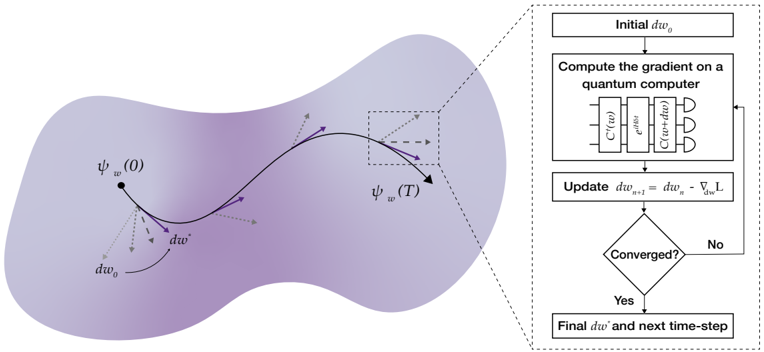
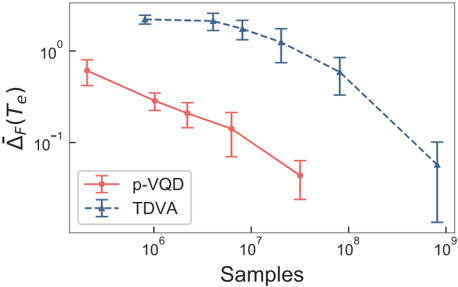
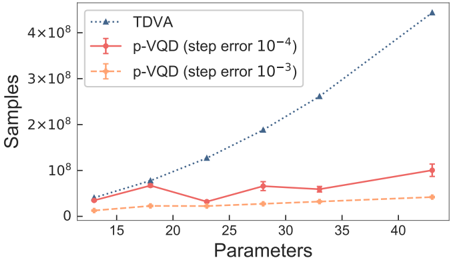
We introduce a novel hybrid algorithm to simulate the real-time evolution of quantum systems using parameterized quantum circuits. The method, named "projected – Variational Quantum Dynamics" (p-VQD) realizes an iterative, global projection of the exact time evolution onto the parameterized manifold. In the small time-step limit, this is equivalent to the McLachlan's variational principle. Our approach is efficient in the sense that it exhibits an optimal linear scaling with the total number of variational parameters. Furthermore, it is global in the sense that it uses the variational principle to optimize all parameters at once. The global nature of our approach then significantly extends the scope of existing efficient variational methods, that instead typically rely on the iterative optimization of a restricted subset of variational parameters. Through numerical experiments, we also show that our approach is particularly advantageous over existing global optimization algorithms based on the time-dependent variational principle that, due to a demanding quadratic scaling with parameter numbers, are unsuitable for large parameterized quantum circuits.
Overview
The claims and statistics of this paper haven’t been checked yet.
Free: it reads the open-access text and checks the first 5 claims that cite a source we can check. Create a free account to check every claim.
Integrity signals
Registry
Cites
Statistics
Figures
Verification
Claims the paper makes
The claims and statistics of this paper haven’t been checked yet.
Free: it reads the open-access text and checks the first 5 claims that cite a source we can check. Create a free account to check every claim.
Claims other papers make about this one
Each is checked against this paper’s own text: does it say what the citing paper says it does?
The cited source says what the claim attributes to it.
In the citing paper
“If one wants to avoid optimizing with respect to a projector onto a single state, one can instead use a local observable that also becomes maximal for the target state, namely ˆ O = 1 N ∑ N k = 1 ∣ 0 k ⟩ ⟨ 0 k ∣ ⊗ I ¯ k , where I ¯ k is the identity matrix for all qubits except k and ∣ 0 k ⟩ is the zero state for qubit k (Barison et al. , 2021; Cerezo et al. , 2021).”
From Noisy intermediate-scale quantum algorithms (2022) · cites this paper as Barison et al., 2021
The cited source says what the claim attributes to it.
In the citing paper
“Alternatively, the projected - Variational Quantum Dynamics method (p-VQD) has been proposed to bypass the measurement of aforementioned matrices (Barison et al. , 2021; Otten et al. , 2019).”
From Noisy intermediate-scale quantum algorithms (2022) · cites this paper as Barison et al. , 2021
Self-check
Percentages, sums and reported differences re-computed from the paper’s own numbers.
The self-check needs the paper’s full text.
Citations
Cites
Algorithms for quantum computation: discrete logarithms and factoring
Shor, P. W. (2002) · Proceedings 35th Annual Symposium on Foundations of Computer Science · doi:10.1109/sfcs.1994.365700 · Cited by 8,713 · cited 2×
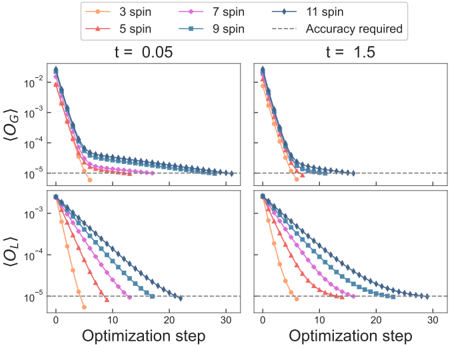
“6 we show the minimisation of both cost functions for different time steps and increasing number of spins N ∈ [3, 11], obtained using the exact state-vector simulator.”
MethodQuantum supremacy using a programmable superconducting processor
Arute, F., Arya, K., Babbush, R., Bacon, D., Bardin, J. C., Barends, R., Biswas, R., Boixo, S., Brandao, F. G. S. L., Buell, D. A., et al. (2019) · Nature · doi:10.1038/s41586-019-1666-5 · Cited by 7,720 · cited 1×
“Among all experimental platforms, the number of addressable qubits has increased remarkably: both Google [1] and IBM [2] have reported superconducting circuits chips with ≈ 50 qubits and according to their public timelines they expect to build 1000-qubit devices within the next 2 years.”
BackgroundBiamonte, J., Wittek, P., Pancotti, N., Rebentrost, P., Wiebe, N., & Lloyd, S. (2017) · Nature · doi:10.1038/nature23474 · Cited by 4,779 · cited 1×
“Quantum circuits can be used as the model of a machine-learning problem [14, 15], such as a quantum classifiers [16, 17], quantum kernel machines [18, 19, 20], quantum Boltzmann machines [21] or convolutional networks [22] to name a few.”
MethodA variational eigenvalue solver on a photonic quantum processor
Peruzzo, A., McClean, J., Shadbolt, P., Yung, M.-H., Zhou, X.-Q., Love, P. J., Aspuru-Guzik, A., & O’Brien, J. L. (2014) · Nature Communications · doi:10.1038/ncomms5213 · Cited by 4,552 · cited 1×
“To circumvent the problem, current generations of quantum algorithms rely on a hybrid classicalquantum approach [8, 9, 10, 11, 12, 13].”
MethodVariational quantum algorithms
Cerezo, M., Arrasmith, A., Babbush, R., Benjamin, S. C., Endo, S., Fujii, K., McClean, J. R., Mitarai, K., Yuan, X., Cincio, L., et al. (2021) · Nature Reviews Physics · doi:10.1038/s42254-021-00348-9 · Cited by 3,385 · cited 1×
“To circumvent the problem, current generations of quantum algorithms rely on a hybrid classicalquantum approach [8, 9, 10, 11, 12, 13].”
MethodNote on Exchange Phenomena in the Thomas Atom
Dirac, P. A. M. (1930) · Mathematical Proceedings of the Cambridge Philosophical Society · doi:10.1017/s0305004100016108 · Cited by 3,302 · cited 1×
“This method, based on a reformulation of the DiracFrenkel and McLachlan variational principle [34, 35, 36], encodes the state into a variational circuit and iteratively updates the parameters by solving a EulerLagrange equation of motion.”
MethodHardware-efficient variational quantum eigensolver for small molecules and quantum magnets
Kandala, A., Mezzacapo, A., Temme, K., Takita, M., Brink, M., Chow, J. M., & Gambetta, J. M. (2017) · Nature · doi:10.1038/nature23879 · Cited by 2,982 · cited 1×
“Quantum circuits can also be used to directly approximate the state of an interacting quantum system [23, 24, 25].”
BackgroundGeorgescu, I. M., Ashhab, S., & Nori, F. (2014) · Reviews of Modern Physics · doi:10.1103/revmodphys.86.153 · Cited by 2,932 · cited 1×
“Algorithms such as Shor’s [3], Quantum-Fourier Transform [4] or general Quantum Simulators [5, 6, 7] require a number of operations (gates) at least polynomial in the qubit number.”
MethodSupervised learning with quantum-enhanced feature spaces
Havlíček, V., Córcoles, A. D., Temme, K., Harrow, A. W., Kandala, A., Chow, J. M., & Gambetta, J. M. (2019) · Nature · doi:10.1038/s41586-019-0980-2 · Cited by 2,572 · cited 1×
“Quantum circuits can be used as the model of a machine-learning problem [14, 15], such as a quantum classifiers [16, 17], quantum kernel machines [18, 19, 20], quantum Boltzmann machines [21] or convolutional networks [22] to name a few.”
MethodBarren plateaus in quantum neural network training landscapes
McClean, J. R., Boixo, S., Smelyanskiy, V. N., Babbush, R., & Neven, H. (2018) · Nature Communications · doi:10.1038/s41467-018-07090-4 · Cited by 2,329
Research works printed but not linked: 6
- Iordanis Kerenidis et al. "q-means: A quantum algorithm for unsupervised machine learning". In: Advances in Neural Information Processing Systems. Ed. by H. Wallach et al. Vol. 32. Cur- ran Associates, Inc., 2019, pp. 4134-4144. url: https : / / proceedings . neurips . cc / paper / 2019/file/16026d60ff9b54410b3435b403afd 226-Paper.pdf.
- Benjamin Commeau et al. Variational Hamil- tonian Diagonalization for Dynamical Quan- tum Simulation. 2020. arXiv: 2009 . 02559 [quant-ph].
- Jacov Frenkel. Wave Mechanics: Advanced Gen- eral Theory. London: Oxford University Press, 1934.
- Daniel Gottesman and Isaac Chuang. Quantum Digital Signatures. May 2001. arXiv: quant-ph/ 0105032 [quant-ph].
- Gavin E. Crooks. Gradients of parameterized quantum gates using the parameter-shift rule and gate decomposition. 2019. arXiv: 1905 . 13311 [quant-ph].
- Carlos Bravo-Prieto et al. Variational Quan- tum Linear Solver. 2020. arXiv: 1909 . 05820 [quant-ph].
Cited by
Noisy intermediate-scale quantum algorithms
Bharti, K., Cervera-Lierta, A., Kyaw, T. H., Haug, T., Alperin-Lea, S., Anand, A., Degroote, M., Heimonen, H., Kottmann, J. S., Menke, T., et al. (2022) · Reviews of Modern Physics · doi:10.1103/revmodphys.94.015004 · Cited by 2,231
Quantum Computing for High-Energy Physics: State of the Art and Challenges
Di Meglio, A., Jansen, K., Tavernelli, I., Alexandrou, C., Arunachalam, S., Bauer, C. W., Borras, K., Carrazza, S., Crippa, A., Croft, V., et al. (2024) · PRX Quantum · doi:10.1103/prxquantum.5.037001 · Cited by 215
The future of quantum computing with superconducting qubits
Bravyi, S., Dial, O., Gambetta, J. M., Gil, D., & Nazario, Z. (2022) · Journal of Applied Physics · doi:10.1063/5.0082975 · Cited by 334
Emerging quantum computing algorithms for quantum chemistry
Motta, M., & Rice, J. E. (2022) · WIREs Computational Molecular Science · doi:10.1002/wcms.1580 · Cited by 173
“For example, VQS techniques based on minimizing the distance (or maximizing the overlap) between states evolved in time exactly and variationally have been proposed [357, 358], along with techniques to economize quantum measurements introducing causal light-cone structure in the Ansatz [358–360].”
MethodNISQ computing: where are we and where do we go?
Lau, J. W. Z., Lim, K. H., Shrotriya, H., & Kwek, L. C. (2022) · AAPPS Bulletin · doi:10.1007/s43673-022-00058-z · Cited by 173
Adaptive Variational Quantum Dynamics Simulations
Yao, Y.-X., Gomes, N., Zhang, F., Wang, C.-Z., Ho, K.-M., Iadecola, T., & Orth, P. P. (2021) · PRX Quantum · doi:10.1103/prxquantum.2.030307 · Cited by 184
Quantum many-body simulations on digital quantum computers: State-of-the-art and future challenges
Fauseweh, B. (2024) · Nature Communications · doi:10.1038/s41467-024-46402-9 · Cited by 152
Avoiding Barren Plateaus Using Classical Shadows
Sack, S. H., Medina, R. A., Michailidis, A. A., Kueng, R., & Serbyn, M. (2022) · PRX Quantum · doi:10.1103/prxquantum.3.020365 · Cited by 194
“While our results and numerical simulations are focused on VQEs, they readily extend to other variational hybrid algorithms, such as quantum machine learning [8,55,56], quantum optimization [6,57,58], or variational time evolution [59,60].”
ResultBeyond-classical computation in quantum simulation
King, A. D., Nocera, A., Rams, M. M., Dziarmaga, J., Wiersema, R., Bernoudy, W., Raymond, J., Kaushal, N., Heinsdorf, N., Harris, R., et al. (2025) · Science · doi:10.1126/science.ado6285 · Cited by 138
Gujju, Y., Matsuo, A., & Raymond, R. (2024) · Physical Review Applied · doi:10.1103/physrevapplied.21.067001 · Cited by 138
Towards Adiabatic Quantum Computing Using Compressed Quantum Circuits
Keever, C. M., & Lubasch, M. (2024) · PRX Quantum · doi:10.1103/prxquantum.5.020362 · Cited by 108
“1 (e), can create a quantum state that is hard to simulate for classical computers but efficient to realize on a quantum computer and, therefore, has the potential to provide a quantum advantage.”
BackgroundQuantum Computing for Molecular Biology**
Baiardi, A., Christandl, M., & Reiher, M. (2023) · ChemBioChem · doi:10.1002/cbic.202300120 · Cited by 93
Quantum algorithms for quantum dynamics
Miessen, A., Ollitrault, P. J., Tacchino, F., & Tavernelli, I. (2022) · Nature Computational Science · doi:10.1038/s43588-022-00374-2 · Cited by 131
“…variationally approximating the Hamiltonian or the time evolution operator in diagonal form 59–61 , or at each step optimizing the fidelity between a suitably small time step with a PF and a variational state 62–65 , including promising proposals of ansatze based on tensor networks (TNs) 66,67 .”
BackgroundClassically optimized Hamiltonian simulation
Keever, C. M., & Lubasch, M. (2023) · Physical Review Research · doi:10.1103/physrevresearch.5.023146 · Cited by 112
Neural predictor based quantum architecture search
Zhang, S.-X., Hsieh, C.-Y., Zhang, S., & Yao, H. (2021) · Machine Learning: Science and Technology · doi:10.1088/2632-2153/ac28dd · Cited by 88
Scalable quantum simulations of scattering in scalar field theory on 120 qubits
Zemlevskiy, N. A. (2025) · Physical review. D/Physical review. D. · doi:10.1103/qr72-51v1 · Cited by 90
Quantum Optimization: Potential, Challenges, and the Path Forward
Abbas, A., (NNSA), U. N. N. S. A., Ambainis, A., Augustino, B., Bärtschi, A., Buhrman, H., Coffrin, C., Cortiana, G., Dunjko, V., Egger, D., et al. (2023) · OSTI OAI (U.S. Department of Energy Office of Scientific and Technical Information) · doi:10.2172/2229681 · Cited by 67
Optimal training of variational quantum algorithms without barren plateausPreprint
Haug, T., & Kim, M. S. (2021) · arXiv (Cornell University) · doi:10.48550/arxiv.2104.14543 · Cited by 71
Error-mitigated simulation of quantum many-body scars on quantum computers with pulse-level control
Chen, I.-C., Burdick, B., Yao, Y., Orth, P. P., & Iadecola, T. (2022) · Physical Review Research · doi:10.1103/physrevresearch.4.043027 · Cited by 76
Variational Quantum Simulation: A Case Study for Understanding Warm Starts
Puig, R., Drudis, M., Thanasilp, S., & Holmes, Z. (2025) · PRX Quantum · doi:10.1103/prxquantum.6.010317 · Cited by 89
“[39] a local fidelity measure, and a similar analysis could be performed in those cases.”
InfluentialFermionic wave packet scattering: a quantum computing approach
Chai, Y., Crippa, A., Jansen, K., Kühn, S., Pascuzzi, V. R., Tacchino, F., & Tavernelli, I. (2025) · Quantum · doi:10.22331/q-2025-02-19-1638 · Cited by 68
“In order to be able to simulate scattering processes, the following steps have to be accomplished.”
Berthusen, N., Trevisan, T. V., Iadecola, T., & Orth, P. P. (2022) · Physical Review Research · doi:10.1103/physrevresearch.4.023097 · Cited by 61
“[27], and instead choose the non-gradient based genetic optimization algorithm CMA-ES [29].”
BackgroundMethodResultInfluentialUnbiasing time-dependent Variational Monte Carlo by projected quantum evolution
Sinibaldi, A., Giuliani, C., Carleo, G., & Vicentini, F. (2023) · Quantum · doi:10.22331/q-2023-10-10-1131 · Cited by 51
“These latter equations can be integrated with an explicit scheme, the time-dependent Variational Monte Carlo or tVMC [30, 31], or with an implicit method by solving an optimization problem at every time-step [32, 33, 34, 35, 36].”
BackgroundSelf-citationQuantum computing and chemistry
Weidman, J. D., Sajjan, M., Mikolas, C. A., Stewart, Z. J., Pollanen, J., Kais, S., & Wilson, A. K. (2024) · Cell Reports Physical Science · doi:10.1016/j.xcrp.2024.102105 · Cited by 71
Quantum algorithms for quantum dynamics: A performance study on the spin-boson model
Miessen, A., Ollitrault, P. J., & Tavernelli, I. (2021) · Physical Review Research · doi:10.1103/physrevresearch.3.043212 · Cited by 59
“This issue was also raised by Barison and coworkers [18] who proposed a variational algorithm which reduces the scaling of Ncirc from quadratic to linear in the number of parameters.”
BackgroundSimulating groundstate and dynamical quantum phase transitions on a superconducting quantum computer
Dborin, J., Wimalaweera, V., Barratt, F., Ostby, E. P., O’Brien, T. E., & Green, A. G. (2022) · Nature Communications · doi:10.1038/s41467-022-33737-4 · Cited by 64
Variational Hamiltonian simulation for translational invariant systems via classical pre-processing
Mansuroglu, R., Eckstein, T., Nützel, L., Wilkinson, S. A., & Hartmann, M. J. (2023) · Quantum Science and Technology · doi:10.1088/2058-9565/acb1d0 · Cited by 56
“[26] Stefano Barison, Filippo Vicentini, and Giuseppe Carleo.”
Quantum simulation of Z 2 lattice gauge theory with minimal resources
Irmejs, R., Bañuls, M. C., & Cirac, J. I. (2023) · Physical review. D/Physical review. D. · doi:10.1103/physrevd.108.074503 · Cited by 55
Error bounds for variational quantum time evolution
Zoufal, C., Sutter, D., & Woerner, S. (2023) · Physical Review Applied · doi:10.1103/physrevapplied.20.044059 · Cited by 45
“Applications of QTE are numerous and range from simulating Ising models [1], to approximating quantum Gibbs states [2–6], to solving combinatorial optimization problems [7].”
BackgroundVariational quantum time evolution without the quantum geometric tensor
Gacon, J., Nys, J., Rossi, R., Woerner, S., & Carleo, G. (2024) · Physical Review Research · doi:10.1103/physrevresearch.6.013143 · Cited by 47
Self-citationNoisy intermediate-scale quantum algorithm for semidefinite programming
Bharti, K., Haug, T., Vedral, V., & Kwek, L. C. (2022) · Physical Review A · doi:10.1103/physreva.105.052445 · Cited by 46
Optimal compression of quantum many-body time evolution operators into brickwall circuits
Tepaske, M. S. J., Hahn, D., & Luitz, D. J. (2023) · SciPost Physics · doi:10.21468/scipostphys.14.4.073 · Cited by 48
Effective calculation of the Green's function in the time domain on near-term quantum processors
Libbi, F., Rizzo, J., Tacchino, F., Marzari, N., & Tavernelli, I. (2022) · Physical Review Research · doi:10.1103/physrevresearch.4.043038 · Cited by 37
Variational quantum simulation of U(1) lattice gauge theories with qudit systems
Popov, P. P., Meth, M., Lewenstein, M., Hauke, P., Ringbauer, M., Zohar, E., & Kasper, V. (2024) · Physical Review Research · doi:10.1103/physrevresearch.6.013202 · Cited by 47
Computing Free Energies with Fluctuation Relations on Quantum Computers
Oftelie, L. B., Klymko, K., Liu, D., Tubman, N. M., & de Jong, W. A. (2022) · Physical Review Letters · doi:10.1103/physrevlett.129.130603 · Cited by 42
ArQTiC: A Full-stack Software Package for Simulating Materials on Quantum Computers
Oftelie, L. B., Powers, C., & de Jong, W. A. (2022) · ACM Transactions on Quantum Computing · doi:10.1145/3511715 · Cited by 34
Quench dynamics of the Schwinger model via variational quantum algorithms
Nagano, L., Bapat, A., & Bauer, C. (2023) · Physical review. D/Physical review. D. · doi:10.1103/physrevd.108.034501 · Cited by 40
Machine learning time-local generators of open quantum dynamics
Mazza, P. P., Zietlow, D., Carollo, F., Andergassen, S., Martius, G., & Lesanovsky, I. (2021) · Physical Review Research · doi:10.1103/physrevresearch.3.023084 · Cited by 37
Quantum algorithms for grid-based variational time evolution
Ollitrault, P. J., Jandura, S., Miessen, A., Burghardt, I., Martinazzo, R., Tacchino, F., & Tavernelli, I. (2023) · Quantum · doi:10.22331/q-2023-10-12-1139 · Cited by 37
“[40] Stefano Barison, Filippo Vicentini, and Giuseppe Carleo.”
BackgroundNISQ Algorithm for Hamiltonian simulation via truncated Taylor series
Lau, J. W. Z., Haug, T., Kwek, L. C., & Bharti, K. (2022) · SciPost Physics · doi:10.21468/scipostphys.12.4.122 · Cited by 35
“Using the ideas in [33], our goal now is to variationally approximate the time evolution of the system by adjusting our variational parameters.”
BackgroundMethodCombining matrix product states and noisy quantum computers for quantum simulation
Martin, B. A., Ayral, T., Jamet, F., Rančić, M. J., & Simon, P. (2024) · Physical Review A · doi:10.1103/physreva.109.062437 · Cited by 39
Unitary block optimization for variational quantum algorithms
Slattery, L., Villalonga, B., & Clark, B. K. (2022) · Physical Review Research · doi:10.1103/physrevresearch.4.023072 · Cited by 34
Quantum imaginary time evolution steered by reinforcement learning
Cao, C., An, Z., Hou, S., Zhou, D. L., & Zeng, B. (2022) · Communications Physics · doi:10.1038/s42005-022-00837-y · Cited by 34
Natural parametrized quantum circuit
Haug, T., & Kim, M. S. (2022) · Physical Review A · doi:10.1103/physreva.106.052611 · Cited by 30
“For NISQ computers, variational quantum algorithms (VQAs) have been proposed to solve tasks difficult for classical computers [3–6] such as finding the ground state of Hamiltonians [3] or simulating quantum dynamics [7, 8].”
BackgroundInfluentialVariational Quantum Dynamics of Two-Dimensional Rotor Models
Medvidović, M., & Sels, D. (2023) · PRX Quantum · doi:10.1103/prxquantum.4.040302 · Cited by 39
“Recently, it has been proposed that methods inspired by classical and quantum machine learning might alleviate some of these problems [15–19].”
Collective neutrino oscillations on a quantum computer with hybrid quantum-classical algorithm
Siwach, P., Harrison, K., & Balantekin, A. B. (2023) · Physical review. D/Physical review. D. · doi:10.1103/physrevd.108.083039 · Cited by 30
Simulating Static and Dynamic Properties of Magnetic Molecules with Prototype Quantum Computers
Crippa, L., Tacchino, F., Chizzini, M., Aita, A., Grossi, M., Chiesa, A., Santini, P. M., Tavernelli, I., & Carretta, S. (2021) · Magnetochemistry · doi:10.3390/magnetochemistry7080117 · Cited by 24
“As an example, this can be done by leveraging the so called Dirac-Frenkel, McLachlan or time-dependent variational principles [102,103].”
MethodSimulating time evolution with fully optimized single-qubit gates on parametrized quantum circuits
Wada, K., Raymond, R., Ohnishi, Y., Kaminishi, E., Sugawara, M., Yamamoto, N., & Watanabe, H. C. (2022) · Physical Review A · doi:10.1103/physreva.105.062421 · Cited by 26
“[39] utilize a global optimization for parameters without matrix inversion.”
MethodQuantum computing Floquet energy spectra
Fauseweh, B., & Zhu, J. (2023) · Quantum · doi:10.22331/q-2023-07-20-1063 · Cited by 28
“This can be avoided by replacing the global observable with a local observable with identical extremum, see also [61].”
BackgroundMethodOverhead-constrained circuit knitting for variational quantum dynamics
Gentinetta, G., Metz, F., & Carleo, G. (2024) · Quantum · doi:10.22331/q-2024-03-21-1296 · Cited by 35
“It has been shown that for small enough time steps ∆ t , PVQD is not affected by this problem as the initial guess | ψ ( θ t − 1 ) ⟩ has a non-zero overlap with the target state e − i ∆ tH | ψ ( θ t − 1 ) ⟩ [41, 50].”
BackgroundMethodInfluentialSelf-citationHuang, Y., Shao, Y., Ren, W., Sun, J., & Lv, D. (2023) · Journal of Chemical Theory and Computation · doi:10.1021/acs.jctc.3c00071 · Cited by 29
“[70] Stefano Barison, Filippo Vicentini, and Giuseppe Carleo.”
BackgroundScattering phase shifts from a quantum computer
Sharma, S. K., Papenbrock, T., & Platter, L. (2024) · Physical Review C · doi:10.1103/physrevc.109.l061001 · Cited by 25
Variational preparation of normal matrix product states on quantum computers
Jaderberg, B., Pennington, G., Marshall, K. V., Anderson, L. W., Agarwal, A., Lindoy, L. P., Rungger, I., Mensa, S., & Crain, J. N. (2026) · Physical Review Research · doi:10.1103/m5kb-4f43 · Cited by 27
Variational quantum algorithms for simulation of Lindblad dynamics
Watad, T., & Lindner, N. H. (2023) · Quantum Science and Technology · doi:10.1088/2058-9565/ad17d8 · Cited by 24
Variational dynamics as a ground-state problem on a quantum computer
Barison, S., Vicentini, F., Cirac, J. I., & Carleo, G. (2022) · Physical Review Research · doi:10.1103/physrevresearch.4.043161 · Cited by 22
“In this Appendix we compare the VFK method to the p-VQD method presented in [29].”
BackgroundMethodInfluentialSelf-citationVariational quantum algorithm for ergotropy estimation in quantum many-body batteries
Hoang, D. T., Metz, F., Thomasen, A. M. D., Anh-Tai, T. D., Busch, T., & Fogarty, T. (2024) · Physical Review Research · doi:10.1103/physrevresearch.6.013038 · Cited by 29
“Here, we employ the projected-variational quantum dynamics (p-VQD) algorithm due to its efficiency [79]. p-VQD iteratively evolves the parameters w ( t + δt ) = w ( t ) + dw of a state ansatz | ψ w ( t ) ⟩ = U ( w ( t )) 0 in short time increments δt by minimizing the infidelity between the ansatz…”
BackgroundMethodFast-forwarding with NISQ processors without feedback loop
Lim, K. H., Haug, T., Kwek, L. C., & Bharti, K. (2021) · Quantum Science and Technology · doi:10.1088/2058-9565/ac2e52 · Cited by 23
Time evolution of uniform sequential circuits
Astrakhantsev, N., Lin, S.-H., Pollmann, F., & Smith, A. (2023) · Physical Review Research · doi:10.1103/physrevresearch.5.033187 · Cited by 18
Problem-specific classical optimization of Hamiltonian simulation
Mansuroglu, R., Fischer, F., & Hartmann, M. J. (2023) · Physical Review Research · doi:10.1103/physrevresearch.5.043035 · Cited by 22
Experimental quantum learning of a spectral decomposition
Geller, M. R., Holmes, Z., Coles, P. J., & Sornborger, A. T. (2021) · Physical Review Research · doi:10.1103/physrevresearch.3.033200 · Cited by 19
“[66] Stefano Barison, Filippo Vicentini, and Giuseppe Carleo, “An efficient quantum algorithm for the time evolution of parameterized circuits,” arXiv preprint arXiv:2101.”
BackgroundNatural Orbitals and Sparsity of Quantum Mutual Information
Ratini, L., Capecci, C., & Guidoni, L. (2024) · Journal of Chemical Theory and Computation · doi:10.1021/acs.jctc.3c01325 · Cited by 18
“[1, 2, 3, 4] Many algorithms have been developed, [5, 6, 7] including hybrid quantum-classical algorithms that use classical and quantum resources in combination, exploiting at best the features of both devices.”
MethodQuantum simulation of operator spreading in the chaotic Ising model
Geller, M. R., Arrasmith, A., Holmes, Z., Yan, B., Coles, P. J., & Sornborger, A. T. (2022) · Physical review. E · doi:10.1103/physreve.105.035302 · Cited by 20
Fast-Forwarding with NISQ Processors without Feedback Loop
Lim, K. H., Haug, T., Kwek, L. C., & Bharti, K. (2021) · arXiv · doi:10.48550/arxiv.2104.01931 · Cited by 15
Digital quantum simulation of non-perturbative dynamics of open systems with orthogonal polynomials
Guimarães, J. D., Vasilevskiy, M. I., & Barbosa, L. S. (2024) · Quantum · doi:10.22331/q-2024-02-05-1242 · Cited by 18
“Therefore, one may instead simulate the closed Hamiltonian dynamics via hybrid quantum-classical methods, such as the Variational Quantum Simulator [22, 47], Variational Fast-Forwarding meth-ods [48, 49] or variational compressed Trotter techniques [50, 51].”
MethodLarge-scale simulations of Floquet physics on near-term quantum computers
Eckstein, T., Mansuroglu, R., Czarnik, P., Zhu, J., Hartmann, M. J., Cincio, Ł., Sornborger, A. T., & Holmes, Z. (2024) · npj Quantum Information · doi:10.1038/s41534-024-00866-1 · Cited by 24
Fast gradient-free optimization of excitations in variational quantum eigensolvers
Jäger, J., Kaldenbach, T. N., Haas, M., & Schultheis, E. (2025) · Communications Physics · doi:10.1038/s42005-025-02375-9 · Cited by 26
“Besides the showcased application of ExcitationSolve to ground state preparations, it can be analogously employed to perform projected variational quantum dynamics (pVQD) 54 .”
Exact Non-Markovian Quantum Dynamics on the NISQ Device Using Kraus Operators
Seneviratne, A., Walters, P., & Wang, F. (2024) · ACS Omega · doi:10.1021/acsomega.3c09720 · Cited by 21
Adaptive projected variational quantum dynamics
Linteau, D., Barison, S., Lindner, N. H., & Carleo, G. (2024) · Physical Review Research · doi:10.1103/physrevresearch.6.023130 · Cited by 18
Self-citationMeasuring Trotter error and its application to precision-guaranteed Hamiltonian simulations
Ikeda, T. N., Kono, H., & Fujii, K. (2024) · Physical Review Research · doi:10.1103/physrevresearch.6.033285 · Cited by 18
“[25, 26] for variational approaches).”
Universal imaginary-time critical dynamics on a quantum computer
Zhang, S., & Yin, S. (2024) · Physical review. B./Physical review. B · doi:10.1103/physrevb.109.134309 · Cited by 15
“The second approach of the ansatz-based family, called p-VQD [35], determines θ⃗(τ) by constructing a variational optimization problem in each imaginary time step dτ .”
MethodMixed quantum-classical dynamics for near term quantum computers
Bultrini, D., & Vendrell, O. (2023) · Communications Physics · doi:10.1038/s42005-023-01451-2 · Cited by 12
“’s ”projected variational quantum dynamics” (p-VQD) algorithm [11].”
BackgroundMethodInfluentialVariational Quantum Computing for Quantum Simulation: Principles, Implementations, and Challenges
Galvão, L. Q., de Souza, A. B. M., Moret, M. A., & Cruz, C. (2025) · Brazilian Journal of Physics · doi:10.1007/s13538-025-01946-z · Cited by 11
Direct estimation of the density of states for fermionic systems
Goh, M. L., & Koczor, B. (2026) · Physical Review Research · doi:10.1103/h8l5-87zt · Cited by 12
“This ensures that CoVaR is initialized in the a vicinity of the solution, where it performs best, and also may help circumvent the barren plateaus that plague variational methods in general [55].”
Adaptive variational quantum dynamics simulations with compressed circuits and fewer measurements
Zhang, F., Wang, C., Iadecola, T., Orth, P. P., & Yao, Y. (2025) · Physical review. B./Physical review. B · doi:10.1103/physrevb.111.094310 · Cited by 10
“[37], in the limit of δt → 0, pVQD is equivalent to the McLachlan variational principle implemented in AVQDS(T).”
Zhao, T., Sun, C., Cohen, A., STOKES, J. M., & Veerapaneni, S. (2023) · Quantitative Finance · doi:10.1080/14697688.2023.2259954 · Cited by 13
“TD-VPs for the TDSE have been devised for tensor network states [12], neural-network quantum states (NQS) [5] and parametrized quantum circuits [25, 2].”
MethodLow-Rank Variational Quantum Algorithm for the Dynamics of Open Quantum Systems
dos Santos, S. D. L., Song, X., & Savona, V. (2025) · Quantum · doi:10.22331/q-2025-02-04-1620 · Cited by 13
“…evolution, variational methods have the advantage of a significantly reduced circuit depth and gate count, thanks to the availability of circuit-efficient variational ansatze [13], making it possible to approximately simulate the unitary evolution with shallow circuits on NISQ devices [16, 17].”
Neural network enhanced hybrid quantum many-body dynamical distributions
Koch, R., & Lado, J. L. (2021) · Physical Review Research · doi:10.1103/physrevresearch.3.033102 · Cited by 8
Non-Hermitian ground-state-searching algorithm enhanced by a variational toolbox
Chen, Y., Zhang, S., Hsieh, C., & Zhang, S. (2023) · Physical Review A · doi:10.1103/physreva.107.042418 · Cited by 8
Numerical and geometrical aspects of flow-based variational quantum Monte Carlo
STOKES, J. M., Chen, B., & Veerapaneni, S. (2023) · Machine Learning Science and Technology · doi:10.1088/2632-2153/acc8b9 · Cited by 12
“Derivation of time-dependent variational principles In this section we review the derivation of (26), synthesizing the results of [36, 2].”
MethodKanasugi, S., Hidaka, Y., Nakagawa, Y. O., Tsutsui, S., Matsumoto, N., Maruyama, K., Oshima, H., & Sato, S. (2025) · Physical Review Research · doi:10.1103/kb94-tf7t · Cited by 8
Walters, P., Sherazi, M. U., & Wang, F. (2025) · The Journal of Physical Chemistry Letters · doi:10.1021/acs.jpclett.4c03431 · Cited by 7
“We adopt the p-VQD, 19 an optimization-based method, to construct the quantum circuit.”
Scalable Quantum Algorithms for Noisy Quantum Computers
Gacon, J. (2024) · arXiv (Cornell University) · doi:10.5075/epfl-thesis-11132 · Cited by 9
Entanglement-informed construction of variational quantum circuits
Joch, A., Uhrig, G. S., & Fauseweh, B. (2025) · Quantum Science and Technology · doi:10.1088/2058-9565/addb6f · Cited by 11
Exploring the topological sector optimization on quantum computers
Ding, Y.-M., Wang, Y.-C., Zhang, S., & Zheng, Y. Q. (2024) · Physical Review Applied · doi:10.1103/physrevapplied.22.034031 · Cited by 7
Guo, Y., & Gao, X. B. (2025) · Journal of Chemical Theory and Computation · doi:10.1021/acs.jctc.5c00517 · Cited by 9
Ratini, L., Capecci, C., & Guidoni, L. (2023) · Electronic Structure · doi:10.1088/2516-1075/ad018e · Cited by 6
“Electronic structure problems are approached on quantum computers using different algorithms as the phase estimation [11], projective quantum eigensolver [12], time evolution methods [13, 14], contracted quantum eigensolvers [15] and many others.”
Echo-evolution data generation for quantum error mitigation via neural networks
Валерьевич, Б. Д. (2024) · Quantum Information Processing · doi:10.1007/s11128-024-04603-7 · Cited by 6
Tarocco, F., Materia, D., Ratini, L., & Guidoni, L. (2025) · Journal of Physics A Mathematical and Theoretical · doi:10.1088/1751-8121/adc4a1 · Cited by 5
“Simulations of quantum systems [7, 17, 18] stand out as a particularly promising application of quantum algorithms, especially sparkling considerable enthusiasm due to its potential applications in tackling in the realm of quantum chemistry [19–22], aiming to address the electronic structure of…”
BackgroundJensen, P. W. K., Johnson, P. D., & Kunitsa, A. A. (2023) · Physical Review A · doi:10.1103/physreva.108.022422 · Cited by 6
Compressed quantum error mitigation
Tepaske, M. S. J., & Luitz, D. J. (2023) · Physical review. B./Physical review. B · doi:10.1103/physrevb.107.l201114 · Cited by 7
Optimal compression of constrained quantum time evolution
Tepaske, M. S. J., Luitz, D. J., & Hahn, D. (2024) · Physical review. B./Physical review. B · doi:10.1103/physrevb.109.205134 · Cited by 8
Sequence of penalties method to study excited states using VQE
Carobene, R., Barison, S., & Giachero, A. (2023) · Quantum Science and Technology · doi:10.1088/2058-9565/acd1a9 · Cited by 5
Self-citationAn application of continuous-variable gate synthesis to quantum simulation of classical dynamics
Cochran, S., STOKES, J. M., Jayakumar, P., & Veerapaneni, S. (2025) · AVS Quantum Science · doi:10.1116/5.0234007 · Cited by 3
“The simplest example is the first order Trotter-Suzuki product formula, which is defined as Product formulas are central to fault-tolerant quantum simulation algorithms, as well as variational quantum algorithms for time evolution [20, 14, 4, 1].”
Correcting and Extending Trotterized Quantum Many-Body Dynamics
Gentinetta, G., Metz, F., & Carleo, G. (2025) · PRX Quantum · doi:10.1103/1nqt-x5xh · Cited by 5
Self-citationAnomalous transport in U(1)-symmetric quantum circuits
Summer, A., Nico-Katz, A., Dooley, S., & Goold, J. (2026) · npj Quantum Information · doi:10.1038/s41534-025-01178-8 · Cited by 4
Simulation of a spin-boson model by iterative optimization of a parametrized quantum circuit
Nishi, T., & Yamanouchi, K. (2024) · AVS Quantum Science · doi:10.1116/5.0193981 · Cited by 3
Hybrid Hamiltonian Simulation for Excitation Dynamics
Wan, L., Liu, J., Li, Z., & Yang, J. (2024) · The Journal of Physical Chemistry Letters · doi:10.1021/acs.jpclett.4c02624 · Cited by 6
Li, J., Li, W., Xiao, X., Liu, L., Li, Z., Ren, J., & Fang, W. (2025) · The Journal of Physical Chemistry Letters · doi:10.1021/acs.jpclett.5c00739 · Cited by 4
Singh, H., Majumder, S., & Mishra, S. (2025) · The Journal of Chemical Physics · doi:10.1063/5.0289105 · Cited by 2
NISQ algorithm for the matrix elements of a generic observable
Erbanni, R., Bharti, K., Kwek, L. C., & Poletti, D. (2023) · SciPost Physics · doi:10.21468/scipostphys.15.4.180 · Cited by 2
Metadata
- Authors
- Barison, S., Vicentini, F., & Carleo, G.
- Affiliations
- École Polytechnique Fédérale de Lausanne (CH)
- Venue
- Quantum
- Published
- 2021-07-28
- Volume
- 5
- Pages
- 512
- ISSN
- 2521-327X (ISSN-L)
- OpenAlex
- W3120410077
- Cited by
- 110
- References
- 58
- Citations by year
- 2026: 6 · 2025: 19 · 2024: 24 · 2023: 30 · 2022: 21 · 2021: 10
- FWCI
- 7.51
- Type
- journal article
- Language
- en
- Open access
- gold
- doi.org
- Locations
- Quantum (publishedVersion, cc-by)
- arXiv (Cornell University) (submittedVersion)
- DOAJ (DOAJ: Directory of Open Access Journals) (submittedVersion, cc-by-sa)
- Infoscience (Ecole Polytechnique Fédérale de Lausanne) (submittedVersion, cc-by-nc-nd)
- arXiv (Cornell University) (cc-by)
- Topics
- Physical Sciences › Computer Science › Artificial Intelligence › Quantum Computing Algorithms and Architecture
- Physical Sciences › Physics and Astronomy › Atomic and Molecular Physics, and Optics › Quantum many-body systems
- Physical Sciences › Mathematics › Numerical Analysis › Numerical Solvers for Ordinary Differential Equations
- Keywords
- variational quantum circuits, time-dependent variational principle, hybrid quantum-classical algorithms
About these checks
Registry, retraction, Cites and statistics results are computed, not judged, with one exception: a printed reference that no index lists is read once by a model before it counts as a citation error. Claims are extracted by a model and kept only when their quote appears verbatim in the text; each cited source is then checked, with a model’s help, for whether it says what the claim relies on. Those verdicts can be wrong — read the claim’s quote and the cited source before relying on one.
Statistics and arithmetic are recomputed, not judged.
Confidence bands are shown only for fields calibrated on our annotated test set. None is calibrated yet, so no band is shown.
What counts as a claim ›How we measure confidence ›How we check this ›
Are you an author, or do you see a problem with this page? Request a review
Data sources
Bibliographic data: Semantic Scholar, OpenAlex, Crossref.
Contains information from the Semantic Scholar Academic Graph Datasets, made available under the ODC Attribution License (ODC-BY 1.0).
Semantic Scholar’s data is described in: Kinney, R., et al. (2023). The Semantic Scholar Open Data Platform. arXiv:2301.10140.
