

Effect of barren plateaus on gradient-free optimization
Open accessThe DOI matches its Crossref record; 54 of the 54 references it cites were found in a registry or an index; 10 of the 21 sources its claims cite were checked for support.
Abstract
Barren plateau landscapes correspond to gradients that vanish exponentially in the number of qubits. Such landscapes have been demonstrated for variational quantum algorithms and quantum neural networks with either deep circuits or global cost functions. For obvious reasons, it is expected that gradient-based optimizers will be significantly affected by barren plateaus. However, whether or not gradient-free optimizers are impacted is a topic of debate, with some arguing that gradient-free approaches are unaffected by barren plateaus. Here we show that, indeed, gradient-free optimizers do not solve the barren plateau problem. Our main result proves that cost function differences, which are the basis for making decisions in a gradient-free optimization, are exponentially suppressed in a barren plateau. Hence, without exponential precision, gradient-free optimizers will not make progress in the optimization. We numerically confirm this by training in a barren plateau with several gradient-free optimizers (Nelder-Mead, Powell, and COBYLA algorithms), and show that the numbers of shots required in the optimization grows exponentially with the number of qubits.
Overview
CoChat Summary
TL;DR
The paper argues analytically and numerically that gradient-free optimizers do not avoid barren plateaus: cost-function differences are exponentially suppressed in the number of qubits, so optimizers need exponential precision to make progress. Numerical training of a parameterized quantum circuit with Nelder-Mead, Powell, and COBYLA shows shot requirements growing exponentially or worse with qubit number.
Key findings
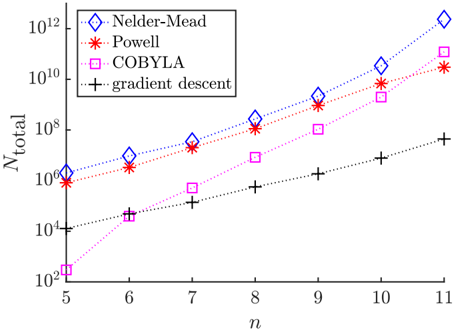
Proposition 1 proves that for a barren-plateau cost function, the difference \(\Delta C=C(\theta_B)-C(\theta_A)\) between two points separated by \(L\) has \(E_{\theta_A}[\Delta C]=0\) and variance bounded by \(G(n)=m^2L^2F(n)\), with \(G(n)\in O(1/b^n)\) for some \(b>1\). Corollary 1 extends this to independently chosen \(\theta_A,\theta_B\), relevant to global optimizers such as Bayesian methods. A Chebyshev bound gives \(P(|\Delta C|\ge c)\le G(n)/c^2\), implying cost differences are exponentially small with high probability. Numerically, for \(n=5,\dots,11\) qubits and depth \(p=n\), the median total shots needed to reach \(C=0.4\) scale exponentially for Powell, super-exponentially for Nelder-Mead, and irregularly but at least exponentially for COBYLA; gradient descent also scales exponentially.
Methods
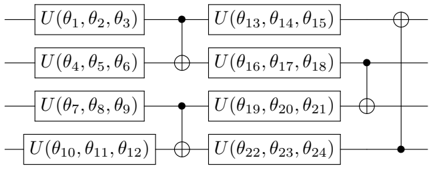
Analytical: finite-difference representation of \(\Delta C\) as a path integral of gradients, then Cauchy-Schwarz and covariance bounds under the barren-plateau definition \(Var_\theta[\partial_\mu C]\le F(n)\in O(1/b^n)\). Numerical: variational quantum compiling with target \(U=\mathbb{1}\), local cost \(C(\theta)=\mathrm{Tr}[O_L V(\theta)|0\rangle\langle0|V^\dagger(\theta)]\), \(O_L=1-\frac1n\sum_i |0_i\rangle\langle0_i|\), and a layered hardware-efficient ansatz with \(p=n\) layers. Optimizers Nelder-Mead, Powell, and COBYLA were run for \(n=5,\dots,11\), with 20 random-initialized runs per setting, stopping at \(C=0.4\) or a maximal shot budget; MATLAB and SciPy were used.
Limitations
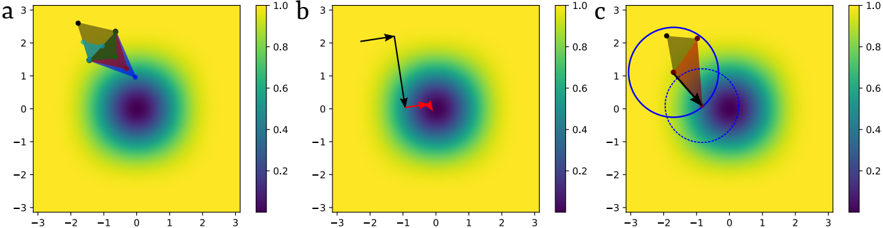
Stated: the exponential scaling found numerically is a lower bound on the asymptotics; Nelder-Mead’s super-exponential scaling is likely due to premature simplex shrinking when cost values are hard to order; COBYLA may suffer a similar premature trust-region shrinking, though the data do not clearly demonstrate it; Powell’s better scaling is likely because statistical noise does not cumulatively affect its state. Evident from the text: the numerical study is limited to a toy compilation problem with \(U=\mathbb{1}\), \(n=5\)–\(11\), a relatively large threshold \(C=0.4\) that probes only initial training, and default hyperparameters unrelated to termination; exact shot-count values are shown only in a figure, not reported numerically in the text.
Model-written summary. Check it against the paper before relying on it.
Integrity signals
Registry
Cites
Statistics
Figures
Verification
Claims the paper makes
7 Valid · 1 Not valid · 5 Not checked · 36 Own results and interpretations
The sources with a verdict support this claim; the rest weren’t checked yet, have no full text we could read, or their verdicts aren’t rated yet.
In the paper
“Due to this difficulty, one would expect the number of iterations required to converge with Nelder-Mead to be especially bad in limited precision environments, though we note that there are a number of modifications that attempt to improve the method's robustness to noise [46,47].”
§ Effect of barren plateaus on gradient-free optimization > 2.2.1 Nelder-Mead
What the sources say
- Supportedcites [46] matched to “Robust simplex algorithm for online optimization” (2018) source
The citation sits on the clause 'there are a number of modifications that attempt to improve the method's robustness to noise', and our copy's Introduction is exactly that: it lists 'a number of attempts to modify the Nelder-Mead simplex method to make it more suitable for dealing with noise in simulation optimization' (Barton & Ivey, Humphrey & Wilson's three-phase approach, Chang's stochastic method) and then presents the author's own noise-aware modification (Sec. II B, 'The robust simplex method'). The preceding 'one would expect ... especially bad in limited precision environments' is the citing authors' own hedged inference, not attributed to this source; our copy frames the difficulty as susceptibility to noise in function evaluation (Introduction; Sec. III Simulation, where Nelder-Mead with sigma=0.01 'typically does not converge to the minimum') rather than to limited numerical precision. (LLM, conf=0.85)
- Not checked yetcites [47] matched to “An efficient method for finding the minimum of a function of several variables without calculating derivatives” (1964) source
hedgedstates a possible cause- Asserted: passes — The authors put it forward as true.
- Checkable: passes — It can be checked against evidence.
- Load-bearing: unclear — It is unclear whether the paper’s conclusions depend on it.
- Based: passes — The paper gives a reason why it holds.
- Supported
The sources with a verdict support this claim; the rest weren’t checked yet, have no full text we could read, or their verdicts aren’t rated yet.
In the paper
“Barren plateau landscapes correspond to gradients that vanish exponentially in the number of qubits.”
- Also stated in: § 1 Introduction · boosted
“The most famous gradient scaling result is the barren plateau phenomenon [19][20][21][22][23][24][25][26][27][28][29][30][31][32][33], whereby the gradient of the cost function shrinks exponentially with the number of qubits.”
§ Effect of barren plateaus on gradient-free optimization > Abstract
What the sources say
- Supportedcites [19] matched to “Cost function dependent barren plateaus in shallow parametrized quantum circuits” (2021) source
The Introduction (p. 1, para on McClean et al.) explicitly defines the phenomenon: a 2-design ansatz 'leads to a barren plateau, i.e., with the gradient vanishing exponentially in the number of qubits, n.' The Warm-up example (Results) detects the barren plateau via a gradient variance 'which is exponentially vanishing in n,' while the local cost function's variance 'vanishes polynomially with n and hence exhibits no barren plateau.' The Introduction's summary of results likewise contrasts local cost functions vanishing 'polynomially rather than exponentially in n' with barren plateaus, confirming the equivalence the citing sentence asserts. (LLM, conf=0.92)
- Not checked yetcites [20]
- Supportedcites [21] matched to “Noise-induced barren plateaus in variational quantum algorithms” (2021) source
The Introduction of our copy states the characterization directly: recent studies proved 'the gradient vanishes exponentially in n' and 'this vanishing gradient phenomenon is now referred to as barren plateaus in the training landscape.' The Abstract likewise equates a barren plateau with a vanishing gradient and proves the gradient 'vanishes exponentially in the number of qubits n' when depth scales linearly with n (Noise-Induced Barren Plateau, Introduction and Results > General analytical results, Corollary 1). The only nuance is internal to the paper — noise-free barren plateaus are described as exponential decay of the gradient's variance rather than of the gradient itself (Results, Corollary 1 discussion) — but the claim's generic definitional statement is what our copy asserts. (LLM, conf=0.88)
boostedstates a cause- Asserted: passes — The authors put it forward as true.
- Checkable: passes — It can be checked against evidence.
- Load-bearing: passes — The paper’s conclusions depend on it.
- Based: passes — The paper gives a reason why it holds.
- Also stated in: § 1 Introduction · boosted
The cited sources support only part of this claim — read each source’s verdict below.
In the paper
“As shown in the seminal work of Ref. [19], deep random unstructured circuits which form 2-designs on n qubits will exhibit barren plateaus.”
§ Effect of barren plateaus on gradient-free optimization > 2.3 Barren Plateaus
What the sources say
- Partly supportedcites [19] matched to “Cost function dependent barren plateaus in shallow parametrized quantum circuits” (2021) sourceExperimental — accuracy not yet measured
The Introduction (p. 1) does state the substance: random initialization of a V(θ) that forms a 2-design leads to a barren plateau with gradients vanishing exponentially in n, and the Results ('Main results') confirm that for deep circuits their Alternating Layered Ansatz (an approximate one-dimensional 2-design at ~40n layers) 'behaves like a random circuit and we recover the barren plateau result of [ref. 9] for both local and global cost functions'. However, the source explicitly credits that deep-circuit/2-design result to McClean et al. (their ref. 9), calling it the contrasting prior work ('this is in contrast to McClean et al., who showed vanishing gradients for deep PQCs'), and presents its own contribution as the extension to shallow circuits and cost-function dependence (Fig. 1 caption: 'McClean et al. proved that a barren plateau can occur when the depth D ... Here we extend these results'). So the citing sentence's framing of this paper as the seminal/original demonstration of the deep-circuit 2-design barren plateau overstates it, even though the physical content is reported in the paper. (LLM, conf=0.80)
boostedstates a cause- Asserted: passes — The authors put it forward as true.
- Checkable: passes — It can be checked against evidence.
- Load-bearing: passes — The paper’s conclusions depend on it.
- Based: passes — The paper gives a reason why it holds.
- Partly supported
The cited sources support only part of this claim — read each source’s verdict below.
In the paper
“likely due to the chances of prematurely shrinking the simplex when it is hard to order the cost values [46].”
§ Effect of barren plateaus on gradient-free optimization > 5 Discussion
What the sources say
- Partly supportedcites [46] matched to “Robust simplex algorithm for online optimization” (2018) sourceExperimental — accuracy not yet measured
Our copy supports the mechanism half of the claim: Sec. II.B ('The robust simplex method') states that the shrink is performed only when f(n+1)-f(1) is above M2*sigma, a requirement 'imposed to avoid the reduction of the simplex size to a level when comparison operations are swamped by noise', and notes 'there could be ambiguity as to which vertex has the minimum value'; the Introduction ('As soon as the noise starts to alter the results of function value comparisons between the simplex vertices, the algorithm breaks down') and Sec. IV.A ('As its simplex quickly shrank, it soon stopped making appreciable changes') say the same. What the copy does not support is the scaling observation the explanation is offered for: no passage discusses how Nelder-Mead cost scales with the number of parameters N, and there is no mention of exponential or super-exponential growth (all tests are at fixed dimension — n=6 in Sec. III, 14 skew quadrupoles and 8 knobs in Sec. IV). So the cited source does not attribute premature shrinkage to a super-exponential-in-N scaling. (LLM, conf=0.72)
hedgedstates a possible cause- Asserted: passes — The authors put it forward as true.
- Checkable: passes — It can be checked against evidence.
- Load-bearing: unclear — It is unclear whether the paper’s conclusions depend on it.
- Based: passes — The paper gives a reason why it holds.
- Partly supported
Every source the paper cites for this claim was checked and supports it.
In the paper
“This corresponds to the barren plateau scenario in Ref. [19].”
§ Effect of barren plateaus on gradient-free optimization > 4 Numerical Implementation
What the sources say
- Supportedcites [19] matched to “Cost function dependent barren plateaus in shallow parametrized quantum circuits” (2021) source
The Introduction’s Fig. 1 caption describes barren plateaus in deep ansatzes, and Results > Main results says that for deep circuits the ansatz behaves like a random circuit and exhibits barren plateaus for both local and global cost functions. This supports the citing document’s identification of its linearly growing-depth choice as a barren-plateau scenario; the choice p=n is the citing document’s own setup. (LLM, conf=0.84)
plainstates an association- Asserted: passes — The authors put it forward as true.
- Checkable: passes — It can be checked against evidence.
- Load-bearing: passes — The paper’s conclusions depend on it.
- Based: passes — The paper gives a reason why it holds.
- Supported
28 more claims
Create a free account to see all 49 claims and to verify the 11 references still open.
- Probably not a substantial claim. 9
- It may state two separate claims as one. 8
Claims other papers make about this one
Each is checked against this paper’s own text: does it say what the citing paper says it does?
The check wasn’t confident either way, so it gives no verdict — never disputed.
In the citing paper
“Variational-state quantum metrology variationally searches for the optimal probe state [190-193].”
From Variational quantum algorithms (2021) · cites this paper as [193]
Experimental — accuracy not yet measuredThe check wasn’t confident either way, so it gives no verdict — never disputed.
In the citing paper
“Note that since QFI cannot be efficiently computed, an approximation of QFI can be heuristically found by optimizing the measurement basis, or by computing upper and lower bounds on the QFI [193].”
From Variational quantum algorithms (2021) · cites this paper as [193]
Experimental — accuracy not yet measured
Self-check
Percentages, sums and reported differences re-computed from the paper’s own numbers.
Each contradiction between two passages listed here was confirmed by an independent check.
Rated minor: it would not touch a result — a value no result rests on, a p-value that stays on the same side of the significance level, or a conflict that is clerical, resolved elsewhere in the paper, or outside its own findings.
In the paper
§ Effect of barren plateaus on gradient-free optimization > Proposition 1. Consider the cost function of Eq. (1).
“where we have used (5), and Eq. ( 9) from Proposition 1.”
§ Effect of barren plateaus on gradient-free optimization > Proposition 1. Consider the cost function of Eq. (1).
“Var θ A [∆C] G(n) ,(7)”
Citations
Cites
A Simplex Method for Function Minimization
Nelder, J. A., & Mead, R. (1965) · The Computer Journal · doi:10.1093/comjnl/7.4.308 · Cited by 28,905
Powell, M. J. D. (1964) · The Computer Journal · doi:10.1093/comjnl/7.2.155 · Cited by 4,632 · cited 2×
“The Powell algorithm [40] is another popular gradientfree optimizer that performs sequential line searches.”
MethodA variational eigenvalue solver on a photonic quantum processor
Peruzzo, A., McClean, J., Shadbolt, P., Yung, M.-H., Zhou, X.-Q., Love, P. J., Aspuru-Guzik, A., & O’Brien, J. L. (2014) · Nature Communications · doi:10.1038/ncomms5213 · Cited by 4,552 · cited 1×
“In this case, the cost takes a simpler form, where the training set contains a single state ( S = 1 ) and the cost is C ( θ ) = Tr[ OV ( θ ) ρV † ( θ )] , with O a Hermitian operator [3–14].”
BackgroundVariational quantum algorithms
Cerezo, M., Arrasmith, A., Babbush, R., Benjamin, S. C., Endo, S., Fujii, K., McClean, J. R., Mitarai, K., Yuan, X., Cincio, L., et al. (2021) · Nature Reviews Physics · doi:10.1038/s42254-021-00348-9 · Cited by 3,385 · cited 1×
“These circuits are utilized in both Variational Quantum Algorithms (VQAs) [1–14] and Quantum Neural Networks (QNNs) [15–18].”
MethodSelf-citationBarren plateaus in quantum neural network training landscapes
McClean, J. R., Boixo, S., Smelyanskiy, V. N., Babbush, R., & Neven, H. (2018) · Nature Communications · doi:10.1038/s41467-018-07090-4 · Cited by 2,329 · cited 4×
“[17], deep random unstructured circuits which form 2-designs on n qubits will exhibit barren plateaus.”
BackgroundInfluentialNoisy intermediate-scale quantum algorithms
Bharti, K., Cervera-Lierta, A., Kyaw, T. H., Haug, T., Alperin-Lea, S., Anand, A., Degroote, M., Heimonen, H., Kottmann, J. S., Menke, T., et al. (2022) · Reviews of Modern Physics · doi:10.1103/revmodphys.94.015004 · Cited by 2,231
A Quantum Approximate Optimization Algorithm
Farhi, E., Goldstone, J., & Gutmann, S. (2014) · arXiv · doi:10.48550/arxiv.1411.4028 · Cited by 1,789 · cited 3×
“[3] E.”
BackgroundMethodQuantum convolutional neural networks
Cong, I., Choi, S., & Lukin, M. D. (2019) · Nature Physics · doi:10.1038/s41567-019-0648-8 · Cited by 1,517 · cited 2×
“For instance, in a binary classification problem the cost function is given by the mean squared-error C(θ) = ∑ x(yx − ỹ(θ, ρx)) 2 [14, 15, 31, 32].”
BackgroundMethodPowell, M. J. D. (1994) · Advances in Optimization and Numerical Analysis · doi:10.1007/978-94-015-8330-5_4 · Cited by 1,369 · cited 11×
“Constrained Optimization BY Linear Approximation (COBYLA) is another popular gradient-free optimizer by Powell [42].”
BackgroundMethodInfluentialThe power of quantum neural networks
Abbas, A., Sutter, D., Zoufal, C., Lucchi, A., Figalli, A., & Woerner, S. (2021) · Nature Computational Science · doi:10.1038/s43588-021-00084-1 · Cited by 1,082
Research works printed but not linked: 5
- M. Cerezo, K. Sharma, A. Arrasmith, and P. J. Coles, Variational quantum state eigensolver, arXiv preprint arXiv:2004.01372 (2020). · arXiv
- K. Sharma, M. Cerezo, L. Cincio, and P. J. Coles, Trainability of dissipative perceptron-based quantum neural networks, arXiv preprint arXiv:2005.12458 (2020). · arXiv
- T. Volkoff and P. J. Coles, Large gradi- ents via correlation in random parameter- ized quantum circuits, Quantum Science and Technology 6, 025008 (2021). · doi:10.1088/2058-9565/abd89
- M. J. Powell, in Advances in optimization and numerical analysis (Springer, 1994) pp. 51-67. · DOI · Paper page
- A. Harrow and S. Mehraban, Approxi- mate unitary t-designs by short random quantum circuits using nearest-neighbor and long-range gates, arXiv preprint arXiv:1809.06957 (2018). · arXiv
Cited by
Items 201–300 of 414
Scaling of symmetry-restricted Lie groups
Mansky, M. B., Martinez, M. A., de la Serna, A. B., Castillo, S. L., Nikolaidou, D., Sathish, G., Wang, Z., Wölckert, S., & Linnhoff–Popien, C. (2025) · Physica Scripta · doi:10.1088/1402-4896/adf0ee · Cited by 8
Trainability issues in quantum policy gradients
Sequeira, A., Santos, L. P., & Barbosa, L. S. (2024) · Machine Learning Science and Technology · doi:10.1088/2632-2153/ad6830 · Cited by 9
A circuit-generated quantum subspace algorithm for the variational quantum eigensolver
Hirsbrunner, M. R., Mullinax, J. W., Shen, Y., Williams‐Young, D. B., Klymko, K., Beeumen, R. V., & Tubman, N. M. (2024) · The Journal of Chemical Physics · doi:10.1063/5.0224883 · Cited by 8
Learning to learn with an evolutionary strategy applied to variational quantum algorithms
Friedrich, L., & Maziero, J. (2025) · Physical Review A · doi:10.1103/physreva.111.022630 · Cited by 9
“13, 14, and 15, it’s evident that all three methods exhibit similar trends.”
Towards solving the BCS Hamiltonian gap in near-term quantum computers
Sá, N., Oliveira, I. S., & Roditi, I. (2022) · Results in Physics · doi:10.1016/j.rinp.2022.106131 · Cited by 8
Concentration-Free Quantum Kernel Learning in the Rydberg BlockadePreprint
Sarkar, A., Schnee, M., Kallullathil, S. D., Radgohar, R., Fadaie, M., Drouin-Touchette, V., & Kourtis, S. (2025) · arXiv (Cornell University) · doi:10.48550/arxiv.2508.10819 · Cited by 8
A review of variational quantum algorithms: Insights into fault-tolerant quantum computing
Wang, Z., Huang, J., Ye, R., Li, Q., Ding, Q.-M., Huang, Y., Zhang, T., Zeng, Y., Gao, J., Yuan, X., et al. (2026) · Frontiers of Physics · doi:10.15302/frontphys.2027.023301 · Cited by 7
“Furthermore, even when BPs are avoided, landscapes may still suffer from ill-conditioned Hessian matrices (narrow gorges) [116], which suppress both gradient-based and gradient-free optimization [117].”
Grover’s search with learning oracle for constrained binary optimization problems
Ohno, H. (2024) · Quantum Machine Intelligence · doi:10.1007/s42484-024-00148-1 · Cited by 7
Manko, S., & Frolovtsev, D. N. (2025) · Signal Image and Video Processing · doi:10.1007/s11760-025-03875-5 · Cited by 7
“Like classical neural networks, QNNs have several problems, such as a barren plateau that decreases the gradient as the number of qubits increases [32, 33].”
QD-MSA : A quantum distributed tensor network framework for multimodal sentiment analysis
Li, Y., Li, Y., Qi, Z., Yang, H., Shang, R., & Jiao, L. (2025) · Information Fusion · doi:10.1016/j.inffus.2025.103404 · Cited by 8
Policy Gradient Approach to Compilation of Variational Quantum Circuits
Herrera-Martí, D. A. (2022) · Quantum · doi:10.22331/q-2022-09-08-797 · Cited by 7
Variational Quantum Simulation of Valence-Bond Solids
Huerga, D. (2022) · Quantum · doi:10.22331/q-2022-12-13-874 · Cited by 7
Ito, K., & Fujii, K. (2023) · arXiv (Cornell University) · doi:10.48550/arxiv.2312.15791 · Cited by 7
Generalization Error in Quantum Machine Learning in the Presence of Sampling NoisePreprint
Hu, F., & Gao, X. (2024) · arXiv (Cornell University) · doi:10.48550/arxiv.2410.14654 · Cited by 7
“In contrast to classical machine learning, QML suffers from this inherent QSN which places a strong constraint on practical optimization and performance [26, 27].”
BackgroundJohri, S. (2025) · arXiv (Cornell University) · doi:10.48550/arxiv.2501.02148 · Cited by 7
Quantum Deep Learning: A Comprehensive ReviewPreprint
Ji, Y., Chen, Z.-Y., Roth, M., Kreplin, D. A., Schiffer, C., King, M., Anton, O., Alam, M. S., Krutzik, M., Willsch, D., et al. (2026) · arXiv (Cornell University) · doi:10.48550/arxiv.2603.06644 · Cited by 7
Expressivity limits in quantum walk-based optimization
Bridi, G. A., Lim, D., Pira, L., Santos, R. A. M., Marquezino, F. D. L., & Adhikary, S. (2026) · Physical Review A · doi:10.1103/8l54-9g97 · Cited by 6
Tkachenko, N. V., Ren, H., Billings, W. M., Tomann, R., Whaley, K. B., & Head‐Gordon, M. (2025) · Chemical Science · doi:10.1039/d5sc03585f · Cited by 6
Tailored Quantum Alternating Operator Ansätzes for Circuit Fault Diagnostics
Leipold, H., Spedalieri, F. M., & Rieffel, E. G. (2022) · Algorithms · doi:10.3390/a15100356 · Cited by 6
Quantum computing for data-centric engineering and science
Herbert, S. (2022) · Data-Centric Engineering · doi:10.1017/dce.2022.36 · Cited by 6
Optimisation-free density estimation and classification with quantum circuits
Vargas-Calderón, V., Gonzalez, F. A., & Vinck-Posada, H. (2022) · Quantum Machine Intelligence · doi:10.1007/s42484-022-00074-0 · Cited by 6
“2021) (despite some controversy (Arrasmith et al. 2021; authorname year; Cerezo et al. 2021)), as well as coming up with quantum-inspired gradient-free machine learning methods that can run both on classical and quantum computers (González et al.”
BackgroundFriedrich, L., & Maziero, J. (2024) · Research Square · doi:10.21203/rs.3.rs-3943271/v1 · Cited by 6
Quantum Reservoir Computing: Recent Advances and Future DirectionsPreprint
Tariq, S., Talha, M., Ali, A., Diyan, M., & Chatzinotas, S. (2026) · arXiv (Cornell University) · doi:10.48550/arxiv.2607.18552 · Cited by 6
Exploring new variational quantum circuit ansatzes for solving SU(2) matrix models
Dao, H. L. (2025) · The European Physical Journal C · doi:10.1140/epjc/s10052-025-14322-7 · Cited by 5
Variational quantum algorithm for entanglement quantification
Friedrich, L., Basso, M. L. W., de Palhares, A. B., Varela, J. M., Morais, L., Chaves, R., & Maziero, J. (2025) · Physical Review A · doi:10.1103/839s-4qqv · Cited by 5
Quantum LLMs Using Quantum Computing to Analyze and Process Semantic Information
Lab, F. F. P., & Laine, T. A. (2026) · Open Access Journal of Applied Science and Technology · doi:10.33140/oajast.04.01.02 · Cited by 5
“However, the development of practical QML algorithms faces significant challenges, including the limitations of current quantum hardware and the difficulty of demonstrating a quantum advantage [24].”
Daka, C., & Bhattacharyya, S. (2026) · Scientific Reports · doi:10.1038/s41598-026-45140-w · Cited by 5
“As a trust-region method , COBYLA avoids the explicit, costly, and noise-sensitive computation of gradients, which usually results in barren plateau landscapes 30,51,52 .”
Gince, J., Pagé, J.-M., Armenta, M., Sarkar, A., & Kourtis, S. (2024) · IEEE International Conference on Quantum Computing and Engineering (QCE) · doi:10.1109/qce60285.2024.00195 · Cited by 5
Srimahajariyapong, K., Thanasilp, S., & Chotibut, T. (2026) · Communications Physics · doi:10.1038/s42005-026-02528-4 · Cited by 5
Restricting to the chip architecture maintains the quantum neural network accuracy
Friedrich, L., & Maziero, J. (2024) · Quantum Information Processing · doi:10.1007/s11128-024-04336-7 · Cited by 5
Image classification by combining quantum kernel learning and tensor networks
Kodama, N. X., Bocharov, A., & Silva, M. P. D. (2025) · Physical Review A · doi:10.1103/physreva.111.012630 · Cited by 5
Sokolov, I., & Dziarmaga, J. (2025) · Physical review. B./Physical review. B · doi:10.1103/wkys-cd39 · Cited by 5
Calculation of the moscovium ground‐state energy by quantum algorithms
Zaytsev, V. A., Groshev, M. E., Maltsev, I. A., Durova, A. V., & Шабаев, В. М. (2023) · International Journal of Quantum Chemistry · doi:10.1002/qua.27232 · Cited by 5
Theory on variational high-dimensional tensor networksPreprint
Liu, Z., Ye, Q., Yu, L.-W., Duan, L. M., & Deng, D.-L. (2023) · arXiv (Cornell University) · doi:10.48550/arxiv.2303.17452 · Cited by 5
Truncation technique for variational quantum eigensolver for Molecular HamiltoniansPreprint
Xu, Q., & Setia, K. (2024) · arXiv (Cornell University) · doi:10.48550/arxiv.2402.01630 · Cited by 5
Discretized Quantum Exhaustive Search for Variational Quantum AlgorithmsPreprint
Alfassi, I., Meirom, D., & Mor, T. (2024) · arXiv (Cornell University) · doi:10.48550/arxiv.2407.17659 · Cited by 6
“The concentration of most of the cost function values that have a significant difference between them in a small area makes the search hard also for gradient-free optimizers [2].”
BackgroundFeature Encoding in Quantum Machine Learning: A Survey and Practical GuidelinesPreprint
Sammartino, V. (2026) · arXiv (Cornell University) · doi:10.48550/arxiv.2606.05387 · Cited by 7
Hamiltonian expressibility for ansatz selection in variational quantum algorithms
Brozzi, F., Turati, G., Dacrema, M. F., Caruso, F., & Cremonesi, P. (2026) · Quantum Machine Intelligence · doi:10.1007/s42484-026-00407-3 · Cited by 4
“A key challenge in the optimization of variational quantum circuits is the phenomenon of barren plateaus (McClean et al. 2018; Arrasmith et al. 2021, 2022; Cerezo and Coles 2021; Holmes et al. 2022; Larocca et al. 2022; Volkoff and Coles 2021).”
On the Role of Controllability in Pulse-based Quantum Machine Learning Models
Tao, H.-X., & Wu, R.-B. (2024) · IEEE Conference on Decision and Control (CDC) · doi:10.1109/cdc56724.2024.10886070 · Cited by 4
“This phenomenon causes gradients to vanish exponentially with qubit number, rendering models intractable to optimize for large systems [8], [36], [37], [38], [39], [40], [41].”
Evolving a Multi-Population Evolutionary-QAOA on Distributed QPUs
Schiavello, F., Altamura, E., Tavernelli, I., Mensa, S., & Symons, B. C. B. (2025) · IEEE International Conference on Quantum Computing and Engineering (QCE) · doi:10.1109/qce65121.2025.00012 · Cited by 4
“There is still a discussion within the literature about whether or not gradient-free methods are useful, for example, Arrasmith et al. argue that these do not solve the barren plateau problem [11].”
Optimizing a parameterized controlled gate using free quaternion selection
Kurogi, H., Endo, K., Sato, Y., Sugawara, M., Wada, K., Sugisaki, K., Kanno, S., Watanabe, H. C., & Nakano, H. (2026) · Quantum Science and Technology · doi:10.1088/2058-9565/ae379d · Cited by 4
Design of expressive and trainable pulse-based quantum machine learning models
Tao, H.-X., Wang, X., & Wu, R.-B. (2026) · Physical Review Research · doi:10.1103/gvj4-kqwd · Cited by 4
Simulating NMR Spectra with a Quantum ComputerPreprint
Ossorio-Castillo, J., & Rodríguez-Coello, A. (2024) · arXiv (Cornell University) · doi:10.48550/arxiv.2410.20836 · Cited by 4
“However, even gradient-free optimizers may be affected by the barren plateau problem [2].”
BackgroundCircuit Design based on Feature Similarity for Quantum Generative ModelingPreprint
Makarski, M., Kato, J., Sato, Y., & Yamamoto, N. (2026) · Research Square · doi:10.21203/rs.3.rs-8853286/v1 · Cited by 4
Practical Error Suppression and Mitigation for Reliable Quantum ComputingPreprint
Li, H.-Z., Yang, M., Yan, X., Koh, D. E., Lee, C. H., & Shen, R. (2026) · arXiv (Cornell University) · doi:10.48550/arxiv.2608.20453 · Cited by 5
Variational quantum compiling for three-qubit-gate design in quantum dots
Zhou, Y., He, H., Pang, F., Lyu, H., Zhang, Y., & Chen, X. (2025) · Physical Review A · doi:10.1103/physreva.111.042616 · Cited by 3
Photonic variational quantum eigensolver for NISQ-compatible quantum technology
Hu, K.-M., Namkung, M., & Lim, H. (2025) · Nano Convergence · doi:10.1186/s40580-025-00525-x · Cited by 4
“It is noted that, however, the COBYLA does not effectively circumvent the barren plateau problem, which may degrade ability of various VQAs [113].”
Rahman, R., & Nguyen, D. C. (2025) · IEEE Internet of Things Journal · doi:10.1109/jiot.2025.3639049 · Cited by 3
“In a barren plateau, the cost function becomes almost flat in large areas of the parameter space, making it exceedingly difficult for gradient-based optimization methods to determine a meaningful direction for parameter updates [6].”
Illustration of Barren Plateaus in Quantum Computing
Stenzel, G., Rohe, T., Kölle, M., Sünkel, L., Stein, J., & Linnhoff–Popien, C. (2026) · International Conference on Agents and Artificial Intelligence (ICAART) · doi:10.5220/0014310300004052 · Cited by 3
“Gradients are typically estimated through finite sampling, introducing noise that can make certain directions appear more promising than they actually are (Arrasmith et al., 2021).”
InfluentialOn the Stability of Local Interpretable Model-Agnostic Explanations for Quantum Classifiers
Acampora, G., & Vitiello, A. (2026) · Machine Learning · doi:10.1007/s10994-026-07071-5 · Cited by 3
“…recently, due to the drawbacks related to the computation of cost-function gradients such as the bar - ren plateau problem (McClean et al., 2018), gradient-free approaches such as COBYLA (Arrasmith et al., 2021) and Genetic Algorithms (Acampora et al., 2022) are emerging as a good alternative.”
Möller, M. (2023) · Computational methods in applied sciences · doi:10.1007/978-3-031-29082-4_21 · Cited by 3
Robustness of optimized numerical estimation schemes for noisy variational quantum algorithms
Teo, Y. S. (2024) · Physical Review A · doi:10.1103/physreva.109.012620 · Cited by 3
Tackling Blind Spot Challenges in Metaheuristics Algorithms Through Exploration and Exploitation
Črepinšek, M., Ravber, M., Mernik, L., & Mernik, M. (2025) · Mathematics · doi:10.3390/math13101580 · Cited by 3
Chen, X., Gao, P., Qiu, C.-D., Lu, Y.-N., Yang, F., Zhao, Y., Li, H., Zhang, J., Wei, S., Xing, T., et al. (2024) · New Journal of Physics · doi:10.1088/1367-2630/ad309d · Cited by 3
Variational simulation of higher-spin systems on qubit-based quantum simulators
Lyu, C., Zou, Z., Xu, X., Yung, M., & Bayat, A. (2026) · Physical Review Research · doi:10.1103/lfc9-cjqd · Cited by 3
“9 as evidence for the present system and ansatz rather than as a general necessity of gradient information [125, 126].”
Wang, S., Li, G., Wang, Z., Chen, Z., Wang, P., Gu, Y., Wu, Y.-C., & Guo, G. (2026) · Physical Review A · doi:10.1103/2p4m-5mt8 · Cited by 3
“Recent progress for alleviating, and even possibly avoiding, the notorious BPs mainly focuses on the study of ansatze [16, 18, 19, 20], parameter initializations [16, 21, 22, 23], cost functions [24, 25, 26], and optimization methods [27, 28, 29, 30].”
BackgroundFast and noise-aware machine learning variational quantum eigensolver optimiser
Karim, A., Zhang, S., & Usman, M. (2026) · Nano Futures · doi:10.1088/2399-1984/ae9fa5 · Cited by 3
“This is especially problematic as the optimisation routine may be trapped in a barren plateau where the gradient vanishes exponentially with problem size [18, 19].”
Li, Z., Meng, F., Zeng, H., Gong, Z., Zhang, Z., & Yu, X. (2023) · Advanced Quantum Technologies · doi:10.1002/qute.202200130 · Cited by 3
“When the ansatz exhibits the BP phenomenon, the probability decreases exponentially with respect to n, which indicates that the precision to determine a cost-minimizing direction is exponentially large to n [28, 37, 38].”
BackgroundVariational Quantum Eigensolver for Classification in Credit Sales RiskPreprint
Wiśniewska, J., & Sawerwain, M. (2023) · arXiv (Cornell University) · doi:10.48550/arxiv.2303.02797 · Cited by 3
“For comparison, in case of the VQE method based on eight qubits, the learning time was over 600 (700 for No. 4, Table 2) seconds for the COBYLA optimizer [18], [2].”
MethodA sequentially generated variational quantum circuit with polynomial complexityPreprint
Hou, X., Li, Q., Yung, M., Xu, X., Wang, Z., Guo, C., & Wang, X. (2023) · arXiv (Cornell University) · doi:10.48550/arxiv.2305.12856 · Cited by 3
Investigating quantum many-body systems with tensor networks, machine learning and quantum computers
Kottmann, K. (2022) · UPCommons institutional repository (Universitat Politècnica de Catalunya) · doi:10.5821/dissertation-2117-379461 · Cited by 3
Binkowski, L., Osborne, T. J., Schwiering, M., Schwonnek, R., & Ziegler, T. (2024) · arXiv (Cornell University) · doi:10.48550/arxiv.2411.00435 · Cited by 3
“The parameter landscape becomes practically flat almost everywhere which affects gradient-based methods and gradient-free optimisation routines alike [33].”
Variational Quantum Algorithms: From Theory to NISQ-Era Applications Challenges and OpportunitiesPreprint
Benamer, H. (2025) · Preprints.org · doi:10.20944/preprints202508.1482.v1 · Cited by 3
The disparate impact of noise on quantum learning algorithms
Angrisani, A. (2023) · theses.fr (ABES) · doi:10.70675/69f942ebz4417z4eceza746z1c9d436d09bb · Cited by 3
The role of data-induced randomness in quantum machine learning classification tasks
Casas, B., Bonet-Monroig, X., & Pérez-Salinas, A. (2026) · npj Quantum Information · doi:10.1038/s41534-026-01330-y · Cited by 2
The impact of architecture and cost function on dissipative quantum neural networks
Sutter, T. C., Popp, C., & Hiesmayr, B. C. (2026) · Quantum Machine Intelligence · doi:10.1007/s42484-026-00432-2 · Cited by 2
“This well-known trainability issue is not exclusive to gradient-based optimization, which we used in this work, but also appears in gradient-free schemes [51].”
Yeo, M., Kim, H., & Jeong, Y. (2025) · Journal of Lightwave Technology · doi:10.1109/jlt.2025.3594709 · Cited by 2
“Thus,arelevantgradient-freeCBCalgorithm hasbeenbeingsoughtafterinavarietyofapplications[21], [22], [23], [24].”
Slice-wise initial state optimization to improve cost and accuracy of the VQE on lattice models
Gaberle, C., & Jattana, M. S. (2025) · Physica Scripta · doi:10.1088/1402-4896/ae26f8 · Cited by 2
“The right choice of ansatz is the primary factor to tackle the problem of barren plateaus, a phenomenon in optimization where the gradient vanishes exponentially with the size of the landscape, making optimization impossible [18, 19, 20].”
Mittal, A., Srikanth, K. V., Bosco, F. S. D., Singh, A., & Chopra, A. (2025) · Supercomputing India (SCI) · doi:10.1109/sci68648.2025.11333835 · Cited by 2
“While gradient-based approaches risk converging to local optima [4] and gradient-free meth-ods face barren plateaus [5], metaheuristic optimizers [6, 7]—including Genetic Algorithms (GA) [8], Ant Colony Optimization (ACO) [9], and Particle Swarm Optimization (PSO) [10, 11]—are well suited to…”
Zhang, H., Guo, Y., Xu, G., Feng, Y., Zhang, J.-N., Yu, H., & Zhao, S. P. (2026) · Physical Review Applied · doi:10.1103/j3d6-wr9v · Cited by 2
Ramadhan, R. U., Permatahati, L. K., Prayitno, T. B., & Sarwono, Y. P. (2026) · The Journal of Physical Chemistry A · doi:10.1021/acs.jpca.5c08292 · Cited by 2
Revisiting semiconductor bulk hamiltonians using quantum computers
Pimenta, R. C. D. S., & Bezerra, A. T. (2023) · Physica Scripta · doi:10.1088/1402-4896/acbdc8 · Cited by 2
Quantum-Assisted Open-Pit Optimization
Paradezhenko, G. V., Pervishko, A. A., & Yudin, D. (2024) · Journal of Experimental and Theoretical Physics Letters · doi:10.1134/s0021364023604256 · Cited by 2
Torta, P. (2024) · SDL · Cited by 2
Quantum Neural Networks: Issues, Training, and Applications
Marrero, C. O., USDOE, Wiebe, N., Furches, J., & Ragone, M. (2023) · OSTI OAI (U.S. Department of Energy Office of Scientific and Technical Information) · doi:10.2172/2337965 · Cited by 2
“Additionally, recent work showed that under mild assumptions barren plateaus arise whenever QNNs are highly expressible [8] and the issue cannot be alleviated using gradient-free methods [9] or higher-derivatives [10].”
BackgroundBuilding spatial symmetries into parameterized quantum circuits for faster training
Sauvage, F., (NNSA), U. N. N. S. A., Larocca, M., Coles, P. J., & Cerezo, M. (2024) · OSTI OAI (U.S. Department of Energy Office of Scientific and Technical Information) · doi:10.2172/2375832 · Cited by 2
Self-citationVariational Quantum Optimization with Continuous BanditsPreprint
Wanner, M., Jonasson, J., Carlsson, E., & Dubhashi, D. (2025) · arXiv (Cornell University) · doi:10.48550/arxiv.2502.04021 · Cited by 2
“The first example reproduces the experimental setup from [3], which aims to train a PQC with respect to an objective that exhibits barren plateaus.”
Turati, G., Foderà, S., Nembrini, R., Dacrema, M. F., & Cremonesi, P. (2025) · arXiv (Cornell University) · doi:10.48550/arxiv.2507.16001 · Cited by 2
Quantum-centric machine learning for molecular dynamicsPreprint
Tao, Y., Wan, L., Zeng, X., Jin, Y., Jie, L., Li, Z., & Yang, J. (2025) · arXiv (Cornell University) · doi:10.48550/arxiv.2511.07771 · Cited by 2
Gate Freezing Method for Gradient-Free Variational Quantum Algorithms in Circuit OptimizationPreprint
Pankkonen, J. V., Ylinen, L., Raasakka, M., Marchesin, A., & Tittonen, I. J. (2025) · arXiv (Cornell University) · doi:10.48550/arxiv.2507.07742 · Cited by 2
“We provide additional results for incremental gate freeze method in Appendix B and with different ansatz circuits in Appendix C.”
Quantum neural networks facilitating quantum state classificationPreprint
Sharma, D., Sabale, V. B., M., T., & Kumar, A. (2025) · arXiv (Cornell University) · doi:10.48550/arxiv.2504.06622 · Cited by 2
“However, the random initialisation of parameters can also lead to the condition of a barren plateau [50]; therefore, in this study, we will also correlate the impact of barren plateaus on QNN performance.”
Zhang, F., & Zhao, Y. (2026) · arXiv (Cornell University) · doi:10.48550/arxiv.2601.18482 · Cited by 2
““Flat” qubit encodings struggle to capture the complex temporal coupling of energy storage and ramping constraints, often hitting the “barren plateau” phenomenon where gradients vanish exponentially with system size [22], [23].”
Klug, S., Pickl, S., & Moll, M. (2026) · Research Square · doi:10.21203/rs.3.rs-8437365/v1 · Cited by 2
Neutron-proton pairing problems simulated on quantum computers
Zhang, J. (2025) · theses.fr (ABES) · doi:10.70675/066a889bzbfb9z40d4z8957za0e98b2d394a · Cited by 2
Quantum Tilted Loss in Variational Optimization: Theory and ApplicationsPreprint
Qiu, Y., Lumbreras, J., Li, X., & Rebentrost, P. (2026) · arXiv (Cornell University) · doi:10.48550/arxiv.2605.02850 · Cited by 2
Research progress on quantum neural networks and quantum machine learningPreprint
Sun, Y., Sun, B., Tian, J., & Zhang, X. (2026) · arXiv (Cornell University) · doi:10.48550/arxiv.2605.30724 · Cited by 2
“It is important to note that strategies such as using higher-order gradients, gradient-free optimizers, QNGD, or noise mitigation techniques cannot resolve barren plateaus, as these approaches do not fundamentally alter the geometric properties of the landscape [252].”
Athanasakos, D., Tejedor-García, G., Araz, J. Y., Ramôa, M., Sambasivam, B., Economou, S. E., & Ringer, F. (2026) · Quantum Science and Technology · doi:10.48550/arxiv.2606.05297 · Cited by 3
“Earlier results suggest that such problem-inspired ans¨atze are less susceptible to the bar-ren plateau problem than generic parameterized circuits, resulting in a more favorable optimization landscape for classical optimizers [52, 55, 93, 94].”
VQE as Initial State Preparation for QPE on Heisenberg Spin-Glass HamiltoniansPreprint
Pelofske, E., & Eidenbenz, S. (2026) · arXiv (Cornell University) · doi:10.48550/arxiv.2606.15061 · Cited by 2
“These obstacles include a combination of vanishing gradients, local minima proliferation, qubit decoherence, and shot noise that make classical learning very challenging [26–33].”
Hybrid Quantum Neural Networks: Theory, Implementations, and ApplicationsPreprint
Monbroussou, L., Periyasamy, M., Kuzmin, V., Sekatski, P., Patapovich, V., Sagingalieva, A., & Melnikov, A. A. (2026) · arXiv (Cornell University) · doi:10.48550/arxiv.2608.01194 · Cited by 2
Supervised Quantum Machine Learning
Monroy-Azpeitia, A., Montiel-Pérez, J. Y., Maldonado-Romo, A., Arvizu-Velazquez, A. A., López-Bonilla, J. L., & Vidal-Beltrán, S. (2025) · Studies in computational intelligence · doi:10.1007/978-3-031-85614-3_10 · Cited by 1
Noise-Induced Transition in Optimal Solutions of Variational Quantum Algorithms
Li, C., & Hernandez, I. (2024) · OSTI OAI (U.S. Department of Energy Office of Scientific and Technical Information) · doi:10.2172/2361123 · Cited by 1
Pande, M. B. (2025) · Lecture notes in electrical engineering · doi:10.1007/978-981-97-4711-5_1 · Cited by 1
An Optimized Hybrid Quantum-Classical Neural Network Model for Handwritten Digit Classification
Nguyen, V.-Q.-M., Le, T.-K., Bui, T.-T., & Le, D.-H. (2025) · International Conference on Integrated Circuits, Design, and Verification (ICDV) · doi:10.1109/icdv66179.2025.11135335 · Cited by 1
“Convergence of H-QNN training and loss with 2 and 3 qubits plored in this paper, may be required [20].”
Quantum approximate optimization of finite-state bosonic systems
Daryanoosh, S. (2026) · Physical review. E · doi:10.1103/yg66-8ypn · Cited by 1
“Incremental achievement could be well related to the Barren plateau and the difficulty of classical optimizer routines in searching the optimization landscape for finding the optimal or near-optimal set of parameters [60, 61].”
Re-uploading Data in Tensor Network
Sineglazov, V. M., & Chynnyk, P. (2025) · Electronics and Control Systems · doi:10.18372/1990-5548.85.20428 · Cited by 1
“…our study: the challenges of barren plateaus in QML [1], [2]; the efficiency of tensor networks for scalable quantum architectures [4], [10], [14]; the advantages of data re-uploading and gradient-free optimization in improving model expressiveness and training stability [3], [5], [6], [20].”
Fernandez, B. O., Bloot, R., & Moret, M. A. (2025) · IEEE International Conference on Quantum Computing and Engineering (QCE) · doi:10.1109/qce65121.2025.00215 · Cited by 1
“A bottleneck in QAOA concerns its structure, which requires a classical optimization calculation, and resides in the convergence stagnation effect induced by a massive amount of local minima, as explained in [10] and [11].”
Relative Entropy-Based Training of Quantum Neural Networks
Mondal, S., & Dutta, A. K. (2025) · IEEE Transactions on Quantum Engineering · doi:10.1109/tqe.2025.3638878 · Cited by 2
“Even without hardware noise, challenges like barren plateaus and local minima persist [15], [16], motivating quantum analogues of classical components—perceptrons, configurations, optimizers, and loss functions [17], [18].”
Emergent‐Coupling‐Based Ansatz Evaluated on a Superconducting Quantum Processor
Joch, A., Lively, K., & Fauseweh, B. (2026) · Advanced Quantum Technologies · doi:10.1002/qute.70505 · Cited by 2
“In particular, issues, such as barren plateaus can severely hinder convergence, especially for deep or highly expressive circuits [ 12–14 ].”
Study of Effects of Shot Noise on Quantum Machine Learning Models
Etar, A., Tripathi, S. M., Soni, J., Upadhyay, H., & Perez-Pons, A. (2025) · Conference on AI, Science, Engineering, and Technology (AIxSET) · doi:10.1109/aixset65682.2025.00023 · Cited by 1
“More recent contributions by Arrasmith et al. [25] and LaRose et al. [26] discuss the effect of finite sampling noise on quantum learning models and provide guidelines for realistic QML evaluation.”
Quantum circuit evolutionary framework applied to the set partitioning problem
Fernandez, B. O., Bloot, R., & Moret, M. A. (2026) · The Journal of Supercomputing · doi:10.1007/s11227-026-08511-8 · Cited by 1
Metadata
- Authors
- Arrasmith, A., Cerezo, M., Czarnik, P., Cincio, L., & Coles, P. J.
- Affiliations
- Los Alamos National Laboratory (US)
- ORCID
- Czarnik, Piotr
- Venue
- Quantum
- Published
- 2021-10-05
- Volume
- 5
- Pages
- 558
- ISSN
- 2521-327X (ISSN-L)
- OpenAlex
- W3108496771
- Semantic Scholar
- a062fde5340e24ce5213eb6126f3a74fc78fdbf9
- Cited by
- 248
- References
- 43
- Citations by year
- 2026: 39 · 2025: 57 · 2024: 46 · 2023: 43 · 2022: 42 · 2021: 21
- FWCI
- 13.38
- Type
- journal article
- Language
- en
- Open access
- gold
- doi.org
- Locations
- Quantum (publishedVersion, cc-by)
- arXiv (Cornell University) (submittedVersion)
- OSTI OAI (U.S. Department of Energy Office of Scientific and Technical Information) (submittedVersion, cc-by)
- DOAJ (DOAJ: Directory of Open Access Journals) (submittedVersion, cc-by-sa)
- arXiv (Cornell University) (cc-by)
- Funders
- LANL LDRD (20190065DR, 20190659PRD4)
- Topics
- Physical Sciences › Computer Science › Artificial Intelligence › Quantum Computing Algorithms and Architecture
- Physical Sciences › Computer Science › Artificial Intelligence › Metaheuristic Optimization Algorithms Research
- Physical Sciences › Physics and Astronomy › Atomic and Molecular Physics, and Optics › Quantum many-body systems
- Keywords
- barren plateaus, derivative-free optimization, variational quantum algorithms, quantum neural networks, Nelder-Mead, Powell algorithm, COBYLA, variational quantum circuits
About these checks
Registry, retraction, Cites and statistics results are computed, not judged, with one exception: a printed reference that no index lists is read once by a model before it counts as a citation error. Claims are extracted by a model and kept only when their quote appears verbatim in the text; each cited source is then checked, with a model’s help, for whether it says what the claim relies on. Those verdicts can be wrong — read the claim’s quote and the cited source before relying on one.
The claim verdicts this report counts are experimental: their accuracy is not yet measured.
A language model drew the claims from the paper on 2026-10-08, under version 3 of the claim definition (model deepseek-v4.1-flash, prompt extract-v3).
A second model labelled each claim on 2026-10-08 (model jev-1.13-20260917, definition revision gold-guideline-v0.2).
Cited sources are checked with a language model’s help (qwen3.8-omni-flash and gpt-6-sol).
Statistics and arithmetic are recomputed, not judged.
Confidence bands are shown only for fields calibrated on our annotated test set. None is calibrated yet, so no band is shown.
What counts as a claim ›How we measure confidence ›How we check this ›
Are you an author, or do you see a problem with this page? Request a review
Data sources
Bibliographic data: Semantic Scholar, OpenAlex, Crossref.
Contains information from the Semantic Scholar Academic Graph Datasets, made available under the ODC Attribution License (ODC-BY 1.0).
Semantic Scholar’s data is described in: Kinney, R., et al. (2023). The Semantic Scholar Open Data Platform. arXiv:2301.10140.
