

Effect of barren plateaus on gradient-free optimization
Open accessThe DOI matches its Crossref record; 54 of the 54 references it cites were found in a registry or an index; 10 of the 21 sources its claims cite were checked for support.
Abstract
Barren plateau landscapes correspond to gradients that vanish exponentially in the number of qubits. Such landscapes have been demonstrated for variational quantum algorithms and quantum neural networks with either deep circuits or global cost functions. For obvious reasons, it is expected that gradient-based optimizers will be significantly affected by barren plateaus. However, whether or not gradient-free optimizers are impacted is a topic of debate, with some arguing that gradient-free approaches are unaffected by barren plateaus. Here we show that, indeed, gradient-free optimizers do not solve the barren plateau problem. Our main result proves that cost function differences, which are the basis for making decisions in a gradient-free optimization, are exponentially suppressed in a barren plateau. Hence, without exponential precision, gradient-free optimizers will not make progress in the optimization. We numerically confirm this by training in a barren plateau with several gradient-free optimizers (Nelder-Mead, Powell, and COBYLA algorithms), and show that the numbers of shots required in the optimization grows exponentially with the number of qubits.
Overview
CoChat Summary
TL;DR
The paper argues analytically and numerically that gradient-free optimizers do not avoid barren plateaus: cost-function differences are exponentially suppressed in the number of qubits, so optimizers need exponential precision to make progress. Numerical training of a parameterized quantum circuit with Nelder-Mead, Powell, and COBYLA shows shot requirements growing exponentially or worse with qubit number.
Key findings
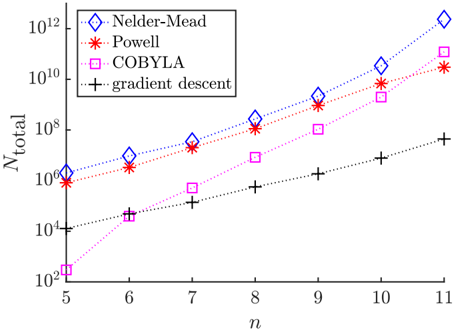
Proposition 1 proves that for a barren-plateau cost function, the difference \(\Delta C=C(\theta_B)-C(\theta_A)\) between two points separated by \(L\) has \(E_{\theta_A}[\Delta C]=0\) and variance bounded by \(G(n)=m^2L^2F(n)\), with \(G(n)\in O(1/b^n)\) for some \(b>1\). Corollary 1 extends this to independently chosen \(\theta_A,\theta_B\), relevant to global optimizers such as Bayesian methods. A Chebyshev bound gives \(P(|\Delta C|\ge c)\le G(n)/c^2\), implying cost differences are exponentially small with high probability. Numerically, for \(n=5,\dots,11\) qubits and depth \(p=n\), the median total shots needed to reach \(C=0.4\) scale exponentially for Powell, super-exponentially for Nelder-Mead, and irregularly but at least exponentially for COBYLA; gradient descent also scales exponentially.
Methods
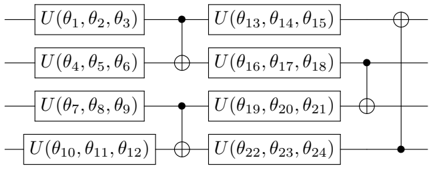
Analytical: finite-difference representation of \(\Delta C\) as a path integral of gradients, then Cauchy-Schwarz and covariance bounds under the barren-plateau definition \(Var_\theta[\partial_\mu C]\le F(n)\in O(1/b^n)\). Numerical: variational quantum compiling with target \(U=\mathbb{1}\), local cost \(C(\theta)=\mathrm{Tr}[O_L V(\theta)|0\rangle\langle0|V^\dagger(\theta)]\), \(O_L=1-\frac1n\sum_i |0_i\rangle\langle0_i|\), and a layered hardware-efficient ansatz with \(p=n\) layers. Optimizers Nelder-Mead, Powell, and COBYLA were run for \(n=5,\dots,11\), with 20 random-initialized runs per setting, stopping at \(C=0.4\) or a maximal shot budget; MATLAB and SciPy were used.
Limitations
Stated: the exponential scaling found numerically is a lower bound on the asymptotics; Nelder-Mead’s super-exponential scaling is likely due to premature simplex shrinking when cost values are hard to order; COBYLA may suffer a similar premature trust-region shrinking, though the data do not clearly demonstrate it; Powell’s better scaling is likely because statistical noise does not cumulatively affect its state. Evident from the text: the numerical study is limited to a toy compilation problem with \(U=\mathbb{1}\), \(n=5\)–\(11\), a relatively large threshold \(C=0.4\) that probes only initial training, and default hyperparameters unrelated to termination; exact shot-count values are shown only in a figure, not reported numerically in the text.
Model-written summary. Check it against the paper before relying on it.
Integrity signals
Registry
Cites
Statistics
Figures
Verification
Claims the paper makes
7 Valid · 1 Not valid · 5 Not checked · 36 Own results and interpretations
The sources with a verdict support this claim; the rest weren’t checked yet, have no full text we could read, or their verdicts aren’t rated yet.
In the paper
“Due to this difficulty, one would expect the number of iterations required to converge with Nelder-Mead to be especially bad in limited precision environments, though we note that there are a number of modifications that attempt to improve the method's robustness to noise [46,47].”
§ Effect of barren plateaus on gradient-free optimization > 2.2.1 Nelder-Mead
What the sources say
- Supportedcites [46] matched to “Robust simplex algorithm for online optimization” (2018) source
The citation sits on the clause 'there are a number of modifications that attempt to improve the method's robustness to noise', and our copy's Introduction is exactly that: it lists 'a number of attempts to modify the Nelder-Mead simplex method to make it more suitable for dealing with noise in simulation optimization' (Barton & Ivey, Humphrey & Wilson's three-phase approach, Chang's stochastic method) and then presents the author's own noise-aware modification (Sec. II B, 'The robust simplex method'). The preceding 'one would expect ... especially bad in limited precision environments' is the citing authors' own hedged inference, not attributed to this source; our copy frames the difficulty as susceptibility to noise in function evaluation (Introduction; Sec. III Simulation, where Nelder-Mead with sigma=0.01 'typically does not converge to the minimum') rather than to limited numerical precision. (LLM, conf=0.85)
- Not checked yetcites [47] matched to “An efficient method for finding the minimum of a function of several variables without calculating derivatives” (1964) source
hedgedstates a possible cause- Asserted: passes — The authors put it forward as true.
- Checkable: passes — It can be checked against evidence.
- Load-bearing: unclear — It is unclear whether the paper’s conclusions depend on it.
- Based: passes — The paper gives a reason why it holds.
- Supported
The sources with a verdict support this claim; the rest weren’t checked yet, have no full text we could read, or their verdicts aren’t rated yet.
In the paper
“Barren plateau landscapes correspond to gradients that vanish exponentially in the number of qubits.”
- Also stated in: § 1 Introduction · boosted
“The most famous gradient scaling result is the barren plateau phenomenon [19][20][21][22][23][24][25][26][27][28][29][30][31][32][33], whereby the gradient of the cost function shrinks exponentially with the number of qubits.”
§ Effect of barren plateaus on gradient-free optimization > Abstract
What the sources say
- Supportedcites [19] matched to “Cost function dependent barren plateaus in shallow parametrized quantum circuits” (2021) source
The Introduction (p. 1, para on McClean et al.) explicitly defines the phenomenon: a 2-design ansatz 'leads to a barren plateau, i.e., with the gradient vanishing exponentially in the number of qubits, n.' The Warm-up example (Results) detects the barren plateau via a gradient variance 'which is exponentially vanishing in n,' while the local cost function's variance 'vanishes polynomially with n and hence exhibits no barren plateau.' The Introduction's summary of results likewise contrasts local cost functions vanishing 'polynomially rather than exponentially in n' with barren plateaus, confirming the equivalence the citing sentence asserts. (LLM, conf=0.92)
- Not checked yetcites [20]
- Supportedcites [21] matched to “Noise-induced barren plateaus in variational quantum algorithms” (2021) source
The Introduction of our copy states the characterization directly: recent studies proved 'the gradient vanishes exponentially in n' and 'this vanishing gradient phenomenon is now referred to as barren plateaus in the training landscape.' The Abstract likewise equates a barren plateau with a vanishing gradient and proves the gradient 'vanishes exponentially in the number of qubits n' when depth scales linearly with n (Noise-Induced Barren Plateau, Introduction and Results > General analytical results, Corollary 1). The only nuance is internal to the paper — noise-free barren plateaus are described as exponential decay of the gradient's variance rather than of the gradient itself (Results, Corollary 1 discussion) — but the claim's generic definitional statement is what our copy asserts. (LLM, conf=0.88)
boostedstates a cause- Asserted: passes — The authors put it forward as true.
- Checkable: passes — It can be checked against evidence.
- Load-bearing: passes — The paper’s conclusions depend on it.
- Based: passes — The paper gives a reason why it holds.
- Also stated in: § 1 Introduction · boosted
The cited sources support only part of this claim — read each source’s verdict below.
In the paper
“As shown in the seminal work of Ref. [19], deep random unstructured circuits which form 2-designs on n qubits will exhibit barren plateaus.”
§ Effect of barren plateaus on gradient-free optimization > 2.3 Barren Plateaus
What the sources say
- Partly supportedcites [19] matched to “Cost function dependent barren plateaus in shallow parametrized quantum circuits” (2021) sourceExperimental — accuracy not yet measured
The Introduction (p. 1) does state the substance: random initialization of a V(θ) that forms a 2-design leads to a barren plateau with gradients vanishing exponentially in n, and the Results ('Main results') confirm that for deep circuits their Alternating Layered Ansatz (an approximate one-dimensional 2-design at ~40n layers) 'behaves like a random circuit and we recover the barren plateau result of [ref. 9] for both local and global cost functions'. However, the source explicitly credits that deep-circuit/2-design result to McClean et al. (their ref. 9), calling it the contrasting prior work ('this is in contrast to McClean et al., who showed vanishing gradients for deep PQCs'), and presents its own contribution as the extension to shallow circuits and cost-function dependence (Fig. 1 caption: 'McClean et al. proved that a barren plateau can occur when the depth D ... Here we extend these results'). So the citing sentence's framing of this paper as the seminal/original demonstration of the deep-circuit 2-design barren plateau overstates it, even though the physical content is reported in the paper. (LLM, conf=0.80)
boostedstates a cause- Asserted: passes — The authors put it forward as true.
- Checkable: passes — It can be checked against evidence.
- Load-bearing: passes — The paper’s conclusions depend on it.
- Based: passes — The paper gives a reason why it holds.
- Partly supported
The cited sources support only part of this claim — read each source’s verdict below.
In the paper
“likely due to the chances of prematurely shrinking the simplex when it is hard to order the cost values [46].”
§ Effect of barren plateaus on gradient-free optimization > 5 Discussion
What the sources say
- Partly supportedcites [46] matched to “Robust simplex algorithm for online optimization” (2018) sourceExperimental — accuracy not yet measured
Our copy supports the mechanism half of the claim: Sec. II.B ('The robust simplex method') states that the shrink is performed only when f(n+1)-f(1) is above M2*sigma, a requirement 'imposed to avoid the reduction of the simplex size to a level when comparison operations are swamped by noise', and notes 'there could be ambiguity as to which vertex has the minimum value'; the Introduction ('As soon as the noise starts to alter the results of function value comparisons between the simplex vertices, the algorithm breaks down') and Sec. IV.A ('As its simplex quickly shrank, it soon stopped making appreciable changes') say the same. What the copy does not support is the scaling observation the explanation is offered for: no passage discusses how Nelder-Mead cost scales with the number of parameters N, and there is no mention of exponential or super-exponential growth (all tests are at fixed dimension — n=6 in Sec. III, 14 skew quadrupoles and 8 knobs in Sec. IV). So the cited source does not attribute premature shrinkage to a super-exponential-in-N scaling. (LLM, conf=0.72)
hedgedstates a possible cause- Asserted: passes — The authors put it forward as true.
- Checkable: passes — It can be checked against evidence.
- Load-bearing: unclear — It is unclear whether the paper’s conclusions depend on it.
- Based: passes — The paper gives a reason why it holds.
- Partly supported
Every source the paper cites for this claim was checked and supports it.
In the paper
“This corresponds to the barren plateau scenario in Ref. [19].”
§ Effect of barren plateaus on gradient-free optimization > 4 Numerical Implementation
What the sources say
- Supportedcites [19] matched to “Cost function dependent barren plateaus in shallow parametrized quantum circuits” (2021) source
The Introduction’s Fig. 1 caption describes barren plateaus in deep ansatzes, and Results > Main results says that for deep circuits the ansatz behaves like a random circuit and exhibits barren plateaus for both local and global cost functions. This supports the citing document’s identification of its linearly growing-depth choice as a barren-plateau scenario; the choice p=n is the citing document’s own setup. (LLM, conf=0.84)
plainstates an association- Asserted: passes — The authors put it forward as true.
- Checkable: passes — It can be checked against evidence.
- Load-bearing: passes — The paper’s conclusions depend on it.
- Based: passes — The paper gives a reason why it holds.
- Supported
28 more claims
Create a free account to see all 49 claims and to verify the 11 references still open.
- Probably not a substantial claim. 9
- It may state two separate claims as one. 8
Claims other papers make about this one
Each is checked against this paper’s own text: does it say what the citing paper says it does?
The check wasn’t confident either way, so it gives no verdict — never disputed.
In the citing paper
“Variational-state quantum metrology variationally searches for the optimal probe state [190-193].”
From Variational quantum algorithms (2021) · cites this paper as [193]
Experimental — accuracy not yet measuredThe check wasn’t confident either way, so it gives no verdict — never disputed.
In the citing paper
“Note that since QFI cannot be efficiently computed, an approximation of QFI can be heuristically found by optimizing the measurement basis, or by computing upper and lower bounds on the QFI [193].”
From Variational quantum algorithms (2021) · cites this paper as [193]
Experimental — accuracy not yet measured
Self-check
Percentages, sums and reported differences re-computed from the paper’s own numbers.
Each contradiction between two passages listed here was confirmed by an independent check.
Rated minor: it would not touch a result — a value no result rests on, a p-value that stays on the same side of the significance level, or a conflict that is clerical, resolved elsewhere in the paper, or outside its own findings.
In the paper
§ Effect of barren plateaus on gradient-free optimization > Proposition 1. Consider the cost function of Eq. (1).
“where we have used (5), and Eq. ( 9) from Proposition 1.”
§ Effect of barren plateaus on gradient-free optimization > Proposition 1. Consider the cost function of Eq. (1).
“Var θ A [∆C] G(n) ,(7)”
Citations
Cites
A Simplex Method for Function Minimization
Nelder, J. A., & Mead, R. (1965) · The Computer Journal · doi:10.1093/comjnl/7.4.308 · Cited by 28,905
Powell, M. J. D. (1964) · The Computer Journal · doi:10.1093/comjnl/7.2.155 · Cited by 4,632 · cited 2×
“The Powell algorithm [40] is another popular gradientfree optimizer that performs sequential line searches.”
MethodA variational eigenvalue solver on a photonic quantum processor
Peruzzo, A., McClean, J., Shadbolt, P., Yung, M.-H., Zhou, X.-Q., Love, P. J., Aspuru-Guzik, A., & O’Brien, J. L. (2014) · Nature Communications · doi:10.1038/ncomms5213 · Cited by 4,552 · cited 1×
“In this case, the cost takes a simpler form, where the training set contains a single state ( S = 1 ) and the cost is C ( θ ) = Tr[ OV ( θ ) ρV † ( θ )] , with O a Hermitian operator [3–14].”
BackgroundVariational quantum algorithms
Cerezo, M., Arrasmith, A., Babbush, R., Benjamin, S. C., Endo, S., Fujii, K., McClean, J. R., Mitarai, K., Yuan, X., Cincio, L., et al. (2021) · Nature Reviews Physics · doi:10.1038/s42254-021-00348-9 · Cited by 3,385 · cited 1×
“These circuits are utilized in both Variational Quantum Algorithms (VQAs) [1–14] and Quantum Neural Networks (QNNs) [15–18].”
MethodSelf-citationBarren plateaus in quantum neural network training landscapes
McClean, J. R., Boixo, S., Smelyanskiy, V. N., Babbush, R., & Neven, H. (2018) · Nature Communications · doi:10.1038/s41467-018-07090-4 · Cited by 2,329 · cited 4×
“[17], deep random unstructured circuits which form 2-designs on n qubits will exhibit barren plateaus.”
BackgroundInfluentialNoisy intermediate-scale quantum algorithms
Bharti, K., Cervera-Lierta, A., Kyaw, T. H., Haug, T., Alperin-Lea, S., Anand, A., Degroote, M., Heimonen, H., Kottmann, J. S., Menke, T., et al. (2022) · Reviews of Modern Physics · doi:10.1103/revmodphys.94.015004 · Cited by 2,231
A Quantum Approximate Optimization Algorithm
Farhi, E., Goldstone, J., & Gutmann, S. (2014) · arXiv · doi:10.48550/arxiv.1411.4028 · Cited by 1,789 · cited 3×
“[3] E.”
BackgroundMethodQuantum convolutional neural networks
Cong, I., Choi, S., & Lukin, M. D. (2019) · Nature Physics · doi:10.1038/s41567-019-0648-8 · Cited by 1,517 · cited 2×
“For instance, in a binary classification problem the cost function is given by the mean squared-error C(θ) = ∑ x(yx − ỹ(θ, ρx)) 2 [14, 15, 31, 32].”
BackgroundMethodPowell, M. J. D. (1994) · Advances in Optimization and Numerical Analysis · doi:10.1007/978-94-015-8330-5_4 · Cited by 1,369 · cited 11×
“Constrained Optimization BY Linear Approximation (COBYLA) is another popular gradient-free optimizer by Powell [42].”
BackgroundMethodInfluentialThe power of quantum neural networks
Abbas, A., Sutter, D., Zoufal, C., Lucchi, A., Figalli, A., & Woerner, S. (2021) · Nature Computational Science · doi:10.1038/s43588-021-00084-1 · Cited by 1,082
Research works printed but not linked: 5
- M. Cerezo, K. Sharma, A. Arrasmith, and P. J. Coles, Variational quantum state eigensolver, arXiv preprint arXiv:2004.01372 (2020). · arXiv
- K. Sharma, M. Cerezo, L. Cincio, and P. J. Coles, Trainability of dissipative perceptron-based quantum neural networks, arXiv preprint arXiv:2005.12458 (2020). · arXiv
- T. Volkoff and P. J. Coles, Large gradi- ents via correlation in random parameter- ized quantum circuits, Quantum Science and Technology 6, 025008 (2021). · doi:10.1088/2058-9565/abd89
- M. J. Powell, in Advances in optimization and numerical analysis (Springer, 1994) pp. 51-67. · DOI · Paper page
- A. Harrow and S. Mehraban, Approxi- mate unitary t-designs by short random quantum circuits using nearest-neighbor and long-range gates, arXiv preprint arXiv:1809.06957 (2018). · arXiv
Cited by
Variational quantum algorithms
Cerezo, M., Arrasmith, A., Babbush, R., Benjamin, S. C., Endo, S., Fujii, K., McClean, J. R., Mitarai, K., Yuan, X., Cincio, L., et al. (2021) · Nature Reviews Physics · doi:10.1038/s42254-021-00348-9 · Cited by 3,385
“large precision to resolve against finite sampling noise and determine a cost-minimizing direction, with this being valid independently of using a gradient-based [68] or gradient-free optimization method [165].”
MethodSelf-citationNoisy intermediate-scale quantum algorithms
Bharti, K., Cervera-Lierta, A., Kyaw, T. H., Haug, T., Alperin-Lea, S., Anand, A., Degroote, M., Heimonen, H., Kottmann, J. S., Menke, T., et al. (2022) · Reviews of Modern Physics · doi:10.1103/revmodphys.94.015004 · Cited by 2,231
Cost function dependent barren plateaus in shallow parametrized quantum circuits
Cerezo, M., Sone, A., Volkoff, T., Cincio, L., & Coles, P. J. (2021) · Nature Communications · doi:10.1038/s41467-021-21728-w · Cited by 1,047
“From (31), the partial derivative of the global cost function in (1) can be expressed as”
BackgroundMethodSelf-citationThe Variational Quantum Eigensolver: A review of methods and best practices
Tilly, J., Chen, H., Cao, S., Picozzi, D., Setia, K., Li, Y., Grant, E., Wossnig, L., Rungger, I., Booth, G. H., et al. (2022) · Physics Reports · doi:10.1016/j.physrep.2022.08.003 · Cited by 1,031
Noise-Induced Barren Plateaus in Variational Quantum Algorithms
Wang, S., Fontana, E., Cerezo, M., Sharma, K., Sone, A., Cincio, L., & Coles, P. J. (2020) · arXiv · doi:10.48550/arxiv.2007.14384 · Cited by 791
Self-citationNoise-induced barren plateaus in variational quantum algorithms
Wang, S., Fontana, E., Cerezo, M., Sharma, K., Sone, A., Cincio, L., & Coles, P. J. (2021) · Nature Communications · doi:10.1038/s41467-021-27045-6 · Cited by 773
Self-citationChallenges and opportunities in quantum machine learning
Cerezo, M., Verdon, G., Huang, H.-Y., Cincio, L., & Coles, P. J. (2022) · Nature Computational Science · doi:10.1038/s43588-022-00311-3 · Cited by 689
Self-citationConnecting Ansatz Expressibility to Gradient Magnitudes and Barren Plateaus
Holmes, Z., Sharma, K., Cerezo, M., & Coles, P. J. (2022) · PRX Quantum · doi:10.1103/prxquantum.3.010313 · Cited by 570
Self-citationGeneralization in quantum machine learning from few training data
Caro, M. C., Huang, H.-Y., Cerezo, M., Sharma, K., Sornborger, A., Cincio, L., & Coles, P. J. (2022) · Nature Communications · doi:10.1038/s41467-022-32550-3 · Cited by 476
Self-citationTensorFlow Quantum: A Software Framework for Quantum Machine Learning
Broughton, M., Verdon, G., McCourt, T., Martinez, A. J., Yoo, J. H., Isakov, S. V., Massey, P., Halavati, R., Niu, M. Y., Zlokapa, A., et al. (2020) · arXiv · doi:10.48550/arxiv.2003.02989 · Cited by 308
Barren plateaus in variational quantum computing
Larocca, M., Thanasilp, S., Wang, S., Sharma, K., Biamonte, J., Coles, P. J., Cincio, L., McClean, J. R., Holmes, Z., & Cerezo, M. (2025) · Nature Reviews Physics · doi:10.1038/s42254-025-00813-9 · Cited by 257
“However, studies have shown that these approaches still require an exponential number of measurements to obtain a loss-minimizing direction 22,27,217 .”
Self-citationEquivalence of quantum barren plateaus to cost concentration and narrow gorges
Arrasmith, A., Holmes, Z., Cerezo, M., & Coles, P. J. (2022) · Quantum Science and Technology · doi:10.1088/2058-9565/ac7d06 · Cited by 137
“Moreover, the exponential precision requirements has been shown to affect both derivativebased [50] and derivative-free [51] optimization methods, meaning that one cannot improve the trainability of the cost function in a barren plateau by simply changing the optimization method.”
Self-citationTheory for Equivariant Quantum Neural Networks
Nguyen, Q. T., Schatzki, L., Braccia, P., Ragone, M., Coles, P. J., Sauvage, F., Larocca, M., & Cerezo, M. (2024) · PRX Quantum · doi:10.1103/prxquantum.5.020328 · Cited by 233
Self-citationEntanglement devised barren plateau mitigation
Patti, T. L., Najafi, K., Gao, X., & Yelin, S. F. (2021) · Physical Review Research · doi:10.1103/physrevresearch.3.033090 · Cited by 148
“Moreover, even gradient-free algorithms can be impacted [12, 13].”
BackgroundQuantum variational algorithms are swamped with traps
Anschuetz, E. R., & Kiani, B. T. (2022) · Nature Communications · doi:10.1038/s41467-022-35364-5 · Cited by 226
VQE method: a short survey and recent developments
Fedorov, D. A., Peng, B., Govind, N., & Alexeev, Y. (2022) · Materials Theory · doi:10.1186/s41313-021-00032-6 · Cited by 224
Quantum Computing for High-Energy Physics: State of the Art and Challenges
Di Meglio, A., Jansen, K., Tavernelli, I., Alexandrou, C., Arunachalam, S., Bauer, C. W., Borras, K., Carrazza, S., Crippa, A., Croft, V., et al. (2024) · PRX Quantum · doi:10.1103/prxquantum.5.037001 · Cited by 215
Diagnosing Barren Plateaus with Tools from Quantum Optimal Control
Larocca, M., Czarnik, P., Sharma, K., Muraleedharan, G., Coles, P. J., & Cerezo, M. (2022) · Quantum · doi:10.22331/q-2022-09-29-824 · Cited by 214
“Moreover, as shown in [40, 42], barren plateaus affect both gradient-based and gradient-free methods meaning that simply changing the optimization strategy does not mitigate or solve the barren plateau issues.”
BackgroundSelf-citationHybrid quantum-classical algorithms in the noisy intermediate-scale quantum era and beyond
Callison, A., & Chancellor, N. (2022) · Physical Review A · doi:10.1103/physreva.106.010101 · Cited by 207
“The fact that barren plateaus cause gradients to vanish begs the question whether they will be problematic if optimization of parameters is performed with a gradient free method, unfortunately, recent work suggests that they are still an impediment [96].”
Avoiding Barren Plateaus Using Classical Shadows
Sack, S. H., Medina, R. A., Michailidis, A. A., Kueng, R., & Serbyn, M. (2022) · PRX Quantum · doi:10.1103/prxquantum.3.020365 · Cited by 195
“We also note that gradient-free optimization strategies do not circumvent the BP problem since the optimization landscape is inherently flat [35].”
BackgroundExponential concentration in quantum kernel methods
Thanasilp, S., Wang, S., Cerezo, M., & Holmes, Z. (2024) · Nature Communications · doi:10.1038/s41467-024-49287-w · Cited by 189
Self-citationA comprehensive review of quantum machine learning: from NISQ to fault tolerance
Wang, Y., & Liu, J. (2024) · Reports on Progress in Physics · doi:10.1088/1361-6633/ad7f69 · Cited by 192
“The barren plateau phenomenon was first studied in deep hardware-efficient QNNs [109], where they arise due to the high expressivity of the model [9, 29].”
Adaptive Variational Quantum Dynamics Simulations
Yao, Y.-X., Gomes, N., Zhang, F., Wang, C.-Z., Ho, K.-M., Iadecola, T., & Orth, P. P. (2021) · PRX Quantum · doi:10.1103/prxquantum.2.030307 · Cited by 184
Quantum machine learning: from physics to software engineering
Melnikov, A. A., Kordzanganeh, M., Alodjants, A. P., & Lee, R. (2023) · Advances in Physics X · doi:10.1080/23746149.2023.2165452 · Cited by 182
“[142] confirmed that barren plateaus also exist in gradient-free optimisation methods.”
MethodTheory of overparametrization in quantum neural networks
Larocca, M., Ju, N., García-Martín, D., Coles, P. J., & Cerezo, M. (2023) · Nature Computational Science · doi:10.1038/s43588-023-00467-6 · Cited by 176
Self-citationSynergistic pretraining of parametrized quantum circuits via tensor networks
Rudolph, M. S., Miller, J., Motlagh, D., Chen, J., Acharya, A., & Perdomo‐Ortiz, A. (2023) · Nature Communications · doi:10.1038/s41467-023-43908-6 · Cited by 174
“This is a pattern that is expected for exponential concentration phenomena in general, and is a form of probabilistic exponential concentration [1].”
BackgroundQuantum Krylov subspace algorithms for ground- and excited-state energy estimation
Cortes, C. L., & Gray, S. K. (2022) · Physical Review A · doi:10.1103/physreva.105.022417 · Cited by 175
“[21] Andrew Arrasmith, M Cerezo, Piotr Czarnik, Lukasz Cincio, and Patrick J Coles, “Effect of barren plateaus on gradient-free optimization,” arXiv preprint arXiv:2011.”
BackgroundNISQ computing: where are we and where do we go?
Lau, J. W. Z., Lim, K. H., Shrotriya, H., & Kwek, L. C. (2022) · AAPPS Bulletin · doi:10.1007/s43673-022-00058-z · Cited by 173
“Even gradient-free optimization routines are afflicted with this problem [54].”
BackgroundEscaping from the Barren Plateau Via Gaussian Initializations in Deep Variational Quantum Circuits
Zhang, K., Liu, L., Hsieh, M.-H., & Tao, D. (2022) · neural information processing systems · doi:10.52202/068431-1352 · Cited by 173
“Another corollary is that both gradient-free [54] and higher-order methods [55] could not solve the barren plateau problem.”
BackgroundNoisy intermediate-scale quantum (NISQ) algorithms
Bharti, K., Cervera-Lierta, A., Kyaw, T. H., Haug, T., Alperin-Lea, S., Anand, A., Degroote, M., Heimonen, H., Kottmann, J. S., Menke, T., et al. (2021) · arXiv · doi:10.48550/arxiv.2101.08448 · Cited by 166
Understanding quantum machine learning also requires rethinking generalization
Gil-Fuster, E., Eisert, J., & Bravo-Prieto, C. (2024) · Nature Communications · doi:10.1038/s41467-024-45882-z · Cited by 169
Subtleties in the trainability of quantum machine learning models
Thanasilp, S., Wang, S., Nghiem, N. A., Coles, P. J., & Cerezo, M. (2023) · Quantum Machine Intelligence · doi:10.1007/s42484-023-00103-6 · Cited by 143
Self-citationRecent advances for quantum classifiers
Li, W., & Deng, D.-L. (2021) · Science China Physics Mechanics and Astronomy · doi:10.1007/s11433-021-1793-6 · Cited by 137
Can Error Mitigation Improve Trainability of Noisy Variational Quantum Algorithms?
Wang, S., Czarnik, P., Arrasmith, A., Cerezo, M., Cincio, Ł., & Coles, P. J. (2024) · Quantum · doi:10.22331/q-2024-03-14-1287 · Cited by 133
“This means that an exponentially large number of shots are needed to navigate the flat landscape and determine a cost-minimizing direction [57, 58].”
BackgroundSelf-citationBarren Plateaus Preclude Learning Scramblers
Holmes, Z., Arrasmith, A., Yan, B., Coles, P. J., Albrecht, A., & Sornborger, A. T. (2021) · Physical Review Letters · doi:10.1103/physrevlett.126.190501 · Cited by 125
Self-citationBarren plateaus preclude learning scramblers
Holmes, Z., Arrasmith, A., Yan, B., Coles, P. J., Albrecht, A., & Sornborger, A. T. (2020) · arXiv · doi:10.48550/arxiv.2009.14808 · Cited by 125
Self-citationHigher order derivatives of quantum neural networks with barren plateaus
Cerezo, M., & Coles, P. J. (2021) · Quantum Science and Technology · doi:10.1088/2058-9565/abf51a · Cited by 118
Self-citationTrainability barriers and opportunities in quantum generative modeling
Rudolph, M. S., Lerch, S., Thanasilp, S., Kiss, O., Shaya, O., Vallecorsa, S., Grossi, M., & Holmes, Z. (2024) · npj Quantum Information · doi:10.1038/s41534-024-00902-0 · Cited by 120
“This, with high probability, results in poorly trained models using a polynomial number of measurement shots (regardless of the optimization method employed) [26].”
Equivariant quantum circuits for learning on weighted graphs
Skolik, A., Cattelan, M., Yarkoni, S., Bäck, T., & Dunjko, V. (2023) · npj Quantum Information · doi:10.1038/s41534-023-00710-y · Cited by 120
A semi-agnostic ansatz with variable structure for variational quantum algorithms
Bilkis, M., Cerezo, M., Verdon, G., Coles, P. J., & Cincio, L. (2023) · Quantum Machine Intelligence · doi:10.1007/s42484-023-00132-1 · Cited by 58
“Hence, when the cost exhibits a barren plateau, an exponentially large precision is needed to determine a cost minimizing direction and navigate the flat landscape [36, 37].”
Self-citationLong-time simulations for fixed input states on quantum hardware
Gibbs, J., Gili, K., Holmes, Z., Commeau, B., Arrasmith, A., Cincio, Ł., Coles, P. J., & Sornborger, A. T. (2022) · npj Quantum Information · doi:10.1038/s41534-022-00625-0 · Cited by 100
Self-citationEntangled Datasets for Quantum Machine LearningPreprint
Schatzki, L., Arrasmith, A., Coles, P. J., & Cerezo, M. (2021) · arXiv (Cornell University) · doi:10.48550/arxiv.2109.03400 · Cited by 96
Self-citationOn fundamental aspects of quantum extreme learning machines
Xiong, W., Facelli, G., Sahebi, M., Agnel, O., Chotibut, T., Thanasilp, S., & Holmes, Z. (2025) · Quantum Machine Intelligence · doi:10.1007/s42484-025-00239-7 · Cited by 94
Variational quantum algorithms for trace distance and fidelity estimation
Chen, R., Song, Z., Zhao, X., & Wang, X. (2021) · Quantum Science and Technology · doi:10.1088/2058-9565/ac38ba · Cited by 87
“Reference [56] shows BP is independent of the optimization methods, meaning that simply change into a gradient-free optimizer would not help.”
Quantum computing of the Li6 nucleus via ordered unitary coupled clusters
Kiss, O., Grossi, M., Lougovski, P., Sánchez, F. A., Vallecorsa, S., & Papenbrock, T. (2022) · Physical Review C · doi:10.1103/physrevc.106.034325 · Cited by 84
Presence and Absence of Barren Plateaus in Tensor-Network Based Machine Learning
Liu, Z., Yu, L.-W., Duan, L., & Deng, D.-L. (2022) · Physical Review Letters · doi:10.1103/physrevlett.129.270501 · Cited by 82
“In fact, even for some other optimization approaches, such as these Hessian-based [70] or gradient free [72] ones, the barren plateaus may still pose a serious challenge to escape from.”
BackgroundGe, X., Wu, R.-B., & RABITZ, H. A. (2022) · Annual Reviews in Control · doi:10.1016/j.arcontrol.2022.06.001 · Cited by 83
“In the presence of BPs, the landscape value will exhibit an exponential concentration about the mean [49, 52], i.”
BackgroundQuantum Computing in Wireless Communications and Networking: A Tutorial-cum-Survey
Zhao, W., Weng, T., Ruan, Y., Liu, Z., Wu, X., Zheng, X., & Kato, N. (2024) · IEEE Communications Surveys & Tutorials · doi:10.1109/comst.2024.3502762 · Cited by 80
“These plateaus not only impede gradient-based optimizers but also pose challenges for gradient-free algorithms like Nelder-Mead and COBYLA, as the flat landscape tends to exponentially dampen the cost function [71].”
Quantum approximate optimization via learning-based adaptive optimization
Cheng, L., Chen, Y., Zhang, S., & Zhang, S. (2024) · Communications Physics · doi:10.1038/s42005-024-01577-x · Cited by 80
“In addition, barren plateaus can also emerge in the QAOA landscape with increasing qubit number or circuit depth [16–19].”
BackgroundBuilding spatial symmetries into parameterized quantum circuits for faster training
Sauvage, F., Larocca, M., Coles, P. J., & Cerezo, M. (2024) · Quantum Science and Technology · doi:10.1088/2058-9565/ad152e · Cited by 77
Self-citationAvoiding barren plateaus with classical deep neural networks
Friedrich, L., & Maziero, J. (2022) · Physical Review A · doi:10.1103/physreva.106.042433 · Cited by 74
“In addition, BP are also related to entanglement [8, 9], expressivity [10], presence of noise [11], and gradient free methods [12].”
BackgroundExponential data encoding for quantum supervised learning
Shin, S., Teo, Y. S., & Jeong, H. (2023) · Physical Review A · doi:10.1103/physreva.107.012422 · Cited by 76
Mitigating barren plateaus with transfer-learning-inspired parameter initializations
Liu, H., Sun, T.-P., Wu, Y.-C., Han, Y., & Guo, G. (2023) · New Journal of Physics · doi:10.1088/1367-2630/acb58e · Cited by 74
“This exponential suppression of cost differences makes parameter optimization also difficult with gradient-free methods [49], where parameters are updated based on sampled cost differences.”
BackgroundInvestigating and mitigating barren plateaus in variational quantum circuits: a survey
Cunningham, J., & Zhuang, J. (2025) · Quantum Information Processing · doi:10.1007/s11128-025-04665-1 · Cited by 69
“Arrasmith et al. [38] empirically verify that the gradient-free optimizer does not solve the barren plateau problem.”
Dynamical simulation via quantum machine learning with provable generalization
Gibbs, J., Holmes, Z., Caro, M. C., Ezzell, N., Huang, H.-Y., Cincio, Ł., Sornborger, A. T., & Coles, P. J. (2024) · Physical Review Research · doi:10.1103/physrevresearch.6.013241 · Cited by 67
Self-citationAbsence of Barren Plateaus in Finite Local-Depth Circuits with Long-Range Entanglement
Zhang, H.-K., Liu, S., & Zhang, S. (2024) · Physical Review Letters · doi:10.1103/physrevlett.132.150603 · Cited by 67
Say NO to Optimization: A Nonorthogonal Quantum Eigensolver
Baek, U., Hait, D., Shee, J., Leimkuhler, O., Huggins, W. J., Stetina, T. F., Head‐Gordon, M., & Whaley, K. B. (2023) · PRX Quantum · doi:10.1103/prxquantum.4.030307 · Cited by 66
“[17] Andrew Arrasmith, M Cerezo, Piotr Czarnik, Lukasz Cincio, and Patrick J Coles, “Effect of barren plateaus on gradient-free optimization,” Quantum 5, 558 (2021).”
BackgroundEnhancing quantum adversarial robustness by randomized encodings
Gong, W., Dong, Y., Li, W., & Deng, D.-L. (2024) · Physical Review Research · doi:10.1103/physrevresearch.6.023020 · Cited by 65
On physics-informed neural networks for quantum computers
Markidis, S. (2022) · Frontiers in Applied Mathematics and Statistics · doi:10.3389/fams.2022.1036711 · Cited by 61
“The barren plateau problem is fundamentally due to the geometry of parametrized quantum circuits (our quantum surrogate neural network) and training landscapes related to hybrid classical-quantum algorithms [3, 38].”
BackgroundInvestigating the effect of circuit cutting in QAOA for the MaxCut problem on NISQ devices
Bechtold, M., Barzen, J., Leymann, F., Mandl, A., Obst, J., Truger, F., & Weder, B. (2023) · Quantum Science and Technology · doi:10.1088/2058-9565/acf59c · Cited by 60
“Moreover, although gradient-free optimization methods do not use gradient information, they also scale exponentially in the number of shots for ans¨atze with exponentially small gradients [60].”
BackgroundGeneralized quantum assisted simulator
Haug, T., & Bharti, K. (2022) · Quantum Science and Technology · doi:10.1088/2058-9565/ac83e7 · Cited by 38
“Even gradient-free optimization techniques fail to evade the fatality of the barren plateaus [20].”
Engineered dissipation to mitigate barren plateaus
Sannia, A., Tacchino, F., Tavernelli, I., Giorgi, G. L., & Zambrini, R. (2024) · npj Quantum Information · doi:10.1038/s41534-024-00875-0 · Cited by 59
“Published in partnership with The University of New South Wales https://doi.org/10.1038/s41534-024-00875-0”
InfluentialDetecting and quantifying entanglement on near-term quantum devices
Wang, K., Song, Z., Zhao, X., Wang, Z., & Wang, X. (2022) · npj Quantum Information · doi:10.1038/s41534-022-00556-w · Cited by 58
Fock state-enhanced expressivity of quantum machine learning models
Gan, B. Y., Leykam, D., & Angelakis, D. G. (2022) · EPJ Quantum Technology · doi:10.1140/epjqt/s40507-022-00135-0 · Cited by 57
“Similar to the standard noisy and large scale variational circuits, the variational machine learning approach becomes more difficult to train as the dimension of the Fock space increases, likely due to the issue of vanishing cost function gradients [61–65], requiring exponentiallygrowing precision to optimize the circ…”
BackgroundReduction of finite sampling noise in quantum neural networks
Kreplin, D. A., & Roth, M. (2024) · Quantum · doi:10.22331/q-2024-06-25-1385 · Cited by 57
Kottmann, K., Metz, F., Fraxanet, J., & Baldelli, N. (2021) · Physical Review Research · doi:10.1103/physrevresearch.3.043184 · Cited by 56
“While gradient-free optimization does not solve the Barren Plateau problem [20], other proposals give hope for large-scale and deep variational quantum circuits [21, 22].”
BackgroundHu, F., Angelatos, G., Khan, S. A., Vives, M., Türeci, H. E., Bello, L., Rowlands, G. E., Ribeill, G. J., & Türeci, H. E. (2023) · Physical Review X · doi:10.1103/physrevx.13.041020 · Cited by 57
Natural evolutionary strategies for variational quantum computation
Anand, A., Degroote, M., & Aspuru-Guzik, A. (2021) · Machine Learning: Science and Technology · doi:10.1088/2632-2153/abf3ac · Cited by 40
Quantum Generative Training Using Rényi DivergencesPreprint
Kieferová, M., Carlos, O. M., & Wiebe, N. (2021) · arXiv (Cornell University) · doi:10.48550/arxiv.2106.09567 · Cited by 53
“[2021] and they cannot be alleviated using gradient-free methods Arrasmith et al. [2020] or by using higher-derivatives Cerezo and Coles [2021]. These results paint a bleak picture of the future of quantum machine learning and finding an approach for scalable training of generic QNNs is a central problem in quantum ma…”
MethodInfluentialAdaptive shot allocation for fast convergence in variational quantum algorithmsPreprint
Gu, A., Lowe, A., Dub, P. A., Coles, P. J., & Arrasmith, A. (2021) · arXiv (Cornell University) · doi:10.48550/arxiv.2108.10434 · Cited by 53
Self-citationQuantifying the barren plateau phenomenon for a model of unstructured variational ansätzePreprint
Napp, J. (2022) · arXiv (Cornell University) · doi:10.48550/arxiv.2203.06174 · Cited by 52
Quantum Graph Neural Network Models for Materials Search
Ryu, J.-Y., Elala, E., & Rhee, J. K. (2023) · Materials · doi:10.3390/ma16124300 · Cited by 48
“This prohibits the training of quantum models designed for high-dimensional data, even This prohibits training of quantum models designed for high dimensional data, even when gradient-free optimization algorithms are used [61]. when gradient-free optimization algorithms are used [61].”
BackgroundHybrid Classical–Quantum Transfer Learning for Cardiomegaly Detection in Chest X-rays
Decoodt, P., Liang, T. J., Bopardikar, S., Santhanam, H., Eyembe, A., García-Zapirain, B., & Sierra-Sosa, D. (2023) · Journal of Imaging · doi:10.3390/jimaging9070128 · Cited by 49
“In QNN models, the cost function or the network gradient is evaluated in the quantum simulator or hardware; then, a classical optimization algorithm trains the parameters of the PQC to minimize the loss or cost of the function [50].”
MethodSilvirianti, S., Narottama, B., & Shin, S. Y. (2023) · IEEE Internet of Things Journal · doi:10.1109/jiot.2023.3285968 · Cited by 46
“In addition, the use of local loss in quantum machine learning helps to mitigate the occurrence of the barren plateaus phenomenon where the gradients exponentially vanish, which can happen with deep layers and a global cost function [20].”
BackgroundBeyond unital noise in variational quantum algorithms: noise-induced barren plateaus and limit sets
Singkanipa, P., & Lidar, D. A. (2025) · Quantum · doi:10.22331/q-2025-01-30-1617 · Cited by 48
Universal Compiling and (No-)Free-Lunch Theorems for Continuous-Variable Quantum Learning
Volkoff, T. J., Holmes, Z., & Sornborger, A. T. (2021) · PRX Quantum · doi:10.1103/prxquantum.2.040327 · Cited by 45
Surviving The Barren Plateau in Variational Quantum Circuits with Bayesian Learning InitializationPreprint
Rad, A., Seif, A., & Linke, N. M. (2022) · arXiv (Cornell University) · doi:10.48550/arxiv.2203.02464 · Cited by 45
Efficient Estimation of Trainability for Variational Quantum Circuits
Heyraud, V., Li, Z., Donatella, K., Boité, A. L., & Ciuti, C. (2023) · PRX Quantum · doi:10.1103/prxquantum.4.040335 · Cited by 46
Climate Change Through Quantum Lens: Computing and Machine Learning
Rahman, S. M., Alkhalaf, O. H., Alam, M. S., Tiwari, S. P., Shafiullah, M., Al-Judaibi, S. M., & Al–Ismail, F. S. (2024) · Earth Systems and Environment · doi:10.1007/s41748-024-00411-2 · Cited by 44
“Such a scenario renders the cost landscape flat, demanding exponentially improved precision—irrespective of whether one adopts a gradient-based (Cerezo and Coles 2020) or gradient-free optimization approach (Arrasmith et al. 2020).”
Entanglement entropy production in Quantum Neural Networks
Ballarin, M., Mangini, S., Montangero, S., Macchiavello, C., & Mengoni, R. (2023) · Quantum · doi:10.22331/q-2023-05-31-1023 · Cited by 44
“BPs are regions in parameter space where the loss function is essentially flat, with no interesting minimising direction, so that it is not possible to train the model efficiently and independently of the optimization methods used, be it gradient-based [41] or gradient-free [42].”
MethodQuantum optimization for training quantum neural networks
Liao, Y., Hsieh, M.-H., & Ferrie, C. (2024) · Quantum Machine Intelligence · doi:10.1007/s42484-024-00169-w · Cited by 41
“Moreover, it has been shown that gradient-free approaches are also adversely affected by barren plateaus [24].”
BackgroundThe barren plateaus of quantum neural networks: review, taxonomy and trends
Qi, H., Wang, L., Zhu, H., Gani, A., & Gong, C. (2023) · Quantum Information Processing · doi:10.1007/s11128-023-04188-7 · Cited by 42
Using Differential Evolution to avoid local minima in Variational Quantum Algorithms
Faílde, D., Viqueira, J. D., Juane, M. M., & Gómez, A. (2023) · Scientific Reports · doi:10.1038/s41598-023-43404-3 · Cited by 40
Quantum Circuit Evolution on NISQ Devices
Franken, L., Georgiev, B., Mücke, S., Wolter, M., Heese, R., Bauckhage, C., & Piatkowski, N. (2022) · IEEE Congress on Evolutionary Computation (CEC) · doi:10.1109/cec55065.2022.9870269 · Cited by 40
“However, other work expects the problem to persist in gradient-free optimization [25].”
BackgroundLaziness, barren plateau, and noises in machine learning
Liu, J., Lin, Z., & Jiang, L. (2024) · Machine Learning Science and Technology · doi:10.1088/2632-2153/ad35a3 · Cited by 39
“Although the existence of the barren plateau is verified by numerous works [23–26], the theoretical understanding of the barren plateau problem is unclear.”
BackgroundGeneralized Quantum Assisted Simulator
Haug, T., & Bharti, K. (2020) · arXiv · doi:10.48550/arxiv.2011.14737 · Cited by 38
“Even gradient-free optimization techniques fail to evade the fatality of the barren plateaus [20].”
Numerical evidence against advantage with quantum fidelity kernels on classical data
Slattery, L., Shaydulin, R., Chakrabarti, S., Pistoia, M., Khairy, S., & Wild, S. M. (2023) · Physical Review A · doi:10.1103/physreva.107.062417 · Cited by 38
Optimal Tuning of Quantum Generative Adversarial Networks for Multivariate Distribution Loading
Agliardi, G., & Prati, E. (2022) · Quantum Reports · doi:10.3390/quantum4010006 · Cited by 39
“On one side, they promise to mitigate the barren plateau effect [56–59], even if their actua ability to overcome such a problem is still debated [60].”
BackgroundBayesian Optimization for QAOA
Tibaldi, S., Vodola, D., Tignone, E., & Ercolessi, E. (2023) · IEEE Transactions on Quantum Engineering · doi:10.1109/tqe.2023.3325167 · Cited by 39
“However, in [28] it was shown that gradient-free optimizers such as COBYLA, Powell and Nelder-Mead suffer from BPs too.”
BackgroundGenerative Quantum Machine Learning
Zoufal, C. (2021) · arXiv (Cornell University) · doi:10.3929/ethz-b-000514692 · Cited by 38
Quantum Approximate Optimization Algorithm (QAOA)
Fakhimi, R., & Validi, H. (2023) · Springer eBooks · doi:10.1007/978-3-030-54621-2_854-1 · Cited by 38
Meng, F., Li, Z., Yu, X., & Zhang, Z. (2021) · IEEE Transactions on Quantum Engineering · doi:10.1109/tqe.2021.3119010 · Cited by 36
Classical splitting of parametrized quantum circuits
Tüysüz, C., Clemente, G., Crippa, A., Hartung, T., Kühn, S., & Jansen, K. (2023) · Quantum Machine Intelligence · doi:10.1007/s42484-023-00118-z · Cited by 37
“Since the gradient-free optimization methods are also affected from BPs, the values of the cost become a more inclusive indicator [17].”
Liu, Z., Shen, P.-X., Li, W., Duan, L.-M., & Deng, D.-L. (2022) · Quantum Science and Technology · doi:10.1088/2058-9565/aca55d · Cited by 34
Emergence of noise-induced barren plateaus in arbitrary layered noise models
Schumann, M., Wilhelm, F. K., & Ciani, A. (2024) · Quantum Science and Technology · doi:10.1088/2058-9565/ad6285 · Cited by 34
“The barren plateau phenomenon clearly affects training via gradient-based methods, but they also affect gradient-free optimization [32, 34].”
Solving quantum master equations with deep quantum neural networks
Liu, Z., Duan, L., & Deng, D.-L. (2022) · Physical Review Research · doi:10.1103/physrevresearch.4.013097 · Cited by 34
Quantum machine learning for quantitative finance
Mironowicz, P., Akshata Shenoy, H., Mandarino, A., Yilmaz, A. E., & Ankenbrand, T. (2026) · Quantum Science and Technology · doi:10.1088/2058-9565/aeb8ed · Cited by 33
A General Approach to Dropout in Quantum Neural Networks
Scala, F., Ceschini, A., Panella, M., & Gerace, D. (2023) · Advanced Quantum Technologies · doi:10.1002/qute.202300220 · Cited by 32
“If on the one hand training deep overparametrized quantum models [31–34] greatly helps to avoid barren plateaus [35–40], on the other hand, the presence of multiple data re-uploading and redundancy in the parameters may lead to overfitting the data.”
BackgroundSequential optimal selections of single-qubit gates in parameterized quantum circuits
Wada, K., Raymond, R., Sato, Y., & Watanabe, H. C. (2024) · Quantum Science and Technology · doi:10.1088/2058-9565/ad4583 · Cited by 32
An Empirical Review of Optimization Techniques for Quantum Variational CircuitsPreprint
Lockwood, O. (2022) · arXiv (Cornell University) · doi:10.48550/arxiv.2202.01389 · Cited by 32
“Optimization of these algorithms suffers from the barren plateaus problem that negatively impacts both gradient and gradient free optimizers [McClean et al., 2018, Arrasmith et al., 2021].”
Background
Metadata
- Authors
- Arrasmith, A., Cerezo, M., Czarnik, P., Cincio, L., & Coles, P. J.
- Affiliations
- Los Alamos National Laboratory (US)
- ORCID
- Czarnik, Piotr
- Venue
- Quantum
- Published
- 2021-10-05
- Volume
- 5
- Pages
- 558
- ISSN
- 2521-327X (ISSN-L)
- OpenAlex
- W3108496771
- Semantic Scholar
- a062fde5340e24ce5213eb6126f3a74fc78fdbf9
- Cited by
- 248
- References
- 43
- Citations by year
- 2026: 39 · 2025: 57 · 2024: 46 · 2023: 43 · 2022: 42 · 2021: 21
- FWCI
- 13.38
- Type
- journal article
- Language
- en
- Open access
- gold
- doi.org
- Locations
- Quantum (publishedVersion, cc-by)
- arXiv (Cornell University) (submittedVersion)
- OSTI OAI (U.S. Department of Energy Office of Scientific and Technical Information) (submittedVersion, cc-by)
- DOAJ (DOAJ: Directory of Open Access Journals) (submittedVersion, cc-by-sa)
- arXiv (Cornell University) (cc-by)
- Funders
- LANL LDRD (20190065DR, 20190659PRD4)
- Topics
- Physical Sciences › Computer Science › Artificial Intelligence › Quantum Computing Algorithms and Architecture
- Physical Sciences › Computer Science › Artificial Intelligence › Metaheuristic Optimization Algorithms Research
- Physical Sciences › Physics and Astronomy › Atomic and Molecular Physics, and Optics › Quantum many-body systems
- Keywords
- barren plateaus, derivative-free optimization, variational quantum algorithms, quantum neural networks, Nelder-Mead, Powell algorithm, COBYLA, variational quantum circuits
About these checks
Registry, retraction, Cites and statistics results are computed, not judged, with one exception: a printed reference that no index lists is read once by a model before it counts as a citation error. Claims are extracted by a model and kept only when their quote appears verbatim in the text; each cited source is then checked, with a model’s help, for whether it says what the claim relies on. Those verdicts can be wrong — read the claim’s quote and the cited source before relying on one.
The claim verdicts this report counts are experimental: their accuracy is not yet measured.
A language model drew the claims from the paper on 2026-10-08, under version 3 of the claim definition (model deepseek-v4.1-flash, prompt extract-v3).
A second model labelled each claim on 2026-10-08 (model jev-1.13-20260917, definition revision gold-guideline-v0.2).
Cited sources are checked with a language model’s help (qwen3.8-omni-flash and gpt-6-sol).
Statistics and arithmetic are recomputed, not judged.
Confidence bands are shown only for fields calibrated on our annotated test set. None is calibrated yet, so no band is shown.
What counts as a claim ›How we measure confidence ›How we check this ›
Are you an author, or do you see a problem with this page? Request a review
Data sources
Bibliographic data: Semantic Scholar, OpenAlex, Crossref.
Contains information from the Semantic Scholar Academic Graph Datasets, made available under the ODC Attribution License (ODC-BY 1.0).
Semantic Scholar’s data is described in: Kinney, R., et al. (2023). The Semantic Scholar Open Data Platform. arXiv:2301.10140.
