

Effect of barren plateaus on gradient-free optimization
Open accessThe DOI matches its Crossref record; 54 of the 54 references it cites were found in a registry or an index; 10 of the 21 sources its claims cite were checked for support.
Abstract
Barren plateau landscapes correspond to gradients that vanish exponentially in the number of qubits. Such landscapes have been demonstrated for variational quantum algorithms and quantum neural networks with either deep circuits or global cost functions. For obvious reasons, it is expected that gradient-based optimizers will be significantly affected by barren plateaus. However, whether or not gradient-free optimizers are impacted is a topic of debate, with some arguing that gradient-free approaches are unaffected by barren plateaus. Here we show that, indeed, gradient-free optimizers do not solve the barren plateau problem. Our main result proves that cost function differences, which are the basis for making decisions in a gradient-free optimization, are exponentially suppressed in a barren plateau. Hence, without exponential precision, gradient-free optimizers will not make progress in the optimization. We numerically confirm this by training in a barren plateau with several gradient-free optimizers (Nelder-Mead, Powell, and COBYLA algorithms), and show that the numbers of shots required in the optimization grows exponentially with the number of qubits.
Overview
CoChat Summary
TL;DR
The paper argues analytically and numerically that gradient-free optimizers do not avoid barren plateaus: cost-function differences are exponentially suppressed in the number of qubits, so optimizers need exponential precision to make progress. Numerical training of a parameterized quantum circuit with Nelder-Mead, Powell, and COBYLA shows shot requirements growing exponentially or worse with qubit number.
Key findings
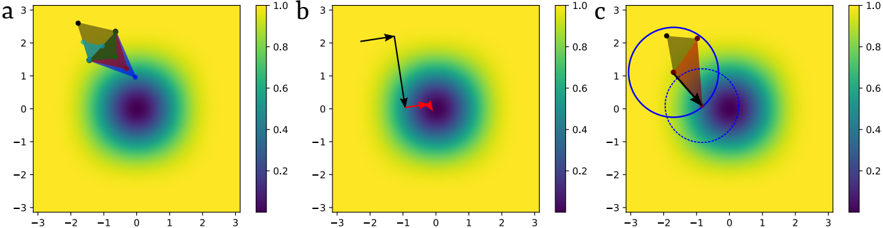
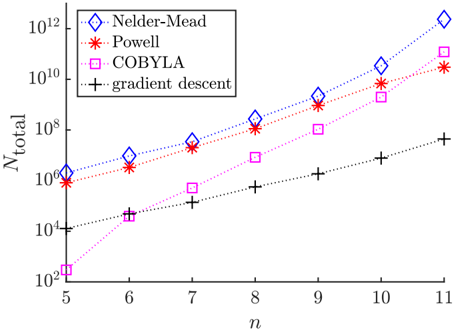
Proposition 1 proves that for a barren-plateau cost function, the difference \(\Delta C=C(\theta_B)-C(\theta_A)\) between two points separated by \(L\) has \(E_{\theta_A}[\Delta C]=0\) and variance bounded by \(G(n)=m^2L^2F(n)\), with \(G(n)\in O(1/b^n)\) for some \(b>1\). Corollary 1 extends this to independently chosen \(\theta_A,\theta_B\), relevant to global optimizers such as Bayesian methods. A Chebyshev bound gives \(P(|\Delta C|\ge c)\le G(n)/c^2\), implying cost differences are exponentially small with high probability. Numerically, for \(n=5,\dots,11\) qubits and depth \(p=n\), the median total shots needed to reach \(C=0.4\) scale exponentially for Powell, super-exponentially for Nelder-Mead, and irregularly but at least exponentially for COBYLA; gradient descent also scales exponentially.
Methods
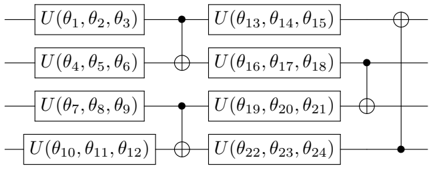
Analytical: finite-difference representation of \(\Delta C\) as a path integral of gradients, then Cauchy-Schwarz and covariance bounds under the barren-plateau definition \(Var_\theta[\partial_\mu C]\le F(n)\in O(1/b^n)\). Numerical: variational quantum compiling with target \(U=\mathbb{1}\), local cost \(C(\theta)=\mathrm{Tr}[O_L V(\theta)|0\rangle\langle0|V^\dagger(\theta)]\), \(O_L=1-\frac1n\sum_i |0_i\rangle\langle0_i|\), and a layered hardware-efficient ansatz with \(p=n\) layers. Optimizers Nelder-Mead, Powell, and COBYLA were run for \(n=5,\dots,11\), with 20 random-initialized runs per setting, stopping at \(C=0.4\) or a maximal shot budget; MATLAB and SciPy were used.
Limitations
Stated: the exponential scaling found numerically is a lower bound on the asymptotics; Nelder-Mead’s super-exponential scaling is likely due to premature simplex shrinking when cost values are hard to order; COBYLA may suffer a similar premature trust-region shrinking, though the data do not clearly demonstrate it; Powell’s better scaling is likely because statistical noise does not cumulatively affect its state. Evident from the text: the numerical study is limited to a toy compilation problem with \(U=\mathbb{1}\), \(n=5\)–\(11\), a relatively large threshold \(C=0.4\) that probes only initial training, and default hyperparameters unrelated to termination; exact shot-count values are shown only in a figure, not reported numerically in the text.
Model-written summary. Check it against the paper before relying on it.
Integrity signals
Registry
Cites
Statistics
Figures
Verification
Claims the paper makes
7 Valid · 1 Not valid · 5 Not checked · 36 Own results and interpretations
The sources with a verdict support this claim; the rest weren’t checked yet, have no full text we could read, or their verdicts aren’t rated yet.
In the paper
“Due to this difficulty, one would expect the number of iterations required to converge with Nelder-Mead to be especially bad in limited precision environments, though we note that there are a number of modifications that attempt to improve the method's robustness to noise [46,47].”
§ Effect of barren plateaus on gradient-free optimization > 2.2.1 Nelder-Mead
What the sources say
- Supportedcites [46] matched to “Robust simplex algorithm for online optimization” (2018) source
The citation sits on the clause 'there are a number of modifications that attempt to improve the method's robustness to noise', and our copy's Introduction is exactly that: it lists 'a number of attempts to modify the Nelder-Mead simplex method to make it more suitable for dealing with noise in simulation optimization' (Barton & Ivey, Humphrey & Wilson's three-phase approach, Chang's stochastic method) and then presents the author's own noise-aware modification (Sec. II B, 'The robust simplex method'). The preceding 'one would expect ... especially bad in limited precision environments' is the citing authors' own hedged inference, not attributed to this source; our copy frames the difficulty as susceptibility to noise in function evaluation (Introduction; Sec. III Simulation, where Nelder-Mead with sigma=0.01 'typically does not converge to the minimum') rather than to limited numerical precision. (LLM, conf=0.85)
- Not checked yetcites [47] matched to “An efficient method for finding the minimum of a function of several variables without calculating derivatives” (1964) source
hedgedstates a possible cause- Asserted: passes — The authors put it forward as true.
- Checkable: passes — It can be checked against evidence.
- Load-bearing: unclear — It is unclear whether the paper’s conclusions depend on it.
- Based: passes — The paper gives a reason why it holds.
- Supported
The sources with a verdict support this claim; the rest weren’t checked yet, have no full text we could read, or their verdicts aren’t rated yet.
In the paper
“Barren plateau landscapes correspond to gradients that vanish exponentially in the number of qubits.”
- Also stated in: § 1 Introduction · boosted
“The most famous gradient scaling result is the barren plateau phenomenon [19][20][21][22][23][24][25][26][27][28][29][30][31][32][33], whereby the gradient of the cost function shrinks exponentially with the number of qubits.”
§ Effect of barren plateaus on gradient-free optimization > Abstract
What the sources say
- Supportedcites [19] matched to “Cost function dependent barren plateaus in shallow parametrized quantum circuits” (2021) source
The Introduction (p. 1, para on McClean et al.) explicitly defines the phenomenon: a 2-design ansatz 'leads to a barren plateau, i.e., with the gradient vanishing exponentially in the number of qubits, n.' The Warm-up example (Results) detects the barren plateau via a gradient variance 'which is exponentially vanishing in n,' while the local cost function's variance 'vanishes polynomially with n and hence exhibits no barren plateau.' The Introduction's summary of results likewise contrasts local cost functions vanishing 'polynomially rather than exponentially in n' with barren plateaus, confirming the equivalence the citing sentence asserts. (LLM, conf=0.92)
- Not checked yetcites [20]
- Supportedcites [21] matched to “Noise-induced barren plateaus in variational quantum algorithms” (2021) source
The Introduction of our copy states the characterization directly: recent studies proved 'the gradient vanishes exponentially in n' and 'this vanishing gradient phenomenon is now referred to as barren plateaus in the training landscape.' The Abstract likewise equates a barren plateau with a vanishing gradient and proves the gradient 'vanishes exponentially in the number of qubits n' when depth scales linearly with n (Noise-Induced Barren Plateau, Introduction and Results > General analytical results, Corollary 1). The only nuance is internal to the paper — noise-free barren plateaus are described as exponential decay of the gradient's variance rather than of the gradient itself (Results, Corollary 1 discussion) — but the claim's generic definitional statement is what our copy asserts. (LLM, conf=0.88)
boostedstates a cause- Asserted: passes — The authors put it forward as true.
- Checkable: passes — It can be checked against evidence.
- Load-bearing: passes — The paper’s conclusions depend on it.
- Based: passes — The paper gives a reason why it holds.
- Also stated in: § 1 Introduction · boosted
The cited sources support only part of this claim — read each source’s verdict below.
In the paper
“As shown in the seminal work of Ref. [19], deep random unstructured circuits which form 2-designs on n qubits will exhibit barren plateaus.”
§ Effect of barren plateaus on gradient-free optimization > 2.3 Barren Plateaus
What the sources say
- Partly supportedcites [19] matched to “Cost function dependent barren plateaus in shallow parametrized quantum circuits” (2021) sourceExperimental — accuracy not yet measured
The Introduction (p. 1) does state the substance: random initialization of a V(θ) that forms a 2-design leads to a barren plateau with gradients vanishing exponentially in n, and the Results ('Main results') confirm that for deep circuits their Alternating Layered Ansatz (an approximate one-dimensional 2-design at ~40n layers) 'behaves like a random circuit and we recover the barren plateau result of [ref. 9] for both local and global cost functions'. However, the source explicitly credits that deep-circuit/2-design result to McClean et al. (their ref. 9), calling it the contrasting prior work ('this is in contrast to McClean et al., who showed vanishing gradients for deep PQCs'), and presents its own contribution as the extension to shallow circuits and cost-function dependence (Fig. 1 caption: 'McClean et al. proved that a barren plateau can occur when the depth D ... Here we extend these results'). So the citing sentence's framing of this paper as the seminal/original demonstration of the deep-circuit 2-design barren plateau overstates it, even though the physical content is reported in the paper. (LLM, conf=0.80)
boostedstates a cause- Asserted: passes — The authors put it forward as true.
- Checkable: passes — It can be checked against evidence.
- Load-bearing: passes — The paper’s conclusions depend on it.
- Based: passes — The paper gives a reason why it holds.
- Partly supported
The cited sources support only part of this claim — read each source’s verdict below.
In the paper
“likely due to the chances of prematurely shrinking the simplex when it is hard to order the cost values [46].”
§ Effect of barren plateaus on gradient-free optimization > 5 Discussion
What the sources say
- Partly supportedcites [46] matched to “Robust simplex algorithm for online optimization” (2018) sourceExperimental — accuracy not yet measured
Our copy supports the mechanism half of the claim: Sec. II.B ('The robust simplex method') states that the shrink is performed only when f(n+1)-f(1) is above M2*sigma, a requirement 'imposed to avoid the reduction of the simplex size to a level when comparison operations are swamped by noise', and notes 'there could be ambiguity as to which vertex has the minimum value'; the Introduction ('As soon as the noise starts to alter the results of function value comparisons between the simplex vertices, the algorithm breaks down') and Sec. IV.A ('As its simplex quickly shrank, it soon stopped making appreciable changes') say the same. What the copy does not support is the scaling observation the explanation is offered for: no passage discusses how Nelder-Mead cost scales with the number of parameters N, and there is no mention of exponential or super-exponential growth (all tests are at fixed dimension — n=6 in Sec. III, 14 skew quadrupoles and 8 knobs in Sec. IV). So the cited source does not attribute premature shrinkage to a super-exponential-in-N scaling. (LLM, conf=0.72)
hedgedstates a possible cause- Asserted: passes — The authors put it forward as true.
- Checkable: passes — It can be checked against evidence.
- Load-bearing: unclear — It is unclear whether the paper’s conclusions depend on it.
- Based: passes — The paper gives a reason why it holds.
- Partly supported
Every source the paper cites for this claim was checked and supports it.
In the paper
“This corresponds to the barren plateau scenario in Ref. [19].”
§ Effect of barren plateaus on gradient-free optimization > 4 Numerical Implementation
What the sources say
- Supportedcites [19] matched to “Cost function dependent barren plateaus in shallow parametrized quantum circuits” (2021) source
The Introduction’s Fig. 1 caption describes barren plateaus in deep ansatzes, and Results > Main results says that for deep circuits the ansatz behaves like a random circuit and exhibits barren plateaus for both local and global cost functions. This supports the citing document’s identification of its linearly growing-depth choice as a barren-plateau scenario; the choice p=n is the citing document’s own setup. (LLM, conf=0.84)
plainstates an association- Asserted: passes — The authors put it forward as true.
- Checkable: passes — It can be checked against evidence.
- Load-bearing: passes — The paper’s conclusions depend on it.
- Based: passes — The paper gives a reason why it holds.
- Supported
28 more claims
Create a free account to see all 49 claims and to verify the 11 references still open.
- Probably not a substantial claim. 9
- It may state two separate claims as one. 8
Claims other papers make about this one
Each is checked against this paper’s own text: does it say what the citing paper says it does?
The check wasn’t confident either way, so it gives no verdict — never disputed.
In the citing paper
“Variational-state quantum metrology variationally searches for the optimal probe state [190-193].”
From Variational quantum algorithms (2021) · cites this paper as [193]
Experimental — accuracy not yet measuredThe check wasn’t confident either way, so it gives no verdict — never disputed.
In the citing paper
“Note that since QFI cannot be efficiently computed, an approximation of QFI can be heuristically found by optimizing the measurement basis, or by computing upper and lower bounds on the QFI [193].”
From Variational quantum algorithms (2021) · cites this paper as [193]
Experimental — accuracy not yet measured
Self-check
Percentages, sums and reported differences re-computed from the paper’s own numbers.
Each contradiction between two passages listed here was confirmed by an independent check.
Rated minor: it would not touch a result — a value no result rests on, a p-value that stays on the same side of the significance level, or a conflict that is clerical, resolved elsewhere in the paper, or outside its own findings.
In the paper
§ Effect of barren plateaus on gradient-free optimization > Proposition 1. Consider the cost function of Eq. (1).
“where we have used (5), and Eq. ( 9) from Proposition 1.”
§ Effect of barren plateaus on gradient-free optimization > Proposition 1. Consider the cost function of Eq. (1).
“Var θ A [∆C] G(n) ,(7)”
Citations
Cites
A Simplex Method for Function Minimization
Nelder, J. A., & Mead, R. (1965) · The Computer Journal · doi:10.1093/comjnl/7.4.308 · Cited by 28,905
Powell, M. J. D. (1964) · The Computer Journal · doi:10.1093/comjnl/7.2.155 · Cited by 4,632 · cited 2×
“The Powell algorithm [40] is another popular gradientfree optimizer that performs sequential line searches.”
MethodA variational eigenvalue solver on a photonic quantum processor
Peruzzo, A., McClean, J., Shadbolt, P., Yung, M.-H., Zhou, X.-Q., Love, P. J., Aspuru-Guzik, A., & O’Brien, J. L. (2014) · Nature Communications · doi:10.1038/ncomms5213 · Cited by 4,552 · cited 1×
“In this case, the cost takes a simpler form, where the training set contains a single state ( S = 1 ) and the cost is C ( θ ) = Tr[ OV ( θ ) ρV † ( θ )] , with O a Hermitian operator [3–14].”
BackgroundVariational quantum algorithms
Cerezo, M., Arrasmith, A., Babbush, R., Benjamin, S. C., Endo, S., Fujii, K., McClean, J. R., Mitarai, K., Yuan, X., Cincio, L., et al. (2021) · Nature Reviews Physics · doi:10.1038/s42254-021-00348-9 · Cited by 3,385 · cited 1×
“These circuits are utilized in both Variational Quantum Algorithms (VQAs) [1–14] and Quantum Neural Networks (QNNs) [15–18].”
MethodSelf-citationBarren plateaus in quantum neural network training landscapes
McClean, J. R., Boixo, S., Smelyanskiy, V. N., Babbush, R., & Neven, H. (2018) · Nature Communications · doi:10.1038/s41467-018-07090-4 · Cited by 2,329 · cited 4×
“[17], deep random unstructured circuits which form 2-designs on n qubits will exhibit barren plateaus.”
BackgroundInfluentialNoisy intermediate-scale quantum algorithms
Bharti, K., Cervera-Lierta, A., Kyaw, T. H., Haug, T., Alperin-Lea, S., Anand, A., Degroote, M., Heimonen, H., Kottmann, J. S., Menke, T., et al. (2022) · Reviews of Modern Physics · doi:10.1103/revmodphys.94.015004 · Cited by 2,231
A Quantum Approximate Optimization Algorithm
Farhi, E., Goldstone, J., & Gutmann, S. (2014) · arXiv · doi:10.48550/arxiv.1411.4028 · Cited by 1,789 · cited 3×
“[3] E.”
BackgroundMethodQuantum convolutional neural networks
Cong, I., Choi, S., & Lukin, M. D. (2019) · Nature Physics · doi:10.1038/s41567-019-0648-8 · Cited by 1,517 · cited 2×
“For instance, in a binary classification problem the cost function is given by the mean squared-error C(θ) = ∑ x(yx − ỹ(θ, ρx)) 2 [14, 15, 31, 32].”
BackgroundMethodPowell, M. J. D. (1994) · Advances in Optimization and Numerical Analysis · doi:10.1007/978-94-015-8330-5_4 · Cited by 1,369 · cited 11×
“Constrained Optimization BY Linear Approximation (COBYLA) is another popular gradient-free optimizer by Powell [42].”
BackgroundMethodInfluentialThe power of quantum neural networks
Abbas, A., Sutter, D., Zoufal, C., Lucchi, A., Figalli, A., & Woerner, S. (2021) · Nature Computational Science · doi:10.1038/s43588-021-00084-1 · Cited by 1,082
Research works printed but not linked: 5
- M. Cerezo, K. Sharma, A. Arrasmith, and P. J. Coles, Variational quantum state eigensolver, arXiv preprint arXiv:2004.01372 (2020). · arXiv
- K. Sharma, M. Cerezo, L. Cincio, and P. J. Coles, Trainability of dissipative perceptron-based quantum neural networks, arXiv preprint arXiv:2005.12458 (2020). · arXiv
- T. Volkoff and P. J. Coles, Large gradi- ents via correlation in random parameter- ized quantum circuits, Quantum Science and Technology 6, 025008 (2021). · doi:10.1088/2058-9565/abd89
- M. J. Powell, in Advances in optimization and numerical analysis (Springer, 1994) pp. 51-67. · DOI · Paper page
- A. Harrow and S. Mehraban, Approxi- mate unitary t-designs by short random quantum circuits using nearest-neighbor and long-range gates, arXiv preprint arXiv:1809.06957 (2018). · arXiv
Cited by
Items 301–400 of 414
Shao, H., Wu, Y., Deng, X., & Jiang, Y. (2026) · Physica Scripta · doi:10.1088/1402-4896/ae7d6d · Cited by 1
Variational quantum algorithm for anion exchange across an electrolyzer membrane
Gubaev, T., Pfeffer, P., Dreßler, C., & Schumacher, J. (2026) · Physical Review Applied · doi:10.1103/149q-4z6s · Cited by 1
“Moreover, restricting oneself only to gradient-free approaches does not contribute to mitigating the problem, as the issue affects both gradient-free and gradient-based optimization algorithms [52].”
Gentini, L., Cuccoli, A., & Banchi, L. (2022) · Physical Review Applied · doi:10.1103/physrevapplied.18.034025 · Cited by 1
Bayesian network structure learning using quantum generative models
Ohno, H. (2024) · Quantum Machine Intelligence · doi:10.1007/s42484-024-00217-5 · Cited by 1
“…are not directly related to the number of qubits, whereas the response surface of the global cost function for QML becomes exponentially flat with the number of qubits (Cerezo et al. 2021) even if we use black-box optimization algorithms such as the Nelder-Mead algo-rithm (Arrasmith et al. 2021) 3”
Benchmarking Classical and Quantum Optimizers for Quantum Simulator
Hai, V. T., Le, V. T. D., Luan, P. H., & Nakashima, Y. (2024) · International Symposium on Computing and Networking · doi:10.1109/candar64496.2024.00038 · Cited by 1
Statistical Models of Barren Plateaus and Anti-Concentration of Pauli Observables
Nemkov, N. A. (2025) · Journal of Experimental and Theoretical Physics Letters · doi:10.1134/s0021364025607511 · Cited by 2
“When a loss function has a BP, the standard gradient-based and gradient-free optimization methods simply can not escape the flat region and find good solutions [9].”
Designing minimalistic variational quantum ansatz inspired by algorithmic cooling
Shin, S., Kim, H. E., Kim, J., Yeo, H., Jhe, W., & Jeong, K. (2026) · Journal of the Korean Physical Society · doi:10.1007/s40042-026-01627-3 · Cited by 1
Algorithmic Strategies for seizing Quantum Computing
Pérez-Salinas, A. (2021) · Dipòsit Digital de la Universitat de Barcelona (Universitat de Barcelona) · doi:10.48550/arxiv.2112.15175 · Cited by 1
The battle of clean and dirty qubits in the era of partial error correction
Bultrini, D., (NNSA), U. N. N. S. A., EPSRC, U., Wang, S., Czarnik, P., Gordon, M. H., Cerezo, M., Coles, P. J., & Cincio, Ł. (2023) · OSTI OAI (U.S. Department of Energy Office of Scientific and Technical Information) · doi:10.2172/2378046 · Cited by 1
Self-citationVariational Quantum Algorithms for Many-Body SystemsPreprint
Consiglio, M. (2025) · arXiv (Cornell University) · doi:10.48550/arxiv.2502.11985 · Cited by 1
Barbaste, P., Oullier, O., & Vasques, X. (2025) · arXiv (Cornell University) · doi:10.48550/arxiv.2512.02978 · Cited by 1
“A major obstacle, widely known as the “barren plateau” problem 82 , has emerged as a key limitation in training quantum neural networks such as variational quantum circuits.”
Parametrized Quantum Circuits for Reinforcement Learning
Andrés Núñez, E. M. (2024) · Institutional Repository of the University of Granada (University of Granada) · Cited by 1
Optimization schedules for the quantum approximate optimization algorithm
Grotti, M. (2023) · AMS Laurea Institutional Research Repository (University of Bologna) · Cited by 1
Quantum-based solutions for the Prognosis and Health Management of Critical Infrastructures
San Martin Silva, G. A. (2025) · eScholarship (California Digital Library) · Cited by 1
Practical Quantum Chemistry on Near Term Quantum Computers
Ralli, A. (2023) · UCL Discovery (University College London) · Cited by 1
Simulation of, and with, first generation quantum computers
Jones, T. (2022) · Oxford University Research Archive (ORA) (University of Oxford) · doi:10.5287/ora-zrerqmjew · Cited by 1
Quantum Generator KernelsPreprint
Altmann, P. J., Mansky, M. B., Zorn, M., Stein, J., & Linnhoff–Popien, C. (2026) · arXiv (Cornell University) · doi:10.48550/arxiv.2602.00361 · Cited by 1
“…capacities and subject to errors, embedding large-scale data into quantum devices is a significant hurdle that must be overcome to exploit the full potential of QML. Hybrid QML architectures bridge this gap, using classical pre-processing to embed data into quantum systems (Cerezo et al., 2021).”
Probabilistic approximate optimization using single-photon avalanche diode arraysPreprint
Alswaidan, Z., Abdelrahman, A. S., Sajal, M., Chowdhury, S., Lin, K.-C., Guthrie, H., Seshan, S., Blanton, S., Morone, F., Dandin, M. P., et al. (2026) · arXiv (Cornell University) · doi:10.48550/arxiv.2602.13943 · Cited by 1
Performance comparison of QAOA mixers for ternary portfolio optimization
Yamamura, S., Watanabe, S., Kunimi, M., Saito, K., & Nikuni, T. (2026) · Quantum Information Processing · doi:10.48550/arxiv.2602.21562 · Cited by 1
Classical Regularization in Variational Quantum EigensolversPreprint
Chernyak, Y. (2026) · Research Square · doi:10.21203/rs.3.rs-9168724/v1 · Cited by 1
Absence of poor local minima in matrix product statesPreprint
Zhang, H.-K., Zhu, C., Liu, S., Zhang, S.-X., & Xiang, T. (2026) · arXiv (Cornell University) · doi:10.48550/arxiv.2606.09988 · Cited by 1
When AI meets quantum information: A comprehensive reviewPreprint
Chen, M., Gan, Y., Jin, X., Li, Y., Wang, J., Wu, Z., Wang, Y., Zhang, B., Srivastava, P., Chen, T., et al. (2026) · arXiv (Cornell University) · doi:10.48550/arxiv.2607.00365 · Cited by 1
The Virtuous Cycle of Quantum-Classical Machine LearningPreprint
Tomašev, N., McClean, J. R., & Bausch, J. (2026) · arXiv · doi:10.48550/arxiv.2607.10563 · Cited by 1
Imaginarity as a necessary resource for trainability in QAOAPreprint
Hassan, S. M. A., Blekos, K., Kühn, S., Kollas, N., & Jansen, K. (2026) · arXiv (Cornell University) · Cited by 1
Modeling quantum neural network gradient with reinforcement learningPreprint
Luu, N. T., Luu, D. T., Pham, N. N., & Truong, T. C. (2026) · arXiv (Cornell University) · doi:10.48550/arxiv.2609.31066 · Cited by 1
“In that regime the reward differences used to drive policy gradients vanish at the same rate as conventional cost-function differences, echoing the result of [36] that no gradient-free optimizer (including surrogate-gradient models) can escape the exponential shot-budget scaling of a barren plateau.”
Niu, Y.-F., Zhang, S., Ding, C., et al. (2022) · SciPost Physics · doi:10.21468/scipost.report.6023
Niu, Y.-F., Zhang, S., Ding, C., et al. (2022) · SciPost Physics · doi:10.21468/scipost.report.5745
Hamiltonian Minimization in the NISQ EraPreprint
da Silva, R. P. (2023) · SSRN Electronic Journal · doi:10.2139/ssrn.4652979
Variatsionnaya kvantovaya optimizatsiya otkrytogo kar'era
Paradezhenko, G. V., Pervishko, A. A., & Yudin, D. (2024) · Письма в Журнал экспериментальной и теоретической физики · doi:10.31857/s1234567824060090
Noise and trainability in quantum machine learning
Heyraud, V. (2023) · theses.fr (ABES) · doi:10.70675/bff70fa6zf210z4833zb75cze3a22be94ef6
Quantum Time-Series Learning with Evolutionary AlgorithmsPreprint
Anantharamakrishnan, V., & Taddei, M. M. (2024) · arXiv (Cornell University) · doi:10.48550/arxiv.2412.17580
Quantum Computing in Estimating Ground State Energies of Systems
Yalcin, B. (2024) · International journal of high school research · doi:10.36838/v6i5.5
Hybrid classical-quantum computation of heat diffusion in multilayer materialsPreprint
Moradi, S. (2025) · Research Square · doi:10.21203/rs.3.rs-6887498/v1
Rahma, H., Abdullah, D., & Yulisda, D. (2025) · Bulletin of Computer Science Research · doi:10.47065/bulletincsr.v5i5.712
Quantum Machine Learning Applied to the Sinking of the TitanicPreprint
Santos, L. H., Chinaglia, E. F., Curado, J. F., Guazzelli, M. A., Pojar, M., Masunaga, S. H., & Santos, R. B. B. (2025) · arXiv (Cornell University) · doi:10.48550/arxiv.2509.00916
“…the parameter landscape becomes flat as the problem size increases affects both gradient-based as well gradient-free optimization algorithms, turning the search into a random walk through a exponentially flat region in the parameter landscape, and reducing the train-ability of the model [46, 47].”
Garza, T., & Sri, C. (2025) · ChemRxiv · doi:10.26434/chemrxiv-2025-0h0v8
Distributed quantum architecture search using multi-agent reinforcement learningPreprint
Sergeev, M. D., Paradezhenko, G. V., Rabinovich, D., & Palyulin, V. V. (2025) · arXiv (Cornell University) · doi:10.48550/arxiv.2511.22708
“Once new gates are added to the circuit, we optimize all its variational parameters θ by means of the COBYLA optimizer [70], which is a derivative-free method widely used for optimizing PQCs (see, e.g., [71]).”
From quantum computing to condensed matter : a machine learning perspective
Kairon, P. (2024) · cIRcle (University of British Columbia) · doi:10.14288/1.0445178
On the controllability and quantum speed limit of qubit arrays
Gago-Encinas, F. (2024) · Refubium (Universitätsbibliothek der Freien Universität Berlin) · doi:10.17169/refubium-45699
Machine learning for quantum models and quantum optimization for classical problems
Tibaldi, S. (2024) · AMS Dottorato Institutional Doctoral Theses Repository (University of Bologna) · doi:10.48676/unibo/amsdottorato/11530
Utilization of SU(2) Symmetry for Efficient Simulation of Quantum SystemsPreprint
Hryniv, O. (2025) · arXiv (Cornell University) · doi:10.48550/arxiv.2506.19879
Machine learning in quantum mechanical and optical systems
Schmiesing, V.-S. (2025) · Institutional Repository of Leibniz Universität Hannover (Leibniz Universität Hannover) · doi:10.15488/18472
Robust Variational Ground-State Solvers via Dissipative Quantum Feedback ModelsPreprint
Lee, Y., Petersen, I. R., & Dong, D. (2025) · arXiv (Cornell University) · doi:10.48550/arxiv.2507.19977
Design and implementation of quantum algorithms in the noisy intermediate scale quantum era
Sopena González, A. (2025) · Biblos-e Archivo (Universidad Autónoma de Madrid)
Quantum Machine Learning and Quantum Protocols for Solving Differential Equations
Paine, A. (2024) · Open Research Exeter (University of Exeter)
Estimation of gradients and analysis of gradient-based optimizers for variational quantum algorithms
Wierichs, D. (2023) · Kölner Universitäts PublikationsServer (Universität zu Köln)
The Trainability and Expressivity of Quantum Machine Learning Models
Anschuetz, E. R. (2023) · DSpace@MIT (Massachusetts Institute of Technology)
Approaches for utilizing quantum computing with limited resources (本文)
タムラ, ケ., Tamura, K., & 田村, 賢. (2024) · Institutional Repositories DataBase (IRDB)
Horizons of Artificial Intelligence in Quantum Computation
Kiani, B. T. (2023) · DSpace@MIT (Massachusetts Institute of Technology)
Quantum machine learning for remote sensing : exploring potential and challenges
Miroszewski, A., Nalepa, J., Saux, B. L., & B, J. M. A. (2023) · Jagiellonian University Repository (Jagiellonian University)
Goyal, K., & Pathak, A. (2025) · International Conference on AI-ML Systems (AIMLSystems) · doi:10.1109/aimlsystems67835.2025.11331164
Classical Regularization in Variational Quantum EigensolversPreprint
Chernyak, Y., Mohammad, I. A., & Plesch, M. (2026) · arXiv (Cornell University) · doi:10.48550/arxiv.2601.16679
“Additional instabilities arise from optimizer sensitivity [4], expressibility–trainability trade-offs [5], and finite-sampling noise [6].”
Chao, S., Deng, Y., Liu, Z., & Zhang, Y. (2025) · Conference proceedings/Conference proceedings - IEEE International Conference on Systems, Man, and Cybernetics · doi:10.1109/smc58881.2025.11342998
“However, VQE still faces the Barren Plateau (BP) problem [3], where the cost function gradients become extremely small when optimizing large Parameterized Quantum Circuits (PQCs), making the optimization process difficult and inefficient.”
PVLS: A Learning-Based Parameter Initialization Method for Variational Quantum Linear SolversPreprint
Yang, Y. (2026) · Research Square · doi:10.21203/rs.3.rs-8253544/v1
Quantum-Enhanced DNA Image Compression: Theoretical Framework and NISQ Implementation Strategy
Lee, Y.-H., & Lee, W.-B. (2026) · Applied Sciences · doi:10.3390/app16031502
Quantum Reinforcement Learning with Transformers for the Capacitated Vehicle Routing ProblemPreprint
Andrés, E. (2026) · arXiv (Cornell University) · doi:10.48550/arxiv.2602.05920
“Trainability issues such as barren plateaus [21] have also received significant attention, with recent work exploring quantum natural gradients, geometry-aware ansätze, and tensor-network-inspired circuit constructions to improve scalability [22, 23, 24, 25, 26].”
Experimental demonstration of entanglement forging for solving Max-Cut problem
Wang, T., Wu, Z., 陈, Y. 昱. C., Hou, Y., Li, Z., & Peng, X. (2026) · Physical Review Research · doi:10.1103/kk9v-5jk8
Kelemen, Á. A., Perczel, A., & Jákli, I. (2026) · International Journal of Quantum Chemistry · doi:10.1002/qua.70160
Optimization landscapes of variational quantum algorithmsPreprint
Ge, X., Cheng, S., Zhang, G., & Wu, R.-B. (2026) · arXiv (Cornell University) · doi:10.48550/arxiv.2603.05190
Noisy intermediate-scale quantum computation and its application (本文)
ナカジ, コ., Nakaji, K., & 中路, 紘. (2021) · Institutional Repositories DataBase (IRDB)
YOĞUN MADDE İÇİNDE ZAMAN YAYILIMI İÇİN KUANTUM GRAFİK SİNİR AĞLARI
Yurtseven, K. (2024) · OpenMETU (Middle East Technical University)
Applicability of quantum-enhanced machine learning (本文)
スズキ, ユ., Suzuki, Y., & 鈴木, 雄. (2023) · Institutional Repositories DataBase (IRDB)
Barren Plateaus Beyond Observable ConcentrationPreprint
Li, Z.-S., Wu, B., Li, X.-W., & Yung, M.-H. (2026) · arXiv (Cornell University) · doi:10.48550/arxiv.2603.18479
Quantum information processing for quantum simulations
Calonnec, C. L. (2023) · theses.fr (ABES) · doi:10.70675/b46267d0z0466z489dzbda2z220bc68889cb
Loss-aware state space geometry for quantum variational algorithms
Gill, A., & Pal, K. (2026) · Journal of Physics A Mathematical and Theoretical · doi:10.1088/1751-8121/aea669
Mitigating Barren Plateaus in Variational Quantum Circuits through PDE-Constrained Loss FunctionsPreprint
Hewage, P. N. M. U., Chakkravarthy, M., & Abeysekara, R. K. (2026) · arXiv (Cornell University) · doi:10.48550/arxiv.2604.09957
Soós, D., Paterno, M., Stenger, J., & Chrisochoides, N. P. (2026) · arXiv (Cornell University) · doi:10.48550/arxiv.2604.20639
“While theoretically sound for discrete structures, NISQ-era implementations of QAOA have shown only marginal improvements over classical baselines and are highly sensitive to parameter settings and the structural noise of the hardware [23]–[25].”
Çifci, P., Akkoyun, S., & Ronde, L. L. (2026) · The European Physical Journal A · doi:10.1140/epja/s10050-026-01939-9
Query-Efficient Quantum Approximate Optimization via Graph-Conditioned Trust RegionsPreprint
Huynh, M. (2026) · arXiv (Cornell University) · doi:10.48550/arxiv.2604.24803
Performance Comparison of QAOA Mixers for Ternary Portfolio OptimizationPreprint
Yamamura, S., Watanabe, S., Kunimi, M., Saito, K., & Nikuni, T. (2026) · Research Square · doi:10.21203/rs.3.rs-9005100/v1
Mahanta, A., Kaur, J., Kumar, K. S., & Jain, M. (2026) · International Conference on Smart Electronic Devices and Intelligent Systems (ICSEDIS) · doi:10.1109/icsedis68157.2026.11518232
“The proposed framework introduces a straightforward and scalable way of implementing realistic quantum graph learning because it takes the physical constraints into the framework at the algorithmic level (Arrasmith et al., 2021).”
Recent Developments in Quantum Machine Learning
Kahvazadeh, I., & Fong, A. C. (2025) · International Conference on Intelligent & Innovative Practices in Engineering & Management (IIPEM) · doi:10.1109/iipem65914.2025.11547992
“The degradation of trainability associated with barren plateau may be quantified through the variance scaling relation in (4), which shows that the variance of the cost-function gradient decreases exponentially with the number of qubits [26].”
Towards the implementation of a quantum classifierPreprint
Confalonieri, L. (2026) · arXiv (Cornell University) · doi:10.48550/arxiv.2606.10150
Hybrid Quantum-Classical Algorithms for Quantum Computing Applications in Computational Physics
Schuhmacher, J. (2026) · Infoscience (Ecole Polytechnique Fédérale de Lausanne) · doi:10.5075/epfl-thesis-12091
Separation of Statistical Complexity and Trainability in Variational Quantum CircuitsPreprint
Mandal, S., Daughtry, M., & Mucciolo, E. R. (2026) · arXiv (Cornell University) · doi:10.48550/arxiv.2606.18580
Meduri, K., Yedla, R., Addula, S. R., Sajja, G. S., Rana, S., Cruz, E. D. L., Maturi, M. H., & Gonaygunta, H. (2026) · Informatics · doi:10.3390/informatics13060098
“They arise principally at larger qubit counts and circuit depths than used here [17]; gradient-free optimisers do not escape them either [18].”
GLEAM: Mitigating Barren Plateaus in Hybrid Quantum Machine Learning via Small-World Entanglement
Ding, Z., Xing, F., Xia, Y., & Zeng, P. (2026) · International Conference on Image Processing and Artificial Intelligence (ICIPAI) · doi:10.1109/icipai70034.2026.11605634
“2) Barren Plateaus : Deep parameterized circuits exhibit exponentially vanishing gradients [13], [14], making Cross-Entropy optimization ineffective on a flat landscape [15].”
Eliminating vendor lock-in in quantum machine learning via framework-agnostic neural networks
Kumaresan, P., Singaravelu, S., Rajendran, L., & Sivasubramani, S. (2026) · Frontiers in Quantum Science and Technology · doi:10.3389/frqst.2026.1862700
Quantum Gradient Descent in Neural Network Training Optimization
Rallis, Z., & Vougiouklis, K. (2023) · Journal of Applied Automation Technologies · doi:10.64972/jaat.2023v1.304p18e:242-254
“A parameter-shift rule is suitable for finding the exact derivative of gates generated by Pauli operators through two shifted circuit evaluations, thereby avoiding numerical differentiation [21].”
Sharma, M., & Lau, H. C. (2026) · Research Square · doi:10.21203/rs.3.rs-10341151/v1
Shen, B., & Ling, K. (2026) · Journal of High School Science · doi:10.64336/001c.166201
Hybrid Classical-Quantum Systems: The Unsung Heroes of the NISQ EraPreprint
Amiri, S. M. H., & Zahan, A. (2026) · SSRN Electronic Journal · doi:10.20944/preprints202608.1044.v1
SPSA Hyperparameter Tuning for Variational Quantum Natural Language InferencePreprint
D'Souza, N., & Agostino, C. J. (2026) · arXiv (Cornell University) · doi:10.48550/arxiv.2608.16939
Quantum-KIP: Kernel Inducing Points for Quantum Privacy
Song, B., Pokhrel, S. R., Vasilakos, A. V., Zhu, T., & Li, G. (2026) · IEEE Transactions on Information Forensics and Security · doi:10.1109/tifs.2026.3725557
“Gradient-based updates further increase this cost: parameter-shift rules require at least two circuit evaluations per trainable parameter [30], while device noise and barren plateaus degrade gradient quality and slow convergence [12].”
Distributed Variational Quantum Eigensolver: Embarrassingly Parallel strategies on NISQPreprint
Losada, M., Faílde, D., & Tato, A. G. (2026) · arXiv (Cornell University) · doi:10.48550/arxiv.2608.19824
“Barren plateaus, where gradients vanish exponentially with system size, affect both gradient-based and gradient-free optimization [16,13,2].”
Future Trends and Innovations in Quantum Principal Component Analysis (PCA)
Pradeep, A., Raghavendra, R., Vanitha, V., Ahamed, M. U., & Jayanthiladevi, A. (2026) · Wiley eBooks · doi:10.1002/9781394382682.ch4
Braga, C. M., Serrano, M. A., & Fernández‐Medina, E. (2026) · IEEE International Conference on Quantum Software (QSW) · doi:10.1109/qsw72780.2026.00018
Learning properties of parametrized quantum states: Practical algorithms with theoretical guarantees
Wanner, M. C. (2026) · Chalmers Research (Chalmers University of Technology)
Klug, S., & Moll, M. (2026) · Machine Learning Science and Technology · doi:10.1088/2632-2153/aea3a0
Jin, F., & Liu, Y. (2026) · Micromachines · doi:10.3390/mi17091074
Self-guided certification of nonlocality in quantum networksPreprint
Cortés, J., Pereira, L., & Delgado, A. (2026) · arXiv (Cornell University) · doi:10.48550/arxiv.2609.11451
Kang, P. (2026) · arXiv (Cornell University) · doi:10.48550/arxiv.2609.21243
“BPs manifest as concentration of the cost landscape itself, so that gradient-free optimizers suffer from the same signal loss as gradient-based ones [21], and even away from exponentially flat regions, the landscape can be dense with poor local minima and traps [22].”
Readout-level trace-distance margin regularization for trainable quantum neural networksPreprint
Fan, Y., Yu, W., Yang, Z., Wang, Y., Cheng, H., Li, R., Zhu, K., & Chen, Y. (2026) · SSRN Electronic Journal · doi:10.2139/ssrn.7507226
Quantum Superposition over Near Optimal Seeds for Maximum Independent Set on Dense GraphsPreprint
Dasgupta, K., Mukherjee, S., Verma, D., Sajja, S. S. K., Singh, A., Phan, D., & Kalagnanam, J. (2026) · Research Square · doi:10.21203/rs.3.rs-11124934/v1
Datta, D., Biswas, D., Mahapatra, U. S., Paul, M., & White, D. (2026) · Agriculture · doi:10.3390/agriculture16192069
Quantum Representation Learning for Reinforcement Learning in Robot Navigation
Le, V., Tan, L. T., & Ho, K. C. (2026) · IEEE Access · doi:10.1109/access.2026.3736724
“They lie outside the scope of the representation results in this subsection and are typically mitigated using established techniques such as regularization, variance-reduction strategies, and carefully designed circuit architectures; see, e.g. [32], [33], [34], [35], [36], [37].”
Block-Wise Variational Quantum Algorithms for PDEs with Interface Penalty ConstraintsPreprint
Jie, H., Cui, Y., & Kim, S. (2026) · arXiv (Cornell University) · doi:10.48550/arxiv.2609.36710
“…circuit and the trainability of the measurable cost function, which is intimately linked to gradient structures and the risk of barren plateaus [7–9]; the accumulation of shot noise from repeated circuit executions; state-preparation overhead; and, crucially, the extent to which the ansatz…”
Metadata
- Authors
- Arrasmith, A., Cerezo, M., Czarnik, P., Cincio, L., & Coles, P. J.
- Affiliations
- Los Alamos National Laboratory (US)
- ORCID
- Czarnik, Piotr
- Venue
- Quantum
- Published
- 2021-10-05
- Volume
- 5
- Pages
- 558
- ISSN
- 2521-327X (ISSN-L)
- OpenAlex
- W3108496771
- Semantic Scholar
- a062fde5340e24ce5213eb6126f3a74fc78fdbf9
- Cited by
- 248
- References
- 43
- Citations by year
- 2026: 39 · 2025: 57 · 2024: 46 · 2023: 43 · 2022: 42 · 2021: 21
- FWCI
- 13.38
- Type
- journal article
- Language
- en
- Open access
- gold
- doi.org
- Locations
- Quantum (publishedVersion, cc-by)
- arXiv (Cornell University) (submittedVersion)
- OSTI OAI (U.S. Department of Energy Office of Scientific and Technical Information) (submittedVersion, cc-by)
- DOAJ (DOAJ: Directory of Open Access Journals) (submittedVersion, cc-by-sa)
- arXiv (Cornell University) (cc-by)
- Funders
- LANL LDRD (20190065DR, 20190659PRD4)
- Topics
- Physical Sciences › Computer Science › Artificial Intelligence › Quantum Computing Algorithms and Architecture
- Physical Sciences › Computer Science › Artificial Intelligence › Metaheuristic Optimization Algorithms Research
- Physical Sciences › Physics and Astronomy › Atomic and Molecular Physics, and Optics › Quantum many-body systems
- Keywords
- barren plateaus, derivative-free optimization, variational quantum algorithms, quantum neural networks, Nelder-Mead, Powell algorithm, COBYLA, variational quantum circuits
About these checks
Registry, retraction, Cites and statistics results are computed, not judged, with one exception: a printed reference that no index lists is read once by a model before it counts as a citation error. Claims are extracted by a model and kept only when their quote appears verbatim in the text; each cited source is then checked, with a model’s help, for whether it says what the claim relies on. Those verdicts can be wrong — read the claim’s quote and the cited source before relying on one.
The claim verdicts this report counts are experimental: their accuracy is not yet measured.
A language model drew the claims from the paper on 2026-10-08, under version 3 of the claim definition (model deepseek-v4.1-flash, prompt extract-v3).
A second model labelled each claim on 2026-10-08 (model jev-1.13-20260917, definition revision gold-guideline-v0.2).
Cited sources are checked with a language model’s help (qwen3.8-omni-flash and gpt-6-sol).
Statistics and arithmetic are recomputed, not judged.
Confidence bands are shown only for fields calibrated on our annotated test set. None is calibrated yet, so no band is shown.
What counts as a claim ›How we measure confidence ›How we check this ›
Are you an author, or do you see a problem with this page? Request a review
Data sources
Bibliographic data: Semantic Scholar, OpenAlex, Crossref.
Contains information from the Semantic Scholar Academic Graph Datasets, made available under the ODC Attribution License (ODC-BY 1.0).
Semantic Scholar’s data is described in: Kinney, R., et al. (2023). The Semantic Scholar Open Data Platform. arXiv:2301.10140.
