

Effect of barren plateaus on gradient-free optimization
Open accessThe DOI matches its Crossref record; 54 of the 54 references it cites were found in a registry or an index; 10 of the 21 sources its claims cite were checked for support.
Abstract
Barren plateau landscapes correspond to gradients that vanish exponentially in the number of qubits. Such landscapes have been demonstrated for variational quantum algorithms and quantum neural networks with either deep circuits or global cost functions. For obvious reasons, it is expected that gradient-based optimizers will be significantly affected by barren plateaus. However, whether or not gradient-free optimizers are impacted is a topic of debate, with some arguing that gradient-free approaches are unaffected by barren plateaus. Here we show that, indeed, gradient-free optimizers do not solve the barren plateau problem. Our main result proves that cost function differences, which are the basis for making decisions in a gradient-free optimization, are exponentially suppressed in a barren plateau. Hence, without exponential precision, gradient-free optimizers will not make progress in the optimization. We numerically confirm this by training in a barren plateau with several gradient-free optimizers (Nelder-Mead, Powell, and COBYLA algorithms), and show that the numbers of shots required in the optimization grows exponentially with the number of qubits.
Overview
CoChat Summary
TL;DR
The paper argues analytically and numerically that gradient-free optimizers do not avoid barren plateaus: cost-function differences are exponentially suppressed in the number of qubits, so optimizers need exponential precision to make progress. Numerical training of a parameterized quantum circuit with Nelder-Mead, Powell, and COBYLA shows shot requirements growing exponentially or worse with qubit number.
Key findings
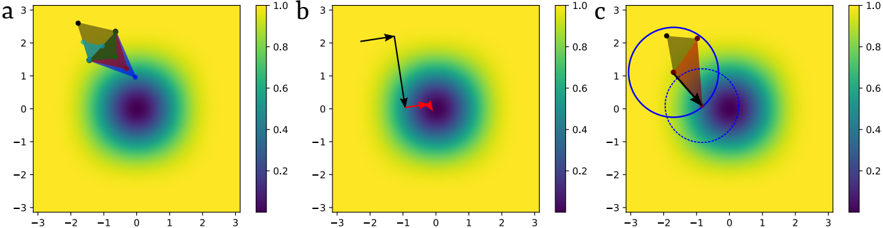
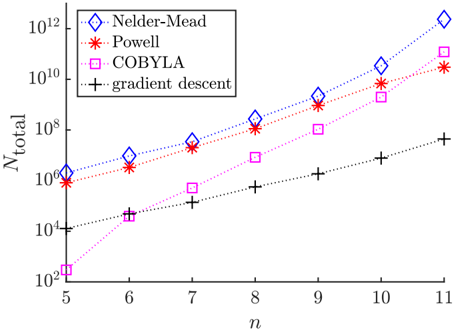
Proposition 1 proves that for a barren-plateau cost function, the difference \(\Delta C=C(\theta_B)-C(\theta_A)\) between two points separated by \(L\) has \(E_{\theta_A}[\Delta C]=0\) and variance bounded by \(G(n)=m^2L^2F(n)\), with \(G(n)\in O(1/b^n)\) for some \(b>1\). Corollary 1 extends this to independently chosen \(\theta_A,\theta_B\), relevant to global optimizers such as Bayesian methods. A Chebyshev bound gives \(P(|\Delta C|\ge c)\le G(n)/c^2\), implying cost differences are exponentially small with high probability. Numerically, for \(n=5,\dots,11\) qubits and depth \(p=n\), the median total shots needed to reach \(C=0.4\) scale exponentially for Powell, super-exponentially for Nelder-Mead, and irregularly but at least exponentially for COBYLA; gradient descent also scales exponentially.
Methods
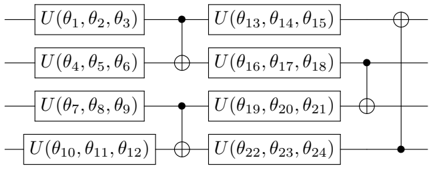
Analytical: finite-difference representation of \(\Delta C\) as a path integral of gradients, then Cauchy-Schwarz and covariance bounds under the barren-plateau definition \(Var_\theta[\partial_\mu C]\le F(n)\in O(1/b^n)\). Numerical: variational quantum compiling with target \(U=\mathbb{1}\), local cost \(C(\theta)=\mathrm{Tr}[O_L V(\theta)|0\rangle\langle0|V^\dagger(\theta)]\), \(O_L=1-\frac1n\sum_i |0_i\rangle\langle0_i|\), and a layered hardware-efficient ansatz with \(p=n\) layers. Optimizers Nelder-Mead, Powell, and COBYLA were run for \(n=5,\dots,11\), with 20 random-initialized runs per setting, stopping at \(C=0.4\) or a maximal shot budget; MATLAB and SciPy were used.
Limitations
Stated: the exponential scaling found numerically is a lower bound on the asymptotics; Nelder-Mead’s super-exponential scaling is likely due to premature simplex shrinking when cost values are hard to order; COBYLA may suffer a similar premature trust-region shrinking, though the data do not clearly demonstrate it; Powell’s better scaling is likely because statistical noise does not cumulatively affect its state. Evident from the text: the numerical study is limited to a toy compilation problem with \(U=\mathbb{1}\), \(n=5\)–\(11\), a relatively large threshold \(C=0.4\) that probes only initial training, and default hyperparameters unrelated to termination; exact shot-count values are shown only in a figure, not reported numerically in the text.
Model-written summary. Check it against the paper before relying on it.
Integrity signals
Registry
Cites
Statistics
Figures
Verification
Claims the paper makes
7 Valid · 1 Not valid · 5 Not checked · 36 Own results and interpretations
The sources with a verdict support this claim; the rest weren’t checked yet, have no full text we could read, or their verdicts aren’t rated yet.
In the paper
“Due to this difficulty, one would expect the number of iterations required to converge with Nelder-Mead to be especially bad in limited precision environments, though we note that there are a number of modifications that attempt to improve the method's robustness to noise [46,47].”
§ Effect of barren plateaus on gradient-free optimization > 2.2.1 Nelder-Mead
What the sources say
- Supportedcites [46] matched to “Robust simplex algorithm for online optimization” (2018) source
The citation sits on the clause 'there are a number of modifications that attempt to improve the method's robustness to noise', and our copy's Introduction is exactly that: it lists 'a number of attempts to modify the Nelder-Mead simplex method to make it more suitable for dealing with noise in simulation optimization' (Barton & Ivey, Humphrey & Wilson's three-phase approach, Chang's stochastic method) and then presents the author's own noise-aware modification (Sec. II B, 'The robust simplex method'). The preceding 'one would expect ... especially bad in limited precision environments' is the citing authors' own hedged inference, not attributed to this source; our copy frames the difficulty as susceptibility to noise in function evaluation (Introduction; Sec. III Simulation, where Nelder-Mead with sigma=0.01 'typically does not converge to the minimum') rather than to limited numerical precision. (LLM, conf=0.85)
- Not checked yetcites [47] matched to “An efficient method for finding the minimum of a function of several variables without calculating derivatives” (1964) source
hedgedstates a possible cause- Asserted: passes — The authors put it forward as true.
- Checkable: passes — It can be checked against evidence.
- Load-bearing: unclear — It is unclear whether the paper’s conclusions depend on it.
- Based: passes — The paper gives a reason why it holds.
- Supported
The sources with a verdict support this claim; the rest weren’t checked yet, have no full text we could read, or their verdicts aren’t rated yet.
In the paper
“Barren plateau landscapes correspond to gradients that vanish exponentially in the number of qubits.”
- Also stated in: § 1 Introduction · boosted
“The most famous gradient scaling result is the barren plateau phenomenon [19][20][21][22][23][24][25][26][27][28][29][30][31][32][33], whereby the gradient of the cost function shrinks exponentially with the number of qubits.”
§ Effect of barren plateaus on gradient-free optimization > Abstract
What the sources say
- Supportedcites [19] matched to “Cost function dependent barren plateaus in shallow parametrized quantum circuits” (2021) source
The Introduction (p. 1, para on McClean et al.) explicitly defines the phenomenon: a 2-design ansatz 'leads to a barren plateau, i.e., with the gradient vanishing exponentially in the number of qubits, n.' The Warm-up example (Results) detects the barren plateau via a gradient variance 'which is exponentially vanishing in n,' while the local cost function's variance 'vanishes polynomially with n and hence exhibits no barren plateau.' The Introduction's summary of results likewise contrasts local cost functions vanishing 'polynomially rather than exponentially in n' with barren plateaus, confirming the equivalence the citing sentence asserts. (LLM, conf=0.92)
- Not checked yetcites [20]
- Supportedcites [21] matched to “Noise-induced barren plateaus in variational quantum algorithms” (2021) source
The Introduction of our copy states the characterization directly: recent studies proved 'the gradient vanishes exponentially in n' and 'this vanishing gradient phenomenon is now referred to as barren plateaus in the training landscape.' The Abstract likewise equates a barren plateau with a vanishing gradient and proves the gradient 'vanishes exponentially in the number of qubits n' when depth scales linearly with n (Noise-Induced Barren Plateau, Introduction and Results > General analytical results, Corollary 1). The only nuance is internal to the paper — noise-free barren plateaus are described as exponential decay of the gradient's variance rather than of the gradient itself (Results, Corollary 1 discussion) — but the claim's generic definitional statement is what our copy asserts. (LLM, conf=0.88)
boostedstates a cause- Asserted: passes — The authors put it forward as true.
- Checkable: passes — It can be checked against evidence.
- Load-bearing: passes — The paper’s conclusions depend on it.
- Based: passes — The paper gives a reason why it holds.
- Also stated in: § 1 Introduction · boosted
The cited sources support only part of this claim — read each source’s verdict below.
In the paper
“As shown in the seminal work of Ref. [19], deep random unstructured circuits which form 2-designs on n qubits will exhibit barren plateaus.”
§ Effect of barren plateaus on gradient-free optimization > 2.3 Barren Plateaus
What the sources say
- Partly supportedcites [19] matched to “Cost function dependent barren plateaus in shallow parametrized quantum circuits” (2021) sourceExperimental — accuracy not yet measured
The Introduction (p. 1) does state the substance: random initialization of a V(θ) that forms a 2-design leads to a barren plateau with gradients vanishing exponentially in n, and the Results ('Main results') confirm that for deep circuits their Alternating Layered Ansatz (an approximate one-dimensional 2-design at ~40n layers) 'behaves like a random circuit and we recover the barren plateau result of [ref. 9] for both local and global cost functions'. However, the source explicitly credits that deep-circuit/2-design result to McClean et al. (their ref. 9), calling it the contrasting prior work ('this is in contrast to McClean et al., who showed vanishing gradients for deep PQCs'), and presents its own contribution as the extension to shallow circuits and cost-function dependence (Fig. 1 caption: 'McClean et al. proved that a barren plateau can occur when the depth D ... Here we extend these results'). So the citing sentence's framing of this paper as the seminal/original demonstration of the deep-circuit 2-design barren plateau overstates it, even though the physical content is reported in the paper. (LLM, conf=0.80)
boostedstates a cause- Asserted: passes — The authors put it forward as true.
- Checkable: passes — It can be checked against evidence.
- Load-bearing: passes — The paper’s conclusions depend on it.
- Based: passes — The paper gives a reason why it holds.
- Partly supported
The cited sources support only part of this claim — read each source’s verdict below.
In the paper
“likely due to the chances of prematurely shrinking the simplex when it is hard to order the cost values [46].”
§ Effect of barren plateaus on gradient-free optimization > 5 Discussion
What the sources say
- Partly supportedcites [46] matched to “Robust simplex algorithm for online optimization” (2018) sourceExperimental — accuracy not yet measured
Our copy supports the mechanism half of the claim: Sec. II.B ('The robust simplex method') states that the shrink is performed only when f(n+1)-f(1) is above M2*sigma, a requirement 'imposed to avoid the reduction of the simplex size to a level when comparison operations are swamped by noise', and notes 'there could be ambiguity as to which vertex has the minimum value'; the Introduction ('As soon as the noise starts to alter the results of function value comparisons between the simplex vertices, the algorithm breaks down') and Sec. IV.A ('As its simplex quickly shrank, it soon stopped making appreciable changes') say the same. What the copy does not support is the scaling observation the explanation is offered for: no passage discusses how Nelder-Mead cost scales with the number of parameters N, and there is no mention of exponential or super-exponential growth (all tests are at fixed dimension — n=6 in Sec. III, 14 skew quadrupoles and 8 knobs in Sec. IV). So the cited source does not attribute premature shrinkage to a super-exponential-in-N scaling. (LLM, conf=0.72)
hedgedstates a possible cause- Asserted: passes — The authors put it forward as true.
- Checkable: passes — It can be checked against evidence.
- Load-bearing: unclear — It is unclear whether the paper’s conclusions depend on it.
- Based: passes — The paper gives a reason why it holds.
- Partly supported
Every source the paper cites for this claim was checked and supports it.
In the paper
“This corresponds to the barren plateau scenario in Ref. [19].”
§ Effect of barren plateaus on gradient-free optimization > 4 Numerical Implementation
What the sources say
- Supportedcites [19] matched to “Cost function dependent barren plateaus in shallow parametrized quantum circuits” (2021) source
The Introduction’s Fig. 1 caption describes barren plateaus in deep ansatzes, and Results > Main results says that for deep circuits the ansatz behaves like a random circuit and exhibits barren plateaus for both local and global cost functions. This supports the citing document’s identification of its linearly growing-depth choice as a barren-plateau scenario; the choice p=n is the citing document’s own setup. (LLM, conf=0.84)
plainstates an association- Asserted: passes — The authors put it forward as true.
- Checkable: passes — It can be checked against evidence.
- Load-bearing: passes — The paper’s conclusions depend on it.
- Based: passes — The paper gives a reason why it holds.
- Supported
28 more claims
Create a free account to see all 49 claims and to verify the 11 references still open.
- Probably not a substantial claim. 9
- It may state two separate claims as one. 8
Claims other papers make about this one
Each is checked against this paper’s own text: does it say what the citing paper says it does?
The check wasn’t confident either way, so it gives no verdict — never disputed.
In the citing paper
“Variational-state quantum metrology variationally searches for the optimal probe state [190-193].”
From Variational quantum algorithms (2021) · cites this paper as [193]
Experimental — accuracy not yet measuredThe check wasn’t confident either way, so it gives no verdict — never disputed.
In the citing paper
“Note that since QFI cannot be efficiently computed, an approximation of QFI can be heuristically found by optimizing the measurement basis, or by computing upper and lower bounds on the QFI [193].”
From Variational quantum algorithms (2021) · cites this paper as [193]
Experimental — accuracy not yet measured
Self-check
Percentages, sums and reported differences re-computed from the paper’s own numbers.
Each contradiction between two passages listed here was confirmed by an independent check.
Rated minor: it would not touch a result — a value no result rests on, a p-value that stays on the same side of the significance level, or a conflict that is clerical, resolved elsewhere in the paper, or outside its own findings.
In the paper
§ Effect of barren plateaus on gradient-free optimization > Proposition 1. Consider the cost function of Eq. (1).
“where we have used (5), and Eq. ( 9) from Proposition 1.”
§ Effect of barren plateaus on gradient-free optimization > Proposition 1. Consider the cost function of Eq. (1).
“Var θ A [∆C] G(n) ,(7)”
Citations
Cites
A Simplex Method for Function Minimization
Nelder, J. A., & Mead, R. (1965) · The Computer Journal · doi:10.1093/comjnl/7.4.308 · Cited by 28,905
Powell, M. J. D. (1964) · The Computer Journal · doi:10.1093/comjnl/7.2.155 · Cited by 4,632 · cited 2×
“The Powell algorithm [40] is another popular gradientfree optimizer that performs sequential line searches.”
MethodA variational eigenvalue solver on a photonic quantum processor
Peruzzo, A., McClean, J., Shadbolt, P., Yung, M.-H., Zhou, X.-Q., Love, P. J., Aspuru-Guzik, A., & O’Brien, J. L. (2014) · Nature Communications · doi:10.1038/ncomms5213 · Cited by 4,552 · cited 1×
“In this case, the cost takes a simpler form, where the training set contains a single state ( S = 1 ) and the cost is C ( θ ) = Tr[ OV ( θ ) ρV † ( θ )] , with O a Hermitian operator [3–14].”
BackgroundVariational quantum algorithms
Cerezo, M., Arrasmith, A., Babbush, R., Benjamin, S. C., Endo, S., Fujii, K., McClean, J. R., Mitarai, K., Yuan, X., Cincio, L., et al. (2021) · Nature Reviews Physics · doi:10.1038/s42254-021-00348-9 · Cited by 3,385 · cited 1×
“These circuits are utilized in both Variational Quantum Algorithms (VQAs) [1–14] and Quantum Neural Networks (QNNs) [15–18].”
MethodSelf-citationBarren plateaus in quantum neural network training landscapes
McClean, J. R., Boixo, S., Smelyanskiy, V. N., Babbush, R., & Neven, H. (2018) · Nature Communications · doi:10.1038/s41467-018-07090-4 · Cited by 2,329 · cited 4×
“[17], deep random unstructured circuits which form 2-designs on n qubits will exhibit barren plateaus.”
BackgroundInfluentialNoisy intermediate-scale quantum algorithms
Bharti, K., Cervera-Lierta, A., Kyaw, T. H., Haug, T., Alperin-Lea, S., Anand, A., Degroote, M., Heimonen, H., Kottmann, J. S., Menke, T., et al. (2022) · Reviews of Modern Physics · doi:10.1103/revmodphys.94.015004 · Cited by 2,231
A Quantum Approximate Optimization Algorithm
Farhi, E., Goldstone, J., & Gutmann, S. (2014) · arXiv · doi:10.48550/arxiv.1411.4028 · Cited by 1,789 · cited 3×
“[3] E.”
BackgroundMethodQuantum convolutional neural networks
Cong, I., Choi, S., & Lukin, M. D. (2019) · Nature Physics · doi:10.1038/s41567-019-0648-8 · Cited by 1,517 · cited 2×
“For instance, in a binary classification problem the cost function is given by the mean squared-error C(θ) = ∑ x(yx − ỹ(θ, ρx)) 2 [14, 15, 31, 32].”
BackgroundMethodPowell, M. J. D. (1994) · Advances in Optimization and Numerical Analysis · doi:10.1007/978-94-015-8330-5_4 · Cited by 1,369 · cited 11×
“Constrained Optimization BY Linear Approximation (COBYLA) is another popular gradient-free optimizer by Powell [42].”
BackgroundMethodInfluentialThe power of quantum neural networks
Abbas, A., Sutter, D., Zoufal, C., Lucchi, A., Figalli, A., & Woerner, S. (2021) · Nature Computational Science · doi:10.1038/s43588-021-00084-1 · Cited by 1,082
Cost function dependent barren plateaus in shallow parametrized quantum circuits
Cerezo, M., Sone, A., Volkoff, T., Cincio, L., & Coles, P. J. (2021) · Nature Communications · doi:10.1038/s41467-021-21728-w · Cited by 1,047 · cited 4×
“This is currently a topic of debate [20, 28].”
BackgroundMethodInfluentialSelf-citationNoise-Induced Barren Plateaus in Variational Quantum Algorithms
Wang, S., Fontana, E., Cerezo, M., Sharma, K., Sone, A., Cincio, L., & Coles, P. J. (2020) · arXiv · doi:10.48550/arxiv.2007.14384 · Cited by 791
Self-citationNoise-induced barren plateaus in variational quantum algorithms
Wang, S., Fontana, E., Cerezo, M., Sharma, K., Sone, A., Cincio, L., & Coles, P. J. (2021) · Nature Communications · doi:10.1038/s41467-021-27045-6 · Cited by 773 · cited 3×
“Finally, in [20] a noise-induced barren plateau mechanism was found.”
BackgroundSelf-citationTraining deep quantum neural networks
Beer, K., Bondarenko, D., Farrelly, T., Osborne, T. J., Salzmann, R., Scheiermann, D., & Wolf, R. (2020) · Nature Communications · doi:10.1038/s41467-020-14454-2 · Cited by 726 · cited 2×
“For instance, in a binary classification problem the cost function is given by the mean squared-error C(θ) = ∑ x(yx − ỹ(θ, ρx)) 2 [14, 15, 31, 32].”
BackgroundMethodThe quest for a Quantum Neural Network
Schuld, M., Sinayskiy, I., & Petruccione, F. (2014) · Quantum Information Processing · doi:10.1007/s11128-014-0809-8 · Cited by 671
Classification with Quantum Neural Networks on Near Term Processors
Farhi, E., & Neven, H. (2018) · arXiv · doi:10.48550/arxiv.1802.06002 · Cited by 598 · cited 1×
“For instance, in a binary classification problem the cost function is given by the mean squared-error C ( θ ) = x ( y x − e y ( θ , ρ x )) 2 [16, 17, 39, 40].”
MethodConnecting Ansatz Expressibility to Gradient Magnitudes and Barren Plateaus
Holmes, Z., Sharma, K., Cerezo, M., & Coles, P. J. (2022) · PRX Quantum · doi:10.1103/prxquantum.3.010313 · Cited by 570 · cited 1×
“Various issues lead to barren plateaus, such as deep ansatzes that lack structure [19, 21, 31], global cost functions [20, 21], high levels of noise [22, 32], scrambling target unitaries [24], and large entanglement [28, 29].”
BackgroundSelf-citationQuantum autoencoders for efficient compression of quantum data
Romero, J., Olson, J. P., & Aspuru-Guzik, A. (2017) · Quantum Science and Technology · doi:10.1088/2058-9565/aa8072 · Cited by 559
Stokes, J., Izaac, J., Killoran, N., & Carleo, G. (2020) · Quantum · doi:10.22331/q-2020-05-25-269 · Cited by 473
Continuous-variable quantum neural networks
Killoran, N., Bromley, T. R., Arrazola, J. M., Schuld, M., Quesada, N., & Lloyd, S. (2019) · Physical Review Research · doi:10.1103/physrevresearch.1.033063 · Cited by 418 · cited 2×
“For instance, in a binary classification problem the cost function is given by the mean squared-error C(θ) = ∑ x(yx − ỹ(θ, ρx)) 2 [14, 15, 31, 32].”
BackgroundMethodAn initialization strategy for addressing barren plateaus in parametrized quantum circuits
Grant, E., Wossnig, L., Ostaszewski, M., & Benedetti, M. (2019) · Quantum · doi:10.22331/q-2019-12-09-214 · Cited by 406
Local Random Quantum Circuits are Approximate Polynomial-Designs
Brandão, F. G. S. L., Harrow, A. W., & Horodecki, M. (2016) · Communications in Mathematical Physics · doi:10.1007/s00220-016-2706-8 · Cited by 404
On Bayesian Methods for Seeking the Extremum
Močkus, J. (1975) · Optimization Techniques IFIP Technical Conference · doi:10.1007/978-3-662-38527-2_55 · Cited by 402
Quantum-assisted quantum compiling
Khatri, S., LaRose, R., Poremba, A., Cincio, L., Sornborger, A. T., & Coles, P. J. (2019) · Quantum · doi:10.22331/q-2019-05-13-140 · Cited by 382 · cited 2×
“As shown in [5, 10], the following local cost function is faithful”
BackgroundMethodSelf-citationAbsence of Barren Plateaus in Quantum Convolutional Neural Networks
Pesah, A., Cerezo, M., Wang, S., Volkoff, T., Sornborger, A. T., & Coles, P. J. (2021) · Physical Review X · doi:10.1103/physrevx.11.041011 · Cited by 343 · cited 1×
“Some examples include employing local cost functions [18], modifying the architecture [23], pre-training [26], parameter correlation [27], layer-by-layer training [28], and initializing layers to the identity [29].”
BackgroundSelf-citationAbsence of Barren Plateaus in Quantum Convolutional Neural Networks
Pesah, A., Cerezo, M., Wang, S., Volkoff, T., Sornborger, A. T., & Coles, P. J. (2020) · arXiv · doi:10.48550/arxiv.2011.02966 · Cited by 343
Self-citationRandom Quantum Circuits are Approximate 2-designs
Harrow, A. W., & Low, R. A. (2009) · Communications in Mathematical Physics · doi:10.1007/s00220-009-0873-6 · Cited by 324
Layerwise learning for quantum neural networks
Skolik, A., McClean, J. R., Mohseni, M., van der Smagt, P., & Leib, M. (2021) · Quantum Machine Intelligence · doi:10.1007/s42484-020-00036-4 · Cited by 324 · cited 2×
“[28] Andrea Skolik, Jarrod R McClean, Masoud Mohseni, Patrick van der Smagt, and Martin Leib, “Layerwise learning for quantum neural networks,” arXiv preprint arXiv:2006.”
BackgroundVariational Quantum Linear Solver
Bravo-Prieto, C., LaRose, R., Cerezo, M., Subasi, Y., Cincio, L., & Coles, P. J. (2019) · arXiv · doi:10.48550/arxiv.1909.05820 · Cited by 284
Self-citationVariational fast forwarding for quantum simulation beyond the coherence time
Cîrstoiu, C., Holmes, Z., Iosue, J., Cincio, L., Coles, P. J., & Sornborger, A. (2020) · npj Quantum Information · doi:10.1038/s41534-020-00302-0 · Cited by 232
Self-citationStochastic gradient descent for hybrid quantum-classical optimization
Sweke, R., Wilde, F., Meyer, J., Schuld, M., Faehrmann, P. K., Meynard-Piganeau, B., & Eisert, J. (2020) · Quantum · doi:10.22331/q-2020-08-31-314 · Cited by 219
Variational quantum state diagonalization
LaRose, R., Tikku, A., O’Neel-Judy, É., Cincio, L., & Coles, P. J. (2019) · npj Quantum Information · doi:10.1038/s41534-019-0167-6 · Cited by 199 · cited 3×
“[6] R.”
BackgroundMethodSelf-citationNoise resilience of variational quantum compiling
Sharma, K., Khatri, S., Cerezo, M., & Coles, P. J. (2020) · New Journal of Physics · doi:10.1088/1367-2630/ab784c · Cited by 196 · cited 4×
“We remark that there is an efficient quantum circuit to compute C(θ) [10].”
BackgroundMethodInfluentialSelf-citationNoisy intermediate-scale quantum (NISQ) algorithms
Bharti, K., Cervera-Lierta, A., Kyaw, T. H., Haug, T., Alperin-Lea, S., Anand, A., Degroote, M., Heimonen, H., Kottmann, J. S., Menke, T., et al. (2021) · arXiv · doi:10.48550/arxiv.2101.08448 · Cited by 166
Entanglement devised barren plateau mitigation
Patti, T. L., Najafi, K., Gao, X., & Yelin, S. F. (2021) · Physical Review Research · doi:10.1103/physrevresearch.3.033090 · Cited by 148
An Adaptive Optimizer for Measurement-Frugal Variational Algorithms
Kübler, J. M., Arrasmith, A., Cincio, L., & Coles, P. J. (2020) · Quantum · doi:10.22331/q-2020-05-11-263 · Cited by 141
Self-citationEquivalence of quantum barren plateaus to cost concentration and narrow gorges
Arrasmith, A., Holmes, Z., Cerezo, M., & Coles, P. J. (2022) · Quantum Science and Technology · doi:10.1088/2058-9565/ac7d06 · Cited by 137
Self-citationOn barren plateaus and cost function locality in variational quantum algorithms
Uvarov, A. V., & Biamonte, J. D. (2021) · Journal of Physics A: Mathematical and Theoretical · doi:10.1088/1751-8121/abfac7 · Cited by 126
Barren Plateaus Preclude Learning Scramblers
Holmes, Z., Arrasmith, A., Yan, B., Coles, P. J., Albrecht, A., & Sornborger, A. T. (2021) · Physical Review Letters · doi:10.1103/physrevlett.126.190501 · Cited by 125 · cited 1×
“Various issues lead to barren plateaus, such as deep ansatzes that lack structure [19, 21, 31], global cost functions [20, 21], high levels of noise [22, 32], scrambling target uni-taries [24], and large entanglement [28, 29].”
BackgroundSelf-citationBarren plateaus preclude learning scramblers
Holmes, Z., Arrasmith, A., Yan, B., Coles, P. J., Albrecht, A., & Sornborger, A. T. (2020) · arXiv · doi:10.48550/arxiv.2009.14808 · Cited by 125
Self-citationHigher order derivatives of quantum neural networks with barren plateaus
Cerezo, M., & Coles, P. J. (2021) · Quantum Science and Technology · doi:10.1088/2058-9565/abf51a · Cited by 118
Self-citationVariational Quantum Fidelity Estimation
Cerezo, M., Poremba, A., Cincio, L., & Coles, P. J. (2020) · Quantum · doi:10.22331/q-2020-03-26-248 · Cited by 116 · cited 3×
“These circuits are utilized in both Variational Quantum Algorithms (VQAs) [1–12] and Quantum Neural Networks (QNNs) [13–16].”
BackgroundMethodSelf-citationLearning to learn with quantum neural networks via classical neural networks
Verdon, G., Broughton, M., McClean, J. R., Sung, K. J., Babbush, R., Zhang, J., Neven, H., & Mohseni, M. (2019) · arXiv (Cornell University) · doi:10.48550/arxiv.1907.05415 · Cited by 73 · cited 2×
“Some examples include employing local cost functions [18], modifying the architecture [23], pre-training [26], parameter correlation [27], layer-by-layer training [28], and initializing layers to the identity [29].”
BackgroundA universal training algorithm for quantum deep learning
Verdon, G., Pye, J., & Broughton, M. (2018) · arXiv · doi:10.48550/arxiv.1806.09729 · Cited by 68 · cited 1×
“[16] Guillaume Verdon, Jason Pye, and Michael Broughton, “A universal training algorithm for quantum deep learning,” arXiv preprint arXiv:1806.”
BackgroundVariational consistent histories as a hybrid algorithm for quantum foundations
Arrasmith, A., Cincio, L., Sornborger, A. T., Zurek, W. H., & Coles, P. J. (2019) · Nature Communications · doi:10.1038/s41467-019-11417-0 · Cited by 66
Self-citationOperator Sampling for Shot-frugal Optimization in Variational Algorithms
Arrasmith, A., Cincio, L., Somma, R. D., & Coles, P. J. (2020) · arXiv · doi:10.48550/arxiv.2004.06252 · Cited by 53 · cited 1×
“[35] Andrew Arrasmith, Lukasz Cincio, Rolando D Somma, and Patrick J Coles, “Operator sampling for shot-frugal optimization in variational algorithms,” arXiv preprint arXiv:2004.”
BackgroundSelf-citationModifications of the Nelder-Mead simplex method for stochastic simulation response optimization
Barton, R. R., & Ivey, J. S. (2002) · Winter Simulation Conference · doi:10.1109/wsc.1991.185709 · Cited by 51 · cited 3×
“Due to this diffi-culty, one would expect the number of iterations required to converge with Nelder-Mead to be especially bad in limited precision environments, though we note that there are a number of mod-ifications that attempt to improve the method’s robustness to noise [46, 47].”
BackgroundAbrupt transitions in variational quantum circuit training
Campos, E., Nasrallah, A., & Biamonte, J. (2021) · Physical Review A · doi:10.1103/physreva.103.032607 · Cited by 46
Natural evolutionary strategies for variational quantum computation
Anand, A., Degroote, M., & Aspuru-Guzik, A. (2021) · Machine Learning: Science and Technology · doi:10.1088/2632-2153/abf3ac · Cited by 40
Entanglement-Induced Barren Plateaus
Ortiz Marrero, C., Kieferová, M., & Wiebe, N. (2021) · PRX Quantum · doi:10.1103/prxquantum.2.040316 · Cited by 39
Toward Trainability of Quantum Neural Networks
Zhang, K., Hsieh, M.-H., Liu, L., & Tao, D. (2020) · arXiv · doi:10.48550/arxiv.2011.06258 · Cited by 36 · cited 1×
“Some examples include employing local cost functions [20], modifying the architecture [25, 26], pre-training [34], parameter correlation [35], layer-by-layer training [36], and initializing layers to the identity [37].”
BackgroundRobust simplex algorithm for online optimization
Huang, X. (2018) · Physical Review Accelerators and Beams · doi:10.1103/physrevaccelbeams.21.104601 · Cited by 30 · cited 1×
“Due to this diffi-culty, one would expect the number of iterations required to converge with Nelder-Mead to be especially bad in limited precision environments, though we note that there are a number of mod-ifications that attempt to improve the method’s robustness to noise [46, 47].”
BackgroundOn the learnability of quantum neural networksPreprint
Du, Y., Hsieh, M.-H., Liu, T., You, S., & Tao, D. (2020) · Research Square · doi:10.21203/rs.3.rs-80242/v1 · Cited by 18 · cited 1×
“Various issues lead to barren plateaus, such as deep ansatzes that lack structure [19, 21, 31], global cost functions [20, 21], high levels of noise [22, 32], scrambling target uni-taries [24], and large entanglement [28, 29].”
BackgroundOn the learnability of quantum neural networksPreprint
Du, Y., Hsieh, M.-H., Liu, T., et al. (2020) · arXiv (Cornell University) · doi:10.48550/arxiv.2007.12369 · Cited by 8 · cited 1×
“Various issues lead to barren plateaus, such as deep ansatzes that lack structure [19, 21, 31], global cost functions [20, 21], high levels of noise [22, 32], scrambling target uni-taries [24], and large entanglement [28, 29].”
Background
Research works printed but not linked: 5
- M. Cerezo, K. Sharma, A. Arrasmith, and P. J. Coles, Variational quantum state eigensolver, arXiv preprint arXiv:2004.01372 (2020). · arXiv
- K. Sharma, M. Cerezo, L. Cincio, and P. J. Coles, Trainability of dissipative perceptron-based quantum neural networks, arXiv preprint arXiv:2005.12458 (2020). · arXiv
- T. Volkoff and P. J. Coles, Large gradi- ents via correlation in random parameter- ized quantum circuits, Quantum Science and Technology 6, 025008 (2021). · doi:10.1088/2058-9565/abd89
- M. J. Powell, in Advances in optimization and numerical analysis (Springer, 1994) pp. 51-67. · DOI · Paper page
- A. Harrow and S. Mehraban, Approxi- mate unitary t-designs by short random quantum circuits using nearest-neighbor and long-range gates, arXiv preprint arXiv:1809.06957 (2018). · arXiv
Cited by
Variational quantum algorithms
Cerezo, M., Arrasmith, A., Babbush, R., Benjamin, S. C., Endo, S., Fujii, K., McClean, J. R., Mitarai, K., Yuan, X., Cincio, L., et al. (2021) · Nature Reviews Physics · doi:10.1038/s42254-021-00348-9 · Cited by 3,385
“large precision to resolve against finite sampling noise and determine a cost-minimizing direction, with this being valid independently of using a gradient-based [68] or gradient-free optimization method [165].”
MethodSelf-citationNoisy intermediate-scale quantum algorithms
Bharti, K., Cervera-Lierta, A., Kyaw, T. H., Haug, T., Alperin-Lea, S., Anand, A., Degroote, M., Heimonen, H., Kottmann, J. S., Menke, T., et al. (2022) · Reviews of Modern Physics · doi:10.1103/revmodphys.94.015004 · Cited by 2,231
Cost function dependent barren plateaus in shallow parametrized quantum circuits
Cerezo, M., Sone, A., Volkoff, T., Cincio, L., & Coles, P. J. (2021) · Nature Communications · doi:10.1038/s41467-021-21728-w · Cited by 1,047
“From (31), the partial derivative of the global cost function in (1) can be expressed as”
BackgroundMethodSelf-citationThe Variational Quantum Eigensolver: A review of methods and best practices
Tilly, J., Chen, H., Cao, S., Picozzi, D., Setia, K., Li, Y., Grant, E., Wossnig, L., Rungger, I., Booth, G. H., et al. (2022) · Physics Reports · doi:10.1016/j.physrep.2022.08.003 · Cited by 1,031
Noise-Induced Barren Plateaus in Variational Quantum Algorithms
Wang, S., Fontana, E., Cerezo, M., Sharma, K., Sone, A., Cincio, L., & Coles, P. J. (2020) · arXiv · doi:10.48550/arxiv.2007.14384 · Cited by 791
Self-citation
Metadata
- Authors
- Arrasmith, A., Cerezo, M., Czarnik, P., Cincio, L., & Coles, P. J.
- Affiliations
- Los Alamos National Laboratory (US)
- ORCID
- Czarnik, Piotr
- Venue
- Quantum
- Published
- 2021-10-05
- Volume
- 5
- Pages
- 558
- ISSN
- 2521-327X (ISSN-L)
- OpenAlex
- W3108496771
- Semantic Scholar
- a062fde5340e24ce5213eb6126f3a74fc78fdbf9
- Cited by
- 248
- References
- 43
- Citations by year
- 2026: 39 · 2025: 57 · 2024: 46 · 2023: 43 · 2022: 42 · 2021: 21
- FWCI
- 13.38
- Type
- journal article
- Language
- en
- Open access
- gold
- doi.org
- Locations
- Quantum (publishedVersion, cc-by)
- arXiv (Cornell University) (submittedVersion)
- OSTI OAI (U.S. Department of Energy Office of Scientific and Technical Information) (submittedVersion, cc-by)
- DOAJ (DOAJ: Directory of Open Access Journals) (submittedVersion, cc-by-sa)
- arXiv (Cornell University) (cc-by)
- Funders
- LANL LDRD (20190065DR, 20190659PRD4)
- Topics
- Physical Sciences › Computer Science › Artificial Intelligence › Quantum Computing Algorithms and Architecture
- Physical Sciences › Computer Science › Artificial Intelligence › Metaheuristic Optimization Algorithms Research
- Physical Sciences › Physics and Astronomy › Atomic and Molecular Physics, and Optics › Quantum many-body systems
- Keywords
- barren plateaus, derivative-free optimization, variational quantum algorithms, quantum neural networks, Nelder-Mead, Powell algorithm, COBYLA, variational quantum circuits
About these checks
Registry, retraction, Cites and statistics results are computed, not judged, with one exception: a printed reference that no index lists is read once by a model before it counts as a citation error. Claims are extracted by a model and kept only when their quote appears verbatim in the text; each cited source is then checked, with a model’s help, for whether it says what the claim relies on. Those verdicts can be wrong — read the claim’s quote and the cited source before relying on one.
The claim verdicts this report counts are experimental: their accuracy is not yet measured.
A language model drew the claims from the paper on 2026-10-08, under version 3 of the claim definition (model deepseek-v4.1-flash, prompt extract-v3).
A second model labelled each claim on 2026-10-08 (model jev-1.13-20260917, definition revision gold-guideline-v0.2).
Cited sources are checked with a language model’s help (qwen3.8-omni-flash and gpt-6-sol).
Statistics and arithmetic are recomputed, not judged.
Confidence bands are shown only for fields calibrated on our annotated test set. None is calibrated yet, so no band is shown.
What counts as a claim ›How we measure confidence ›How we check this ›
Are you an author, or do you see a problem with this page? Request a review
Data sources
Bibliographic data: Semantic Scholar, OpenAlex, Crossref.
Contains information from the Semantic Scholar Academic Graph Datasets, made available under the ODC Attribution License (ODC-BY 1.0).
Semantic Scholar’s data is described in: Kinney, R., et al. (2023). The Semantic Scholar Open Data Platform. arXiv:2301.10140.
