

Declining β-Cell Function Relative to Insulin Sensitivity With Increasing Fasting Glucose Levels in the Nondiabetic Range in Children
Open accessThe DOI matches its Crossref record; 30 of the 30 references it cites were found in a registry or an index.
Abstract
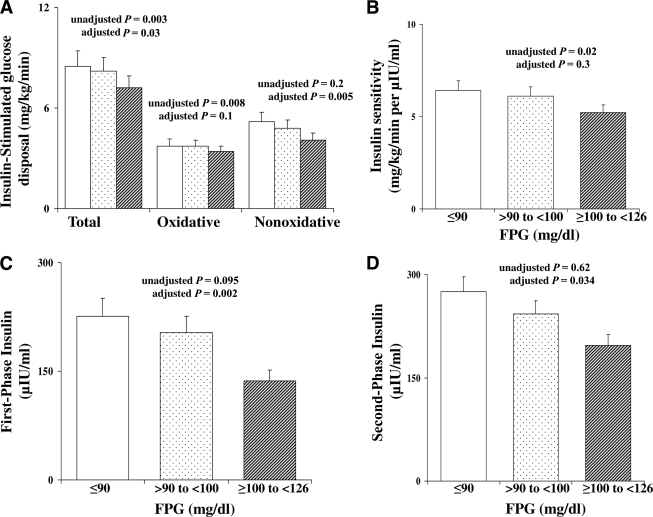
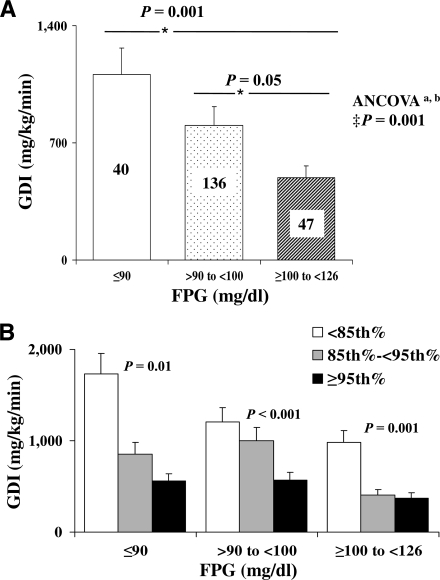
OBJECTIVE: In adults, higher fasting plasma glucose (FPG) levels, even within the normoglycemic range, are associated with increased diabetes risk. This investigation tested the hypothesis that β-cell function relative to insulin sensitivity decreases with increasing FPG in youth. RESEARCH DESIGN AND METHODS: A total of 223 youth with FPG <126 mg/dl underwent evaluation of first- and second-phase insulin secretion during a 2-h hyperglycemic (∼225 mg/dl) clamp, insulin sensitivity during a 3-h hyperinsulinemic-euglycemic clamp, body composition, and abdominal adiposity with dual-energy X-ray absorptiometry and computed tomographic scan. β-Cell function relative to insulin sensitivity was calculated as the product of first-phase insulin and insulin sensitivity, i.e., glucose disposition index (GDI). The subjects were divided into three FPG categories: ≤90, >90–<100, and ≥100–<126 mg/dl. RESULTS: GDI decreased significantly across the three categories as FPG increased (1,086 ± 192 vs. 814 ± 67 and 454 ± 57 mg/kg/min, P = 0.002). This decline remained significant after adjustment for race, sex, BMI, and percent body fat or visceral fat. Within each FPG category, GDI declined with increasing BMI percentiles. CONCLUSIONS: The impairment in β-cell function relative to insulin sensitivity is apparent even within the nondiabetic FPG range in children. At the current cutoff of 100 mg/dl for impaired fasting glucose (IFG), there is an ∼49% decline in the GDI independent of obesity and race. This observation may reflect a heightened risk of β-cell dysfunction and progression to diabetes in these children. Considering the near doubling of IFG prevalence among youth between National Health and Nutrition Examination Survey 1999–2000 and 2005–2006, our findings have important public health implications.
Overview
The claims and statistics of this paper haven’t been checked yet.
Free: it reads the open-access text and checks the first 5 claims that cite a source we can check. Create a free account to check every claim.
Integrity signals
Registry
Cites
Statistics
Figures
Verification
Claims the paper makes
The claims and statistics of this paper haven’t been checked yet.
Free: it reads the open-access text and checks the first 5 claims that cite a source we can check. Create a free account to check every claim.
Claims other papers make about this one
Each is checked against this paper’s own text: does it say what the citing paper says it does?
In the citing paper
“The children with high fasting blood glucose have 49% lower glucose deposition index”
From Lack of Exercise Is a Major Cause of Chronic Diseases (2012) · cites this paper as [504]
Self-check
Percentages, sums and reported differences re-computed from the paper’s own numbers.
The self-check needs the paper’s full text.
Citations
Cites
Diagnosis and Classification of Diabetes Mellitus
American Diabetes Association (2011) · Diabetes Care · doi:10.2337/dc11-s062 · Cited by 13,988
Report of the Expert Committee on the Diagnosis and Classification of Diabetes Mellitus
The Expert Committee on the Diagnosis and Classification of Diabetes Mellitus* (2002) · Diabetes Care · doi:10.2337/diacare.25.2007.s5 · Cited by 10,338
The metabolic phenotype in obesity: Fat mass, body fat distribution, and adipose tissue function
Goossens, G. H. (2017) · Obesity Facts · doi:10.1159/000471488 · Cited by 8,481
Report of the Expert Committee on the Diagnosis and Classification of Diabetes Mellitus
The Expert Committee on the Diagnosis and Classification of Diabetes Mellitus (1997) · Diabetes Care · doi:10.2337/diacare.20.7.1183 · Cited by 6,220
Follow-up report on the diagnosis of diabetes mellitus
The Expert Committee on the Diagnosis and Classification of Diabetes Mellitus* (2003) · Diabetes Care · doi:10.2337/diacare.26.11.3160 · Cited by 3,784 · cited 1×
“The American Diabetes Association classifies this intermediate state of FPG as impaired fasting glucose (IFG) (4) and initially defined it as fasting glucose of 110–125 mg/dl (8), which was lowered to 100 mg/dl in 2003 to better identify subjects at risk of diabetes development (9).”
BackgroundCalculation of substrate oxidation rates in vivo from gaseous exchange.
Frayn, K. N. (1983) · Journal of Applied Physiology · doi:10.1152/jappl.1983.55.2.628 · Cited by 2,365 · cited 1×
“Insulin-stimulated carbohydrate and fat oxidation rates were calculated according to the formulas of Frayn (18) from the indirect calorimetry data.”
MethodKahn, S. E. (2003) · Diabetologia · doi:10.1007/s00125-002-1009-0 · Cited by 2,166 · cited 1×
“This tight regulation is maintained by a delicate balance between insulin sensitivity and secretion (19).”
BackgroundHigh body mass index for age among US children and adolescents, 2003-2006.
Ogden, C. L. (2008) · JAMA · doi:10.1001/jama.299.20.2401 · Cited by 1,850 · cited 1×
“3% (24), which translates to 5 million children in the overweight category.”
BackgroundDiagnosis and classification of diabetes mellitus
American Diabetes Association (2009) · Diabetes Care · doi:10.2337/dc09-s062 · Cited by 1,817
Coutinho, M., Gerstein, H. C., Wang, Y., & Yusuf, S. (1999) · Diabetes Care · doi:10.2337/diacare.22.2.233 · Cited by 1,685 · cited 1×
“In addition, a meta-analysis of prospective studies showed a continuous relationship between baseline fasting glucose and subsequent cardiovascular risk (10).”
Background
Cited by
Lack of Exercise Is a Major Cause of Chronic Diseases
Booth, F. W., Roberts, C. K., & Laye, M. J. (2012) · Comprehensive Physiology · doi:10.1002/cphy.c110025 · Cited by 2,575
Arslanian, S., Bacha, F., Grey, M., Marcus, M. D., White, N. H., & Zeitler, P. (2018) · Diabetes Care · doi:10.2337/dci18-0052 · Cited by 349
Self-citationISPAD Clinical Practice Consensus Guidelines 2018: Type 2 diabetes mellitus in youth
Zeitler, P., Arslanian, S., Fu, J., Pinhas-Hamiel, O., Reinehr, T., Tandon, N., Urakami, T., Wong, J., & Maahs, D. M. (2018) · Pediatric Diabetes · doi:10.1111/pedi.12719 · Cited by 221
“However, data in youth demonstrate that β-cell function relative to insulin sensitivity is impaired even below the typically accepted cut points for fasting and the 2-hour glucose concentrations diagnostic of IFG and IGT.60,61 • In obese adolescents, pre-diabetes is often transient, with as many as 60% of individuals…”
BackgroundInfluentialSelf-citationEsser, N., Utzschneider, K. M., & Kahn, S. E. (2020) · Diabetologia · doi:10.1007/s00125-020-05245-x · Cited by 192
The changing face of diabetes in youth: lessons learned from studies of type 2 diabetes
Hannon, T. S., & Arslanian, S. A. (2015) · Annals of the New York Academy of Sciences · doi:10.1111/nyas.12939 · Cited by 137
Self-citation
Metadata
- Authors
- Tfayli, H., Lee, S., & Arslanian, S.
- Affiliations
- Children's Hospital of Pittsburgh (US)
- Corresponding author
- Arslanian, Silva
- Venue
- Diabetes Care
- Publisher
- American Diabetes Association
- Published
- 2010-09-01
- Volume
- 33
- Issue
- 9
- Pages
- 2024-2030
- ISSN
- 0149-5992 (ISSN-L)
- 1935-5548
- PMC
- PMC2928357
- OpenAlex
- W2123147152
- Cited by
- 57
- References
- 30
- Citations by year
- 2025: 1 · 2024: 1 · 2023: 2 · 2022: 3 · 2021: 3 · 2020: 5 · 2019: 2 · 2018: 6 · 2017: 3 · 2016: 1 · 2015: 4 · 2014: 5 · 2013: 9 · 2012: 8
- FWCI
- 7.08
- Type
- journal article
- Language
- en
- Open access
- hybrid
- doi.org
- Licence
- Locations
- Diabetes Care (publishedVersion, cc-by-nc-nd)
- Europe PMC (PubMed Central) (publishedVersion, cc-by-nc-nd)
- PubMed Central (publishedVersion, cc-by-nc-nd)
- PubMed (publishedVersion)
- Funders
- American Diabetes Association
- Rural and Environment Science and Analytical Services Division
- National Institutes of Health (UL1TR000005)
- U.S. Public Health Service
- Center for Clinical and Translational Sciences, University of Texas Health Science Center at Houston
- National Institute of Diabetes and Digestive and Kidney Diseases (R21DK083654)
- National Center for Research Resources (M01-RR-00084, UL1RR024153, M01RR000084)
- NIH Clinical Center
- National Center for Advancing Translational Sciences
- Eunice Kennedy Shriver National Institute of Child Health and Human Development (R01‐HD27503, R01HD027503, K24HD001357, K24 HD 01357)
- Topics
- Health Sciences › Medicine › Endocrinology, Diabetes and Metabolism › Pancreatic function and diabetes
- Health Sciences › Medicine › Endocrinology, Diabetes and Metabolism › Diabetes, Cardiovascular Risks, and Lipoproteins
- Health Sciences › Medicine › Endocrinology, Diabetes and Metabolism › Diabetes Management and Research
- Keywords
- beta-cell function, insulin sensitivity, fasting blood glucose, impaired fasting glucose, children, youth, prediabetes, type 2 diabetes risk, hyperinsulinemic-euglycemic clamp, hyperglycemic clamp, body mass index, visceral fat, first-phase insulin secretion
- MeSH terms
- Adolescent, Adult, Blood Glucose, Body Composition, Child, Fasting, Female, Humans, Insulin Resistance, Male, Glucose Clamp Technique, Absorptiometry, Photon, Adiposity, Insulin-Secreting Cells, Young Adult
About these checks
Registry, retraction, Cites and statistics results are computed, not judged, with one exception: a printed reference that no index lists is read once by a model before it counts as a citation error. Claims are extracted by a model and kept only when their quote appears verbatim in the text; each cited source is then checked, with a model’s help, for whether it says what the claim relies on. Those verdicts can be wrong — read the claim’s quote and the cited source before relying on one.
Statistics and arithmetic are recomputed, not judged.
Confidence bands are shown only for fields calibrated on our annotated test set. None is calibrated yet, so no band is shown.
What counts as a claim ›How we measure confidence ›How we check this ›
Are you an author, or do you see a problem with this page? Request a review
How to cite
Cite CoChat for the checks on this page, and the paper for its own findings.
- This page
- CoChat. (2026). Citation check: Declining β-Cell Function Relative to Insulin Sensitivity With Increasing Fasting Glucose Levels in the Nondiabetic Range in Children. https://app.cochat.ai/papers/10.2337/dc09-2292
- The paper
- Tfayli, H., Lee, S., & Arslanian, S. (2010). Declining β-Cell Function Relative to Insulin Sensitivity With Increasing Fasting Glucose Levels in the Nondiabetic Range in Children. Diabetes Care. https://doi.org/10.2337/dc09-2292
Data sources
Bibliographic data: Semantic Scholar, OpenAlex, Crossref.
Contains information from the Semantic Scholar Academic Graph Datasets, made available under the ODC Attribution License (ODC-BY 1.0).
Semantic Scholar’s data is described in: Kinney, R., et al. (2023). The Semantic Scholar Open Data Platform. arXiv:2301.10140.
