

Reduced Hypoglycemia and Increased Time in Target Using Closed-Loop Insulin Delivery During Nights With or Without Antecedent Afternoon Exercise in Type 1 Diabetes
Open accessThe DOI matches its Crossref record; 27 of the 27 references it cites were found in a registry or an index.
Abstract
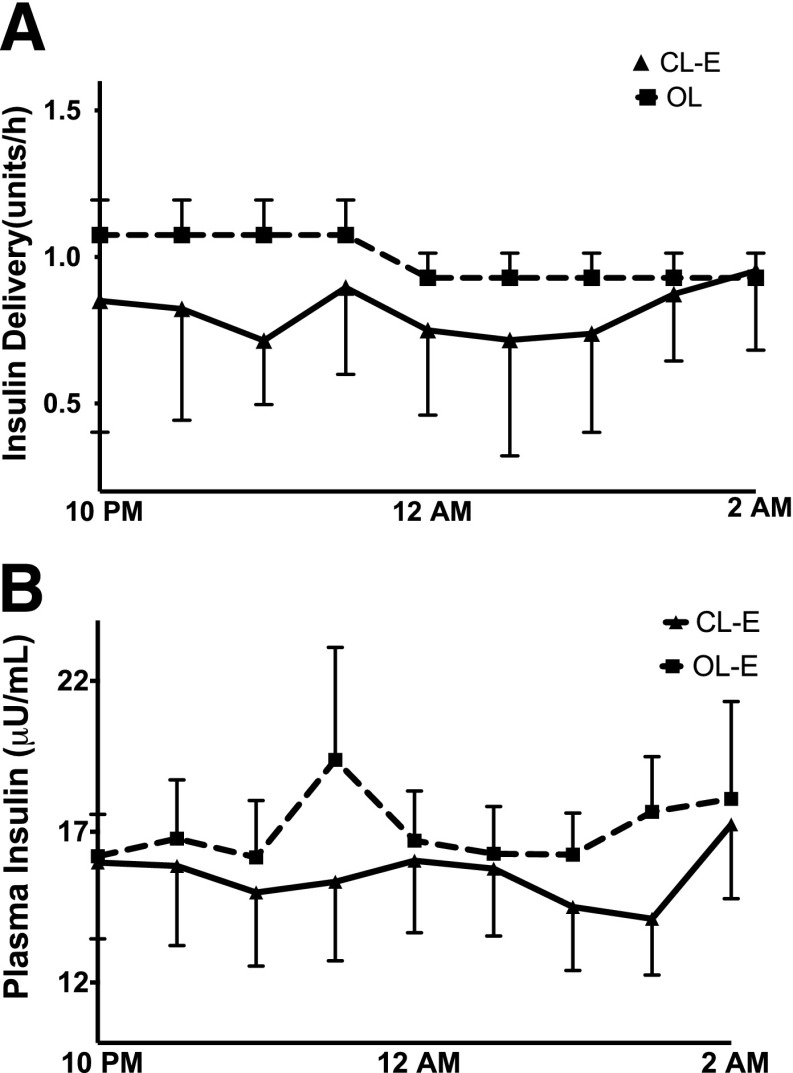
OBJECTIVE: Afternoon exercise increases the risk of nocturnal hypoglycemia (NH) in subjects with type 1 diabetes. We hypothesized that automated feedback-controlled closed-loop (CL) insulin delivery would be superior to open-loop (OL) control in preventing NH and maintaining a higher proportion of blood glucose levels within the target blood glucose range on nights with and without antecedent afternoon exercise. RESEARCH DESIGN AND METHODS: Subjects completed two 48-h inpatient study periods in random order: usual OL control and CL control using a proportional-integrative-derivative plus insulin feedback algorithm. Each admission included a sedentary day and an exercise day, with a standardized protocol of 60 min of brisk treadmill walking to 65–70% maximum heart rate at 3:00 p.m. RESULTS: Among 12 subjects (age 12–26 years, A1C 7.4 ± 0.6%), antecedent exercise increased the frequency of NH (reference blood glucose <60 mg/dL) during OL control from six to eight events. In contrast, there was only one NH event each on nights with and without antecedent exercise during CL control (P = 0.04 vs. OL nights). Overnight, the percentage of glucose values in target range was increased with CL control (P < 0.0001). Insulin delivery was lower between 10:00 p.m. and 2:00 a.m. on nights after exercise on CL versus OL, P = 0.008. CONCLUSIONS: CL insulin delivery provides an effective means to reduce the risk of NH while increasing the percentage of time spent in target range, regardless of activity level in the mid-afternoon. These data suggest that CL control could be of benefit to patients with type 1 diabetes even if it is limited to the overnight period.
Overview
The claims and statistics of this paper haven’t been checked yet.
Free: it reads the open-access text and checks the first 5 claims that cite a source we can check. Create a free account to check every claim.
Integrity signals
Registry
Cites
Statistics
Figures


Verification
Claims the paper makes
The claims and statistics of this paper haven’t been checked yet.
Free: it reads the open-access text and checks the first 5 claims that cite a source we can check. Create a free account to check every claim.
Claims other papers make about this one
Each is checked against this paper’s own text: does it say what the citing paper says it does?
The source backs part of the claim, not all of it — or backs it for a different population, condition or comparison.
In the citing paper
“These systems may also lower the risk of exercise-related hypoglycemia (219) and have been shown to have psychosocial benefits (221)(222)(223)(224)(225).”
From 7. Diabetes Technology: Standards of Care in Diabetes—2025 (2025) · cites this paper as [219]
Experimental — accuracy not yet measured
Self-check
Percentages, sums and reported differences re-computed from the paper’s own numbers.
The self-check needs the paper’s full text.
Citations
Cites
Continuous glucose monitoring and intensive treatment of type 1 diabetes
(2008) · New England Journal of Medicine · doi:10.1056/nejmoa0805017 · Cited by 1,559
Weinzimer, S. A., Steil, G. M., Swan, K. L., Dziura, J., Kurtz, N., & Tamborlane, W. V. (2008) · Diabetes Care · doi:10.2337/dc07-1967 · Cited by 567
Self-citationthe SWITCH Study Group, Battelino, T., Conget, I., Olsen, B., Schütz-Fuhrmann, I., Hommel, E., Hoogma, R., Schierloh, U., Sulli, N., & Bolinder, J. (2012) · Diabetologia · doi:10.1007/s00125-012-2708-9 · Cited by 494
Feasibility of Automating Insulin Delivery for the Treatment of Type 1 Diabetes
Steil, G. M., Rebrin, K., Darwin, C., Hariri, F., & Saad, M. F. (2006) · Diabetes · doi:10.2337/db06-0419 · Cited by 473 · cited 1×
“Steil and colleagues carried out the “first in man” studies of a closed-loop (CL) system using an external insulin pump, external glucose sensor, and a proportional-integrative-derivative (PID) algorithm in 10 adult patients with type 1 diabetes in a clinical research center setting (10).”
BackgroundThe T1D exchange clinic registry
Beck, R. W., Tamborlane, W. V., Bergenstal, R. M., Miller, K. M., DuBose, S. N., Hall, C. A., & for the T1D Exchange Clinic Network (2012) · The Journal of Clinical Endocrinology & Metabolism · doi:10.1210/jc.2012-1561 · Cited by 456
Self-citationHovorka, R., Allen, J. M., Elleri, D., Chassin, L. J., Harris, J., Xing, D., Kollman, C., Hovorka, T., Larsen, A. M. F., Nodale, M., et al. (2010) · The Lancet · doi:10.1016/s0140-6736(09)61998-x · Cited by 450 · cited 1×
“In those investigations, studies were carried out on sedentary days (10– 17) or days with shorter periods of physical activity (17,25,26).”
BackgroundNocturnal Glucose Control with an Artificial Pancreas at a Diabetes Camp
Phillip, M., Battelino, T., Atlas, E., Kordonouri, O., Bratina, N., Miller, S., Biester, T., Avbelj Stefanija, M., Muller, I., Nimri, R., et al. (2013) · New England Journal of Medicine · doi:10.1056/nejmoa1206881 · Cited by 435 · cited 1×
“Recently, the first outpatient testing of an artificial pancreas in a transitional setting of a camp demonstrated that use of such insulin delivery modalities can decrease NH while providing tighter glycemic control than could be achieved with SAP therapy (24).”
BackgroundA Bihormonal Closed-Loop Artificial Pancreas for Type 1 Diabetes
El-Khatib, F. H., Russell, S. J., Nathan, D. M., Sutherlin, R. G., & Damiano, E. R. (2010) · Science Translational Medicine · doi:10.1126/scitranslmed.3000619 · Cited by 403
Decreased Epinephrine Responses to Hypoglycemia during Sleep
Jones, T. W., Porter, P., Sherwin, R. S., Davis, E. A., O'Leary, P., Frazer, F., Byrne, G., Stick, S., & Tamborlane, W. V. (1998) · New England Journal of Medicine · doi:10.1056/nejm199806043382303 · Cited by 301 · cited 1×
“Using the hypoglycemic clamp technique, Jones and colleagues demonstrated that plasma epinephrine responses to hypoglycemia are markedly blunted in children and adolescents with and without diabetes during deep sleep at night (2).”
MethodSelf-citationImpact of Exercise on Overnight Glycemic Control in Children with Type 1 Diabetes Mellitus
Children, T. D. R. I. (2005) · The Journal of Pediatrics · doi:10.1016/j.jpeds.2005.04.065 · Cited by 264
Cited by
Weisman, A., Bai, J.-W., Cardinez, M., Kramer, C. K., & Perkins, B. A. (2017) · The Lancet Diabetes & Endocrinology · doi:10.1016/s2213-8587(17)30167-5 · Cited by 463
Closed-Loop Artificial Pancreas Systems: Engineering the Algorithms
Doyle, F. J., Huyett, L. M., Lee, J. B., Zisser, H. C., & Dassau, E. (2014) · Diabetes Care · doi:10.2337/dc13-2108 · Cited by 394
“The number of fully automated AP designs is increasing, with over 42% of clinical trials in 2013 including at least one unannounced meal challenge (2,6,14,15,20,21,23,26,29,34,35).”
BackgroundMethod7. Diabetes Technology: Standards of Medical Care in Diabetes—2022
American Diabetes Association Professional Practice Committee (2022) · Diabetes Care · doi:10.2337/dc22-s007 · Cited by 358
“glycemia (181) and may have psychosocial benefits (182–184).”
Background7. Diabetes Technology: Standards of Care in Diabetes—2025
American Diabetes Association Professional Practice Committee, ElSayed, N. A., McCoy, R. G., Aleppo, G., Balapattabi, K., Beverly, E. A., Briggs Early, K., Bruemmer, D., Echouffo-Tcheugui, J. B., Ekhlaspour, L., et al. (2025) · Diabetes Care · doi:10.2337/dc25-s007 · Cited by 348
7. Diabetes Technology: Standards of Care in Diabetes — 2023
ElSayed, N. A., Aleppo, G., Aroda, V. R., Bannuru, R. R., Brown, F. M., Bruemmer, D., Collins, B. S., Hilliard, M. E., Isaacs, D., Johnson, E. L., et al. (2023) · Diabetes Care · doi:10.2337/dc23-s007 · Cited by 301
Metadata
- Authors
- Sherr, J. L., Cengiz, E., Palerm, C. C., Clark, B., Kurtz, N., Roy, A., Carria, L., Cantwell, M., Tamborlane, W. V., & Weinzimer, S. A.
- Affiliations
- Yale University (US)
- Medtronic (United States) (US)
- Corresponding author
- Sherr, Jennifer L.
- ORCID
- Venue
- Diabetes Care
- Publisher
- American Diabetes Association
- Published
- 2013-09-14
- Volume
- 36
- Issue
- 10
- Pages
- 2909-2914
- ISSN
- 0149-5992 (ISSN-L)
- 1935-5548
- PMC
- PMC3781513
- OpenAlex
- W2035452578
- Cited by
- 125
- References
- 27
- Citations by year
- 2026: 1 · 2025: 10 · 2024: 9 · 2023: 1 · 2022: 7 · 2021: 5 · 2020: 8 · 2019: 13 · 2018: 16 · 2017: 16 · 2016: 11 · 2015: 14 · 2014: 14
- FWCI
- 10.23
- Type
- journal article
- Language
- en
- Open access
- hybrid
- doi.org
- Licence
- Locations
- Diabetes Care (publishedVersion, cc-by-nc-nd)
- Europe PMC (PubMed Central) (publishedVersion, cc-by-nc-nd)
- PubMed Central (publishedVersion, cc-by-nc-nd)
- PubMed (publishedVersion)
- Funders
- National Institute of Diabetes and Digestive and Kidney Diseases (K12DK094714, R01DK085618, P30DK045735)
- National Center for Research Resources (UL1RR024139)
- Topics
- Health Sciences › Medicine › Endocrinology, Diabetes and Metabolism › Diabetes Management and Research
- Health Sciences › Medicine › Endocrinology, Diabetes and Metabolism › Diabetes Management and Education
- Life Sciences › Biochemistry, Genetics and Molecular Biology › Genetics › Diabetes and associated disorders
- Keywords
- type 1 diabetes, nocturnal hypoglycemia, artificial pancreas, continuous glucose monitoring, time in range, insulin delivery, treadmill walking
- MeSH terms
- Adolescent, Adult, Blood Glucose, Child, Diabetes Mellitus, Type 1, Female, Humans, Hypoglycemia, Insulin, Male, Time Factors, Exercise, Young Adult
About these checks
Registry, retraction, Cites and statistics results are computed, not judged, with one exception: a printed reference that no index lists is read once by a model before it counts as a citation error. Claims are extracted by a model and kept only when their quote appears verbatim in the text; each cited source is then checked, with a model’s help, for whether it says what the claim relies on. Those verdicts can be wrong — read the claim’s quote and the cited source before relying on one.
Statistics and arithmetic are recomputed, not judged.
Confidence bands are shown only for fields calibrated on our annotated test set. None is calibrated yet, so no band is shown.
What counts as a claim ›How we measure confidence ›How we check this ›
Are you an author, or do you see a problem with this page? Request a review
Data sources
Bibliographic data: Semantic Scholar, OpenAlex, Crossref.
Contains information from the Semantic Scholar Academic Graph Datasets, made available under the ODC Attribution License (ODC-BY 1.0).
Semantic Scholar’s data is described in: Kinney, R., et al. (2023). The Semantic Scholar Open Data Platform. arXiv:2301.10140.
