

The DOI matches its Crossref record; 1 of the 1 references it cites were found in a registry or an index.
ONLINE COMMUNITY OF INQUIRY REVIEW: SOCIAL, COGNITIVE, AND TEACHING PRESENCE ISSUES
Abstract
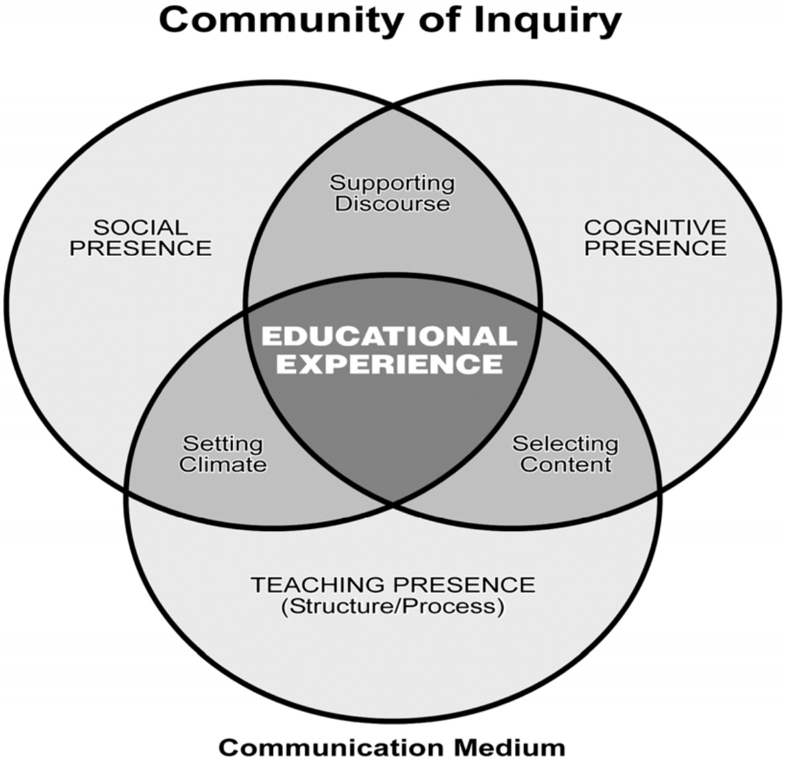
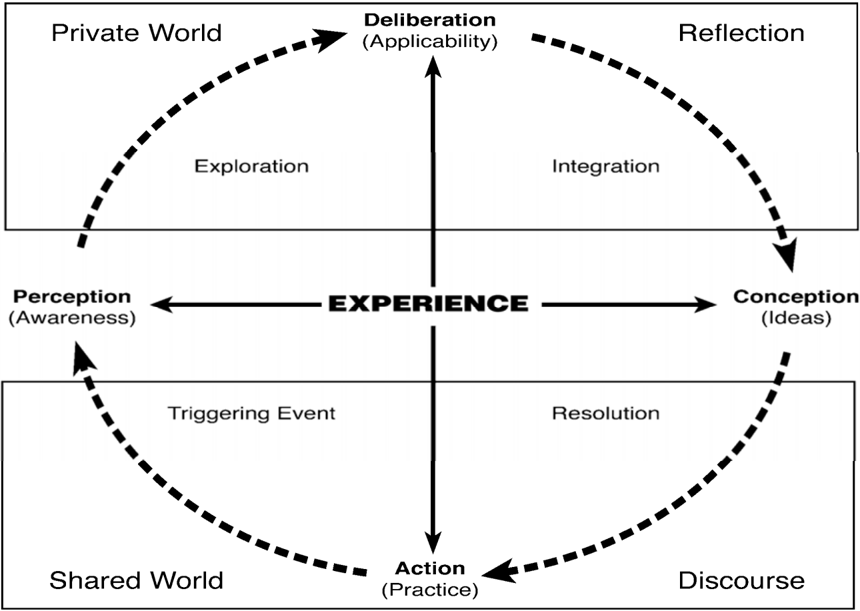
This paper explores four issues that have emerged from the research on social, cognitive and teaching presence in an online community of inquiry. The early research in the area of online communities of inquiry has raised several issues with regard to the creation and maintenance of social, cognitive and teaching presence that require further research and analysis. The other overarching issue is the methodological validity associated with the community of inquiry framework.The first issue is about shifting social presence from socio-emotional support to a focus on group cohesion (from personal to purposeful relationships). The second issue concerns the progressive development of cognitive presence (inquiry) from exploration to resolution. That is, moving discussion beyond the exploration phase. The third issue has to do with how we conceive of teaching presence (design, facilitation, direct instruction). More specifically, is there an important distinction betweenfacilitation and direct instruction? Finally, the methodological issue concerns qualitative transcript analysis and the validity of the coding protocol.
Overview
The claims and statistics of this paper haven’t been checked yet.
Run the check — free, no account needed. It reads the open-access text and checks the sources it cites.
Integrity signals
Registry
Cites
Statistics
Figures
Verification
Claims the paper makes
The claims and statistics of this paper haven’t been checked yet.
Run the check — free, no account needed. It reads the open-access text and checks the sources it cites.
Claims other papers make about this one
Each is checked against this paper’s own text: does it say what the citing paper says it does?
In the citing paper
“collaborative projects, according to this study, may also help establish and maintain social presence.”
From Mechanizing People and Pedagogy: Establishing Social Presence in the Online Classroom (2015) · cites this paper as Garrison, 2007
Self-check
Percentages, sums and reported differences re-computed from the paper’s own numbers.
The self-check needs the paper’s full text.
Citations
Cites
Critical Inquiry in a Text-Based Environment: Computer Conferencing in Higher Education
Garrison, D. R., Anderson, T., & Archer, W. (1999) · The Internet and Higher Education · doi:10.1016/s1096-7516(00)00016-6 · Cited by 6,619
Self-citation
Research works printed but not linked: 46
- Rovai, A. P. Development of an instrument to measure classroom community. The Internet and Higher Education 5(3): 197–211, 2002. · DOI
- Thompson, T. L. and C. J. MacDonald. Community building, emergent design and expecting the unexpected: Creating a quality eLearning experience. The Internet and Higher Education 8(3): 233–249, 2005. · DOI
- Rovai, A. P. Sense of community, perceived cognitive learning, and persistence in asynchronous learning networks. The Internet and Higher Education 5(4): 319–332, 2002. · DOI
- Shea, P. A study of students’ sense of learning community in online environments. Journal of Asynchronous Learning Networks 10(10): 2006. http://www.sloan-c.org/publications/jaln/v10n1/v10n1_4shea_member.asp. · DOI
- Henri, F. Computer conferencing and content analysis. In: A. R. Kaye (Ed.), Collaborative learning through computer conferencing: The Najaden papers, Berlin: Springer-Verlag, 117–136, 1992. · DOI · Paper page
- Garrison, D. R. and W. Archer. A Community of Inquiry Framework for Online Learning. In: M. Moore (Ed.), Handbook of distance education. New York: Erlbaum, 2003.
- Garrison, D. R., M. Cleveland-Innes, M. Koole and J. Kappelman. Revisting methodological issues in the analysis of transcripts: Negotiated coding and reliability. The Internet and Higher Education 9(1): 1–8, 2006. · DOI
- Garrison, D. R., M. Cleveland-Innes and T. Fung. Student role adjustment in online communities of inquiry: Model and instrument validation. Journal of Asynchronous Learning Networks 8(2): 61–74, 2004. Retrieved August 13, 2005 from http://www.sloan-c.org/publications/jaln/v8n2/pdf/v8n2_garrison.pdf. · DOI
- Arbaugh, J. B. and A. Hwang. Does “teaching presence” exist in online MBA courses? The Internet and Higher Education 9(1): 9–21, 2006. · DOI
- Picciano, A. G. Beyond student perceptions: Issues of interaction, presence, and performance in an online course. Journal of Asynchronous Learning Networks 6(1): 2002. Retrieved January, 6, 2006 from http://www.sloan-c.org/publications/jaln/v6n1/pdf/v6n1_picciano.pdf. · DOI · Paper page
- Swan, K. and L. F. Shih. On the nature and development of social presence in online course discussions. Journal of Asynchronous Learning Networks 9(3): October 2005. http://www.sloanc.org/publications/jaln/v9n3/pdf/v9n3_swan.pdf. · DOI
- Swan, K. Developing social presence in online discussions. In: S. Naidu (Ed.), Learning and teaching with technology: Principles and practices, 147–164. London: Kogan Page, 2003.
- Arbaugh, J. B. Is there an optimal design for on-line MBA courses? Academy of Management Learning & Education 4(2): 135–149, 2005. · DOI
- Vaughan, N. D. Investigating how a blended learning approach can support an inquiry process within a faculty learning community. Doctoral dissertation, University of Calgary, 2004.
- Vaughan, N. and D. R. Garrison. How blended learning can support a faculty development community of inquiry. Journal of Asynchronous Learning Networks 10(4): December 2006. · DOI
- Abrams, Z. Asynchronous CMC, Collaboration and the development of critical thinking in a graduate seminar in applied linguistics. Canadian Journal of Learning Technology 31(2): 23–47, 2005. · DOI
- Dewey, J. How we think (Rev. Ed.). Boston: D.C. Heath, 1933.
- Garrison, D. R. and T. Anderson. E-Learning in the 21st century: A framework for research and practice. London: Routledge/Falmer, 2003. · DOI
- Garrison, D. R., T. Anderson and W. Archer. Critical thinking and computer conferencing: A model and tool to assess cognitive presence. American Journal of Distance Education 15(1): 7–23, 2001. · DOI · Paper page
- Kanuka, H. and T. Anderson. Online social interchange, discord, and knowledge construction. Journal of Distance Education 13(1): 57–75, 1998.
- Luebeck, J. L. and L. R. Bice. Online discussion as a mechanism of conceptual change among mathematics and science teachers. Journal of Distance Education 20(2): 21–39, 2005.
- Meyer, K. A. Face-to-face versus threaded discussions: The role of time and higher-order thinking. Journal of Asynchronous Learning Networks 7(3): 55–65, 2003. · DOI
- Meyer, K. A. Evaluating online discussions: Four different frames of analysis. Journal of Asynchronous Learning Networks 8(2): 101–114, 2004. · DOI
- Murphy, E. Recognizing and promoting collaboration in an online asynchronous discussion. British Journal of Educational Technology 35(4): 421–431, 2004. · DOI
- Newman, D. R., C. Johnson, C. Cochrane and B. Webb. An experiment in group learning technology: Evaluating critical thinking in face-to-face and computer-supported seminars. Interpersonal Computing and Technology 4(1): 57–74, 1996. Retrieved March 30, 2005 from http://www.helsinki.fi/science/optek/1996/n1/newman.txt.
- Vaughan, N. and D. R. Garrison. Creating cognitive presence in a blended faculty development community. Internet and Higher Education 8: 1–12, 2005. · DOI
- Arnold, N. and L. Ducate. Future foreign language teachers’ social and cognitive collaboration in an online environment. Language Learning & Technology 10(1): 42–66, 2006. Retrieved January 14, 2006 from http://llt.msu.edu/vol10num1/pdf/arnoldducate.pdf. · DOI
- Murphy, E. Identifying and measuring ill-structured problem formulation and resolution in online asynchronous discussions. Canadian Journal of Learning and Technology 30(1): 5–20, 2004b. · DOI
- Tuckman, B. W. and M. C. Jensen. Stages of Small-Group Development Revisited. Group and Organization Studies 2: 419–427, 1977. · DOI · Paper page
- Pawan, F., T. M. Paulus, S. Yalcin and C. Chang. Online learning: Patterns of engagement and interaction among in-service teachers. Language Learning & Technology 7(3): 119–140, 2003. · DOI · Paper page
- Garrison, D. R. and M. Cleveland-Innes. Facilitating cognitive presence in online learning: Interaction is not enough. American Journal of Distance Education 19(3): 133–148, 2005. · DOI · Paper page
- Shea, P. J., A. M. Pickett and W. E. Pelz. Enhancing student satisfaction through faculty development: The importance of teaching presence. In: J. Bourne & J. C. Moore (Eds.), Elements of Quality Online Education: Into the Mainstream, Vol. 5, 39–59. Needham, MA: Sloan-C, 2004.
- Varnhagen, S., D. Wilson, E. Krupa, S. Kasprzak and V. Hunting. Comparison of student experiences with different online graduate courses in health promotion. Canadian Journal of Learning and Technology 31(1): 99–117, 2005. · DOI
- Wu, D. and S. R. Hiltz. Predicting learning from asynchronous online discussions. Journal of Asynchronous Learning Networks 8(2): 139–152, 2004. · DOI
- Gilbert, P. K. and N. Dabbagh. How to structure online discussions for meaningful discourse: A case study. British Journal of Educational Technology 36(1): 5–18, 2005. · DOI · Paper page
- Shea, P. J., E. E. Fredericksen, A. M. Picket and W. E. Pelz. A preliminary investigation of “teaching presence” in the SUNY learning network. In: J. Bourne and J. C. Moore (Eds.), Elements of Quality Online Education: Practice and Direction, Vol. 4, 279–312. Needham, MA: Sloan-C, 2003.
- Rourke, L. and T. Anderson. Validity in Quantitative Content Analysis. Educational Technology Research and Development 52(1): 5–18, 2004. · DOI
- Gunawardena, C., C. Lowe and T. Anderson. Analysis of a global online debate and the development of an interaction analysis model for examining social construction of knowledge in computer conferencing. Journal of Educational Computing Research 17(4): 379–431, 1997. · DOI
- Marra, R. M., J. L. Moore and A. K. Klimczak. Educational Technology Research & Development 52(2): 23–40, 2004. · DOI
- Murphy, E. and J. Ciszewska-Carr. Sources of difference in reliability: Identifying sources of difference in reliability in content analysis of online asynchronous discussions. International Review of Research in Open and Distance Learning 6(2): 2005. Retrieved January 17, 2006 from http://www.irrodl.org/index.php/irrodl/article/view/233/408. · DOI
- Fahy, P. J. Addressing some common problems in transcript analysis. International Review of Research in Open and Distance Learning 1(2): 2001. Retrieved June 20, 2005 from http://www.irrodl.org/index.php/irrodl/article/view/321/530. · DOI
- Rourke, L., T. Anderson, D. R. Garrison and W. Archer. Methodological Issues in the Content Analysis of Computer Conference Transcripts. International Journal of Artificial Intelligence in Education 12(1): 8–22, 2001.
- Gunawardena, C. and F. Zittle. Social presence as a predictor of satisfaction within a computer mediated conferencing environment. American Journal of Distance Education 11(3): 8–26, 1997. · DOI · Paper page
- Richardson, J. C. and K. Swan. Examining social presence in online courses in relation to students' perceived learning and satisfaction. Journal of Asynchronous Learning Networks 7(1): 68–88, 2003. · DOI
- Garrison, D. R. and H. Kanuka. Blended Learning: Uncovering its Transformative Potential in Higher Education. The Internet and Higher Education 7(2): 95–105, 2004. · DOI · Paper page
- McPherson, M. and M. B. Munes. The failure of a virtual social space (VSS) designed to create a learning community: Lessons learned. British Journal of Educational Technology 35(3): 305–321, 2004. · DOI
Cited by
Sorted by citations
Arbaugh, J. B., Cleveland-Innes, M., Diaz, S. R., Garrison, D. R., Ice, P., Richardson, J. C., & Swan, K. P. (2008) · The Internet and Higher Education · doi:10.1016/j.iheduc.2008.06.003 · Cited by 1,065
Self-citationMeasuring Student Engagement in the Online Course: The Online Student Engagement Scale (OSE)
Dixson, M. D. (2015) · Online Learning · doi:10.24059/olj.v19i4.561 · Cited by 707
Shea, P., & Bidjerano, T. (2009) · Computers & Education · doi:10.1016/j.compedu.2008.10.007 · Cited by 641
Händel, M., Stephan, M., Gläser-Zikuda, M., Kopp, B., Bedenlier, S., & Ziegler, A. (2022) · Journal of Research on Technology in Education · doi:10.1080/15391523.2020.1846147 · Cited by 292
Online learner engagement: Conceptual definitions, research themes, and supportive practices
Martin, F., & Borup, J. (2022) · Educational Psychologist · doi:10.1080/00461520.2022.2089147 · Cited by 220
Metadata
- Authors
- Garrison, D. R.
- Venue
- Online Learning
- Publisher
- The Online Learning Consortium
- Published
- 2007-03-01
- Volume
- 11
- Issue
- 1
- ISSN
- 2472-5730
- 2472-5749
- Cited by
- 152
- References
- 1
About these checks
Registry, retraction, Cites and statistics results are computed, not judged, with one exception: a printed reference that no index lists is read once by a model before it counts as a citation error. Claims are extracted by a model and kept only when their quote appears verbatim in the text; each cited source is then checked, with a model’s help, for whether it says what the claim relies on. Those verdicts can be wrong — read the claim’s quote and the cited source before relying on one.
Statistics and arithmetic are recomputed, not judged.
Confidence bands are shown only for fields calibrated on our annotated test set. None is calibrated yet, so no band is shown.
What counts as a claim ›How we measure confidence ›How we check this ›
Are you an author, or do you see a problem with this page? Request a review
How to cite
Cite CoChat for the checks on this page, and the paper for its own findings.
- This page
- CoChat. (2026). Citation check: ONLINE COMMUNITY OF INQUIRY REVIEW: SOCIAL, COGNITIVE, AND TEACHING PRESENCE ISSUES. https://app.cochat.ai/papers/10.24059/olj.v11i1.1737
- The paper
- Garrison, D. R. (2007). ONLINE COMMUNITY OF INQUIRY REVIEW: SOCIAL, COGNITIVE, AND TEACHING PRESENCE ISSUES. Online Learning. https://doi.org/10.24059/olj.v11i1.1737
