

Authenticity and Authorship Beyond the Algorithm: Action, Institution, and Epistemic Responsibility under Generative AI
Open accessThe DOI matches its Crossref record; 23 of the 33 references it cites were found in a registry or an index, and 7 are not checked yet; 5 of the 31 sources its claims cite were checked for support.
Abstract
This paper examines whether generative artificial intelligence can be considered an authentic author. While large language models (LLMs) demonstrate advanced linguistic competence and produce coherent academic discourse, they foreground unresolved questions concerning the ontology of authorship and the status of authenticity in scholarly authorship. The article is concerned with authorship rather than writing as such; writing is treated as the practical and institutional site through which authorship becomes visible, contested, and assigned. Rather than treating authorship as a property of textual output, the paper conceptualises it as an activity across three intersecting perspectives: praxis, institutional recognition, and epistemic responsibility. Extending Hannah Arendt’s The Human Condition, authorship is theorised in terms of linguistic labour, linguistic work, and linguistic action, with authenticity located in linguistic action as public, accountable, position -taking engagement. A Foucauldian perspective reframes authorship as an institutional function governed by discursive norms, while the epistemic perspective examines whether LLMs satisfy conditions such as semantic understanding, grounding, and epistemic commitment. The paper argues that AI can perform linguistic labour, support linguistic work, and approximate institutional markers of authorship, but cannot initiate linguistic action or assume epistemic responsibility.
Verified 2026-11-19 · 7 references not checked yet
Overview
CoChat Summary
TL;DR
The paper argues that generative AI can perform linguistic labour and support linguistic work, and can approximate institutional markers of authorship, but cannot initiate Arendtian linguistic action or assume epistemic responsibility, so it cannot be an authentic author in the strong sense. It develops a three-perspective framework—praxis, institutional, and epistemic—and a typology distinguishing authentic, performative, marginal, and simulated authorship.
Key findings
- AI can perform linguistic labour strongly and support linguistic work partially, but linguistic action is absent; authentic authorship resides in public, accountable position-taking, not fluent textual output.
- Institutionally, AI can reproduce genre and procedural compliance and approximate authorial markers, but attribution and accountability are absent or derivative; authenticity is recognised and authorised through procedures, not merely expressed from inner sincerity.
- Epistemically, current LLMs show plausibility and coherence strongly, but grounding and epistemic commitment are weak or absent; they lack semantic understanding, stable agency, communicative intentions, and truth orientation. The paper notes that GPT-4 was judged human 54% of the time in an interactive two-player Turing Test (Jones & Bergen, 2024), but treats behavioural indistinguishability as insufficient for authorship.
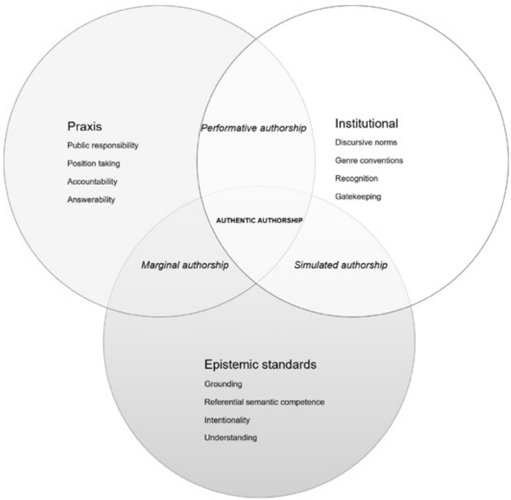
- The schematic yields a typology: performative authorship (praxis + institutional, epistemically weak), marginal authorship (praxis + epistemic, institutionally unrecognised), and simulated authorship (institutional + epistemic, lacking praxis/ownership); AI-mediated authorship most closely aligns with simulated authorship.
Methods
- Conceptual and theoretical paper with no empirical data collection; it integrates Hannah Arendt’s labour/work/action distinction, Michel Foucault’s author-function, and epistemic debates on LLM understanding, grounding, agency, and subjective experience.
- Develops a schematic framework and Table 1 disaggregating AI capabilities across praxis, institutional, and epistemic dimensions, using illustrative examples and literature synthesis rather than experimental or statistical analysis.
- The analysis is normative and analytical, aimed at making the question of AI authorship analytically tractable rather than resolving it empirically.
Limitations
- Stated: the paper is primarily conceptual and does not offer a comprehensive sociocultural account of authorship and authenticity; it treats the question as dynamic rather than finally resolvable at a single technological moment, and calls for future research on concrete scholarly settings, institutional AI policies, and drafting/review/revision processes.
- Stated: it does not offer a general theory of academic writing or a comprehensive intervention into writing studies, and it does not settle the philosophy of language or cognition.
- Evident: the framework is normative and not empirically validated; its claims concern current LLMs and may not apply to future systems, and it relies on selected philosophical literature and current capability assessments.
Model-written summary. Check it against the paper before relying on it.
Integrity signals
Registry
Cites
Statistics
Figures
Verification
Claims the paper makes
5 Valid · 4 Not valid · 23 Not checked · 90 Own results and interpretations
The cited sources support only part of this claim — read each source’s verdict below.
In the paper
“An authentic author probably has some degree of agential stability over time, which the current generation of LLMs lacks (Hicks et al., 2024).”
What the sources say
- Partly supportedcites Hicks et al., 2024 sourceExperimental — accuracy not yet measured
In “ChatGPT may be a hard bullshitter” (page not available), the authors say ChatGPT is not an agent or intentional in precisely the way humans are. That supports a difference in agency, but the paper does not establish that authentic authors have agential stability over time or that current LLMs specifically lack that stability. (LLM, conf=0.78)
hedgedstates an association- Asserted: passes — The authors put it forward as true.
- Checkable: passes — It can be checked against evidence.
- Load-bearing: passes — The paper’s conclusions depend on it.
- Based: passes — The paper gives a reason why it holds.
- Rests on an assumption not shown here.
- Partly supported
The sources with a verdict support this claim; the rest weren’t checked yet, have no full text we could read, or their verdicts aren’t rated yet.
In the paper
“In this respect, their outputs may be characterised as”
What the sources say
- Not checked — no full text of the sourcecites Frankfurt, 2005 source
- Supportedcites Hicks et al., 2024 source
The Introduction explicitly argues that outputs of LLMs like ChatGPT are, at minimum, “soft bullshit,” defined as text produced without concern for its truth. This directly supports the citing document’s hedged characterization. (LLM, conf=0.94)
hedged- Asserted: passes — The authors put it forward as true.
- Checkable: passes — It can be checked against evidence.
- Load-bearing: passes — The paper’s conclusions depend on it.
- Based: passes — The paper gives a reason why it holds.
- Rests on an assumption not shown here.
A conclusion the paper draws from its own results — it cites no other source for it, so there is none to check. The quote shows it is in the paper.
In the paper
“cannot initiate linguistic action or assume epistemic responsibility”
- Also stated in: § Authorship as an institutional function · hedged
“AI is limited in terms of epistemic responsibility when it comes to the accountability of the author regarding claims, errors, and positioning.”
plain- Asserted: passes — The authors put it forward as true.
- Checkable: unclear — It is unclear whether it could be checked against evidence.
- Load-bearing: passes — The paper’s conclusions depend on it.
- Based: passes — The paper gives a reason why it holds.
- Also stated in: § Authorship as an institutional function · hedged
A conclusion the paper draws from its own results — it cites no other source for it, so there is none to check. The quote shows it is in the paper.
In the paper
“support linguistic work”
- Also stated in: § Authorship as praxis: linguistic labour, work, and action · plain
“AI also assists here”
- Also stated in: § Authorship as praxis: linguistic labour, work, and action · plain
“assist greatly, or even fully, in linguistic work”
plainstates a cause- Asserted: passes — The authors put it forward as true.
- Checkable: passes — It can be checked against evidence.
- Load-bearing: passes — The paper’s conclusions depend on it.
- Based: passes — The paper gives a reason why it holds.
- Also stated in: § Authorship as praxis: linguistic labour, work, and action · plain
A conclusion the paper draws from its own results — it cites no other source for it, so there is none to check. The quote shows it is in the paper.
In the paper
“current LLM behaviour does not amount to the kind of understanding humans exhibit.”
plain- Asserted: passes — The authors put it forward as true.
- Checkable: unclear — It is unclear whether it could be checked against evidence.
- Load-bearing: passes — The paper’s conclusions depend on it.
- Based: passes — The paper gives a reason why it holds.
31 more claims
Create a free account to see all 122 claims and to verify the 2 references still open.
- It may state two separate claims as one. 36
- Probably not a substantial claim. 63
Self-check
Percentages, sums and reported differences re-computed from the paper’s own numbers.
Each contradiction between two passages listed here was confirmed by an independent check.
Rated minor: it would not touch a result — a value no result rests on, a p-value that stays on the same side of the significance level, or a conflict that is clerical, resolved elsewhere in the paper, or outside its own findings.
In the paper
§ Authenticity and Authorship Beyond the Algorithm: Action, Institution…
“We label this as marginal authorship, an instance of unrecognised authenticity.”
§ Authenticity and Authorship Beyond the Algorithm: Action, Institution…
“This is why authentic authorship requires the intersection of praxis, institutional recognition, and epistemic responsibility.”
Citations
Cites
I.—COMPUTING MACHINERY AND INTELLIGENCE
TURING, A. M. (1950) · Mind · doi:10.1093/mind/lix.236.433 · Cited by 10,290
Nagel, T. (1974) · The Philosophical Review · doi:10.2307/2183914 · Cited by 7,440
On the Dangers of Stochastic Parrots: Can Language Models Be Too Big? 🦜
Bender, E. M., Gebru, T., McMillan-Major, A., & Shmitchell, S. (2021) · Proceedings of the 2021 ACM Conference on Fairness, Accountability, and Transparency · doi:10.1145/3442188.3445922 · Cited by 6,988
Searle, J. R. (1980) · Behavioral and Brain Sciences · doi:10.1017/s0140525x00005756 · Cited by 6,954
Facing up to the problem of consciousness
Chalmers, D. J. (1996) · Toward a Science of Consciousness · doi:10.7551/mitpress/6860.003.0003 · Cited by 1,966
Frankfurt, H. G. (2005) · doi:10.1515/9781400826537 · Cited by 1,175
Cronin, B. (2001) · Journal of the American Society for Information Science and Technology · doi:10.1002/asi.1097 · Cited by 500
Hicks, M. T., Humphries, J., & Slater, J. (2024) · Ethics and Information Technology · doi:10.1007/s10676-024-09775-5 · Cited by 456
Guignon, C. (2004) · doi:10.4324/9780203646793 · Cited by 382
The Turing Test: the first 50 years
French, R. M. (2000) · Trends in Cognitive Sciences · doi:10.1016/s1364-6613(00)01453-4 · Cited by 250
Metadata
- Authors
- Kunwar, J. B.
- Affiliations
- Åbo Akademi University (FI)
- Corresponding author
- Kunwar, Jagat Bahadur
- Venue
- Discourses on Culture
- Publisher
- Walter de Gruyter GmbH
- Published
- 2026-06-01
- Volume
- 25
- Issue
- 1
- Pages
- 135-164
- ISSN
- 2450-0402 (ISSN-L)
- OpenAlex
- W7165539134
- Cited by
- 0
- References
- 29
- FWCI
- 0.00
- Type
- journal article
- Language
- en
- Open access
- diamond
- doi.org
- Licence
- Locations
- Discourses on Culture (publishedVersion, cc-by-nc-nd)
- Åbo Akademi University Research Portal (submittedVersion, cc-by-nc-nd)
- Topics
- Social Sciences › Law › Literary and Philosophical Studies
- Social Sciences › Arts and Humanities › History and Philosophy of Science › Cybernetics and Technology in Society
- Physical Sciences › Computer Science › Artificial Intelligence › Ethics and Social Impacts of AI
- Keywords
- generative AI, authorship, authenticity, large language models, epistemic responsibility, Hannah Arendt, The Human Condition, linguistic action, linguistic work, institutional recognition, Michel Foucault, discursive norms, scholarly authorship, position-taking, epistemic commitment
About these checks
Registry, retraction, Cites and statistics results are computed, not judged, with one exception: a printed reference that no index lists is read once by a model before it counts as a citation error. Claims are extracted by a model and kept only when their quote appears verbatim in the text; each cited source is then checked, with a model’s help, for whether it says what the claim relies on. Those verdicts can be wrong — read the claim’s quote and the cited source before relying on one.
The claim verdicts this report counts are experimental: their accuracy is not yet measured.
A language model drew the claims from the paper on 2026-10-12, under version 3 of the claim definition (model deepseek-v4.1-flash, prompt extract-v3).
A second model labelled each claim on 2026-10-12 (model jev-1.13-20260917, definition revision gold-guideline-v0.2).
Cited sources are checked with a language model’s help (gpt-6-sol).
Statistics and arithmetic are recomputed, not judged.
Confidence bands are shown only for fields calibrated on our annotated test set. None is calibrated yet, so no band is shown.
What counts as a claim ›How we measure confidence ›How we check this ›
Are you an author, or do you see a problem with this page? Request a review
How to cite
Cite CoChat for the checks on this page, and the paper for its own findings.
- This page
- CoChat. (2026). Citation check: Authenticity and Authorship Beyond the Algorithm: Action, Institution, and Epistemic Responsibility under Generative AI. https://app.cochat.ai/papers/10.2478/doc-2026-0006
- The paper
- Kunwar, J. B. (2026). Authenticity and Authorship Beyond the Algorithm: Action, Institution, and Epistemic Responsibility under Generative AI. Discourses on Culture. https://doi.org/10.2478/doc-2026-0006
Data sources
Bibliographic data: Semantic Scholar, OpenAlex, Crossref.
Contains information from the Semantic Scholar Academic Graph Datasets, made available under the ODC Attribution License (ODC-BY 1.0).
Semantic Scholar’s data is described in: Kinney, R., et al. (2023). The Semantic Scholar Open Data Platform. arXiv:2301.10140.
