

Probiotic Properties of Enterococcus faecium EF9296 Strain Isolated from Silage
Open accessThe DOI matches its Crossref record; 27 of the 29 references it cites were found in a registry or an index.
Abstract
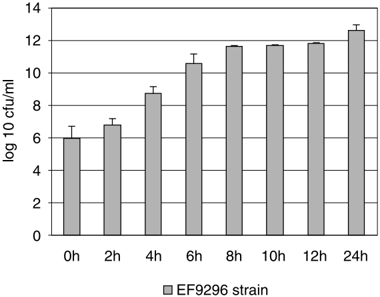
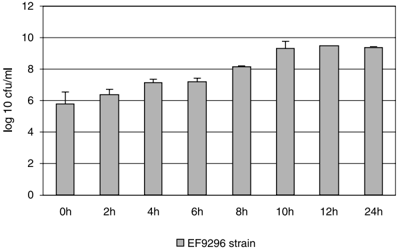
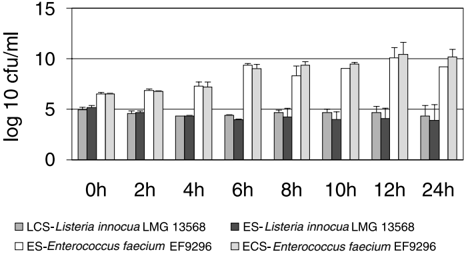
Ensilage means preserving forage fed by livestock when fresh material is less available.When the silo is opened, the silage is exposed to air and this leads to aerobic deterioration whereby aerobic microorganisms degrade lactic acid.Therefore, it is necessary to use some additives to control microbes in silage fermentation.The strain EF9296, isolate from silage was allotted to the species Enterococcus faecium by genotyping.This strain is sensitive to ampicillin (10 µg), erythromycin (15 µg), tetracycline, rifampicin, vancomycin (30 µg) and it is kanamycin-resistant (30 µg).EF9296 strain possess good adhesive capability to human as well as to canine mucus (human 5.5 log 10 cfu/ml, canine 4.7 log 10 cfu/ml).In addition, EF9296 is bile tolerant, lactic acid producing (0.997 ± 0.29 mmol/l) with ureolytic activity (16.9 ± 1.2 nkat/ml).The strain EF9296 produces a bacteriocin-like substance with the inhibitory activity against Gram-positive bacteria including enterococci and L. monocytogenes with activity from 100 to 800 AU/ml.Amplified fragment of bacteriocin produced by 9296 strain corresponds with PCR signal for a structural gene of well-known enterocin A. Ent.faecium 9296 strain reached the stationary phase at 8 h in Trypticase-soy broth (11.57± 0.07 log 10 cfu/ml) and at 10 h in rumen fluid (9.25 ± 0.48 log 10 cfu/ml).It means, EF9296 strain grew in both media, although its growth in rumen fluid was slower in comparison with counts in TSY broth.In addition, the antilisterial effect of Enterococcus faecium EF9296 in rumen fluid was detected in experimental sample after 6 h from EF9296 strain application in comparison to the Listeria control sample (0.4 log).This effect was prolonged up to the end of the experiment (8 h -0.44 log, 10 h -0.65 log, 12 h -0.62 log).Enterococcus faecium EF9296 strain might be used as potential probiotic to protect silage against microbial contaminants e.g.Listeria spp. Bacteria, silage, Listeria, Enterococci
Overview
The claims and statistics of this paper haven’t been checked yet.
Free: it reads the open-access text and checks the first 5 claims that cite a source we can check. Create a free account to check every claim.
Integrity signals
Registry
Cites
Statistics
Figures
Verification
Claims the paper makes
The claims and statistics of this paper haven’t been checked yet.
Free: it reads the open-access text and checks the first 5 claims that cite a source we can check. Create a free account to check every claim.
Self-check
Percentages, sums and reported differences re-computed from the paper’s own numbers.
The self-check needs the paper’s full text.
Citations
Cites
McDonald, P. (1981) · Medical Entomology and Zoology · Cited by 1,473
Enterococci at the crossroads of food safety?
Franz, C. M. A. P., Holzapfel, W. H., & Stiles, M. E. (1999) · International Journal of Food Microbiology · doi:10.1016/s0168-1605(99)00007-0 · Cited by 735 · cited 1×
“Enterococci are intrinsically resistant against kanamycin (Franz et al. 1999).”
Aymerich, T., Holo, H., Håvarstein, L. S., Hugas, M., Garriga, M., & Nes, I. F. (1996) · Applied and Environmental Microbiology · doi:10.1128/aem.62.5.1676-1682.1996 · Cited by 439
The detrimental effects of air on silage
Woolford, M. K. (1990) · Journal of Applied Bacteriology · doi:10.1111/j.1365-2672.1990.tb02554.x · Cited by 392 · cited 1×
“Aerobic deterioration generates considerable heat, increases pH, and decreases digestibility (Woolford 1990).”
BackgroundA modification of the Barker-Summerson method for the determination of lactic acid
Pryce, J. D. (1969) · The Analyst · doi:10.1039/an9699401151 · Cited by 356 · cited 1×
“…strain was expressed in colony forming units per milliliter (cfu/ml) ± SD. Production of lactic acid was measured by precipitate method according to Pryce (1969) and expressed in mmol/l after four replicates ± SD. Urease activity was measured by the spectrophotometric method according to Cook…”
MethodSelection of strains for probiotic use
Havenaar, R., Brink, B. T., & Huis In ’t Veld, J. H. J. (1992) · Probiotics · doi:10.1007/978-94-011-2364-8_9 · Cited by 340 · cited 1×
“Tolerance to bile salts is considered to be a prerequisite for colonization and metabolic activity of bacteria in the small intestine of the host (Havenaar et al. 1992).”
BackgroundThe ability of probiotic bacteria to bind to human intestinal mucus
Kirjavainen, P. (1998) · FEMS Microbiology Letters · doi:10.1016/s0378-1097(98)00387-5 · Cited by 285
Zhao, T., Doyle, M. P., Harmon, B. G., Brown, C. A., Mueller, P. O. E., & Parks, A. H. (1998) · Journal of Clinical Microbiology · doi:10.1128/jcm.36.3.641-647.1998 · Cited by 269 · cited 1×
“Probiotic LAB are also fed by livestock to improve intestinal microbial balance, including elimination or reduction of undesirable microorganisms (Zhao et al. 1998).”
BackgroundGrowth Limits of Listeria monocytogenes as a Function of Temperature, pH, NaCl, and Lactic Acid
Tienungoon, S., Ratkowsky, D. A., McMeekin, T. A., & Ross, T. (2000) · Applied and Environmental Microbiology · doi:10.1128/aem.66.11.4979-4987.2000 · Cited by 262 · cited 1×
“Because Listeria can grow at low temperatures (Tienungoon et al. 2000), hay crop silage stored in large plastic bags has frequently been contaminated (Wilkinson 1999).”
BackgroundGenomic fingerprints produced by PCR with consensus tRNA gene primers
Welsh, J., & McClelland, M. (1991) · Nucleic Acids Research · doi:10.1093/nar/19.4.861 · Cited by 216 · cited 1×
“Supernatant was used as template for tDNA-intergenic PCR (tRNAintergenic length polymorphism analysis, Baele et al. 2000) followed by capillary electrophoresis (Welsh and McClelland 1991).”
Method
Cited by
Silage review: Recent advances and future uses of silage additives
Muck, R. E., Nadeau, E. M. G., McAllister, T. A., Contreras-Govea, F. E., Santos, M. C., & Kung, L. (2018) · Journal of Dairy Science · doi:10.3168/jds.2017-13839 · Cited by 1,038
Use of ‘natural’ products as alternatives to antibiotic feed additives in ruminant production
Jouany, J.-P., & Morgavi, D. P. (2007) · Animal · doi:10.1017/s1751731107000742 · Cited by 324
“Production of bacteriocin-like substances by some bacteria such as Enterococcus faecium has been tested as a way to control the growth of pathogens in the rumen (Marcinakova et al., 2004).”
BackgroundRecent Advances in Screening of Anti-Campylobacter Activity in Probiotics for Use in Poultry
Saint-Cyr, M. J., Guyard‐Nicodème, M., Messaoudi, S., Chemaly, M., Cappelier, J.-M., Dousset, X., & Haddad, N. (2016) · Frontiers in Microbiology · doi:10.3389/fmicb.2016.00553 · Cited by 94
“…strains Production cost Diversity of Campylobacter strains Bacteriocin treatment Use of bacteria-produced antimicrobial compounds against Campylobacter Easy to use Production cost Variable sensitivity of Campylobacter strains Prebiotics Incorporation of feed additives to improve…”
BackgroundSelection of tropical lactic acid bacteria for enhancing the quality of maize silage
Santos, A. O., Ávila, C. L. S., & Schwan, R. F. (2013) · Journal of Dairy Science · doi:10.3168/jds.2013-6782 · Cited by 72
“Nevertheless, studies in the selection of inoculants aimed at inhibiting the growth of these deteriorating and pathogenic microorganisms are still scarce (Saarisalo et al., 2007; Marci áková et al., 2008).”
BackgroundImpact of Probiotics on Dairy Production Efficiency
Nalla, K., Manda, N. K., Dhillon, H. S., Kanade, S. R., Rokana, N., Hess, M., & Puniya, A. K. (2022) · Frontiers in Microbiology · doi:10.3389/fmicb.2022.805963 · Cited by 96
“Earlier studies in this line have shown that live yeast can help to stabilize rumen pH and reduce susceptibility to acidosis in dairy animals (Chaucheyras-Durand et al., 2008; Marden et al., 2008; Maamouri and Ben Salem, 2021).”
BackgroundJalč, D., Lauková, A., Simonová, M. P., Váradyová, Z., & Homolka, P. (2009) · Czech Journal of Animal Science · doi:10.17221/1665-cjas · Cited by 48
“Marciňáková M., Lauková A., Simonová M., Strompfová V., Koréneková B., Naď P. (2008): Probiotic properties of Enterococcus faecium EF9296 strain isolated from silage.”
BackgroundInfluentialSelf-citationMarciňáková, M., Klingberg, T. D., Lauková, A., & Budde, B. B. (2009) · Anaerobe · doi:10.1016/j.anaerobe.2009.05.001 · Cited by 46
Self-citationBacteriocin Activity of Enterococci from Rabbits
Simonová, M. P., & Lauková, A. (2007) · Veterinary Research Communications · doi:10.1007/s11259-006-3411-4 · Cited by 38
Self-citationJalč, D., Lauková, A., Váradyová, Z., Homolka, P., & Koukolová, V. (2009) · Animal Feed Science and Technology · doi:10.1016/j.anifeedsci.2008.11.004 · Cited by 34
Self-citationAcosta Aragón, Y., Jatkauskas, J., & Vrotniakiene, V. (2012) · ISRN Veterinary Science · doi:10.5402/2012/345927 · Cited by 31
“Microbial inoculants containing homofermentative lactic acid bacteria (LAB), in most of the cases Lactobacillus plantarum, are often added to silage because they very quickly produce large quantities of lactic acid, which lowers the pH of the silage [7, 8].”
BackgroundMarciňáková, M., Lauková, A., Simonová, M. P., Strompfová, V., Koréneková, B., & Naď, P. (2008) · Czech Journal of Animal Science · doi:10.17221/348-cjas · Cited by 38
“Enterococcus faecium EF9296 represents a new probiotic and bacteriocin-producing strain, isolated from silage, the properties of which were reported in our previous study (Marciňáková et al., 2004).”
BackgroundSelf-citationHaridas, D. V., & Pillai, D. (2020) · Brazilian Journal of Microbiology · doi:10.1007/s42770-020-00230-3 · Cited by 33
Potential factors that may limit the effectiveness of silage additives
Kung, L. (2009) · Cited by 27
Silage pathogens and biological control agents: effects, action mechanisms, challenges and prospects
Jiang, H., Okoye, C. O., Wu, Y., Gao, L., Li, X., Wang, Y., & Jiang, J. (2024) · BioControl · doi:10.1007/s10526-023-10236-z · Cited by 20
Hu, Z., Ma, D., Niu, H., Chang, J., Yu, J., Tong, Q., & Li, S. (2021) · AMB Express · doi:10.1186/s13568-020-01158-5 · Cited by 19
An investigation of pulmonary findings of Crimean–Congo haemorrhagic fever patients
Bilgin, G., Hatipoğlu, Ç. A., ALTUN, Ş., Bulut, C., KINIKLI, S., & Demiröz, A. P. (2013) · TURKISH JOURNAL OF MEDICAL SCIENCES · doi:10.3906/sag-1208-95 · Cited by 15
“Because both of our inoculants produce bacteriocins, although counts of the Listeria-like bacteria of inoculated GS decreased only numerically, the decrease can be explained by the antimicrobial activity of their enterocins (Marciňáková et al. 2004; Lauková et al. 2008; Marciňáková et al. 2008).”
BackgroundFermentasi Silase dan Manfaat Probiotik Silase bagi Ruminansia
Widyastuti, Y. (2008) · Media Peternakan · Cited by 28
Enterococcus isolated from poultry intestine for potential probiotic use
Carvajal, E. L., Contreras, S., Díaz, W. F., Martínez-Bello, D., McCown, M., Ardila-Gómez, Y. A., & Vásquez, M. C. (2023) · Veterinary World · doi:10.14202/vetworld.2023.1605-1614 · Cited by 9
“Enterococcus faecium has shown probiotic activity in isolations from silage [32], and it has been evaluated in piglets for managing weaning diarrhea [33], and the immunomodulating activity in the nematode model [34].”
BackgroundThe Use of Probiotic Strains as Silage Inoculants
Acosta, Y. (2012) · Probiotic in Animals · doi:10.5772/50431 · Cited by 7
EFFECT OF INOCULANTS ON FERMENTATION PARAMETERS AND CHEMICAL COMPOSITION OF GRASS AND CORN SILAGES
Jalč, D., Lauková, A., & Kišidayová, S. (2010) · Slovak Journal of Animal Science · Cited by 11
Self-citationPotential Applications of Probiotic, Bacteriocin-Producing Enterococci and Their Bacteriocins
Lauková, A. (2011) · CRC Press eBooks · doi:10.1201/b11503-4 · Cited by 9
Self-citationNurcahyo, H., Suyanta, Dale, A., & Furqon, F. Y. A. (2019) · Journal of Physics Conference Series · doi:10.1088/1742-6596/1397/1/012043 · Cited by 6
Occurrence of structural enterocin genes among silage enterococci
Marciňáková, M., Simonová, M. P., Strompfová, V., & Lauková, A. (2005) · Cited by 11
Self-citationLauková, A., Švec, P., Strompfová, V., Štětina, V., & Sedláček, I. (2007) · Folia Microbiologica · doi:10.1007/bf02931309 · Cited by 5
Self-citationPotential Applications of Probiotic, Bacteriocin-Producing Enterococci and eir Bacteriocins
Lauková, A. (2011) · CRC Press eBooks · doi:10.1201/b11503-7 · Cited by 5
Self-citationJan, S., Baron, F., Coat, R., & Gonçalves, O. (2018) · Elsevier eBooks · doi:10.1016/b978-1-78548-271-7.50002-x · Cited by 5
Les entérocoques : avantages et inconvénients en biotechnologie (synthèse bibliographique)
Aguilar‐Galvez, A., Dubois-Dauphin, R., Destain, J., Campos, D., & Thonart, P. (2012) · ORBi (University of Liège) · Cited by 16
Váradyová, Z., Jalč, D., Lauková, A., Mihaliková, K., & Homolka, P. (2013) · TURKISH JOURNAL OF AGRICULTURE AND FORESTRY · doi:10.3906/tar-1206-47 · Cited by 3
Self-citationLauková, A., Simonová, M. P., Kubašová, I., Miltko, R., Bełżecki, G., & Strompfová, V. (2018) · Polish Journal of Veterinary Sciences · doi:10.24425/124288 · Cited by 2
“faecium from silage – Ent 9296 (Marciňáková et al. 2004) and Ent 2019 produced”
BackgroundMethodInfluentialSelf-citationŠčerbová, J., Kandričáková, A., Hamarová, Ľ., & Lauková, A. (2019) · Poultry Science · doi:10.3382/ps/pez371 · Cited by 2
“2012; Mareková et al., 2003, 2007; Strompfová and Lauková, 2007; Marciňáková et al., 2008), to explain why 10 strains were susceptible to some Ents and to another ones not could be probably because of phenomenon of immunity in class II bacteriocins (in which used Ents belong).”
BackgroundSelf-citationHarahap, A. E. (2009) · Cited by 8
(2021) · Middle East Journal of Applied Sciences · doi:10.36632/mejas/2021.11.1.25
Szűcs, J. P., Süli, Á., Süli-Zakar, T., Berecz, E., & Pék, M. (2018) · Review on Agriculture and Rural Development · doi:10.14232/rard.2017.1-2.50-56
Szucs, J. P., Süli, Á., Zakar, T. S., Berecz, E., & Pék, M. (2019) · Review on Agriculture and Rural Development · doi:10.14232/rard.2018.1-2.127-132
Probiotics in dairy farming: A holistic approach to animal nutrition
Shukla, N., Tripathi, A., Tiwari, A., & Sharma, K. (2024) · International Journal of Advanced Biochemistry Research · doi:10.33545/26174693.2024.v8.i5sf.1206 · Cited by 3
Hu, Z., Ma, D., Niu, H., Chang, J., Yu, J., Tong, Q., & Li, S. (2021) · Figshare · doi:10.6084/m9.figshare.13534949
Hu, Z., Ma, D., Niu, H., Chang, J., Yu, J., Tong, Q., & Li, S. (2021) · Figshare · doi:10.6084/m9.figshare.13534934
Hu, Z., Ma, D., Niu, H., Chang, J., Yu, J., Tong, Q., & Li, S. (2021) · Figshare · doi:10.6084/m9.figshare.13534943
Hu, Z., Ma, D., Niu, H., Chang, J., Yu, J., Tong, Q., & Li, S. (2021) · Figshare · doi:10.6084/m9.figshare.13534940
Hu, Z., Ma, D., Niu, H., Chang, J., Yu, J., Tong, Q., & Li, S. (2021) · Figshare · doi:10.6084/m9.figshare.13534937
Metadata
- Authors
- Marciňáková, M., Simonová, M., & Lauková, A.
- Affiliations
- Slovak Academy of Sciences (SK)
- Venue
- Acta Veterinaria Brno
- Published
- 2004
- Volume
- 73
- Issue
- 4
- Pages
- 513-519
- ISSN
- 0001-7213 (ISSN-L)
- 1801-7576
- OpenAlex
- W2089299652
- Cited by
- 40
- References
- 29
- Citations by year
- 2024: 2 · 2023: 1 · 2022: 1 · 2021: 7 · 2020: 1 · 2019: 3 · 2018: 4 · 2016: 1 · 2013: 3 · 2012: 3
- FWCI
- 2.09
- Type
- journal article
- Language
- en
- Open access
- hybrid
- doi.org
- Licence
- cc-by
- creativecommons.org/licenses/by/4.0/ (vor)
- creativecommons.org/licenses/by/4.0/ (tdm)
- Locations
- Acta Veterinaria Brno (publishedVersion, cc-by)
- Funders
- Vedecká Grantová Agentúra MŠVVaŠ SR a SAV
- Topics
- Life Sciences › Agricultural and Biological Sciences › Food Science › Probiotics and Fermented Foods
- Life Sciences › Agricultural and Biological Sciences › Animal Science and Zoology › Animal Nutrition and Physiology
- Life Sciences › Agricultural and Biological Sciences › Animal Science and Zoology › Ruminant Nutrition and Digestive Physiology
- Keywords
- silage, probiotics, enterocin A, bacteriocins, antimicrobial activity, Listeria monocytogenes, rumen fluid, silage fermentation, antimicrobial resistance, bile tolerance, mucus adhesion, lactic acid production, ureolytic activity, silage additives
About these checks
Registry, retraction, Cites and statistics results are computed, not judged, with one exception: a printed reference that no index lists is read once by a model before it counts as a citation error. Claims are extracted by a model and kept only when their quote appears verbatim in the text; each cited source is then checked, with a model’s help, for whether it says what the claim relies on. Those verdicts can be wrong — read the claim’s quote and the cited source before relying on one.
Statistics and arithmetic are recomputed, not judged.
Confidence bands are shown only for fields calibrated on our annotated test set. None is calibrated yet, so no band is shown.
What counts as a claim ›How we measure confidence ›How we check this ›
Are you an author, or do you see a problem with this page? Request a review
Data sources
Bibliographic data: Semantic Scholar, OpenAlex, Crossref.
Contains information from the Semantic Scholar Academic Graph Datasets, made available under the ODC Attribution License (ODC-BY 1.0).
Semantic Scholar’s data is described in: Kinney, R., et al. (2023). The Semantic Scholar Open Data Platform. arXiv:2301.10140.
