

The DOI matches its Crossref record; 7 of the 7 references it cites were found in a registry or an index.
Effects of Narrative Exposure Therapy for Treating Depressive and Anxious Disorders: A Systematic Review and Meta-Analysis
Abstract
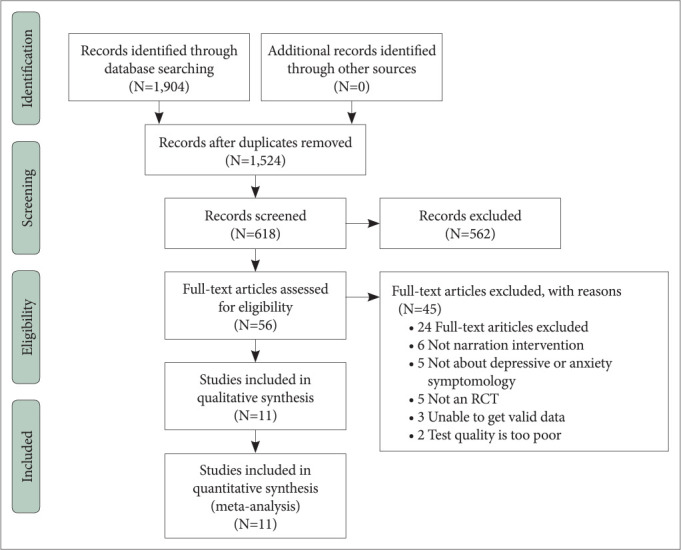
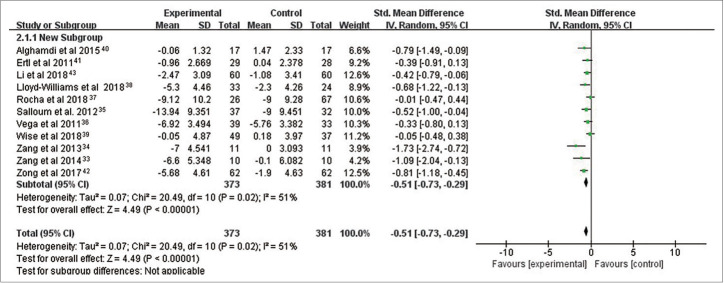
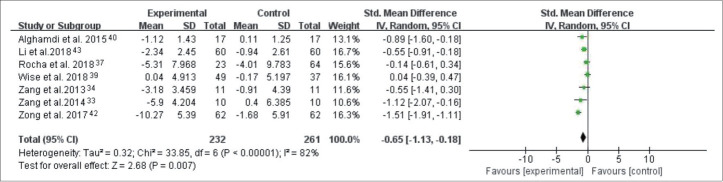
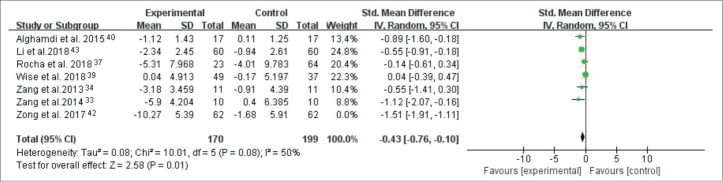
Objective Narrative exposure therapy (NET) has been used in various contexts for the treatment of the effects of trauma, with promising results in clinical trials. However, its effects on anxiety and depression are still unclear. The present study is a systematic review and meta-analysis of the effects of NET on depression and anxiety.Methods The Embase, Cumulative Index of Nursing and Allied Health Literature, PubMed, Web of Science core collection, Cochrane Library, Chinese National Knowledge Infrastructure, Chinese Biomedical Database, and Wangfang databases were searched from the earliest records to March 2023. Two researchers independently screened the literature, extracted data, evaluated the risk of bias, and cross-checked the data. Meta-analysis was performed using the program RevMan 5.3.Results Eleven randomized controlled trials with a total of 754 participants were included in the study. The results showed that NET reduced both the depression (standard mean difference [SMD]=-0.51, 95% confidence interval [CI] -0.73–-0.29, p<0.00001) and anxiety (SMD=-0.65, 95% CI -1.13–-0.18, p=0.007) scores of the patients. Furthermore, NET was found to alleviate negative emotions associated with guilt (mean difference [MD]=-3.60, 95% CI -5.52–-1.68, p=0.0005) and negative change (MD=-5.80, 95% CI -9.76–-1.83, p=0.004).Conclusion This analysis showed that NET can alleviate depression and anxiety. It may thus be used in clinical settings to alleviate patients’ negative feelings and aid their overall recovery.
Overview
The claims and statistics of this paper haven’t been checked yet.
Run the check — free, no account needed. It reads the open-access text and checks the sources it cites.
Integrity signals
Registry
Cites
Statistics
Figures
Verification
Claims the paper makes
The claims and statistics of this paper haven’t been checked yet.
Run the check — free, no account needed. It reads the open-access text and checks the sources it cites.
Claims other papers make about this one
Each is checked against this paper’s own text: does it say what the citing paper says it does?
In the citing paper
“Compared to traditional treatments, narrative therapy tends to be more effective because it helps individuals rebuild meaning and self-identity by incorporating complex emotional experiences, such as trauma or chronic illnesses, into a coherent life story, which helps reduce depression and anxiety symptoms (Geng et al., 2024).”
From Effectiveness Of Narrative Therapy In Addressing Psychological Challenges: A Systematic Review Of Randomised Controlled Trials (2026) · cites this paper as Geng et al., 2024
Self-check
Percentages, sums and reported differences re-computed from the paper’s own numbers.
The self-check needs the paper’s full text.
Citations
Cites
Cognitive behavioural therapy for anxiety disorders in children and adolescents
James, A. C., James, G., Cowdrey, F. A., Soler, A., & Choke, A. (2015) · Cochrane Database of Systematic Reviews · doi:10.1002/14651858.cd004690.pub4 · Cited by 876
Anxiety disorders and their clinical correlates in multiple sclerosis patients
Korostil, M., & Feinstein, A. (2007) · Multiple Sclerosis Journal · doi:10.1177/1352458506071161 · Cited by 424
Psychological therapies for generalised anxiety disorder
Hunot, V., Churchill, R., Teixeira, V., & Silva de Lima, M. (2007) · Cochrane Database of Systematic Reviews · doi:10.1002/14651858.cd001848.pub4 · Cited by 315
Bichescu, D., Neuner, F., Schauer, M., & Elbert, T. (2007) · Behaviour Research and Therapy · doi:10.1016/j.brat.2006.12.006 · Cited by 183
Generalized anxiety disorder: diagnosis and treatment
Hoge, E. A., Ivkovic, A., & Fricchione, G. L. (2012) · BMJ · doi:10.1136/bmj.e7500 · Cited by 137
Salloum, A., & Overstreet, S. (2012) · Behaviour Research and Therapy · doi:10.1016/j.brat.2012.01.001 · Cited by 114
Gask, L., Bower, P., Lamb, J., Burroughs, H., Chew-Graham, C., Edwards, S., Hibbert, D., Kovandžić, M., Lovell, K., Rogers, A., et al. (2012) · BMC Health Services Research · doi:10.1186/1472-6963-12-249 · Cited by 61
Research works printed but not linked: 41
- 10.1093/ije/dyu038 · DOI · Paper page
- 10.3109/09638288.2012.667503 · DOI
- 10.5455/msm.2018.30.176-179 · DOI
- 10.1016/j.dhjo.2009.09.002 · DOI
- 10.1007/s10865-007-9095-6 · DOI
- 10.1016/s0140-6736(07)61415-9 · DOI · Paper page
- 10.1177/0706743716664885 · DOI
- O’Kearney, 2006, Behavioural and cognitive behavioural therapy for obsessive compulsive disorder in children and adolescents, CD004856
- 10.1002/14651858.cd008162 · DOI
- 10.1002/da.22868 · DOI
- 10.1080/10503307.2013.874052 · DOI
- Paré, 1993, White M, Epston D (1990). Narrative means to therapeutic ends, 289
- 10.1037/0022-006x.75.2.232 · DOI
- 10.7812/tpp/12-058 · DOI · Paper page
- 10.1016/j.cpr.2010.07.004 · DOI · Paper page
- 10.1111/j.1752-0606.2005.tb01565.x · DOI
- 10.1016/j.jad.2015.08.014 · DOI
- 10.1080/03124070600985970 · DOI · Paper page
- 10.1002/j.1556-6678.2005.tb00578.x · DOI
- Brown, 2010, How do you write pain? A preliminary study of narrative therapy for people with chronic pain, 43
- 10.1080/1354850031000087528 · DOI
- 10.1080/10503301003591792 · DOI
- 10.1016/j.jad.2014.05.042 · DOI · Paper page
- 10.1016/j.jad.2012.11.013 · DOI
- 10.1371/journal.pmed.1000097 · DOI · Paper page
- 10.1002/14651858.ed000142 · DOI · Paper page
- Seagroatt, 1998, Bias in meta-analysis detected by a simple, graphical test. Test had 10% false positive rate, 470
- 10.1186/preaccept-3338858811250236 · DOI
- 10.1186/1471-244x-13-41 · DOI
- 10.1002/pon.1800 · DOI
- 10.1007/s00737-018-0822-5 · DOI
- 10.1177/0269216317711322 · DOI
- 10.1089/jpm.2017.0007 · DOI
- 10.1016/j.brat.2015.01.008 · DOI
- 10.1001/jama.2011.1060 · DOI
- Zong, 2017, Random control trial study on effect of narrative medicine mode on rehabilitation of patients underwent radical nephrectomy, 1525
- Li, 2018, Effect of narrative nursing on mood and symptom management of patients with advanced lung cancer, 28
- 10.1037/a0024969 · DOI
- 10.1016/j.cpr.2014.06.005 · DOI
- Volpe, 2017, Narrative exposure therapy: a proposed model to address intimate partner violence-related PTSD in parenting and pregnant adolescents, 258
- 10.1136/bmj.c332 · DOI · Paper page
Cited by
Sorted by citations
Permatasari, D. P., Windarwati, H. D., & Lestari, R. (2026) · Indigenous: Jurnal Ilmiah Psikologi · doi:10.23917/indigenous.v11i1.13778
Metadata
- Authors
- Geng, C., Zhang, M., Zhang, L., Yin, H., & Wang, S.
- Venue
- Psychiatry Investigation
- Publisher
- Korean Neuropsychiatric Association
- Published
- 2024-04-25
- Volume
- 21
- Issue
- 4
- Pages
- 329-339
- ISSN
- 1738-3684
- 1976-3026
- PMC
- PMC11065527
- Cited by
- 6
- References
- 7
- Language
- en
About these checks
Registry, retraction, Cites and statistics results are computed, not judged, with one exception: a printed reference that no index lists is read once by a model before it counts as a citation error. Claims are extracted by a model and kept only when their quote appears verbatim in the text; each cited source is then checked, with a model’s help, for whether it says what the claim relies on. Those verdicts can be wrong — read the claim’s quote and the cited source before relying on one.
Statistics and arithmetic are recomputed, not judged.
Confidence bands are shown only for fields calibrated on our annotated test set. None is calibrated yet, so no band is shown.
What counts as a claim ›How we measure confidence ›How we check this ›
Are you an author, or do you see a problem with this page? Request a review
