

Benefits and Pitfalls of Multimedia and Interactive Features in Technology-Enhanced Storybooks: A Meta-Analysis
Open accessThe DOI matches its Crossref record; 111 of the 113 references it cites were found in a registry or an index.
Abstract
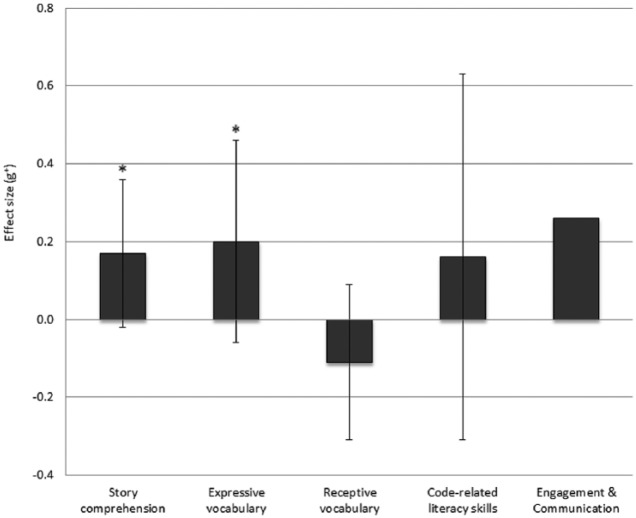
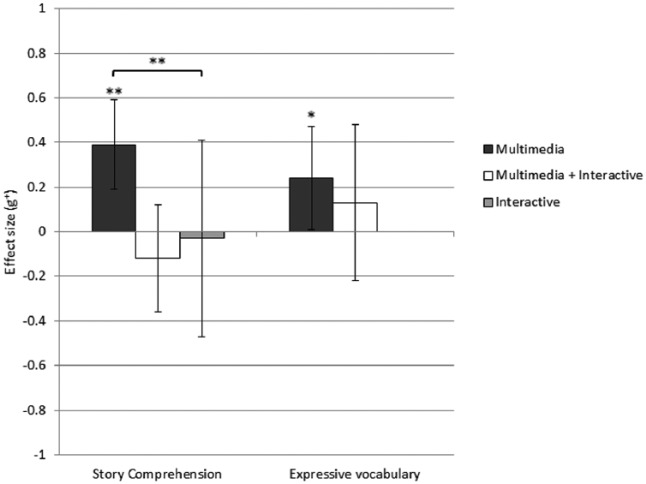
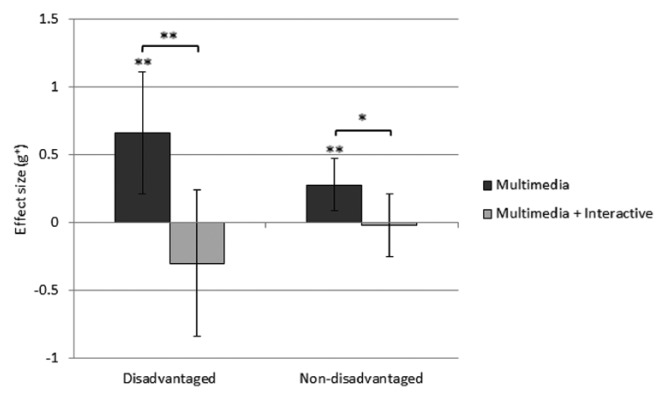
A meta-analysis was conducted on the effects of technology-enhanced stories for young children’s literacy development when compared to listening to stories in more traditional settings like storybook reading. A small but significant additional benefit of technology was found for story comprehension (g+ = 0.17) and expressive vocabulary (g+ = 0.20), based on data from 2,147 children in 43 studies. When investigating the different characteristics of technology-enhanced stories, multimedia features like animated pictures, music, and sound effects were found beneficial. In contrast, interactive elements like hotspots, games, and dictionaries were found to be distracting. Especially for children disadvantaged because of less stimulating family environments, multimedia features were helpful and interactive features were detrimental. Findings are discussed from the perspective of cognitive processing theories.
Overview
The claims and statistics of this paper haven’t been checked yet.
Free: it reads the open-access text and checks the first 5 claims that cite a source we can check. Create a free account to check every claim.
Integrity signals
Registry
Cites
Statistics
Figures
Verification
Claims the paper makes
The claims and statistics of this paper haven’t been checked yet.
Free: it reads the open-access text and checks the first 5 claims that cite a source we can check. Create a free account to check every claim.
Claims other papers make about this one
Each is checked against this paper’s own text: does it say what the citing paper says it does?
The cited source says what the claim attributes to it.
In the citing paper
“That is, the design aimed for a strong match between the verbal and nonverbal information in the stories (Takacs et al. 2015).”
From Supporting Literacy and Digital Literacy Development in Early Childhood Education Using Storytelling Activities (2018) · cites this paper as Takacs et al. 2015
Self-check
Percentages, sums and reported differences re-computed from the paper’s own numbers.
The self-check needs the paper’s full text.
Citations
Cites
Tabachnick, B. G., & Fidell, L. S. (1983) · Cited by 80,058
Borenstein, M., Hedges, L. V., Higgins, J. P. T., & Rothstein, H. R. (2009) · doi:10.1002/9780470743386 · Cited by 14,225
Borenstein, M., Hedges, L. V., Higgins, J. P. T., & Rothstein, H. R. (2021) · doi:10.1002/9781119558378 · Cited by 9,799
(2000) · Cited by 9,198
The file drawer problem and tolerance for null results.
Rosenthal, R. (1979) · Psychological Bulletin · doi:10.1037/0033-2909.86.3.638 · Cited by 9,068 · cited 1×
“A fail-safe number of 5 k + 10 is considered robust, where k is the number of studies in the meta-analysis (Rosenthal, 1979).”
Background(1991) · Choice Reviews Online · doi:10.5860/choice.28-5764 · Cited by 6,847
The Handbook of Research Synthesis and Meta-Analysis
(2019) · doi:10.7758/9781610448864 · Cited by 4,553
Nine Ways to Reduce Cognitive Load in Multimedia Learning
Mayer, R. E., & Moreno, R. (2003) · Educational Psychologist · doi:10.1207/s15326985ep3801_6 · Cited by 4,207 · cited 2×
“This outcome is probably because the processing of games and extra animations can be considered as extraneous materials that interfere with the processing of the story content (Mayer & Moreno, 2003).”
BackgroundA Nonparametric “Trim and Fill” Method of Accounting for Publication Bias in Meta-Analysis
Duval, S., & Tweedie, R. (2000) · Journal of the American Statistical Association · doi:10.1080/01621459.2000.10473905 · Cited by 2,955
Morris, S. B., & DeShon, R. P. (2002) · Psychological Methods · doi:10.1037/1082-989x.7.1.105 · Cited by 2,502
Research works printed but not linked: 7
- McKenna M. C. Labbo L. D. Kieffer R. D. Reinking D. (Eds.). (2006). International handbook of literacy and technology: Vol. II. Mahwah, NJ: Lawrence Erlbaum Associates.
- *Chiong C. Ree J. Takeuchi L. Erickson I. (2012). Print books vs e-books. Comparing parent-child co-reading on print, basic and enhanced e-book platforms. New York, NY: The Joan Ganz Cooney Center at Sesame Workshop Retrieved from http://www.joanganzcooneycenter.org/wp-content/uploads/2012/07/jgcc_ebooks_quickreport.pdf
- *Critelli K. (2011). The effect of multimedia e-books on the acquisition of early literacy skills (Master’s thesis). Retrieved from Proquest Dissertations and Theses Global (UMI: 1500577).
- Guernsey L. Levine M. Chiong C. Severns M. (2012). Pioneering literacy in the digital wild west: Empowering parents and educators. New York, NY: The Joan Ganz Cooney Center at Sesame Workshop Retrieved from http://www.joanganzcooneycenter.org/wp-content/uploads/2012/12/GLR_TechnologyGuide_final.pdf
- Meringoff L. K. (1982, 3). What pictures can and can’t do for children’s story understanding. Paper presented at the Annual Meeting of the American Educational Research Association, New York, NY.
- Roskos K. Burstein K. (2013, 4). Engagement with e-Books: Does device matter? Paper presented at the annual meeting of the American Educational Research Association, San Francisco, CA.
- *Verhallen M. J. A. J. Bus A. (2009b). Video storybooks: a worthwhile investment for all young L2 learners? (Unpublished doctoral dissertation). Leiden University, Leiden, the Netherlands.
Cited by
Items 101–200 of 401
Karemaker, A. M., Jelley, F., Clancy, C., & Sylva, Κ. (2017) · International Journal of Child-Computer Interaction · doi:10.1016/j.ijcci.2017.01.004 · Cited by 28
Lian, X., Sunar, M. S., Lian, Q., & Mokhtar, M. K. (2023) · International Journal of Human-Computer Studies · doi:10.1016/j.ijhcs.2023.103085 · Cited by 31
E-Reader apps and reading engagement: A descriptive case study
Hashim, A. K., & Vongkulluksn, V. W. (2018) · Computers & Education · doi:10.1016/j.compedu.2018.06.021 · Cited by 29
Arslan‐Ari, I., & Ari, F. (2021) · Journal of Research on Technology in Education · doi:10.1080/15391523.2021.1938763 · Cited by 21
“Takacs et al. (2015) stressed that e-books may enhance children’s reading skills if high temporal continuity is achieved “due to a closer match between nonverbal and verbal information” (p. 700).”
BackgroundChen, C., & Jamiat, N. (2023) · Frontiers in Psychology · doi:10.3389/fpsyg.2023.1189864 · Cited by 49
“With advancements in technology, children now have the opportunity to access stories through various mediums such as television, computers, CDs, DVDs, and the internet (Takacs et al., 2015).”
BackgroundAukerman, M. S., & Schuldt, L. C. (2016) · Reading Research Quarterly · doi:10.1002/rrq.138 · Cited by 42
Skibbe, L. E., Thompson, J., & Plavnick, J. B. (2017) · Early Childhood Education Journal · doi:10.1007/s10643-017-0876-4 · Cited by 21
Kucirkova, N. I. (2018) · Qualitative Research in Psychology · doi:10.1080/14780887.2018.1545065 · Cited by 26
“The description focuses on the interactivity and multimedia features of the four story-apps because these features have been most widely studied in relation to children ’ s learning outcomes before, including two major meta-analyses (Bus, Takacs & Kegel 2015; Takacs et al. 2015).”
BackgroundUsing Digital Technology to Improve Learning: Evidence Review
Lewin, C., Smith, A. J. M., Morris, S., & Craig, E. (2019) · e-space (Manchester Metropolitan University) · Cited by 42
Li, H., Zhang, T., Woolley, J. D., An, J., & Wang, F. (2023) · Journal of Experimental Child Psychology · doi:10.1016/j.jecp.2023.105680 · Cited by 50
Immersive storytelling experiences: a design methodology
Polydorou, D. (2024) · Digital Creativity · doi:10.1080/14626268.2024.2389886 · Cited by 27
“They even refer to Takacs, Swart, and Bus (2015) and state ‘ as suggested by previous research on combining narrative reading and interactive gameplay, the latter can distract readers from following the story ’ .”
Categories, themes and research evolution of the study of digital literacy: a bibliometric analysis
Wu, D., Sukumaran, S., Zhi, X., Zhou, W., Li, L., & You, H. (2024) · Education and Information Technologies · doi:10.1007/s10639-024-12955-x · Cited by 38
“Such themes as media literacies (Takacs et al., 2015), digital divide and online learning gradually diminished.”
Shamir, A., Segal-Drori, O., & Goren, I. (2017) · Education and Information Technologies · doi:10.1007/s10639-017-9653-7 · Cited by 30
“In recent meta-analyses on e-books, Takacs et al. (2014, 2015) found that multimedia features such as animations, music and sound effects, as well as pictures that closely illustrate the story’s content, facilitate children’s story understanding, probably by depicting and concretizing the story’s…”
BackgroundSilverman, R. D., Artzi, L., McNeish, D., Hartranft, A. M., Martin‐Beltrán, M., & Peercy, M. M. (2018) · Contemporary Educational Psychology · doi:10.1016/j.cedpsych.2018.12.004 · Cited by 33
Quinn, M. F., & Bliss, M. (2019) · Journal of Early Childhood Literacy · doi:10.1177/1468798419838598 · Cited by 22
“There have been multiple reviews examining topics such as the impact of digital storybooks on young children’s reading-related skills (e.g. Bus et al., 2015; Takacs et al., 2015).”
BackgroundEwim, D. R. E., Nundlal, Y., Govender, K., Nzuke, N. L., Mbatha, M. V., Gwexa, N., Naidoo, K., Laseinde, O. T., & Abolarin, S. M. (2023) · African Journal of Science Technology Innovation and Development · doi:10.1080/20421338.2023.2213965 · Cited by 22
“Torres and Giddie (2020) suggested building strong partnerships between schools, private institutions, and non-governmental organizations to provide learning supporting materials for relevant skill acquisition and academic performance improvement (Takacs, Swart, and Bus 2015; Brasiel et al. 2016).”
BackgroundGrace, T. D., Abel, C., & Salen, K. (2023) · ACM International Conference on Interaction Design and Children (IDC) · doi:10.1145/3585088.3589370 · Cited by 40
The Impact of Shared Book Reading on Children’s Phonological Awareness Skills: A Meta-analysis
Parpucu, N., & Ezmeci, F. (2023) · Reading & Writing Quarterly · doi:10.1080/10573569.2023.2245383 · Cited by 19
“Takacs et al. (2015) conducted a meta-analysis review of technology-enhanced interactive book-reading interventions.”
Samudra, P. G., Flynn, R. M., & Wong, K. M. (2019) · AERA Open · doi:10.1177/2332858419853238 · Cited by 22
“Following from this, Takacs, Swart, and Bus (2015) conducted a meta-analysis to determine if multimedia features, such as sound and animations, may promote the vocabulary growth of children from less stimulating family environments.”
BackgroundNarrative comprehension and engagement with e-books vs. paper-books in autism spectrum condition
Wainwright, B. R., Allen, M. L., & Cain, K. (2020) · Autism & Developmental Language Impairments · doi:10.1177/2396941520917943 · Cited by 29
“…demonstrating that interactive and multimodal features can prevent distraction from external stimuli (Holmes et al., 2012), leading to less looking away from the screen and potentially allowing for synchronisation of narrative information with visual pictorial information (Takacs et al., 2015).”
BackgroundResultInfluentialBai, J., Cheng, X., Zhang, H., Qin, Y., Xu, T., & Zhou, Y. (2025) · Education and Information Technologies · doi:10.1007/s10639-025-13328-8 · Cited by 26
“However, digital books have been criticized for potentially reducing interaction between care - givers and young children (Munzer et al., 2019) and causing distractions (Takacs et al., 2015).”
Mobile Multimedia Education for Language Disorders
Gkeka, E. G., Agorastou, E., & Drigas, A. S. (2020) · International Journal of Emerging Technologies in Learning (iJET) · doi:10.3991/ijet.v15i06.11175 · Cited by 18
Home literacy in the digital era: The role of mobile screen media frequency in a U.S. state
Turco, R. G., Lesaux, N. K., & Jones, S. M. (2022) · British Journal of Educational Technology · doi:10.1111/bjet.13259 · Cited by 24
Augmented reality books: in-depth insights into children’s reading engagement
Alhamad, K., Manches, A., & McGeown, S. P. (2024) · Frontiers in Psychology · doi:10.3389/fpsyg.2024.1423163 · Cited by 45
Children learning a concept with a book and an e-book: a comparison with matched instruction
Raynaudo, G., & Peralta, O. A. (2018) · European Journal of Psychology of Education · doi:10.1007/s10212-018-0370-4 · Cited by 20
Two may be better than one: Promoting incidental word learning through multiple media
Neuman, S. B., Samudra, P. G., & Wong, K. M. (2021) · Journal of Applied Developmental Psychology · doi:10.1016/j.appdev.2021.101252 · Cited by 24
Bahari, A., & Gholami, L. (2022) · Interactive Learning Environments · doi:10.1080/10494820.2022.2065308 · Cited by 30
“…reviews have mainly addressed the e ff ects of di ff erent TALL applications and features on reading (e.g. Abrami et al., 2020; Cheung & Slavin, 2012; Takacs et al., 2015; ter Beek et al., 2018) and writing (e.g. Golonka et al., 2014; Strobl, 2014; Turan & Akdag-Cimen, 2020) skills development.”
BackgroundSoftware to Promote Young Children’s Growth in Literacy: A Comparison of Online and Offline Formats
Wood, E., Grant, A., Gottardo, A., Savage, R. S., & Evans, M. A. (2016) · Early Childhood Education Journal · doi:10.1007/s10643-016-0779-9 · Cited by 23
“For example, learning gains can occur when information is presented through multiple modalities (visual, verbal and touch), and when there is redundancy of information (visual and verbal; Bus et al. 2008; Takacs et al. 2015).”
BackgroundReese, E., Gunn, A. C., Bateman, A., & Carr, M. (2019) · Early Years Journal of International Research and Development · doi:10.1080/09575146.2019.1621804 · Cited by 25
“Digital learning stories could also be explored for their potential to foster (or dampen) high-quality interactions in comparison to hard copies of learning stories (see Takacs, Swart, and Bus 2015 for research comparing traditional storybooks to e-books).”
BackgroundThe impact of home literacy on bilingual vocabulary development
Ryan, È. (2021) · Bilingual Research Journal · doi:10.1080/15235882.2021.1905105 · Cited by 22
“In their meta-analysis comparing the effects of technology-enhanced stories vs. traditional story-telling on young children’s literacy development, Takacs, Swart, and Bus (2015) found a small but significant advantage for technology.”
BackgroundA guiding framework for considering touchscreens in children under two
Kucirkova, N. I., & ZUCKERMAN, B. S. (2017) · International Journal of Child-Computer Interaction · doi:10.1016/j.ijcci.2017.03.001 · Cited by 22
Wearable stories for children: embodied learning through pretend and physical play
Kim, S. J., & Bacos, C. A. (2020) · Interactive Learning Environments · doi:10.1080/10494820.2020.1764979 · Cited by 20
Florit, E., Barachetti, C., Majorano, M., & Lavelli, M. (2021) · International Journal of Environmental Research and Public Health · doi:10.3390/ijerph18010296 · Cited by 23
Young Children’s Social Interactions with Parents during Digital Activities at Home
Konca, A. S., & Erden, F. T. (2021) · Child Indicators Research · doi:10.1007/s12187-020-09800-1 · Cited by 22
Sabino, M. J. J., & Almenara, J. C. (2021) · Innoeduca International Journal of Technology and Educational Innovation · doi:10.24310/innoeduca.2021.v7i1.11940 · Cited by 16
Altun, D. (2022) · Journal of Early Childhood Literacy · doi:10.1177/14687984221079010 · Cited by 26
“These fi ndings are in line with the DCT and CTML views that multimedia components aid in dual information processing and story comprehension (Altun, 2018; De Jong and Bus, 2004; Doty et al., 2001; Takacs et al., 2015).”
BackgroundResultInfluentialPartnering with Families to Use Screen Time for Supporting Early Language and Literacy
Tatar, B. H., & Gerde, H. K. (2022) · The Reading Teacher · doi:10.1002/trtr.2150 · Cited by 24
Segal-Drori, O., Kalmanovich, L. B. H., & Shamir, A. (2018) · Journal of Educational Computing Research · doi:10.1177/0735633118769459 · Cited by 17
Quick, incidental word learning in educational media: all contexts are not equal
Neuman, S. B., Flynn, R. M., Wong, K. M., & Kaefer, T. (2020) · Educational Technology Research and Development · doi:10.1007/s11423-020-09815-z · Cited by 21
Plak, R. D., Merkelbach, I., Kegel, C. A. T., van IJzendoorn, M. H., & Bus, A. G. (2016) · Learning and Instruction · doi:10.1016/j.learninstruc.2016.06.002 · Cited by 18
Self-citationChiu, M.-S. (2020) · Research in Science & Technological Education · doi:10.1080/02635143.2020.1830270 · Cited by 17
“(Takacs, Swart, and Bus 2015), and virtual reality-based instruction (Merchant et al. 2014).”
BackgroundParent-child joint reading of digital books in bilingual families in Malta
Mifsud, C. L., Georgieva, R., & Kucirkova, N. I. (2021) · International Journal of Educational Research · doi:10.1016/j.ijer.2021.101844 · Cited by 22
“Well-designed digital books have higher learning benefits than print books for children with special educational needs (Korat & Falk 2017) and can, in some contexts, replace the reading adult with appropriate scaffolds and support during the child ’ s reading (Takacs, Swart & Bus 2015).”
BackgroundGremmen, M. C., Molenaar, I., & Teepe, R. C. (2016) · Journal of Computer Assisted Learning · doi:10.1111/jcal.12150 · Cited by 19
“These results correspond closely to the conclusions of Van Kleeck et al. (1977) with respect to toddlers’ gains in language development.”
ResultInfluentialvan Daal, V. H. P., Sandvik, J. M., & Adèr, H. J. (2019) · Literacy studies · doi:10.1007/978-3-030-20077-0_14 · Cited by 20
Designing Dialogs Around Picture Book Apps
Tønnessen, E. S., & Hoel, T. (2019) · Literacy studies · doi:10.1007/978-3-030-20077-0_11 · Cited by 22
Sung, J. (2017) · Child & Youth Care Forum · doi:10.1007/s10566-017-9428-8 · Cited by 27
A Digital Early Spelling Game: The Role of Auditory and Visual Support
Elimelech, A., & Aram, D. (2019) · AERA Open · doi:10.1177/2332858419857702 · Cited by 20
“The contribution of combined supports has been examined primarily in electronic books (Korat & Falk, 2017; Takacs et al., 2015).”
BackgroundKovač, M., & Mohar, A. K. (2022) · Center for Educational Policy Studies Journal · doi:10.26529/cepsj.1290 · Cited by 26
“In a research synthesis of 29 studies involving 1272 young children, Takacs et al. (2015) found evidence that multimedia stories were more conducive to story comprehension and word learning than when children were exposed to the same stories in a linear format in print without adult support;…”
BackgroundDevelopment of Learning Management with Animated Video to Increase Motivation and Learning Outcomes
Utaminingsih, S., Machfud, Santosa, S., & Kassymova, G. K. (2024) · Journal of Advanced Research in Applied Sciences and Engineering Technology · doi:10.37934/araset.41.2.3142 · Cited by 67
Is attention the missing link? Coviewing and preschoolers’ comprehension of educational media
Samudra, P. G., Wong, K. M., & Neuman, S. B. (2020) · Journal of Applied Developmental Psychology · doi:10.1016/j.appdev.2019.101108 · Cited by 13
Bernard, R. M., Borokhovski, E., Schmid, R. F., & Tamim, R. M. (2018) · Springer eBooks · doi:10.1007/978-3-319-17727-4_109-2 · Cited by 26
The impact of visual cues on reducing cognitive load in interactive storybooks for children
Bali, C., Várkonyi, G., Szabó, M., & Zsido, A. N. (2025) · Journal of Experimental Child Psychology · doi:10.1016/j.jecp.2025.106320 · Cited by 24
Korat, O., Atishkin, S., & Segal-Drori, O. (2021) · Early Child Development and Care · doi:10.1080/03004430.2021.1885391 · Cited by 19
Lee, S. H. (2019) · Reading and Writing · doi:10.1007/s11145-019-09983-2 · Cited by 16
Huber, B., Meyer, D., & Kaufman, J. (2019) · Media Psychology · doi:10.1080/15213269.2019.1611451 · Cited by 14
Egert, F., Hartig, F., & Cordes, A.-K. (2022) · Frühe Bildung · doi:10.1026/2191-9186/a000562 · Cited by 16
Wu, J., Peng, J., Li, Z., Deng, H., Huang, Z.-M., He, Y., Tu, J., Cao, L., & Huang, J. (2023) · Frontiers in Psychology · doi:10.3389/fpsyg.2022.1059889 · Cited by 16
Cordes, A.-K., Egert, F., & Hartig, F. (2023) · Zeitschrift für Entwicklungspsychologie und Pädagogische Psychologie · doi:10.1026/0049-8637/a000264 · Cited by 21
Jiang, Y., Pongsakornrungsilp, S., Pongsakornrungsilp, P., & Li, L. (2024) · TEM Journal · doi:10.18421/tem133-41 · Cited by 31
Chi, C., Chen, H. H.-J., Tseng, W., & Liu, Y. (2022) · ReCALL · doi:10.1017/s0958344022000088 · Cited by 15
Bempt, F. V., Economou, M., Dehairs, W., Vandermosten, M., Wouters, J. M., Ghesquière, P., & Vanderauwera, J. (2022) · JMIR Serious Games · doi:10.2196/34698 · Cited by 20
Interactive Technologies: Tablets, Smartphones, and Learning
Courage, M. L. (2019) · Elsevier eBooks · doi:10.1016/b978-0-12-809324-5.23561-x · Cited by 14
Preschoolers’ electrodermal activity and story comprehension during print and digital shared reading
Strouse, G. A., Chesnut, S. R., Newland, L. A., Mourlam, D. J., Hertel, D., & Nutting, B. H. (2022) · Computers & Education · doi:10.1016/j.compedu.2022.104506 · Cited by 17
A taxonomy and research framework for personalization in children’s literacy apps
Kucirkova, N. I. (2018) · Educational Media International · doi:10.1080/09523987.2018.1512446 · Cited by 15
Butler, Y. G. (2022) · Language Teaching for Young Learners · doi:10.1075/ltyl.21009.but · Cited by 14
Considerations on the Curation of Educational Apps for Digital Play and Learning
Lim, F. V., & Toh, W. (2022) · Contemporary Educational Technology · doi:10.30935/cedtech/11809 · Cited by 15
“Likewise, in their meta-analysis of the effects of technology-enhanced stories for young children’s literacy development, Takacs et al. (2015) reported that the positive effects of educational apps fade when they contain interactive elements such as games and interactive features due to cognitive…”
BackgroundSidi, Y., Blau, I., & Shamir‐Inbal, T. (2022) · Journal of Computer Assisted Learning · doi:10.1111/jcal.12714 · Cited by 19
Zhao, F., Schützler, L., Christ, O., & Gaschler, R. (2022) · Teaching Statistics · doi:10.1111/test.12324 · Cited by 12
The Added Challenge of Digital Reading: Exploring Young Children's Page Turning Behaviors
Xu, Y., Yau, J. C., & Reich, S. M. (2019) · ACM International Conference on Interaction Design and Children (IDC) · doi:10.1145/3311927.3323121 · Cited by 15
El desarrollo de las habilidades narrativas en niños: una revisión sistemática de la literatura
Portilla, A., Almanza, V., Castillo, A., & Restrepo, G. (2021) · Revista de Investigación en Logopedia · doi:10.5209/rlog.67607 · Cited by 33
“En cuanto a los metaanálisis, nuestra búsqueda permitió encontrar dos estudios que se excluyeron pues, el primero (Takacs et al.,2015) es un metaanálisis de los estudios que comparan la comprensión de cuentos leídos, en forma tradicional con aquellos en formato multimedia.”
BackgroundImpact of multimedia technology on university students learning agility and creativity
Alhulail, H., & Singh, H. P. (2023) · Revista Amazonia Investiga · doi:10.34069/ai/2023.70.10.17 · Cited by 12
“A multimedia learning environment entails presenting information via multiple channels, such as auditory and visual (Jiang & Benbasat, 2007; Takács et al., 2015; Michalski et al., 2016).”
BackgroundDu, J., Xu, J., Liu, F., Huang, B., & Li, Z. (2019) · The Asia-Pacific Education Researcher · doi:10.1007/s40299-019-00452-6 · Cited by 13
Learning to eRead : A qualitative exploration of young children's developing eReader practices
Schmitt, K. L., Hurwitz, L. B., & Nichols, D. (2021) · Journal of Computer Assisted Learning · doi:10.1111/jcal.12631 · Cited by 14
Hoel, T., & Jernes, M. (2023) · Early Years Journal of International Research and Development · doi:10.1080/09575146.2023.2172552 · Cited by 29
A duplex adaptation mechanism in the personalized learning environment
Wongwatkit, C., & Panjaburee, P. (2023) · Journal of Computers in Education · doi:10.1007/s40692-023-00292-w · Cited by 15
“Rule-based adaptation, with modifications driven by conditional statements, and algorithm-based adaptation, wielding advanced machine learning algorithms, are two prominent methods in practice (Deng et al., 2022; Elghouch et al., 2016; Kolekar et al., 2010; Oxman & Wong, 2014; Takacs et al., 2015).”
Son, S.-H. C., & Butcher, K. R. (2024) · Journal of Research in Reading · doi:10.1111/1467-9817.12452 · Cited by 38
Yang, D., Yan, G., Sun, Y., Collins, P., Jaeggi, S. M., Xu, Y., Shea, Z. M., & Warschauer, M. (2024) · Child Development · doi:10.1111/cdev.14128 · Cited by 15
“The positive effects of multimedia features on story comprehension have been larger for disadvantaged children compared to the non-disadvantaged children (Takacs et al., 2015).”
Wen, C.-N., Huang, C., Chang, P.-Y., Yang, T.-H., You, H., Ning, H., & Tsao, K. (2022) · BMC Medical Education · doi:10.1186/s12909-022-03724-w · Cited by 13
Animation video based on PowToon to upgrade student learning achievement
Marini, A., Khairunisa, A., Yarmi, G., Safitri, D., Lestari, I., Suntari, Y., Siregar, R., & Yuliati, S. R. (2023) · AIP conference proceedings · doi:10.1063/5.0141390 · Cited by 9
Long, B. T., Hall, T., Hogan, M., & Papastamatiou, N. (2017) · Literacy · doi:10.1111/lit.12128 · Cited by 13
Learning to read: where should early childhood educators begin?
Nicholas, M., & Rouse, E. (2020) · Literacy · doi:10.1111/lit.12229 · Cited by 25
Wu, Z., & Amzah, F. (2023) · Forum for Linguistic Studies · doi:10.59400/fls.v5i3.1954 · Cited by 17
Affordances and challenges of digital reading for individuals with different learning profiles
Ben‐Yehudah, G., Hautala, J., Padeliadu, S., Antoniou, F., Petrová, Z., Leppänen, P. H. T., & Barzillai, M. (2018) · Studies in written language and literacy · doi:10.1075/swll.17.05ben · Cited by 13
Samtalebasert lesing av bildebok-apper: barnehagelærerversus hotspoter
Hoel, T., & Jernes, M. (2020) · Norsk pedagogisk tidsskrift · doi:10.18261/issn.1504-2987-2020-02-04 · Cited by 13
The Distance Between the “Self” and the “Other” in Children’s Digital Books
Kucirkova, N. I., & Littleton, K. (2020) · Frontiers in Psychology · doi:10.3389/fpsyg.2020.589281 · Cited by 17
“, 2018), as well as of the obstacles that learners face in assimilating meaning from highly interactive digital books that distract from the main story content (Takacs et al., 2015).”
BackgroundLiang, C., Zhang, L., & Sun, J. (2025) · International Journal of Early Childhood · doi:10.1007/s13158-024-00410-4 · Cited by 12
van Dijken, M. J. (2022) · Reading and Writing · doi:10.1007/s11145-022-10304-3 · Cited by 20
“The digital features built into e-books can enhance children’s motivation (Smith, 2012) and draw their attention towards important aspects of print or story elements, thereby providing scaffolding to children and contributing to improved emergent literacy (Liao et al., 2020; Takacs et al., 2015).”
BackgroundHao, L. (2022) · Literacy · doi:10.1111/lit.12312 · Cited by 13
Teknik Ice Breaking pada Pembelajaran Tematik di Sekolah Dasar
Algivari, A., & Mustika, D. (2022) · Journal of Education Action Research · doi:10.23887/jear.v6i4.53917 · Cited by 8
Bernard, R. M., Borokhovski, E., Schmid, R. F., & Tamim, R. M. (2023) · Springer eBooks · doi:10.1007/978-3-319-17461-7_109 · Cited by 12
Identifying features of apps to support using evidence-based language intervention with children
Heyman, N. (2018) · Assistive Technology · doi:10.1080/10400435.2018.1553078 · Cited by 10
Technology Support for Adults and Children Reading Together: Questions Answered and Questions Raised
Revelle, G. L., Strouse, G. A., Troseth, G. L., Rvachew, S., & Thompson, D. (2019) · Literacy studies · doi:10.1007/978-3-030-20077-0_7 · Cited by 9
The Problem of Methodological Training of Future Teachers in the Digital Environment
Кіндей, Л., Нікітіна, О., Baraniuk, I., Yulia, K., & Natalka, K. (2022) · Journal of Curriculum and Teaching · doi:10.5430/jct.v11n5p146 · Cited by 12
Investigating Research Trends on Digital Storytelling: A Bibliometric and Visualized Analysis
Özkaya, P. G. (2022) · International Journal of Progressive Education · doi:10.29329/ijpe.2022.426.21 · Cited by 14
Eye-tracking research in interactive language learning environments: A systematic review
Li, X. (2024) · Education and Information Technologies · doi:10.1007/s10639-024-12648-5 · Cited by 10
“Moreover, eye-tracking research for CALL can leverage learners’ cognitive processes as a tool to analyze how diverse instructional approaches influence their cognitive processing (Schugar et al., 2013; Takacs et al., 2015 ).”
Distractions in digital reading: a meta-analysis of attentional interference effects
Shen, Y. (2025) · Frontiers in Psychology · doi:10.3389/fpsyg.2025.1671214 · Cited by 27
Bali, C., Matuz-Budai, T., Arató, N., Lábadi, B., & Zsido, A. N. (2023) · Heliyon · doi:10.1016/j.heliyon.2023.e12899 · Cited by 13
“Unlike multimedia elements, interactive features are controlled by the user [4] and thus, the narration and interactive features may dissociate in time.”
BackgroundInfluentialBodén, U., Stenliden, L., & Nissen, J. (2023) · Journal of Visual Literacy · doi:10.1080/1051144x.2023.2168395 · Cited by 19
“There are some studies concerning students and interactive digital texts/books, also referred to as e-texts, consisting of narrative electronic texts, illustrations, hot-spots, sound effects and embedded glossaries etc. (Clinton-Lisell et al., 2021; Kelley & Kinney, 2017; Takacs et al., 2015).”
BackgroundCordes, A.-K., Egert, F., & Hartig, F. (2020) · Diskurs Kindheits- und Jugendforschung / Discourse Journal of Childhood and Adolescence Research · doi:10.3224/diskurs.v15i3.02 · Cited by 10
An Investigation of the Parental Mediation Situations of Preschool Children’s Parents
Yaman, N. D., Karademir, A., & Yaman, F. (2023) · Anadolu Journal Of Educational Sciences International · doi:10.18039/ajesi.1258231 · Cited by 12
Metadata
- Authors
- Takacs, Z. K., Swart, E. K., & Bus, A. G.
- Affiliations
- Leiden University
- Leiden University (NL)
- Venue
- Review of Educational Research
- Published
- 2015-12
- Volume
- 85
- Issue
- 4
- Pages
- 698-739
- ISSN
- 0034-6543 (ISSN-L)
- 1935-1046
- PMC
- PMC4647204
- OpenAlex
- W2161429259
- Cited by
- 403
- References
- 113
- Citations by year
- 2026: 39 · 2025: 32 · 2024: 33 · 2023: 62 · 2022: 40 · 2021: 40 · 2020: 36 · 2019: 51 · 2018: 30 · 2017: 21 · 2016: 17 · 2015: 2
- FWCI
- 59.00
- Type
- journal article
- Language
- en
- Open access
- hybrid
- doi.org
- Licence
- cc-by-nc
- journals.sagepub.com/page/policies/text-and-data-mining-license (tdm)
- Locations
- Review of Educational Research (publishedVersion, cc-by-nc)
- PubMed Central (publishedVersion, cc-by-nc)
- PubMed (publishedVersion)
- Edinburgh Research Explorer (University of Edinburgh) (submittedVersion, cc-by-nc)
- Leiden Repository (Leiden University) (submittedVersion)
- Data Archiving and Networked Services (DANS) (submittedVersion)
- Data Archiving and Networked Services (DANS) (submittedVersion, other-oa)
- Topics
- Social Sciences › Psychology › Developmental and Educational Psychology › Reading and Literacy Development
- Social Sciences › Psychology › Experimental and Cognitive Psychology › Visual and Cognitive Learning Processes
- Social Sciences › Education › Digital Storytelling and Education
- Keywords
- multimedia features, interactive features, early literacy development, narrative comprehension, expressive vocabulary, young children, animated pictures, hot spots, family environment
About these checks
Registry, retraction, Cites and statistics results are computed, not judged, with one exception: a printed reference that no index lists is read once by a model before it counts as a citation error. Claims are extracted by a model and kept only when their quote appears verbatim in the text; each cited source is then checked, with a model’s help, for whether it says what the claim relies on. Those verdicts can be wrong — read the claim’s quote and the cited source before relying on one.
Statistics and arithmetic are recomputed, not judged.
Confidence bands are shown only for fields calibrated on our annotated test set. None is calibrated yet, so no band is shown.
What counts as a claim ›How we measure confidence ›How we check this ›
Are you an author, or do you see a problem with this page? Request a review
Data sources
Bibliographic data: Semantic Scholar, OpenAlex, Crossref.
Contains information from the Semantic Scholar Academic Graph Datasets, made available under the ODC Attribution License (ODC-BY 1.0).
Semantic Scholar’s data is described in: Kinney, R., et al. (2023). The Semantic Scholar Open Data Platform. arXiv:2301.10140.
