

Benefits and Pitfalls of Multimedia and Interactive Features in Technology-Enhanced Storybooks: A Meta-Analysis
Open accessThe DOI matches its Crossref record; 116 of the 116 references it cites were found in a registry or an index.
Abstract
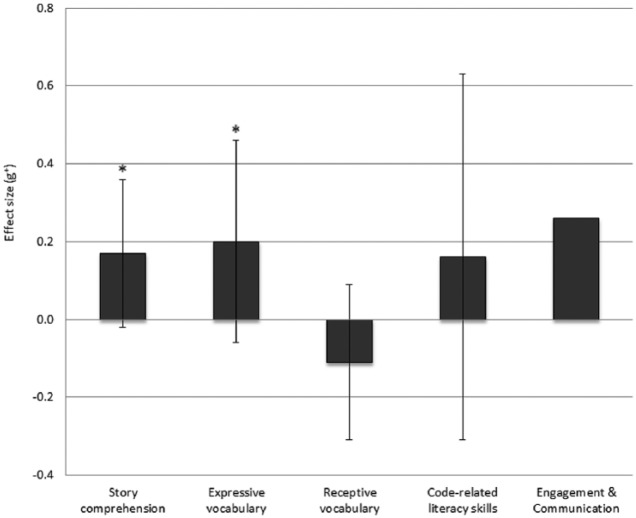
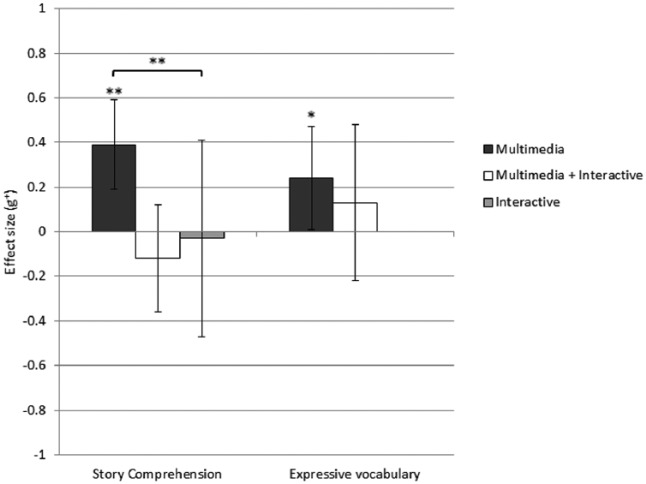
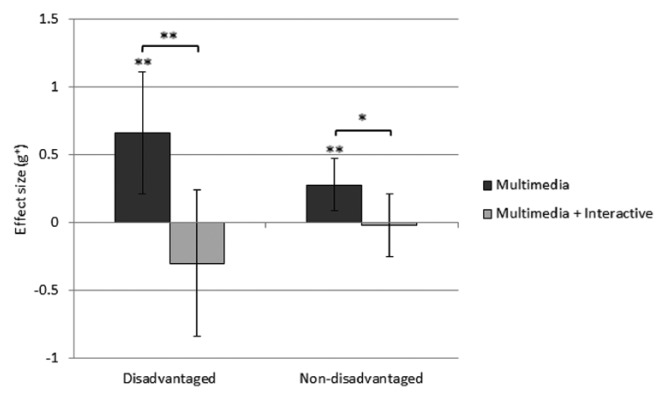
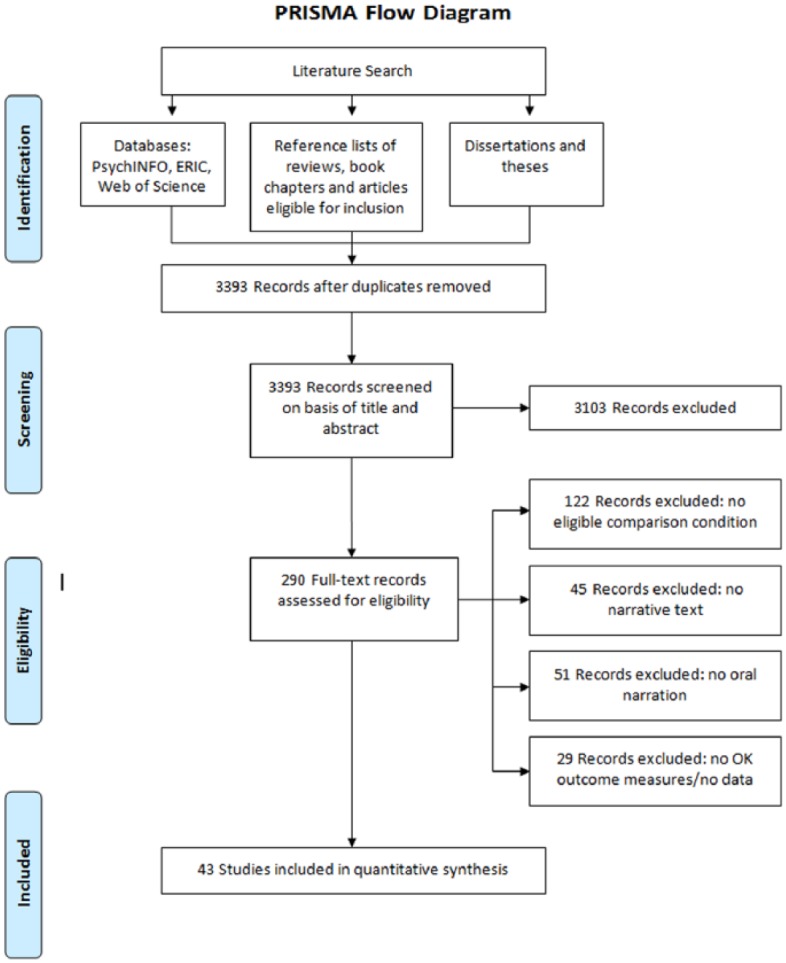
A meta-analysis was conducted on the effects of technology-enhanced stories for young children’s literacy development when compared to listening to stories in more traditional settings like storybook reading. A small but significant additional benefit of technology was found for story comprehension (g+ = 0.17) and expressive vocabulary (g+ = 0.20), based on data from 2,147 children in 43 studies. When investigating the different characteristics of technology-enhanced stories, multimedia features like animated pictures, music, and sound effects were found beneficial. In contrast, interactive elements like hotspots, games, and dictionaries were found to be distracting. Especially for children disadvantaged because of less stimulating family environments, multimedia features were helpful and interactive features were detrimental. Findings are discussed from the perspective of cognitive processing theories.
Overview
The claims and statistics of this paper haven’t been checked yet.
Free: it reads the open-access text and checks the first 5 claims that cite a source we can check. Create a free account to check every claim.
Integrity signals
Registry
Cites
Statistics
Figures
Verification
Claims the paper makes
The claims and statistics of this paper haven’t been checked yet.
Free: it reads the open-access text and checks the first 5 claims that cite a source we can check. Create a free account to check every claim.
Claims other papers make about this one
Each is checked against this paper’s own text: does it say what the citing paper says it does?
The cited source says what the claim attributes to it.
In the citing paper
“That is, the design aimed for a strong match between the verbal and nonverbal information in the stories (Takacs et al. 2015).”
From Supporting Literacy and Digital Literacy Development in Early Childhood Education Using Storytelling Activities (2018) · cites this paper as Takacs et al. 2015
Self-check
Percentages, sums and reported differences re-computed from the paper’s own numbers.
The self-check needs the paper’s full text.
Citations
Cites
Tabachnick, B. G., & Fidell, L. S. (1983) · Cited by 80,058
Borenstein, M., Hedges, L. V., Higgins, J. P. T., & Rothstein, H. R. (2009) · doi:10.1002/9780470743386 · Cited by 14,225
Borenstein, M., Hedges, L. V., Higgins, J. P. T., & Rothstein, H. R. (2021) · doi:10.1002/9781119558378 · Cited by 9,799
(2000) · Cited by 9,198
The file drawer problem and tolerance for null results.
Rosenthal, R. (1979) · Psychological Bulletin · doi:10.1037/0033-2909.86.3.638 · Cited by 9,068 · cited 1×
“A fail-safe number of 5 k + 10 is considered robust, where k is the number of studies in the meta-analysis (Rosenthal, 1979).”
Background(1991) · Choice Reviews Online · doi:10.5860/choice.28-5764 · Cited by 6,847
The Handbook of Research Synthesis and Meta-Analysis
(2019) · doi:10.7758/9781610448864 · Cited by 4,553
Nine Ways to Reduce Cognitive Load in Multimedia Learning
Mayer, R. E., & Moreno, R. (2003) · Educational Psychologist · doi:10.1207/s15326985ep3801_6 · Cited by 4,207 · cited 2×
“This outcome is probably because the processing of games and extra animations can be considered as extraneous materials that interfere with the processing of the story content (Mayer & Moreno, 2003).”
BackgroundA Nonparametric “Trim and Fill” Method of Accounting for Publication Bias in Meta-Analysis
Duval, S., & Tweedie, R. (2000) · Journal of the American Statistical Association · doi:10.1080/01621459.2000.10473905 · Cited by 2,955
Morris, S. B., & DeShon, R. P. (2002) · Psychological Methods · doi:10.1037/1082-989x.7.1.105 · Cited by 2,502
Research works printed but not linked: 7
- McKenna M. C. Labbo L. D. Kieffer R. D. Reinking D. (Eds.). (2006). International handbook of literacy and technology: Vol. II. Mahwah, NJ: Lawrence Erlbaum Associates.
- *Chiong C. Ree J. Takeuchi L. Erickson I. (2012). Print books vs e-books. Comparing parent-child co-reading on print, basic and enhanced e-book platforms. New York, NY: The Joan Ganz Cooney Center at Sesame Workshop Retrieved from http://www.joanganzcooneycenter.org/wp-content/uploads/2012/07/jgcc_ebooks_quickreport.pdf
- *Critelli K. (2011). The effect of multimedia e-books on the acquisition of early literacy skills (Master’s thesis). Retrieved from Proquest Dissertations and Theses Global (UMI: 1500577).
- Guernsey L. Levine M. Chiong C. Severns M. (2012). Pioneering literacy in the digital wild west: Empowering parents and educators. New York, NY: The Joan Ganz Cooney Center at Sesame Workshop Retrieved from http://www.joanganzcooneycenter.org/wp-content/uploads/2012/12/GLR_TechnologyGuide_final.pdf
- Meringoff L. K. (1982, 3). What pictures can and can’t do for children’s story understanding. Paper presented at the Annual Meeting of the American Educational Research Association, New York, NY.
- Roskos K. Burstein K. (2013, 4). Engagement with e-Books: Does device matter? Paper presented at the annual meeting of the American Educational Research Association, San Francisco, CA.
- *Verhallen M. J. A. J. Bus A. (2009b). Video storybooks: a worthwhile investment for all young L2 learners? (Unpublished doctoral dissertation). Leiden University, Leiden, the Netherlands.
Cited by
Reading from paper compared to screens: A systematic review and meta‐analysis
Clinton, V. (2019) · Journal of Research in Reading · doi:10.1111/1467-9817.12269 · Cited by 436
Social Robots for Language Learning: A Review
van den Berghe, R., Verhagen, J., Oudgenoeg-Paz, O., van der Ven, S., & Leseman, P. (2019) · Review of Educational Research · doi:10.3102/0034654318821286 · Cited by 365
Kassai, R., Futo, J., Demetrovics, Z., & Takacs, Z. K. (2019) · Psychological Bulletin · doi:10.1037/bul0000180 · Cited by 294
A Comparison of Children’s Reading on Paper Versus Screen: A Meta-Analysis
Furenes, M. I., Kucirkova, N., & Bus, A. G. (2021) · Review of Educational Research · doi:10.3102/0034654321998074 · Cited by 284
Self-citationTPACK in teacher education: are we preparing teachers to use technology for early literacy?
Voogt, J., & McKenney, S. (2017) · Technology, Pedagogy and Education · doi:10.1080/1475939x.2016.1174730 · Cited by 267
“…but also to interface structures that are ergonomi-cally sound for the age group (Segers & Verhoeven, 2002), promote on-task attention focusing (Takacs et al., 2015; Trushell & Maitland, 2005), and elicit active engagement (National Association for the Education of Young Chidren, 1996; Van…”
Towards an understanding of social media use in the classroom: a literature review
Van Den Beemt, A., Thurlings, M., & Willems, M. (2020) · Technology, Pedagogy and Education · doi:10.1080/1475939x.2019.1695657 · Cited by 225
Strouse, G. A., Nyhout, A., & Ganea, P. A. (2018) · Frontiers in Psychology · doi:10.3389/fpsyg.2018.00050 · Cited by 191
Comparing reading comprehension between children reading augmented reality and print storybooks
Danaei, D., Jamali, H. R., Mansourian, Y., & Rastegarpour, H. (2020) · Computers & Education · doi:10.1016/j.compedu.2020.103900 · Cited by 184
Comparing electronic and paper storybooks for preschoolers: Attention, engagement, and recall
Richter, A., & Courage, M. L. (2017) · Journal of Applied Developmental Psychology · doi:10.1016/j.appdev.2017.01.002 · Cited by 182
“The variation among the procedures and outcomemeasures that have been reported in the literature further complicate the evaluation `of learning effectiveness (Miller & Warschauer, 2014; Takacs et al., 2015).”
BackgroundSanders, T., Noetel, M., Parker, P., Del Pozo Cruz, B., Biddle, S., Ronto, R., Hulteen, R., Parker, R., Thomas, G., De Cocker, K., et al. (2023) · Nature Human Behaviour · doi:10.1038/s41562-023-01712-8 · Cited by 148
Tablet-Based eBooks for Young Children: What Does the Research Say?
Reich, S. M., Yau, J. C., & Warschauer, M. (2016) · Journal of Developmental & Behavioral Pediatrics · doi:10.1097/dbp.0000000000000335 · Cited by 163
Developing numeracy skills using interactive technology in a play-based learning environment
Miller, T. (2018) · International Journal of STEM Education · doi:10.1186/s40594-018-0135-2 · Cited by 206
Kao, G. Y., Tsai, C., Liu, C., & Yang, C.-H. (2016) · Computers & Education · doi:10.1016/j.compedu.2016.04.013 · Cited by 153
“…have suggested that interactive elements, such as games and hotspots, were not beneficial to understanding the story content because the visual information would distract students from the verbal texts (de Jong & Bus, 2002, 2003; Rolandelli, 1989; Schugar et al., 2013; Takacs et al., 2015).”
BackgroundInfluentialAnimating student engagement: The impacts of cartoon instructional videos on learning experience
Liu, C., & Elms, P. (2019) · Research in Learning Technology · doi:10.25304/rlt.v27.2124 · Cited by 187
“2018; Clark, Tanner-Smith, and Killingsworth 2016; Mayer and Anderson 1992; Takacs, Swart, and Bus 2015; Theobald 2017).”
BackgroundShared Book Reading Interventions With English Learners: A Meta-Analysis
Fitton, L., McIlraith, A. L., & Wood, C. L. (2018) · Review of Educational Research · doi:10.3102/0034654318790909 · Cited by 140
Maureen, I. Y., van der Meij, H., & de Jong, T. (2018) · International Journal of Early Childhood · doi:10.1007/s13158-018-0230-z · Cited by 110
Effects of interactivity in E-textbooks on 7th graders science learning and cognitive load
Weng, C., Otanga, S., Weng, A., & Cox, J. (2018) · Computers & Education · doi:10.1016/j.compedu.2018.02.008 · Cited by 133
Troseth, G. L., Strouse, G. A., Flores, I., Stuckelman, Z. D., & Russo Johnson, C. (2020) · Early Childhood Research Quarterly · doi:10.1016/j.ecresq.2019.02.009 · Cited by 100
The Impact of E-Book Reading on Young Children’s Emergent Literacy Skills: An Analytical Review
López‐Escribano, C., Montesino, S. V., & García-Ortega, V. (2021) · International Journal of Environmental Research and Public Health · doi:10.3390/ijerph18126510 · Cited by 193
“Despite the positive outcomes of e-book reading, a number of researchers have taken a more critical view on e-books due to their incorporation of features such as hotspots that contain animation, sound, and other multimedia effects and may distract young readers from the story content and negatively affect their under…”
BackgroundResultInfluentialBooton, S. A., Hodgkiss, A., & Murphy, V. A. (2021) · Computer Assisted Language Learning · doi:10.1080/09588221.2021.1930057 · Cited by 154
“This is consistent with an earlier meta-analysis of all digital book formats (including PC versions), which found that hotspots had a negative or no impact on children’s story comprehension (Takacs et al., 2015).”
BackgroundMethodResultInfluentialYoung Children’s Tablet Use and Associations with Maternal Well-Being
Pempek, T. A., & McDaniel, B. T. (2016) · Journal of Child and Family Studies · doi:10.1007/s10826-016-0413-x · Cited by 111
Takács, Z. K., & Bus, A. G. (2016) · Frontiers in Psychology · doi:10.3389/fpsyg.2016.01591 · Cited by 121
“…and music in the stories in the present study but only motion in the illustrations, the current findings corroborate the hypothesis that motion can elevate story comprehension and thus is a crucial part of a well-designed multimedia environment for children’s storybooks (cf. Takacs et al., 2015).”
BackgroundMethodResultInfluentialSelf-citationSo, W. M. W., Chen, Y. A., & Wan, Z. H. (2019) · Journal of Science Education and Technology · doi:10.1007/s10956-019-09782-y · Cited by 148
Gaudreau, C., King, Y. A., Dore, R. A., Puttre, H., Nichols, D., Hirsh‐Pasek, K., & Golinkoff, R. M. (2020) · Frontiers in Psychology · doi:10.3389/fpsyg.2020.02158 · Cited by 116
“One meta-analysis of e-books suggests that preschoolers and kindergarteners benefit from multimedia features, such as animations and sound effects, triggered by the story narration, rather than children’s touch (Takacs et al., 2015).”
BackgroundAll Tapped Out: Touchscreen Interactivity and Young Children’s Word Learning
Russo-Johnson, C., Troseth, G., Duncan, C., & Mesghina, A. (2017) · Frontiers in Psychology · doi:10.3389/fpsyg.2017.00578 · Cited by 83
A systematic review of artificial intelligence technologies used for story writing
Fang, X., Ng, D. T. K., Leung, J. K. L., & Chu, S. K. W. (2023) · Education and Information Technologies · doi:10.1007/s10639-023-11741-5 · Cited by 82
“Third, some writers may struggle with technical challenges or digital competencies and feel difficult to produce multimedia elements (e.g., graphics, animation) using digital tools (Dahlström, 2019; Takacs et al., 2015).”
Screen media exposure and young children's vocabulary learning and development: A meta-analysis
Jing, M., Ye, T., Kirkorian, H. L., & Mares, M. (2023) · Child Development · doi:10.1111/cdev.13927 · Cited by 134
Zipke, M. (2016) · Education and Information Technologies · doi:10.1007/s10639-016-9513-x · Cited by 110
Toddlers’ word learning and transfer from electronic and print books
Strouse, G. A., & Ganea, P. A. (2017) · Journal of Experimental Child Psychology · doi:10.1016/j.jecp.2016.12.001 · Cited by 92
Anderson, D. R., & Davidson, M. C. (2019) · Computers in Human Behavior · doi:10.1016/j.chb.2019.05.008 · Cited by 79
Parent–Toddler Behavior and Language Differ When Reading Electronic and Print Picture Books
Strouse, G. A., & Ganea, P. A. (2017) · Frontiers in Psychology · doi:10.3389/fpsyg.2017.00677 · Cited by 94
Lim, J., Whitehead, G. E. K., & Choi, Y. (2020) · System · doi:10.1016/j.system.2020.102434 · Cited by 110
Supporting learning from text: A meta-analysis on the timing and content of effective feedback
Swart, E. K., Nielen, T. M. J., & Sikkema - de Jong, M. T. (2019) · Educational Research Review · doi:10.1016/j.edurev.2019.100296 · Cited by 68
Self-citationReich, S. M., Yau, J. C., Xu, Y., Muskat, T., Uvalle, J., & Cannata, D. (2019) · AERA Open · doi:10.1177/2332858419878389 · Cited by 94
“Although reviews of electronic reading have been done for books in several languages (e.g., Bus, Takacs, & Kegel, 2015; Korat & Falk, 2019; Takacs et al., 2015), they document a diversity of findings.”
BackgroundChildren’s Reading With Digital Books: Past Moving Quickly to the Future
Kucirkova, N. I. (2019) · Child Development Perspectives · doi:10.1111/cdep.12339 · Cited by 109
Fikrat‐Wevers, S., van Steensel, R., & Arends, L. R. (2021) · Review of Educational Research · doi:10.3102/0034654321998075 · Cited by 98
Building word knowledge, learning strategies, and metacognition with the Word-Knowledge e-Book
Connor, C. M., Day, S., Zargar, E., Wood, T., Taylor, K. S., Jones, M. R., & Hwang, J. K. (2018) · Computers & Education · doi:10.1016/j.compedu.2018.09.016 · Cited by 86
Aliagas, C., & González, A. M. M. (2016) · Literacy · doi:10.1111/lit.12089 · Cited by 58
An analysis of e-book learning platforms: Affordances, architecture, functionality and analytics
Roskos, K. A., Brueck, J., & Lenhart, L. A. (2017) · International Journal of Child-Computer Interaction · doi:10.1016/j.ijcci.2017.01.003 · Cited by 70
Schwabe, A., Lind, F., Kosch, L., & Boomgaarden, H. G. (2022) · Media Psychology · doi:10.1080/15213269.2022.2070216 · Cited by 101
“However, in contrast to Takacs, Swart, and Bus (2015), who also reported a positive effect of multimedia functions on comprehension but also showed no significant effect of interactive functions, we did not find a difference between different types of additional funtions in their effect on…”
Oakley, G., Wildy, H., & Berman, Y. E. (2018) · Journal of Early Childhood Literacy · doi:10.1177/1468798418779171 · Cited by 55
“In the context of reading, multimodal texts can also facilitate comprehension, because pictures, animation and video can be supportive of written text (Doty et al., 2001; Takacs et al., 2015).”
BackgroundSun, H. Q., Loh, J., & Roberts, A. C. (2019) · AERA Open · doi:10.1177/2332858419848431 · Cited by 75
Savva, M., Higgins, S., & Beckmann, N. (2021) · Journal of Computer Assisted Learning · doi:10.1111/jcal.12623 · Cited by 99
Improving emergent literacy with school-based shared reading: Paper versus ebooks
Rvachew, S., Rees, K., Carolan, E., & Nadig, A. (2017) · International Journal of Child-Computer Interaction · doi:10.1016/j.ijcci.2017.01.002 · Cited by 53
Lehrl, S., Linberg, A., Niklas, F., & Kuger, S. (2021) · Frontiers in Psychology · doi:10.3389/fpsyg.2021.592513 · Cited by 50
Egert, F., Cordes, A.-K., & Hartig, F. (2022) · Educational Research Review · doi:10.1016/j.edurev.2022.100472 · Cited by 85
When (and how) interacting with technology-enhanced storybooks helps dual language learners.
Walker, E., Adams, A. M., Restrepo, M. A., Fialko, S., & Glenberg, A. M. (2017) · Translational Issues in Psychological Science · doi:10.1037/tps0000100 · Cited by 54
“On the surface, the large benefits of simulation for DLL children contradict the recent findings of Takacs et al. (2015) in a meta-analysis of the effects of interactive features on listening comprehension.”
BackgroundResultInfluentialNeuman, S. B., Wong, K. M., Flynn, R. M., & Kaefer, T. (2018) · Journal of Educational Psychology · doi:10.1037/edu0000278 · Cited by 58
Educational and Fun? Parent Versus Preschooler Perceptions and Co-Use of Digital and Print Media
Strouse, G. A., Newland, L. A., & Mourlam, D. J. (2019) · AERA Open · doi:10.1177/2332858419861085 · Cited by 59
“Animations, music, and sound effects may provide this alignment by incorporating visual depictions and audio cues that align with the narrative arc of the story as children listen (Bus, Takacs, & Kegel, 2015; Takacs et al., 2015).”
BackgroundSung, H., Hwang, G., Chen, C.-Y., & Liu, W. (2019) · Interactive Learning Environments · doi:10.1080/10494820.2019.1664595 · Cited by 77
Plugging Into Word Learning: The Role of Electronic Toys and Digital Media in Language Development
Dore, R. A., Zosh, J. M., Hirsh‐Pasek, K., & Golinkoff, R. M. (2017) · Elsevier eBooks · doi:10.1016/b978-0-12-809481-5.00004-3 · Cited by 48
Kucirkova, N. I. (2017) · British Educational Research Journal · doi:10.1002/berj.3317 · Cited by 70
The Efficacy of Multimedia Stories in Preschoolers’ Explicit and Implicit Story Comprehension
Altun, D. (2018) · Early Childhood Education Journal · doi:10.1007/s10643-018-0916-8 · Cited by 58
Home Learning Environments for Young Children in the U.S. During COVID-19
Sonnenschein, S., Stites, M. L., & Ross, A. D. (2021) · Early Education and Development · doi:10.1080/10409289.2021.1943282 · Cited by 63
“These inconsistencies reflect the differences in the type of device and the specific skill to be fostered (see Chen et al., 2020; Neumann et al., 2017; Takacs et al., 2015, for further review).”
BackgroundE-book reading in kindergarten and story comprehension support
Korat, O., Tourgeman, M., & Segal-Drori, O. (2021) · Reading and Writing · doi:10.1007/s11145-021-10175-0 · Cited by 61
Teepe, R. C., Molenaar, I., & Verhoeven, L. (2017) · Journal of Computer Assisted Learning · doi:10.1111/jcal.12169 · Cited by 44
Hassinger‐Das, B., Brennan, S., Dore, R. A., Golinkoff, R. M., & Hirsh‐Pasek, K. (2020) · Annual Review of Developmental Psychology · doi:10.1146/annurev-devpsych-060320-095612 · Cited by 67
Uğurlu, B. S., Başal, H. A., Takács, Z. K., & Bus, A. G. (2018) · Journal of Experimental Child Psychology · doi:10.1016/j.jecp.2018.11.006 · Cited by 50
Self-citationKao, G. Y., Chiang, X.-Z., & Foulsham, T. (2019) · Computers & Education · doi:10.1016/j.compedu.2019.03.010 · Cited by 51
Understanding parents’ conflicting beliefs about children’s digital book reading
Kucirkova, N. I., & Flewitt, R. (2020) · Journal of Early Childhood Literacy · doi:10.1177/1468798420930361 · Cited by 72
“Skills-oriented experimental and quasi-experimental studies focusing on the format of digital books have identified how multimedia elements (such as the sensory enhancement of story content with music, hotspots and/or film-like animations) can be distracting if they are not aligned with story content or plot (Takacs e…”
BackgroundChild-Centered Design: Developing an Inclusive Letter Writing App
Martens, M., Rinnert, G. C., & Andersen, C. (2018) · Frontiers in Psychology · doi:10.3389/fpsyg.2018.02277 · Cited by 52
Kucirkova, N. I. (2019) · Journal of Early Childhood Literacy · doi:10.1177/1468798418824364 · Cited by 51
“The authors combined the definition of interactivity as proposed by experimental psychologists (Takacs et al., 2015) and narrative theory by Ryan’s (2006) typology of interactivity.”
BackgroundChen, S.-Y. (2022) · Frontiers in Psychology · doi:10.3389/fpsyg.2022.1063659 · Cited by 68
“At the same time, many researches have shown that the design of multimedia elements in picture books may increase the cognitive load of readers and distract them from learning (Takacs et al., 2015).”
BackgroundElimelech, A., & Aram, D. (2019) · Reading Research Quarterly · doi:10.1002/rrq.264 · Cited by 56
Press, swipe and read: Do interactive features facilitate engagement and learning with e‐Books ?
Xu, Y., Yau, J. C., & Reich, S. M. (2020) · Journal of Computer Assisted Learning · doi:10.1111/jcal.12480 · Cited by 57
Screen Media and the Youngest Viewers: Implications for Attention and Learning
Courage, M. L. (2017) · Elsevier eBooks · doi:10.1016/b978-0-12-809481-5.00001-8 · Cited by 49
Mangen, A., Hoel, T., Jernes, M., & Moser, T. (2019) · International Journal of Educational Research · doi:10.1016/j.ijer.2019.07.002 · Cited by 43
Christ, A., Penthin, M., & Kröner, S. (2019) · Social Science Computer Review · doi:10.1177/0894439319888455 · Cited by 44
The role of bilingual discussion prompts in shared E-book reading
Yang, D., Xia, C., Collins, P., & Warschauer, M. (2022) · Computers & Education · doi:10.1016/j.compedu.2022.104622 · Cited by 49
When Representation Becomes Reality: Interactive Digital Media and Symbolic Development.
Troseth, G. L., Flores, I., & Stuckelman, Z. D. (2019) · Advances in Child Development and Behavior · doi:10.1016/bs.acdb.2018.12.001 · Cited by 10
Toddlers Using Tablets: They Engage, Play, and Learn
Courage, M. L., Frizzell, L. M., Walsh, C. S., & Smith, M. (2021) · Frontiers in Psychology · doi:10.3389/fpsyg.2021.564479 · Cited by 46
Etta, R. A., & Kirkorian, H. L. (2019) · Frontiers in Psychology · doi:10.3389/fpsyg.2018.02733 · Cited by 45
“Previous research suggests that simple, relevant hotspots can increase learning from eBooks (Smeets and Bus, 2014) while complex, irrelevant features such as mini-games disrupt word learning (Takacs et al., 2015).”
BackgroundAbrami, P. C., Lysenko, L., & Borokhovski, E. (2020) · Journal of Computer Assisted Learning · doi:10.1111/jcal.12417 · Cited by 45
Technology in Early Childhood Education: Electronic Books for Improving Students’ Literacy Skills
Kaynar, N., Sadık, O., & Boichuk, E. (2020) · TechTrends · doi:10.1007/s11528-020-00520-5 · Cited by 52
“Various research studies have been conducted on the use of e-books in early childhood education with the observable results on their literacy skills improvement (Shamir et al. 2012; Smeets and Bus 2015; Takacs et al. 2015).”
BackgroundThe Impact of the Digital Home Environment on Kindergartners’ Language and Early Literacy
Segers, E., & Kleemans, T. (2020) · Frontiers in Psychology · doi:10.3389/fpsyg.2020.538584 · Cited by 43
“Apps are available that provide digital story books, which have been shown to benefit language development (Ihmeideh, 2014; Takacs et al., 2015).”
BackgroundSon, S.-H. C., Butcher, K. R., & Liang, L. A. (2020) · The Elementary School Journal · doi:10.1086/707009 · Cited by 46
Chen, C., & Jamiat, N. (2023) · Contemporary Educational Technology · doi:10.30935/cedtech/12941 · Cited by 58
“…as any reading medium specifically designed for children ’ s use that contains oral narration instead of or in addition to text, as well as multimedia elements (e.g., animated pictures, sound effects, background music) and interactive functions (e.g., questions, games) (Takacs et al., 2015).”
BackgroundResultInfluentialDesigning and using digital books for learning: The informative case of young children and video
Troseth, G. L., & Strouse, G. A. (2016) · International Journal of Child-Computer Interaction · doi:10.1016/j.ijcci.2016.12.002 · Cited by 41
Word Learning and Story Comprehension From Digital Storybooks: Does Interaction Make a Difference?
Kelley, E., & Kinney, K. (2016) · Journal of Educational Computing Research · doi:10.1177/0735633116669811 · Cited by 40
Expert views on TPACK for early literacy: Priorities for teacher education
McKenney, S. E., & Voogt, J. M. (2016) · Australasian Journal of Educational Technology · doi:10.14742/ajet.2502 · Cited by 36
Embodied Action Scaffolds Dialogic Reading
Wall, D., Foltz, S., Kupfer, A. S., & Glenberg, A. M. (2021) · Educational Psychology Review · doi:10.1007/s10648-021-09617-6 · Cited by 39
Effects of Triple P on Digital Technological Device Use in Preschool Children
Özyurt, G., Eliküçük, Ç. D., Çalışkan, Z., & Evgin, D. (2017) · Journal of Child and Family Studies · doi:10.1007/s10826-017-0882-6 · Cited by 34
Educator Perceptions and Use of Technology in South African Schools
Torres, K. M., & Giddie, L. (2020) · Peabody Journal of Education · doi:10.1080/0161956x.2020.1745611 · Cited by 31
Principles for educational game development for young children
Miller, J., & Kocurek, C. A. (2017) · Journal of Children and Media · doi:10.1080/17482798.2017.1308398 · Cited by 36
From Print to Digital: The Medium Is Only Part of the Message
Courage, M. L. (2019) · Literacy studies · doi:10.1007/978-3-030-20077-0_3 · Cited by 35
Reexamining models of early learning in the digital age: Applications for learning in the wild.
Barr, R., & Kirkorian, H. L. (2023) · Journal of Applied Research in Memory and Cognition · doi:10.1037/mac0000132 · Cited by 37
Xiao, F., Zou, E. W., Lin, J., Li, Z., & Yang, D. (2025) · British Journal of Educational Technology · doi:10.1111/bjet.13615 · Cited by 42
Eutsler, L., & Trotter, J. (2020) · Literacy Research and Instruction · doi:10.1080/19388071.2020.1777229 · Cited by 35
Multimedia Input and Bilingual Children’s Language Learning
Sun, H. Q., & Yin, B. (2020) · Frontiers in Psychology · doi:10.3389/fpsyg.2020.02023 · Cited by 42
“In addition, multimedia content tend to be more engaging for children (Takacs et al., 2015), which contributes to their language learning.”
BackgroundKucirkova, N. I., Evertsen, C., Studsrød, I., Jensen, I. B., & Størksen, I. (2020) · International Journal of Child-Computer Interaction · doi:10.1016/j.ijcci.2020.100203 · Cited by 26
“The need for such a cross-disciplinary dialogue has been highlighted by the members’ previous research in which they documented low quality of commercially produced e-books for children and the negative impact of such e-books on children’s learning [5].”
Technical Supports and Emotional Design in Digital Picture Books for Children: A Review
Bai, J., Zhang, H., Chen, Q., Cheng, X., & Zhou, Y. (2022) · Procedia Computer Science · doi:10.1016/j.procs.2022.03.025 · Cited by 38
Page and screen: Storybook features that promote parent-child talk during shared reading
Strouse, G. A., Troseth, G. L., & Stuckelman, Z. D. (2023) · Journal of Applied Developmental Psychology · doi:10.1016/j.appdev.2023.101522 · Cited by 36
Organizing Shared Digital Reading in Groups: Optimizing the Affordances of Text and Medium
Hoel, T., & Tønnessen, E. S. (2019) · AERA Open · doi:10.1177/2332858419883822 · Cited by 43
Şimşek, E. E. (2024) · Frontiers in Psychology · doi:10.3389/fpsyg.2024.1459264 · Cited by 54
Florit, E., Carli, P. D., Rodà, A., Domenicale, S., & Masón, L. (2022) · Reading and Writing · doi:10.1007/s11145-022-10327-w · Cited by 39
“, digital storybooks) in addition to traditional texts in promoting the development of some literacy skills in printed text comprehension (Lauricella et al., 2014; Takacs et al., 2015).”
BackgroundChen, C., Jamiat, N., & Mao, Y. (2023) · Frontiers in Psychology · doi:10.3389/fpsyg.2023.1236297 · Cited by 60
“The use of such e-books in the language classroom can have significant benefits as they offer immersive and interactive approaches that embed learning content in realistic contexts (Takacs et al., 2015; Chen and Jamiat, 2023).”
BackgroundChildren's engagement during shared reading of ebooks and paper books: A systematic review
Clinton‐Lisell, V., Strouse, G. A., & Langowski, A. M. (2024) · International Journal of Child-Computer Interaction · doi:10.1016/j.ijcci.2023.100632 · Cited by 41
The challenge and the opportunity of lexical inferencing in language minority students
Shahar‐Yames, D., & Prior, A. (2018) · Reading and Writing · doi:10.1007/s11145-018-9830-0 · Cited by 27
Silverman, R. D., Keane, K., Darling-Hammond, E., & Khanna, S. (2024) · Review of Educational Research · doi:10.3102/00346543241261073 · Cited by 54
“For example, Takacs et al. (2015) conducted a meta-analysis examining the effects of technology-enhanced storybooks (i.e., electronic books or e-books).”
InfluentialPengembangan Pembelajaran Kebugaran Jasmani Unsur Kelincahan Berbasis Multimedia Interaktif
Arief, M. G., Kurniawan, A. W., & Kurniawan, R. (2021) · Sport Science and Health · doi:10.17977/um062v3i22021p40-53 · Cited by 32
Metadata
- Authors
- Takacs, Z. K., Swart, E. K., & Bus, A. G.
- Affiliations
- Leiden University
- Leiden University (NL)
- Venue
- Review of Educational Research
- Published
- 2015-12
- Volume
- 85
- Issue
- 4
- Pages
- 698-739
- ISSN
- 0034-6543 (ISSN-L)
- 1935-1046
- PMC
- PMC4647204
- OpenAlex
- W2161429259
- Cited by
- 403
- References
- 113
- Citations by year
- 2026: 39 · 2025: 32 · 2024: 33 · 2023: 62 · 2022: 40 · 2021: 40 · 2020: 36 · 2019: 51 · 2018: 30 · 2017: 21 · 2016: 17 · 2015: 2
- FWCI
- 59.00
- Type
- journal article
- Language
- en
- Open access
- hybrid
- doi.org
- Licence
- cc-by-nc
- journals.sagepub.com/page/policies/text-and-data-mining-license (tdm)
- Locations
- Review of Educational Research (publishedVersion, cc-by-nc)
- PubMed Central (publishedVersion, cc-by-nc)
- PubMed (publishedVersion)
- Edinburgh Research Explorer (University of Edinburgh) (submittedVersion, cc-by-nc)
- Leiden Repository (Leiden University) (submittedVersion)
- Data Archiving and Networked Services (DANS) (submittedVersion)
- Data Archiving and Networked Services (DANS) (submittedVersion, other-oa)
- Topics
- Social Sciences › Psychology › Developmental and Educational Psychology › Reading and Literacy Development
- Social Sciences › Psychology › Experimental and Cognitive Psychology › Visual and Cognitive Learning Processes
- Social Sciences › Education › Digital Storytelling and Education
- Keywords
- multimedia features, interactive features, early literacy development, narrative comprehension, expressive vocabulary, young children, animated pictures, hot spots, family environment
About these checks
Registry, retraction, Cites and statistics results are computed, not judged, with one exception: a printed reference that no index lists is read once by a model before it counts as a citation error. Claims are extracted by a model and kept only when their quote appears verbatim in the text; each cited source is then checked, with a model’s help, for whether it says what the claim relies on. Those verdicts can be wrong — read the claim’s quote and the cited source before relying on one.
Statistics and arithmetic are recomputed, not judged.
Confidence bands are shown only for fields calibrated on our annotated test set. None is calibrated yet, so no band is shown.
What counts as a claim ›How we measure confidence ›How we check this ›
Are you an author, or do you see a problem with this page? Request a review
Data sources
Bibliographic data: Semantic Scholar, OpenAlex, Crossref.
Contains information from the Semantic Scholar Academic Graph Datasets, made available under the ODC Attribution License (ODC-BY 1.0).
Semantic Scholar’s data is described in: Kinney, R., et al. (2023). The Semantic Scholar Open Data Platform. arXiv:2301.10140.
